
Anti-Sniper Detection Systems Market Size and Share
Market Overview
| Study Period | 2020 - 2032 |
|---|---|
| Market Size (2027) | USD 0.75 Billion |
| Market Size (2032) | USD 1.18 Billion |
| Growth Rate (2027 - 2032) | 9.49 % |
| Fastest Growing Market | Asia-Pacific |
| Largest Market | North America |
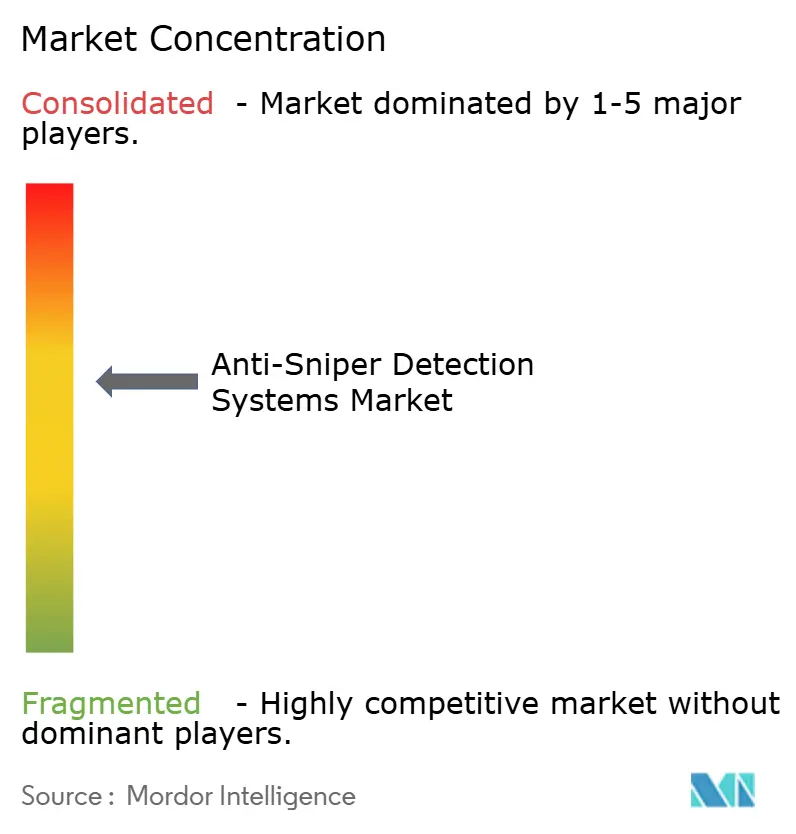
| Market Concentration | Medium |
Major Players *Disclaimer: Major Players sorted in no particular order Image © Mordor Intelligence. Reuse requires attribution under CC BY 4.0. | |
Anti-Sniper Detection Systems Market Analysis by Mordor Intelligence
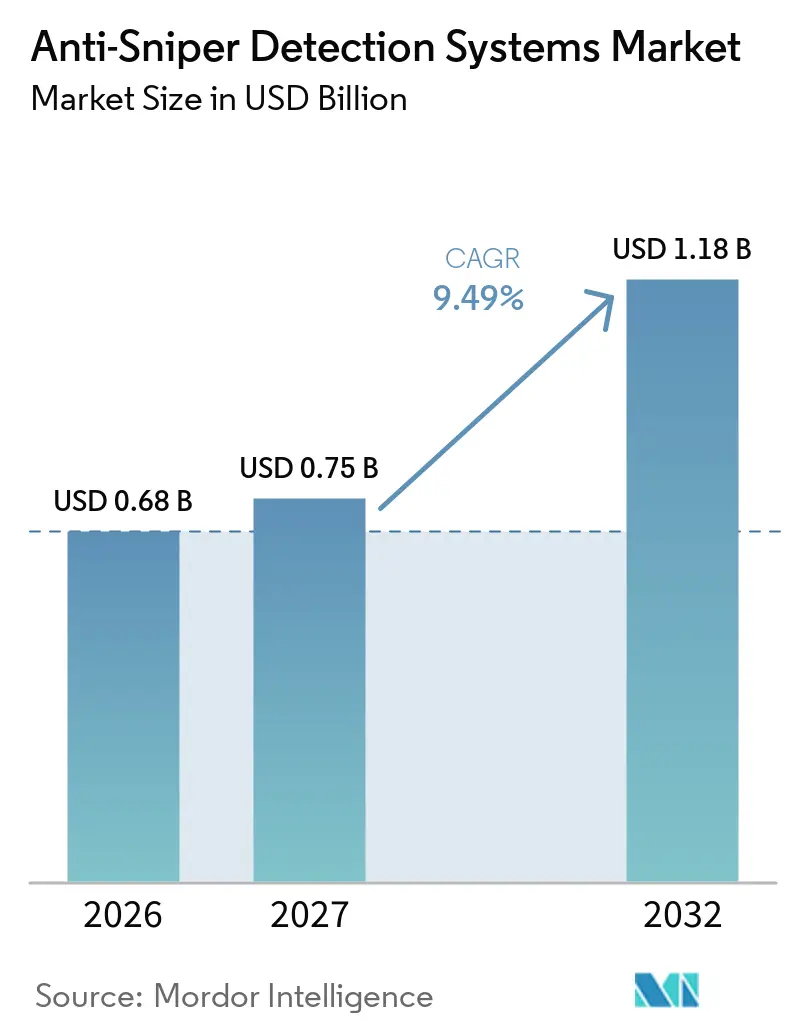
The anti-sniper detection systems market size was valued at USD 0.68 billion in 2026 and is forecast to grow from USD 0.75 billion in 2027 to reach USD 1.18 billion by 2032, at a 9.49% CAGR during the forecast period (2027-2032). Higher defense spending is supporting force-protection procurement across established and emerging defense markets. Global military expenditure reached USD 2,887 billion in 2025, marking the 11th consecutive annual increase. NATO members committed in June 2025 to raise annual defense and security-related spending to 5% of GDP by 2035. The anti-sniper detection systems market is also shaped by urban conflict conditions, which require fast and accurate threat identification. Suppliers are responding with sensor fusion, portable equipment, and integration options for existing defense and security networks.
Key Report Takeaways
- By technology, acoustic held 34.67% of the anti-sniper detection systems market share in 2026, while radar and LiDAR are forecast to grow at a 10.54% CAGR through 2032.
- By platform, portable systems accounted for 42.23% of the market in 2026 and are projected to expand at a 10.11% CAGR through 2032.
- By range, long-range systems held 62.48% of the market in 2026 and are forecast to grow at a 10.87% CAGR through 2032.
- By end user, military held 65.54% of the market in 2026, while law enforcement and homeland security are projected to record a 10.90% CAGR through 2032.
- By geography, North America held 32.89% of the market in 2026, while Asia-Pacific is forecast to grow at a 10.61% CAGR through 2032.
Note: Market numbers in this report are based on Mordor Intelligence's proprietary estimation framework, which combines nine months of actuals with Q4 projections for base year 2026.
Global Anti-Sniper Detection Systems Market Trends and Insights
Drivers Impact Analysis*
| Driver | (~) % Impact on CAGR Forecast | Geographic Relevance | Impact Timeline |
|---|---|---|---|
| Defense and homeland-security modernization | +2.80% | Global | Long term (≥ 4 years) |
| Real-time force-protection requirements in urban and asymmetric warfare | +1.90% | Global, concentrated in Asia-Pacific, Europe, and Middle East and Africa conflict zones | Short term (≤ 2 years) |
| Expansion of border, perimeter, and critical-infrastructure protection | +1.60% | North America and Europe, with Asia-Pacific demand extending to Middle East and Africa | Medium term (2-4 years) |
| AI-enabled multi-sensor fusion and false-alarm reduction | +1.40% | Global | Medium term (2-4 years) |
| Weaponized optics and battlefield laser proliferation | +0.80% | Global, concentrated in active conflict zones | Short term (≤ 2 years) |
| Modular retrofit demand for existing C4ISR and camera infrastructure | +0.70% | North America and Europe | Medium term (2-4 years) |
| Source: Mordor Intelligence | |||
Defense and Homeland Security Modernization Reshaping Procurement Pipelines
European NATO members spent USD 864 billion in 2025, a 14% real increase, while Germany exceeded 2% of GDP for defense spending for the first time since 1990. Spain recorded a 50% increase in defense spending during the same year. These commitments place the anti-sniper detection systems market within broader programs for networked sensing and force protection. The UK MoD awarded Leonardo UK a GBP 18.30 million (USD 24.49 million) contract for the SONUS acoustic weapon-location system in February 2026. The contract was placed 5 years ahead of the original schedule, and the system is 70% lighter than its predecessor. This approach makes sensor procurement more likely to be funded through larger modernization programs than through separate equipment budgets.
Real-Time Force Protection in Urban and Asymmetric Warfare Driving Technical Requirements
Urban conflict requires systems that can separate weapon signatures from building reflections, civilian noise, and multiple simultaneous events. A 2025 review found that acoustic gunshot detection could shorten prehospital response intervals in military settings. The review also identified survivability, false positives, and EW exposure as unresolved limits. These conditions are pushing the anti-sniper detection systems market toward systems that combine acoustic, radar, camera, and other inputs. Networked sensor systems can correlate threat information in real time and reduce reliance on large groups of human observers. Vendors must therefore show performance in dense locations as well as in open terrain. Operational resilience is becoming as important as initial detection capability in the anti-sniper detection systems market. Procurement teams increasingly assess these factors together.
Border, Perimeter, and Critical Infrastructure Protection Creating New Demand Pools
Border surveillance and infrastructure programs are extending demand beyond battlefield deployments. NATO launched Baltic Sentry in January 2025 to increase protection for critical undersea infrastructure through enhanced surveillance and other measures. Eastern European NATO members also increased physical and electronic protection at power sites during 2025. India reported that its Comprehensive Integrated Border Management System produced results during Operation Sindoor and is being extended along the Line of Control. The program integrates thermal imagers, radar, sonar, and fiber-optic sensors. This creates a broader role for the anti-sniper detection systems market, in which acoustic and optical data must fit into existing security architectures. It also supports demand for interoperable protection tools across land and infrastructure sites for security users.
AI-Enabled Multi-Sensor Fusion and Laser Threat Detection Improving Operational Use
AI-enabled fusion is intended to improve trust in systems operating amid complex noise and visual activity. Purdue University Northwest reported that its multimodal approach, using acoustic and air-quality sensors, had zero false alarms across more than 220,000 tested sound events. A 2025 study described how neural-network denoising can improve muzzle-blast detection in vehicle-mounted systems. Laser threat detection is also gaining importance as battlefield optics and laser systems become more common. The anti-sniper detection systems market can benefit when sensor data from different threat types is processed on the same platform. Modular retrofits can further support the anti-sniper detection systems market where existing C4ISR and camera systems remain in service.
Restraints Impact Analysis*
| Restraint | (~) % Impact on CAGR Forecast | Geographic Relevance | Impact Timeline |
|---|---|---|---|
| Procurement, integration, and lifecycle-cost complexity | -1.80% | Global | Long term (≥ 4 years) |
| False positives, privacy concerns, and evidence-transparency risk | -1.20% | North America and Europe | Medium term (2-4 years) |
| Acoustic occlusion and calibration drift in dense built environments | -0.90% | Global | Short term (≤ 2 years) |
| Export controls, sovereign data requirements, and component dependencies | -0.80% | Global | Medium term (2-4 years) |
| Source: Mordor Intelligence | |||
Procurement, Integration, and Lifecycle Cost Complexity Constraining Adoption
Procurement and integration burdens can limit deployment by smaller defense organizations. The US Government Accountability Office identified USD 49.30 billion in combined cost growth across 30 major defense programs in its 2025 assessment. The assessment found that the average period from program start to initial capability exceeded 12 years. Integrating acoustic, electro-optical, radar, and laser nodes into legacy C4ISR networks requires systems engineering and long-term support planning. Operating and support costs can account for nearly 90% of life-cycle expenditure in comparable sensor programs. The anti-sniper detection systems market therefore faces purchasing decisions that extend beyond the acquisition price. Buyers may favor suppliers that provide interoperable systems, staged upgrades, and clear support arrangements. These factors can reduce program risk over time.
False Positives, Privacy Concerns, and Dense-Environment Limitations Impeding Adoption
False alerts can reduce operational confidence and complicate the use of acoustic detection in dense urban settings. The Massachusetts Supreme Judicial Court called for scrutiny of the methodology behind ShotSpotter evidence in May 2025. Privacy concerns also arise when always-on acoustic equipment may capture information beyond a gunshot event. Acoustic occlusion, reflections, and calibration drift remain practical issues in built environments. Export control revisions in September 2025 add compliance requirements for multinational suppliers.[1] The anti-sniper detection systems market must address technical validation, evidence transparency, and local data requirements to maintain adoption in civil-security settings. These requirements can lengthen evaluation periods before contract award and require documented evidence of operations.
*Our forecasts treat driver/restraint impacts as directional, not additive. The impact forecasts reflect baseline growth, mix effects, and variable interactions.
Segment Analysis
By Technology: Acoustic Maturity Meets AI-Enhanced Radar Growth
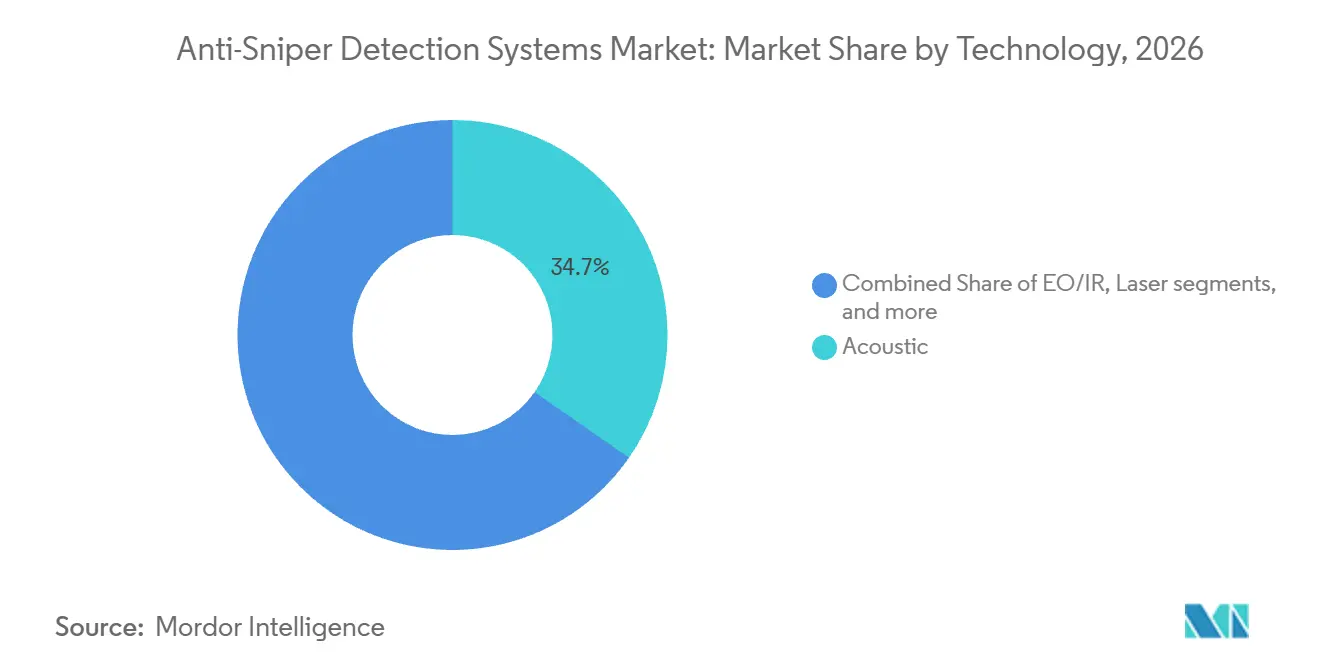
Acoustic held 34.67% of the anti-sniper detection systems market in 2026, supported by its passive operation and long record of battlefield use. Their lack of electronic emissions is valuable in locations where EW is a concern. Radar and LiDAR are forecast to grow at a 10.54% CAGR through 2032. Acoustic systems remain important where the system needs to detect and locate a gunshot without transmitting a signal. Radar and LiDAR systems can provide an additional source of location information when acoustic readings are difficult to interpret. This complements passive acoustic coverage in difficult operating conditions.
EO/IR systems act as cueing and confirmation layers within multi-sensor architectures. Laser-Based Systems address concealed sniper scopes and hostile laser emissions. The Others category includes combined systems without a single primary sensing method. These configurations are increasingly relevant to border programs that require multiple sensing functions. The anti-sniper detection systems industry is consequently moving toward configurations that can support multiple agencies and threat scenarios through a single integrated system. Such designs can also simplify combined surveillance planning and procurement across several security functions.

By Platform: Portable Systems Support Forward-Deployed Requirements
Portable systems held 42.23% of the anti-sniper detection systems market and are forecast to grow at a 10.11% CAGR through 2032. This combination indicates that demand is expanding in the leading platform rather than moving away from other platforms. Dismounted infantry needs equipment that weighs less than 3 kg, deploys in less than 3 minutes, and does not require calibration. Leonardo UK’s SONUS system weighs 70% less than the previous system and can be deployed in less than 3 minutes. Its February 2026 contract demonstrates the importance of reduced weight and fast fielding. Portable systems also suit short-duration missions where a fixed installation would not be practical. Their design helps units reposition protective assets quickly in changing field conditions and during mobile missions.
Fixed platforms provide continuous protection at bases, critical sites, and other facilities requiring unattended operation. Vehicle-mounted systems are a growing sub-segment as acoustic detection is increasingly incorporated into armored-vehicle modernization programs. Vehicle-mounted detection procurement can be linked to fleet modernization cycles rather than standalone sensor budgets. This makes early C4ISR partnership agreements commercially important. Vehicle programs may bring long procurement cycles, but they also provide a defined integration path. The anti-sniper detection systems industry can gain from early relationships with vehicle manufacturers and C4ISR suppliers. Platform choices will continue to be guided by the operating conditions of infantry, infrastructure, and armored formations. This preserves the need for separate form factors across users and different operational environments.
By Range: Long-Range Dominance Reflects Extended Threat Envelopes
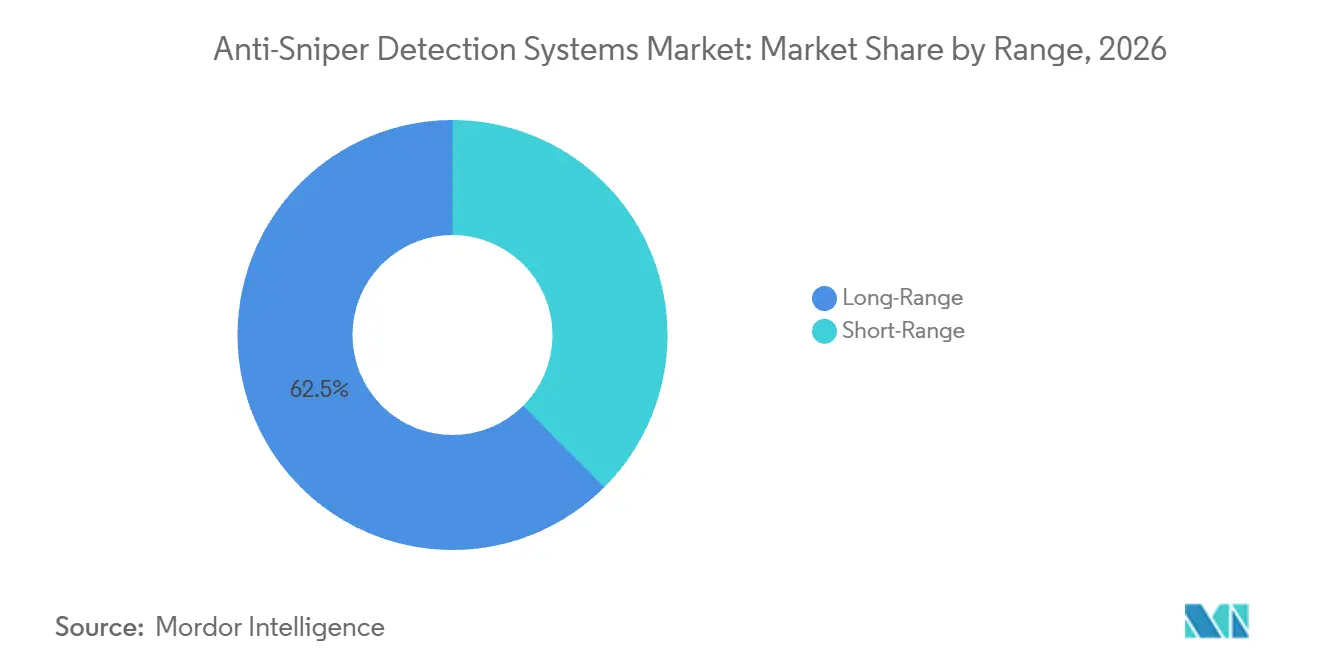
Long-range systems above 500 m held 62.48% of the market in 2026 and are forecast to grow at a 10.87% CAGR through 2032. Modern conflict has increased the need to detect precision threats beyond 800 meters. The approach is relevant where muzzle-blast detection is limited by suppression or distance. Long-range platforms can provide tactical warning before a threat reaches close-in protective zones. They also command higher prices than short-range commercial systems. This pricing difference helps explain their high revenue contribution to the anti-sniper detection systems market. It remains important even when unit shipments are lower than short-range commercial deployments.
Short-range systems with a range of up to 500 m serve base perimeters, vehicle crews, and law-enforcement applications. SoundThinking, Inc. stated that its ShotSpotter system served more than 170 cities in the United States and achieved an average monthly accuracy of 94% in 2024, under a contractual 90% accuracy floor.[2] These deployments show that short-range urban networks form a distinct demand base outside military procurement. Their use is strongest where a rapid response can follow a localized alert. However, legal, privacy, and false-positive concerns can affect deployment decisions. The anti-sniper detection systems market includes both long-range military systems and short-range networks, even though their buying processes and operating requirements differ. This broad range of use cases supports demand across different security budgets. It also requires different deployment and support models.
By End User: Military Primacy Continues As Civil Security Demand Grows
Military users held 65.54% of the market in 2026, reflecting the technology’s force-protection origins and the larger procurement values of defense programs. Military specifications require environmental resilience, electronic-warfare hardening, and C4ISR interoperability. These requirements raise the revenue per system compared with many civil-security products.
Law enforcement and homeland security are forecast to grow at a 10.90% CAGR through 2032. The segment is supported by the spread of gunshot-detection networks across South America, the Middle East, and Southeast Asia. It also benefits when municipalities connect acoustic detection with cameras, command centers, and response systems. The anti-sniper detection systems industry therefore serves both dedicated military users and authorities seeking faster situational awareness. Each group uses different operating standards and procurement processes that influence system configuration and support.
SoundThinking, Inc. deployed ShotSpotter in Brazil in March 2025 through a 3-year agreement valued at USD 1.70 million. The system covers 10 square kilometers and connects with the city’s 120-camera and 522-device public-security center. Shooter Detection Systems introduced SDS Perimeter in September 2025 to extend acoustic-IR detection for outdoor perimeters and campus applications. This reflects a closer connection between military, perimeter, and municipal security product designs. Civil-security buyers require operational accuracy and transparent evidence practices. Suppliers that address those needs can reach users beyond conventional defense customers. The boundary between military and civilian procurement is becoming less distinct for outdoor protection applications. This creates a wider set of potential deployment settings for suppliers and public security agencies.
Geography Analysis
North America held 32.89% of the anti-sniper detection systems market share in 2026. The US Army Program Executive Office Intelligence, Electronic Warfare and Sensors supports the Boomerang III vehicle-mounted program and the next-generation FALCONS target-acquisition effort. In June 2025, Victorville, California, made its first ShotSpotter deployment. ITAR revisions effective in September 2025 raise compliance requirements but also reinforce domestic-sourcing incentives for US integrators. These rules shape supplier selection and cross-border component planning for systems entering the United States.
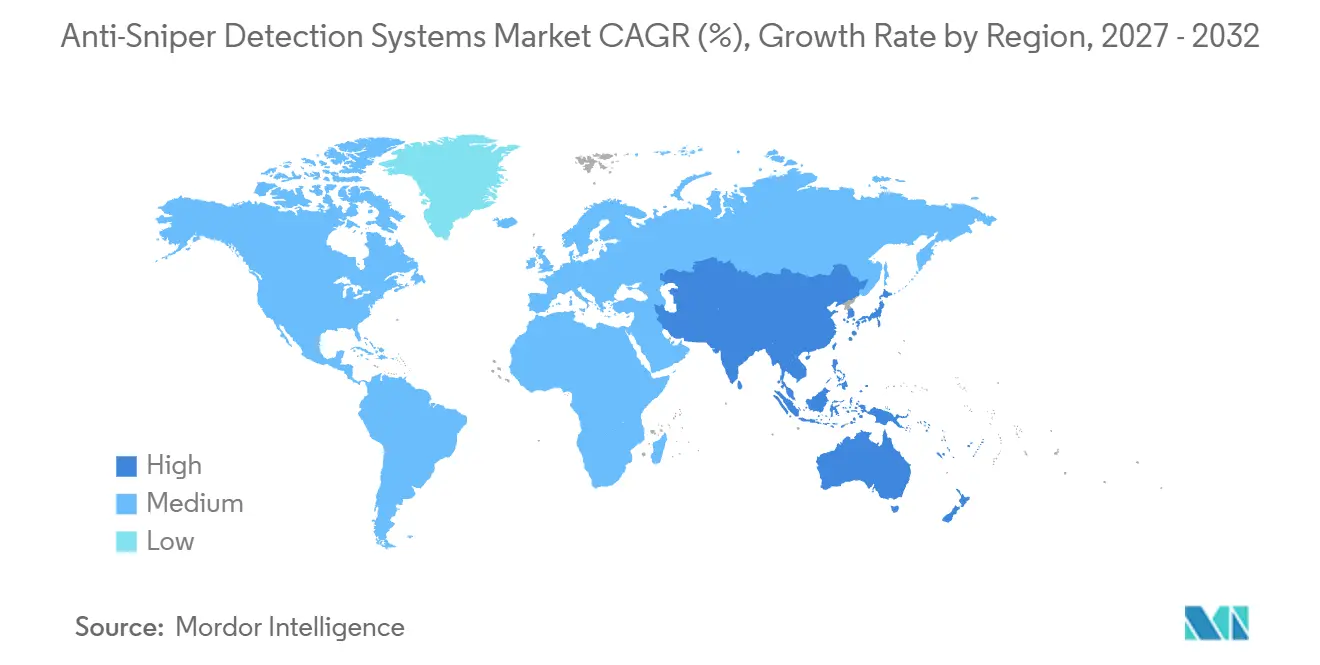
Asia-Pacific is forecast to record a 10.61% CAGR through 2032, the highest regional rate in the anti-sniper detection systems market. Regional military spending reached USD 681 billion in 2025, the largest annual increase since 2009.[3] Japan’s FY2025 defense allocation reached USD 55.10 billion, supporting stand-off sensing and force protection. India is developing as both a demand market and a production location for acoustic detection. Its CIBMS infrastructure combines several sensing technologies along sensitive borders. South Korea and Australia are secondary demand centers where procurement often follows interoperability with US-aligned defense equipment. This demand adds to the regional opportunity for the anti-sniper detection systems market through interoperability-led procurement.
Europe is seeing rising demand for tactical sensors linked to the Russia-Ukraine conflict and broader NATO modernization. Germany increased military spending 24% to USD 114 billion in 2025. France and Italy emphasize domestic industrial participation through companies such as ACOEM Group and Leonardo. The Middle East and Africa are supported by Israeli capabilities and Gulf investment in energy-infrastructure protection. South America remains at an earlier stage, with demand centered on law-enforcement acoustic networks. These regional patterns give the anti-sniper detection systems market a mix of long-cycle defense programs and smaller public-safety deployments. The balance varies by country, program maturity, security priorities, and funding structures.
Competitive Landscape
The anti-sniper detection systems market is moderately consolidated at the platform-integration level. RTX Corporation, SoundThinking, Inc., Rheinmetall AG, QinetiQ Group, and ACOEM Group hold strong positions in military programs through relationships with NATO and allied defense ministries. Leonardo S.p.A., Thales Group, Elbit Systems Ltd., ASELSAN A.Ş., Microflown AVISA, and Sentinel Photonics hold specialist positions through proprietary sensor architectures. Several specialists are placing sensor cores within prime-contractor systems rather than competing only for direct contracts. This model expands their reach through system integration rather than standalone procurement. It can produce durable revenue relationships that are less visible than large platform awards. This structure supports specialist participation in the anti-sniper detection systems market and preserves technology-focused competition.
Competition centers on AI-enabled sensor fusion, compliance with modular open-systems requirements, and local production partnerships. The US Government Accountability Office has identified the need for better planning for modular open systems to achieve expected benefits in defense acquisition. This requirement favors companies able to connect multiple sensors within an open architecture. The anti-sniper detection systems market also offers an opportunity at the connection between C-UAS and gunshot detection. A shared platform could provide users with broader threat awareness while reducing the number of separate sensor systems they must manage. It can also align purchasing with broader force-protection requirements across military and infrastructure-protection programs.
Companies that establish partnerships before vehicle or border programs are defined can improve their route to deployment. The anti-sniper detection systems market remains competitive because specialists retain technical influence even when large contractors manage the main platform contract. This relationship can shape supplier roles throughout a program cycle and support continuing technology collaboration.
Anti-Sniper Detection Systems Industry Leaders
-
RTX Corporation
-
ACOEM Group
-
Rheinmetall AG
-
SoundThinking, Inc.
-
QinetiQ Group
- *Disclaimer: Major Players sorted in no particular order
Recent Industry Developments
- July 2026: SoundThinking, Inc. announced multi-year customer renewals in Q2 2026 for its ShotSpotter acoustic detection and shooter-localization technology, reflecting continued investment in gunfire detection and shooter-location identification systems, and supporting demand for acoustic localization technologies in the broader anti-sniper detection systems market.
- January 2026: Thales Defense and Security developed a pocket-sized optical augmentation kit that identifies the location of snipers and other tactical threats across a range of battlefield situations.
- February 2025: SoundThinking, Inc. introduced a perimeter-based sniper gunfire detection solution for utility substations and other critical infrastructure. The system expands the company’s established acoustic detection technology to identify sniper gunfire threats targeting protected facilities.
Global Anti-Sniper Detection Systems Market Report Scope
The anti-sniper detection systems market comprises technologies and integrated systems designed to detect, locate, identify, and provide early warning of sniper threats and hostile gunfire across military, law enforcement, and homeland security applications. The market covers acoustic, EO/IR, laser-based, radar-based, LiDAR-based, and other detection technologies deployed for battlefield surveillance, force protection, border security, perimeter monitoring, and critical infrastructure protection. The scope includes fixed, portable, and vehicle-mounted systems used to detect gunfire, identify potential sniper positions, and support real-time threat assessment and response.
The anti-sniper detection systems market is segmented by technology, platform, range, end user, and geography. By technology, the market is segmented into acoustic, electro-optical/infrared (EO/IR), laser, radar and LiDAR, and others. By platform, the market is segmented into fixed, portable, and vehicle-mounted systems. By range, the market is segmented into short-range (up to 500 m) and long-range (above 500 m). By end user, the market is segmented into military and law enforcement and homeland security. The report also covers market sizes and forecasts for the anti-sniper detection systems market across major countries in major countries across different regions. For each segment, the market size is provided in terms of value (USD).
| Acoustic |
| Electro-Optical/Infrared (EO/IR) |
| Laser |
| Radar and LiDAR |
| Others |
| Fixed |
| Portable |
| Vehicle-Mounted |
| Short-Range (Up to 500 m) |
| Long-Range (Above 500 m) |
| Military |
| Law Enforcement and Homeland Security |
| North America | United States | |
| Canada | ||
| Mexico | ||
| Europe | United Kingdom | |
| France | ||
| Germany | ||
| Russia | ||
| Rest of Europe | ||
| Asia-Pacific | China | |
| India | ||
| Japan | ||
| South Korea | ||
| Australia | ||
| Rest of Asia-Pacific | ||
| South America | Brazil | |
| Rest of South America | ||
| Middle East and Africa | Middle East | United Arab Emirates |
| Saudi Arabia | ||
| Israel | ||
| Rest of Middle East | ||
| Africa | South Africa | |
| Egypt | ||
| Rest of Africa | ||
| By Technology | Acoustic | ||
| Electro-Optical/Infrared (EO/IR) | |||
| Laser | |||
| Radar and LiDAR | |||
| Others | |||
| By Platform | Fixed | ||
| Portable | |||
| Vehicle-Mounted | |||
| By Range | Short-Range (Up to 500 m) | ||
| Long-Range (Above 500 m) | |||
| By End User | Military | ||
| Law Enforcement and Homeland Security | |||
| By Geography | North America | United States | |
| Canada | |||
| Mexico | |||
| Europe | United Kingdom | ||
| France | |||
| Germany | |||
| Russia | |||
| Rest of Europe | |||
| Asia-Pacific | China | ||
| India | |||
| Japan | |||
| South Korea | |||
| Australia | |||
| Rest of Asia-Pacific | |||
| South America | Brazil | ||
| Rest of South America | |||
| Middle East and Africa | Middle East | United Arab Emirates | |
| Saudi Arabia | |||
| Israel | |||
| Rest of Middle East | |||
| Africa | South Africa | ||
| Egypt | |||
| Rest of Africa | |||
Key Questions Answered in the Report
What is the expected growth rate for anti-sniper detection systems market?
The anti-sniper detection systems market is forecast to grow at a 9.53% CAGR from 2027 to 2032, reaching USD 1.18 billion by 2032.
Which technology leads anti-sniper detection deployments?
Acoustic technology lead with a 34.67% share in 2026, while radar and LiDAR have the highest forecast growth rate at 10.54% CAGR.
Why are portable anti-sniper systems important?
Portable systems held 42.23% of 2026 demand and are projected to grow at a 10.11% CAGR because infantry units need low-weight systems that deploy quickly.
Which end users are adopting anti-sniper equipment fastest?
Military remains the largest end-user group at 65.54% in 2026, while law enforcement and homeland security are forecast to grow at a 10.90% CAGR.
Which region has the strongest future demand?
Asia-Pacific is forecast to expand at a 10.61% CAGR through 2032, supported by rising defense expenditure and border-security investment.