
Animal Ortho-Prosthetics Market Size and Share
Market Overview
| Study Period | 2020 - 2031 |
|---|---|
| Market Size (2026) | USD 64.71 Million |
| Market Size (2031) | USD 99.96 Million |
| Growth Rate (2026 - 2031) | 9.09 % |
| Fastest Growing Market | Asia Pacific |
| Largest Market | North America |
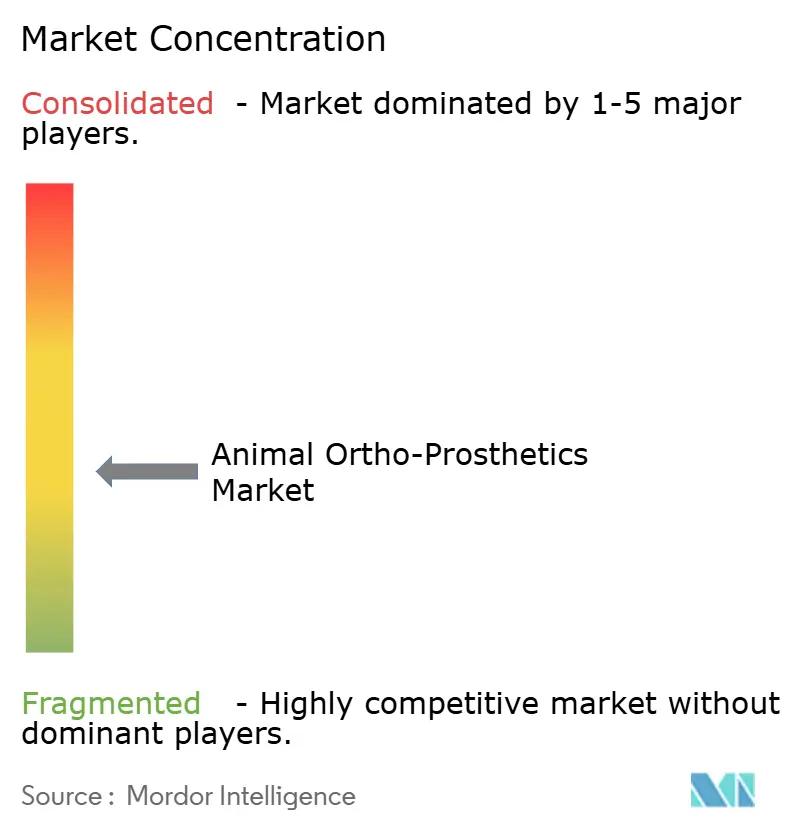
| Market Concentration | Medium |
Major Players *Disclaimer: Major Players sorted in no particular order Image © Mordor Intelligence. Reuse requires attribution under CC BY 4.0. | |
Animal Ortho-Prosthetics Market Analysis by Mordor Intelligence
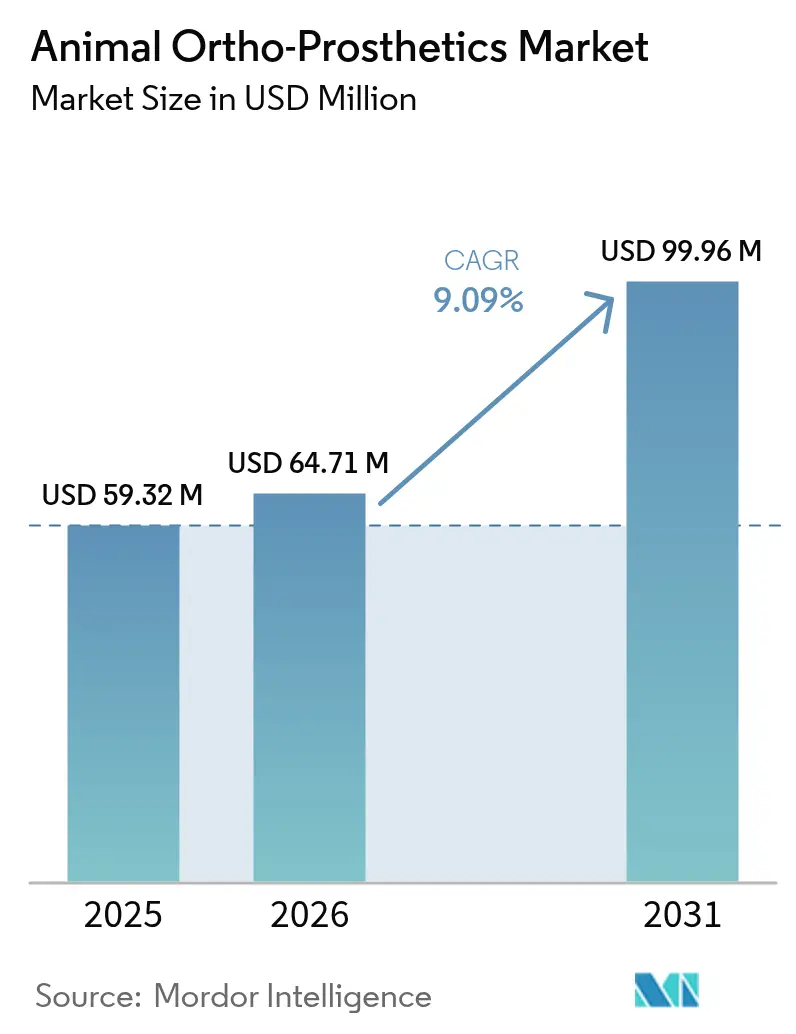
The animal ortho-prosthetics market size is expected to grow from USD 59.32 million in 2025 to USD 64.71 million in 2026 and is forecast to reach USD 99.96 million by 2031 at 9.09% CAGR over 2026-2031. Demand for custom limbs, braces, and mobility carts is rising as pet owners look beyond amputation toward solutions that preserve activity and comfort. Three trends sustain the expansion: widespread pet humanization, rapid gains in 3-D printing that shorten production cycles, and evolving clinical guidelines that promote limb-sparing care over surgical removal. Competition remains fragmented because every patient requires a made-to-order device, yet scale advantages flow to firms that blend veterinary partnerships with digital design workflows. Emerging markets add a second growth engine; local clinics prefer lower-cost conventional fabrication, so both advanced and traditional technologies grow in parallel.
Key Report Takeaways
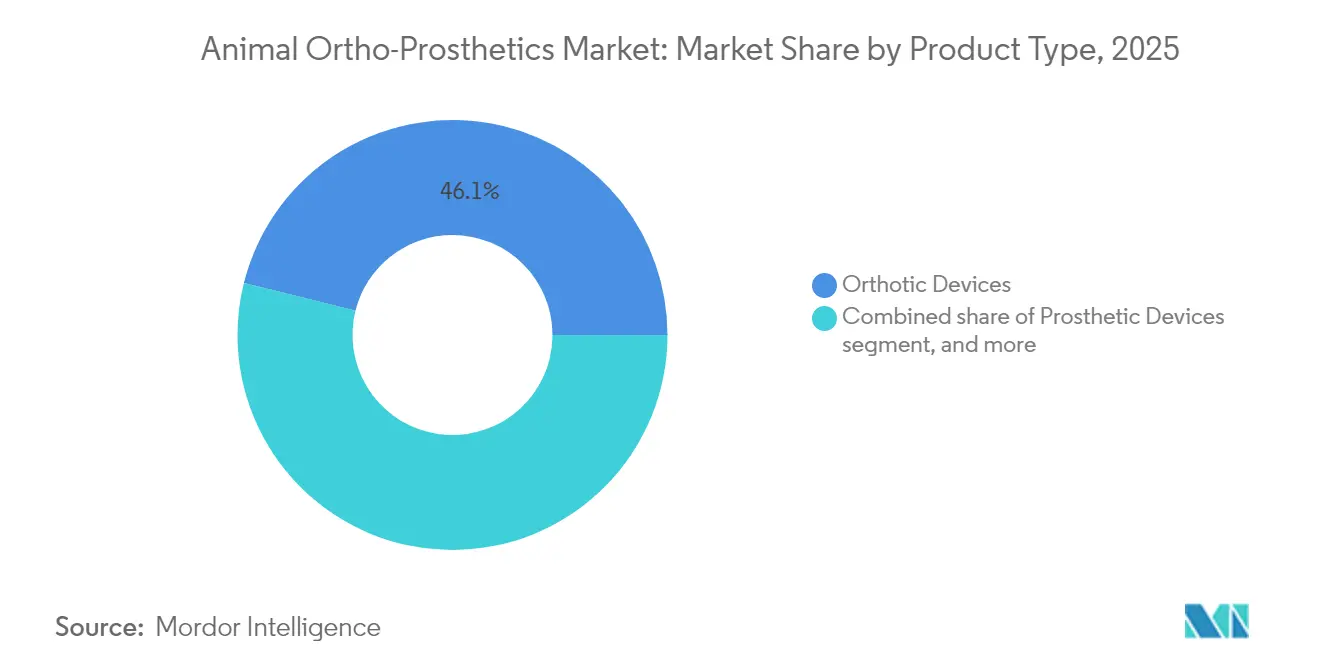
- By product type, orthotic devices held 46.12% of animal ortho-prosthetics market share in 2025 while mobility aids are projected to advance at an 11.52% CAGR through 2031.
- By technology, 3-D printing captured 57.94% share of the animal ortho-prosthetics market in 2025, whereas conventional manufacturing is forecast to post a 11.88% CAGR to 2031.
- By animal type, canine cases accounted for 67.63% of the animal ortho-prosthetics market size in 2025, and the equine segment is set to grow at a 12.06% CAGR to 2031.
- By end user, veterinary hospitals and clinics controlled 58.98% share in 2025, while rehabilitation centers are on track for a 12.69% CAGR to 2031.
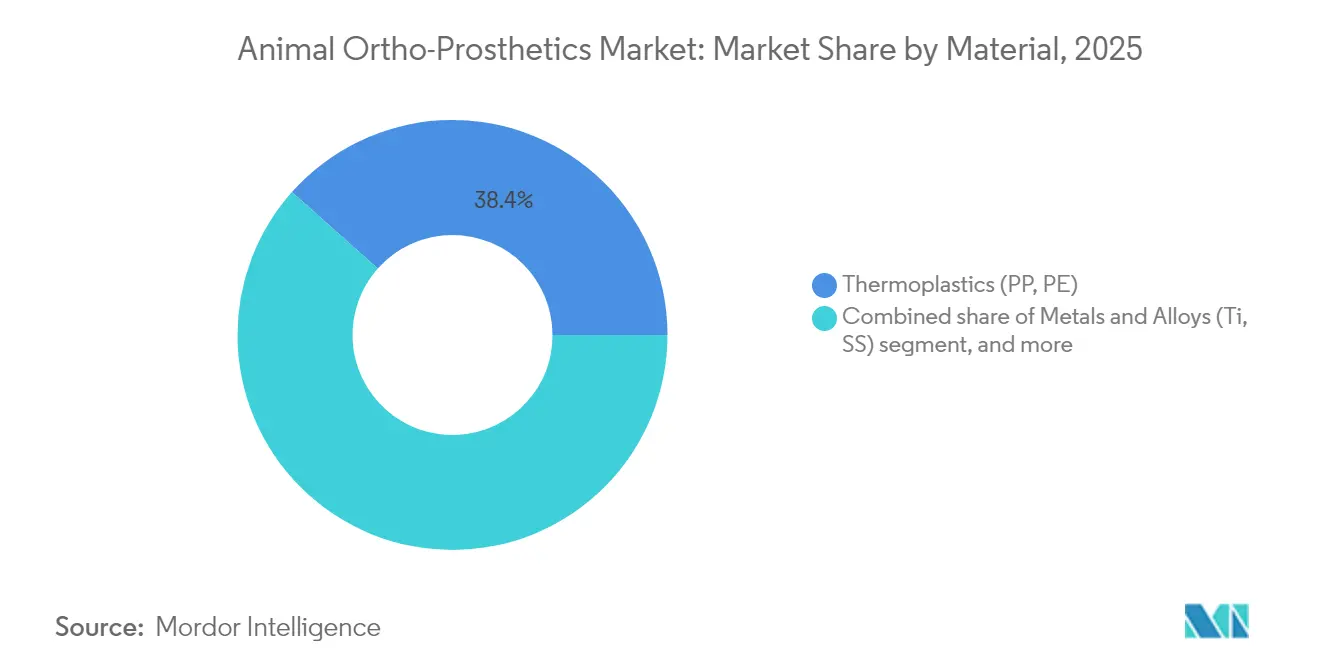
- By material, thermoplastics commanded 38.42% share in 2025, and metals and alloys will register an 11.78% CAGR during the forecast window.
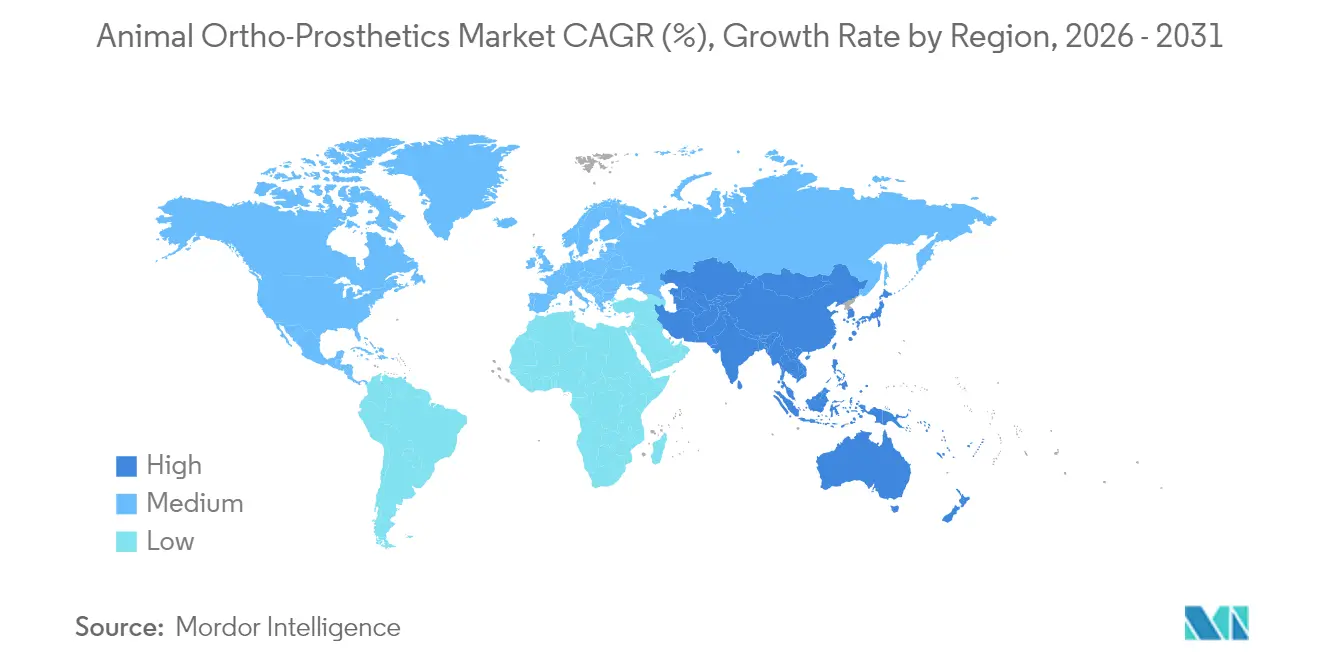
- By geography, North America led with 41.95% revenue share in 2025; Asia-Pacific shows the fastest expansion at a 10.18% CAGR through 2031.
Note: Market size and forecast figures in this report are generated using Mordor Intelligence’s proprietary estimation framework, updated with the latest available data and insights as of 2026.
Market Trends and Insights
Drivers Impact Analysis of Animal Ortho-Prosthetics Market*
| Driver | % Impact on CAGR Forecast | Geographic Relevance | Impact Timeline |
|---|---|---|---|
| Rising global pet expenditure | +2.8% | North America, Europe, key urban centers in Asia-Pacific | Medium term (2-4 years) |
| Technological innovations in veterinary orthopedics | +2.1% | North America and European Union leading; adoption accelerating in Asia-Pacific | Long term (≥4 years) |
| Increasing prevalence of animal musculoskeletal disorders | +1.6% | Mature pet economies with aging populations | Medium term (2-4 years) |
| Expanding veterinary care infrastructure and insurance penetration | +1.4% | Asia-Pacific core, spill-over to Middle East & Africa and Latin America | Long term (≥4 years) |
| Growing awareness of animal mobility solutions | +0.9% | Global, strongest in large urban markets | Short term (≤2 years) |
| Adoption of tele-rehabilitation and remote fitting platforms | +0.5% | North America, Europe, expanding to Asia-Pacific | Medium term (2-4 years) |
| Source: Mordor Intelligence | |||
Rising Global Pet Expenditure
Pet spending continues to swell as millennial and Gen Z owners treat animals as family members; surveys show U.S. outlays could move from USD 121 billion in 2023 to USD 279 billion by 2030[1]. The budget shift makes prosthetic costs between USD 1,000 and USD 2,000 tolerable, positioning devices as essential healthcare, not luxuries. Demand proves resilient during downturns because owners rarely cut pet health expenses first. Premium brands therefore focus on quality-of-life outcomes rather than price, reinforcing value perceptions. Insurers are slowly broadening coverage, which further cushions household budgets and widens adoption.
Technological Innovations in Veterinary Orthopedics
Titanium and carbon-fiber parts produced on high-resolution 3-D printers now replicate precise limb geometry, promoting bone integration and weight savings. Hospital networks such as VCA opened dedicated additive labs in 2024, trimming fabrication lead times from several weeks to a few days. Computer-aided modeling lets engineers balance strength and flexibility, reducing stress shielding that once triggered revision surgery. As scanning, software, and printing operate on one digital thread, clinics can iterate designs quickly and deliver superior fit, a clear edge over manual plaster casting.
Increasing Prevalence of Animal Musculoskeletal Disorders
Longer life expectancy means more pets present with osteoarthritis, cruciate tears, and congenital deformities that once ended active lifestyles. In 2024, 95% of veterinarians surveyed called for standardized canine osteoarthritis protocols. Studies also note that 91.66% of prosthetic recipients regain the ability to stand, and 87.5% resume walking after device acclimatization[2]. With outcomes documented, clinicians now recommend limb-sparing treatments earlier, generating predictable demand for off-the-shelf braces and bespoke implants.
Expanding Veterinary Infrastructure and Insurance Penetration
Asia-Pacific governments are investing in modern clinics, imaging suites, and postgraduate training that bring advanced orthopedic care closer to pet owners[3]. Parallel growth in pet insurance, especially in China and South Korea, lowers out-of-pocket hurdles. Tele-consultation platforms allow specialists in urban centers to guide fittings in rural regions, boosting reach without heavy capital outlay. Harmonization of device approval pathways, although incomplete, signals future regulatory clarity that should unlock cross-border scale economies.
Restraints Impact Analysis of Animal Ortho-Prosthetics Market*
| Restraints Impact Analysis | (~) % Impact on CAGR Forecast | Geographic Relevance | Impact Timeline |
|---|---|---|---|
| High cost of custom prosthetic solutions | -1.8% | Global, particularly acute in emerging economies | Medium term (2-4 years) |
| Limited skilled workforce in veterinary orthopedics | -1.2% | Global shortage, most severe in rural and developing regions | Long term (≥4 years) |
| Lack of standardized regulatory framework | -0.9% | Fragmented across Asia-Pacific, Latin America, and parts of Europe | Long term (≥4 years) |
| Limited market penetration in emerging economies | -0.7% | Asia-Pacific tier-2 cities, Middle East & Africa, Latin America | Medium term (2-4 years) |
| Source: Mordor Intelligence | |||
High Cost of Custom Prosthetic Solutions
A full limb device from market leader OrthoPets ranges from USD 1,265 to USD 2,125 before clinic fees double the bill. Limited production batches and premium materials block economies of scale and keep price elasticities high. Insurers often cap payouts or exclude mobility aids, leaving owners to carry residual costs. When ongoing adjustments, padding replacements, and refurbishment are factored in, lifetime expenses climb further, dampening demand outside affluent households.
Limited Skilled Workforce in Veterinary Orthopedics
Specialists need training that blends anatomical insight with material science and digital design, yet only a few universities offer integrated programs. A regional workforce study highlighted a shortfall of more than 1,000 veterinarians in New England alone by 2024, with orthopedics among the scarcest disciplines. Without fitters, cases in secondary cities wait or travel long distances, lengthening lead times and hurting outcomes. Skills shortages also limit manufacturer expansion because every clinic partnership hinges on practitioner confidence.
*Our forecasts treat driver/restraint impacts as directional, not additive. The impact forecasts reflect baseline growth, mix effects, and variable interactions.
Animal Ortho-Prosthetics Market Segment Analysis
By Product Type:
Mobility Solutions Gain SpeedOrthotic braces generated the largest revenue in 2024, yet carts and wheelchairs deliver the highest forecast growth. Orthotics appeal because they avoid surgery, offering immediate stability for ligament injuries. However, complete limb loss cases now receive custom carts that restore gait with minimal rehabilitation time. The animal ortho-prosthetics market size for mobility aids is projected to reach USD 27.33 million by 2031, a 6-year jump underpinned by lightweight aluminum frames and quick-release harness systems. Orthotics remain indispensable for partial weight bearing, but manufacturers are bundling braces with wheels and ramps, selling integrated mobility kits rather than single parts. This bundling strategy unlocks cross-sell revenue and strengthens clinic relationships.
Prosthetic limbs occupy a smaller volume niche yet command higher unit prices because of titanium pylons, silicone liners, and detailed finishing. Accessory lines—replacement straps, paw covers, and joint locks—are gaining recognition as recurring revenue streams. Clinics often sign annual supply contracts to ensure patients receive timely consumables, anchoring aftermarket sales. Providers that master both durable goods and consumables diversify risk and build loyalty in the animal ortho-prosthetics market.

By Animal Type:
Equine Potential AcceleratesCompanion dogs dominate procedure counts as owners prioritize pets’ welfare, but working horses generate rising traction. The animal ortho-prosthetics market share for canine applications was 67.63% in 2025, yet targeted programs for sport and police horses are forecast to post a 12.06% CAGR. Gait analysis tools such as inertial sensors now objectify lameness metrics, letting farriers and veterinarians decide when a brace can defer euthanasia. Breeding operations see direct financial returns when a high-value stallion resumes service sooner, supporting premium price points.
Cats index lower because device acceptance is hindered by grooming behavior and stature. Exotic mammals and livestock remain marginal but strategic; zoos and dairies commission high-margin one-off builds when an animal has significant conservation or economic value. These cases spark media coverage that lifts public perception of the animal ortho-prosthetics market and indirectly boosts adoption among mainstream pet owners.
By End User:
Rehabilitation Centers Scale UpHospitals and clinics are primary distributors because they diagnose injuries and conduct surgery when required. In 2025 these facilities processed 58.98% of orders and acted as formal payers for some insured cases. Rehabilitation centers, often operated by physiotherapists with canine hydrotherapy pools, are expanding networks quickly; their 12.69% CAGR reflects strong owner demand for post-operative exercise and device tuning. The animal ortho-prosthetics market size recorded from this channel is set to double by 2030 as centers integrate treadmills, laser therapy, and online coaching.
Home-based usage lags because fittings must account for muscle atrophy and stump swelling that change weekly. Tele-rehabilitation apps partly bridge gaps by guiding owners through video sessions and alerting clinics when symmetry or pressure metrics deviate. Companies now ship adjustment kits with extra liners, wrenches, and adhesive pads so minor tweaks happen on site, easing the support burden on busy clinics.
By Material:
High-Performance Alloys Gain MomentumThermoplastics remain cost-effective for braces that need periodic heating and shaping. Yet weight-bearing implants increasingly rely on Ti-Nb-Zr alloys that align modulus with cortical bone, cutting implant loosening risk. Metals and alloys show an 11.78% CAGR, the fastest within materials, as practitioners trust corrosion resistance for long-term service. Carbon-fiber shells shield hardware and distribute load while preserving agility; these shells extend brace life and permit color personalization, an underrated factor in owner satisfaction. Antimicrobial nanosilver coatings debut in 2025 product lines, answering infection concerns stated by clinicians.
Silicone interfaces reduce chafing at socket edges, improving compliance. Suppliers partner with chemical companies to co-develop medical-grade elastomers that endure outdoor conditions. Collectively, diversified materials broaden indications and support device crossover from orthotics into prosthetics, deepening penetration of the animal ortho-prosthetics market.
By Technology:
Dual Paths to ScaleAdditive manufacturing captured 57.94% of revenue in 2025 by delivering near-perfect anatomical fit. Yet conventional milling, vacuum forming, and hand lamination still win orders in cost-sensitive settings, climbing at 11.88% CAGR. Clinics in India and Brazil favor polypropylene sheets thermo-formed over casts because printers and titanium powder are scarce. Hybrid workflows emerge: a limb is scanned digitally, but the mold is milled from polyurethane foam and finished manually to save on metal powder. The animal ortho-prosthetics market benefits when both methods coexist, giving providers pricing flexibility. Regulatory milestones—such as China’s 2025 approval of a laser-printed knee—signal broader acceptance and should normalize additive implants in animals next.
Geography Analysis
North America Animal Ortho-Prosthetics Market
North America leads the animal ortho-prosthetics market with a 41.95% share because owners allocate premium budgets, insurers reimburse partial costs, and device makers cluster around academic veterinary hubs. The region shows steady single-digit unit growth while mix shifts toward high ticket prosthetics. Clinics in Colorado, Texas, and Ontario pioneer osseointegrated fixation, positioning the continent for early adoption of load-bearing implant lines. Regulatory guidance from the U.S. Food and Drug Administration on veterinary devices reduces ambiguity and keeps compliance costs manageable.
APAC Animal Ortho-Prosthetics Market
Asia-Pacific records the highest forecast CAGR at 10.18% as urban households acquire pedigree pets and treat them as family. China’s acceptance of a 3-D printed knee in 2025 demonstrates state endorsement of advanced orthopedics. However, inter-regional disparity persists: tier-one cities host specialist hospitals, while provincial clinics lack imaging and fabrication labs. Government investment and insurer entry should narrow gaps, though pricing must align with middle-income affordability. Conventional fabrication remains dominant today, creating scope for local manufacturing hubs that leverage lower labor costs.
EMEA and South America Animal Ortho-Prosthetics Market
Europe ranks third in value terms and enjoys harmonized product standards under CE marking. Universities in Germany, the Netherlands, and the United Kingdom perform biomechanics research that feeds into design enhancements, while small enterprises craft bespoke solutions for equine sports medicine. The Middle East and Africa plus South America form a long-tail opportunity curve. Affluent Gulf households import devices, but broader uptake waits for wider veterinary coverage. In Brazil, rehabilitation chains add hydrotherapy pools, indicating momentum despite economic volatility. Across these regions, distributors that bundle fitting, after-care, and remote support win contracts because clinics seek turnkey offerings.
Regulatory Landscape
Regulation for animal ortho-prosthetics remains fragmented, with limited veterinary-specific premarket oversight in several major markets. In the United States, the FDA does not require PMA or 510(k) clearance for veterinary-only medical devices, but manufacturers and distributors remain subject to FD&C Act provisions around adulteration and misbranding. This keeps labeling, quality controls, and complaint handling central to compliance.
Outside the United States, requirements vary by country and are often handled through general product safety and liability regimes rather than a dedicated veterinary device pathway. In Europe, there is no harmonized EU-wide framework equivalent to the human MDR for veterinary devices, and broad product-safety rules such as the EU General Product Safety Regulation (EU) 2023/988 can become the practical compliance anchor for non-human-use devices. Companies often reference human prosthetics and orthotics standards, for example ISO 22523:2006, to support design verification and risk management where species-specific regulatory classifications are not in place.
Competitive Landscape
The animal ortho-prosthetics market remains moderately concentrated, with no single vendor exceeding a 15% revenue share. OrthoPets, Bionic Pets, and several regional specialists anchor the field, each focusing on specific species or device classes. Money flows into vertical integration: OrthoPets operates scanning, design, production, and after-care under one roof, shortening cycle times and locking in clinical referrals. Bionic Pets invests heavily in social media storytelling, turning successful recoveries into viral marketing that widens consumer pull.
Digital tooling constitutes a sharp competitive wedge. Companies that own cloud-based design software let clinics upload scans, approve renderings in hours, and receive shipments in under one week. Those without such systems face churn as veterinarians favor faster partners. Materials know-how is the second wedge: suppliers with proprietary titanium or composite blends achieve lighter builds that can justify 20% price premiums and command loyalty among athletic dog owners.
Strategic moves signal impending consolidation. Orthopedic groups serving humans, such as OrthoPediatrics, bought brace specialists in 2024, hinting at cross-species synergies in supply chains and R&D. Venture funds allocated USD 35 million to pet health in 2024, targeting niche disruptors developing tele-rehab platforms and AI-based gait analysis. As investment scales up, smaller craftsman outfits may partner or sell to broaden distribution. Still, regulatory diversity and custom fabrication complexity will likely keep the animal ortho-prosthetics industry moderately fragmented over the next decade.
Animal Ortho-Prosthetics Industry Leaders
-
OrthoPets LLC
-
Animal OrthoCare
-
Bionic Pets
-
Walkin’ Pets By HandicappedPets
-
Össur Veterinary
- *Disclaimer: Major Players sorted in no particular order
Animal Ortho-Prosthetics Market Companies Covered in this Report
- OrthoPets LLC
- Animal OrthoCare
- Bionic Pets
- Walkin’ Pets By HandicappedPets
- My Pet's Brace
- Thera-Paw Inc.
- Eddie's Wheels
- KVP Orthotics
- Hero Braces
- L’Il Back Bracer
- Wheelchairs For Dogs (USA)
- Pawsthetics
- Motion 3-D (UK)
- Veterinary Inclusive 3-D Solutions
- Animal Bionics India
- CamMedica (EU)
- PawDynamics
- OrthoVet LLC
- Ottobock VetCare
- Össur Veterinary
Market Opportunities and Future Outlook
White-space in animal ortho-prosthetics is widening around digitized customization and higher-performance limb-salvage constructs, as clinical evidence continues to accumulate for 3D-printed, anatomically matched solutions. Published 2026 research, including a June 2026 case series on customized 3D-printed orthopedic exoprostheses in dogs and 2026 feasibility work on 3D-printed PEEK exo-endoprostheses for limb salvage, supports broader clinical confidence in additive workflows. At the same time, it highlights where adoption bottlenecks persist, including stump health, case selection, and the need for structured follow-up. This is creating a product and service opening for manufacturers that bundle scanning, digital design, and post-fit monitoring into a single pathway that clinics can operationalize.
Another opportunity is shifting toward species and indication expansion where current solutions are constrained by durability, infection risk, and the availability of specialist fitting. North America clinics are already piloting osseointegrated fixation approaches, and association-level messaging such as the AAEPs 2026 clarification that animal medical devices are not subject to FDA premarket review reinforces the importance of industry-led protocols for testing, documentation, and after-care. Companies that translate human-device material know-how and validation practices into veterinary-specific quality systems can differentiate on reliability and clinician confidence, particularly for load-bearing prosthetics, equine use cases, and higher-value implant-adjacent devices.
Recent Industry Developments in Animal Ortho-Prosthetics Market
- February 2026: OrthoPets LLCs Chapter 7 bankruptcy case in the U.S. Bankruptcy Court for the District of Colorado was terminated. The closure of the proceeding formalized the disruption around one of the better-known custom veterinary orthotics brands and reinforced consolidation risk in a market where service continuity and clinic relationships are critical.
- November 2025: OrthoPets LLC filed for Chapter 7 bankruptcy in the U.S. Bankruptcy Court for the District of Colorado (Case No. 1:25-bk-17609). The filing signaled financial stress in custom fabrication models that carry high labor content and working-capital needs, prompting clinics and referral partners to reassess supplier redundancy and turnaround-time guarantees.
- March 2025: Naton Biotechnology secured Chinese approval for a laser 3D-printed total knee. The milestone strengthened the precedent for advanced, load-bearing additive implants in China and supported wider clinical acceptance of 3D-printed orthopedic components that can spill over into veterinary applications and local supply chains.
Animal Ortho-Prosthetics Market Report Scope and Research Methodology
Market Definition and Coverage
For this study, the animal ortho-prosthetics market includes orthotic supports and prosthetic limbs used in veterinary care to improve mobility and function for animals with injury, deformity, or limb loss.
Scope exclusions: We exclude general mobility accessories and standard surgical implants that are not custom or fitted ortho-prosthetic devices.
Segments Covered in This Report
- By Product Type
- Orthotic Devices
- Prosthetic Devices
- Mobility Aids (Carts, Wheel-chairs)
- Components & Accessories
- By Animal Type
- Canine
- Feline
- Equine
- Other Animal Types
- By End-User
- Veterinary Hospitals & Clinics
- Rehabilitation & Physiotherapy Centers
- Home-Care (Pet Owners)
- By Material
- Thermoplastics (PP, PE)
- Metals & Alloys (Ti, SS)
- Carbon-Fiber Composites
- Silicone & Others
- By Technology
- 3-D Printing / Additive Manufacturing
- Conventional Manufacturing
- Geography
- North America
- United States
- Canada
- Mexico
- Europe
- Germany
- United Kingdom
- France
- Italy
- Spain
- Rest of Europe
- Asia-Pacific
- China
- Japan
- India
- Australia
- South Korea
- Rest of Asia-Pacific
- Middle East & Africa
- GCC
- South Africa
- Rest of Middle East & Africa
- South America
- Brazil
- Argentina
- Rest of South America
- North America
Data Sources, Market Sizing, and Validation
Desk Research
Desk research sets the base for the model by anchoring animal health spending, pet ownership trends, and the clinical context behind orthopedic care. Public sources such as USDA and APHIS, the American Veterinary Medical Association, and the US Census Bureau help frame the addressable population and household-level ability to pay.
We also refer to peer-reviewed veterinary orthopedic journals to map procedure pathways and typical device use, and to trade and association websites that track rehabilitation adoption and care standards. Company filings, investor presentations, and reputable press are used to confirm product availability, channel presence, and broad pricing direction, and patent databases support directional checks on design and material innovation. For efficiency, paid subscriptions for company financials and intelligence and for news and financials are used selectively to confirm ownership links and track notable product activity. The sources listed here are illustrative, and many other public and reference materials were also consulted to collect, verify, and clarify inputs.
Primary Interviews and Surveys
Primary work focuses on validating what desk sources cannot show clearly, especially typical device price bands, fitment timelines, and real purchase behavior at clinics and rehab centers. We speak with veterinary clinicians, rehab specialists, and distribution-side contacts across major regions so adoption rates and usage frequency are not assumed from one geography. Respondent input is then used to tighten the demand pool and stress test the forecast drivers that move the market year to year.
Distribution of primary research fieldwork respondents
| Company type | Respondent position | Region |
|---|---|---|
| Top tier: 33% | CXOs: 12% | APAC: 42% |
| Mid tier: 45% | Functional/Unit leaders: 33% | EMEA: 34% |
| Smaller Players: 22% | Managers: 55% | Americas: 24% |
Market-Sizing & Forecasting
Sizing starts with a top-down reconstruction that builds the treated demand pool from companion animal population signals, the share of orthopedic cases that progress to bracing or prosthetic fitting, and the clinic and rehab center capacity to deliver these services. The model then applies realistic price bands using observed pricing patterns shared in interviews, adjusted for regional mix and the share of custom versus standard-fit devices.
To corroborate totals, we use selective bottom-up approximations such as sampled average selling price times estimated annual fittings by end-user type, followed by channel checks on how much is routed through specialty clinics versus hospital groups. Inputs that matter most include procedure and injury incidence direction, 3D printing adoption in custom fabrication workflows, owner willingness to pay, rehabilitation referral rates, and regional veterinary service utilization. For forecasting, scenario analysis is used around two practical levers, adoption of prosthetics for limb loss and penetration of orthotics for post-surgery support, and the ranges are aligned to expert consensus before finalizing the central case. When bottom-up visibility is thin for smaller geographies, gaps are handled through ratio-based allocation from comparable markets, followed by interview re-checks on feasibility.
Data Validation & Update Cycle
Validation is done through multiple checks so the final number is not driven by one assumption. We compare outputs against independent signals such as veterinary service activity direction, observed pricing movement, and the implied volume of fittings needed to support the total value.
Outliers are reviewed in a separate step, and assumptions are reworked when the model implies unrealistic penetration at clinic level or an abrupt price shift without supporting evidence. A second analyst review is completed before sign-off, and experts are re-contacted if a material variance is detected in a key region or end-user channel. Reports are refreshed annually, with interim updates when major events occur, and a final pre-delivery pass is done so clients receive the most current view.
Mordor Intelligence's Animal Ortho Prosthetics Market Size Compared With Other Published Estimates
Published market sizes for animal ortho-prosthetics can vary even when the topic name looks the same, because the counted products, base year choices, and pricing assumptions are not aligned. Some estimates also mix service revenue with device revenue, which shifts totals quickly in a market where fitting and rehab pathways differ by region.
Clinic and rehabilitation center utilization checks, along with price-band validation from practitioner interviews, are the evidence points that keep Mordor Intelligence tied to device-level revenue for braces and prosthetics rather than broader veterinary orthopedic spending. The remaining spread usually comes from whether livestock and equine use is weighted heavily, how custom fabrication is priced over time, and whether the update cycle captures newer 3D printing driven uptake.
Benchmark comparison
| Source | Market Size | Gaps in Research Methodology |
|---|---|---|
| Mordor Intelligence | USD 64.71 M (2026) | |
| Industry Publisher A | USD 72.10 M (2026) | Often applies higher average selling prices and a wider end-user scope that can fold specialized prosthetics clinics and related services into the device value. |
| Research Group B | USD 58.60 M (2024) | Uses an earlier base year and may rely more on broad incidence assumptions for limb loss and orthopedic disorders, with limited normalization for regional channel mix and price dispersion. |
Across the three figures, the main takeaway is that scope boundaries and price logic drive most of the gap, not a different view of overall demand direction. By keeping inputs tied to fitted device volumes, end-user throughput, and realistic price bands, we aim to provide a clear number that can be traced back to repeatable steps and checked with practical market signals.
Key Questions Answered in the Report
How big is the animal ortho-prosthetics market in 2026?
The animal ortho-prosthetics market size is USD 64.71 million in 2026.
What is the projected growth rate for the market?
Revenue is forecast to rise at a 9.09% CAGR over 2026-2031, hitting USD 99.96 million by 2031.
Which product segment is growing fastest?
Mobility carts and wheelchairs are expected to expand at an 11.52% CAGR through 2031.
Why is Asia-Pacific the fastest-growing region?
Rapid urban pet ownership, new veterinary hospitals, and supportive regulators push regional demand at a 10.18% CAGR.
Who are the key market players?
Specialists such as OrthoPets, Bionic Pets, and several regional manufacturers lead through custom design, advanced materials, and clinic partnerships.
What limits wider adoption of animal prosthetics?
High customization costs and shortages of skilled veterinary orthopedists remain the main barriers despite growing owner interest.