
Aluminum Caps And Closures Market Size and Share
Market Overview
| Study Period | 2020 - 2031 |
|---|---|
| Market Size (2026) | USD 7.65 Billion |
| Market Size (2031) | USD 9.02 Billion |
| Growth Rate (2026 - 2031) | 3.34 % |
| Fastest Growing Market | Middle East and Africa |
| Largest Market | Asia Pacific |
| Market Concentration | Low |
Major Players *Disclaimer: Major Players sorted in no particular order Image © Mordor Intelligence. Reuse requires attribution under CC BY 4.0. | |
Aluminum Caps And Closures Market Analysis by Mordor Intelligence
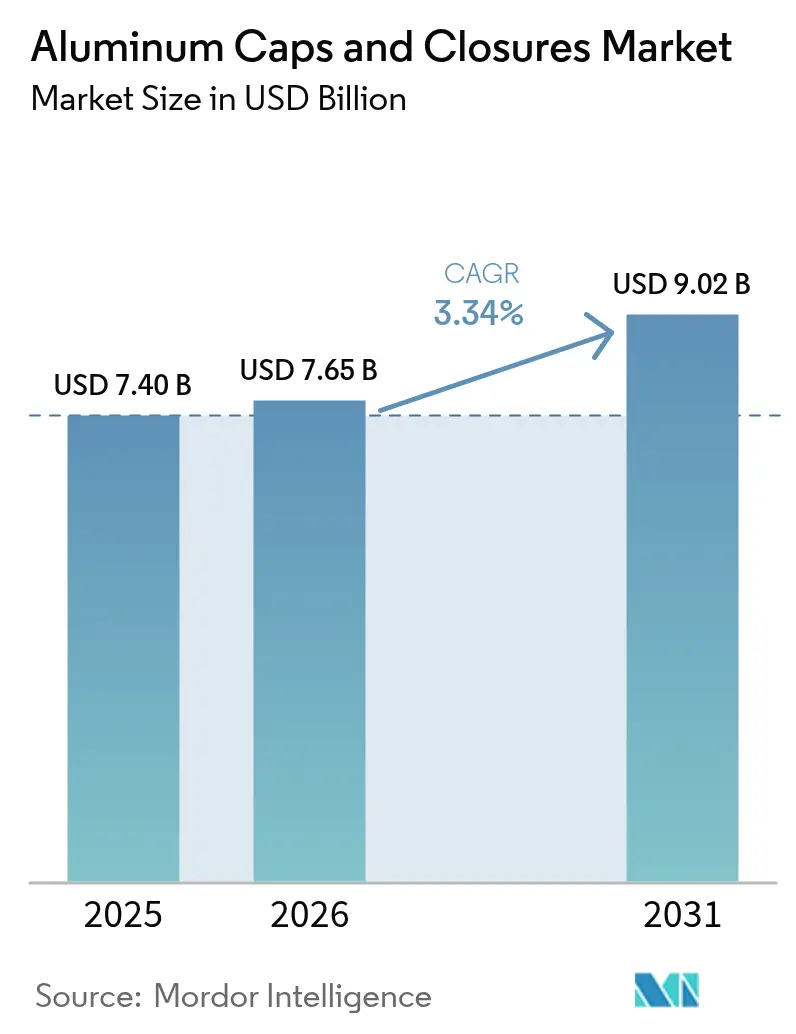
The aluminium caps and closures market size is expected to grow from USD 7.40 billion in 2025 to USD 7.65 billion in 2026 and is forecast to reach USD 9.02 billion by 2031 at 3.34% CAGR over 2026-2031. Demand growth is paced, not explosive, because penetration in core beverage segments is mature; however, upgrades in premium spirits, biologics packaging, and EU sustainability rules continue to open profitable niches. Mandatory tethered-cap regulations in Europe, recycled-aluminium incentives in China, and a shift toward premium ready-to-drink offerings in North America are prompting brand owners to redesign closures with higher functional and aesthetic value. Volatility in London Metal Exchange (LME) pricing tightens converter margins, yet the push for infinitely recyclable materials still tilts preference toward aluminium over cork, steel, or plastic[1]Source: London Metal Exchange, “LME Aluminium,” lme.com . Regional cost advantages particularly additional recycled capacity in Asia-Pacific are helping offset raw-material swings while keeping premium segments insulated from low-cost PET alternatives.
Key Report Takeaways
- By cap type, screw caps led with 50.74% of the aluminium caps and closures market share in 2025.
- By application, the beverage segment accounted for 46.02% of the aluminium caps and closures market size in 2025.
- By cap type, screw caps led with 50.74% of the aluminium caps and closures market share in 2025.
- By Neck Finish Diameter, 31-40 mm captured 48.12% of the aluminium caps and closures market size in 2025.
- By geography, Asia-Pacific held 40.20% revenue share of the aluminium caps and closures market in 2025.
Note: Market size and forecast figures in this report are generated using Mordor Intelligence’s proprietary estimation framework, updated with the latest available data and insights as of 2026.
Market Trends and Insights
Drivers Impact Analysis of Aluminum Caps And Closures Market*
| Driver | (~) % Impact on CAGR Forecast | Geographic Relevance | Impact Timeline |
|---|---|---|---|
| Rise of premium RTD-cocktail aluminium bottling in North America | +0.8% | North America, spill-over to Europe | Medium term (2-4 years) |
| Mandatory transition to tethered caps in EU beverage packaging | +0.6% | Europe, potential global adoption | Short term (≤ 2 years) |
| Beverage-grade recycled aluminium capacity expansions in China | +0.5% | APAC core, global supply chain benefits | Long term (≥ 4 years) |
| Pharma shift to flip-off tear-down aluminium seals for biologics | +0.4% | Global, concentrated in developed markets | Medium term (2-4 years) |
| Craft spirits’ migration from cork to aluminium ROPP in Europe | +0.3% | Europe, North America adoption | Long term (≥ 4 years) |
| E-commerce leakage-testing protocols driving lug-cap adoption in India | +0.2% | India, emerging APAC markets | Medium term (2-4 years) |
| Source: Mordor Intelligence | |||
Rise of Premium RTD-Cocktail Aluminium Bottling in North America
Premium ready-to-drink cocktail brands introduced aluminium bottles throughout 2024 to signal upscale positioning while retaining recyclability. Several brands recorded 40–60% price premiums versus conventional cans, indicating consumers value tactile rigidity and re-close functionality. The barrier performance of aluminium protects botanical extracts from UV light and oxygen, supporting shelf life for spirit-based formulations. Brand collaborations with environmental non-profits reinforce sustainable credentials, creating a marketing halo that smaller steel or PET formats cannot match. The phenomenon is spilling into European travel-retail channels where single-serve spirits require tamper-evident yet elegant closures.
Mandatory Transition to Tethered Caps in EU Beverage Packaging (Directive 2019/904)
Since July 2024, EU beverage bottles must feature tethered closures, sparking redesign activity across carbonated soft drink and water segments.Early consumer pushback against plastic tethered systems led premium water and juice brands to adopt aluminium screw-top variants with integrated hinge mechanisms. Because aluminium is infinitely recyclable and easily detached in material-recovery facilities, brand owners meet both tethered-cap rules and forthcoming 90% metal-collection targets. Multinationals are harmonizing pack formats across non-EU markets to avoid line-change complexity, magnifying near-term demand for value-added aluminium closures.[2]Source: European Parliament, “Parliamentary Question | Tethered Bottle Caps,” europarl.europa.eu
Beverage-Grade Recycled Aluminium Capacity Expansions in China
China’s January 2025 tariff removal on imported recycled aluminium, paired with a policy exempting recycled content from the country’s 45 million-tonne primary cap, is shifting cost curves globally. Domestic mills quote beverage-grade coil at price points 8–12% below primary aluminium, enabling competitive exports of closure stock into Europe and the Americas. Western flat-rolled suppliers answered by announcing alliances aimed at 100% recycled beverage can sheet. While imports alleviate supply tightness, they also deepen scrutiny of traceability systems, accelerating blockchain pilots that certify post-consumer content.
Pharma Shift to Flip-Off Tear-Down Aluminium Seals for Biologics
Cold-chain breakage rates for mRNA vaccines highlighted weaknesses in rubber and plastic closure systems. Regulatory guidance in 2024 emphasized verified container closure integrity for parenterals stored at -20 °C or below, elevating aluminium tear-down seals to the default standard for new biologic drug applications. Contract development and manufacturing organizations retrofitted filling lines with ISO 15378-qualified sealers, creating high switching costs that favor incumbent suppliers. As biologics accelerate from 48% of FDA approvals in 2024 to a projected majority before 2030, aluminium closure demand in pharmaceutical contexts expands in tandem.
Restraints Impact Analysis of Aluminum Caps And Closures Market*
| Restraint | (~) % Impact on CAGR Forecast | Geographic Relevance | Impact Timeline |
|---|---|---|---|
| Volatile LME aluminium prices compressing converter margins | -0.7% | Global, acute in price-sensitive segments | Short term (≤ 2 years) |
| Brand-owner switch to PET tethered caps in carbonated soft drinks | -0.4% | Europe, potential global adoption | Medium term (2-4 years) |
| Tin-free steel crown-cork substitution in Mexican beer | -0.3% | Mexico, Latin America expansion | Long term (≥ 4 years) |
| Limited food-grade recycling streams in Middle East | -0.2% | Middle East, North Africa | Long term (≥ 4 years) |
| Source: Mordor Intelligence | |||
Volatile LME Aluminium Prices Compressing Converter Margins
Aluminium ingot reached USD 2,662 per ton in February 2025, swinging more than 15% within six months and squeezing converters that sell on long-term fixed contracts. Smaller closure firms without hedging programs face eroded margins, making them attractive acquisition targets for multinationals with advanced risk-management desks. Russian export uncertainty, elevated European smelting power costs, and new US container duties all amplify volatility. To stabilize supply, leading converters raise recycled content and explore alloy recipes with higher scrap tolerance, an approach aligned with carbon-reduction pledges yet requiring capital spend on upgraded annealing furnaces.
Brand-Owner Switch to PET Tethered Caps in Carbonated Soft Drinks
Global soft-drink majors opted for PET tethered closures across mainstream SKUs to comply with EU rules at the lowest unit cost. Because these beverages operate on razor-thin per-serving margins, aluminium cannot always match PET economics. Closure makers catering to carbonated categories therefore reposition aluminium as a premium upgrade reserved for flagship products where visual impact and “plastic-free” messaging justify price differentials. The bifurcation underscores the need for solution selling rather than volume chasing in price-sensitive channels.
*Our forecasts treat driver/restraint impacts as directional, not additive. The impact forecasts reflect baseline growth, mix effects, and variable interactions.
Aluminum Caps And Closures Market Segment Analysis
By Cap Type:
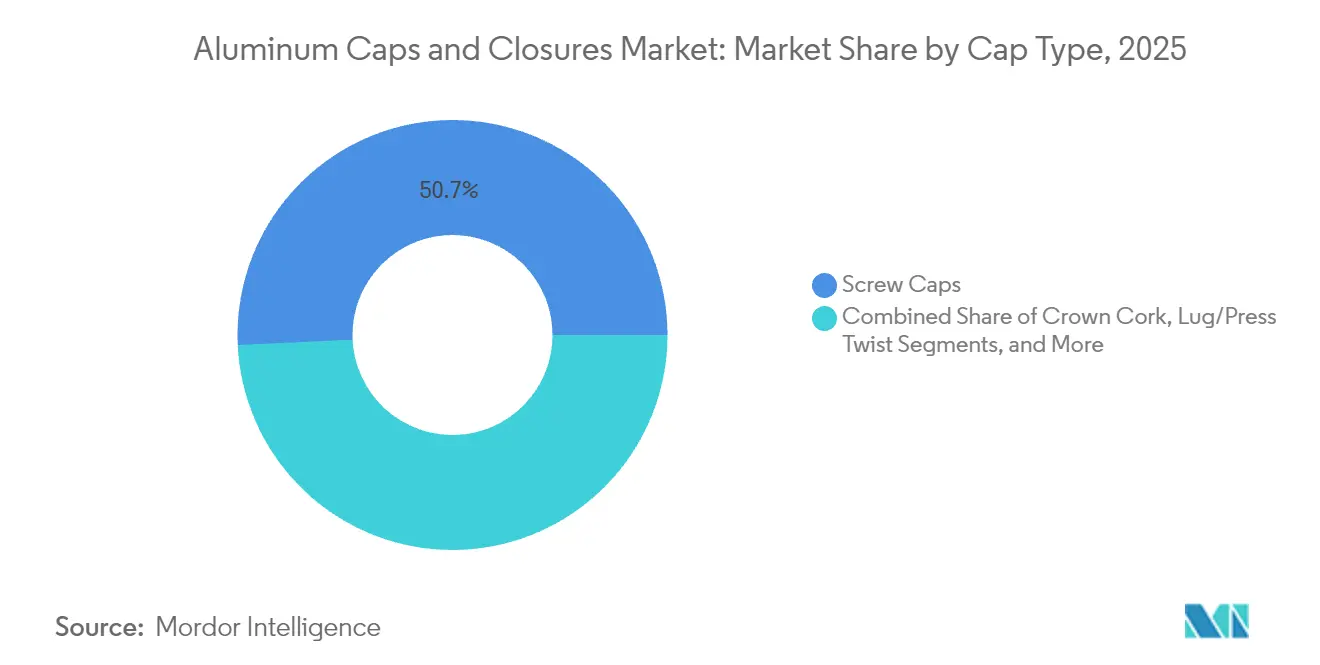
Easy-Open Innovation Drives GrowthScrew caps retained dominance with 50.74% share in 2025 as they span beverages, condiments, and pharmaceuticals. That share equals USD 3.75 billion of the aluminium caps and closures market size in 2025, reflecting their proven sealing reliability. Easy-open ends, while smaller, are gaining fastest at a 6.38% CAGR through 2031 as consumers gravitate toward convenience features in canned coffee and ready meals. Continuous-thread ROPP variants secure traction in craft spirits because they reconcile tamper evidence with luxury visual cues. Crown corks hold relevance in traditional beer packaging, yet their growth is modest given the migration toward full-body slim cans. Lug, press-twist, and specialized flip-off designs serve tamper-sensitive food and pharma uses, illustrating the segmentation’s shift from generalist to application-specific solutions.
Investment is flowing into die-cutting and scoring technologies that create safer, finger-friendly easy-open tabs, unlocking new mass channels like senior-nutrition beverages. Closure makers are also integrating laser-etched QR codes for trace-and-trace compliance without compromising decoration space. These embellishments carry higher unit economics, cushioning margins when raw-material costs rise. In contrast, standard screw-cap formats face commoditization, pressing manufacturers to differentiate through liner chemistry improvements that extend shelf life in aggressive-pH drinks.



By Application:
Pharmaceutical Biologics Accelerate DemandBeverages commanded 46.02% share in 2025, equivalent to USD 3.41 billion of the aluminium caps and closures market. The segment covers still water, carbonated drinks, beer, wine, and premium spirits, each with nuanced closure needs. Premium alcohol producers elevate aluminium as a branding canvas, whereas carbonated soft-drink fillers chase lowest cost compliance to EU tethering. Pharmaceutical demand is expanding at a 6.76% CAGR, adding USD 284 million incremental value by 2031. Growth rests on biologic drug launches that specify flip-off tear-down seals to ensure sterile integrity. Food applications remain steady, propelled by gourmet oils and sauces pursuing metal lug caps for smooth pour control. Personal-care brands leverage aluminium’s recyclability story to displace mixed-material lids, evidenced by high-profile deodorant launches in recyclable aluminium aerosols.
Cross-sector learning accelerates innovation: beverage can suppliers partner with personal-care companies to adapt internal varnishes for lotion compatibility, broadening addressable markets. Industrial chemical closures, though niche, benefit from aluminium’s corrosion resistance when combined with specialty liners. The versatility across end-uses supports balanced portfolio exposure, hedging against cyclical dips in any one sector.
By Neck Finish Diameter:
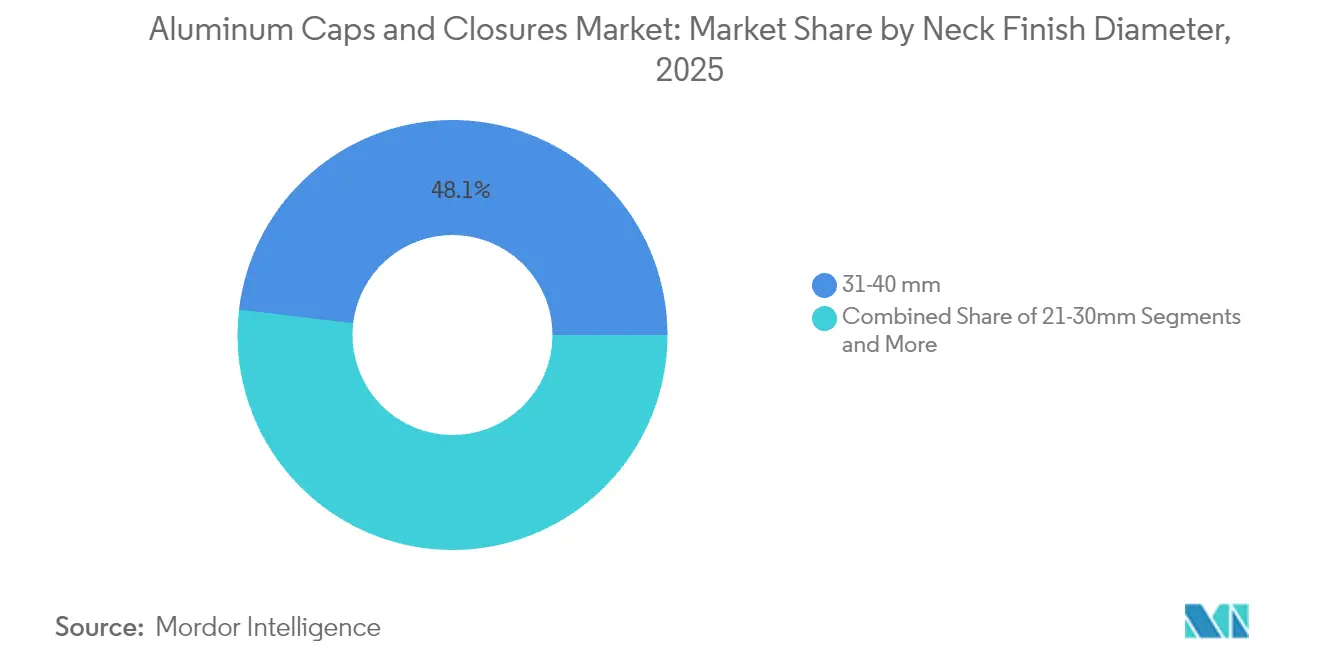
Mid-Range Dominance Reflects VersatilityClosures sized 31-40 mm captured 48.12% of revenue in 2025, translating to USD 3.56 billion of the aluminium caps and closures market size. They fit standard wine, premium water, and spirit bottles, making them the workhorse of the industry. The 21-30 mm segment is set to expand at 5.52% CAGR as craft beverage brands and functional water players adopt slender bottle profiles to signal modernity. Sub-20 mm diameters cater to ampoules, vials, and single-dose nutraceutical shots where dosing accuracy is vital. Large diameters above 40 mm address wide-mouth condiments, sports-nutrition powders, and household chemicals areas with steady if unspectacular growth.
Manufacturers are investing in adjustable forming lines to shift swiftly between neck-finish sizes, lowering inventory risk. Lightweighting initiatives focus on mid-range diameters where demand density justifies tooling upgrades, yielding 5-8% material savings per closure without compromising performance. Such gains are instrumental in buffering LME volatility and meeting corporate emissions targets.
By Distribution Channels:
Direct Sales Maintain Technical AdvantageDirect engagement delivered 78.10% of 2025 revenue because closure development often intertwines with filler-line geometry, liner selection, and artwork integration. Major suppliers embed engineers within customer sites, creating sticky relationships and multi-year tooling amortization structures. Indirect channels distributors and e-commerce portals grow at 4.21% CAGR, supplying regional craft brewers and SME food packers seeking smaller order quantities. Digital configurators now allow small buyers to specify liner compound, print colors, and embossing online, compressing design-to-delivery cycles to under four weeks.
In emerging markets, distributors leverage local language support and regulatory guidance, filling a knowledge gap for brands new to food-contact and child-resistant norms. Meanwhile, global procurement teams of multinational FMCGs still favor direct contracts to secure capacity during demand spikes. The coexistence of high-touch technical collaboration and quick-turn commodity distribution underscores the dual-speed nature of the aluminium caps and closures industry.
Geography Analysis
APAC Aluminum Caps and Closures Market
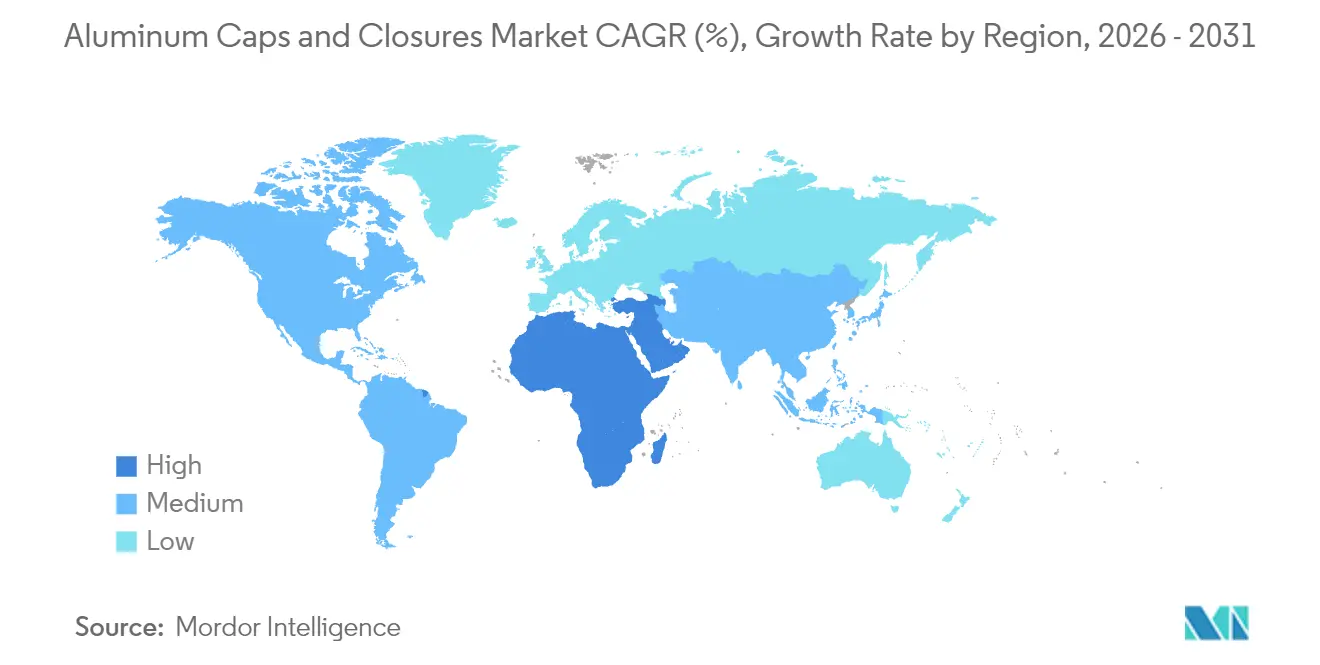
Asia-Pacific anchored 40.20% of global revenue in 2025, driven by China’s prolific beverage output and India’s packaged-goods expansion. Cost competitiveness improved after November 2024 when China abolished tariffs on imported recycled aluminium, enabling mills to supply coil at discounts versus primary metal. Japan and South Korea added a layer of technological sophistication, exporting closure presses and vision-inspection systems regionally. Southeast Asian demand benefitted from urbanization and Western quick-service restaurant chains insisting on tamper-proof lids, stimulating local cap conversion lines. India’s standards upgrade mandating QR traceability for edible-oil packs nudged value share toward premium lug caps, attracting foreign joint ventures.
MEA Aluminum Caps and Closures Market
The Middle East and Africa represent the fastest-growing territory, forecast at 6.89% CAGR through 2031. Beverage investments in Nigeria and Kenya, plus desalinated bottled-water capacity in the Gulf, underpin volume. However, limited circular-economy infrastructure tempers aluminium caps and closures market penetration. Egypt’s move to establish a dedicated food-grade recycling mill marks progress, yet widespread adoption awaits proof of economically viable collection streams. South Africa’s established aluminium smelter base and port connectivity create export opportunities into landlocked neighbors.
Europe Aluminum Caps and Closures Market
Europe, though mature, remains pivotal because regulation steers global specifications. The July 2024 tethered-cap deadline forced fillers to redesign PET and aluminium containers simultaneously, generating engineering consulting revenue for closure specialists. Germany’s mechanical-engineering cluster pioneered continuous-thread screw-top machines capable of 600 cpm with integrated torque monitoring, raising performance benchmarks. Italy’s design houses customized embossing and color-shift inks for premium spirits, preserving perceived luxury even as closures migrate from cork to aluminium for sustainability reasons.
The Americas Aluminum Caps and Closures Market
North America’s market rides consumer migration to craft beverages and ready-to-drink cocktails packaged in resealable aluminium bottles. US tariff barriers imposed in April 2025 boosted domestic can-stock production, indirectly supporting closure coil producers by tightening local supply and encouraging reshoring. Mexico, a major beer exporter, toggles between aluminium and steel closure options to balance cost and supply risk, yet aluminium retains a foothold in premium bottle lines destined for European customers. South America, led by Brazil, invests in new beverage can lines that include in-house closure modules, shortening lead times.

Regulatory Landscape
In Europe, packaging rules are tightening around both design and end-of-life performance. The tethered-closure requirement under Directive 2019/904 has been applicable since July 2024 for beverage bottles, accelerating redesign activity across closures, liner systems, and filling-line compatibility. Separately, the EU Packaging and Packaging Waste Regulation (EU) 2025/40 entered into force on 11 February 2025 and applies from 12 August 2026, reinforcing recyclability-by-design expectations (recyclability performance grades start in 2030) and influencing how metal closures are specified for collection and sorting pathways.
Collection and environmental-claims requirements also shape procurement for aluminum caps and closures. The PPWR framework includes deposit return system (DRS) provisions for beverage containers by 2029, with exemption conditions tied to separate collection performance (including an 80% separate collection threshold referenced for 2026), which is pushing brand owners and suppliers to align packaging formats with national collection systems. At the same time, ISO 14025:2026 (published June 2026) raises the bar for environmental product declaration programs, increasing demand for verified LCA-backed documentation in tendering, while US food-contact compliance continues to evolve through FDA actions such as the January 2025 Federal Register notice that certain previously authorized Food Contact Notifications were no longer effective after manufacturers ceased production.
Competitive Landscape
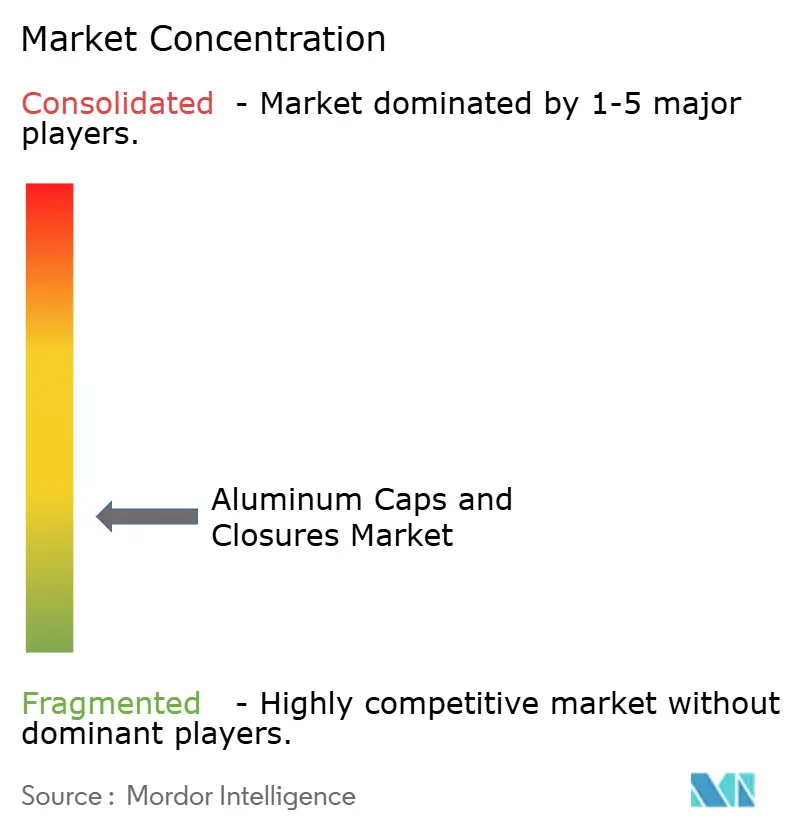
The aluminium caps and closures market exhibits low concentration. Crown Holdings, Silgan, and Guala Closures dominate high-volume contracts for global beverage brands, leveraging economies of scale and vertically integrated coil sourcing. Crown reported 24% beverage-can segment income growth in Q1 2025, attributing performance to robust demand in Brazil and Europe as well as productivity gains in newly automated lines. Silgan’s EUR 838 million acquisition of Weener Packaging in January 2025 expanded its specialty-closure footprint, particularly in European personal-care markets, while adding design centers that cross-pollinate aesthetics across sectors.
Competitive intensity is escalating as can-sheet producers push downstream into closures to secure margin capture. Amcor’s April 2025 all-stock merger with Berry Global integrated films, dispensing systems, and metal-closure know-how, creating a one-stop packaging supplier with USD 650 million synergy targets. Regional challengers in Asia-Pacific and Latin America differentiate through shorter lead times and proximity to low-cost scrap pools, attracting second-tier beverage fillers. Intellectual-property filings reveal a surge in tethered-aluminium classifications and child-resistant reseal mechanisms, signaling technological races beyond simple diameter or threading changes.
Digitalization of quality control camera-based seal inspection linked to factory analytics has become table stakes for winning pharmaceutical and premium-spirit contracts. Established players deploy inline X-ray porosity scanners and real-time torque analytics, translating into lower recall risk for customers. Sustainability credentials also weigh heavily: Novelis’ 3x30 initiative targets 75% recycled content by 2030, positioning the company favorably for brand owners with net-zero pledges. Smaller firms unable to document recycled content or energy intensity face procurement exclusion from top clients, nudging the sector toward gradual consolidation.
Aluminum Caps And Closures Industry Leaders
Amcor Plc
O.Berk Company
Reynolds Packaging Group Ltd
Pelliconi & C. SpA
Nippon Closures Co. Ltd
- *Disclaimer: Major Players sorted in no particular order
Aluminum Caps And Closures Market Companies Covered in this Report
- Amcor plc
- Crown Holdings Inc.
- Silgan Holdings Inc.
- Guala Closures S.p.A
- Tecnocap Group
- Pelliconi and C. SpA
- Nippon Closures Co. Ltd
- Closure Systems International (CSI)
- Berlin Packaging LLC
- Bericap GmbH
- AptarGroup Inc.
- SKS Bottle and Packaging Inc.
- Hicap Closures Co. Ltd
- Federfin Tech SRL
- Rauh GmbH & Co.
- O.Berk Company
- The Cary Company
- Alutop SAS
- Shandong Lipeng Co. Ltd
- Idea Cap SRL
- Easy Open Lid Industry Corp. (Yiwu)
- RPC Group (PET Power)

Market Opportunities and Future Outlook
Europe’s compliance-driven closure redesign is creating room for higher-value aluminum closure systems that meet tethering requirements while supporting premium aesthetics and easier recycling. The July 2024 tethered-cap requirement under Directive 2019/904 has already pushed brand owners to revisit closure architectures, and the PPWR timeline applying from August 2026 adds another anchor around recyclability-by-design and collection outcomes. Suppliers able to provide tethered or retention-capable designs in aluminum, while holding torque performance, tamper evidence, and decoration space for premium water, juice, and spirits, have a clearer route to specification upgrades than players positioned mainly on commodity screw caps.
Circular sourcing and documentation are also creating openings in low-carbon and recycled-content offerings. Industry steps such as Novelis extending its partnership with Infinitum in Norway to secure post-consumer aluminum for closed-loop processing at its Latchford (UK) plant (April 2026) indicate a more integrated scrap-to-sheet model that supports traceability needs behind packaging claims. On the manufacturing side, process advances like JISCOs stable mass production of high-deep-drawing aluminum sheet for bottle caps using a short-process cast-rolling method (May 2026) point to where cost and performance differentiation in cap stock can matter, including for converters managing LME-linked input volatility while meeting tighter customer expectations for recycled content disclosure and verified environmental communications under standards such as ISO 14025:2026.
Recent Industry Developments in Aluminum Caps And Closures Market
- July 2026: Amcor commenced supply of a 28 mm two-piece tamper-evident, aluminum-compatible closure for Belgian mineral water brand Ginstberg. The win highlights brand-side demand for premium, differentiated closures that still fit established bottle formats and retail handling requirements, supporting value-added closure mix in European beverages.
- April 2026: Pelliconi & C. SpA communicated a stronger focus on lightweight metal closure designs, including its 0.15 mm profile LightCrown cap and the EcoCrown with an EcoSeal liner concept. Lightweighting and liner optimization directly reduce metal and component usage per closure, helping converters protect margins under volatile aluminum inputs while aligning with customer sustainability scorecards.
- March 2026: Amcor expanded supply of tethered closures to Austrian mineral water brand Voeslauer to align with EU Single-Use Plastics Directive requirements. The expansion reflects ongoing line conversions and format harmonization by beverage bottlers, raising demand for closure engineering support and validated performance on high-speed filling lines.


Aluminum Caps And Closures Market Report Scope and Research Methodology
Market Definition and Coverage
This market covers the value of aluminum caps and closures used to seal and protect packaged products, mainly on bottles, jars, and similar containers, across key end-use packaging applications worldwide.
Scope exclusions: We exclude closures made fully from other materials (such as plastic or steel), and we also exclude container bodies and general packaging services that are not closures.
Segments Covered in This Report
- By Cap Type
- Screw Caps
- Crown Cork
- Lug / Press-Twist
- Easy-Open End
- Roll-On Pilfer Proof (ROPP)
- Others (Flip-Off, Tear-Down)
- By Application
- Beverages
- Alcoholic Beverages
- Non-Alcoholic Beverages
- Food
- Pharmaceutical
- Cosmetics and Personal Care
- Industrial and Household Chemicals
- Beverages
- By Neck Finish Diameter
- Less than and Equal to 20 mm
- 21-30 mm
- 31-40 mm
- More than 40 mm
- By Distribution Channels
- Direct Sales Channels
- Indirect Sales Channels
- By Region
- North America
- United States
- Canada
- Mexico
- Europe
- Germany
- France
- Italy
- United Kingdom
- Spain
- Rest of Europe
- Asia-Pacific
- China
- Japan
- India
- South Korea
- ASEAN
- Rest of Asia-Pacific
- South America
- Brazil
- Argentina
- Rest of South America
- Middle East and Africa
- Middle East
- GCC
- Turkey
- Rest of Middle East
- Africa
- South Africa
- Kenya
- Rest of Africa
- Middle East
- North America
Data Sources, Market Sizing, and Validation
Desk Research
Desk work starts by building a fact base on packaged beverage and food output, pharmaceutical production trends, and international trade flows for closure-related items. We mainly use public sources such as UN Comtrade import and export statistics, the US International Trade Commission data tools, Eurostat packaging and manufacturing tables, and the World Bank macro indicators to keep country level demand logic consistent.
To connect packaging demand with closure usage, we also review sources such as the Alcohol and Tobacco Tax and Trade Bureau beverage statistics, the US FDA packaging and compliance related publications, and peer reviewed packaging science journals that discuss closure performance and material shifts. Company annual reports, investor presentations, and reputable industry press are then used to sanity check capacity additions, plant expansions, and pricing discussions, supported where needed by paid subscriptions for company financials and an import and export shipment-level database. The sources listed above are illustrative only, and many other public documents were also used for collection, validation, and clarification.
Primary Interviews and Surveys
Primary work is used to pressure test the desk assumptions around aluminum closure adoption, pricing movement, and the mix between beverage, food, and pharma usage. We spoke with packaging converters, closure suppliers, brand owners, and distributors across major regions so gaps in trade led views could be corrected, and so the respondent input could be aligned to real buying patterns and qualification timelines.
Distribution of primary research fieldwork respondents
| Company type | Respondent position | Region |
|---|---|---|
| Top tier: 33% | CXOs: 16% | APAC: 42% |
| Mid tier: 51% | Functional/Unit leaders: 31% | EMEA: 32% |
| Smaller Players: 16% | Managers: 53% | Americas: 26% |
Market-Sizing & Forecasting
Sizing is built using a top-down demand pool that reconstructs closure needs from packaged output signals and trade patterns, and then ties that demand to aluminum closure penetration. The model leans on practical inputs such as beverage bottling volumes, share of aluminum screw caps and ROPP usage by application, average closure weight and scrap rates, and observed aluminum price and conversion cost movement that influences selling prices.
To keep totals realistic, selective bottom-up approximations are used as cross checks, such as sampled price per thousand units against estimated unit demand, plus channel checks on regional supply tightness. When company disclosures are limited, gaps are handled by using proxy production indicators and import reliance patterns, which are then adjusted after interviews.
For forecasting, we use scenario analysis supported by a light multivariate regression on packaged output growth, premiumization trends that change closure mix, and regional shifts in filling capacity. Forecast inputs are aligned to what experts expect for application growth and pricing resets, which helps us avoid overreacting to one year raw material swings.
Data Validation & Update Cycle
Validation is done in steps so any mismatch is caught early and explained before final numbers are signed off. We compare modeled outcomes with independent signals like aluminum packaging demand direction, trade balance changes for closure related items, and major capacity announcements, then review anomalies and rework until the drivers align.
A second analyst review is completed for key assumptions, unit conversions, and currency handling, followed by targeted re-contact if a variance cannot be explained with public evidence. The report is refreshed every year, and interim updates are triggered when material events happen (for example, large plant starts, major regulation changes, or sharp input cost shocks). Before delivery, the latest public updates are checked again so clients receive a current view.
Mordor Intelligence's Aluminum Caps and Closures Market Size Compared With Other Published Estimates
Published market numbers for aluminum caps and closures can vary even when studies focus on similar end-use industries, because the boundaries and price mechanics are not always aligned. Differences usually show up in what is counted as an aluminum closure, the base year used, and how pricing is moved forward with aluminum and conversion costs.
By tracking unit demand signals and refreshing scope checks each cycle, Mordor Intelligence keeps the 2026 value tied to aluminum-only closures and avoids mixing in broader metal closures or adjacent packaging parts, which is a common reason for spread across studies.
Benchmark comparison
| Source | Market Size | Gaps in Research Methodology |
|---|---|---|
| Mordor Intelligence | USD 7.65 B (2026) | |
| Industry Research House A | USD 6.30 B (2024) | Uses an earlier base year and can understate later period pricing resets, and it also appears to mix a wider set of closure formats (for example, vial seals and easy-open ends) without clarifying what is excluded from the closure-only boundary. |
| Global Research House B | USD 7.80 B (2025) | Anchors the model on a different base year and applies a faster growth path that can assume higher penetration gains across end uses, while the pricing build is less clearly linked to aluminum input cycles and regional conversion spreads. |
The table shows that the spread is mainly explained by base year choice, which closure formats are counted, and how price progression is carried through the forecast years. When scope is kept to aluminum caps and closures only and the pricing logic is connected back to observable aluminum and conversion indicators, the resulting number becomes easier to trace and repeat.


Key Questions Answered in the Report
What is the current size of the aluminium caps and closures market?
The market was valued at USD 7.65 billion in 2026 and is projected to reach USD 9.02 billion by 2031 at a 3.34% CAGR.
Which cap type holds the largest share?
Screw caps commanded 50.74% of global revenue in 2025, reflecting their versatility across beverage, food, and pharmaceutical products.
Why are aluminium closures gaining traction in pharmaceuticals?
Flip-off and tear-down aluminium seals meet stringent container-closure integrity requirements for biologics, supporting 6.76% CAGR growth in the pharmaceutical segment.
How will EU tethered-cap regulations influence the market?
Directive 2019/904 accelerates adoption of innovative aluminium tethered designs, particularly for premium beverages, and is adding +0.58% to projected market CAGR.
Which region will grow fastest through 2031?
The Middle East and Africa are forecast to expand at 6.89% CAGR due to rising beverage production and modernization of packaging formats.
How are raw-material price swings affecting suppliers?
Volatile LME aluminium pricing pressures margins, encouraging converters to boost recycled content and hedge metal exposure through long-term coil contracts.
Page last updated on:





