
AI For Autonomous Machines Market Size and Share
Market Overview
| Study Period | 2020 - 2031 |
|---|---|
| Market Size (2026) | USD 14.01 Billion |
| Market Size (2031) | USD 29.47 Billion |
| Growth Rate (2026 - 2031) | 16.03% CAGR |
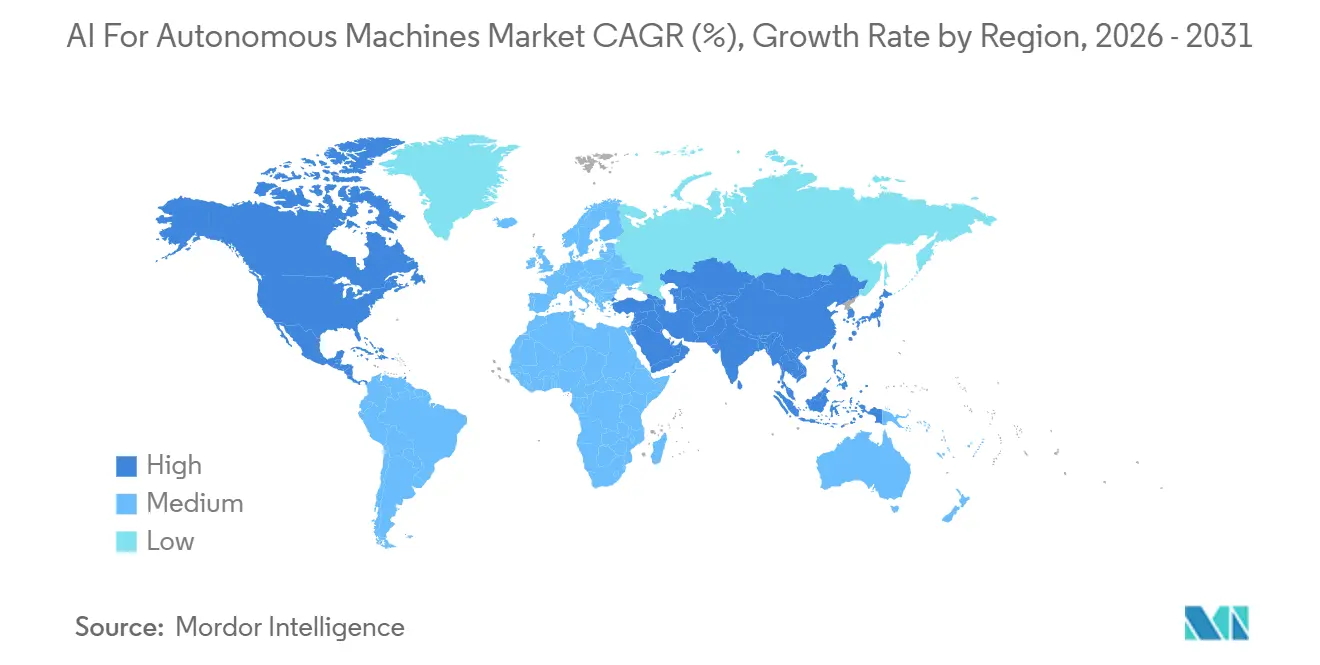
| Fastest Growing Market | Middle East |
| Largest Market | Asia-Pacific |
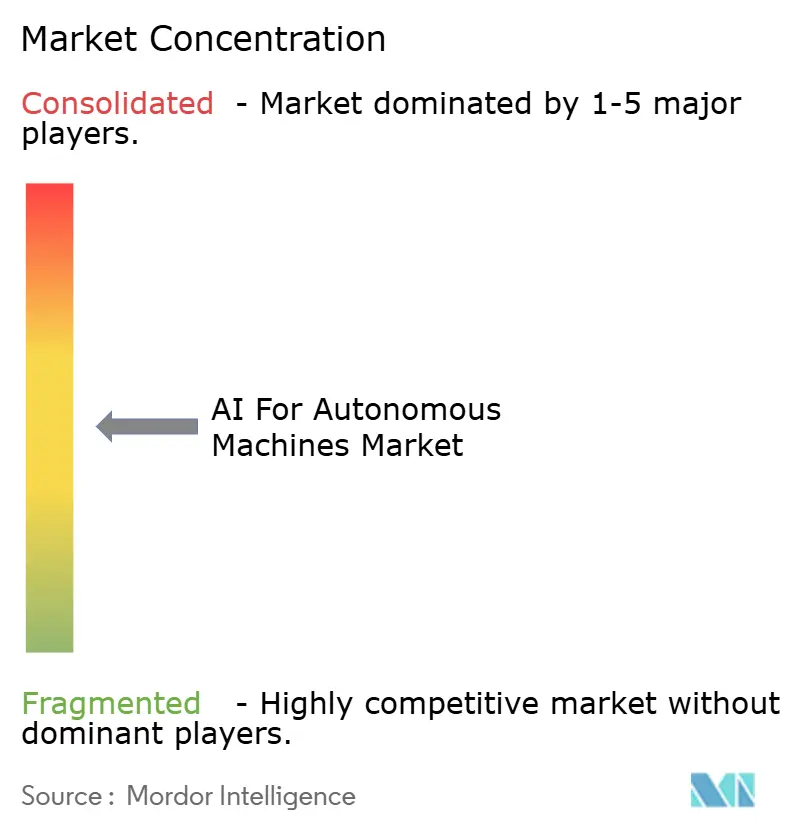
| Market Concentration | Medium |
Major Players *Disclaimer: Major Players sorted in no particular order Image © Mordor Intelligence. Reuse requires attribution under CC BY 4.0. | |
AI For Autonomous Machines Market Analysis by Mordor Intelligence
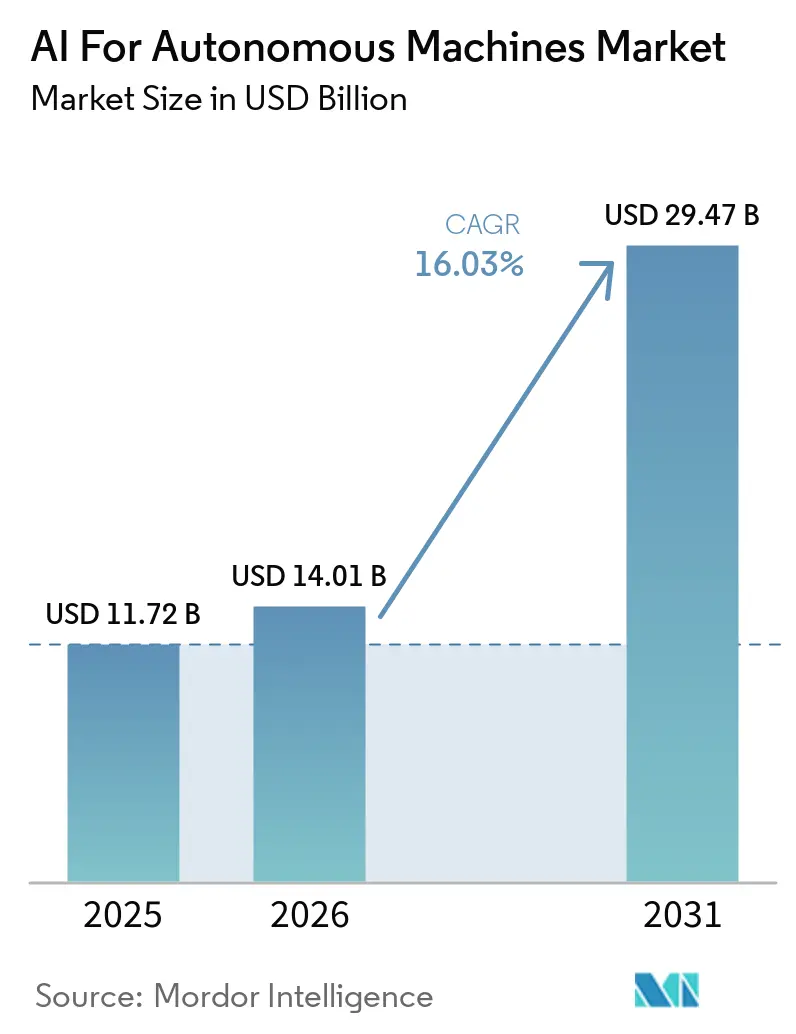
The AI for autonomous machines market size is projected to expand from USD 11.72 billion in 2025 and USD 14.01 billion in 2026 to USD 29.47 billion by 2031, registering a CAGR of 16.03% between 2026 to 2031. Falling edge computing costs, rising labor costs, and higher fulfillment volumes are strengthening the business case for autonomous equipment. Industrial robot installations reached 575,000 units in 2025 and are expected to surpass 700,000 by 2028, supporting a larger installed base of AI-enabled systems. The AI for autonomous machines market is moving beyond isolated automation projects as manufacturers and logistics operators require machines that can perceive conditions, plan tasks, and respond in real time. Hardware remained central to deployment in 2025, while software, training data, and fleet management are becoming more important sources of recurring revenue. Established chip suppliers, robot manufacturers, and specialist software firms are pursuing connected offerings that combine compute, simulation, safety, and operational support.
Key Report Takeaways
- By component, hardware held 57.48% of the AI for autonomous machines market share in 2025, while software is projected to expand at a 18.53% CAGR through 2031.
- By autonomous-machine type, industrial robots and cobots held 40.87% revenue share in 2025, while unmanned marine vehicles are projected to grow at a 17.92% CAGR through 2031.
- By technology, machine learning and deep learning held 34.16% revenue share in 2025, while LiDAR and radar perception technology is projected to grow at a 16.71% CAGR through 2031.
- By end-user industry, automotive held 23.21% of the AI for autonomous machines market share in 2025, while aerospace and defense is projected to expand at a 17.27% CAGR through 2031.
- By geography, Asia-Pacific held 42.47% of the AI for autonomous machines market share in 2025, while the Middle East is projected to expand at a 16.84% CAGR through 2031.
Note: Market size and forecast figures in this report are generated using Mordor Intelligence’s proprietary estimation framework, updated with the latest available data and insights as of January 2026.
Global AI For Autonomous Machines Market Trends and Insights
Drivers Impact Analysis*
| DRIVER | (~) % IMPACT ON CAGR FORECAST | GEOGRAPHIC RELEVANCE | IMPACT TIMELINE |
|---|---|---|---|
| E-Commerce Fulfillment Automation | +3.2% | Global, with concentration in North America, Asia-Pacific, and Europe | Short term (≤ 2 years) |
| Edge-AI Compute for Real-Time Autonomy | +2.8% | Global, with early gains in North America and Asia-Pacific | Short term (≤ 2 years) |
| Labor Shortages and Workforce Cost Pressure | +2.5% | Global, most acute in North America, Europe, Japan, and South Korea | Medium term (2-4 years) |
| Industry 4.0 and Flexible Automation Adoption | +2.1% | North America, Europe, and Asia-Pacific | Medium term (2-4 years) |
| Fleet Learning From Cross-Site Robot Data | +1.8% | North America, Asia-Pacific, with spillover to Europe | Medium term (2-4 years) |
| Liability-Ready Simulation and Digital Twins | +1.2% | Europe and North America, with spillover to Asia-Pacific | Long term (≥ 4 years) |
| Source: Mordor Intelligence | |||
E-Commerce Fulfillment Automation
Rising order volumes and shorter delivery expectations have made warehouse automation a core investment priority for large logistics operators. Amazon had deployed more than 750,000 robots in its fulfillment network by 2025, showing the scale at which robotic systems now support daily operations. In June 2026, Amazon also announced a EUR 10 billion (USD 11.6 billion) investment in its European fulfillment network, alongside new AI-enabled equipment. Large networks generate operating data from picking, routing, handling, and exception management, which can improve later software models. This data advantage raises the threshold for independent providers that lack comparable access to real operating environments. The AI for autonomous machines market also benefits as mid-sized logistics providers seek robotics-as-a-service contracts that link spending to delivery and throughput outcomes.
Edge-AI Compute for Real-Time Autonomy
More capable computing at the machine edge lets autonomous systems make decisions without waiting for a remote cloud response. NVIDIA released the Jetson T4000 module in January 2026 with 1,200 FP4 TFLOPS in a 70-watt design and a USD 1,999 price at 1,000-unit volume. NVIDIA also made Jetson AGX Thor available for humanoid, agricultural, and surgical robotics, extending high-performance local processing to more machine categories.[1]NVIDIA, “NVIDIA Blackwell-Powered Jetson Thor Now Available, Accelerating the Age of General Robotics,” NVIDIA Newsroom, nvidianews.nvidia.com Lower latency supports applications where a machine must respond immediately to movement, obstacles, or changing physical conditions. ABB stated that its RobotStudio HyperReality, working with NVIDIA Omniverse, can reduce deployment costs by up to 40% and shorten time to market by up to 50%. This pattern supports the AI for autonomous machines market by making simulation and local inference more practical for smaller deployment programs.
Labor Shortages and Workforce Cost Pressure
Workforce aging and labor shortages are moving automation from an optional productivity tool toward an operational requirement in several regions. A 2025 ManpowerGroup survey of more than 40,000 employers found that 61% were increasing process automation investment. The share reached 71% among organizations where workforce aging was already affecting operations. Japan Robot Industry Association data showed domestic robot orders rose 20% to 218,987 units in 2025, while order value increased 25.7% to JPY 1.05 trillion, equivalent to USD 6.88 billion.[2]Japan Robot Industry Association, “2025 Statistics Press Release,” Japan Robot Industry Association, jara.jp JARA expects 2026 order revenue to increase 16.7% to JPY 1.22 trillion, equivalent to USD 8.03 billion. Demand to replace scarce workers also creates funding for better sensors, controls, and AI models, which can support later adoption across the AI for autonomous machines market.
Industry 4.0 and Flexible Automation Adoption
Manufacturers are integrating operational data into production systems, enabling robots to respond to current conditions rather than fixed instructions. Rockwell Automation reported that one-third of industrial operations were AI-augmented in 2026. Its respondents expected that share to exceed 50% within 4 years. Connected information and operational systems give autonomous machines access to signals on materials, quality, maintenance, and production schedules. This supports flexible operations where product mixes change too frequently for conventional fixed automation. The AI for autonomous machines industry can therefore serve high-mix and low-volume manufacturers that previously lacked the scale for major robotics programs. Greater software integration also expands the need for reliable cybersecurity, data governance, and retraining support.
Restraints Impact Analysis*
| RESTRAINT | (~) % IMPACT ON CAGR FORECAST | GEOGRAPHIC RELEVANCE | IMPACT TIMELINE |
|---|---|---|---|
| Fragmented Safety and Liability Frameworks | -2.4% | Global, most acute in Europe and North America | Medium term (2-4 years) |
| High Upfront Integration and Retrofit Costs | -2.1% | Global, most acute in SME-heavy markets in Europe and Asia-Pacific | Medium term (2-4 years) |
| Scarcity of Task-Specific Edge Cases for Training | -1.5% | Global | Long term (≥ 4 years) |
| Cyber-Physical Attack Surface in Connected Fleets | -1.0% | Global, concentrated in North America and Europe | Medium term (2-4 years) |
| Source: Mordor Intelligence | |||
Fragmented Safety and Liability Frameworks
Different national rules on safety, accountability, and liability add cost and delay when providers deploy the same platform across borders. The EU AI Act entered full applicability in August 2026 and sets out obligations for high-risk systems, including human oversight, incident records, and fundamental rights assessments. The EU Product Liability Directive extends strict liability to AI-driven software and must be transposed into national law by December 9, 2026. The withdrawal of the proposed EU AI Liability Directive in early 2025 left fault-based civil liability unresolved at the EU level.[3]European Union, “Regulation (EU) 2024/1689,” EUR-Lex, europa.eu Standards such as IEC 61508 and ISO 13849 provide useful reference points, but providers still need to apply them across separate legal settings. The AI for autonomous machines market may favor firms that already have safety processes, certification experience, and documented system controls.
High Upfront Integration and Retrofit Costs
The main cost barrier often comes from engineering, safety configuration, controls integration, and commissioning rather than the equipment itself. General-purpose robots can cost USD 15,000 to USD 250,000 per unit, and early-deployment payback can exceed 2 years. Each site can require a different layout, process design, safety review, and maintenance plan. These requirements make it harder for small and mid-sized manufacturers to fund pilots and later scale them. Robotics-as-a-service arrangements can reduce the initial financial burden by shifting integration and uptime risk to the provider. The approach also requires providers to finance assets and maintain service capacity, which favors companies with established balance sheets. Limited coverage of rare operating conditions remains an issue, as models must handle edge cases beyond warehouses and automotive assembly.
*Our forecasts treat driver/restraint impacts as directional, not additive. The impact forecasts reflect baseline growth, mix effects, and variable interactions.
Segment Analysis
By Component: Software Is Increasingly Capturing Market Value
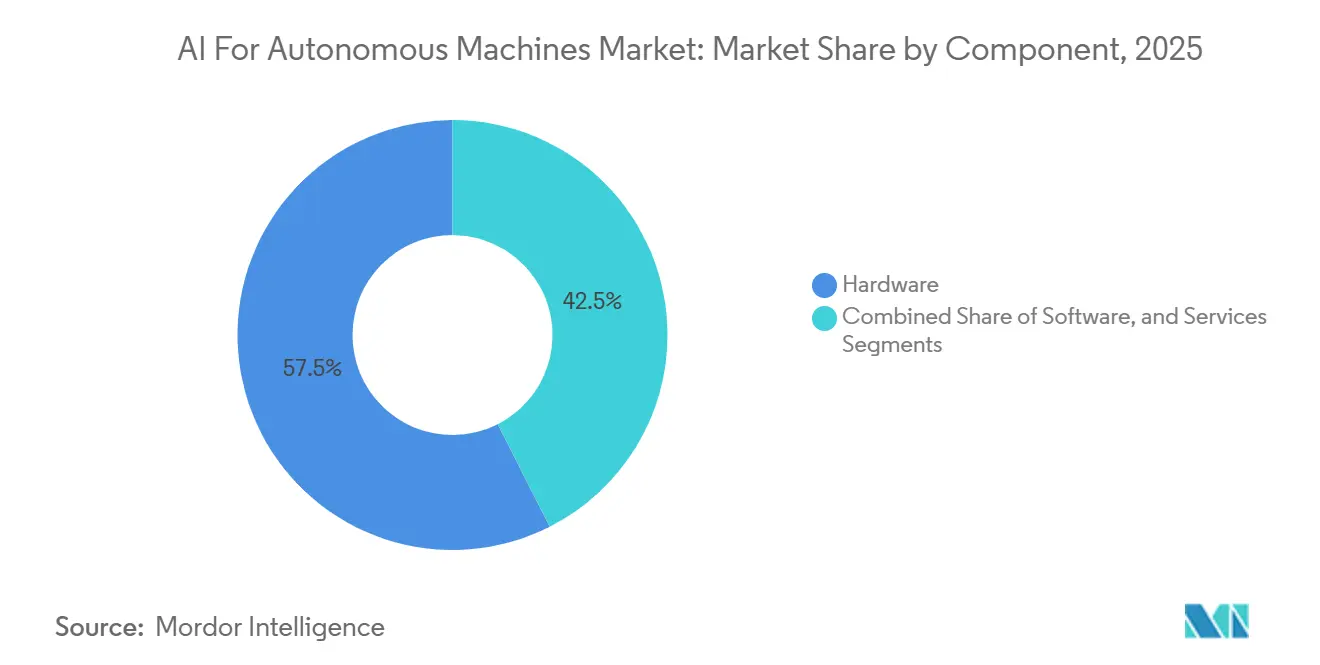
Hardware held 57.48% of the AI for autonomous machines market share by component in 2025. Edge computing modules, LiDAR units, cameras, force-torque sensors, and actuators remained necessary for machines to sense and act in physical settings. These purchases supported hardware demand across warehouse robots, industrial cells, vehicles, and field equipment. Local computing hardware has improved the ability of machines to process data at the point of use. NVIDIA’s Jetson products are used for this purpose across humanoid, agricultural, and surgical robotics. The services sub-segment includes installation, maintenance, model retraining, and fleet-management support. It remains smaller than hardware and software in absolute terms, but it grows with the installed machine base. Service providers also help operators address site-specific safety and systems integration requirements. These activities make services important for repeat deployments within the AI for autonomous machines market.
Software is projected to be the fastest-growing component, with a CAGR of 18.53% through 2031. Demand centers on world foundation models, fleet-orchestration platforms, computer vision, and simulation tools that shorten development cycles. Software helps operators deploy one control approach across several machine types and sites. This is useful when a business needs to modify tasks without rebuilding mechanical systems. The AI for autonomous machines market size for software is supported by a shift toward proprietary model assets, operating data, and interfaces that connect them to fleets. NVIDIA’s Cosmos platform is designed to combine synthetic world generation, vision reasoning, and action simulation for physical AI development. Software firms can build recurring revenue through model updates, analytics, and remote fleet support. Hardware manufacturers are responding by adding software, simulation, and lifecycle services to their offerings. The value of software still depends on reliable integration with sensors, compute modules, and physical safety systems.



By Autonomous-Machine Type: Industrial Robots Lead Volume and Marine Vehicles Lead Growth
Industrial robots and cobots accounted for 40.87% of the autonomous-machine-type segment in 2025. Their installed base supports precision assembly, material movement, welding, inspection, and machine tending. Semiconductor manufacturing and logistics are important sources of demand because each requires repeatable handling with limited tolerance for errors. Collaborative robots have expanded beyond traditional automotive assembly into more varied production environments. Industrial robots and cobots remain central to the AI for autonomous machines market because they combine a broad installed base with growing demand for adaptable control. Their near-term role is strengthened by investment in chip fabrication, electronics assembly, and fulfillment facilities. Adoption still depends on integration skills, worker training, and clear safeguards around human-machine interaction.
Unmanned marine vehicles are projected to be the fastest-growing machine type, with a 17.92% CAGR through 2031. Naval use, offshore energy inspection, and climate monitoring work create demand for machines that can remain on missions for longer periods. AI-guided navigation helps operators manage changing sea conditions and reduce direct human exposure. The United States Navy has emphasized large unmanned surface vehicles and extra-large unmanned undersea vehicles in its planning.[4]U.S. Navy, “Navigation Plan for America’s Warfighting Navy,” U.S. Navy, navy.mil Unmanned aerial vehicles continue to serve logistics, infrastructure inspection, and defense reconnaissance. Unmanned ground vehicles are gaining use in ports, mining logistics, and military operations. Service robots, delivery robots, autonomous heavy equipment, farm machinery, and humanoid machines are also broadening the AI for autonomous machines market. Each category has different safety, sensing, environmental, and maintenance requirements. This diversity creates room for specialized platforms as well as common AI layers that can work across physical systems.
By Technology: ML Leads Adoption and LiDAR and Radar Drive Growth
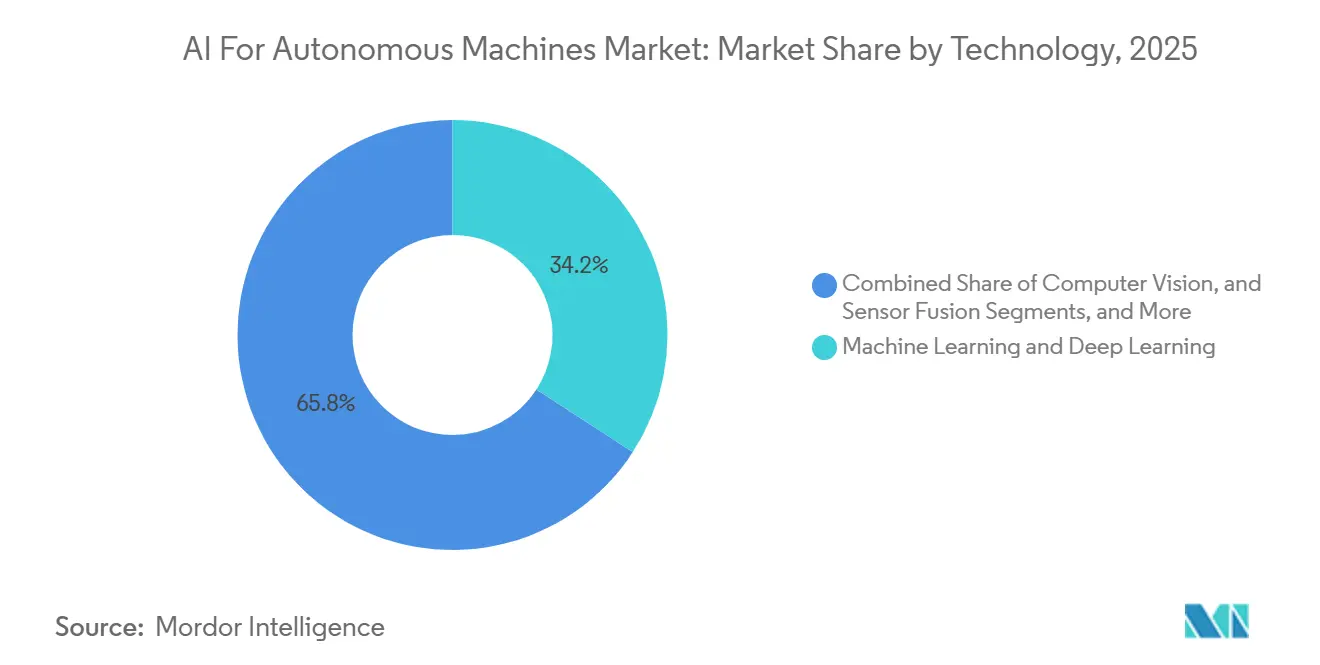
Machine learning and deep learning held 34.16% of the technology segment in 2025. Trained neural architectures support navigation, object classification, task sequencing, and the interpretation of sensor data. Their widespread use reflects the need for machines to recognize changing conditions instead of relying only on predetermined logic. Computer vision remains broadly used across many machine types because cameras provide rich visual information at a practical cost. Sensor fusion combines camera, LiDAR, radar, and inertial inputs into a shared model of the surrounding environment. This approach helps maintain perception when an individual sensor performs poorly. FANUC announced in May 2026 that it would integrate Google Gemini Enterprise into its Physical AI Robot System. The system is intended to let robots perform tasks from natural-language instructions and coordinate work across robot types. This development shows why machine learning remains foundational to the AI for autonomous machines market.
LiDAR and radar perception is projected to be the fastest-growing technology sub-segment, with a CAGR of 16.71% through 2031. These sensors improve depth perception and help machines operate where camera-only systems face low visibility or difficult weather. The AI for autonomous machines market size for LiDAR and radar benefits from applications that require dependable obstacle detection and distance measurement. UN Regulation No. 157 establishes requirements for automated lane-keeping systems, including the technical conditions for their safe operation.[5]United Nations Economic Commission for Europe, “UN Regulation No. 157, Automated Lane Keeping Systems,” UNECE, unece.org This regulatory setting supports the importance of robust perception in automated road vehicles. Four-dimensional imaging radar can provide better sensing in rain, fog, and low-light conditions. LiDAR, radar, cameras, and inertial sensors work best when combined through sensor-fusion software. The technology choice depends on machine type, operating conditions, safety obligations, and total system cost. As more machines move from controlled facilities to open environments, the need for high-quality perception is expected to rise.
By End-User Industry: Automotive Leads Volume and Aerospace and Defense Lead Growth
Automotive held 23.21% of the end-user segment in 2025. The sector uses industrial robots and cobots for body assembly, welding, painting, component handling, and quality inspection. Long-established production systems give automotive manufacturers experience in integrating equipment with process controls. AI can make those systems more adaptable by improving visual inspection, task planning, and predictive maintenance. Automotive suppliers also use automation to address cost pressure and production variability. This established base makes the sector a major source of deployment volume for the AI for autonomous machines market. Electronics and semiconductor production are also important because their tasks demand precision handling and reliable inspection. Retail and e-commerce use autonomous systems for storage, picking, sorting, and material flow. Healthcare and food processing provide further use cases where hygiene, repeatability, and worker safety affect adoption decisions. These adjacent sectors create multiple routes for growth even when automotive investment cycles are uneven.
Aerospace and defense is projected to be the fastest-growing end-user segment, at a CAGR of 17.27% through 2031. Demand is tied to persistent surveillance, autonomous logistics, inspection, and the desire to limit human exposure in hazardous settings. Defense users also require systems that can operate with strong security and audit controls. In December 2025, CISA and its partners issued guidance on secure AI integration in operational technology. The guidance addressed model drift, prompt injection, cyber threats, and other risks in connected operational environments. These requirements create demand for platforms that can demonstrate secure configuration and reliable records. Agriculture and mining are included in other end-user industries and offer further applications for autonomous heavy equipment and precision operations. Brazil’s agricultural infrastructure and South Africa’s deep-mining operations represent settings where remote inspection and material handling can reduce personnel exposure. The AI for autonomous machines industry therefore serves both high-volume factory use and specialized field environments.
Geography Analysis
Asia-Pacific held 42.47% of the AI for autonomous machines market in 2025. The region combines large manufacturing capacity, government support for automation, and sustained demand from electronics production. Japan reported domestic robot orders of 218,987 units in 2025, up 20% from the prior year. The related order value rose 25.7% to JPY 1.05 trillion, equivalent to USD 6.88 billion. Japan’s 2026 outlook calls for a 16.7% increase in order revenue to JPY 1.22 trillion, equivalent to USD 8.03 billion. Japan’s Society 5.0 policy framework and China’s robotics certification standards can shorten certification processes and support local procurement. India is expanding the use of autonomous mobile robots in e-commerce fulfillment and electronics manufacturing. Vietnam, Thailand, and Malaysia are also increasing the adoption of collaborative robots as electronics production grows.
North America and Europe form the second major regional cluster, although their demand drivers differ. North American adoption is concentrated in logistics, automotive, and defense, supported by procurement for unmanned systems and private investment in fulfillment infrastructure. Amazon forecast capital expenditure above USD 200 billion in 2026, with autonomous fulfillment infrastructure among its major investment areas. Canada and Mexico benefit from automotive supply chain integration and nearshoring. Europe has a more mixed outlook because weak automotive conditions affected some robot investment. Germany recorded 27,000 robot installations in 2024, a 5% decline from the prior year.[6]International Federation of Robotics and VDMA, “Germany Is the European Leader in Factory Robots,” International Federation of Robotics, ifr.org European regulations create demand for certified, documented platforms, which can favor experienced providers. This setting supports compliant systems but increases administrative requirements for newer vendors in the AI market for autonomous machines.
The Middle East is projected to be the fastest-growing geography, with a CAGR of 16.84% through 2031. Growth is concentrated in the United Arab Emirates and Saudi Arabia, where industrial diversification and smart-city programs support autonomous logistics, construction inspection, and healthcare robotics. The Saudi Food and Drug Authority has issued requirements for medical-device registration that shape the regulatory path for hospital automation equipment. Logistics hubs in Dubai, Jeddah, and Dammam are scaling autonomous fleet operations ahead of several neighboring locations. Africa and South America remain earlier-stage regions for the AI for autonomous machines market. The AI for autonomous machines market in these regions depends on infrastructure, access to services, and local operating conditions. Brazil offers applications for precision agriculture and automated material handling. South Africa’s deep-mining operations create demand for inspection and handling systems that reduce exposure in underground settings.

Competitive Landscape
The AI for autonomous machines market has moderate to high concentration at the compute and platform level, while machine specialists, integrators, and application software providers remain more fragmented. NVIDIA holds an important position through Jetson compute modules, the Isaac simulation stack, and Cosmos world foundation models. It's June 2026, Halos for Robotics launches combined safety tools and certification-oriented inspection support for physical AI systems. NVIDIA stated that the program draws on more than 18,600 engineering years of autonomous-vehicle safety development. The company’s safety approach addresses IEC 61508, ISO 13849, and ISO/IEC TS 22440 certification pathways. The approach gives suppliers and operators a shared route for testing and validation. Chip providers also compete through performance, energy use, software tools, and partnerships with machine manufacturers. This layer can shape how quickly new robot designs reach commercial use.
Industrial robot manufacturers are adding AI software, simulation, and fleet orchestration to protect margins and support larger deployments. KUKA deployed its Automation Management Platform in live North American automotive production at KUKA Toledo Production Operations in Ohio during July 2026. The platform initially focused on autonomous mobile robots at a facility producing more than 300 vehicle bodies each day. ABB is using virtual commissioning with NVIDIA Omniverse through RobotStudio HyperReality. Such investments help manufacturers simulate layouts and process changes before equipment is installed. This can reduce implementation risk for customers with complex sites. KUKA, ABB, FANUC, Yaskawa Electric, and Boston Dynamics are therefore competing through software capability as well as mechanical performance. The AI for autonomous machines market rewards firms that can connect physical equipment to dependable lifecycle support. The AI for autonomous machines market also rewards providers that manage updates and safety requirements over the equipment lifecycle.
Competition is also expanding from automotive technology into general-purpose robotics and humanoid systems. Mobileye announced in January 2026 a definitive agreement to acquire Mentee Robotics for USD 900 million, including USD 612 million in cash and up to 26.2 million Mobileye Class A shares. FANUC announced a collaboration with Google in May 2026 to add Gemini Enterprise to its Physical AI Robot System. Boston Dynamics also announced a partnership with Google DeepMind to bring foundation-model capability to Atlas humanoid robots. These moves show the importance of AI models that can work across tasks and physical forms. Firms with certified safety processes, hardware-agnostic deployment, and recurring fleet data services are better positioned to serve complex customers. The AI for autonomous machines industry remains open to specialists, as underwater systems, agricultural equipment, and surgical platforms require deep application knowledge. No combined market share for leading companies was provided, so a market concentration score cannot be assigned under the stated scoring method.
AI For Autonomous Machines Industry Leaders
NVIDIA Corporation
ABB Ltd.
FANUC Corporation
KUKA AG
Yaskawa Electric Corporation
- *Disclaimer: Major Players sorted in no particular order

Recent Industry Developments
- July 2026: KUKA Group deployed its AI-driven Automation Management Platform, KUKA AMP, in live North American automotive production at KUKA Toledo Production Operations in Ohio. The 335,000 sq ft facility produces more than 300 vehicle bodies daily. KUKA AMP initially focuses on autonomous mobile robots and represents a direct application of Physical AI in real-world manufacturing at scale.
- July 2026: KUKA launched the LBR iisy collaborative robot on its unified iiQKA.OS2 operating system, providing an entry point to the KUKA automation ecosystem with a clear path to scalability from collaborative scenarios to demanding industrial environments.
- June 2026: NVIDIA launched Halos for Robotics, the industry's first full-stack safety system for physical AI, drawing on 18,600+ engineering years of AV safety development and targeting IEC 61508, ISO 13849, and ISO/IEC TS 22440 certification pathways. The NVIDIA Halos AI Systems Inspection Lab became the world's first ANAB-accredited program for functional and AI safety in autonomous vehicles and robotics. More than 40 companies are engaged across manufacturers, certification bodies, and safety vendors.
- June 2026: Mobileye announced plans to establish a vertically integrated robotaxi business launching in a U.S. city in 2027, with an initial fleet of 100 autonomous vehicles. The move extends Mobileye’s strategy from technology supply into fleet ownership and ride-hailing operations, complementing its existing supplier model.


Global AI For Autonomous Machines Market Report Scope
The AI for Autonomous Machines Market comprises artificial intelligence technologies, platforms, and software solutions that enable machines to perceive their surroundings, learn from data, make informed decisions, and operate independently with minimal human intervention. The market covers AI frameworks and enabling solutions used in autonomous vehicles, mobile robots, drones, industrial equipment, and other intelligent machines deployed across manufacturing, logistics, agriculture, healthcare, and defense applications.
The AI for Autonomous Machines Market Report is Segmented by Component (Hardware, Software, and Services), Autonomous-Machine Type (Unmanned Ground Vehicles, Unmanned Aerial Vehicles, Unmanned Marine Vehicles, Industrial Robots and Cobots, and Other Autonomous-Machine Types), Technology (Machine Learning and Deep Learning, Computer Vision, LiDAR and Radar Perception, Sensor Fusion, and Other Technologies), End-User Industry (Automotive, Electronics and Semiconductors, Retail and E-commerce, Healthcare, Food and Beverage, Aerospace and Defense, and Other End-User Industries), and Geography (North America, South America, Europe, Asia-Pacific, Middle East, and Africa). The Market Forecasts are Provided in Terms of Value (USD).
| Hardware |
| Software |
| Services |
| Unmanned Ground Vehicles |
| Unmanned Aerial Vehicles |
| Unmanned Marine Vehicles |
| Industrial Robots and Cobots |
| Other Autonomous-Machine Types (Service and Delivery Robots, Autonomous Heavy Equipment and Farm Machinery, Humanoid and General-Purpose Robots) |
| Machine Learning and Deep Learning |
| Computer Vision |
| LiDAR and Radar Perception |
| Sensor Fusion |
| Other Technologies |
| Automotive |
| Electronics and Semiconductors |
| Retail and E-commerce |
| Healthcare |
| Food and Beverage |
| Aerospace and Defense |
| Other End-User Industries (Agriculture and Mining, Energy and Utilities) |
| North America | United States |
| Canada | |
| Mexico | |
| South America | Brazil |
| Argentina | |
| Rest of South America | |
| Europe | Germany |
| United Kingdom | |
| France | |
| Italy | |
| Spain | |
| Russia | |
| Rest of Europe | |
| Asia-Pacific | China |
| Japan | |
| South Korea | |
| India | |
| ASEAN | |
| Rest of Asia-Pacific | |
| Middle East | Saudi Arabia |
| United Arab Emirates | |
| Turkey | |
| Israel | |
| Rest of Middle East | |
| Africa | South Africa |
| Egypt | |
| Nigeria | |
| Rest of Africa |
| By Component | Hardware | |
| Software | ||
| Services | ||
| By Autonomous-Machine Type | Unmanned Ground Vehicles | |
| Unmanned Aerial Vehicles | ||
| Unmanned Marine Vehicles | ||
| Industrial Robots and Cobots | ||
| Other Autonomous-Machine Types (Service and Delivery Robots, Autonomous Heavy Equipment and Farm Machinery, Humanoid and General-Purpose Robots) | ||
| By Technology | Machine Learning and Deep Learning | |
| Computer Vision | ||
| LiDAR and Radar Perception | ||
| Sensor Fusion | ||
| Other Technologies | ||
| By End-User Industry | Automotive | |
| Electronics and Semiconductors | ||
| Retail and E-commerce | ||
| Healthcare | ||
| Food and Beverage | ||
| Aerospace and Defense | ||
| Other End-User Industries (Agriculture and Mining, Energy and Utilities) | ||
| By Geography | North America | United States |
| Canada | ||
| Mexico | ||
| South America | Brazil | |
| Argentina | ||
| Rest of South America | ||
| Europe | Germany | |
| United Kingdom | ||
| France | ||
| Italy | ||
| Spain | ||
| Russia | ||
| Rest of Europe | ||
| Asia-Pacific | China | |
| Japan | ||
| South Korea | ||
| India | ||
| ASEAN | ||
| Rest of Asia-Pacific | ||
| Middle East | Saudi Arabia | |
| United Arab Emirates | ||
| Turkey | ||
| Israel | ||
| Rest of Middle East | ||
| Africa | South Africa | |
| Egypt | ||
| Nigeria | ||
| Rest of Africa | ||


Key Questions Answered in the Report
What is the AI for autonomous machines market size?
The AI for autonomous machines market was valued at USD 14.01 billion in 2026 and is projected to reach USD 29.47 billion by 2031 at a 16.03% CAGR.
What is driving adoption of autonomous machines?
E-commerce fulfillment, lower-cost edge computing, labor shortages, and flexible manufacturing needs are increasing demand for AI-enabled systems.
Which component is growing fastest in AI-enabled autonomous systems?
Software is projected to grow fastest at a 18.53% CAGR through 2031, supported by demand for simulation, fleet orchestration, and AI models.
Which machine type has the highest growth outlook?
Unmanned marine vehicles are projected to grow at a 17.92% CAGR through 2031, driven by naval, offshore, and monitoring applications.
Which end-user sector is expanding fastest?
Aerospace and defense is projected to expand at a 17.27% CAGR through 2031 as users seek autonomous surveillance, logistics, and safer operations.
Which region is expected to grow fastest?
The Middle East is projected to grow at a 16.84% CAGR through 2031, supported by industrial diversification and smart-city investment.
Page last updated on:






