
AI Agent Permission Management Market Size and Share
Market Overview
| Study Period | 2020 - 2031 |
|---|---|
| Market Size (2026) | USD 0.21 Billion |
| Market Size (2031) | USD 1.02 Billion |
| Growth Rate (2026 - 2031) | 37.18 % |
| Fastest Growing Market | Asia-Pacific |
| Largest Market | North America |
| Market Concentration | Medium |
Major Players *Disclaimer: Major Players sorted in no particular order Image © Mordor Intelligence. Reuse requires attribution under CC BY 4.0. | |
AI Agent Permission Management Market Analysis by Mordor Intelligence
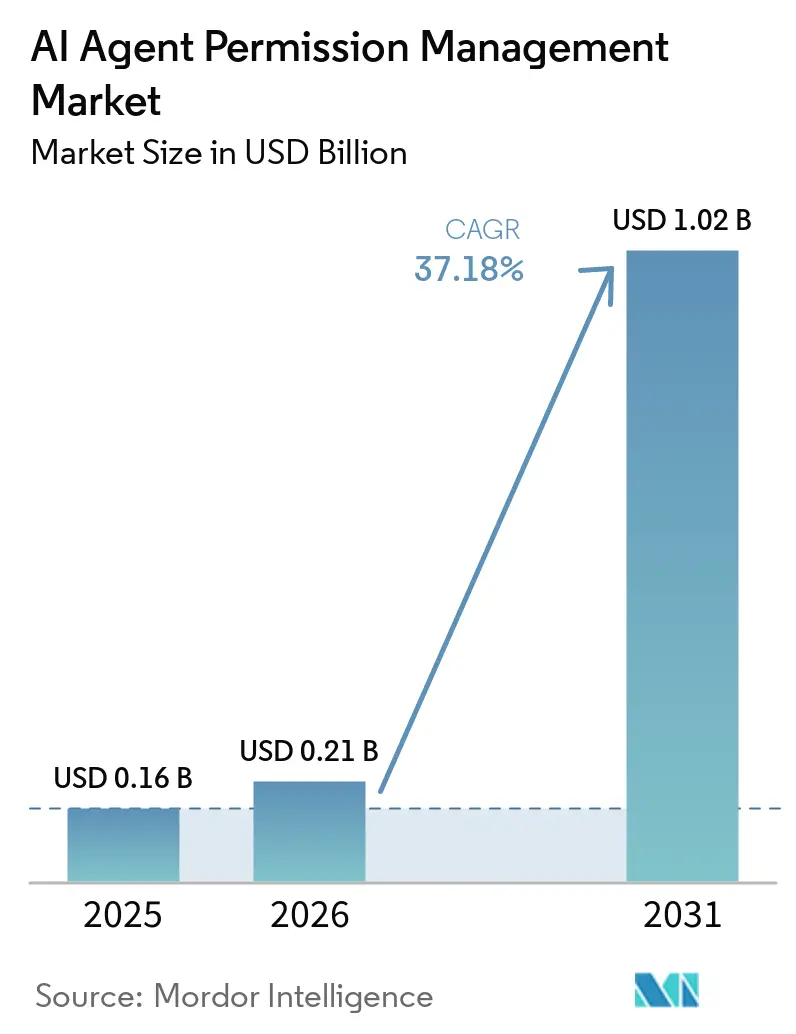
The AI agent permission management market size is projected to expand from USD 0.16 billion in 2025 and USD 0.21 billion in 2026 to USD 1.02 billion by 2031, registering a CAGR of 37.18% between 2026 to 2031. Demand is developing because enterprises are putting autonomous agents into live workflows faster than their security controls can define, grant, review, and withdraw access. The AI agent permission management market is therefore moving from a specialized identity security use case toward a core control for applications that act across tools, APIs, cloud platforms, and data stores. Regulatory attention is also moving procurement toward systems that can record agent activity, identify a responsible owner, and support human oversight. Vendors are responding by adding agent discovery, runtime authorization, and audit functions to existing identity platforms, while specialized providers focus on multi-agent workflows and protocol controls. This leaves room for platforms that can work with existing identity systems without forcing enterprises to replace them.
Key Report Takeaways
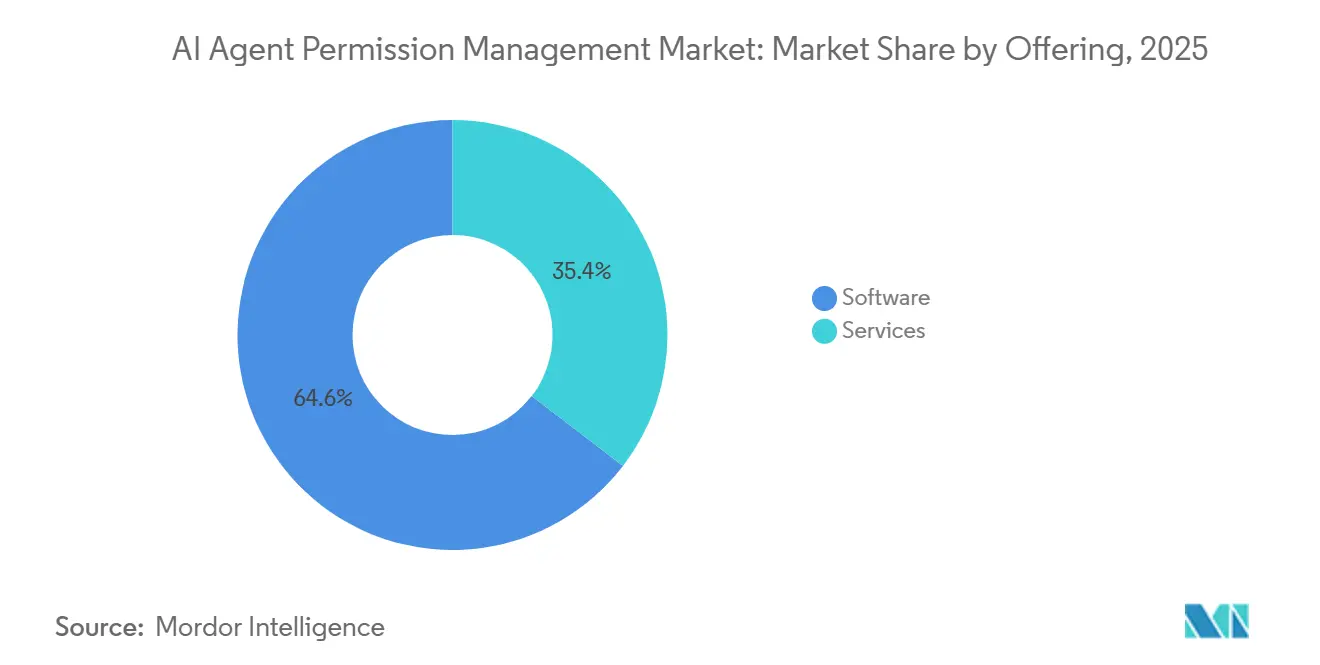
- By offering, software held 64.57% of the AI agent permission management market share in 2025, while services are projected to expand at a 42.78% CAGR through 2031.
- By deployment, cloud-based deployment accounted for 63.89% of the AI agent permission management market size in 2025, while hybrid deployment is projected to expand at a 43.56% CAGR through 2031.
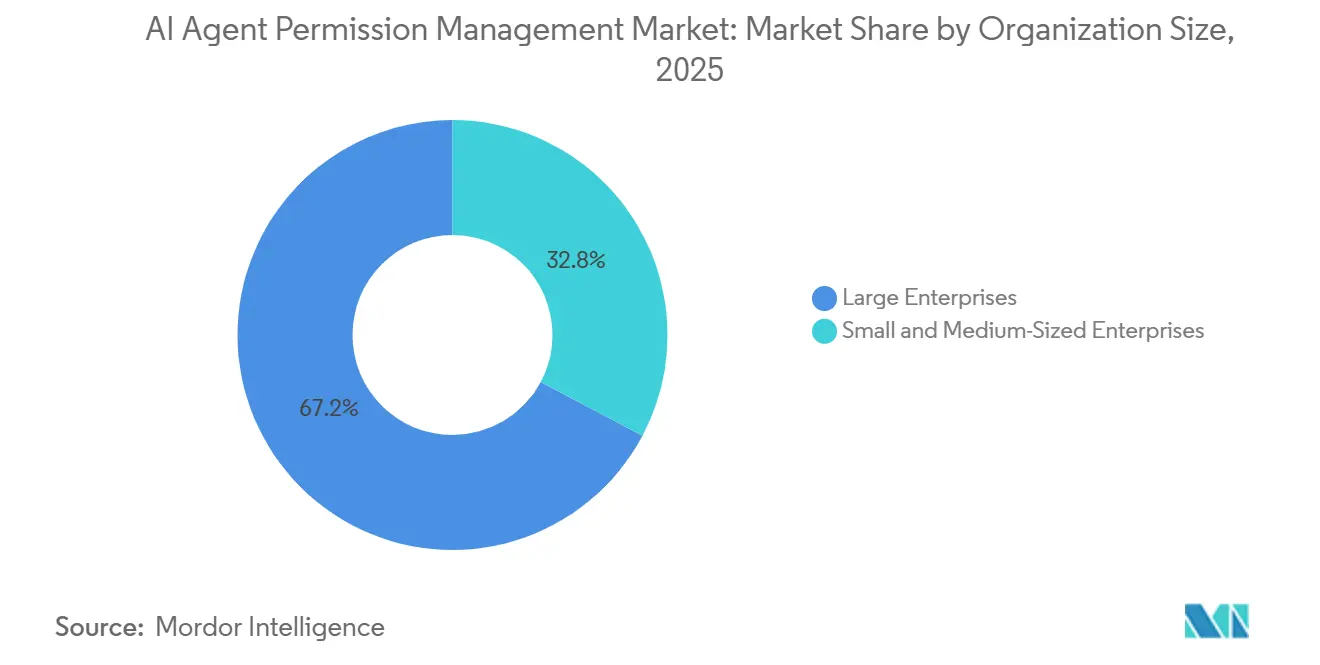
- By organization size, large enterprises held 67.23% of revenue in 2025, while SMEs are projected to expand at a 44.39% CAGR through 2031.
- By industry vertical, BFSI held 26.73% of revenue in 2025, while the energy and utilities industry is projected to expand at a 46.12% CAGR through 2031.
- By geography, North America held 36.26% of the AI agent permission management market share in 2025, while the Asia-Pacific is projected to expand at a 42.51% CAGR through 2031.
Note: Market size and forecast figures in this report are generated using Mordor Intelligence’s proprietary estimation framework, updated with the latest available data and insights as of January 2026.
Global AI Agent Permission Management Market Trends and Insights
Drivers Impact Analysis*
| DRIVER | (~) % IMPACT ON CAGR FORECAST | GEOGRAPHIC RELEVANCE | IMPACT TIMELINE |
|---|---|---|---|
| Enterprise Deployment of Autonomous AI Agents | +10.5% | Global | Short term (≤ 2 years) |
| Regulatory and Auditability Requirements | +8.2% | North America and EU | Short term (≤ 2 years) |
| Non-Human Identity and Least-Privilege Adoption | +6.8% | Global | Medium term (2-4 years) |
| Multi-Agent and Model Context Protocol Expansion | +5.1% | Global | Short term (≤ 2 years) |
| Cloud, SaaS, and API Access Complexity | +3.9% | Global | Medium term (2-4 years) |
| Cryptographic Agent Provenance and Delegated Authority | +2.8% | Global | Long term (≥ 4 years) |
| Source: Mordor Intelligence | |||
Enterprise Deployment of Autonomous AI Agents
Enterprise deployment of autonomous AI agents is the strongest demand driver for the AI agent permission management market. Gartner projected that 40% of enterprise applications would include task-specific AI agents by the end of 2026, compared with fewer than 5% in 2025. Each deployment creates an identity that needs registration, credential management, authorization, and activity records. One workflow can also create many short-lived sub-agents that need limited access to several applications at once. A January 2026 Cloud Security Alliance and Oasis Security survey of 383 security leaders found that 92% lacked confidence in their existing tools for AI and non-human identity risk, while 78% had no formal policy for creating or removing AI identities.[1]Cloud Security Alliance, “Non-Human Identity Governance for Agentic AI,” CSA Labs, cloudsecurityalliance.org. CyberArk reported in November 2025 that many enterprises were already using agentic AI in production without equivalent security controls, which supports demand for dedicated governance capabilities.
Regulatory and Auditability Requirements
Regulatory and auditability requirements are making agent permission controls a compliance matter rather than an optional security upgrade. The EU AI Act requires obligations around transparency, logging, governance, and human oversight for relevant AI systems.[2]European Commission, “Regulatory Framework on Artificial Intelligence,” European Commission Digital Strategy, europa.eu. The Digital Omnibus Regulation confirmed that Article 50 transparency obligations apply now, while Annex III high-risk obligations are scheduled for December 2, 2027. Financial firms also face closer attention to agent actions when those actions can influence transactions or decisions. FINRA's 2026 Annual Regulatory Oversight Report directs firms to retain suitable controls and supervision for emerging technology risks. ISO/IEC 42001 gives buyers a recognized management-system reference for ongoing AI governance, which increases the value of permission tools that generate evidence for reviews.
Non-Human Identity and Least-Privilege Adoption
Non-human identity governance is expanding the AI agent permission management market because agents create credentials during work rather than only at setup. The Cloud Security Alliance reported that more than 16% of organizations do not track the creation of non-human identity tokens. Static role assignments do not readily reflect an agent that changes tasks, calls new tools, or creates a sub-agent. This has increased interest in just-in-time access, which gives credentials only for the duration of a defined task. It has also increased demand for zero-standing-privilege controls that withdraw access when the task is complete. A 2025 academic paper on zero-trust identity for agentic AI identified the limits of conventional identity protocols when permissions must be fine-grained and dynamic.
Multi-Agent and Model Context Protocol Expansion
Multi-agent systems and Model Context Protocol use are broadening the systems that permission platforms must govern. The MCP Authorization Specification, finalized on June 18, 2025, set OAuth 2.1 as the base authorization standard for MCP-connected agents. OAuth 2.1 alone does not decide how access should be narrowed when one agent delegates work to another. The IETF is developing work on agent authorization and agent identity, including approaches to delegation and verifiable identity relationships. A workflow may involve an orchestrator, many specialized agents, and several data or application endpoints. The AI agent permission management market benefits when buyers need a clear record of each delegation step and a way to limit permissions at every step. This requirement favors platforms that can apply policies in real time across cloud, SaaS, and on-premises environments.
Restraints Impact Analysis*
| RESTRAINT | (~) % IMPACT ON CAGR FORECAST | GEOGRAPHIC RELEVANCE | IMPACT TIMELINE |
|---|---|---|---|
| Legacy IAM and Coarse-Grained Authorization | -3.8% | Global | Short term (≤ 2 years) |
| Fragmented Agentic-AI Protocol Standards | -2.6% | Global | Medium term (2-4 years) |
| Non-Deterministic Agent Intent and Execution Risk | -2.0% | Global | Long term (≥ 4 years) |
| Shortage of Agentic Security and Authorization Expertise | -1.4% | Global | Medium term (2-4 years) |
| Source: Mordor Intelligence | |||
Legacy IAM and Coarse-Grained Authorization
Legacy IAM systems constrain the AI agent permission management market because they were built for predictable human users and fixed service accounts. Role-based systems commonly give standing permissions to an identity before a task begins. AI agents can change their sequence of actions, invoke tools outside an initial path, or be redirected by a prompt injection attempt. Adding per-task credentials and runtime checks can require substantial work across identity, application, and security teams. Regulated organizations often need new controls to operate alongside their existing systems because they cannot quickly retire established access models. Research on agent identity has described the need for credentials tied to a specific reasoning episode, model version, policy limit, and ongoing runtime evidence.[3]Authors, “A Novel Zero-Trust Identity Framework for Agentic AI,” arXiv, arxiv.org.
Fragmented Agentic-AI Protocol Standards
Fragmented authorization standards can delay buying decisions in the AI agent permission management market. MCP provides a base authorization approach, but enterprise buyers still see separate drafts and models for identity, delegation, authorization envelopes, and framework-level controls. The IETF's active Agent Authorization Profile illustrates that standards work is still developing. A company using multiple agent frameworks can face separate authorization patterns and custom integration work. This issue is especially difficult for smaller buyers with limited security engineering resources. It can extend evaluation cycles even when leaders agree that stronger agent controls are needed.
*Our forecasts treat driver/restraint impacts as directional, not additive. The impact forecasts reflect baseline growth, mix effects, and variable interactions.
Segment Analysis
By Offering: Software Platforms Lead Current Spending, While Services Support Implementation
Software held 64.57% of revenue in 2025, establishing the largest portion of the AI agent permission management market size and giving security teams a common policy layer. Organizations first selected policy orchestration, agent discovery, and runtime authorization software because these tools provide the basic control layer. The AI agent permission management industry is following a familiar identity security buying pattern, where a platform is selected before services are used to configure and operate it. Software also provides a central place to define access rules across agents, tools, APIs, and data sources. It supports the records that security and compliance teams need for ongoing review.
Services are projected to grow at a 42.78% CAGR through 2031, making them the fastest-growing offering. This growth reflects the shortage of internal staff who can connect agent controls with legacy IAM, reporting systems, and several AI frameworks. Service work includes deploying the platform, defining permissions, testing policies, adjusting controls after an agent is in use, and broadening the reach of the AI agent permission management market into complex enterprise environments. Microsoft made Agent 365 generally available on May 1, 2026, with agent governance functions inside the Microsoft ecosystem. Organizations that need comparable controls across non-Microsoft systems still require integration work, which keeps services relevant to the AI agent permission management industry.


By Deployment: Cloud Holds the Largest Footprint, While Hybrid Supports Cross-Environment Control
Cloud deployment accounted for 63.89% of revenue in 2025 and led the AI agent permission management market share. Cloud deployment remains central to the AI agent permission management market because agent platforms, SaaS applications, and many of the tools used by agents are already hosted in cloud environments. Cloud-delivered authorization services can therefore be connected with initial deployments without extensive local infrastructure. This model also supports centralized policy updates and activity records across distributed teams.
Hybrid deployment is projected to grow at a 43.56% CAGR through 2031. Hybrid adoption expands the AI agent permission management market, where enterprises must connect cloud systems with on-premises data or applications. They need consistent controls, even when data residency rules limit where credentials or policy decisions can be processed. On-premises deployment remains relevant for defense, intelligence, and critical infrastructure settings with restricted networks. IEC 62351-8:2026 covers role-based access control for human users, automated agents, and software applications in power systems.[4]International Electrotechnical Commission, “IEC 62351-8:2026 Role-Based Access Control for Power Systems,” IEC, iec.ch. These requirements increase the importance of deployment models that can apply the same policy across information technology and operational technology environments.
By Organization Size: Large Enterprises Hold Current Demand, While SMEs Accelerate Adoption
Large enterprises held 67.23% of revenue in 2025, representing the largest organization-size position in the AI agent permission management market. They adopted AI platforms earlier, had more mature IAM investments, and faced greater compliance exposure in regulated activities. Larger companies can also fund initial integrations across security, data, and application teams. These factors allow them to put agent identity programs in place before smaller organizations. Their requirements continue to support demand for broad governance platforms with detailed controls and reporting.
SMEs are projected to grow at a 44.39% CAGR through 2031. AI capabilities are being built into tools that smaller organizations already use, including productivity, customer relationship management, and collaboration platforms. Simpler deployment tools and API-first authorization platforms can reduce the burden for these organizations. The AI agent permission management market can expand beyond large enterprises as vendors package controls in accessible services and platform integrations. This pattern points to wider adoption rather than a transfer of revenue from large companies.
By Industry Vertical: BFSI Leads Through Compliance Needs, While Energy and Utilities Grow Fastest
BFSI held 26.73% of revenue in 2025, giving it the largest vertical position in the AI agent permission management market. Financial institutions use agents for fraud detection, compliance monitoring, and algorithmic decision support, where access decisions can have significant operational effects. Their operating environment includes obligations related to resilience, privacy, payment controls, and regulatory supervision. FINRA has emphasized supervision and controls for technology-related risks within member firms.[5]Financial Industry Regulatory Authority, “2026 Annual Regulatory Oversight Report,” FINRA, finra.org. Permission governance helps firms identify the agent, responsible owner, authority level, and activity history for sensitive workflows.
Energy and utilities are projected to grow at a 46.12% CAGR through 2031. This growth extends the AI agent permission management market into operational technology settings. Agents are being used for grid optimization, predictive maintenance, and distributed energy resource management, often connecting with operational technology and requiring narrowly scoped permissions and reliable activity records. NERC CIP-003-9 became effective on April 1, 2026, and CIP-012-2 became effective on July 1, 2026, reinforcing access and cybersecurity expectations for bulk electric system environments. Healthcare and life sciences, IT and telecommunications, and government also remain relevant verticals where agent controls must support sensitive data and critical services.
Geography Analysis
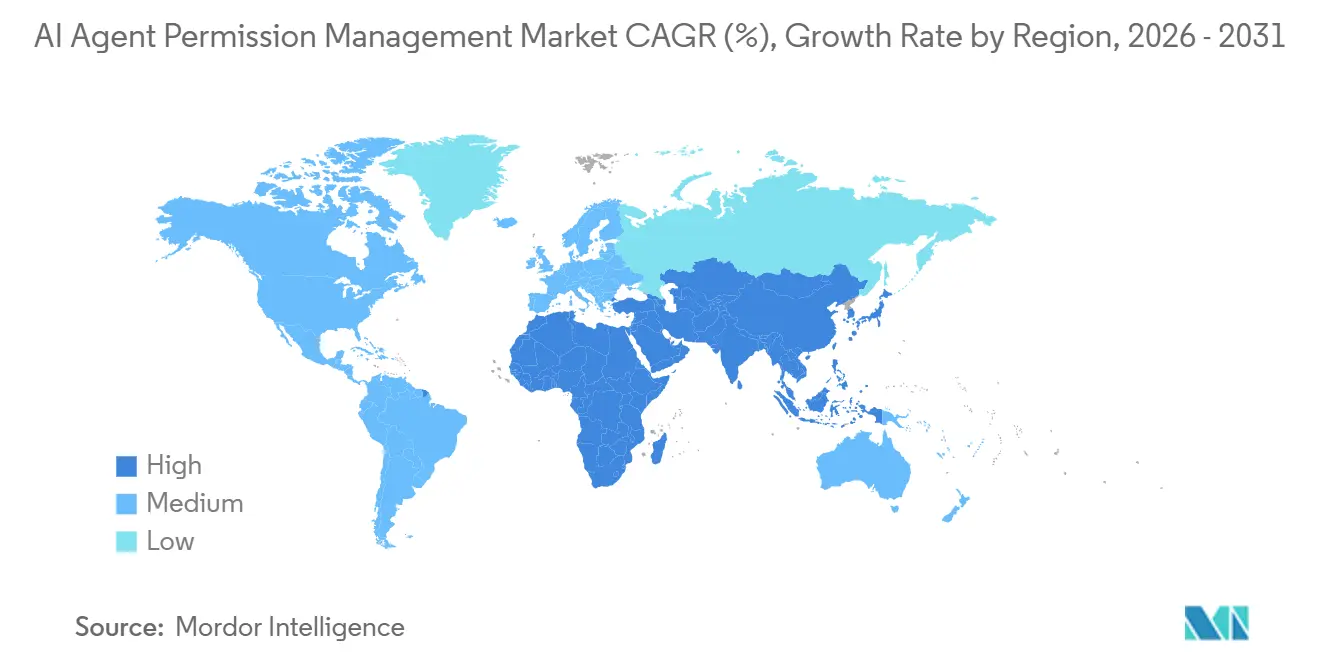
North America accounted for 36.26% of revenue in 2025 and held the largest regional position in the AI agent permission management market. The United States combines enterprise AI spending with mature cloud security practices and active regulatory attention. The OCC stated in its Spring 2026 Semiannual Risk Perspective that AI is changing the cyber threat environment for banks.[6]Office of the Comptroller of the Currency, “Spring 2026 Semiannual Risk Perspective,” OCC, occ.gov. FINRA's 2026 oversight report also supports closer scrutiny of technology controls in financial services. NIST launched its AI Agent Standards Initiative in February 2026 to support interoperable and secure agent systems.
Europe is the second-largest region in the AI agent permission management market, supported by the combined compliance effect of the EU AI Act, GDPR, DORA, and NIS2. The EU AI Act provides a common policy framework for AI governance across member states. These requirements support a single-platform sale when vendors can address access controls, activity records, and oversight needs collectively. Asia-Pacific is projected to grow at a 42.51% CAGR through 2031, the highest regional rate, with China, Japan, India, and South Korea supporting demand through manufacturing, software services, financial services, and electronics. Japan's manufacturing use cases and India's enterprise services deployments increase the need to control access across changing agent workflows.
South America, the Middle East, and Africa remain earlier-stage regions within the AI agent permission management market. Brazil's privacy framework establishes access controls and data minimization requirements for AI-related activities. Financial institutions in Brazil and Argentina are adopting AI as part of existing enterprise technology programs. Saudi Arabia and the UAE are increasing enterprise AI deployment across banking, government, and critical infrastructure, which can create demand for imported platforms, even as local governance practices are still developing.

Competitive Landscape
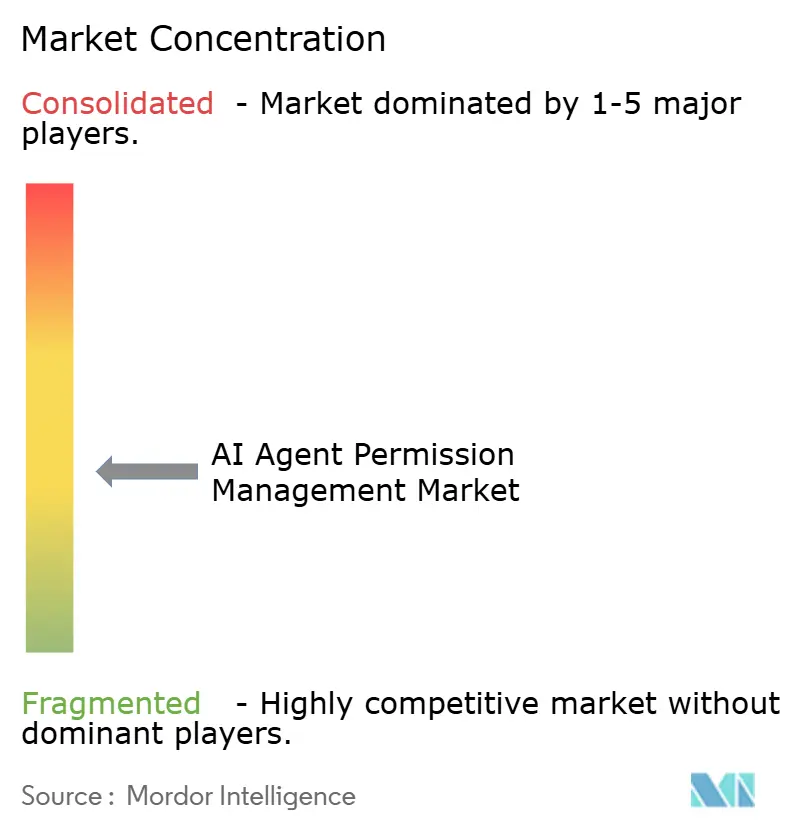
The AI agent permission management market is moderately fragmented, with established identity security providers and specialized vendors competing for enterprise deployments. Large incumbents can add agent controls to existing platforms and use established customer relationships to shorten procurement discussions. Specialized providers compete through non-human identity management, agent-specific access control, MCP governance, and faster alignment with new protocols.
Competition increasingly centers on discovery, runtime enforcement, and a clear record of the authorization chain. Vendors are combining discovery and enforcement rather than offering separate products for each task. They are also using access recommendations to help customers reduce excessive privileges. Veza introduced Native Access Agents and its Enterprise Agent Identity Control Plane on February 25, 2026, extending its access graph approach to AI agent identities. Okta made Okta for AI Agents generally available on April 30, 2026, adding agent registration, credential management, access controls, and governance workflows. These moves show that vendors are seeking to make agents manageable as formal enterprise identities.
CrowdStrike announced Continuous Identity for AI Agents in June 2026, applying real-time authorization decisions to agent actions. Zscaler introduced AI Broker, AI Access Graph, and Endpoint AI Security in June 2026 to extend zero-trust controls to agent communication and data access. Open space remains in energy, manufacturing, and transportation, where permissions must work across information technology and operational technology. Multi-agent delegation also remains a developing area because customers need reliable tools to reduce authority across several handoffs. Alignment with MCP and IETF authorization work can help vendors show that their platforms will remain compatible as standards mature.
AI Agent Permission Management Industry Leaders
Microsoft Corporation
Okta, Inc.
Palo Alto Networks, Inc.
CrowdStrike Holdings, Inc.
CyberArk Software Ltd.
- *Disclaimer: Major Players sorted in no particular order

Recent Industry Developments
- June 2026: CrowdStrike announced Continuous Identity for AI Agents at Identiverse 2026, powered by capabilities from the company's acquisition of SGNL. The solution introduces dynamic, real-time authorization for every agent action, evaluating requests against the identity of the agent owner, the calling identity, and live device risk posture signals from the Falcon platform, replacing static policy models with continuously evaluated and revocable access decisions.
- June 2026: Zscaler unveiled new product innovations to extend the Zscaler Zero Trust Exchange platform to AI agents, introducing AI Broker, an inline enforcement layer for MCP and agent-to-agent communications with an integrated Agent Registry, AI Access Graph, powered by the Symmetry Systems acquisition and mapping identity-to-AI-application-to-data lineage in real time, and Endpoint AI Security, collectively positioned as the industry's first complete zero-trust platform for agentic AI.
- June 2026: Noma launched Noma Agent Access Control on June 2, a governance and enforcement layer for AI agents and MCP servers. The platform assigns distinct identities to each agent, maintains a live registry with governance states of approved, requires review, or blocked, enforces tool-level policies at the moment of connection, and integrates with Noma AI Detection and Response for real-time comparison of permitted against actual agent behavior.
- May 2026: Microsoft made Agent 365 generally available on May 1, 2026, as part of Microsoft 365 E7, priced at USD 99 per user per month. Agent 365 serves as the unified control plane for AI agents within the Microsoft ecosystem, assigning formal Microsoft Entra identities to agents, managing agent permissions and lifecycle, providing audit-ready visibility into agent activity, and extending observability to agents operating with their own credentials and permissions.


Global AI Agent Permission Management Market Report Scope
The AI agent permission management market includes identity governance and access control solutions that define, enforce, and audit permissions for autonomous AI agents operating across enterprise systems, applications, and data sources. These platforms provide capabilities such as agent identity provisioning, least-privilege policy definition, just-in-time access grants, session-based permission scoping, and continuous monitoring of agent actions against authorized boundaries, enabling organizations to prevent unauthorized data access, limit blast radius from compromised or misconfigured agents, and maintain compliance with regulatory frameworks by ensuring that AI agents can only execute approved actions on specific resources within defined temporal and contextual constraints.
The AI Agent Permission Management Market Report is Segmented by Offering (Software, and Services), Deployment (Cloud, On-Premises, and Hybrid), Organization Size (Large Enterprises, and Small and Medium-Sized Enterprises), Industry Vertical (Government and Public Administration, Industrial Manufacturing, Retail and E-Commerce, Transportation and Logistics, Energy and Utilities, Oil and Gas, IT and Telecommunication, Media and Entertainment, Education and Research Institutions, Healthcare and Life Sciences, Banking, Financial Services, and Insurance (BFSI), and Other Industry Verticals), and Geography (North America, South America, Europe, Asia-Pacific, and Middle East and Africa). The Market Forecasts are Provided in Terms of Value (USD).
| Software |
| Services |
| Cloud |
| On-Premises |
| Hybrid |
| Large Enterprises |
| Small and Medium-Sized Enterprises |
| Government and Public Administration |
| Industrial Manufacturing |
| Retail and E-Commerce |
| Transportation and Logistics |
| Energy and Utilities |
| Oil and Gas |
| IT and Telecommunication |
| Media and Entertainment |
| Education and Research Institutions |
| Healthcare and Life Sciences |
| Banking, Financial Services, and Insurance (BFSI) |
| Other Industry Verticals |
| North America | United States | |
| Canada | ||
| Mexico | ||
| South America | Brazil | |
| Argentina | ||
| Rest of South America | ||
| Europe | Germany | |
| United Kingdom | ||
| France | ||
| Italy | ||
| BENELUX | ||
| Rest of Europe | ||
| Asia-Pacific | China | |
| Japan | ||
| India | ||
| South Korea | ||
| Australia | ||
| Rest of Asia-Pacific | ||
| Middle East and Africa | Middle East | United Arab Emirates |
| Saudi Arabia | ||
| Rest of Middle East | ||
| Africa | South Africa | |
| Nigeria | ||
| Egypt | ||
| Rest of Africa | ||
| By Offering | Software | ||
| Services | |||
| By Deployment | Cloud | ||
| On-Premises | |||
| Hybrid | |||
| By Organization Size | Large Enterprises | ||
| Small and Medium-Sized Enterprises | |||
| By Industry Vertical | Government and Public Administration | ||
| Industrial Manufacturing | |||
| Retail and E-Commerce | |||
| Transportation and Logistics | |||
| Energy and Utilities | |||
| Oil and Gas | |||
| IT and Telecommunication | |||
| Media and Entertainment | |||
| Education and Research Institutions | |||
| Healthcare and Life Sciences | |||
| Banking, Financial Services, and Insurance (BFSI) | |||
| Other Industry Verticals | |||
| By Geography | North America | United States | |
| Canada | |||
| Mexico | |||
| South America | Brazil | ||
| Argentina | |||
| Rest of South America | |||
| Europe | Germany | ||
| United Kingdom | |||
| France | |||
| Italy | |||
| BENELUX | |||
| Rest of Europe | |||
| Asia-Pacific | China | ||
| Japan | |||
| India | |||
| South Korea | |||
| Australia | |||
| Rest of Asia-Pacific | |||
| Middle East and Africa | Middle East | United Arab Emirates | |
| Saudi Arabia | |||
| Rest of Middle East | |||
| Africa | South Africa | ||
| Nigeria | |||
| Egypt | |||
| Rest of Africa | |||


Key Questions Answered in the Report
What is the AI agent permission management market size?
The AI agent permission management market size is projected to expand from USD 0.16 billion in 2025 and USD 0.21 billion in 2026 to USD 1.02 billion by 2031, registering a CAGR of 37.18% between 2026 to 2031.
What is driving demand for AI agent permission management?
Enterprises need tools to register agent identities, limit access, monitor actions, and maintain records as agents move into production workflows.
Which offering leads AI agent permission management spending?
Software led with 64.57% of revenue in 2025 because buyers prioritized policy orchestration, discovery, and runtime authorization capabilities.
Which deployment model is growing the fastest?
Hybrid deployment is projected to grow at a 43.56% CAGR through 2031 as organizations need consistent controls across cloud and on-premises systems.
Which end-user sector has the highest growth rate?
Energy and utilities is projected to grow at a 46.12% CAGR through 2031, supported by agent use in grid optimization and operational environments.
Which region is growing fastest for agent permission controls?
Asia-Pacific is projected to grow at a 42.51% CAGR through 2031, supported by demand in China, Japan, India, and South Korea.
Page last updated on:





