

Algeria Agriculture Market Analysis by Mordor Intelligence
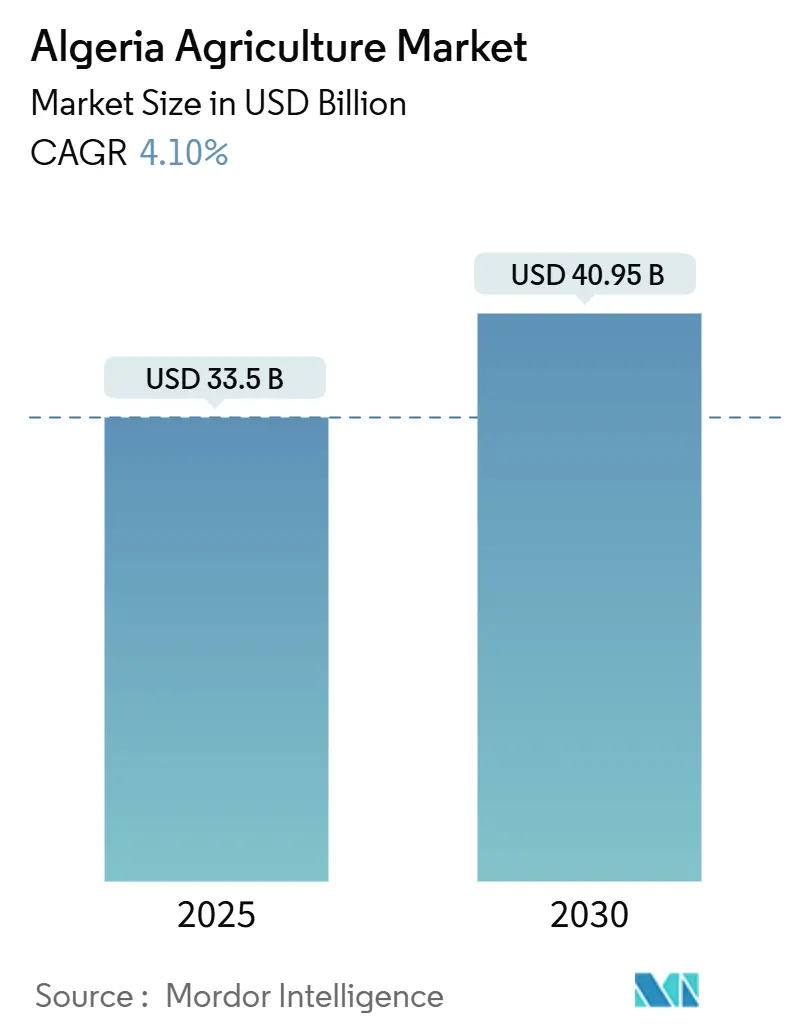
The Algeria agriculture market size is valued at USD 33.50 billion in 2025 and is forecast to reach USD 40.95 billion by 2030, advancing at a 4.1% CAGR during the period. Government investment in desalination, irrigation, and greenhouse infrastructure is stimulating capital flows, while foreign partners from Qatar and Italy are injecting large-scale project finance that accelerates mechanization, logistics modernization, and export capacity. Precision irrigation, solar-powered cold chains, and agri-fintech lending platforms are reshaping production economics in cereals, horticulture, and dairy. Competitive dynamics favor vertically integrated operators that adopt technology early, creating higher barriers for traditional smallholder models. Structural challenges, in particular water-table salinization, fragmented land titles, and volatile fertilizer costs, temper growth but are partially offset by policy support and climate-smart initiatives.
Key Report Takeaways
- By crop type, grains and cereals led with 58.2% of Algeria agriculture market share in 2024. Fruits and vegetables recorded the fastest projected 6.9% CAGR through 2030.
Algeria Agriculture Market Trends and Insights
Drivers Impact Analysis
| Driver | (~) % Impact on CAGR Forecast | Geographic Relevance | Impact Timeline |
|---|---|---|---|
| Rise in drip-irrigation installations | +0.8% | National, with concentration in Saharan regions | Medium term (2-4 years) |
| Government subsidies for cereal intensification | +0.6% | National, focused on northern plains and Saharan expansion zones | Short term (≤ 2 years) |
| Adoption of solar-powered cold-chain units | +0.4% | Southern Algeria and remote agricultural areas | Medium term (2-4 years) |
| Expansion of greenhouse clusters | +0.5% | Coastal regions and peri-urban areas | Long term (≥ 4 years) |
| Growth of agri-fintech lending platforms | +0.3% | National, with higher penetration in developed regions | Long term (≥ 4 years) |
| FAO-led climate-smart pilot programs | +0.2% | Targeted regions including Mitidja Plain and oasis systems | Long term (≥ 4 years) |
| Source: Mordor Intelligence | |||
Rise in Drip-Irrigation Installations
Drip systems now cover more than 100,000 hectares and lift water-use efficiency by 30-40% relative to flood methods[1]Source: FAO, “Crop Mapping Data Collection Missions in Algeria,” fao.org. Government subsidies covering up to 70% of installation costs have democratized access to precision irrigation, particularly benefiting smallholder farmers who previously lacked capital for such investments. Solar pumps linked to these systems remove grid constraints in Saharan farms, positioning the Algeria agriculture market to bring an additional 1 million hectares under cultivation. This technological convergence positions Algeria to expand cultivated area by one million hectares, as outlined in government development plans.
Government Subsidies for Cereal Intensification
Subsidized seed, fertilizer, and guaranteed purchase pricing span over 3 million hectares, raising domestic wheat supply to cover 80% of 2024 demand. Partnerships with Qatar’s Baladna and Italian investors funnel capital and technology into southern desert zones, further reducing import reliance and adding 5,000 direct jobs. The subsidy framework extends beyond input costs to include guaranteed purchase prices, providing farmers with production certainty that encourages investment in improved varieties and cultivation techniques. Strategic partnerships with Qatar and Italy complement domestic production efforts.
Adoption of Solar-Powered Cold-Chain Units
The technology addresses critical infrastructure gaps that previously resulted in 20-30% post-harvest losses, directly impacting farmer profitability and food security outcomes. Integration with photovoltaic systems provides energy independence while reducing operational costs compared to diesel-powered alternatives, with levelized costs significantly lower than conventional cooling solutions. Government initiatives promote cold-chain adoption through targeted subsidies and technical assistance programs, recognizing refrigeration as essential infrastructure for agricultural modernization. The expansion of solar-powered cold storage facilities enables Algeria to develop export-oriented horticulture, particularly for European markets where quality standards demand consistent temperature control throughout the supply chain.
Expansion of Greenhouse Clusters
Single-tunnel and evolving multispan structures generate 3-4 crop cycles yearly, doubling land productivity and cutting water use via controlled climates[2]Source: Acta Horticulturae, “Prospects of Hydroponics and Protected Cultivation,” actahort.org. Protected cultivation is expanding rapidly across Algeria's Mediterranean coastal regions and peri-urban areas, with greenhouse technology adoption driven by water scarcity mitigation and year-round production capabilities. The integration of renewable energy systems with greenhouse operations creates sustainable production models that align with Algeria's climate commitments while reducing operational costs for energy-intensive controlled environment agriculture.
Restraints Impact Analysis
| Restraint | (~) % Impact on CAGR Forecast | Geographic Relevance | Impact Timeline |
|---|---|---|---|
| Water-table salinization | -0.7% | Coastal regions and intensive irrigation zones | Long term (≥ 4 years) |
| Fragmented land titles | -0.5% | National, particularly affecting smallholder areas | Long term (≥ 4 years) |
| Post-harvest logistics bottlenecks | -0.4% | Rural-urban corridors and export routes | Medium term (2-4 years) |
| Volatile fertilizer import prices | -0.6% | National, with higher impact on intensive farming systems | Short term (≤ 2 years) |
| Source: Mordor Intelligence | |||
Water-Table Salinization
Soil salinization affects 10-15% of Algeria's irrigated agricultural areas, with projections indicating worsening conditions due to intensive irrigation practices and climate change impacts on groundwater quality. The challenge is particularly acute in coastal regions where seawater intrusion combines with poor drainage to create increasingly saline conditions that reduce crop yields and limit suitable crop varieties. Date palm groves in southern Algeria show significant spatial variability in salinity levels, with electrical conductivity measurements revealing concentrated salt accumulation that threatens long-term agricultural sustainability. Advanced irrigation scheduling and soil monitoring technologies offer partial solutions, but widespread adoption requires technical training and financial support that current extension services struggle to provide at scale.
Fragmented Land Titles
Average plot sizes below five hectares limit mechanization economies, while unclear tenure discourages long-term soil and irrigation investment[3]Source: World Bank, “Land Policies for Growth and Poverty Reduction,” worldbank.org. The Office national des terres agricoles is mobilizing 122,000 hectares of state-owned land for private investors, though this approach primarily benefits larger operators rather than addressing smallholder fragmentation issues. Resolution requires comprehensive land reform that balances social equity with economic efficiency, a politically sensitive process that extends beyond the current forecast timeline.
Segment Analysis
By Crop Type: Cereals Drive Volume While Horticulture Captures Value
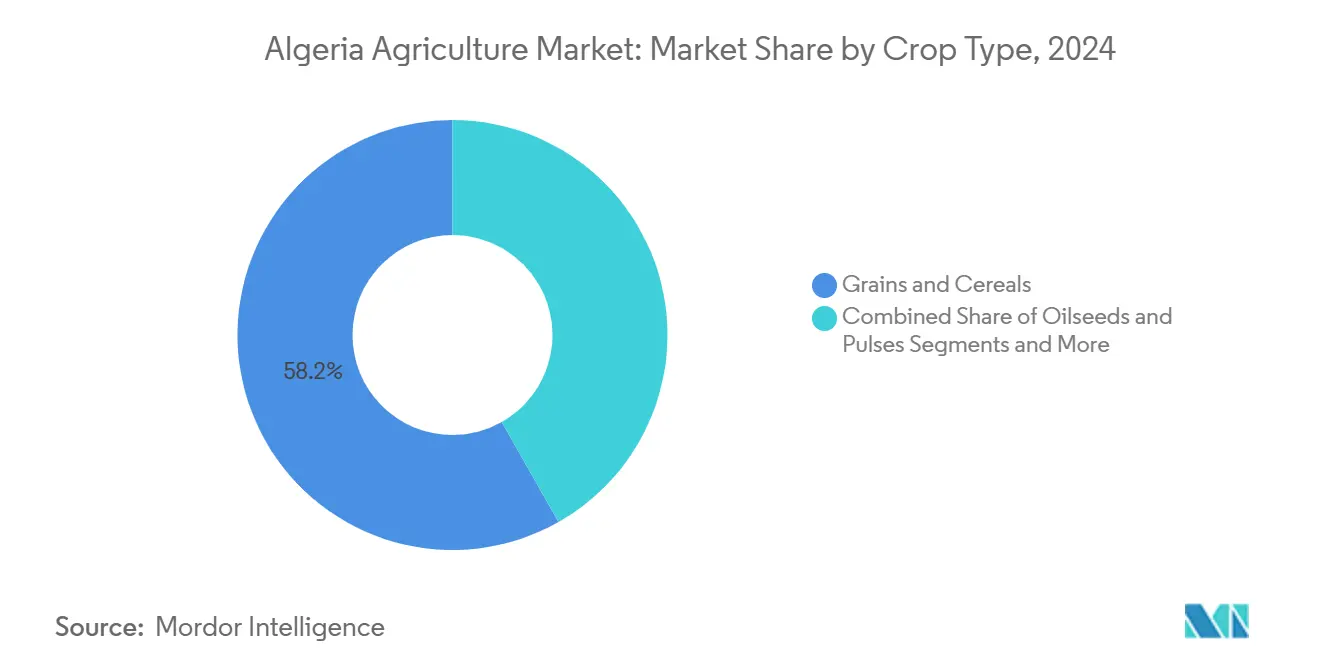
Grains and cereals accounted for 58.2% of Algeria agriculture market share in 2024, anchored by 3 million hectares of wheat and barley supported through guaranteed pricing schemes. Subsidy certainty and desert irrigation expansion raise yields and reduce imports. Fruits and vegetables, supported by greenhouse clusters and solar cold chains, record the strongest 6.9% CAGR forecast to 2030, fueling export revenue diversification.
Oilseeds and pulses represent a smaller yet strategic slice of Algeria agriculture market size as policy pushes protein self-reliance and edible-oil security. Cash crops such as cotton and tobacco remain niche due to water limits and stronger returns from greenhouse tomatoes or citrus. Forage and fodder demand grow in tandem with Baladna’s USD 3.5 billion integrated dairy, driving alfalfa and maize silage acreage in desert concessions, signaling increasing vertical integration within the Algeria agriculture market.
Note: Segment shares of all individual segments available upon report purchase
Get Detailed Market Forecasts at the Most Granular Levels
Download PDF
Geography Analysis
Northern coastal plains, led by the Mitidja region, capitalize on proximity to ports and established irrigation grids. FAO’s WaPOR mapping equips growers with zonal water-efficiency dashboards, unlocking precision fertilization gains. The northern coastal plains and Mitidja region maintain their position as primary production zones, benefiting from favorable climate conditions and established infrastructure that supports both domestic food production and export-oriented horticulture.
Southern Saharan territories, historically marginal, now attract landmark capital, Qatar’s 170,000-hectare dairy and Italy’s 36,000-hectare regenerative project. These developments leverage underground water resources and advanced irrigation technology to establish commercial agriculture in previously marginal lands, supported by government infrastructure investments, including transportation networks and processing facilities. The Office de développement de l'agriculture industrielle en terres sahariennes coordinates strategic crop development across multiple southern regions, focusing on high-value crops that justify the substantial infrastructure investments required for desert agriculture.
Central highlands serve as synthesis zones where mixed cereals and orchard systems integrate new agri-fintech credit models, helping medium farms migrate from rain-fed to partial drip irrigation. Transport corridors under construction promise to shorten farm-to-port delivery, reinforcing competitive advantages for diversified supply chains within the Algeria agriculture industry. Regional specialization is emerging, with coastal areas concentrating on fresh produce and export crops while interior regions develop grain production and livestock operations that benefit from land availability and lower operational costs.
Recent Industry Developments
- January 2025: The Algerian government announced the mobilization of 122,000 hectares of state-owned agricultural land for private investors across, aimed at improving food security and self-sufficiency in strategic products. The initiative led by the Office national des terres agricoles represents a significant expansion of commercial agriculture development.
- May 2024: FAO launched crop mapping in the Mitidja Plain to refine water-use metrics across 100,000 hectares.
- May 2024: Algeria initiated its third general agricultural census to strengthen food security by developing targeted agricultural policies. The census provides essential data for government agencies, businesses, researchers, and international organizations focused on sustainable development.
Algeria Agriculture Market Report Scope
Agriculture plays a crucial role in Algeria's economy and provides livelihoods by cultivating cereals like wheat and barley, fruits such as citrus and dates, olives, and vegetables. The Algerian Agriculture Market is Segmented by Crop Type into Food Crops/Cereals, Fruits, and Vegetables. The report includes the Production Analysis (Volume), Consumption Analysis (Value and Volume), Export Analysis (Value and Volume), Import Analysis (Value and Volume), and Price Trend Analysis for the market. The report offers market sizes and forecasts in terms of value (USD) and volume (metric tons) for the above segments.
By Crop Type (Production Analysis (Volume), Consumption Analysis (Volume and Value), Import Analysis (Volume and Value), Export Analysis (Volume and Value), and Price Trend Analysis)
| Grains and Cereals |
| Oilseeds and Pulses |
| Fruits and Vegetables |
| Forage and Fodder Crops |
| Cash Crops |
| By Crop Type (Production Analysis (Volume), Consumption Analysis (Volume and Value), Import Analysis (Volume and Value), Export Analysis (Volume and Value), and Price Trend Analysis) | Grains and Cereals |
| Oilseeds and Pulses | |
| Fruits and Vegetables | |
| Forage and Fodder Crops | |
| Cash Crops |
Need A Different Region or Segment?
Customize Now
Key Questions Answered in the Report
What is the current value of the Algeria agriculture market?
The Algeria agriculture market size stands at USD 33.50 billion in 2025.
How fast is agricultural value growing in Algeria?
Value is projected to rise at a 4.1% CAGR, reaching USD 40.95 billion by 2030.
Which crop category leads Algerian farming?
Grains and cereals hold 58.2% market share due to government wheat and barley programs.
What infrastructure projects support farm expansion?
USD 5.4 billion in desalination, solar-powered cold chains, and precision irrigation networks underpin capacity growth.
How is technology reducing post-harvest losses?
Solar-powered cold rooms cut perishables spoilage from 30% to under 10%, boosting farmer incomes and export quality.
Page last updated on:

