
Market Overview
| Study Period | 2021 - 2031 |
|---|---|
| Forecast Data Period | 2026 - 2031 |
| Base Year Market Size (2025) | USD 177.16 Million |
| Market Size (2026) | USD 184.60 Million |
| Market Size (2031) | USD 226.76 Million |
| Growth Rate (2026 - 2031) | 4.20 % |
| Market Concentration | Medium |
Major Players *Disclaimer: Major Players sorted in no particular order Image © Mordor Intelligence. Reuse requires attribution under CC BY 4.0. | |
Sudan Alfalfa Market Analysis by Mordor Intelligence
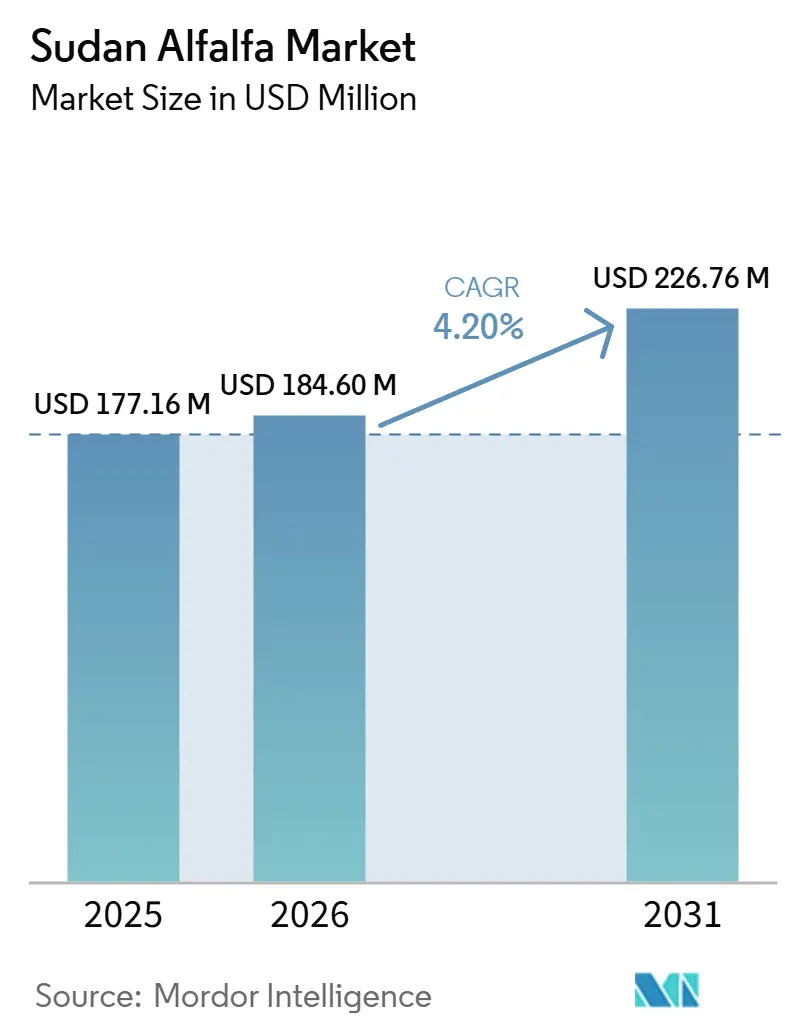
The Sudan alfalfa market was valued at USD 177.16 million in 2025 and is estimated to grow from USD 184.60 million in 2026 to USD 226.76 million by 2031, at a CAGR of 4.20% during the forecast period 2026–2031. The market remains concentrated in the River Nile, Khartoum, and Northern States, where mechanized cultivation and irrigated production define the primary supply base, with nearly 130,000 acres under production according to the 2026 Agricultural Research Corporation of Sudan report. Demand for high-protein forage in dairy and fattening operations continues to support the market, while export demand from Gulf buyers is shifting the product mix toward more standardized formats such as pellets and cubes. Farm activity concentrated in the safer northern corridors has helped preserve part of the forage base, even as broader crop systems have been significantly disrupted. Water access remains the primary structural constraint for the market, as irrigation reliability determines cutting frequency, operational continuity, and the ability to maintain export-grade quality. Competition in the market favors companies that can combine sourcing scale, regulatory compliance, post-harvest processing, and stable logistics to Gulf markets, giving larger forage traders an advantage over fragmented local suppliers.
Key Report Takeaways
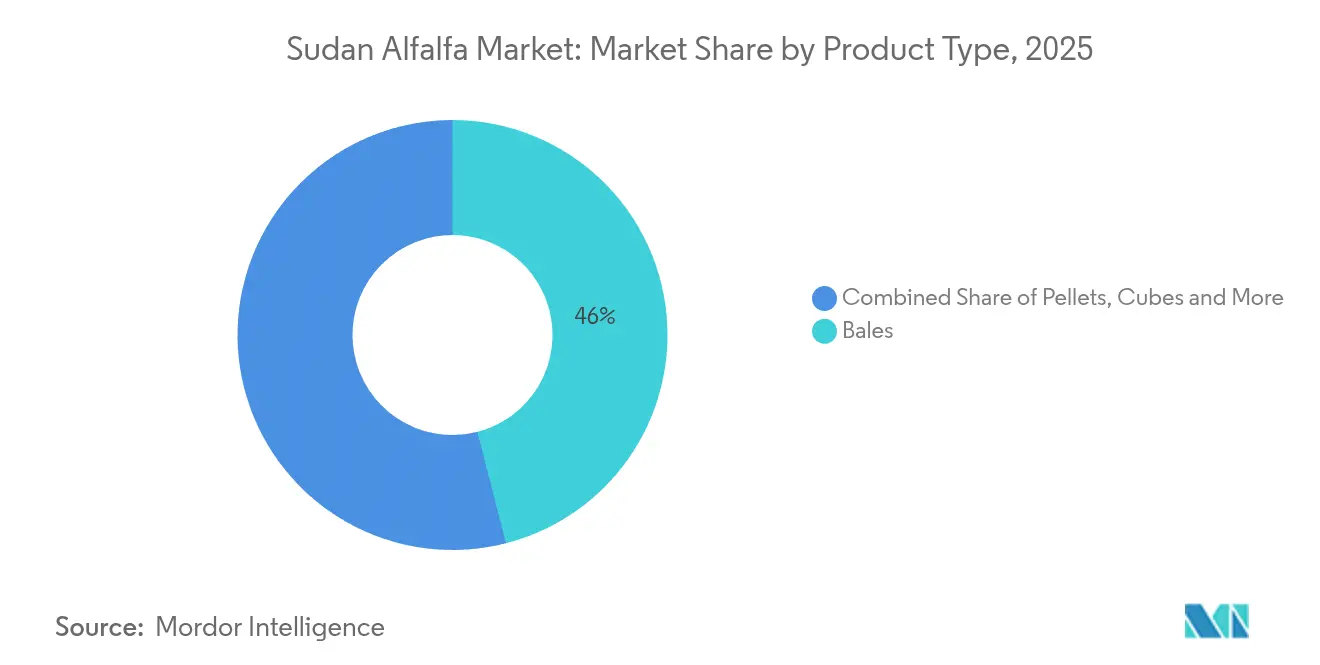
- By product type, bales accounted for 46.0% of the market share of the Sudan alfalfa market size in 2025, while pellets recorded the highest projected CAGR at 6.8% between 2026 and 2031.
- By application, dairy cattle feed held 34.0% share of the market in 2025, while equine feed recorded the fastest CAGR at 6.1% between 2026 and 2031.
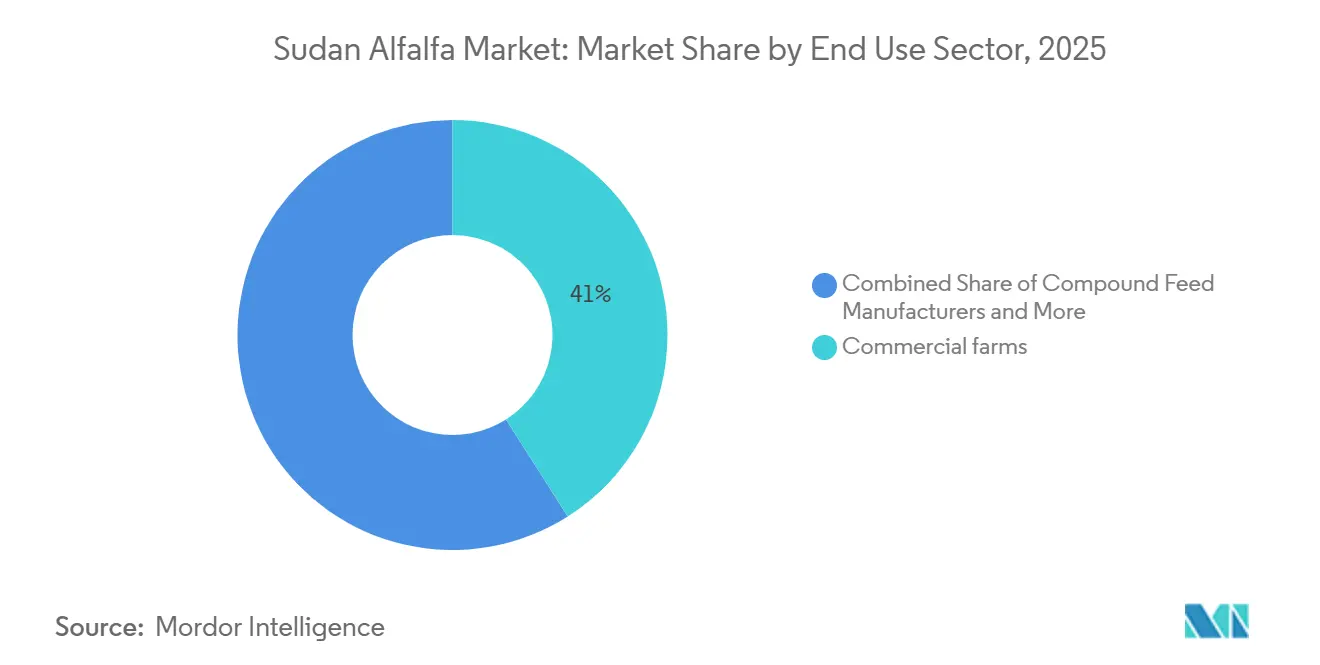
- By end use sector, commercial farms held 41.0% of the Sudan alfalfa market size in 2025, while pet food and specialty nutrition advanced at the highest CAGR of 5.9% between 2026 and 2031.
Note: Market size and forecast figures in this report are generated using Mordor Intelligence’s proprietary estimation framework, updated with the latest available data and insights as of 2026.
Sudan Alfalfa Market Trends and Insights
Drivers Impact Analysis*
| Driver | (~) % Impact on CAGR Forecast | Geographic Relevance | Impact Timeline |
|---|---|---|---|
| Expansion of irrigated alfalfa production in river Nile and Gezira schemes | +1.2% | River Nile State, Gezira, Northern States | Medium term (2-4 years) |
| Export demand from gulf livestock buyers through port Sudan linked supply chains | +1.1% | National, concentrated at Red Sea State and Port Sudan | Short term (≤ 2 years) |
| Rising need for high-protein feed in Sudan’s dairy and fattening operations | +0.9% | National, strongest pull in Khartoum, River Nile, and Gezira corridors | Medium term (2-4 years) |
| Farmer shift toward higher margin forage crops on limited irrigated land | +0.7% | River Nile, Northern States, Kassala | Medium term (2-4 years) |
| Improved acceptance of certified seed and heat-tolerant alfalfa varieties | +0.5% | National, early gains in mechanized pivot irrigation zones | Long term (≥ 4 years) |
| Rotation value of alfalfa in mechanized farms for soil restoration and nitrogen fixation | +0.4% | Gezira scheme, mechanized farming belts in Gedaref and Kassala | Long term (≥ 4 years) |
| Source: Mordor Intelligence | |||
Expansion of Irrigated Alfalfa Production in River Nile and Gezira Schemes
Sudan's irrigated agricultural system remains central to the alfalfa market, as irrigated forage offers the strongest commercial productivity in the country. Mechanized farms in River Nile and Northern States benefit from center-pivot irrigation and well-based water supply, which support more stable output than surface-fed systems in water-stressed zones. This stability is significant because the alfalfa market depends on regular cutting cycles, and farms with greater irrigation control can maintain both volume and quality when regional operating conditions deteriorate. Gezira remains relevant to the market due to its historical role in irrigated crop production, which presents clear recovery potential once infrastructure and field activity normalize. This positions the Sudan alfalfa market for scale-up through existing irrigated corridors rather than a complete reset of the production system.
Export Demand from Gulf Livestock Buyers Through Port Sudan Linked Supply Chains
The market is closely tied to livestock trade flows into Gulf countries, with forage demand supported by both domestic feeding needs and export-linked livestock supply chains. Feed demand rises not only with local herd needs but also with the preparation of cattle, sheep, and camelids moving through export channels. The market is further influenced by buyer consolidation among larger Gulf-facing processors seeking direct access to containerized bale and pellet supply through Port Sudan. This has increased the importance of quality documentation, product consistency, and shipment reliability in commercial relationships. As a result, larger processors that can meet buyer standards hold an advantage in the market, while smaller suppliers remain more exposed to lower-margin domestic sales.
Rising Need for High-Protein Feed in Sudan’s Dairy and Fattening Operations
The Sudan alfalfa market continues to benefit from the country's large livestock base. In 2025, the national herd exceeded 107 million head, and livestock exports reached 3.91 million head, valued at USD 468.34 million[1]Source: Sudan Horizon, “Livestock Ministry to Sudanhorizon: Saudi Arabia and Egypt Top Importers of Livestock,” sudanhorizon.com. Exports in 2024 reached 4.77 million head valued at USD 830.60 million, and the decline in 2025 reflected logistics pressure rather than a contraction in underlying demand. Sudan alfalfa market, as dairy and fattening systems require dependable, high-protein forage even when export movements become uneven. This nutritional profile makes alfalfa difficult to replace in cattle rations without affecting forage quality and feeding consistency. These factors explain why the Sudan alfalfa market maintains a firm base in dairy cattle feed, while faster premium demand is emerging in other specialized applications.
Farmer Shift Toward Higher Margin Forage Crops on Limited Irrigated Land
The market is expanding as irrigated land remains constrained and producers prioritize crops with multiple harvests and higher returns. According to Food and Agriculture Organization (FAO) data from 2024, Sudanese sorghum yields averaged 632.7 kg per hectare, compared with 2,484.8 kg per hectare in neighboring Ethiopia, highlighting the weak economics of lower-value cereals on scarce irrigated land. Alfalfa presents a different economic profile, as its perennial nature allows multiple cuttings from the same planted area and supports more predictable income where farming conditions are stable. This positions the Sudan alfalfa market favorably in northern states where crop selection is tied to irrigation efficiency, machinery use, and access to export-linked buyers. The market can continue to gain relevance within more stable production belts even if broader agricultural recovery remains uneven.
Restraints Impact Analysis*
| Restraint | (~) % Impact on CAGR Forecast | Geographic Relevance | Impact Timeline |
|---|---|---|---|
| Unstable irrigation water access in Nile-dependent farming belts | -1.2% | River Nile State, Northern States, Gezira | Short term (≤ 2 years) |
| Conflict-driven disruption of farm operations, transport, and export logistics | -1.1% | National, most severe in Darfur, Kordofan, and Khartoum logistics corridors | Short term (≤ 2 years) |
| High diesel and power costs for pumping, drying, and baling operations | -0.7% | National, most acute in pivot-irrigated mechanized zones | Medium term (2-4 years) |
| Quality losses from heat, dust, and weak post-harvest handling infrastructure | -0.5% | National, concentrated at export processing facilities and Port Sudan logistics | Medium term (2-4 years) |
| Source: Mordor Intelligence | |||
Unstable Irrigation Water Access in Nile-Dependent Farming Belts
Irrigation reliability is the primary operating constraint on the Sudan alfalfa market, as cutting frequency and forage quality both depend on timely water delivery. The Food and Agriculture Organization's (FAO) 2025 publication on the 2024/25 Gezira irrigation scheme documented a sharp decline in cultivated cropland relative to the 2018-19 baseline, attributed to damage to hydraulic and mechanical systems[2]Source: Food and Agriculture Organization, “Crop type mapping and crop production estimation in the Gezira Irrigation Scheme (2024/25),” openknowledge.fao.org. For the Sudan alfalfa market, missed irrigation cycles reduce the number of annual cuttings and compress revenue more sharply than in single-harvest crops. This is particularly significant for producers that require steady throughput to justify the costs of drying, baling, storage, and transport. The Sudan alfalfa market, therefore, remains highly sensitive to scheme management, repair capacity, and localized investment in field-level irrigation systems. Northern areas with stronger access to well-based irrigation offer the most reliable route to stable output during the current forecast period.
Conflict-Driven Disruption of Farm Operations, Transport, and Export Logistics
Conflict-related disruptions continue to affect the Sudan alfalfa market by limiting farm operations, extending transport times, and reducing access to key production inputs. Nearly 8 million hectares of cultivated farmland were lost after the conflict began in April 2023, and inland trucking handles approximately 95% of crop transportation in Sudan. More than 25 active checkpoints between Port Sudan and Darfur have extended transit times by up to one month, raising costs and reducing shipment reliability. International Food Policy Research Institute (IFPRI) reported in January 2024 that 80% of agri-processing firms faced increased scarcity of key production inputs in 2024, and estimated a GDP loss of nearly USD 10 billion as of September 2024[3]Source: IFPRI, “Sudan’s ongoing conflict disrupts agrifood processing and aggravates unemployment,” sudan.ifpri.info. These conditions directly affect the Sudan alfalfa market because export-grade forage depends on a supply chain that includes field production, dehydration, baling or pelleting, storage, and reliable haulage to port. When any part of that chain is disrupted, smaller suppliers are affected first due to limited capital and reduced capacity to absorb delays, which keeps the Sudan alfalfa market tilted toward better-capitalized northern operators.
*Our forecasts treat driver/restraint impacts as directional, not additive. The impact forecasts reflect baseline growth, mix effects, and variable interactions.
Segment Analysis
By Product Type: Bales Hold Volume Dominance, Pellets Drive Format Transition
Bales accounted for 46.0% of the Sudan alfalfa market size in 2025, making them the largest product type in the category. This position reflects the fact that dehydrated bales integrate well into existing export chains and move through established containerized routes with less processing complexity. Bales remain practical for a wider set of buyers because storage, handling, and trading systems are already familiar with this format. Their shelf-life advantages also align with current production and logistics conditions. As a result, bales continue to anchor the value base of the Sudan alfalfa market within the present structure.
Pellets recorded the fastest CAGR at 6.8% from 2026 to 2031, indicating where product format expansion is concentrating. This growth is tied to mechanized Gulf dairy operations that require denser, more uniform, and easier-to-ration feed inputs. The shift toward pellets also reflects stronger demand for standardized quality and lower storage losses relative to loose forage formats. Cubes serve premium nutrition niches, but pellets are gaining more momentum as they align more directly with large commercial feeding systems. This makes pellets the primary growth driver within the Sudan alfalfa market by product type.



By Application: Dairy Cattle Feed Leads, Equine Feed Opens a Premium Channel
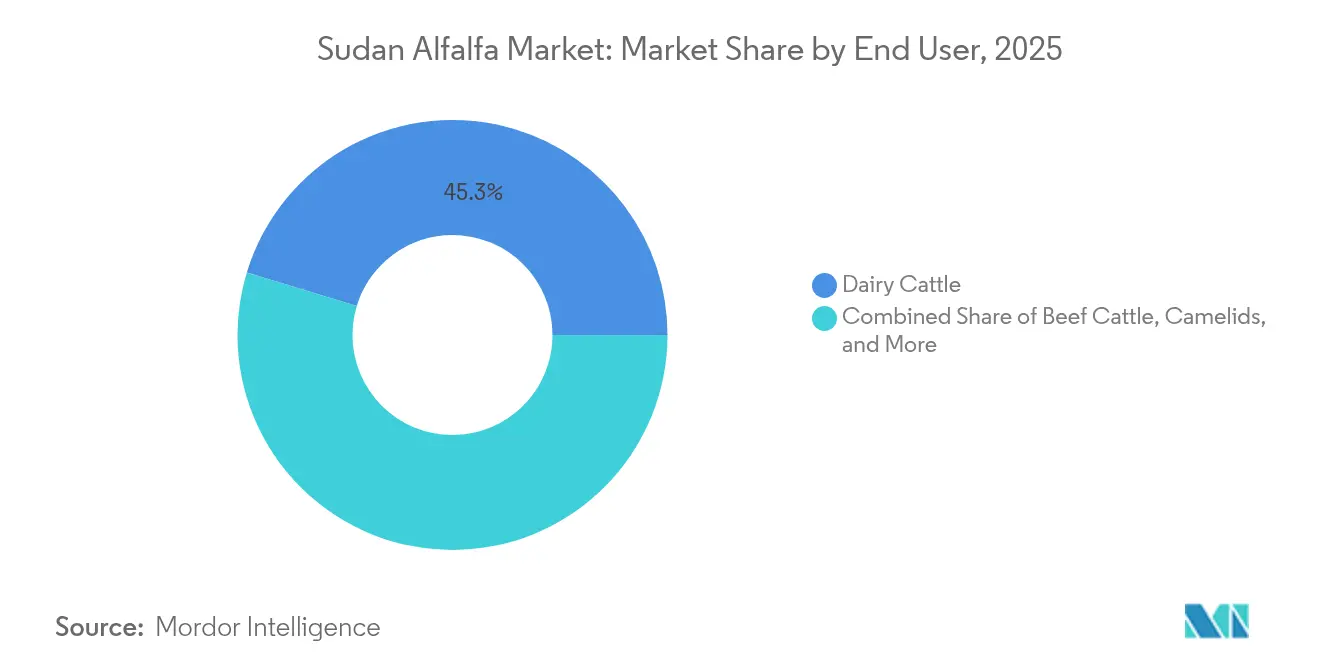
Dairy cattle feed accounted for 34.0% of the Sudan alfalfa market share in 2025, while equine feed is forecast to record the fastest CAGR at 6.1% from 2026 to 2031. Dairy remains the dominant application because commercial and urban-linked cattle systems require consistent forage inclusion and rely on alfalfa's protein profile in ration planning. This gives the market a stable demand base driven by recurring procurement rather than opportunistic buying. Beef cattle feed also remains significant, though its growth is more restrained as feed substitution occurs more readily when cereal-based options become cost-competitive. Poultry feed plays a smaller role, as alfalfa is primarily used as a quality supplement rather than as a bulk input.
Equine feed is emerging as a higher-value application with the fastest growth rate for the Sudan alfalfa market, as Gulf equine and camelid channels place greater emphasis on feed quality, product uniformity, and branded presentation. This growth is linked to the expanding equine and camelid segment in Gulf markets and to the premium positioning of processed alfalfa products in nearby demand centers. Small ruminant feed is also structurally relevant, as Sudan's export-oriented livestock role sustains forage demand beyond cattle. Camelid and other livestock feed categories remain smaller in absolute volume, but these applications support higher-margin specialized procurement. As premium applications expand, value concentration in the Sudan alfalfa market is likely to grow faster than tonnage distribution.
By End Use Sector: Commercial Farms Anchor Supply, Specialty Channels Capture Margin
Commercial farms accounted for 41.0% of end-use demand in 2025. This share reflects the position of mechanized, export-oriented operators in the River Nile and Northern States, where production scale, irrigation control, and post-harvest handling are considerably stronger than in fragmented channels. Commercial farms also influence the Sudan alfalfa market through their capacity to generate 6 to 8 annual cuttings under pivot irrigation, which supports both throughput and quality grading. This segment therefore anchors supply as well as demand across the Sudan alfalfa market, and gives larger farms greater leverage when buyers prioritize reliability over spot-price discounts.
Pet food and specialty nutrition represents a smaller share today, but it is emerging as one of the more attractive value segments, recording the fastest CAGR of 5.9% between 2026 and 2031 in the Sudan alfalfa market, driven by the expansion of branded products in premium animal care channels. Compound feed manufacturers remain relevant, though their growth is more limited as alfalfa faces cost competition from other protein inputs in blended feed. Household and hobby animal owners contribute fragmented urban demand, supporting small-volume trade but not yet defining the overall direction of the Sudan alfalfa market. The end-use pattern indicates that bulk commercial farming continues to drive scale, while specialty formats increasingly shape the margin profile.
Geography Analysis
The market is concentrated in the northern and central irrigated zones, with River Nile State and Northern State accounting for the strongest production base. These areas remain important due to their combination of irrigated farming conditions, mechanized commercial structures, and road access to Port Sudan. The Sudan alfalfa market has also become more dependent on these corridors because safer northern locations have maintained greater operational continuity than many central and western regions. The Agricultural Research Corporation (ARC) of Sudan identified Khartoum, River Nile, and Northern States as the country's principal alfalfa-producing regions in its January 2026 review, noting that most of Sudan's approximately 130,000 acres of alfalfa cultivation are concentrated in these states. As of 2026, these locations still offer the most reliable conditions for volume stability, as irrigation assets and commercial farms remain more viable there than in more disrupted zones.
Gezira and Sinnar remain important to the Sudan alfalfa market due to their historical role in irrigated agriculture, though current production levels remain below earlier levels. Alfalfa requires repeated harvesting and field management, making production difficult to sustain when labor access, irrigation scheduling, and machinery movement are disrupted. On the demand side, Khartoum State remains relevant as it has historically supported urban dairy activity, although commercial production and processing capacity in the region have been more severely affected by conflict. As a result, the Sudan alfalfa market has a geographic structure in which northern supply corridors carry greater weight, while recovery in central regions remains slower and more uncertain.
Port Sudan and Red Sea State anchor the export chain for the Sudan alfalfa market, as containerized bales and pellets depend on reliable access to the country's main maritime outlet. Corporate activity further reinforces the importance of this corridor, with logistics partnerships and export-oriented investment continuing to focus on integrated Gulf supply chains rather than inland market expansion. Blue Nile and Kassala hold future potential, with farmer support and agribusiness systems improving operational readiness, but ongoing disruption limits near-term commercial scaling. The geographic picture, therefore, remains uneven, with the Sudan alfalfa market relying on northern resilience in the near term and on broader irrigation recovery for any larger future expansion.
Competitive Landscape
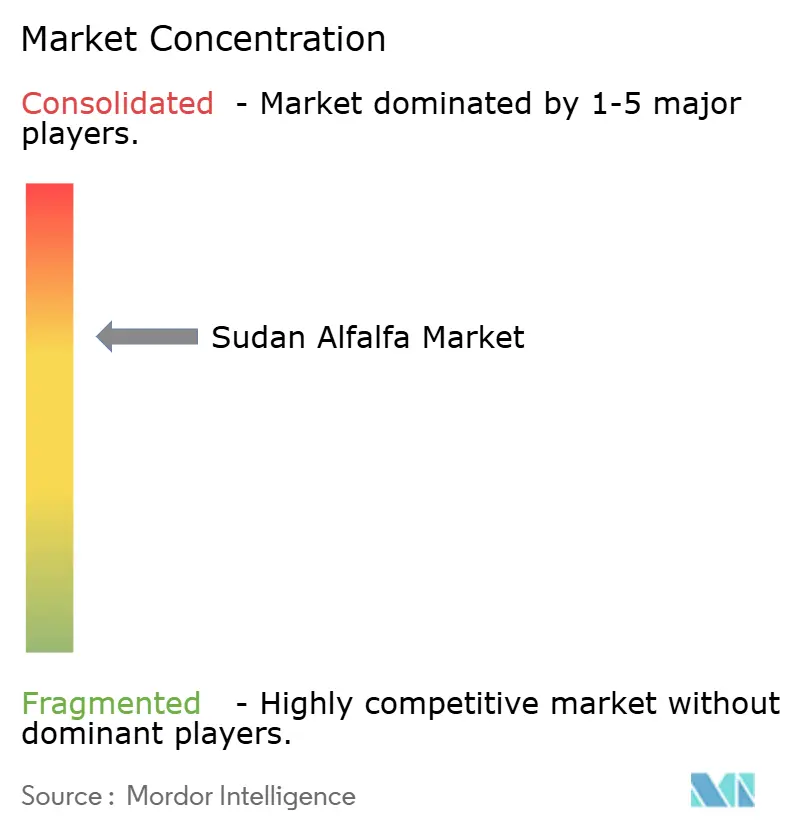
The Sudan alfalfa market has a moderately high concentration, with the top five players,Al Dahra ACX Global Inc., Hassad Food Company, DAL Agriculture (DAL Group), Arab Company for Crop Production (ACCP), and GLB Invest, collectively accounting for a major share in 2025. The competitive structure is shaped by Gulf-backed sovereign agribusiness investors and Sudan-based farm operators rather than international forage trading companies. This dynamic concentrates both production capacity and demand-side purchasing power within the same network of entities. Al Dahra ACX Global Inc. is supported by its integrated global forage platform, while Hassad Food operates as the food and agriculture subsidiary of Qatar Investment Authority. This creates a notable vertical integration dynamic, as Qatar is simultaneously the leading Gulf destination market for Sudan's alfalfa pellet exports and a major capital allocator in the country's forage production capacity.
An opportunity exists for operators that can combine verified pivot-irrigation production with export documentation meeting Gulf buyer specifications. Several investment-backed players in the current competitive set are operating below potential capacity due to conflict-related logistics disruptions. ACCP conducts direct alfalfa and Rhodes grass farm operations using mechanized irrigation systems, positioning it as a production-stage competitor at the top tier rather than an investment-stage or trading-stage entity. Its operational profile offers a replicable model for scaling mid-market producers. GLB Invest and Amtar (Amtaar Investment) represent an emerging tier of Sudan-linked forage investment companies, indicating that mid-market capital continues to enter alfalfa production despite the broader macroeconomic environment.
As of June 2026, the African Development Bank initiated a technical assistance and capacity-building engagement with DAL Group Company Limited in Sudan, signaling that institutional capital is being positioned to support the operational upgrade of Sudan-based agribusiness platforms during recovery. Technology adoption is becoming a key competitive differentiator. DAL Innovative Agriculture Company's December 2025 field day with the University of Al-Gezira showcased AI-assisted field monitoring and remote-control agricultural machinery for irrigated forage operations, a precision-farming capability that smaller producers without institutional backing cannot readily replicate.
Sudan Alfalfa Industry Leaders
Al Dahra ACX Global Inc.
Hassad Food Company (Qatar Investment Authority (QIA))
DAL Agriculture (DAL Group)
Arab Company for Crop Production (ACCP)
GLB Invest
- *Disclaimer: Major Players sorted in no particular order

Recent Industry Developments
- May 2026: Al Dahra ACX Global Inc. and DP World signed a Memorandum of Understanding to co-develop end-to-end agri-logistics supply chain solutions covering port infrastructure, cold-chain warehousing, and agri-food processing hubs across the GCC. For the Sudan alfalfa market, the partnership is relevant because it strengthens the downstream Gulf distribution network that supports forage and alfalfa trade from origin markets such as Sudan, while also supporting Al Dahra ACX Global Inc.'s strategy to build an integrated global agricultural platform.
- June 2025: Standlee Premium Products LLC and Triple Crown Nutrition launched the Triple Crown Diamond Line, comprising 6 premium equine forage and feed products, including Diamond Smart Chopped Forage, Diamond Smart Teff Pellet, and Diamond Smart Cubes, targeting the performance horse nutrition segment and broadening branded alfalfa product reach into premium retail channels.
- January 2024: Standlee Premium Products LLC launched Smart Carb Performance and Forage Plus Gastric Support, 2 new alfalfa-based forage blends formulated for equine metabolic and digestive health, expanding the company's premium forage range into the functional equine nutrition segment.


Sudan Alfalfa Market Report Scope
Alfalfa hay is obtained from the alfalfa plant, also known as lucerne and Medicago sativa. It is cultivated as an important forage crop and is widely used in animal nutrition because of its high protein content and forage value.
The Sudan Alfalfa Market is Segmented by Product Type (Bales, Pellets, Cubes, and Compressed Bales), by Application (Dairy Cattle Feed, Beef Cattle Feed, Poultry Feed, Equine Feed, Small Ruminant Feed, Camelids and Other Livestock Feed), by End Use Sector (Commercial Farms, Compound Feed Manufacturers, Household and Hobby Animal Owners, and Pet Food and Specialty Nutrition). The Market Size and Forecasts are Provided in Terms of Value (USD) and Volume (Metric Tons).
By Product Type
| Bales |
| Pellets |
| Cubes |
| Compressed Bales |
By Application
| Dairy Cattle Feed |
| Beef Cattle Feed |
| Poultry Feed |
| Equine Feed |
| Small Ruminant Feed |
| Camelids and Other Livestock Feed |
By End Use Sector
| Commercial Farms |
| Compound Feed Manufacturers |
| Household and Hobby Animal Owners |
| Pet Food and Specialty Nutrition |
| By Product Type | Bales |
| Pellets | |
| Cubes | |
| Compressed Bales | |
| By Application | Dairy Cattle Feed |
| Beef Cattle Feed | |
| Poultry Feed | |
| Equine Feed | |
| Small Ruminant Feed | |
| Camelids and Other Livestock Feed | |
| By End Use Sector | Commercial Farms |
| Compound Feed Manufacturers | |
| Household and Hobby Animal Owners | |
| Pet Food and Specialty Nutrition |


Key Questions Answered in the Report
What is the size outlook for Sudan alfalfa from 2026 to 2031?
The Sudan alfalfa market size was USD 177.16 million in 2025, reached USD 184.60 million in 2026, and is forecasted to reach USD 226.76 million by 2031 at a CAGR of 4.2%.
Which product type leads Sudan alfalfa revenue today?
Bales led in 2025 with 46.0% of total revenue because they fit current storage, handling, and export logistics more widely than processed formats.
Why are commercial farms so important to Sudan alfalfa supply?
Commercial farms held 41.0% of end-use demand in 2025 and remain central because they operate mechanized irrigated systems that can deliver repeated cuttings and more consistent quality.
What is the biggest risk to future Sudan alfalfa growth?
Irrigation instability and conflict-related disruption remain the main risks because they reduce cutting cycles, raise logistics costs, and limit the movement of export-grade forage to Port Sudan.
Page last updated on:


 Your data is secure and never sold or shared.


