
Market Overview
| Study Period | 2021 - 2031 |
|---|---|
| Forecast Data Period | 2026 - 2031 |
| Base Year Market Size (2025) | USD 1.58 Billion |
| Market Size (2026) | USD 1.66 Billion |
| Market Size (2031) | USD 2.26 Billion |
| Growth Rate (2026 - 2031) | 6.37 % |
| Market Concentration | Low |
Major Players *Disclaimer: Major Players sorted in no particular order Image © Mordor Intelligence. Reuse requires attribution under CC BY 4.0. | |
Africa Yogurt Market Analysis by Mordor Intelligence
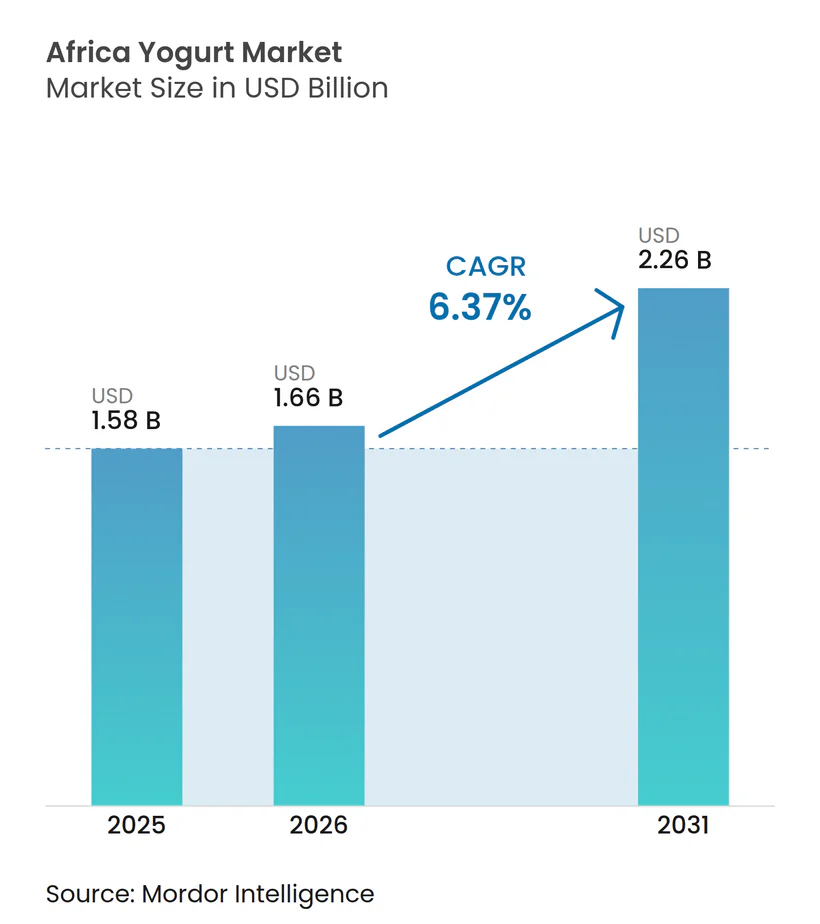
The Africa yogurt market size was valued at USD 1.58 billion in 2025 and estimated to grow from USD 1.66 billion in 2026 to reach USD 2.26 billion by 2031, at a CAGR of 6.37% during the forecast period (2026-2031). Demand is moving beyond basic dairy consumption as more urban households look for protein-rich products that fit daily routines. The Africa yogurt market is also adapting to widespread lactose intolerance through lactose-reduced and probiotic products, which can broaden access for consumers who avoid conventional dairy. Formal retail growth gives manufacturers more routes to introduce new formats, but cold-chain limits still shape where chilled products can be sold. The strongest opportunities depend on local milk collection, practical pack sizes, and distribution models that can serve both organized retail and smaller neighborhood outlets.
Key Report Takeaways
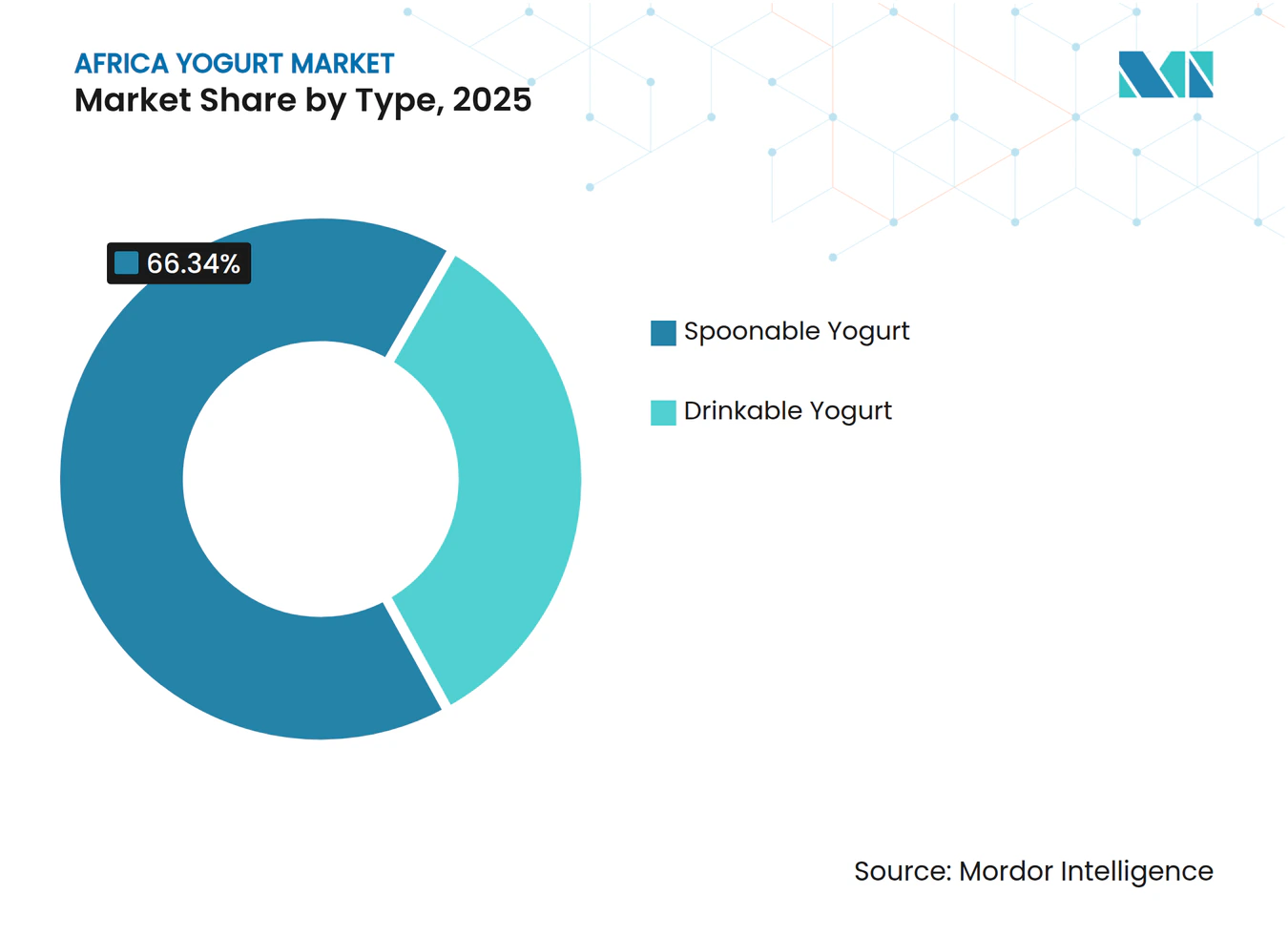
- By type, spoonable yogurt held 66.34% of the Africa yogurt market share in 2025, while drinkable yogurt is projected to grow at a 7.81% CAGR through 2031.
- By source, dairy-based products held 88.37% of the Africa yogurt market share in 2025, while non-dairy based yogurt is projected to grow at a 7.69% CAGR through 2031.
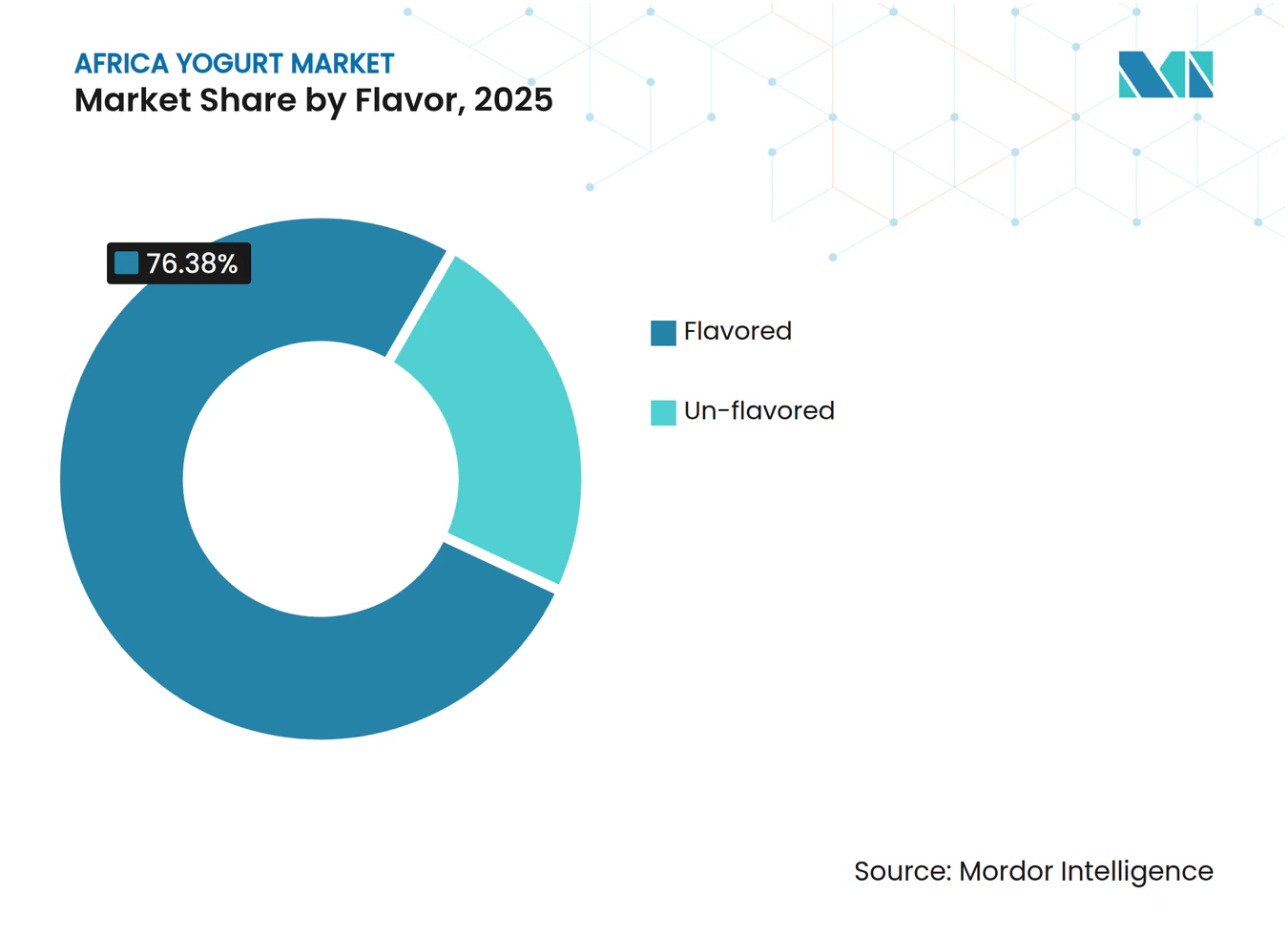
- By flavor, flavored yogurt held 76.38% of revenue in 2025, while un-flavored yogurt is projected to grow at an 8.01% CAGR through 2031.
- By distribution channel, off-trade held 80.27% of revenue in 2025, while on-trade is projected to grow at a 7.77% CAGR through 2031.
- By geography, South Africa held 28.71% of revenue in 2025, while Nigeria is projected to grow at an 8.12% CAGR through 2031.
Note: Market size and forecast figures in this report are generated using Mordor Intelligence’s proprietary estimation framework, updated with the latest available data and insights as of 2026.
Market Trends and Insights
Drivers Impact Analysis of Africa Yogurt Market*
| Driver | (~) % Impact on CAGR Forecast | Geographic Relevance | Impact Timeline |
|---|---|---|---|
| Rising Consumer Awareness of Yogurt's Probiotic and Nutritional Benefits | +1.8% | Regional; concentrated in South Africa, Egypt, Morocco | Medium term (2-4 years) |
| Growing Demand for Convenient and Ready-to-Eat Dairy Products | +1.4% | South Africa, Nigeria, urban East Africa | Short term (≤ 2 years) |
| Rising Demand for Flavored and Fortified Yogurt Products | +1.1% | North Africa (Morocco, Algeria, Egypt), Nigeria | Short term (≤ 2 years) |
| Growing Demand for Affordable, Protein-Rich Foods | +0.9% | Sub-Saharan Africa, particularly Nigeria and Kenya | Medium term (2-4 years) |
| Increasing Availability of Drinkable Yogurt and Single-Serve Packaging | +0.8% | West Africa, East Africa, peri-urban Sub-Saharan markets | Short term (≤ 2 years) |
| Expansion of Domestic Dairy Processing and Local Yogurt Production | +0.6% | Algeria, Morocco, Kenya | Medium term (2-4 years) |
| Source: Mordor Intelligence | |||
Rising Consumer Awareness of Yogurt’s Probiotic and Nutritional Benefits
Health-focused purchasing is increasing the relevance of probiotic and lactose-reduced yogurt in urban African households. The Africa yogurt market can serve people who have historically avoided conventional dairy because lactose nonpersistence is common across many African populations. This changes product development priorities from treating lactose intolerance only as a barrier to creating products that address a clear consumption need. Companies can build demand through plainly stated nutritional claims and products that fit familiar eating occasions. Research on tigernut, soybean, and cow-milk blends showed that locally relevant mixed formulations can gain consumer acceptance in West African trials. These findings support room for lower-cost functional products where imported plant ingredients would make pricing less accessible.
Growing Demand for Convenient and Ready-to-Eat Dairy Products
Urban growth is increasing demand for dairy products that can be consumed away from home or during short meal breaks. South Africa’s urban population reached 70% in 2025, providing a large base for single-serve cups, pouches, and drinkable formats[1]. Portable packs can help manufacturers reach commuters, students, and consumers shopping in convenience stores. The Africa yogurt market also has an opportunity to use ambient-stable formats in areas where refrigerated retail capacity remains limited. These formats reduce the dependence of distribution on continuous refrigeration at every selling point. Product and pack decisions must still balance shelf life, cost, food safety, and the local habits that favor either spoonable or drinkable yogurt.
Rising Demand for Flavored and Fortified Yogurt Products
Flavored and fortified products address consumers who expect yogurt to offer more than basic energy and protein. Flavored yogurt remains the larger flavor category, while fortification can strengthen the role of yogurt in diets for children and women. The Africa yogurt market must align these products with established rules for product composition and labeling. The Codex standard for fermented milks defines the conditions for describing fermented dairy products and gives food authorities a common reference point. Clear compliance matters most in countries with more active food-safety enforcement and a growing modern retail sector. Local flavor preferences and smaller pack sizes can make fortified products more relevant to households with limited food budgets.
Growing Demand for Affordable, Protein-Rich Foods
Food affordability remains central to purchasing decisions across Sub-Saharan Africa. The African Development Bank reported that average inflation in Africa was 12.6% in 2025, following 18.6% in 2024[2]. Yogurt can retain relevance when it provides protein in small, affordable portions that fit household budgets. Manufacturers are responding by considering smaller formats and locally sourced milk where supply conditions permit. The Africa yogurt market is therefore not defined only by premium functional lines, since baseline adoption at accessible prices remains important in Nigeria, Kenya, and other high-population markets. Consistent availability is as important as price because a missing product can weaken purchase habits that take time to establish.
Restraints Impact Analysis of Africa Yogurt Market*
| Restraint | (~) % Impact on CAGR Forecast | Geographic Relevance | Impact Timeline |
|---|---|---|---|
| Limited Cold Chain Infrastructure and Refrigerated Distribution | -1.6% | Sub-Saharan Africa broadly; acute in West and Central Africa | Long term (≥ 4 years) |
| Volatility in Raw Milk Prices and Availability | -1.2% | Kenya, Zimbabwe, Nigeria, Ethiopia | Medium term (2-4 years) |
| High Energy Costs and Unreliable Electricity Supply | -0.9% | Nigeria, Sub-Saharan Africa generally | Long term (≥ 4 years) |
| High Costs of Refrigerated Storage and Transportation | -0.7% | East Africa, West Africa | Medium term (2-4 years) |
| Source: Mordor Intelligence | |||
Limited Cold-Chain Infrastructure and Refrigerated Distribution
Cold-chain coverage remains a persistent constraint on the Africa yogurt market, particularly outside major cities. Weak refrigeration can raise spoilage risk and limit the distance that chilled products travel from processing plants. The Global Cold Chain Alliance identifies investment, infrastructure, and operational capability as continuing issues for cold-chain development across Africa. Kenya’s government began installing 230 bulk milk coolers across 40 counties in July 2025, which added upstream chilling capacity but did not remove the wider distribution challenge[3]. Manufacturers need to match product formats with the actual reliability of power, equipment maintenance, and transport links in each market. Ambient and shelf-stable products offer one response, but they do not replace the need for refrigerated capacity for conventional yogurt lines.
Volatility in Raw Milk Prices and Availability
Raw milk availability and cost can change quickly when feed prices, weather, currency movements, and local supply conditions shift. These changes affect both production costs and the ability to maintain consistent factory utilization. The Africa yogurt market remains exposed when processors depend heavily on imported milk powder or have limited local collection networks. Local sourcing can reduce exposure to some import costs, but it requires dependable farmer relationships, cooling equipment, and quality controls. Supply interruptions can lead to reduced production runs and empty shelves, even where consumer demand remains intact. A stable supply base is therefore necessary for companies that want to compete on accessible pricing without compromising product quality.
*Our forecasts treat driver/restraint impacts as directional, not additive. The impact forecasts reflect baseline growth, mix effects, and variable interactions.
Africa Yogurt Market Segment Analysis
By Type:
Drinkable Yogurt Extends Access Beyond Chilled ShelvesSpoonable yogurt accounted for 66.34% of the Africa yogurt market in 2025, reflecting established household consumption across North Africa, South Africa, and East African cities. The format is familiar to consumers who use yogurt at breakfast, with meals, as a snack, and in family food routines. Its position is supported by supermarket shelves, a wide range of single-serve packs, family tubs, and established refrigerated merchandising in more developed retail settings. Manufacturers can maintain this base with dependable quality, practical portion sizes, recognizable flavors, and clear date marking that helps consumers assess freshness. The category still depends on refrigerated storage through much of the supply chain, from factory dispatch to the final retail display.
Drinkable yogurt is projected to grow at a 7.81% CAGR through 2031, which makes it the faster-growing type within the Africa yogurt market size. Single-serve drinks can be easier to consume while traveling, at school, or during work breaks. Ambient-stable packages can extend coverage into outlets without reliable chilled displays. This gives producers a route into smaller cities and informal retail areas that conventional yogurt may not reach. Lower revenue per liter may be offset by a larger potential consumer base and higher distribution reach.


By Source:
Dairy-Based Products Remain Established While Alternatives Build DemandDairy-based yogurt held 88.37% of revenue in 2025, supported by existing dairy-farming systems and the established use of cow-milk fermentation. The segment benefits from familiar taste, broad availability, and manufacturing practices that processors already understand. Its performance, however, relies on stable milk supply, affordable inputs, and adequate cooling from farm to factory. Companies with local collection systems are better placed to control quality and reduce their dependence on imported ingredients. Dairy-based offerings will remain central where traditional milk consumption and formal retail are well developed.
Non-dairy based yogurt is forecast to grow at a 7.69% CAGR through 2031 in the Africa yogurt market. Interest comes from consumers seeking lactose-free options and products associated with health-focused diets. Tigernut and soybean blends offer a potential route to use ingredients familiar to West African consumers. This segment remains less established than dairy-based yogurt and requires reliable formulations, taste acceptance, and clear labeling. Local manufacturers that manage ingredient costs and build trust may have room to develop early positions.
By Flavor:
Flavored Products Lead While Plain Yogurt Gains RelevanceFlavored yogurt held 76.38% of revenue in 2025, making it the leading flavor segment in the Africa yogurt market. Fruit-based offerings are widely recognized and can encourage trial among consumers who view yogurt as a convenient snack. Their broad appeal supports placement in supermarkets, convenience stores, and foodservice settings. Producers can use locally familiar flavors to differentiate their ranges without moving away from accessible price points. Food labeling and compositional rules remain important where flavoring changes the formal product description.
Un-flavored yogurt is forecast to grow at an 8.01% CAGR through 2031. Plain varieties appeal to consumers seeking lower-sugar choices or a versatile cooking ingredient. They also allow households to add their own fruit, grains, or savory ingredients. The Africa yogurt market can use this demand to develop products positioned around simpler ingredients and everyday use. Manufacturers need to make the benefits clear because flavored products remain the more familiar option for many consumers.

By Distribution Channel:
Off-Trade Retains Scale While Foodservice Adds OccasionsOff-trade channels held 80.27% of revenue in 2025, giving supermarkets, hypermarkets, and convenience stores a central role in the Africa yogurt market. These outlets provide the refrigerator space, stock management, routine deliveries, and promotional visibility needed for a broad chilled dairy range. Modern grocery retail is especially important in South Africa, Morocco, Egypt, and large Nigerian cities where formal stores offer more reliable refrigerated space. Convenience stores add access for immediate consumption, particularly for single-serve products bought by commuters, students, and workers. Online grocery can complement physical retail in urban areas where digital ordering, cold delivery, and payment systems are available.
On-trade distribution is projected to grow at a 7.77% CAGR through 2031. Cafes, quick-service restaurants, food courts, and hotels can use yogurt in breakfast dishes, smoothies, and snacks. This channel creates additional consumption occasions rather than simply replacing grocery purchases. It also requires different package sizes, service formats, and promotional plans than retail. Suppliers that can provide consistent quality and regular delivery will have an advantage as urban foodservice expands.
Geography Analysis
South Africa Yogurt Market
South Africa held 28.71% of Africa yogurt market revenue in 2025 and remains the region’s largest national market. Its developed grocery environment supports launches in lactose-free, probiotic, drinkable, and single-serve products, while giving suppliers a clearer path to test new pack sizes. A 70% urban population in 2025 provides a large concentration of consumers within formal retail catchments. The country also provides a manufacturing base for companies serving nearby Southern African countries where cross-border distribution is workable. Larger retailers can place pressure on suppliers to maintain availability, food-safety standards, promotional support, and competitive prices.
North Africa Yogurt Market
North Africa remains important because yogurt is well established in daily diets across Egypt, Morocco, and Algeria. Morocco’s dairy production reached 2.25 billion liters in 2025. The Africa yogurt market benefits in these countries from a sizeable dairy base, established processing capacity, and consumers familiar with fermented milk products. Producers can build demand through flavor variety, fortified offerings, household packs, and smaller formats suited to individual consumption. The Codex standard for fermented milks offers a common framework for product identity and labeling.
Nigeria and Kenya Yogurt Market
Nigeria is projected to expand at an 8.12% CAGR through 2031, the highest rate among the geographic segments in the Africa yogurt market. The country’s large population and low starting point for yogurt consumption create room for long-term adoption, particularly when products are sold in familiar small formats. Affordable drinkable products and local milk collection could help companies address distribution and price constraints. Kenya remains an important East African market because formal dairy processors have established collection networks, cooling investments, and relationships with milk suppliers.
Competitive Landscape
Market Concentration
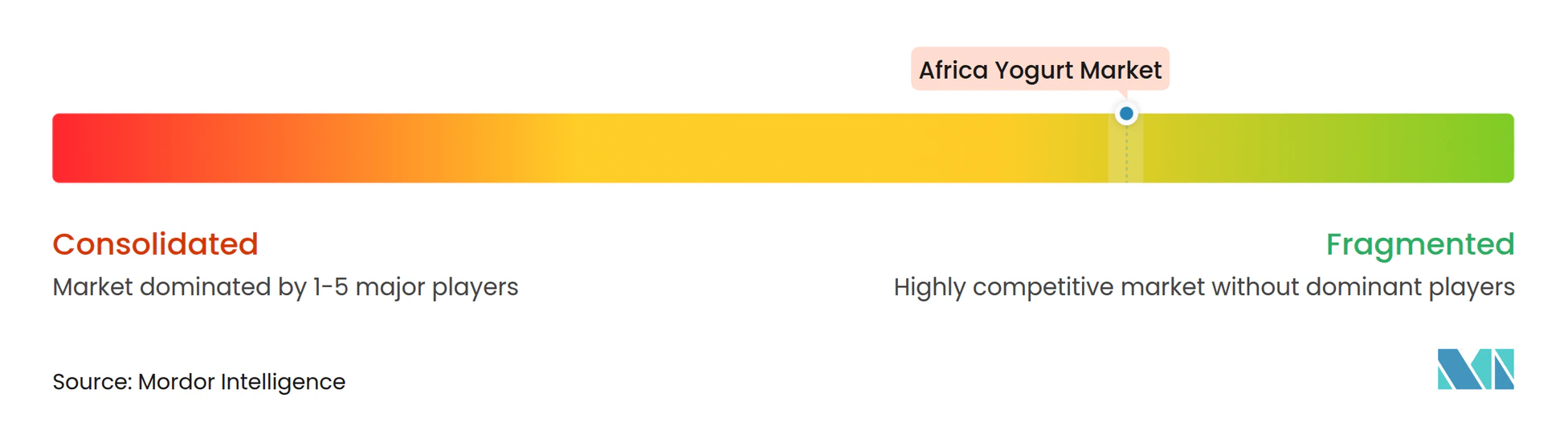
The Africa yogurt market is fragmented, with multinational companies, regional processors, cooperatives, and private-label suppliers competing across different countries. No single company has a dominant position across the whole region because retail systems, milk supply, consumer tastes, and regulation vary widely. Large companies can use local sourcing, established quality systems, and wider distribution to strengthen their positions. Smaller producers can compete where they understand local demand and can offer affordable packs or products made with local inputs. The market’s structure leaves room for regional specialists rather than favoring one standard strategy across Africa.
Danone has built links with dairy farmers across Tunisia, Egypt, Morocco, and Algeria, giving it a local sourcing platform in North Africa. Almarai inaugurated 5 production lines at its Beyti subsidiary in Egypt in November 2025, increasing the site’s production capabilities and export reach. These moves show how larger companies use manufacturing scale and controlled supply systems to improve their position. They also raise the standard for smaller competitors that want to sell into formal retail or export channels. Investment in food safety, factory capacity, and milk collection can be more difficult for smaller firms to fund.
Distribution reliability is likely to determine competitive outcomes in many markets because chilled dairy must reach outlets in saleable condition. Companies that combine cold-chain planning with ambient or drinkable products can serve a wider mix of formal and informal outlets. Private-label products may increase price pressure in more developed grocery markets, especially where consumers compare similar offerings on price. Innovation still matters when it solves practical needs, such as lactose-free products, affordable portions, and familiar local flavors.
Africa Yogurt Industry Leaders
-
Danone S.A.
-
Nestlé S.A.
-
Royal FrieslandCampina NV
-
Lactalis Group
-
Chobani, LLC
- *Disclaimer: Major Players sorted in no particular order
Africa Yogurt Market Companies Covered in this Report
- Danone S.A.
- Nestlé S.A.
- Royal FrieslandCampina NV
- Lactalis Group
- Chobani, LLC
- Brookside Dairy Limited
- Viju Industries Nigeria Limited
- Juhayna Food Industries
- Yakult Honsha Co., Ltd.
- Clover Industries Limited
- FAGE International S.A.
- Promasidor Holdings Limited
- Arla Foods amba
- Almarai Company
- Inyange Industries Ltd.
- Pearl Dairy Farms Limited
- New Kenya Co-operative Creameries Limited
- Chi Limited
- Délifrance
- Sodiaal International
Recent Industry Developments in Africa Yogurt Market
- February 2026: Arla Foods Nigeria launched Cool Cow Yogurt. The product was introduced using 100% fresh milk sourced from the Arla-Dano Farm in Kaduna State. The launch connected Arla's local dairy-farming investments with value-added yogurt production, creating demand for locally produced milk and expanding its consumer yogurt portfolio.
- November 2025: Arla Foods Nigeria commissioned a yogurt factory and Nigerian Dairy Centre of Excellence. Arla Foods Nigeria announced the facilities at its integrated Arla-Dano dairy farm in Damau, Kaduna State. The yogurt factory uses fresh milk sourced from the farm, while the centre supports farmer training, milk hygiene, animal nutrition, and dairy production practices. The development strengthens local yogurt manufacturing and the supply of fresh milk to processors in Nigeria.
- October 2025: UAC completed the acquisition of the Nigerian food and beverage business on October 3, 2025, following the agreement announced by The Coca-Cola Company in July. C.H.I. owns the Hollandia brand, which is a leading player in drinking yogurt in Nigeria.
Africa Yogurt Market Report Scope
Yogurt is a semifluid fermented milk food having a smooth texture and mildly sour flavor because of its lactic acid content. The African yogurt market is segmented by type, source, flavor distribution channel, and geography. Based on type, the market is segmented into spoonable yogurt and drinkable yogurt. Based on source, the market is segmented into dairy-based and non-dairy-based yogurt. Based on flavor, the market is segmented into flavored and un-flavored. Based on distribution channels, the market is segmented into on-trade and off-trade. Based on geography, the report provides an analysis of South Africa, Egypt, Nigeria, Morocco, Algeria, Kenya and the Rest of Africa. For each segment, the market sizing and forecasts have been done on the basis of value (in USD billion).
Segmentation Overview
Type
| Drinkable Yogurt |
| Spoonable Yogurt |
Source
| Dairy-based |
| Non-dairy based |
Flavor
| Flavored |
| Un-flavored |
Distribution Channel
| On-Trade | |
| Off-Trade | Convenience Stores |
| Specialist Retailers | |
| Supermarkets and Hypermarkets | |
| Online Retail Stores | |
| Others (Warehouse clubs, gas stations, etc.) |
By Geography
| South Africa |
| Egypt |
| Nigeria |
| Morocco |
| Algeria |
| Kenya |
| Rest of Africa |
| Type | Drinkable Yogurt | |
| Spoonable Yogurt | ||
| Source | Dairy-based | |
| Non-dairy based | ||
| Flavor | Flavored | |
| Un-flavored | ||
| Distribution Channel | On-Trade | |
| Off-Trade | Convenience Stores | |
| Specialist Retailers | ||
| Supermarkets and Hypermarkets | ||
| Online Retail Stores | ||
| Others (Warehouse clubs, gas stations, etc.) | ||
| By Geography | South Africa | |
| Egypt | ||
| Nigeria | ||
| Morocco | ||
| Algeria | ||
| Kenya | ||
| Rest of Africa | ||
Key Questions Answered in the Report
What is the size of the Africa yogurt market?
The Africa yogurt market is valued at USD 1.66 billion in 2026 and is forecast to reach USD 2.26 billion by 2031, at a 6.37% CAGR.
Which yogurt type is growing fastest in Africa?
Drinkable yogurt is the fastest-growing type, with a projected CAGR of 7.81% through 2031.
What is driving yogurt demand across Africa?
Demand is supported by health-focused choices, convenient portions, flavored and fortified products, and the need for affordable protein-rich foods.
Which country leads yogurt sales in Africa?
South Africa leads the region with a 28.71% share in 2025, supported by developed retail and dairy-processing infrastructure.