
Market Overview
| Study Period | 2020 - 2031 |
|---|---|
| Forecast Data Period | 2026 - 2031 |
| Base Year Market Size (2025) | USD 13.47 Billion |
| Market Size (2026) | USD 14.28 Billion |
| Market Size (2031) | USD 19.16 Billion |
| Growth Rate (2026 - 2031) | 6.05 % |
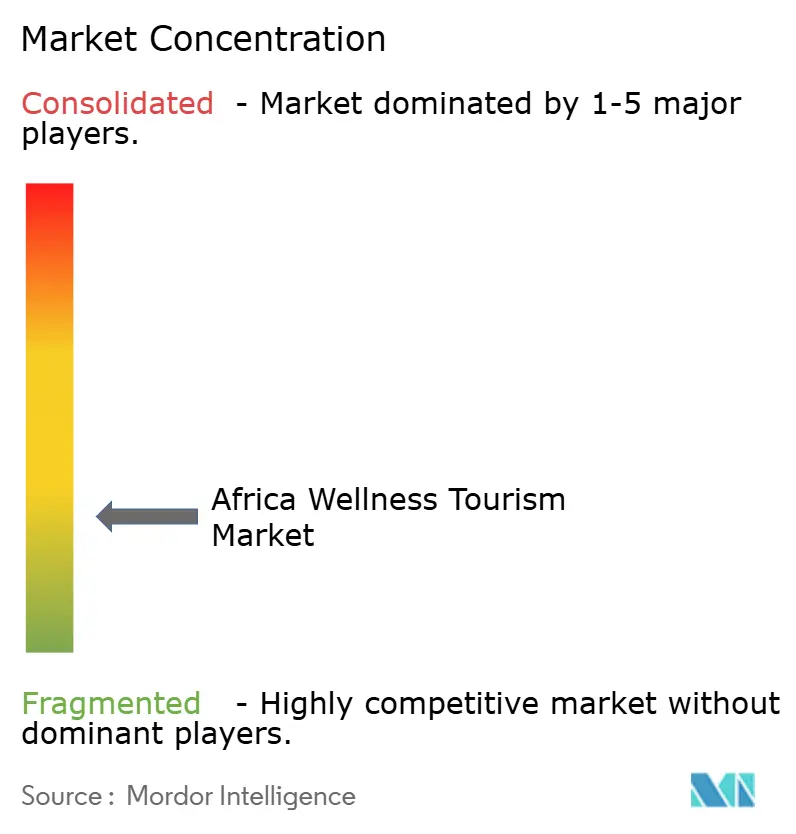
| Market Concentration | Low |
Major Players *Disclaimer: Major Players sorted in no particular order Image © Mordor Intelligence. Reuse requires attribution under CC BY 4.0. | |
Africa Wellness Tourism Market Analysis by Mordor Intelligence
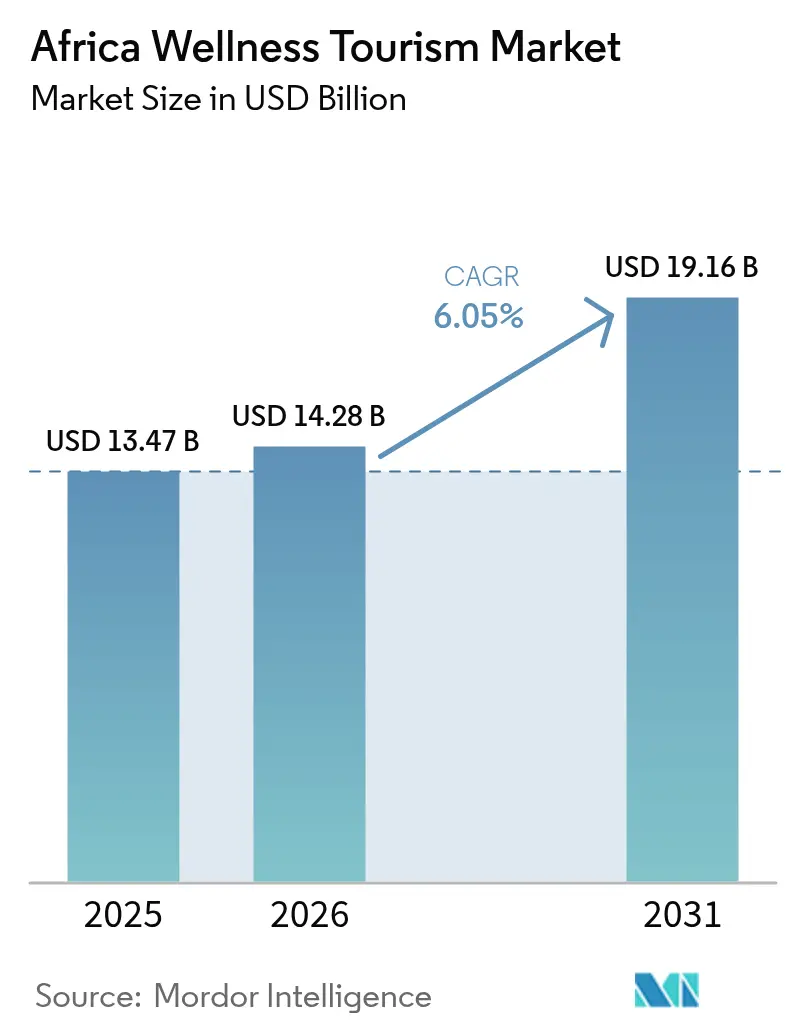
The Africa wellness tourism market size in 2026 is estimated at USD 14.28 billion, growing from 2025 value of USD 13.47 billion with 2031 projections showing USD 19.16 billion, growing at 6.05% CAGR over 2026-2031. This growth underscores how the Africa wellness tourism market is evolving from a niche add-on to a primary travel motivator for affluent global and domestic visitors. Rising disposable incomes among African urban professionals, sustained hotel investment from luxury brands, and government diversification policies jointly encourage capacity expansion across lodging, spa, and retreat formats. Operators that successfully pair authentic African healing modalities with international service benchmarks gain pricing power and higher repeat visitation. Conservation-linked eco-wellness properties add further momentum by bundling nature stewardship with restorative travel, a proposition hard to replicate outside the continent. Digital marketing of low-connectivity safari zones as premium disconnection venues widens the customer funnel, while improved visa openness across 39 countries removes longstanding administrative friction. Infrastructure gaps and security perceptions remain the principal speed bumps, yet first movers who resolve them secure durable competitive advantages.
Key Report Takeaways
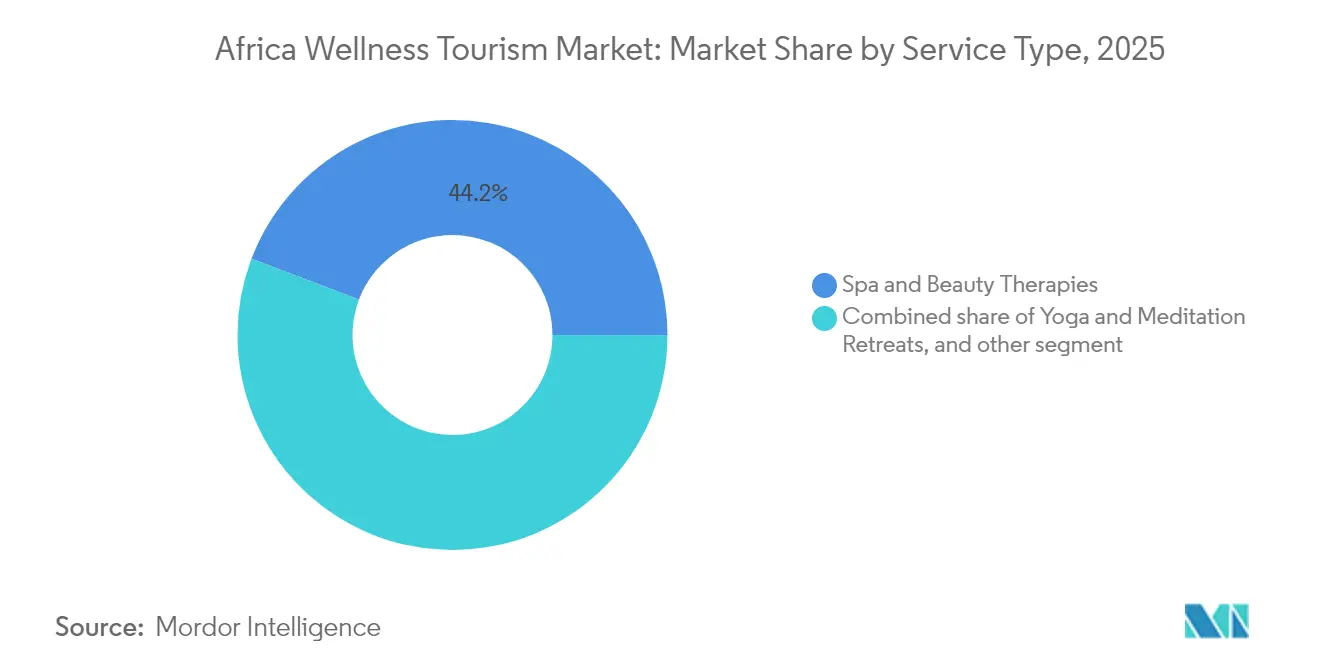
- By service type, spa and beauty therapies led with 44.23% of the Africa wellness tourism market share in 2025; digital-detox escapes are projected to grow at a 12.14% CAGR to 2031.
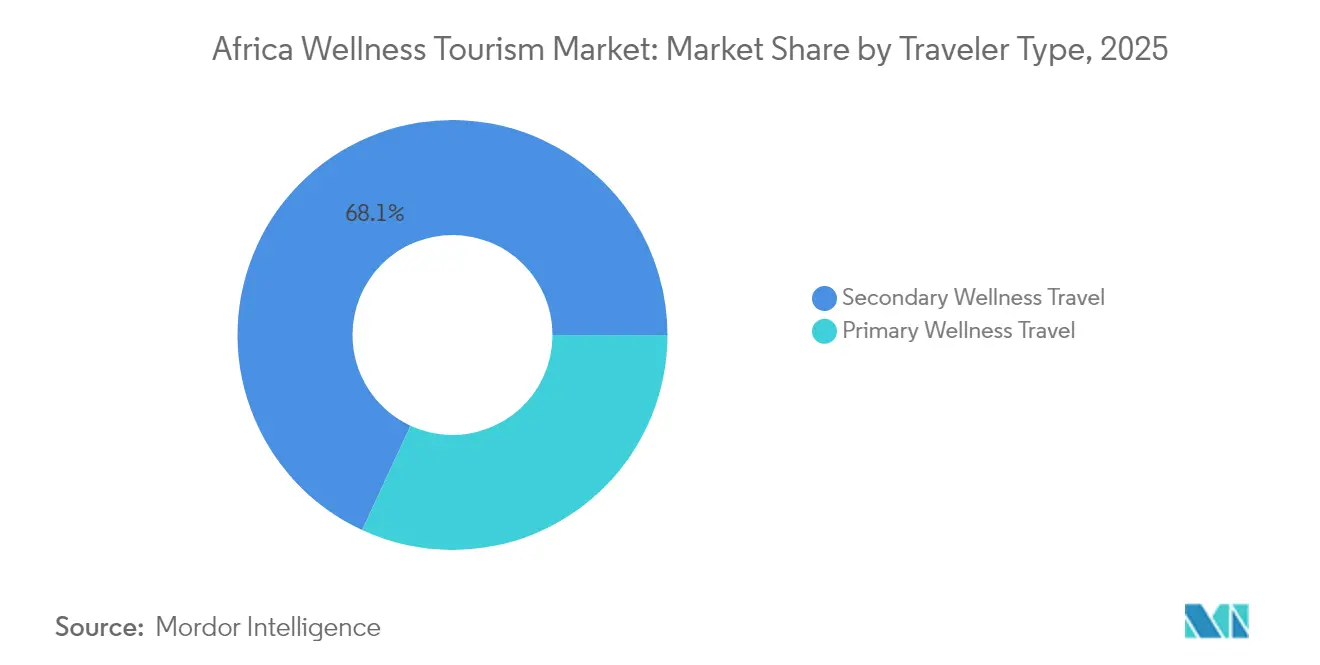
- By traveler type, secondary wellness travel accounted for 68.10% of the Africa wellness tourism market size in 2025, while primary wellness travel is advancing at a 10.45% CAGR through 2031.
- By accommodation type, chain-branded wellness hotels captured 37.25% of the Africa wellness tourism market share in 2025; eco-wellness lodges are expanding at a 13.08% CAGR to 2031.
- By geography, North Africa held 29.55% of the Africa wellness tourism market share in 2025; East Africa is expected to register the highest regional CAGR at 11.35% during 2026-2031.
Note: Market size and forecast figures in this report are generated using Mordor Intelligence’s proprietary estimation framework, updated with the latest available data and insights as of 2026.
Market Trends and Insights
Drivers Impact Analysis of Africa Wellness Tourism Market*
| Driver | (~) % Impact on CAGR Forecast | Geographic Relevance | Impact Timeline |
|---|---|---|---|
| Rising domestic middle-class demand | +1.2% | Sub-Saharan core; spillover to North Africa | Medium term (2-4 years) |
| Government diversification toward wellness | +0.9% | Rwanda, Mauritius, South Africa | Long term (≥4 years) |
| Expansion of luxury hotel brands | +1.5% | East and Southern Africa | Medium term (2-4 years) |
| Awareness of integrative preventive care | +0.8% | Urban African markets | Long term (≥4 years) |
| Surge in Afro-centric spiritual retreats | +0.7% | Ghana, Nigeria, Ethiopia | Short term (≤2 years) |
| Digital-detox itineraries | +1.1% | East and Southern Africa wildlife corridors | Short term (≤2 years) |
| Source: Mordor Intelligence | |||
Rising Domestic Middle-Class Demand for Wellness Experiences
Domestic wellness travel now supplies a reliable utilization base for operators who historically depended on seasonal, long-haul clientele. The Global Wellness Institute’s 2024 policy toolkit notes that a stable local customer base shields businesses from external demand shocks[1]Global Wellness Institute, “Wellness Policy Toolkit,” globalwellnessinstitute.org. . African cities such as Lagos, Nairobi, and Johannesburg have seen sustained salary growth since 2024, enabling residents to spend on spa weekends, mindfulness retreats, and nutritional detox programs. Local operators enjoy cultural fluency and cost advantages that resonate with home-market sensibilities. International chains, in turn, recalibrate program design to reflect African wellness philosophies, from botanical rituals to communal healing circles. This alignment stimulates year-round room occupancy, supports continuous staff training, and motivates investors to widen retreat footprints across secondary cities.
Government Tourism Diversification Strategies Toward Wellness
Rwanda, Mauritius, and South Africa now embed wellness pillars within national tourism plans, channeling grants into certification programs that sharpen service quality[2]IGAD, “Tourism Brief,” igad.int. . Rwanda pioneered spa practitioner accreditation classes in 2024, while Mauritius pairs medical tourism platforms with preventive wellness sessions. South Africa’s provincial tourism boards market indigenous healing within regulated frameworks to reassure international visitors. These interventions attract foreign direct investment by clarifying licensing timelines and raising baseline standards. Harmonized African Union visa policies further streamline multi-country itineraries, encouraging travelers to string together wellness stops across several nations. Over the long term, coordinated policy pushes should cut red tape, lower insurance premiums, and lift occupancy rates across remote lodges.
Expansion of International Luxury Hotel Brands Into Africa
Brands such as Six Senses, Jumeirah, and The LUX Collective accelerated African openings in 2024–2025, signaling investor confidence in the Africa wellness tourism market. Standardized operating procedures reassure wellness seekers who value consistent service benchmarks, while loyalty programs plug African retreats into global distribution systems. Model properties adapt by weaving Maasai or San healing rituals into spa menus, thus preserving authenticity without sacrificing five-star polish. Competitive pressure forces local independents to upgrade gym hardware, wellness cuisine, and therapist certification, elevating the market’s collective reputation. The presence of marquee operators also nudges governments to expedite utility rollouts, easing the cost burden for smaller participants.
Digital-Detox Itineraries Leveraging Low-Connectivity Safari Areas
Remote wildlife zones once written off for spotty signal strength now fetch premium rates as intentional disconnection sanctuaries[3]Wild Nectar Collection, “Luxury Travel Trends 2025,” wildnectarcollection.com.. Lodge itineraries include silent sunrise hikes, guided forest bathing, and evening stargazing, all framed as antidotes to screen fatigue. High-stress executives from New York and London willingly pay surcharges for guaranteed phone-free zones. Operators have begun to install on-site psychologists and mindfulness coaches, turning bush camps into clinical yet soulful retreats. The pivot also extends the average length of stay, as guests require multi-day immersions to detox fully. Adjacent communities benefit through job creation in guiding, organic farming, and artisanal crafts that supply retreat gift shops.
Restraints Impact Analysis of Africa Wellness Tourism Market*
| Restraint | (~) % Impact on CAGR Forecast | Geographic Relevance | Impact Timeline |
|---|---|---|---|
| Limited rural infrastructure & connectivity | −1.8% | Sub-Saharan rural belts, Central Africa | Medium term (2-4 years) |
| Tourist safety & security perceptions | −1.2% | West/Central Africa hotspots | Short term (≤2 years) |
| Shortage of accredited practitioners | −0.7% | Market-wide, acute in remote regions | Long term (≥4 years) |
| Lengthy visa processes | −0.9% | Continental, though easing in select countries | Medium term (2-4 years) |
| Source: Mordor Intelligence | |||
Limited Rural Infrastructure & Connectivity
Poor road quality, intermittent electricity, and constrained water access jointly inflate construction and operating costs in pristine parklands. The TRILAND project’s phased road upgrades will ease truck logistics, yet most works remain on drawing boards[4]Ghana Tourism Authority, “Wellness Tourism Initiatives,” ghanatourismauthority.org. . Consequently, developers must budget for solar arrays, boreholes, and satellite backhaul, driving up capital intensity. Entry barriers deter small entrepreneurs, consolidating first-mover advantages for groups that master off-grid engineering. Controlled bed capacity also boosts exclusivity, allowing nightly rates above USD 2,000 in Botswana’s delta. While infrastructure gaps slow overall volume, they paradoxically support sustainable carrying capacities that align with wellness ideals of tranquility and minimal crowding.
Tourist Safety & Security Perceptions
Media headlines on isolated unrest often color global sentiment toward Africa wellness tourism market destinations, far removed from conflict zones. Studies show that ambiguous language in foreign travel advisories depresses bookings even when actual incidents occur thousands of miles away. Operators respond with visible perimeter security, GPS-enabled transfer vehicles, and transparent incident reporting. Insurers still levy higher premiums in countries with Level 2 or Level 3 advisories, adding cost overhead. Targeted communication campaigns featuring testimonials from solo female guests can recalibrate risk perceptions. Nations that streamline police tourism units and crisis hotlines tend to regain visitor trust faster.
*Our forecasts treat driver/restraint impacts as directional, not additive. The impact forecasts reflect baseline growth, mix effects, and variable interactions.
Africa Wellness Tourism Market Segment Analysis
By Service Type:
Spa Dominance Meets Digital InnovationSpa and beauty therapies accounted for 44.23% of Africa wellness tourism market share in 2025, validating their universal appeal and replicable operating model. Operators capitalize on North African hammam heritage and Southern African mineral-rich mud treatments to differentiate menus. The Africa wellness tourism market size for digital-detox escapes is projected to climb from USD 2.37 billion in 2026 to USD 4.19 billion by 2031, reflecting a 12.14% CAGR. New retreat platforms now bundle measured dopamine-fast protocols, starlit sound baths, and analog journaling workshops. Investors also back mental-wellness retreats that blend cognitive behavioral therapy with ancestral drumming circles, satisfying demand from corporate burnout sufferers. Spiritual healing journeys tap diaspora interest by integrating naming ceremonies, ancestral veneration, and river purification rites, thereby nurturing repeat visitation from North American and Caribbean markets.
Digital-detox pioneers convert prior connectivity liabilities into unique selling points. Lodge architects design Faraday-cage meditation pods that block electromagnetic fields, while neuroscientists track heart-rate variability to evidence stress reduction outcomes. Such data-backed efficacy increases the chances of reimbursement by wellness insurers in Europe. Meanwhile, naturopathy and detox programs leverage Africa’s botanical abundance, substituting imported supplements with indigenous moringa, baobab, and rooibos formulations. Yoga and meditation retreats adopt Swahili mantras and Xhosa breathwork, preserving authenticity while meeting global practice standards. Collectively, these innovations widen the Africa wellness tourism market by appealing to both tradition seekers and biohacking enthusiasts.



By Traveler Type:
Secondary Drives Primary GrowthSecondary wellness visitors, who build spa days into broader cultural or wildlife itineraries, formed 68.10% of the customer base in 2025. They typically add three nights post-safari, lifting average spend per trip to USD 9,400 including charter flights. The Africa wellness tourism market size associated with primary wellness travelers is forecast to reach USD 7.81 billion by 2031, rising at a 10.45% CAGR. Luxury consortia such as Virtuoso report that one in eight high-net-worth clients now book Africa chiefly for wellness transformation. Primary consumers seek screening protocols, personalized nutrition, and genomic analysis, services increasingly available at integrated medical-wellness clinics in Mauritius and South Africa. Secondary travelers still dominate volume, giving operators a defensive buffer during global economic swings.
Parallel demand tracks allow hotels to cross-sell: safari lodges offer mindfulness sundowners, while urban boutique hotels arrange day trips to heritage healers. Primary guests remain more price-insensitive, supporting the rollout of multi-week residencies priced above USD 40,000. However, they also require tightened clinical governance, compelling operators to obtain Global Healthcare Accreditation certification. Over time, a growing cohort of primary travelers is expected to convert into repeat visitors, compounding lifetime value and reinforcing Africa’s share in global wellness flows.
By Accommodation Type:
Chains Lead, Eco-Lodges AccelerateChain-affiliated wellness hotels captured 37.25% of 2025 revenue thanks to recognizable loyalty platforms and airtight brand standards. The Africa wellness tourism market benefits when chains leverage central reservation systems that funnel international traffic into emerging destinations. Eco-wellness lodges, although smaller in absolute numbers, are expanding at a 13.08% CAGR through 2031, twice the pace of chain hotels, because they synchronize conservation funding with holistic health programs. Boutique retreats maintain differentiation through architectural intimacy and chef-driven wellness cuisine, whereas wellness clinics with stay options channel medical travelers needing post-procedure recuperation.
Chains like LUX, Jumeirah, and Six Senses have localized menus by employing herbalists versed in baobab exfoliants or marula-oil massage routines. Eco-lodge operators, meanwhile, secure carbon-neutral certification, integrate solar water heating, and subsidize community health posts, enhancing ESG appeal. Yoga retreat centers frequently collaborate with international teachers to host seasonal intensives, importing clientele who extend itineraries across neighboring countries. Such diversity spreads risk and expands the Africa wellness tourism market’s reach into multiple price tiers.
Geography Analysis
North Africa Wellness Tourism Market
North Africa retained 29.55% market share in 2025, underscoring the long-standing appeal of Morocco’s hammam culture and Egypt’s Red Sea thalassotherapy resorts. Morocco’s Royal Mansour suite nights average USD 2,200 and include 3-hour hammam circuits that command waiting lists in peak months. Egypt’s operator clusters along the Red Sea now pair underwater meditation dives with post-dive acupuncture, blending adventure with wellness. Tunisia capitalizes on Mediterranean proximity, running thermal spring retreats in Hammamet that attract French and Italian weekenders. Libya remains marginal due to lingering instability, though coastal hot-spring projects are on hold pending security clearance.
East, Southern, West and Central Africa Wellness Tourism Market
East Africa’s 11.35% CAGR derives from Rwanda’s certified spa technician programs and Kenya’s safari-wellness hybrids that weave mindfulness into game drives. Tanzania’s Serengeti lodges host resident naturopaths and physiotherapists for post-trek muscle recovery. Uganda integrates gorilla-tracking permits with forest-immersion therapy add-ons. Ethiopia’s rock-hewn churches offer spiritual detachment spaces, though road access still restricts mass adoption. Southern Africa leans on South Africa’s healthcare depth and wine-country spa circuits, while Botswana’s Okavango eco-camps pitch silent mokoro excursions to tech-overconnected visitors. West Africa gains momentum from Ghana’s Year of Return diaspora programs that fuse ancestral healing with modern nutrition workshops. Central Africa, endowed with Congo Basin biodiversity, lags due to road and telecom deficits but holds upside for pioneering low-footprint operators.
Regulatory Landscape
Wellness tourism regulation across Africa is typically handled through broader tourism and hospitality frameworks, where quality, safety, and classification rules influence how wellness operators are licensed and marketed. In Kenya, the Tourism Regulatory Authority (TRA) moved to strengthen this direction through the Tourism Enterprises Regulations (L.N. 200 of 2025), which link licensing and accreditation to compliance on hygiene, safety, security, and operational service standards. These requirements matter for spas, retreat centers, and wellness-led lodges operating as tourism enterprises.
Continental and regional initiatives also shape standardization. The African Union African Tourism Strategic Framework 2019-2028, supported by work under Agenda 2063, provides a policy anchor for aligning tourism approaches across member states. Regional mechanisms such as the East African Community accommodation and catering classification systems and ECOWAS accommodation-classification digitization efforts (Regulation C.REG.2/07/23) support more consistent grading and oversight, while sustainability-linked requirements are being formalized through standards bodies. The draft African Standard DARS AES-04-2024 on tourism sustainability and eco-labelling requirements adds governance expectations that intersect with wellness operations, including worker wellness and adherence to health and safety laws.
Value Chain Analysis
The Africa wellness tourism value chain begins with destination assets and enabling infrastructure, including protected areas, coastlines, cultural-spiritual sites, and hot springs. It then moves into the development and operation of wellness properties, covering chain wellness hotels, boutique retreats, eco-wellness lodges, and clinic-stay formats, before ending with distribution through tour operators, luxury travel consortia, online travel agencies, and specialist wellness aggregators. Service delivery relies on trained practitioners, such as therapists, yoga and mindfulness instructors, nutritionists, and medical staff in some markets, alongside inputs like spa consumables, botanicals, fitness equipment, and wellness cuisine supplied by local farms and specialty producers.
Key friction points remain physical and human-capital related. Road access, power reliability, clean-water availability, and airport connectivity directly affect construction costs and guest logistics, while shortages of skilled staff for specialized facilities, such as yoga pavilions, hydrotherapy systems, and healing-bath infrastructure, limit consistency and throughput. Demand capture is also tied to digital readiness, as many wellness centers under-index on global discovery platforms, including Booking.com and TripAdvisor, as well as niche wellness aggregators, which reduces conversion from long-haul and diaspora demand. Operators that integrate community suppliers for guiding, craft, and food sourcing, and partner with public entities on infrastructure and training, can reduce leakage while improving authenticity and sustainability credentials across the chain.
Competitive Landscape
The Africa wellness tourism market remains fragmented, with low concentration, as the five largest operators hold only a limited share of the overall market. Such dispersion invites agile newcomers to carve niches via cultural immersion, regenerative design, or AI-enabled personalization. International chains deploy capital toward flagship openings in lighthouse destinations, betting on first-mover scale advantages. Indigenous entrepreneurs counter with vernacular architecture, farm-to-spa culinary concepts, and profit-sharing arrangements that embed community goodwill. Technology penetration is early-stage; most spas still manage files manually, suggesting an opportunity for cloud-based patient portals that track treatment outcomes and tailor follow-up programs.
Supply-side rivalry divides into two camps: asset-heavy resorts that secure multi-parcel land concessions and asset-light retreat brands that pop up seasonally inside rented estates. The former chase occupancy efficiencies, whereas the latter flex geographic variety. Barriers to entry include licensing, practitioner accreditation, and foreign exchange exposure for imported equipment. Some operators pursue vertical integration by cultivating medicinal plant gardens that feed on-site apothecaries, trimming supply risk and burnishing sustainability credentials. In parallel, community-owned ecolodges access impact-investment funds conditioned on measurable social returns, reshaping competitive calculus beyond pure profit metrics.
Strategic moves illustrate a race toward flagship differentiation. Six Senses anchoring in Botswana creates a brand halo across the continent. Marriott’s Autograph Collection scouts Cape Verde for wellness-centric additions. South Africa’s Mount Nelson by Belmond partners with neuroscientists to launch brain-health retreats, setting new science-backed standards. Smaller players respond by collaborating with diaspora healers to host limited-edition retreats coinciding with ancestral festivals. Consolidation appears likely but will hinge on harmonizing service protocols across disparate cultural contexts, a challenge not yet fully cracked.
Africa Wellness Tourism Industry Leaders
Mantis Collection
One&Only Resorts
Six Senses Hotels Resorts Spas
&Beyond
Singita
- *Disclaimer: Major Players sorted in no particular order
Africa Wellness Tourism Market Companies Covered in this Report
- Mantis Collection
- One&Only Resorts
- Six Senses Hotels Resorts Spas
- &Beyond
- Singita
- Wilderness Safaris
- Healing Earth
- Amani Spa Group
- Bushmans Kloof Wilderness Reserve & Wellness Retreat
- Karkloof Safari Spa
- Gibb’s Farm
- Azura Retreats
- North Island Seychelles
- Fairmont Hotels & Resorts (Africa properties)
- Four Seasons Hotels & Resorts (Africa properties)
- Satori Africa
- Africa Wellness Safaris
- Royal Mansour Marrakech
- The Oyster Box Hotel Spa
- The Source of Hope Wellness Centre

Market Opportunities and Future Outlook
Wellness-forward coastal developments and boutique concepts are lifting visibility for Africa as a wellness destination, and they are also creating whitespace across programming, practitioner pipelines, and service standards. Zanzibar provides a clear 2026 snapshot: ENVI Paje opened a wellness-focused luxury lodge that incorporates biometric assessment technology as part of its wellness approach, while the NH Collection Pemba Wellness Resort project was launched on Pemba Island as a USD 70 million development. Together, these moves expand opportunities for local and regional operators to participate in higher-value itineraries through add-on services such as therapist partnerships, recovery and mindfulness programming, wellness cuisine, and excursion packaging, rather than relying only on room inventory.
Medical-wellness crossover packaging is another lane where public strategy and private capability can be combined into differentiated offerings. Tanzania integrated medical and wellness tourism into the Dira 2050 development blueprint in 2026, including a stated push toward international hospital certification by 2028. This creates room for bundled pre- and post-care recovery stays, preventive screening retreats, and diaspora-oriented programs spanning accommodation, clinical services, and concierge logistics. In Southern Africa, property-level reinvestment also points to demand for higher-spec wellness infrastructure, with Brahman Hills commencing a major expansion of its Healing Earth Transformative Wellness Spa, including a 22-hectare Serenity Garden. The expansion reinforces whitespace for facility upgrades, science-backed programming partnerships, and standardized training and accreditation that can support premium pricing and international distribution.
Recent Industry Developments in Africa Wellness Tourism Market
- March 2026: Mantis Collection opened Mantis Hiddn in Addo in South Africa's Eastern Cape as an off-grid luxury mountain retreat with 12 suites and two villas, built around nature-led and botanical wellness experiences. The opening adds high-end, low-connectivity wellness inventory aligned with digital-detox and eco-wellness positioning. It also lifts the competitive bar for independent lodges by combining sustainability-led operations with curated wellness programming.
- May 2025: One&Only Resorts completed a refurbishment of the One&Only Cape Town wellness centre, introducing new interiors and redesigned thermal suites alongside a recurring Full Moon treatment menu. The reinvestment is designed to increase the property's ability to sell higher-value, experience-led wellness add-ons to both destination guests and secondary wellness travelers. It also supports Cape Town's role as a chain-backed gateway for wellness extensions tied to broader leisure itineraries.
- November 2024: One&Only Resorts opened a Guerlain Spa at One&Only Le Saint Geran in Mauritius, adding branded spa infrastructure and signature island-inspired treatment menus. The partnership brings luxury spa branding to an established Indian Ocean leisure hub, supporting premiumization of wellness services. It also increases competitive pressure on regional resorts to raise treatment protocols, therapist training, and product partnerships.


Africa Wellness Tourism Market Report Scope and Research Methodology
Market Definition and Coverage
For this study, the market covers spending linked to trips where travelers choose Africa mainly or partly for wellness experiences, and the related travel services used during the trip, which are then captured in USD value terms.
Scope exclusions: We do not count local, non-overnight wellness spending with no travel element, and we exclude general leisure trips that include incidental wellness add-ons with no clear wellness intent.
Segments Covered in This Report
- By Service Type
- Yoga & Meditation Retreats
- Spa & Beauty Therapies
- Naturopathy & Detox Packages
- Mental-Wellness Retreats
- Digital-Detox Escapes
- Spiritual Healing Journeys
- By Traveler Type
- Primary Wellness Travel
- Secondary Wellness Travel
- By Accommodation Type
- Yoga Retreats
- Wellness Hotels (Chain)
- Boutique Retreats
- Eco-Wellness Lodges
- Wellness Clinics with Stay
- By Geography
- North Africa
- West Africa
- East Africa
- Central Africa
- Southern Africa
Data Sources, Market Sizing, and Validation
Desk Research
Desk research is used to set the boundaries and build the starting demand pool before assumptions are tested with interviews. We reviewed public travel and tourism statistics and country dashboards such as UN Tourism, World Bank indicators, national tourism boards and ministries in key destinations, and central bank balance of payments notes that describe travel receipts.
To make the model practical, we also used sources like IATA air travel indicators, WTTC publications on travel and tourism contribution, and selected peer reviewed hospitality and wellness studies for definitions and behavior trends. Company annual reports, investor decks, and property level press releases helped us understand how wellness packages are priced and bundled with lodging and excursions. Where available, a paid subscription for company financials and a patent database were used only to cross check operator scale and emerging wellness service themes. This list is illustrative, and we also referenced other public and paid sources for data collection, validation, and clarification.
Primary Interviews and Surveys
Primary work focused on turning broad tourism indicators into a wellness-specific view for Africa, and then checking pricing and utilization assumptions with people close to the market. We spoke with destination stakeholders, hospitality and retreat operators, travel intermediaries, and wellness service specialists across major sub-regions, so gaps from desk research could be filled and key inputs triangulated.
Distribution of primary research fieldwork respondents
| Company type | Respondent position |
|---|---|
| Top tier: 26% | CXOs: 15% |
| Mid tier: 53% | Functional/Unit leaders: 37% |
| Smaller Players: 21% | Managers: 48% |
Market-Sizing & Forecasting
Our sizing starts with a top-down build that reconstructs the Africa wellness travel demand pool from tourism flows and traveler purpose splits, then allocates spend across trip components that are consistently reported. The output is checked with selective bottom-up approximations, mainly sample price points for wellness packages and retreat stays multiplied by estimated volumes, followed by channel checks to avoid double counting.
Inputs used in the model include international and domestic visitor volumes for key countries, average length-of-stay patterns for wellness-led trips, typical daily spend ranges split across lodging and in-country activities, the mix of primary versus secondary wellness purpose, and the share of spend captured through organized packages versus independent bookings. Where bottom-up visibility is weaker, for example informal offerings, we apply conservative penetration rates and use expert feedback to keep adjustments realistic.
For forecasting, we use scenario analysis, since demand is affected by travel sentiment swings and destination readiness. Scenarios are anchored on variables like airline seat capacity trends, visa policy direction, hotel supply additions, and macro indicators tied to discretionary travel. The final time series is smoothed with simple trend checks so year-to-year steps remain consistent with what practitioners say can be delivered on the ground.
Data Validation & Update Cycle
Results are validated through triangulation across independent signals, and outliers are flagged for follow-up before sign-off. We compare implied spend per trip against observable price points for lodging and wellness experiences, and we also check directionally against tourism receipts and capacity utilization cues in priority destinations.
If a large variance is found, assumptions are revisited and targeted re-contacts are triggered to confirm whether the change is real or a data timing issue. Each report is refreshed annually, and interim updates are made when material events shift travel volumes, access, or pricing. Before delivery, a final analyst pass is completed so clients receive the latest updated view.
Mordor Intelligence's Africa Wellness Tourism Market Size Compared Against Other Published Estimates
Published market numbers for Africa wellness tourism do not always match because the spend boundary can shift, and the trip intent filters are not applied the same way. Differences also come from how domestic trips are treated, how bundled resort packages are split across lodging and activities, and how currency conversion timing is handled.
Arrival and tourism receipts signals, cross-checked with package pricing and stay patterns, are the evidence gates that tie the 2025 estimate in Mordor Intelligence to a defined wellness travel demand pool for Africa rather than a broader leisure or wellness economy spend bucket.
Benchmark comparison
| Source | Market Size | Gaps in Research Methodology |
|---|---|---|
| Mordor Intelligence | USD 13.47 B (2025) | |
| Industry Association A | USD 10.90 B (2025) | Often restricts the scope to inbound wellness trips and formal wellness facilities, and it may exclude secondary-purpose travelers and some bundled travel components like in-country transport and excursions. |
| Global Consultancy B | USD 16.80 B (2025) | Commonly uses a broader wellness travel definition that can include general leisure trips with incidental wellness activities, and it may apply higher spend-per-trip assumptions without country-level checks. |
Taken together, the spread is mainly explained by who gets counted as a wellness traveler and which trip components are included in the spend total. By keeping the scope tied to travel intent and then checking the implied spend against observable tourism and pricing indicators, we can offer a balanced number that is easier to replicate and stress-test.


Key Questions Answered in the Report
What is the expected value of the Africa wellness tourism market by 2031?
It is projected to reach USD 19.16 billion, reflecting a 6.05% CAGR over 2026-2031.
Which service category currently dominates spending?
Spa and beauty therapies led with 44.23% share in 2025, driven by widespread consumer familiarity and replicable operating models.
Which African region is recording the fastest growth in wellness tourism?
East Africa is forecast to expand at an 11.35% CAGR through 2031, propelled by Rwanda’s and Kenya’s strategic initiatives.
How significant is secondary wellness travel?
Secondary wellness travelers comprised 68.10% of 2025 volume, underscoring the importance of wellness add-ons in classic safari and cultural trips.
What type of accommodation is growing quickest?
Eco-wellness lodges are expanding at a 13.08% CAGR, reflecting demand for conservation-linked, authentic experiences.
Why are digital-detox escapes gaining traction?
Africa’s vast low-connectivity wilderness areas allow operators to offer premium disconnection experiences, converting a prior infrastructure weakness into a pricing advantage.
Page last updated on:


 Your data is secure and never sold or shared.


