
Market Overview
| Study Period | 2019 - 2031 |
|---|---|
| Forecast Data Period | 2026 - 2031 |
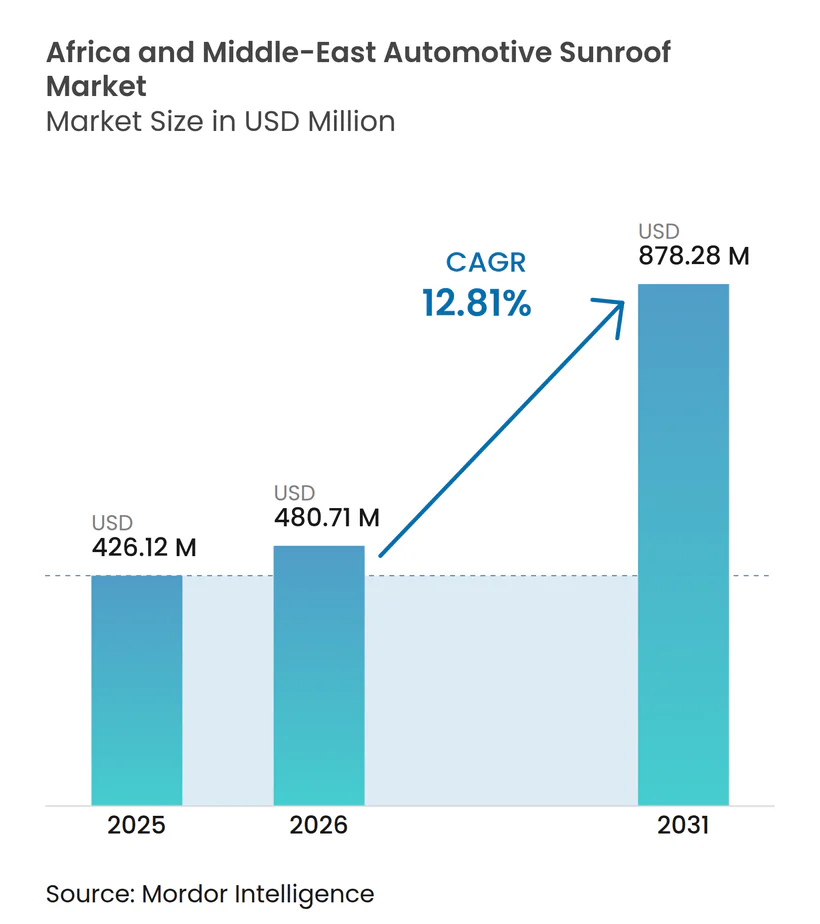
| Base Year Market Size (2025) | USD 426.12 Million |
| Market Size (2026) | USD 480.71 Million |
| Market Size (2031) | USD 878.28 Million |
| Growth Rate (2026 - 2031) | 12.81 % |
| Market Concentration | Medium |
Major Players *Disclaimer: Major Players sorted in no particular order Image © Mordor Intelligence. Reuse requires attribution under CC BY 4.0. | |
Africa and Middle-East Automotive Sunroof Market Analysis by Mordor Intelligence
The Africa and Middle East automotive sunroof market was valued at USD 426.12 million in 2025, is estimated at USD 480.71 million in 2026, and is projected to reach USD 878.28 million by 2031, growing at a CAGR of 12.81% from 2026 to 2031. Growing SUV adoption, sovereign-backed localization plans, and the rapid arrival of battery-electric vehicles are expanding the customer base, while new glazing standards are anchoring glass as the dominant material. Panoramic roofs are now a core differentiator on mid-tier trims, and electric actuation has shifted from premium to default status as tariff reforms in Egypt and technology cost compression sweep through volume segments. Regional manufacturing commitments by Hyundai Motor Group, NIO, and Volkswagen Group have shortened suppliers' lead times. However, challenges such as durability issues in desert climates and fluctuating energy costs for float glass continue to elevate warranty risks and price pressures. While the leading global suppliers dominate the market, their reliance on imported modules has created opportunities for local Tier-2 fabricators. These fabricators, capable of quickly assembling and servicing modules, are well-positioned to address this gap. The competitive intensity in the market remains moderate.
Key Report Takeaways
- By sunroof system type, panoramic roofs led with 43.88% share of the Africa and Middle East automotive sunroof market in 2025 and are projected to grow at 14.64% through 2031.
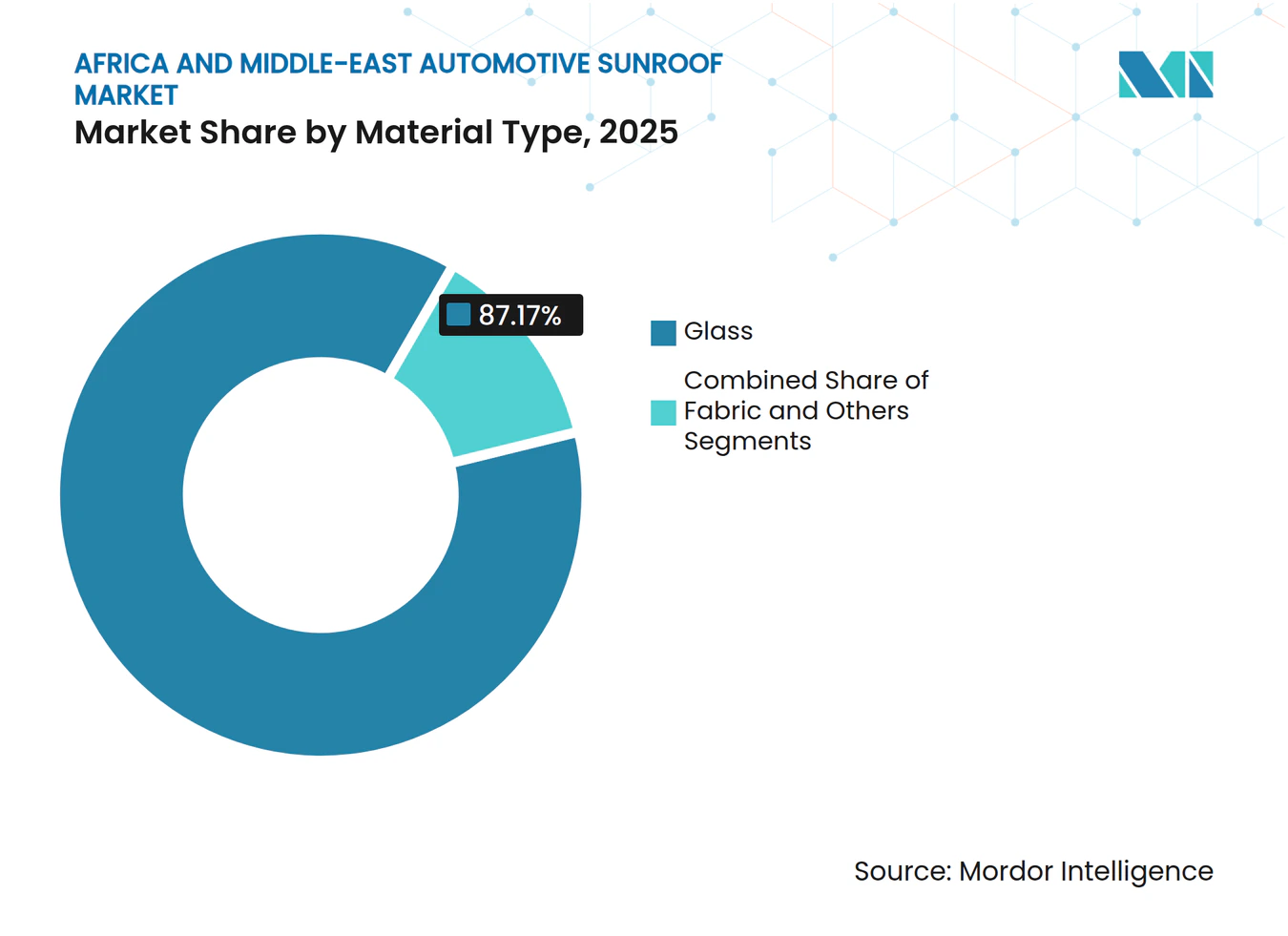
- By material type, glass captured 87.17% share while fabric alternatives are fading; the segment is expanding at a 13.34% CAGR, the highest rate among materials.
- By operation type, electric actuation commanded 84.33% of the Africa and Middle East automotive sunroof market share in 2025 and will rise at 13.28% through 2031.
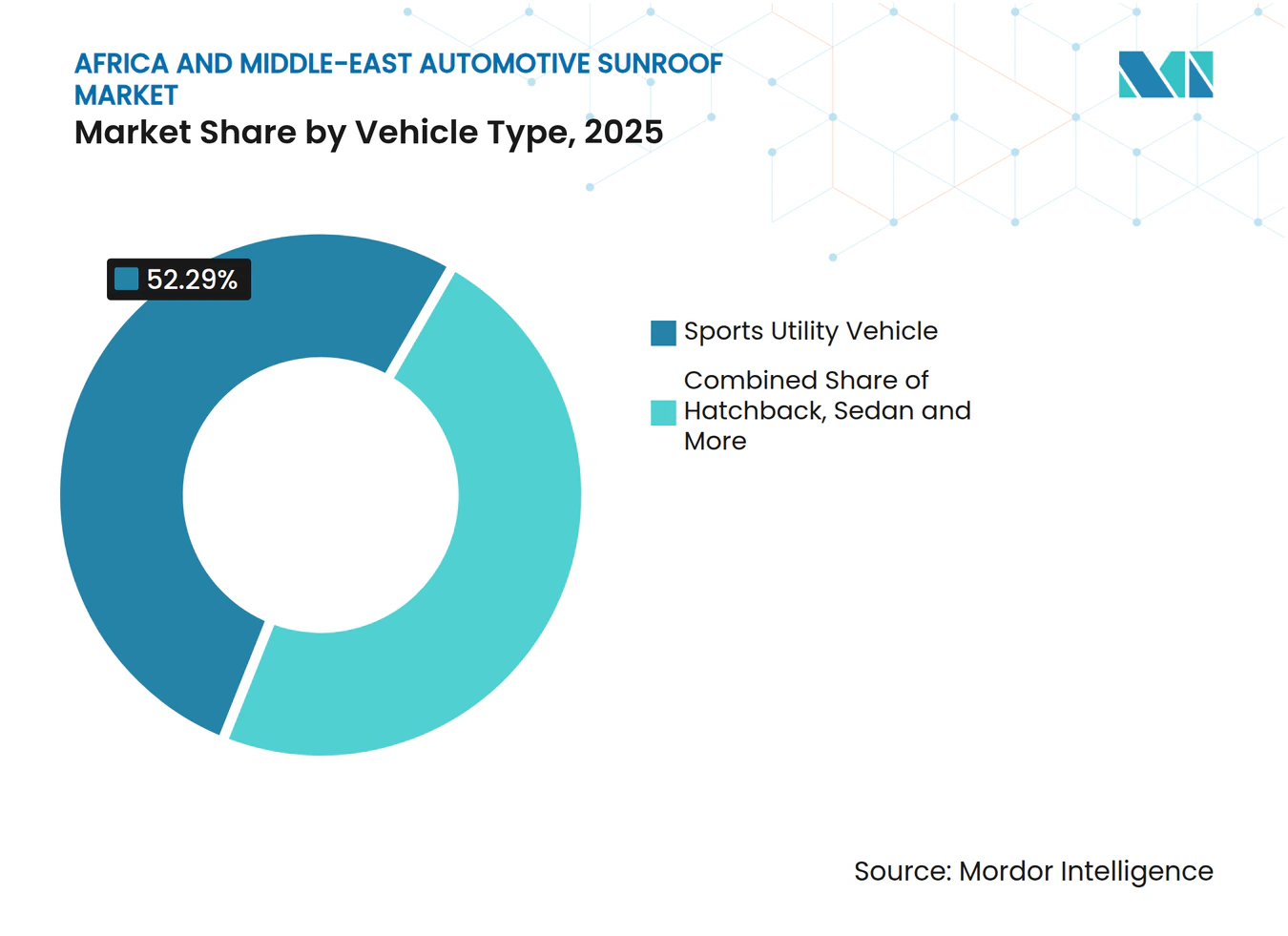
- By vehicle type, sport utility vehicles accounted for 52.29% of revenue in 2025 and remain the fastest-growing body style, with a 13.19% CAGR.
- By propulsion, battery-electric vehicles post the highest growth rate at 15.22%, even though internal-combustion platforms retain 74.43% of sales.
- Geographically, the United Arab Emirates dominated with 35.63% revenue in 2025, whereas Egypt is set to expand the fastest at 12.99% through 2031.
Note: Market size and forecast figures in this report are generated using Mordor Intelligence’s proprietary estimation framework, updated with the latest available data and insights as of January 2026.
Market Trends and Insights
Drivers Impact Analysis of Africa and Middle-East Automotive Sunroof Market*
| Driver | (~) % Impact on CAGR Forecast | Geographic Relevance | Impact Timeline |
|---|---|---|---|
| Surging SUV and Crossover Penetration | +2.5% | UAE, Saudi Arabia, Qatar, Egypt, South Africa | Medium term (2–4 years) |
| Rapid EV Roll-outs with Larger Glass Roofs | +2.2% | UAE, Saudi Arabia, Egypt | Medium term (2–4 years) |
| OEM Localization Incentives in GCC Nations | +1.8% | Saudi Arabia and UAE, plus assembly linkages to Egypt | Long term (≥4 years) |
| Replacement-Cycle Demand for Leak-Free Retrofits | +1.5% | UAE and Saudi Arabia | Short term (≤2 years) |
| Emergence of Solar-Assisted Smart Glass Roofs | +1.3% | GCC premium segments and South Africa | Long term (≥4 years) |
| Regulatory Push for Laminated Safety Glass | +1.2% | GCC nations and South Africa | Short term (≤2 years) |
| Source: Mordor Intelligence | |||
Surging SUV and Crossover Penetration
Sport utility vehicles now make up most new-car sales in Gulf markets, and OEMs routinely bundle panoramic roofs as standard on mid-tier and premium SUV trims to preserve pricing power. Nissan's SUV mix has increased, reflecting a growing preference for SUVs [1]. General Motors has reported significant volume growth, driven entirely by its full-size SUVs. Ford distributors have experienced growth, supported by the strong performance of the Explorer and Expedition models. Suppliers benefit from higher module prices for larger apertures compared to sedans, as well as extended replacement cycles in GCC fleets. As SUV penetration continues to rise, automakers are dedicating more resources to roof integration, enhancing the baseline specifications in the African and Middle Eastern automotive sunroof market.
Rapid EV Roll-outs with Larger Glass Roofs
Battery-electric vehicle platforms are gaining traction in GCC markets, offering panoramic roofs that stand out compared to their ICE counterparts. NIO and CYVN Holdings are establishing production in Egypt, incorporating fixed photovoltaic roofs with advanced energy-generating capabilities. Saudi Arabia's eMobility program aims to significantly increase EV penetration, supported by substantial investments. The Zeekr 001 and BYD Seal, both retailed across the GCC, feature panoramic panels engineered for UV and IR rejection. The International Energy Agency has highlighted a notable increase in EV adoption in Africa, narrowing the gap in feature adoption between Europe and the Middle East. Suppliers are encouraged to prioritize tooling to meet the growing demand for electrified vehicles in the sunroof market across Africa and the Middle East.
OEM Localization Incentives in GCC Nations
Saudi Arabia’s Public Investment Fund and Hyundai Motor Group have formed a joint venture to establish vehicle production with a focus on increasing local content [2]. Stellantis is planning an assembly site in a special economic zone in South Africa to significantly boost production capacity. Volkswagen Group has initiated a feasibility study for an automotive zone in Egypt, strategically positioning Tier-1 clusters near the proposed plant. These initiatives aim to enhance regional manufacturing capabilities and streamline supply chains for components such as glass, frames, and actuators. Early-moving suppliers are leveraging engineering localization opportunities and addressing the growing demand for automotive sunroofs in Africa and the Middle East.
Emergence of Solar-Assisted Smart Glass Roofs
Electrochromic and photovoltaic roofs are transitioning from mere concepts to mainstream automotive features. Renault's Solarbay roof, debuting as standard on the Scenic E-Tech, can rapidly adjust its opacity. AGC's Digital Curtain glass, which can adjust light transmission to minimal levels, has entered series production. Polestar achieved a notable adoption rate for its electrochromic roof, surpassing the regional average. Toyota's Prius harnesses roof-mounted PV cells to enhance its electric range. While these advanced technologies command significant price premiums, they effectively address challenges posed by desert heat, thereby elevating the premium segment of the automotive sunroof market in Africa and the Middle East.
Restraints Impact Analysis of Africa and Middle-East Automotive Sunroof Market*
| Restraint | (~) % Impact on CAGR Forecast | Geographic Relevance | Impact Timeline |
|---|---|---|---|
| Desert-Climate Dust Accelerating Seal Failure | –1.8% | UAE, Saudi Arabia, Qatar, North Africa | Medium term (2–4 years) |
| High Import Duties on Finished Roof Modules | –1.4% | Egypt, Algeria, Morocco | Short term (≤2 years) |
| Volatility in Float-Glass Energy Input Costs | –1.3% | Europe-based suppliers serving Middle East and Africa | Short term (≤2 years) |
| Limited After-Sales Expertise Outside GCC | –0.9% | Egypt, Morocco, Sub-Saharan Africa | Medium term (2–4 years) |
| Source: Mordor Intelligence | |||
Desert-Climate Dust Accelerating Seal Failure
In certain regions, drain tubes clog, and weatherstrips harden significantly faster compared to temperate climates. Audi has issued bulletins highlighting perimeter seal failures in its Q5, Q7, Q8, and e-tron models. BMW has implemented a new drain routing system to address similar issues. Meanwhile, Volkswagen Golf owners in Saudi Arabia and the UAE have reported problems with channel cracking. Warranty claims have discouraged consumers from opting for sunroofs in their subsequent purchases, negatively impacting the potential volume of the automotive sunroof market in Africa and the Middle East.
High Import Duties on Finished Roof Modules
Egypt imposes high duties on finished vehicles, while separated glass panels and actuators face significantly lower duties. This discrepancy encourages suppliers to ship components in a knock-down form, leading to additional handling costs. In Algeria, the requirement for local equity on imports acts as a barrier for Tier-1 specialists. In Morocco, compliance with stringent regulations has increased the cost of imported vehicles, prompting OEMs to omit sunroofs from entry-level trims. These tariff imbalances are slowing the adoption of premium features in the automotive sunroof market across Africa and the Middle East.
*Our forecasts treat driver/restraint impacts as directional, not additive. The impact forecasts reflect baseline growth, mix effects, and variable interactions.
Africa and Middle-East Automotive Sunroof Market Segment Analysis
By Material Type:
Glass Dominance Reinforced by Safety MandatesGlass accounted for 87.17% of the Africa and Middle East automotive sunroof market size in 2025 and will expand at a 13.34% CAGR through 2031. Laminated-glass mandates across GCC nations and South Africa have made fabric roofs commercially irrelevant, cutting their share to 3% by 2031. Saint-Gobain has significantly increased its capacity in Egypt, while AGC's joint venture in Morocco has enhanced its operations, reducing lead time for regional OEMs. Consumers prioritize optical clarity and UV stability, and suppliers avoid the additional tooling costs associated with fabric. As regulations align, laminated glass has become the standard, driving demand for value-added features such as embedded antennas and electrochromic layers in the automotive sunroof market across Africa and the Middle East.
Fabric's limited resistance to weather and its inability to incorporate heating grids or photovoltaic cells further weaken its competitive position. Polycarbonate panels occupy a niche in aftermarket Jeep or off-road kits but face the same regulatory challenges as fabric in type approvals. Glass processors colocated with final assembly benefit from tariff savings and faster warranty turnarounds, thereby improving OEM working-capital cycles. As supply-chain localization progresses, glass is expected to maintain its cost and performance advantages, reinforcing its dominant position in the automotive sunroof sector of Africa and the Middle East.



By Sunroof System Type:
Panoramic Roofs Capture Premium PositioningPanoramic designs captured 43.88% of the Africa and Middle East automotive sunroof market share in 2025 and are forecast to grow 14.64% by 2031. OEMs are pushing larger apertures down the trim ladder, as these features give SUVs and BEVs a more spacious feel and a higher perceived value. While drag-sensitive EVs benefit from built-in roofs that maintain a low profile, the tilt-n-slide feature remains tied to legacy contracts. Meanwhile, entry-level buyers in Egypt and Morocco are gravitating towards pop-up formats.
Advances in tempered glass, coupled with thinner frames and integrated shade tracks, have made panoramic modules scalable and cost-effective. Renault’s Scenic E-Tech now comes standard with a Solarbay roof, signaling that electrochromic panoramic technology has shed its luxury-only label. Data from Polestar indicates that the GCC shows a stronger preference for electrochromic options than Europe does. Module manufacturers are introducing modular rail systems, enabling them to reuse tooling across different wheelbases and, in turn, reducing per-unit costs. As panoramic options increasingly become the centerpiece of showroom marketing, their market share in the Africa and Middle East automotive sunroof segment continues to grow.
By Operation Type:
Electric Actuation Becomes Default SpecificationElectric systems held 84.33% share of the Africa and Middle East automotive sunroof market size in 2025 and are on track for a 13.28% CAGR. Egyptian and Moroccan entry trims continue to feature manual crank roofs due to their cost-effectiveness compared to electric alternatives.
By integrating the motor driver into the body control unit, manufacturers can eliminate the need for a separate harness. Additionally, features like anti-pinch and rain-close address are emerging safety mandates. Hyundai's joint venture in Egypt is prioritizing electric modules, even in mid-tier sedans, accelerating the transition away from manual systems. The increasing adoption of electric actuation is driving a shift toward standardized specifications, simplifying sourcing in the automotive sunroof markets of Africa and the Middle East.
By Vehicle Type:
Sport Utility Vehicle Drive Volume and Margin ExpansionSport utility vehicles accounted for 52.29% of segment revenue in 2025 and are projected to grow at 13.19% through 2031, outpacing every other body style. Sedans are losing showroom share, and hatchbacks are blurring into mini-crossovers, boosting average roof apertures.
Higher ride heights mitigate the loss of headroom caused by thicker laminated panes, so OEMs are aggressively adopting glass roofs on SUVs. Longer vehicle lifespans in GCC fleets are driving greater aftermarket demand for seals and actuators. Suppliers see revenue gains both at sale and throughout the ownership cycle, reinforcing the SUV bias in the African and Middle Eastern automotive sunroof market.

By Vehicle Propulsion:
BEVs Lead Growth Despite ICE DominanceInternal-combustion platforms still accounted for 74.43% of 2025 shipments, yet battery-electric variants will post a 15.22% CAGR through 2031. BEV architectures are now designed to enhance roof space, creating a more spacious cabin feel.
NIO is implementing a photovoltaic roof strategy, while Xiaomi is introducing high-IR-blocking glass. These innovations address concerns about desert heat, making panoramic roofs nearly essential for new EV models. As charging networks expand and the share of BEVs increases, so does the adoption of premium specifications, boosting overall profitability in the sunroof market for the automotive sector in Africa and the Middle East.
Geography Analysis
MEA Automotive Sunroof Market
The United Arab Emirates accounted for 35.63% of regional revenue in 2025, driven by premium imports and the influence of its headquarters on model specifications. Saudi Arabia followed at about 30%, and its Hyundai-PIF plant, launching in 2026, will pull component sourcing onshore. South Africa is supported by its established local vehicle assembly base. Stellantis’ target to produce 1 million units regionally by 2030 is expected to drive further demand for sunroofs over the forecast period.
Egypt is the fastest riser, forecast to grow at a 12.99% CAGR through 2031, following tariff cuts on glass panels and Volkswagen’s feasibility study for a new assembly plant. NIO's announcement of manufacturing and R&D activities in Egypt and Abu Dhabi underscores the strategic importance of these locations for new-energy players, especially for validation in hot climates. Morocco, Algeria, Qatar, and other emerging African markets are expected to gain prominence as supply chains become more efficient.
AGC's plant in Kenitra ensures North African OEMs receive supplies within a tight timeframe. Meanwhile, Saint-Gobain's expansion in Ain Sokhna offers minimal lead times for laminated panes. The region is witnessing growing demand for digital components, driven by evolving market dynamics. These factors highlight the pivotal role of GCC states in driving feature adoption, with Egypt and South Africa emerging as key manufacturing hubs. As after-sales capacities improve, smaller markets are positioned to enhance their penetration, supporting the sustained growth of the Africa and Middle East automotive sunroof market.
Competitive Landscape
Market Concentration
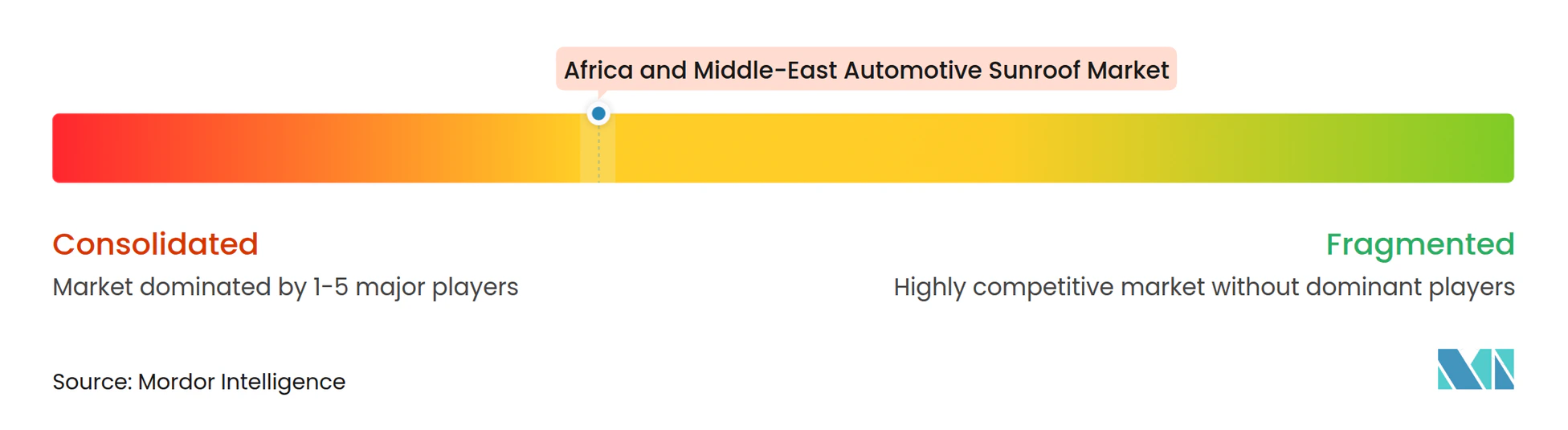
Webasto, Inalfa, and Magna dominate a significant share of shipments but rely heavily on imports for nearly all modules. This dependence exposes them to high tariffs and extended transit times. Webasto generates most of its revenue from its roof systems division, with sales offices located in Dubai and Johannesburg. Inalfa has expanded its Indian facility to cater to Hyundai and Kia vehicles destined for the Gulf. Meanwhile, Magna has identified Morocco as a cost-effective assembly hub but has not yet established any regional capacity.
Saint-Gobain's recent expansion in Egypt, along with its investment in a solar-powered furnace, highlights a strategic move towards vertical integration. This approach stabilizes energy costs and accelerates delivery times. AGC's electrochromic glass has entered production and is targeting multiple GCC OEMs for future models. Additionally, Chinese glass manufacturers, such as Fuyao, are exploring joint ventures in Saudi Arabia and Egypt, driven by localization mandates in the region.
Regional Tier-2 fabricators are assembling knock-down kits and offering competitive warranty services, reducing the advantages previously held by importers. Suppliers that integrate lamination, module framing, and aftermarket distribution are well-positioned to gain market share as OEMs increasingly demand faster cycle times and local-currency pricing. As a result, the automotive sunroof market in Africa and the Middle East is transitioning from a Europe-centric export model to a localized ecosystem. In this evolving landscape, strategies around tariffs and service density will be critical in determining market leaders.
Africa and Middle-East Automotive Sunroof Industry Leaders
-
Webasto Group
-
Inalfa Roof Systems B.V.
-
Magna International Inc.
-
Motherson Yachiyo Automotive Systems Co., Ltd.
-
AISIN Corporation
- *Disclaimer: Major Players sorted in no particular order
Africa and Middle-East Automotive Sunroof Market Companies Covered in this Report
- Webasto Group
- Inalfa Roof Systems B.V.
- Magna International Inc.
- AISIN Corporation
- Motherson Yachiyo Automotive Systems Co., Ltd.
- Inteva Products LLC
- CIE Automotive S.A.
- BOS GmbH & Co. KG
- Johnan America Inc.
- Donghee Industrial Co.
- Mingfang Automotive Parts
- AGC Inc.
- Fuyao Glass Industry Group
- Nippon Sheet Glass Co., Ltd.
- Valeo Group
- Johnson Electric Holdings
Read Analysis of Africa and Middle-East Automotive Sunroof Companies
Recent Industry Developments in Africa and Middle-East Automotive Sunroof Market
- July 2026: Jetour launched the refreshed Dashing and X70 Plus SUVs in South Africa. The updated models offer revised exterior styling, enhanced comfort, advanced technology, and improved safety features. The new Dashing features an upgraded interior, including an eight-speaker Sony audio system, dual-zone climate control, a panoramic sunroof, and heated and ventilated front seats in the Prime variant.
- June 2026: El-Khanagry Group and Delemar Automotive, a subsidiary of Delemar Industrial Group, announced a partnership to develop, manufacture, assemble, and supply smart automotive sunroof systems in Egypt with more than 75% local content.
- April 2026: Saint-Gobain Egypt announced EUR 215 million in new investments in sustainable building materials to support the green economy and localize advanced manufacturing. The first project is a specialty glass plant in the Suez Canal Economic Zone (SCZONE), representing EUR 175 million in foreign direct investment. The facility is set to become the group’s largest in the Middle East and Africa. It is expected to produce 900 tons of glass per day for the automotive and solar energy sectors, helping reduce Egypt’s annual import bill by approximately USD 35 million.
Africa and Middle-East Automotive Sunroof Market Report Scope
The Africa and Middle East Automotive Sunroof Market Report is Segmented by Material Type (Glass, Fabric, and Others), Sunroof System Type (Built-in, Tilt-n-Slide, Panoramic, and Pop-Up / Spoiler), Operation Type (Electric and Manual), Vehicle Type (Hatchback, Sedan, Sports Utility Vehicle, and Multi-purpose Vehicle / Others), Vehicle Propulsion (Internal Combustion Engine, Battery Electric Vehicle, and Hybrid Electric Vehicle / Plug-in Hybrid Electric Vehicle), and Country. Market Forecasts are Provided in Terms of Value (USD).
Segmentation Overview
By Material Type
| Glass |
| Fabric |
| Others |
By Sunroof System Type
| Built-in |
| Tilt-n-Slide |
| Panoramic |
| Pop-Up / Spoiler |
By Operation Type
| Electric |
| Manual |
By Vehicle Type
| Hatchback |
| Sedan |
| Sports Utility Vehicle |
| Multi-puropose Vehicle / Others |
By Vehicle Propulsion
| Internal Combustion Engine |
| Battery Electric Vehicle |
| Hybrid Electric Vehicle / Plug-in Hybrid Electric Vehicle |
By Country
| United Arab Emirates |
| Saudi Arabia |
| South Africa |
| Egypt |
| Rest of Africa and Middle-East |
| By Material Type | Glass |
| Fabric | |
| Others | |
| By Sunroof System Type | Built-in |
| Tilt-n-Slide | |
| Panoramic | |
| Pop-Up / Spoiler | |
| By Operation Type | Electric |
| Manual | |
| By Vehicle Type | Hatchback |
| Sedan | |
| Sports Utility Vehicle | |
| Multi-puropose Vehicle / Others | |
| By Vehicle Propulsion | Internal Combustion Engine |
| Battery Electric Vehicle | |
| Hybrid Electric Vehicle / Plug-in Hybrid Electric Vehicle | |
| By Country | United Arab Emirates |
| Saudi Arabia | |
| South Africa | |
| Egypt | |
| Rest of Africa and Middle-East |
Key Questions Answered in the Report
What is the projected value of the Africa and Middle East automotive sunroof market by 2031?
The market is forecast to reach USD 878.26 million by 2031.
Which sunroof system is growing the fastest in the region?
Panoramic roofs are expanding at a 14.64% CAGR, the highest among system types.
Why are SUVs important to sunroof suppliers in the Middle East?
SUVs command higher roof-module prices, longer replacement cycles, and now represent more than half of new-vehicle sales in GCC markets.
How do laminated-glass regulations affect material choice?
GCC and South African standards require laminated glass, pushing fabric and polycarbonate roofs toward obsolescence.
What is the impact of EV adoption on sunroof demand?
Battery electric vehicles allocate up to 20% more roof aperture, driving the fastest growth rate at 15.22% for sunroof modules.