
Aerospace Floor Panels Market Size and Share
Market Overview
| Study Period | 2020 - 2031 |
|---|---|
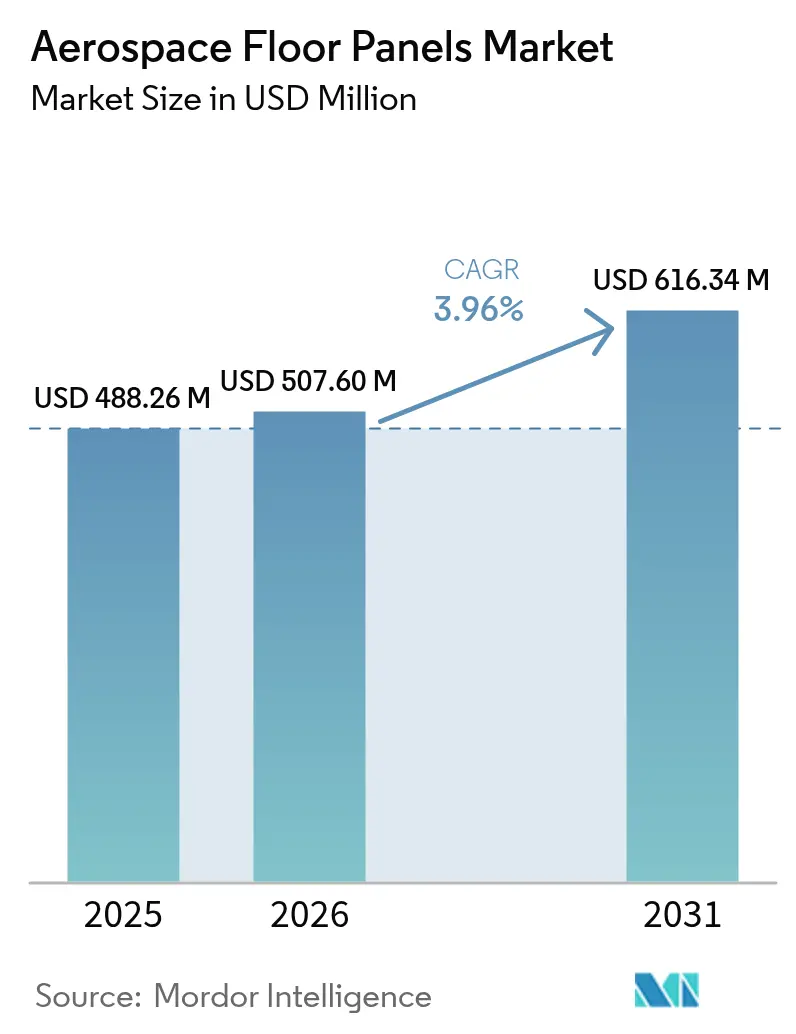
| Market Size (2026) | USD 507.6 Million |
| Market Size (2031) | USD 616.34 Million |
| Growth Rate (2026 - 2031) | 3.96 % |
| Fastest Growing Market | Asia Pacific |
| Largest Market | North America |
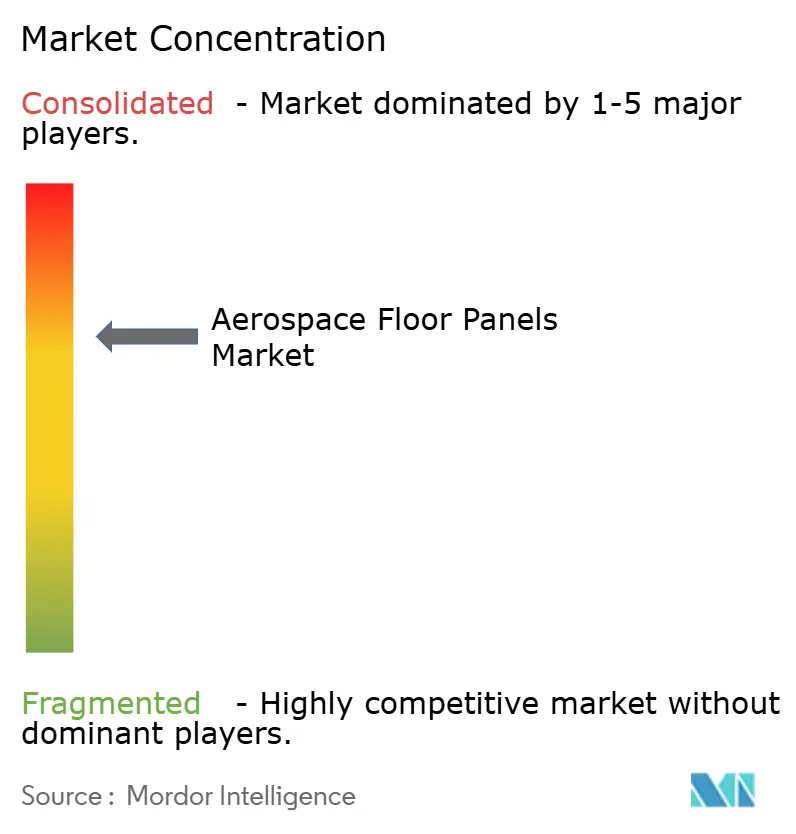
| Market Concentration | Medium |
Major Players *Disclaimer: Major Players sorted in no particular order Image © Mordor Intelligence. Reuse requires attribution under CC BY 4.0. | |
Aerospace Floor Panels Market Analysis by Mordor Intelligence
Aerospace Floor Panels Market size in 2026 is estimated at USD 507.6 million, growing from 2025 value of USD 488.26 million with 2031 projections showing USD 616.34 million, growing at 3.96% CAGR over 2026-2031. Accelerated wide-body and narrow-body aircraft deliveries, stringent fuel-burn regulations, and rapid composite adoption continue to underpin demand. Airlines favour lightweight honeycomb panels that shave 20-30% off structural weight, delivering measurable fuel savings per flight. Strong order backlogs—Boeing alone projects 44,000 new aircraft through 2043—ensure a multiyear production runway. OEMs and tier suppliers are therefore scaling automated thermoplastic lines while investing in regional supply chains that mitigate raw-material uncertainty. Meanwhile, rising retrofit programs create a secondary revenue stream as operators refit legacy cabins to comply with updated FAR 25.853 fire-safety rules.
Key Report Takeaways
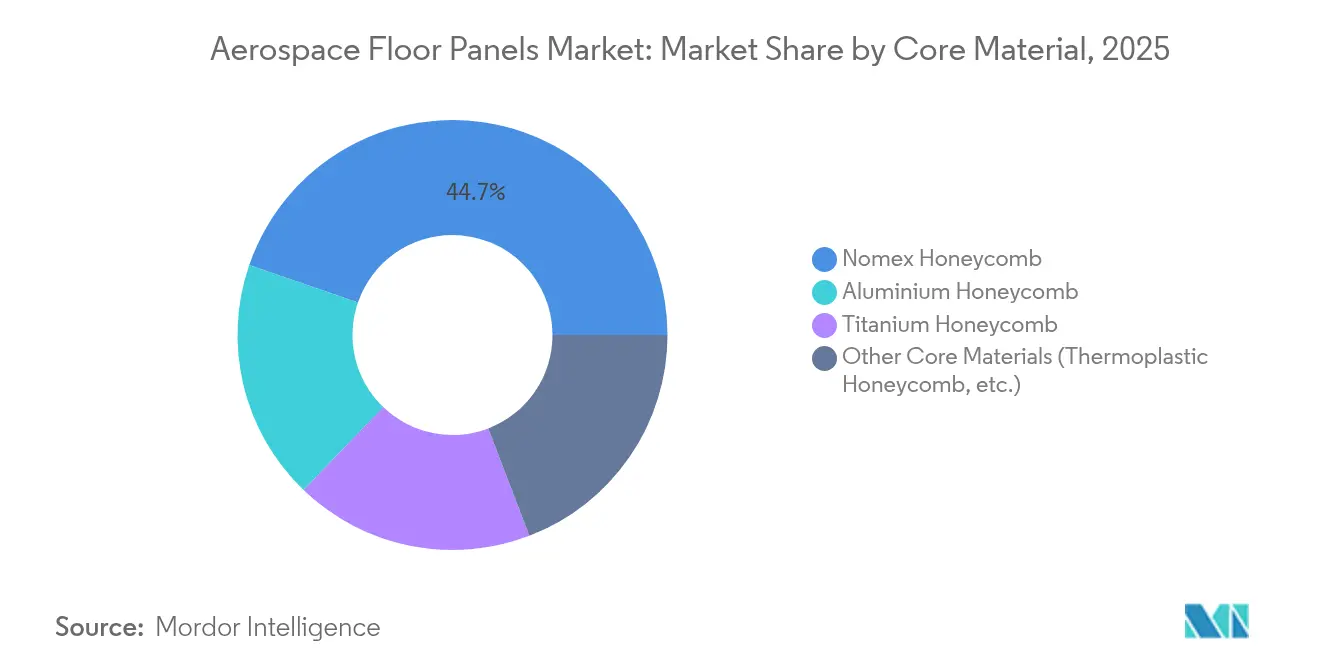
- By core material, Nomex honeycomb led with 44.72% aerospace floor panels market share in 2025, while thermoplastic honeycomb is forecast to expand at a 5.05% CAGR to 2031.
- By installation area, passenger cabin floors accounted for 58.03% of the aerospace floor panels market size in 2025 and are advancing at a 4.98% CAGR through 2031.
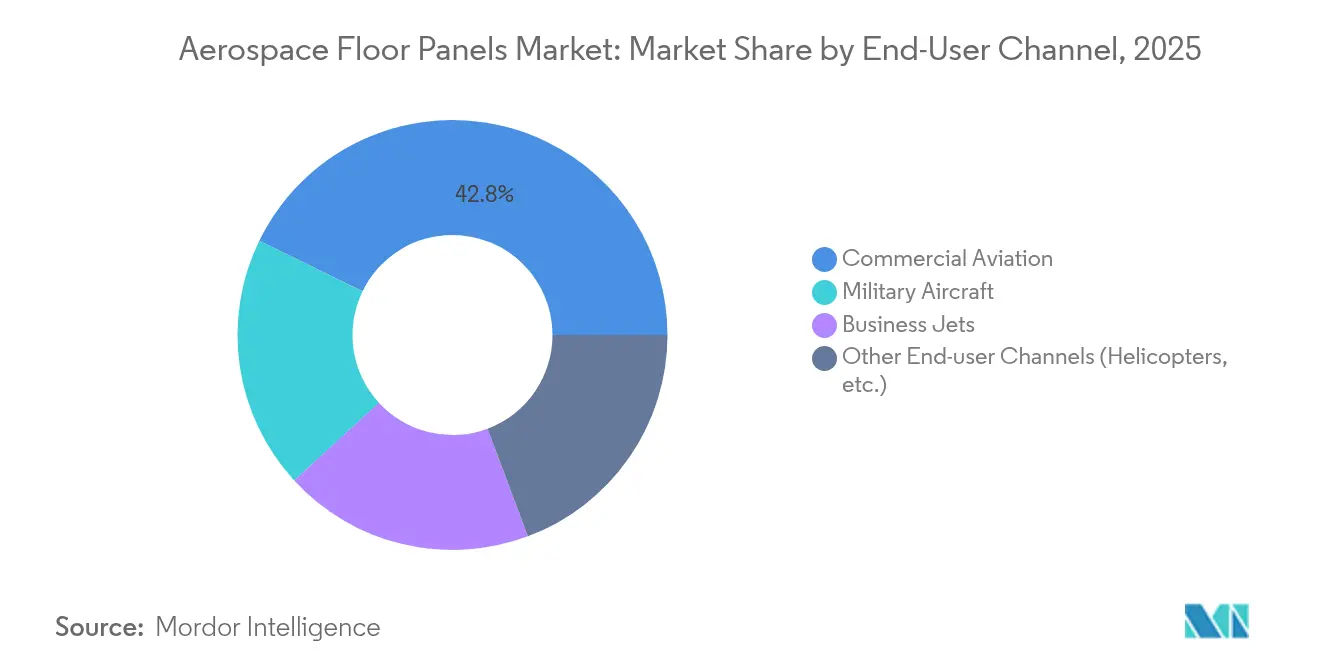
- By end-user channel, commercial aviation held 42.78% revenue share in 2025, whereas other end-user channels post the fastest 5.12% CAGR to 2031.
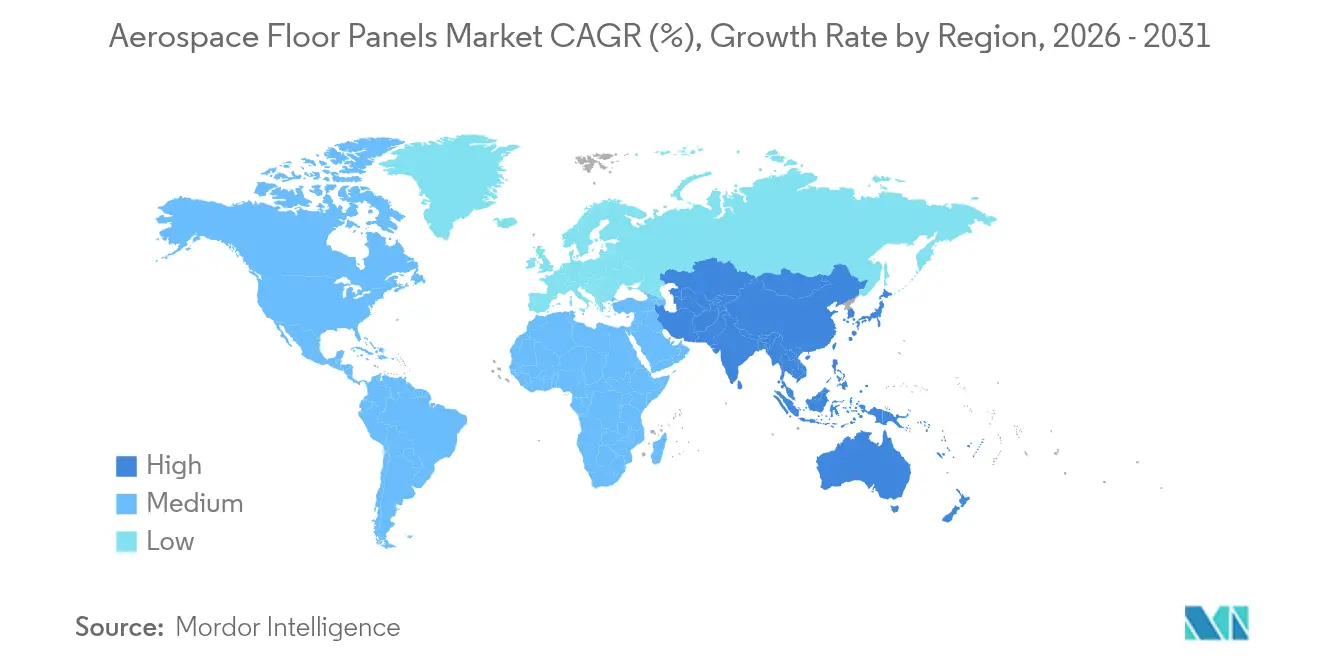
- By geography, North America commanded 38.21% share of the aerospace floor panels market in 2025, yet Asia-Pacific is set to record the highest 4.72% CAGR between 2026-2031.
Note: Market size and forecast figures in this report are generated using Mordor Intelligence’s proprietary estimation framework, updated with the latest available data and insights as of 2026.
Market Trends and Insights
Drivers Impact Analysis of Aerospace Floor Panels Market*
| Driver | (~) % Impact on CAGR Forecast | Geographic Relevance | Impact Timeline |
|---|---|---|---|
| Growing number of new-build & retrofit aircraft deliveries | +1.20% | Global, with concentration in Asia-Pacific and North America | Medium term (2-4 years) |
| Stringent fuel-burn & CO₂ regulations accelerating lightweighting | +0.90% | Global, led by EU and North America regulatory frameworks | Long term (≥ 4 years) |
| Rapid adoption of composite honeycomb floor panels | +0.80% | North America & Europe, expanding to Asia-Pacific | Medium term (2-4 years) |
| Low-cost carrier (LCC) expansion boosting narrow-body demand | +0.70% | Asia-Pacific core, spill-over to Latin America and MEA | Short term (≤ 2 years) |
| Additive-manufactured titanium honeycomb cores speeding MRO turnaround | +0.50% | North America & Europe, with selective adoption in Asia-Pacific | Long term (≥ 4 years) |
| Source: Mordor Intelligence | |||
Growing Number of New-Build & Retrofit Aircraft Deliveries
Boeing forecasts just under 44,000 aircraft additions over the next two decades, with single-aisle models representing roughly three-quarters of the pipeline[1]Boeing, “Boeing Forecasts Demand for Nearly 44,000 New Airplanes Through 2043,” investors.boeing.com . Airlines increasingly schedule mid-life cabin overhauls that replace legacy aluminum boards with lighter honeycomb alternatives to secure immediate fuel savings. India anticipates 4,000 incremental airframes and 200 new airports within twenty years, amplifying retrofit prospects alongside new builds. China adds another growth vector: COMAC plans to lift C919 output to 75 units annually by 2029 to meet a domestic backlog topping 1,000 jets. Each incremental frame requires 30–50 m² of primary cabin flooring, guaranteeing a persistent demand baseline. Retrofit work also benefits MRO centres, which can install certified thermoplastic panels during heavy-check windows without altering structural load paths.
Stringent Fuel-Burn & CO₂ Regulations Accelerating Lightweighting
The European Fit-for-55 package and similar schemes worldwide obligate airlines to slash per-seat emissions, making cabin weight an actionable lever. Composite floor solutions cut panel mass by up to 30% versus aluminium, improving block fuel by roughly 0.5% on a narrow-body mission. Diehl Aviation’s ECO Sidewall, combining carbon fibre skins and Kepler honeycomb, shows how interior programmes integrate weight and waste reduction; the concept trims 10% mass and 33% scrap. Airlines also link lightweighting to sustainable aviation fuel economics because every kilogram saved extends SAF burn efficiency. Consequently, composite panel upgrades feature prominently in decarbonisation roadmaps filed with regulators or used to negotiate airport carbon charges.
Rapid Adoption of Composite Honeycomb Floor Panels
Thermoplastic advancements are removing historical cost and cycle-time barriers. EconCore’s ThermHex line extrudes continuous PP or PEEK honeycomb from a single sheet, achieving 4-6 × throughput gains while enabling full recyclability. Collins Aerospace mirrors this acceleration via automated fibre placement and fusion bonding on a next-generation nacelle programme slated for technology readiness level 6 by 2026. NASA’s HiCAM initiative corroborates scalability, targeting similar 4-6 × productivity leaps using co-curable thermoset and thermoplastic prepregs. Together, these innovations compress production bottlenecks that once limited composite penetration in high-volume narrow-body programmes.
Additive-Manufactured Titanium Honeycomb Cores Speeding MRO Turnaround
Laser-powder-bed technology is unlocking on-demand titanium honeycomb production for high-temperature floor assemblies in military and rotary platforms. GE Aerospace earmarked nearly USD 1 billion for U.S. additive facilities that include honeycomb prototyping cells targeting 40% cycle-time reductions on spares by 2027[2]GE Aerospace, “GE Aerospace to Invest Nearly USD 1B in U.S. Manufacturing in 2025,” geaerospace.com . While currently niche, printed cores alleviate raw-material bottlenecks and cut the logistical lead times that often ground aircraft awaiting replacement parts.
Restraints Impact Analysis of Aerospace Floor Panels Market*
| Restraint | (~) % Impact on CAGR Forecast | Geographic Relevance | Impact Timeline |
|---|---|---|---|
| Raw-material price volatility (aramid fibre, aluminium, titanium) | -0.60% | Global, with acute impact in North America and Europe | Short term (≤ 2 years) |
| Geopolitical supply-chain shocks for aerospace honeycomb cores | -0.40% | Global, concentrated in regions dependent on Eastern European and Russian suppliers | Medium term (2-4 years) |
| Certification delays for next-gen thermoplastic floor systems | -0.30% | North America & Europe regulatory jurisdictions, cascading to global markets | Long term (≥ 4 years) |
| Source: Mordor Intelligence | |||
Raw-Material Price Volatility (Aramid Fibre, Aluminium, Titanium)
Global titanium output slid 12% between 2019 and 2024 as Ukrainian mining disruptions collided with export curbs, pressuring aerospace alloys. Aluminium costs remain sensitive to trade actions; U.S. tariffs of 25% on selected imports keep spot prices elevated relative to pre-trade-war averages. DuPont’s Nomex supply chain has also faced intermittent capacity constraints, triggering double-digit quarterly price swings for aramid paper used in honeycomb cores. OEMs respond by multisourcing, forward-buying, and engineering substitution options, but margin compression persists when contracts lock in catalog prices.
Geopolitical Supply-Chain Shocks for Aerospace Honeycomb Cores
Russia long supplied roughly 30% of commercial-grade titanium sponge used in Western programmes; sanctions now complicate that flow and extend qualification cycles for alternative smelters. Japan and Kazakhstan have ramped investment, yet aerospace certification requires multiyear testing. Meanwhile, honeycomb core conversion often clusters near titanium sources, so any upstream disruption ripples through panel capacity. Government mineral-security initiatives, including stockpiles and low-interest loans for new melt facilities, aim to buffer long-term exposure.
*Our forecasts treat driver/restraint impacts as directional, not additive. The impact forecasts reflect baseline growth, mix effects, and variable interactions.
Aerospace Floor Panels Market Segment Analysis
By Core Material:
Thermoplastic Innovation Challenges Nomex DominanceNomex honeycomb retained 44.72% revenue in 2025, reflecting entrenched OEM specifications and a global supplier ecosystem tuned for high-volume output. Despite its lead, the aerospace floor panels market is tilting toward thermoplastic honeycomb, which is forecast to grow at 5.05% CAGR this decade. The performance uplift hinges on continuous-sheet technologies that marry mechanical strength with one-shot forming, thus cutting takt time and scrap. Thermoplastic boards also meet closed-loop recycling targets that regulators increasingly require. Aluminium honeycomb still finds favour in cargo decks where cost metrics trump every kilogram, while titanium cores remain vital for hot-zone floors on military transports. Additive-manufactured titanium promises future cost parity by eradicating machining waste and enabling lattice optimisation. Other experimental cores—ranging from basalt fibres to bio-resins—continue pilot testing with an eye on life-cycle carbon metrics.
Adoption trajectories vary by platform class. Narrow-body programmes lean toward PP and PEI thermoplastic variants because service temperatures rarely exceed 150 °C. Wide-body jets and long-range business aircraft prefer PEKK or PPS cores that withstand higher cabin floor loads and galley heat. Consequently, material suppliers pursue platform-specific qualification roadmaps rather than one-size strategies. Competition is intensifying as Asian compounders seek to undercut Western incumbents on cost while matching flame and smoke performance. Intellectual-property protection around core geometry remains a differentiator; patents on cell size gradients and edge-closure methods help vendors secure sole-source contracts. The aerospace floor panels industry therefore exhibits a dual dynamic: legacy Nomex supply chains deliver price stability at scale, whereas thermoplastic disruptors capture share through speed and sustainability credentials.



By Installation Area:
Passenger Cabin Floors Drive Market ExpansionPassenger cabin floors generated 58.03% of 2025 revenue and will post the fastest 4.98% CAGR through 2031 as airlines refit densified layouts. Aircraft interiors teams view the cabin floor as prime territory for energy savings because it spans the entire passenger footprint. Installing a full set of advanced composite boards on a single-aisle jet can remove roughly 80 kg, equating to a lifetime fuel saving of near USD 250,000 under prevailing kerosene prices. Cabin reconfigurations escalate turnover because seat-track patterns must align precisely with floor-beam hard points; each time carriers move rows to tweak pitch, they often replace affected panels.
Cargo deck floors trail but still benefit from a projected need for 2,800 freighters by 2043, many converted from passenger airframes. Cockpit floors, galley zones, and lavatories collectively form a stable replacement market driven by avionics retrofit, food-service upgrades, and lavatory downsizing trends. Modular flooring kits are gaining popularity because line-maintenance crews can swap damaged panels during overnight stops, reducing AOG risk. Looking ahead, eVTOL developers are already specifying thermoplastic honeycomb in prototype cabins, potentially opening a nascent subsegment once urban air mobility certifies.
By End-User Channel:
Commercial Aviation Leads as Other Channels AccelerateCommercial carriers represented 42.78% of 2025 spending as major OEM lines in Renton, Toulouse, and Shanghai continued high monthly rates. The aerospace floor panels market size for commercial aviation is predicted to expand steadily given the multi-year delivery skyline. Yet the strongest 5.12% CAGR momentum comes from other end-user channels. Honeywell foresees 8,500 new business jets valued at USD 280 billion within ten years, with North America absorbing two-thirds of these units. High-net-worth buyers demand bespoke interiors, prompting panel suppliers to offer custom veneer faceskins and rapid-prototype core layouts.
On the defence side, floor panels must survive higher point loads from palletised cargo or armoured troop seats, leading to titanium or hybrid carbon-titanium constructions. Rotorcraft fleets add unique requirements such as anti-slip surfacing and vibration damping for medevac missions. MRO organisations increasingly stock thermoplastic spare panels because they can be trimmed on-site with heat-stapling tools, cutting turnaround during phase inspections. The aerospace floor panels industry therefore captures a broad usage spectrum, from volume-driven airlines to low-volume, high-margin bespoke jets, balancing commodity scale with premium engineering.
Geography Analysis
North America Aerospace Floor Panels Market
North America held 38.21% revenue share in 2025, thanks to an established manufacturing base stretching from Wichita through the Carolinas to Québec. Collins Aerospace’s USD 225 million footprint expansion across Fort Worth, Spokane, and Pueblo raised carbon brake and honeycomb capacity by more than 50% and secures long-term panel resin supply. Regional airline fleet renewal, including a 77-aircraft order from ANA Holdings for North American routes, reinforces order stability.
APAC Aerospace Floor Panels Market
Asia-Pacific, however, is registering the quickest 4.72% CAGR. India’s requirement for 2,500-plus aircraft and aggressive airport expansion is reshaping supply-chain geography, with local composite shops popping up around Hyderabad and Bengaluru. China’s C919 advance, aided by annual rates of 75 units by 2029, accelerates domestic demand for compliant cabin components. Japan and South Korea are also incentivising locally sourced interiors under economic-security statutes, nudging global vendors to license technology or pursue JVs.
Europe, LATAM and Middle East Aerospace Floor Panels Market
Europe leverages deep composites expertise clustered in Germany, France, and the UK. Programmes such as Diehl’s ECO Sidewall feed into Airbus interior packages, keeping the region influential in design authority decisions. Latin America and the Middle East show mixed growth tied to tourism recovery and LCC proliferation; both regions import most panels but could cultivate assembly hubs to sidestep shipping lead times. Collectively, these geographic currents ensure the aerospace floor panels market remains globally diversified while tilting toward Asia-centric volume growth.

Regulatory Landscape
Certification and continued airworthiness requirements for aerospace floor panels are governed primarily by FAA and EASA rules for large aeroplanes, with flammability and fire-penetration compliance anchored in 14 CFR 25.853 and EASA CS-25. These frameworks shape material selection and panel architecture, since passenger and cargo-area panels must meet standardized flammability and heat-release testing defined in the associated Appendix F methods.
Beyond regulator text, OEM-specific interior material and sandwich construction standards are also used as day-to-day design inputs. Airbus internal standards such as ABS-5987 control dimensions, tolerances, and material specifications for PAX and CARGO floor panel sandwich constructions, while next-generation processes (including additive manufacturing for metallic sub-elements) still need to demonstrate compliance to the same strength and flammability baselines. In 2025, the Aerospace Industries Association (AIA) guidance referencing ASTM F3572-22 shows how industry frameworks are being used to structure certification evidence for advanced manufacturing without relaxing safety expectations.
Value Chain Analysis
The value chain starts with upstream feedstocks and semi-finished materials, including aramid paper (Nomex-type) and aluminum or titanium inputs for honeycomb cores, carbon fiber or glass fiber reinforcement for faceskins, and flame-retardant resin or prepreg systems for bonding and co-curing. These inputs are then processed by core converters and panel fabricators that manage critical steps such as core splicing, core-to-skin bonding or co-curing, potting and insert integration, and finishing (anti-slip surfaces, edge sealing). Qualification is tied to both OEM material specifications and FAA or EASA compliance pathways.
Downstream, Tier-1 and specialist interior structure suppliers deliver certified floor systems and kits to airframe OEM final assembly lines, and they support the aftermarket through MROs, where panels are replaced during heavy checks and cabin reconfiguration events. Examples of active participants across fabrication and integration include Collins Aerospace (RTX), The Gill Corporation, Comtek Advanced Structures, and Elbe Flugzeugwerke (EFW, an Airbus and ST Engineering joint venture). Bottlenecks typically cluster around honeycomb core availability and qualification, along with process control for bonding and potting, where variability can trigger re-test and re-certification. This dynamic encourages suppliers to move toward standardized semi-finished panel formats and more automated, repeatable manufacturing steps to protect throughput and compliance documentation.
Competitive Landscape
The aerospace floor panels industry features a moderately consolidated tier-one layer atop a long tail of regional players. Hexcel reported 11.8% commercial aerospace revenue growth in 2024 and showcased new honeycomb ranges at the 2025 Paris Air Show that boost out-of-plane compression by 15%. Collins, meanwhile, is verticalising thermoplastic nacelle know-how into floorboards, betting on common materials and robotic drilling to accelerate learning curves.
Strategic alliances dominate. Safran Cabin clinched the 2025 Crystal Cabin “IFEC & Digital Services” award for an integrated interior concept that relies on in-house honeycomb floor assemblies, signalling its intent to bundle panels with electrical and IFE routing. Gurit is expanding German prepreg lines while shutting higher-cost Swiss capacity, highlighting a pivot to regional specialisation.
Entry barriers stem from certification cost and knowledge capital. FAR 25.853 fire testing can swallow USD 2 million per material variant and takes nine to twelve months. Digital simulation is lowering trial iterations, yet incumbents still enjoy decades of statistical fire data that new entrants must replicate. Additive manufacturing is the wild card: if GE or similar OEMs prove repeatability at scale, smaller fabricators might leapfrog traditional core cutting, altering the competitive calculus. Patent landscapes around honeycomb geometry and edge sealing remain intense, prompting continuous litigation monitoring.
Aerospace Floor Panels Industry Leaders
Collins Aerospace
Comtek Advanced Structures Ltd.
Hexcel Corporation
The Gill Corporation
The NORDAM Group LLC
- *Disclaimer: Major Players sorted in no particular order
Aerospace Floor Panels Market Companies Covered in this Report
- AVIC Cabin Systems (UK)
- Collins Aerospace
- Comtek Advanced Structures Ltd.
- Corex Honeycomb
- DuPont
- Elbe Flugzeugwerke GmbH
- Encore Aerospace LLC
- Gurit Services AG, Zurich
- Hexcel Corporation
- Safran
- Showa Aircraft Industry Co., Ltd.
- Teledyne Aerospace & Defense
- The Gill Corporation
- The NORDAM Group LLC
- Toray Advanced Composites

Market Opportunities and Future Outlook
Near-term whitespace centers on certified lightweighting solutions that reduce cabin mass while meeting fire, smoke, and heat-release requirements under 14 CFR 25.853 and EASA CS-25. Airline cabin retrofits are creating recurring pull for replacement panels and modular floor kits that shorten AOG windows. At the same time, OEM and Tier supply bases are investing in higher-throughput composite manufacturing to support high-rate single-aisle programs. The report context also points to continuous-sheet thermoplastic honeycomb approaches (such as EconCore ThermHex) and productivity programs (NASA HiCAM) designed to deliver multi-fold throughput gains.
Materials and sustainability-driven product development are adding further differentiation lanes, especially for recyclable thermoplastic honeycomb and recycled-carbon-fiber sandwich concepts that still need to meet aerospace certification evidence requirements. In 2026, the Eco-Floor project reported completion of a continuous process chain for highly oriented recycled carbon fiber tapes targeted at cabin floor sandwich panels, which provides a reference pathway for lower-waste and circular-material content in interior structures. In parallel, OEM-facing qualification activity around new flame-resistant aramid honeycomb cores, as cited for Boeing in 2026 for interior applications, reinforces the opportunity for suppliers that can deliver certified core-and-skin systems with improved fire performance, stable supply, and repeatable processing across both line-fit and retrofit demand.
Recent Industry Developments in Aerospace Floor Panels Market
- July 2026: Embraer completed the acquisition of the remaining 50% stake in the EZ Air joint venture from Safran Cabin, taking full control of the Chihuahua-based interiors facility. Consolidating ownership strengthens Embraer control over interior industrialization and supply continuity for programs that use cabin components such as floor panels across E-Jet and E2 families.
- June 2026: Hexcel announced a long-term industrial partnership and supply agreement with Deutsche Aircraft to provide advanced composite solutions for the D328eco regional aircraft program. The agreement signals multi-year materials and processing alignment that supports qualification planning and production ramp for composite interior and structural content across the supply chain.
- May 2024: JCB Aero developed an aircraft interior flooring panel system using SHD Composites FRVC411 prepreg, positioned for the MRO market with weight and cost reduction goals. The development highlights aftermarket-driven demand for certified material systems that can be integrated into repair and replacement workflows without compromising fire-safety compliance.


Aerospace Floor Panels Market Report Scope and Research Methodology
Market Definition and Coverage
This market covers floor panels used inside aircraft to form walkable and load-bearing flooring, mainly across passenger cabins and cargo areas, including panels supplied to OEM production and the replacement market.
Scope exclusions: We exclude sidewall and ceiling panels, cargo loading equipment, seats and seat tracks, and unrelated interior sub-assemblies that are not floor-panel structures.
Segments Covered in This Report
- By Core Material
- Nomex Honeycomb
- Aluminium Honeycomb
- Titanium Honeycomb
- Other Core Materials (Thermoplastic Honeycomb, etc.)
- By Installation Area
- Passenger Cabin Floor
- Cargo Deck Floor
- Cockpit Floor
- Galley and Lavatory Zones
- By End-User Channel
- Commercial Aviation
- Military Aircraft
- Business Jets
- Other End-user Channels (Helicopters, etc.)
- By Geography
- Asia-Pacific
- China
- Japan
- India
- South Korea
- ASEAN Countries
- Rest of Asia-Pacific
- North America
- United States
- Canada
- Mexico
- Europe
- Germany
- United Kingdom
- France
- Italy
- Spain
- Russia
- NORDIC Countries
- Rest of Europe
- South America
- Brazil
- Argentina
- Rest of South America
- Middle East and Africa
- Saudi Arabia
- South Africa
- Rest of Middle East and Africa
- Asia-Pacific
Data Sources, Market Sizing, and Validation
Desk Research
Desk work starts by mapping the aircraft production and delivery picture, because floor panels follow the aircraft build cycle and retrofit activity. We reference public sources such as FAA airworthiness and safety releases, EASA rulemaking and certification notes, ICAO air transport statistics, and trade data from sources like UN Comtrade to understand material and component flows.
To translate activity into demand, we also use annual reports, investor decks, and product catalogs from relevant aerospace interior and material suppliers, plus reputable aviation press for program rate changes and cabin retrofit timelines. For checks that are hard to build only from public documents, we selectively use paid subscriptions for company financials and intelligence, patent databases, and aerospace and aviation databases that provide aircraft-level context. These examples are not exhaustive, and other public sources were also reviewed to collect data, validate assumptions, and clarify gaps.
Primary Interviews and Surveys
Primary inputs come from interviews and structured surveys with a mix of aircraft interior component suppliers, raw material providers, MRO-focused participants, and engineering or procurement stakeholders. Since the market is global, we spread coverage across major build and overhaul regions, and we use these discussions to confirm how lightweight cores are adopted, how replacement cycles are described in practice, and how pricing shifts with certification approach and program mix.
Distribution of primary research fieldwork respondents
| Company type | Respondent position | Region |
|---|---|---|
| Top tier: 31% | CXOs: 14% | APAC: 47% |
| Mid tier: 55% | Functional/Unit leaders: 37% | EMEA: 29% |
| Smaller Players: 14% | Managers: 49% | Americas: 24% |
Market-Sizing & Forecasting
Sizing is built using a top-down approach where aircraft production and in-service fleet activity are translated into floor-panel demand by applying fitment intensity and replacement rates. For each major aircraft group, we estimate the typical panel area or set count, then adjust for utilization patterns that drive wear and retrofit needs.
A few practical inputs shape the model, such as aircraft deliveries by type, the share of cabin retrofits versus line-fit, typical panel material mix (for example, honeycomb sandwich versus metallic options), certification-driven content changes, and average selling price movement tied to resin, core materials, and lightweighting requirements. After the top-down totals are built, the results are corroborated with selective bottom-up approximations using sampled supplier revenue exposure, channel checks across OEM and aftermarket, and sanity checks on implied unit pricing.
Forecasting uses scenario analysis supported by multivariate regression on aircraft delivery outlooks and fleet utilization indicators, with assumptions refined through expert feedback. Where supplier coverage is partial in bottom-up checks, gaps are handled by using program-level penetration ranges and then rebalanced to align with the broader demand pool.
Data Validation & Update Cycle
Numbers are validated through multiple passes that compare model outputs with independent signals, such as aircraft delivery trends, MRO shop visit expectations, and the direction of material prices. If a region or aircraft type shows an unusual jump, the drivers are re-checked and, when needed, assumptions are re-confirmed with follow-up outreach.
Before sign-off, the work is reviewed for math consistency, currency handling, and year alignment, and then it is checked again against the storyline so the totals match market reality. Reports are refreshed annually, with interim updates when material events occur, and a final pre-delivery pass is completed so clients receive the latest view.
Mordor Intelligence's Aerospace Floor Panels Market Size Measured Against Other Published Estimates
Published numbers for aerospace floor panels do not always match, even when the topic name looks the same. Differences usually come from what is counted as a floor panel, which aircraft categories are included, the year used as the reference point, and how OEM and aftermarket demand are treated.
The benchmark table shows a noticeable spread, and in Mordor Intelligence's model the value is anchored to aircraft interior floor-panel structures tied to aircraft production and replacement cycles, instead of folding in adjacent cabin interior components or broader panel systems that can inflate totals.
Benchmark comparison
| Source | Market Size | Gaps in Research Methodology |
|---|---|---|
| Mordor Intelligence | USD 507.6 M (2026) | |
| Global Research Publisher A | USD 439.9 M (2024) | Uses an earlier reference year and may apply a narrower demand capture tied to near-term aircraft production, which can understate retrofit-driven replacement volumes when utilization rebounds. |
| Industry Research Publisher B | USD 527.0 M (2025) | Includes a different year and tends to assume faster price and volume expansion over the forward period, which can raise the stated base when aggressive penetration and ASP progression are back-solved. |
Across the three figures, the main drivers are year selection, what gets counted inside the floor-panel scope, and how replacement demand is weighted versus line-fit supply. By keeping assumptions linked to observable aircraft build rates and service activity, we can explain the total with clear steps that are easier to retest when conditions change.


Key Questions Answered in the Report
What is the current size of the aerospace floor panels market?
The aerospace floor panels market size stands at USD 507.6 million in 2026 and is projected to reach USD 616.34 million by 2031.
Which core material holds the largest share?
Nomex honeycomb leads with 44.72% market share, although thermoplastic variants are growing the fastest.
Why are thermoplastic honeycomb panels gaining traction?
They deliver 4-6 × faster production cycles, enable recyclability, and meet emerging sustainability mandates without sacrificing structural performance.
Which region is expanding the fastest?
Asia-Pacific posts the highest 4.72% CAGR, driven by large aircraft backlogs in China and India and expanding local manufacturing capability.
How do fuel-burn regulations influence demand for floor panels?
Weight-saving composite panels help airlines meet CO₂ reduction targets and improve the cost effectiveness of sustainable aviation fuel uptake.
Page last updated on:


 Your data is secure and never sold or shared.


