
Acrylic Coated Films Market Size and Share
Market Overview
| Study Period | 2021 - 2031 |
|---|---|
| Market Size (2026) | USD 5.51 Billion |
| Market Size (2031) | USD 7.29 Billion |
| Growth Rate (2026 - 2031) | 5.76 % |
| Fastest Growing Market | Asia-Pacific |
| Largest Market | Asia-Pacific |
| Market Concentration | Medium |
Major Players *Disclaimer: Major Players sorted in no particular order Image © Mordor Intelligence. Reuse requires attribution under CC BY 4.0. | |
Acrylic Coated Films Market Analysis by Mordor Intelligence
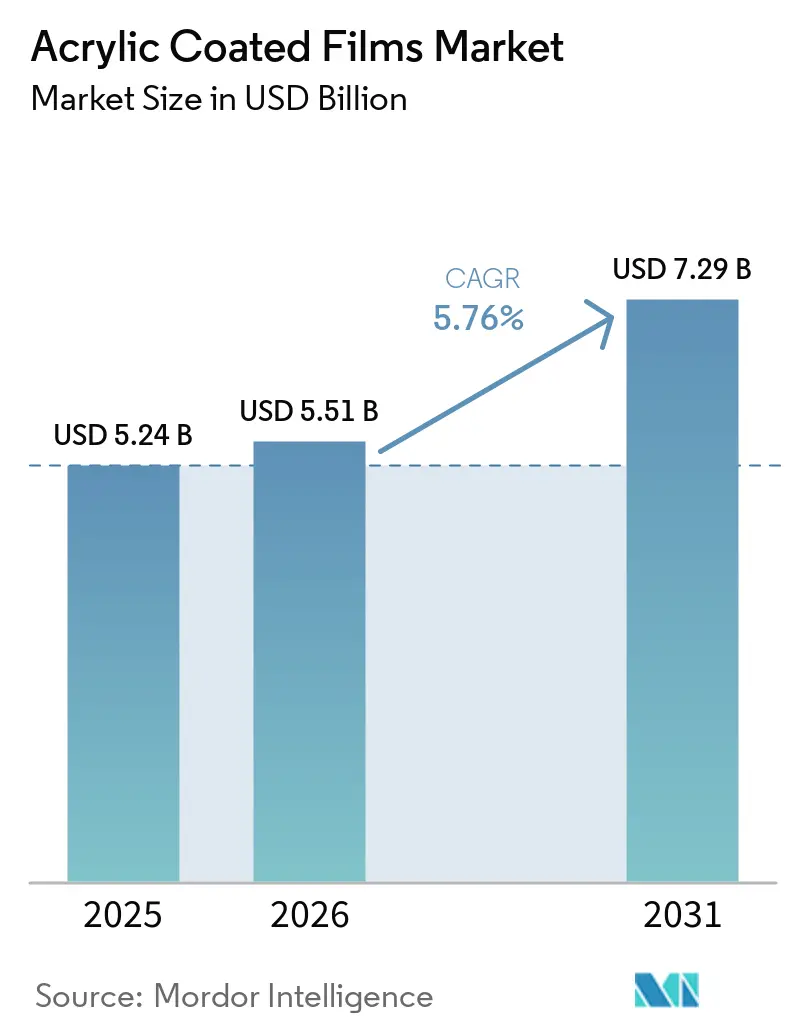
The Acrylic coated films market size was valued at USD 5.24 billion in 2025 and is estimated to grow from USD 5.51 billion in 2026 to reach USD 7.29 billion by 2031, at a CAGR of 5.76% during the forecast period (2026-2031). The acrylic coated films market is benefiting from the shift from rigid packaging to flexible formats in food and consumer goods applications. Shelf-life requirements are driving demand for coatings that provide barrier performance, seal integrity, clarity, and printability in a single layer. Sustainability requirements are directing investment toward water-based, solvent-free, and recyclable coating systems. This trend supports suppliers that meet food-contact, medical, and labeling specifications while simplifying packaging structures. The acrylic coated films market also offers opportunities in medical packaging and electronics protection films, where qualification requirements support specialized product offerings.
Key Report Takeaways
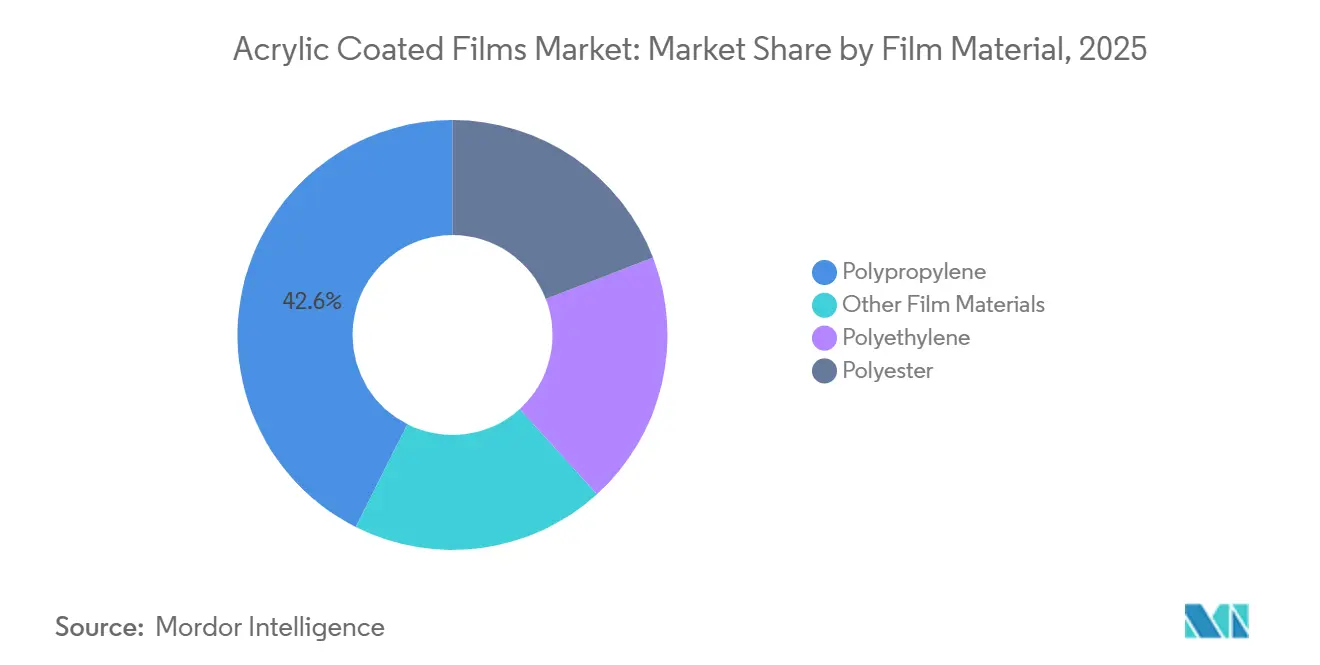
- By film material, polypropylene held 42.57% revenue share in 2025, while polyethylene is forecast to grow at 6.34% CAGR through 2031.
- By coating technology, water-based coatings held 35.34% revenue share in 2025 and are forecast to grow at a 6.51% CAGR through 2031.
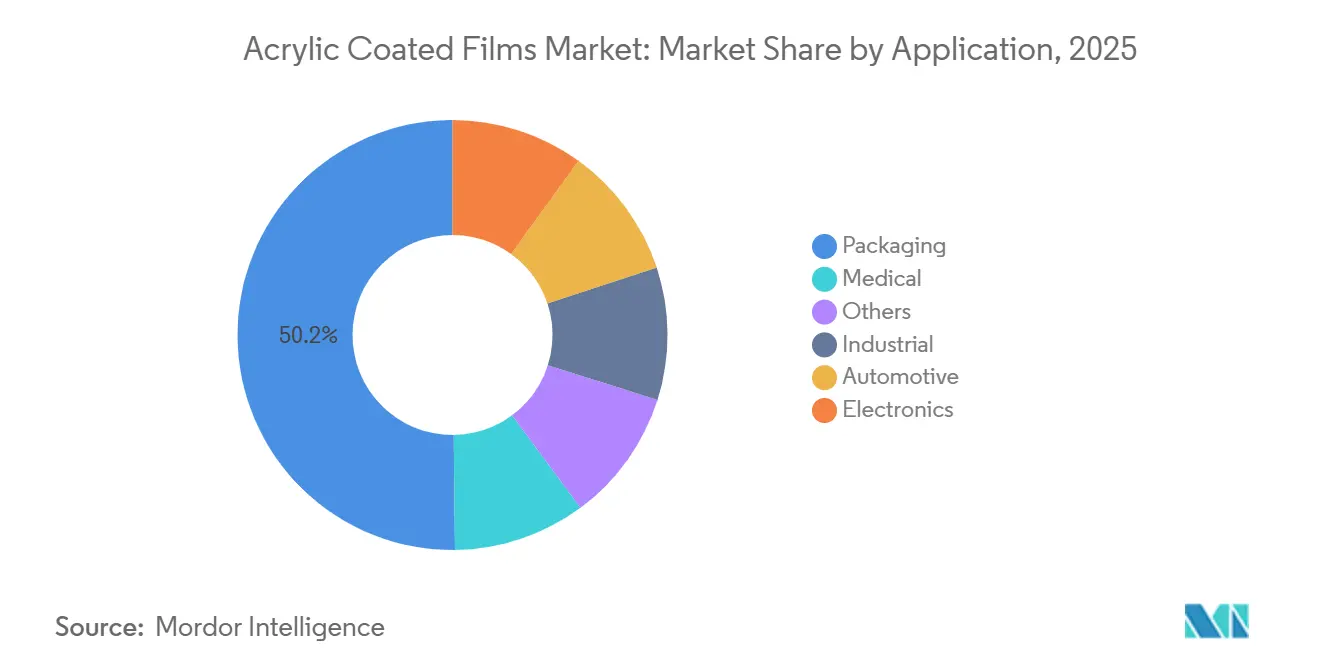
- By application, packaging accounted for 50.18% of revenue in 2025, while medical applications are forecast to grow at a 6.72% CAGR through 2031.
- By geography, Asia-Pacific accounted for 36.62% of revenue in 2025 and is forecast to grow at a 6.47% CAGR through 2031.
Note: Market size and forecast figures in this report are generated using Mordor Intelligence’s proprietary estimation framework, updated with the latest available data and insights as of January 2026.
Global Acrylic Coated Films Market Trends and Insights
Drivers Impact Analysis*
| Drivers | (~) % Impact on CAGR Forecast | Geographic Relevance | Impact Timeline |
|---|---|---|---|
| Flexible Packaging and Shelf-Life Extension Demand | +1.8% | Global | Short term (≤ 2 years) |
| Growth of Premium and Logistics Label Applications | +1.2% | Global, concentrated in North America, the EU, and Asia-Pacific (APAC) | Medium term (2-4 years) |
| Expansion of Mono-Material and Chlorine-Free Packaging Structures | +0.9% | EU core, with spillover to North America and APAC | Medium term (2-4 years) |
| Rising Demand for High-Barrier Transparent Films | +0.8% | Global | Short term (≤ 2 years) |
| Coating Compatibility with Digital and High-Speed Printing | +0.6% | North America, the EU, and APAC | Long term (≥ 4 years) |
| Source: Mordor Intelligence | |||
Flexible Packaging and Shelf-Life Extension Demand
The shift from rigid containers to flexible formats continues to drive demand in the acrylic coated films market, as it alters material consumption, shipping requirements, and packaging-line economics. Flexible packs can reduce package weight by 60-90% compared with glass or tin alternatives, lowering logistics requirements across food and fast-moving consumer goods supply chains and helping brands manage transportation loads. Acrylic coated biaxially oriented polypropylene (BOPP) films provide moisture and aroma barriers, seal performance, and printability for bakery, confectionery, and snack products that require a consistent appearance after distribution. Their use on high-speed horizontal and vertical form-fill-seal lines supports adoption in applications where output consistency, seal reliability, and stable processing conditions are important for converters. Modified-atmosphere packaging also requires controlled oxygen transmission, making coating thickness and uniformity important for fresh-food applications and premium formats with limited shelf-life tolerance. Taghleef Industries introduced a water-based, non-halogenated BOPP coating line in North America that operates at speeds up to 450 m/min and has an annual capacity of 10,000 tons, indicating an investment in this production approach in the acrylic coated films market[1].
Growth of Premium and Logistics Label Applications
Premium labels for wine, spirits, cosmetics, and pharmaceutical packaging require optical clarity, dimensional stability, and precise print registration. These requirements exceed those for many commodity food packaging applications and support the use of acrylic coated BOPP films, where appearance and line performance are important to brand owners, printers, and converters. In logistics applications, coated face-stock films must maintain barcode legibility under abrasion, humidity, and transit-related stress, as relabeling can create cost and service issues in fulfillment operations. Pharmaceutical serialization requirements also support demand for tamper-evident face stocks with reliable adhesive performance on automated dispensing lines and throughout distribution systems. H.B. Fuller stated in 2025 that label solutions must support recycling, perform across different substrates, and meet regulatory and safety requirements, combining multiple performance needs into a single specification. The acrylic coated films market is supported by this trend, as logistics and pharmaceutical distribution generate demand linked to product movement, traceability, and compliance rather than discretionary consumer spending.
Expansion of Mono-Material and Chlorine-Free Packaging Structures
Recyclability requirements are changing how converters design flexible packaging structures in Europe and across export supply chains serving European brand owners. Acrylic coatings can support mono-material designs by providing heat sealing, print adhesion, and aroma-barrier performance on a single polymer substrate, reducing the number of materials to manage after use. This approach reduces the need for cross-polymer adhesive layers, which complicate sorting and mechanical recycling, while allowing converters to retain established package functions. Flint Group launched its NexisCode chlorine-free heat-sealable coating range for mono-material packaging structures and positioned it as a replacement for polyvinyl chloride (PVC)-containing alternatives. Taghleef Industries also commercialized a two-sided acrylic coated oriented polypropylene (OPP) solution for coffee and confectionery overwrap applications, offering mono-material polypropylene (PP) recyclability and commercial machinability on overwrapping equipment. The acrylic coated films market is placing increased emphasis on water-based coating capacity, validated recyclable structures, and suppliers that can support converters during reformulation, particularly when food-contact performance, sealing behavior, appearance, and recycling requirements must be assessed together. Producers must also work closely with converters, as coating changes can affect printing, machine settings, package construction, and customer approval procedures.
Rising Demand for High-Barrier Transparent Films
High-barrier transparent films are used in applications where brands seek product visibility without using opaque metalized or foil structures that may limit shelf presentation. This trend is relevant to fresh-cut produce, premium snacks, and specialty cheese, where transparent packaging supports retail presentation and helps consumers assess products before purchase. Acrylic coated transparent films can provide the barrier and optical properties required for these applications while allowing converters to retain clear package designs. Electronics also represent a specialized application area, as protective overlays and flexible printed circuits require optical purity, antistatic properties, and dimensional stability under demanding service conditions. Acrylic coated films can meet this demand when producers meet electronics customers' technical requirements and support qualification activities. These requirements may favor suppliers with coating development capabilities, application-specific testing, and the ability to consistently control film performance at production scale, rather than suppliers that only demonstrate laboratory results. As a result, technical service, material testing, and knowledge of customer conversion processes can be as important as the coating’s barrier properties.
Restraints Impact Analysis*
| Restraints | (~) % Impact on CAGR Forecast | Geographic Relevance | Impact Timeline |
|---|---|---|---|
| Volatility in Polymer, Acrylic Acid, and Methyl Methacrylate Costs | -1.5% | Global | Short term (≤ 2 years) |
| Recycling Complexity in Coated Multilayer Structures | -1.0% | EU core, with spillover to North America | Medium term (2-4 years) |
| Long Qualification Cycles in Electronics and Automotive Applications | -0.7% | Global | Long term (≥ 4 years) |
| Source: Mordor Intelligence | |||
Volatility in Polymer, Acrylic Acid, and Methyl Methacrylate Costs
Input cost volatility poses a margin challenge for the acrylic coated films market, as substrate polymer and coating chemical costs can increase simultaneously, limiting suppliers' ability to manage price changes across the value chain. Film suppliers face cost pressures during both the base-film and coating stages of production, particularly when feedstock conditions affect multiple inputs at once. Producers without backward integration or indexed supply agreements may have limited capacity to absorb sudden increases in feedstock costs without adjusting customer prices. Delays in passing through higher costs can affect margins, contract negotiations, and the timing of investments in additional coating capacity. Chemical procurement strategies and contract structures are key competitive considerations for acrylic coated film suppliers serving food, label, medical, and specialty applications. Cost uncertainty can also limit smaller producers' ability to plan specialized coating investments and maintain inventory levels to support customers.
Recycling Complexity in Coated Multilayer Structures
Coated films used in multilayer laminates can be difficult to sort and reprocess through conventional mechanical recycling systems because these structures combine multiple materials and surface layers. Thin coating layers can alter surface properties and affect flake separation and the consistency of remelting, particularly in recycling systems with limited process control. Brand owners evaluate laminate structures and reduce coating combinations that do not meet recyclability testing requirements or customer sustainability program criteria. Water-based coatings on mono-material structures may be more compatible with recycling systems than solvent-based multilayer composites; however, manufacturers must assess performance for each end-use application. Outside Europe, the collection and processing infrastructure remains uneven. As a result, packaging reformulated for one recycling system may not perform similarly in other systems. The acrylic coated films market incurs additional qualification costs, longer product development cycles, and more complex product portfolios when producers maintain multiple packaging variants.
*Our forecasts treat driver/restraint impacts as directional, not additive. The impact forecasts reflect baseline growth, mix effects, and variable interactions.
Segment Analysis
By Film Material: Polypropylene Supports Demand, While Polyethylene Leads Mono-Material Growth
Polypropylene accounted for 42.57% of the acrylic coated films market share in 2025, supported by the use of biaxially oriented polypropylene (BOPP) on high-speed form-fill-seal lines. Its stiffness, dimensional stability, and optical clarity make it suitable for packaging in the bakery, confectionery, and fast-moving consumer goods sectors. The installed base for BOPP processing supports demand. Polypropylene also supports established converter practices for printing, sealing, and barrier performance. The acrylic coated films industry continues to use this material in applications where production speed and pack appearance are important. Its established role may limit the rapid substitution of materials in routine packaging formats.
Polyethylene is forecast to grow at a CAGR of 6.34% from 2026 to 2031, making it the fastest-growing film material segment. Demand is linked to mono-material polyethylene (PE) designs for e-commerce protective pouches, stand-up food pouches, and agricultural films. These applications are expanding across Asia-Pacific and North America. The contrast between polypropylene’s scale and polyethylene’s growth reflects the shift toward more readily recyclable designs. Polyester retains a role in thermoformed trays, retort packaging, and electronics overlays due to its thermal resistance. Cast polypropylene and regenerated cellulose continue to serve selected food and industrial applications that require specific breathability or barrier properties.

By Coating Technology: Water-Based Platforms Consolidate at Both Scale and Growth Rate
Water-based coatings held 35.34% of the acrylic coated films market size in 2025 and are forecast to grow at a CAGR of 6.51% through 2031. The segment benefits from its alignment with lower-emission and solvent-free production requirements. Water-based acrylic dispersions can provide heat-sealing, printability, and moisture-barrier performance across food packaging and label applications. The technology is becoming a primary production platform rather than a niche sustainability option. This shift benefits suppliers that have invested in water-based coating lines and creates retrofit requirements for companies that rely on older solvent-based assets.
Taghleef Industries operates a water-based, non-halogenated, high-oxygen-barrier BOPP coating line at speeds of up to 450 m/min, demonstrating the technology’s industrial-scale deployment. Solvent-based coatings remain relevant for applications requiring very high barrier performance, including humidity-sensitive export packaging and specialty industrial films. UV-curable coatings continue to serve overprint varnish and label applications because they cure rapidly at low line temperatures and provide surface hardness. However, their cost and energy requirements may restrict their use in commodity flexible packaging. Flint Group’s chlorine-free NexisCode platform demonstrates how heat-sealable coating chemistry is evolving in response to sustainability and regulatory pressures. The acrylic coated films market is likely to favor coating systems that combine production efficiency with recyclability.
By Application: Food Packaging Anchors Demand While Medical Attracts Premium Investment
Packaging accounted for 50.18% of the acrylic coated films market in 2025, making it the largest application category. Food packaging accounts for the largest share of this demand, driven by coated BOPP films used in bakery, snack, dairy, and personal care product packaging. Established equipment, converter expertise, and food-contact compliance procedures support the continued use of acrylic coated films. Packaging specifications rarely change without a clear technical or cost benefit. Industrial applications include protective films for metal, glass, and plastic surfaces during manufacturing and construction. Automotive and electronics applications have lower volumes but require stricter specifications and supplier approvals.
Medical applications are forecast to grow at a CAGR of 6.72% through 2031, the highest rate among application segments. Sterilization compatibility, flexible sterile barrier systems, and the expansion of pharmaceutical packaging in South and Southeast Asia support demand. Flexible packs for single-use medical devices can also reduce storage and logistics requirements for healthcare facilities. Amcor opened a USD 35 million advanced healthcare packaging coating facility in Subang Jaya, Malaysia, in April 2026, introducing air-knife coating technology for coated medical paper used in sterile device packaging. Long-term supply agreements in pharmaceutical procurement can make medical packaging revenue more predictable than commodity food packaging revenue. The acrylic coated films market offers opportunities in qualified healthcare applications.
Geography Analysis
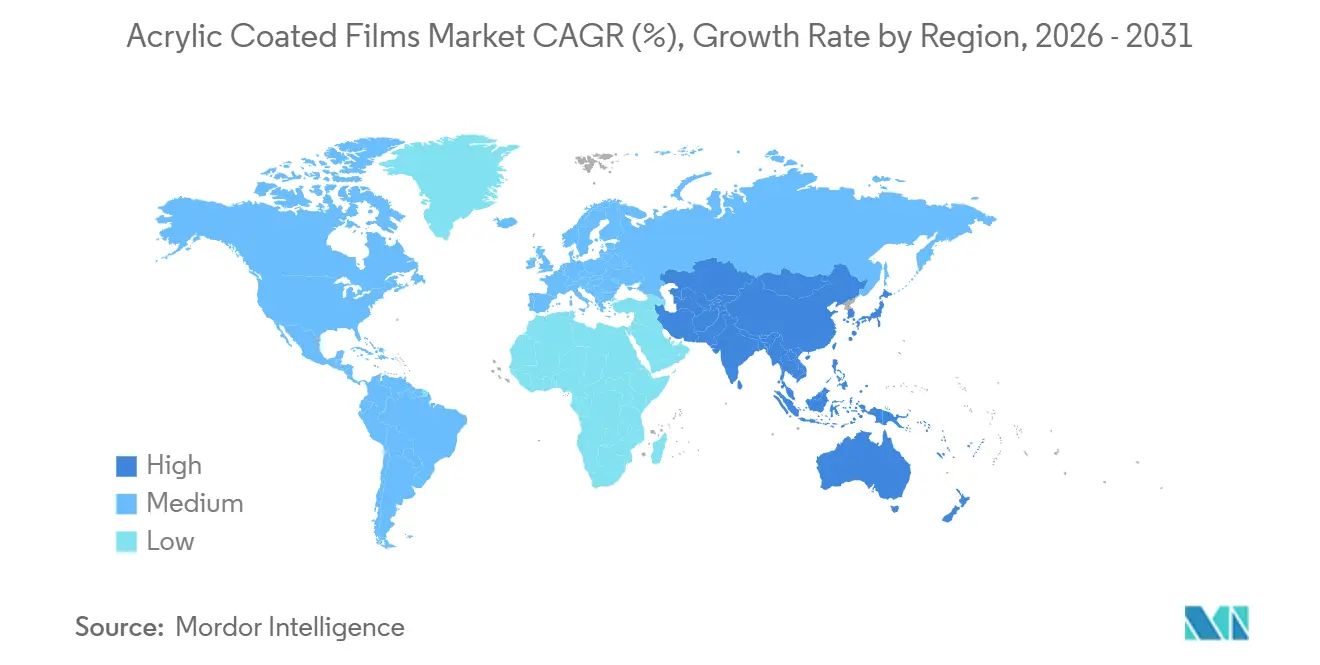
Asia-Pacific held a 36.62% share of the acrylic coated films market in 2025 and is forecast to grow at a CAGR of 6.47% through 2031. The region benefits from its established BOPP production base and the shift from rigid and uncoated packaging to coated flexible formats. China is a major contributor, supported by its large BOPP manufacturing base, while India is generating additional demand from pharmaceutical and fast-moving consumer goods packaging. In June 2026, Amcor expanded its healthcare packaging facility in Sira, Karnataka, through a multi-million-dollar investment in high-performance drug-delivery packaging for South Asia. South Korea supports demand for higher-value applications in electronics packaging, while Japan maintains stringent food safety and pharmaceutical packaging requirements.
North America and Europe represent the second tier of demand in the acrylic coated films market. Although their food packaging and label sectors are mature, packaging quality, sustainability, and regulatory compliance requirements remain stringent. European converters are increasingly adopting water-based coatings and recyclable mono-material structures. In March 2026, Amcor invested in a dedicated high-barrier, recycle-ready film production line at its Lugo di Vicenza, Italy, facility. The nearly 7,000 m² facility includes temperature-controlled curing chambers. In North America, pharmaceutical labels and premium food and beverage brands support demand for face stocks that enable precise print registration. Jindal Films Europe announced an investment at its Brindisi, Italy, site in October 2025, reflecting its continued commitment to specialty film capacity[2].
South America and the Middle East and Africa are developing demand corridors for the acrylic coated films market. Brazil and Argentina lead regional adoption through food and agricultural export packaging applications that require recognized substrate and barrier specifications. Saudi Arabia and South Africa support demand through food-processing modernization and pharmaceutical import-substitution initiatives. These regions currently account for a smaller share of global output. Their future contribution will depend on investments in local packaging infrastructure and the development of food safety and recycling requirements. Producers that adapt their products to local conversion conditions may be positioned to address incremental demand.
Competitive Landscape
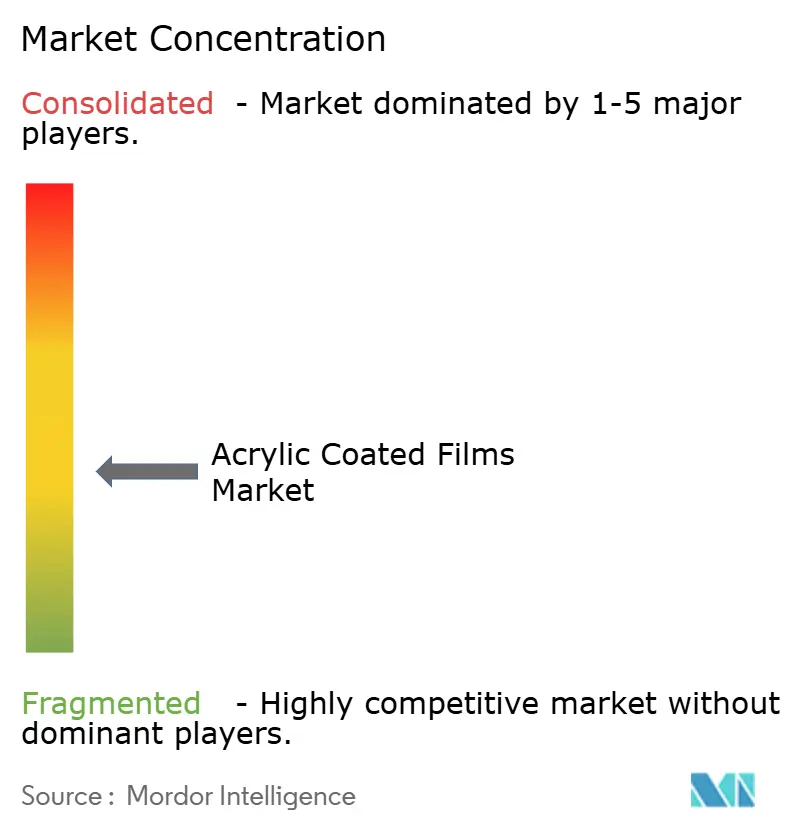
The global acrylic coated films market is moderately fragmented. Amcor, Mondi, and Coveris compete with specialist BOPP film producers, including Cosmo Films, Taghleef Industries, Jindal Films, SRF Limited, and UFlex Limited. Integrated packaging groups are expanding high-barrier coating capacity for medical and food-contact applications. Specialist producers offer water-based, non-halogenated barrier coatings, chlorine-free heat-seal chemistries, and precision multilayer coatings. These strategies address high-volume packaging and technically demanding applications. The acrylic coated films market benefits suppliers that combine production scale, coating expertise, and end-use qualification support.
Cosmo First commissioned a new BOPP line in June 2025, with capital expenditure exceeding INR 4 billion (USD 46 million). The line increased the company’s annual BOPP capacity by 40% to 277,000 tons. The company also stated that it was increasing the share of specialty films in its revenue mix. Smaller suppliers, such as Vacmet India, Vibac Group, and Perlen Packaging AG, compete through regional proximity and responsive application development. Their relationships with local converters can improve service speed in markets where large global platforms offer less flexibility. Competition is increasing as Indian and Southeast Asian producers enhance coating technologies and challenge established European suppliers on price and performance. Medical packaging and recyclable mono-material coatings remain areas where validated technical capabilities support supplier positioning.
Cosmo First invested in a KARO IV laboratory stretching machine in July 2025 to support the pilot-scale development of barrier coatings and recyclable film structures. This in-house development capability can reduce the time required to test new grades. SKC, Toray, and Transcendia operate in PET specialty films, engineered polymer composite structures, and the distribution of custom-engineered films. No single business model serves all film substrates and end-use applications. Amcor’s 2026 investments in Malaysia, India, and Italy indicate that large packaging groups are adding capacity near centers of healthcare and recyclable packaging demand. The acrylic coated films market remains competitive, as customers evaluate suppliers based on film performance, regulatory compliance, coating innovation, supply reliability, and regional service capabilities.
Acrylic Coated Films Industry Leaders
-
Cosmo Films
-
Jindal Films
-
Innovia Films
-
Taghleef Industries
-
Vibac Group S.p.a.
- *Disclaimer: Major Players sorted in no particular order
Recent Industry Developments
- June 2026: Amcor expanded healthcare packaging production at its facility in Sira, Karnataka, India, through a multi-million-dollar investment. The expansion increased capacity for healthcare and drug-delivery packaging, including acrylic coated film applications, for pharmaceutical customers in South Asia.
- October 2025: Jindal Films Europe invested in its manufacturing site in Brindisi, Italy, expanding specialty film production capacity for acrylic coated films and other coated film products used by flexible packaging converters.
Global Acrylic Coated Films Market Report Scope
Acrylic coated films are plastic-based substrate films, most commonly polyester (PET) or BOPP (biaxially oriented polypropylene). Manufacturers apply a thin, uniform acrylic polymer coating to one or both sides of the film to meet specific surface performance and end-use requirements.
The acrylic coated films market is segmented by film material, coating technology, application, and geography. By film material, the market is segmented into polypropylene, polyethylene, polyester, and other film materials. By coating technology, the market is segmented into solvent-based, water-based, UV-curable, and others. By application, the market is segmented into packaging, industrial, automotive, electronics, medical, and others. The report also covers the market size and forecasts for acrylic coated films in 15 countries across major regions. The market sizes and forecasts are provided in terms of value (USD).
| Polypropylene |
| Polyethylene |
| Polyester |
| Other Film Materials |
| Solvent-Based |
| Water-Based |
| UV-Curable |
| Others |
| Packaging |
| Industrial |
| Automotive |
| Electronics |
| Medical |
| Others |
| Asia-Pacific | China |
| India | |
| Japan | |
| South Korea | |
| ASEAN Countries | |
| Rest of Asia-Pacific | |
| North America | United States |
| Canada | |
| Mexico | |
| Europe | Germany |
| United Kingdom | |
| France | |
| Italy | |
| NORDIC Countries | |
| Rest of Europe | |
| South America | Brazil |
| Argentina | |
| Rest of South America | |
| Middle East and Africa | Saudi Arabia |
| South Africa | |
| Rest of Middle East and Africa |
| By Film Material | Polypropylene | |
| Polyethylene | ||
| Polyester | ||
| Other Film Materials | ||
| By Coating Technology | Solvent-Based | |
| Water-Based | ||
| UV-Curable | ||
| Others | ||
| By Application | Packaging | |
| Industrial | ||
| Automotive | ||
| Electronics | ||
| Medical | ||
| Others | ||
| By Geography | Asia-Pacific | China |
| India | ||
| Japan | ||
| South Korea | ||
| ASEAN Countries | ||
| Rest of Asia-Pacific | ||
| North America | United States | |
| Canada | ||
| Mexico | ||
| Europe | Germany | |
| United Kingdom | ||
| France | ||
| Italy | ||
| NORDIC Countries | ||
| Rest of Europe | ||
| South America | Brazil | |
| Argentina | ||
| Rest of South America | ||
| Middle East and Africa | Saudi Arabia | |
| South Africa | ||
| Rest of Middle East and Africa | ||
Key Questions Answered in the Report
What is current market size of Acrylic Coated Films Market?
The Acrylic coated films market size was valued at USD 5.24 billion in 2025 and is estimated to grow from USD 5.51 billion in 2026 to reach USD 7.29 billion by 2031, at a CAGR of 5.76% during the forecast period (2026-2031).
Which film material leads demand for acrylic coated films?
Polypropylene led with a 42.57% revenue share in 2025, supported by its use in BOPP packaging for bakeries, confectionery, and consumer goods. Its stiffness, clarity, and dimensional stability help it run effectively on high-speed form-fill-seal equipment.
Which coating technology is expanding fastest?
Water-based coatings are forecast to expand at a 6.51% CAGR through 2031 and held a 35.34% revenue share in 2025. Their position reflects demand for lower-emission coating processes and recyclable mono-material package designs.
Which application has the fastest projected growth?
Medical applications are forecast to grow at a 6.72% CAGR through 2031, driven by demand for sterile barriers and pharmaceutical packaging. Suppliers must meet sterilization, quality-control, and long-term qualification requirements to support specialized product positions.