
5-Hydroxytryptophan (5-HTP) Market Size and Share
Market Overview
| Study Period | 2020 - 2031 |
|---|---|
| Market Size (2026) | USD 1.11 Billion |
| Market Size (2031) | USD 1.55 Billion |
| Growth Rate (2026 - 2031) | 6.85 % |
| Fastest Growing Market | Asia Pacific |
| Largest Market | North America |
| Market Concentration | Medium |
Major Players *Disclaimer: Major Players sorted in no particular order Image © Mordor Intelligence. Reuse requires attribution under CC BY 4.0. | |
5-Hydroxytryptophan (5-HTP) Market Analysis by Mordor Intelligence
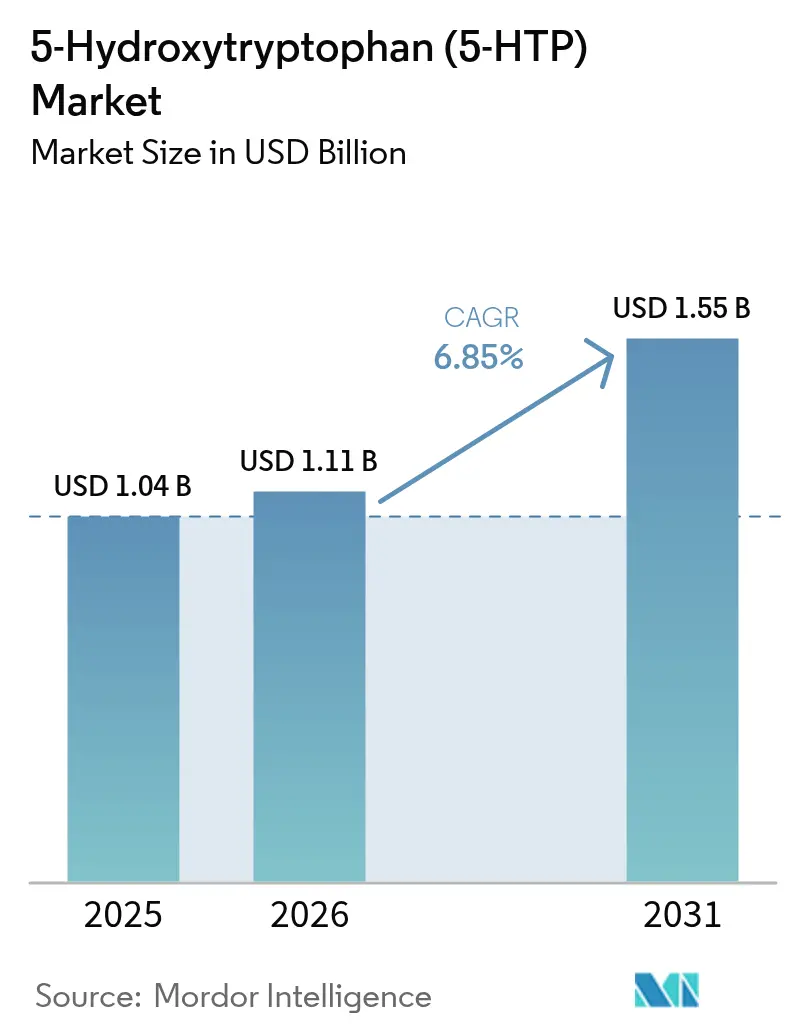
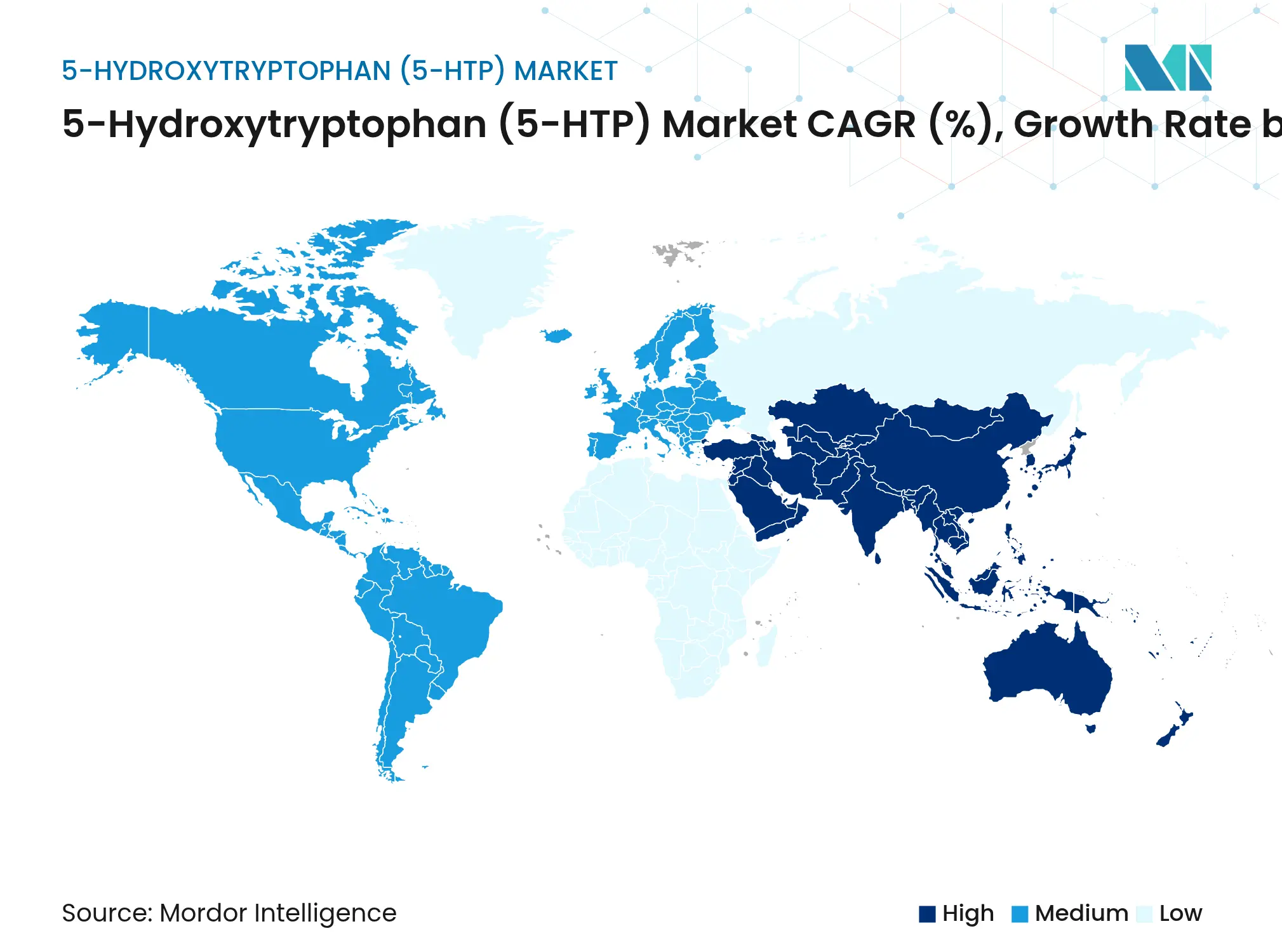
The 5-hydroxytryptophan market size in 2026 is estimated at USD 1.11 billion, growing from 2025 value of USD 1.04 billion with 2031 projections showing USD 1.55 billion, growing at 6.85% CAGR over 2026-2031. Demand accelerates as consumers integrate serotonin-boosting ingredients into daily wellness routines, and formulators embed 5-HTP in functional foods that blur the line between supplementation and conventional eating occasions. Cost-efficient microbial fermentation platforms begin to balance the supply chain, while cardioprotective clinical findings broaden potential pharmaceutical indications. North America retains commercial leadership amid mature regulatory practice; however, regional growth plateaus as product penetration matures. Asia-Pacific shows the sharpest upturn, supported by aging demographics and an 8.21% regional CAGR that reflects strong nutraceutical adoption and regulatory alignment across ASEAN nations.
Key Report Takeaways
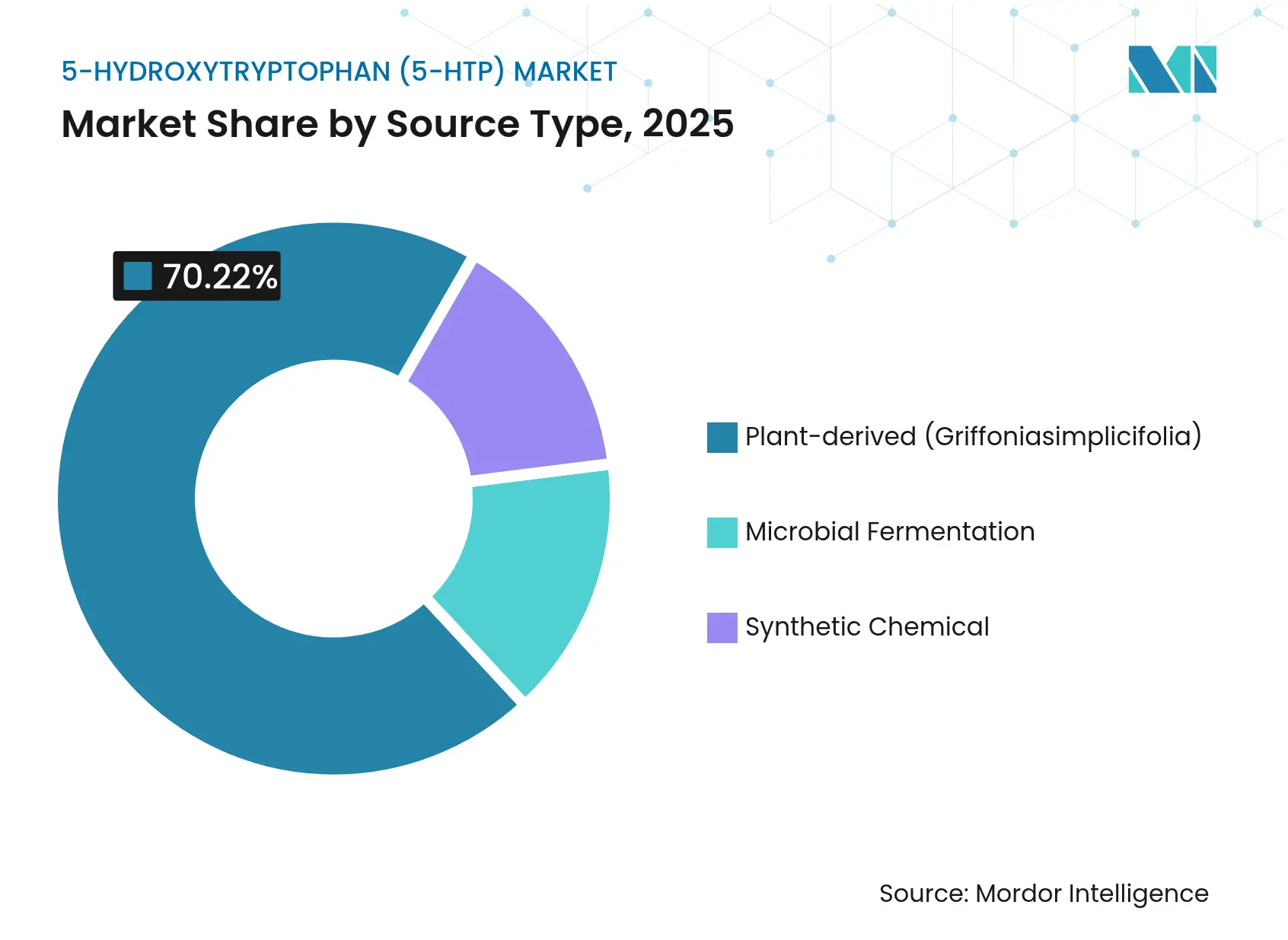
- By source, plant-derived inputs commanded 70.22% share in 2025, while microbial fermentation is slated to expand at 9.02% CAGR to 2031.
- By form, capsules captured 48.10% of the 5-hydroxytryptophan market size in 2025; gummies and functional foods accelerate at an 7.72% CAGR.
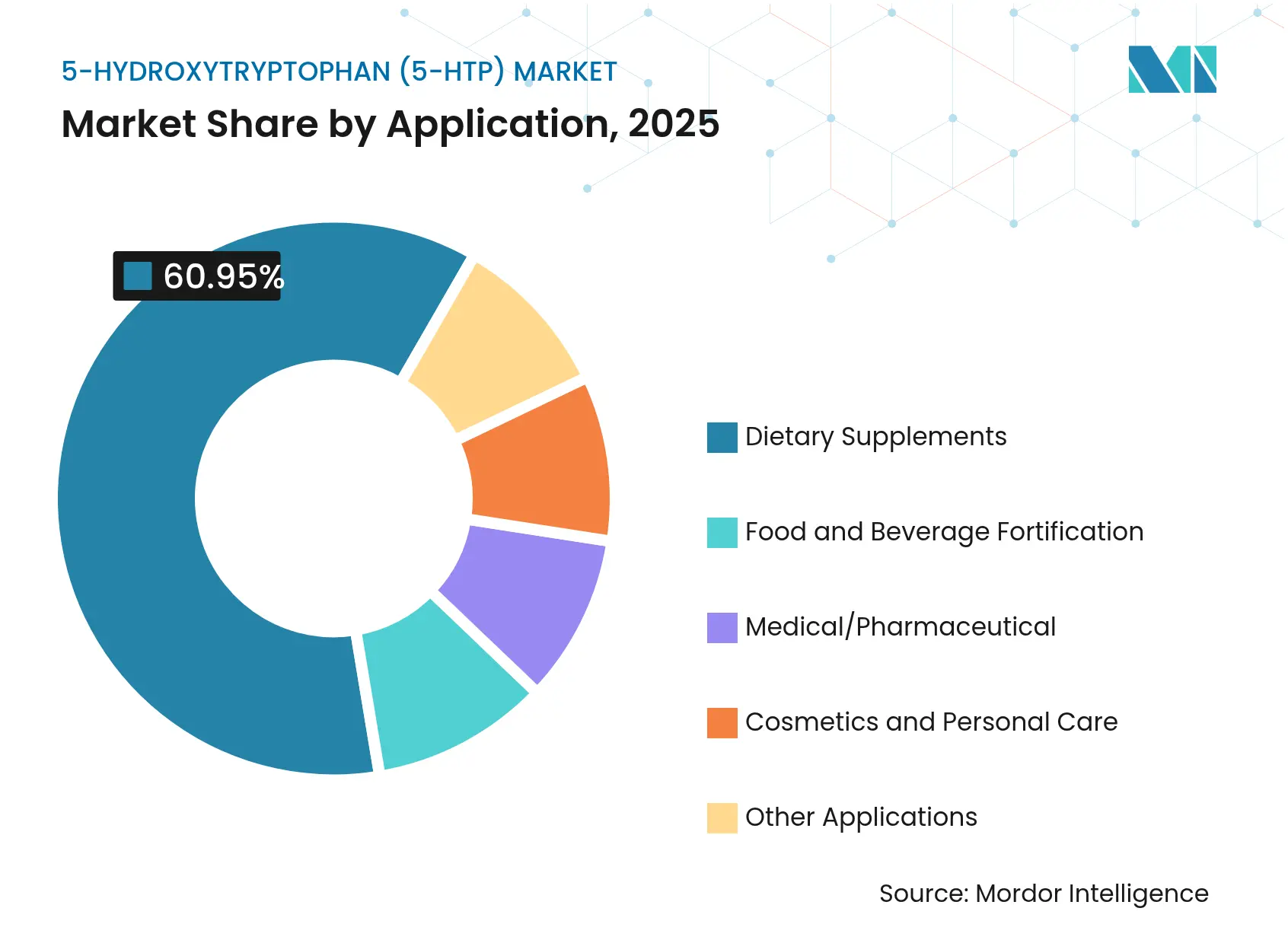
- By application, dietary supplements held 60.95% share of the 5-hydroxytryptophan market size in 2025, whereas food and beverage fortification are progressing at an 8.17% CAGR.
- By geography, North America led with 39.88% of the 5-hydroxytryptophan market share in 2025; Asia-Pacific records the highest projected CAGR at 7.95% through 2031.
Note: Market size and forecast figures in this report are generated using Mordor Intelligence’s proprietary estimation framework, updated with the latest available data and insights as of 2026.
Market Trends and Insights
Drivers Impact Analysis of 5-Hydroxytryptophan (5-HTP) Market*
| Driver | (~) % Impact on CAGR Forecast | Geographic Relevance | Impact Timeline |
|---|---|---|---|
| Rising consumption of mood-support supplements | +1.8% | Global, with concentration in North America & Europe | Medium term (2-4 years) |
| Expansion of sports-nutrition formulations | +1.2% | North America & APAC core markets | Medium term (2-4 years) |
| Growing preference for plant-based nootropics | +1.4% | Global, led by developed markets | Long term (≥ 4 years) |
| Microbial-fermentation cost breakthroughs | +2.1% | Global manufacturing hubs in China & India | Short term (≤ 2 years) |
| Emerging cardioprotective pharma research | +0.8% | North America & Europe regulatory jurisdictions | Long term (≥ 4 years) |
| Source: Mordor Intelligence | |||
Rising Consumption of Mood-Support Supplements
Clinical recognition of 5-HTP as a serotonin precursor underpins robust demand in the 5-hydroxytryptophan market. Trials show 56% of participants experience marked relief from depressive symptoms, establishing a natural alternative to selective serotonin reuptake inhibitors[1]J. Birdsall, “5-Hydroxytryptophan: A Clinically-Effective Serotonin Precursor,” Alternative Medicine Review, altmedrev.com. Post-pandemic self-care culture reinforces preventive mental-wellness spending, particularly where nutraceutical claims are permissible. Premium brands bundle 5-HTP with adaptogens to deliver multi-pathway mood balance, and subscription e-commerce channels foster routine consumption. Collective momentum adds an estimated 1.8 percentage points to overall CAGR, sustaining mid-term revenue visibility for suppliers.
Expansion of Sports-Nutrition Formulations
Endurance athletes recognize serotonin depletion as a performance bottleneck, and 5-HTP’s role in restoring neurotransmitter balance positions the compound for crossover into sports nutrition. Research shows supplementation diminishes exercise-induced oxidative damage while stimulating acute growth-hormone release after 200 mg oral dosing. Brands now integrate 5-HTP with electrolytes and branched-chain amino acids in pre-workout blends, expanding household penetration beyond mood-centric shoppers. Athletic endorsements and clean-label claims reinforce premium pricing, elevating regional growth across established fitness markets.
Growing Preference for Plant-Based Nootropics
Consumers seeking cognitive clarity lean toward botanical actives that avoid synthetic stimulant side-effects. Investigations link higher central serotonin to larger hippocampal volumes and improved neurogenesis biomarkers, validating 5-HTP’s neuroprotective profile[2]Azargoonjahromi, “Serotonin Levels and Hippocampal Volume Correlation,” Molecular Brain, springeropen.com . Seed-sourced material from Griffonia simplicifolia fits clean-label checklists, and formulators pair it with lion’s mane mushroom and ashwagandha in multi-nootropic stacks. Functional beverage developers exploit this effect to claim stress-relief credentials, enabling wider lifestyle positioning in supermarkets rather than supplement aisles.
Microbial-Fermentation Cost Breakthroughs
Engineered Escherichia coli strains have lifted 5-HTP fermentation titers to 1.61 g/L, edging botanical extraction on unit economics. Rapid stainless-steel capacity additions compress lead times and insulate processors from volatile seed prices. Pharmaceutical clients praise batch-to-batch purity, and environmental assessments show lower land-use footprints versus wild-harvested alternatives. Near-term commercialization in China and India could shift the sourcing paradigm, underpinning faster supply-led expansion in the 5-hydroxytryptophan market.
Restraints Impact Analysis of 5-Hydroxytryptophan (5-HTP) Market*
| Restraint | (~) % Impact on CAGR Forecast | Geographic Relevance | Impact Timeline |
|---|---|---|---|
| Volatile Griffonia seed supply & pricing | -1.5% | Global supply chain, concentrated in West Africa | Short term (≤ 2 years) |
| Regulatory uncertainty for fortified foods | -0.9% | North America & Europe regulatory jurisdictions | Medium term (2-4 years) |
| Serotonin-syndrome safety concerns | -0.7% | Global, with heightened focus in developed markets | Medium term (2-4 years) |
| Source: Mordor Intelligence | |||
Volatile Griffonia Seed Supply & Pricing
Ghana exports about 2,000 tonnes of Griffonia simplicifolia seed annually, yet destructive harvesting and habitat loss imperil future yields. Fluctuating farm-gate prices translate into margin pressure for extractors, especially smaller brands with limited inventory buffers. Logistics complexity heightens risk as raw seeds traverse multiple customs regimes en route to Asian processors. Supply anxiety trims 1.5 percentage points from projected CAGR, intensifying interest in fermentation alternatives across the 5-hydroxytryptophan market.
Regulatory Uncertainty for Fortified Foods
Health Canada rejected 5-HTP as a food ingredient in 2024, highlighting data gaps on population-wide exposure[3]Health Canada, “Notice of Decision on 5-HTP in Foods,” canada.ca . The stance diverges from European Union guidance, which allows up to 30% 5-HTP concentration in seed extracts sold in foods without novel-food authorization. Manufacturers juggling region-specific rules incur higher compliance costs, and caution over serotonin syndrome risks tempers dosage innovation. These challenges subtract close to 1 percentage point from growth during the medium term.
*Our forecasts treat driver/restraint impacts as directional, not additive. The impact forecasts reflect baseline growth, mix effects, and variable interactions.
5-Hydroxytryptophan (5-HTP) Market Segment Analysis
By Source Type:
Microbial Innovation Challenges Plant DominancePlant-derived material held 70.22% of 2025 volume as long-standing extraction know-how delivered reliable potency to finished-product formulators. The segment benefits from consumer familiarity with botanical origins and a perception of “naturalness” that bolsters brand storytelling, especially within premium sleep and mood portfolios. Nonetheless, the sustainability crisis surrounding West African seed stocks weakens long-run dependence as habitat degradation erodes collection yields and elevates raw-material costs. Processors report lengthening procurement cycles and more stringent quality screening to manage aflatoxin risk, driving operating-expense creep that narrows margins across the 5-hydroxytryptophan market.
Microbial fermentation, expanding at a 9.02% CAGR, advances through iterative metabolic-engineering breakthroughs that trim media costs and raise product recovery yields. The approach decouples production from agronomic variability and curtails deforestation pressure, creating a compelling sustainability narrative for retailers piloting science-backed carbon labels. Early commercial adopters negotiate long-term offtake agreements to lock in fixed-price supply, thereby safeguarding gross margins when botanical prices spike. This structural shift may pare the plant segment’s command to just over half of the 5-hydroxytryptophan market by decade-end, although consumer education remains pivotal in normalizing “fermentation-sourced” label language. Synthetic chemical production persists within tightly regulated pharmaceutical niches, contributing negligible bulk volume but supporting specialty APIs where defined stereochemistry is essential.



By Form:
Gummies Reshape Traditional Delivery PreferencesCapsules, tablets, and softgels maintained 48.10% of 2025 sales thanks to dose precision, compact pack formats, and established manufacturing infrastructure. The segment aligns with practitioner recommendations and mail-order subscription models that ship three-month supplies in cost-efficient bottles. Multivitamin blends further embed 5-HTP into daily routines, arming legacy brands with cross-selling leverage inside high-repeat consumer cohorts. However, flavor masking challenges occasionally discourage first-time users sensitive to the compound’s naturally bitter taste profile, nudging formulators toward fortified confectionery matrices.
Gummies and functional foods exhibit an 7.72% CAGR, underpinned by widening retail space for “pill-fatigued” shoppers. Cold-set pectin technology permits heat-sensitive 5-HTP integration without potency loss, while chicory-root fiber and monk-fruit sweeteners accommodate sugar-reduction demands. Mass-market snack aisles now display serotonin-support chews alongside adaptogenic bars, expanding reach beyond supplement specialists. Manufacturers exploit vivid colorways and fruit flavors to target millennials and Gen Z users, driving incremental fetch in convenience channels and fueling cross-category promotional tie-ins with relaxation beverages.
Powders and liquids occupy smaller, though strategically relevant, niches. Powders facilitate bespoke stacks in sports-nutrition communities where users titrate specific actives around training cycles. Liquid concentrates meet clinical settings prioritizing rapid absorption for acute mood support. Each enjoys modest but steady penetration, cushioning total category diversity as the 5-hydroxytryptophan market evolves toward personalized delivery ecosystems.
By Application:
Food Fortification Emerges as Growth DriverDietary supplements retained 60.95% share in 2025 on the back of well-established purchasing habits, transparent dosage labeling, and e-commerce fulfillment efficiencies. The channel leverages influencer-led marketing to buttress brand narratives around stress management, sleep quality, and overall mood equilibrium. Subscription models stabilize reorder rates and reinforce habitual intake patterns, protecting lifetime customer value amid intensifying competitive noise within the 5-hydroxytryptophan industry.
Food and beverage fortification, increasing at an 8.17% CAGR, reflects consumer appetite for health benefits seamlessly embedded in daily diets. European bakery and dairy brands introduce low-dose 5-HTP ranges that comply with the 30% extract threshold and deliver on-pack tranquility cues without triggering novel-food reviews. Functional sparkling drinks containing 50 mg of 5-HTP per can have reported mid-single-digit trial-to-repeat conversion after three months on shelf, suggesting early mainstream acceptance. Regulatory divergence limits North American rollouts, yet formulators actively collect safety dossiers to challenge existing rulings and open new growth corridors.
Medical and pharmaceutical pathways explore 5-HTP’s cardioprotective promise after observational cohorts linked higher plasma levels with reduced major adverse cardiovascular events. Hospital compounding pharmacies in the United States prepare oral suspensions for tetrahydrobiopterin-deficiency patients under FDA guidance, demonstrating precedent for indication-specific dosing models. Exploratory dermatology lines trial topical creams targeting photoaging via serotonin-linked skin-barrier modulation, although commercial viability remains formative.
Geography Analysis
North America 5-Hydroxytryptophan (5-HTP) Market
North America generated 39.88% of 2025 revenue on the strength of mature dietary supplement frameworks and superior consumer purchasing power. High internet-adoption rates facilitate direct-to-consumer subscription growth, and expanding telehealth practices integrate nutraceutical recommendations into digital therapy protocols. The United States sees insurers pilot mental-wellness reimbursement bundles that include 5-HTP vouchers, while Canada’s recent fortification denial underscores federal caution toward mass-market exposure. Slower incremental consumption among legacy user cohorts moderates the region’s forward CAGR compared with emerging territories, yet base-year size preserves absolute dollar leadership within the 5-hydroxytryptophan market.
APAC 5-Hydroxytryptophan (5-HTP) Market
Asia-Pacific posts the fastest trajectory at 7.95% through 2031 as aging societies in Japan, South Korea, and China prioritize proactive cognitive health measures. Japan’s USD 9.4 billion supplement sector validates deep wallet share for natural mood aids, and cross-border e-commerce makes premium United States brands visible to Chinese consumers despite domestic formulary expansion. ASEAN regulatory convergence lowers dossier duplication costs, enabling multinational firms to synchronize multilingual pack artwork and accelerate retail entry. Rural distribution infrastructure upgrades across Indonesia and Vietnam further unlock untapped volume potential.
EMEA and South America 5-Hydroxytryptophan (5-HTP) Market
Europe maintains steady expansion anchored by pragmatic ingredient policy that classifies up to 30%-concentration extracts as non-novel, streamlining routes to shelf for baked goods, ready-to-drink coffees, and ambient snacks. Inflationary pressures on energy and transportation raise cost-of-goods sold, yet premium positioning shields recommended retail prices. Scandinavian pharmacy chains pilot mental-wellness end-caps bundling 5-HTP with magnesium and vitamin B6, offering cross-promotional elasticity. South America and the Middle East & Africa still represent nascent demand clusters, handicapped by fragmented channel infrastructure and sporadic regulatory enforcement. Nonetheless, social-media wellness influencers spark initial brand recognition, setting the stage for multiyear education-led seeding.

Regulatory Landscape
Globally, 5-HTP oversight varies by end use (dietary supplement versus fortified food), which shapes labeling, permitted claims, and pre-market expectations. In the United States, 5-HTP is marketed primarily as a dietary supplement under the Dietary Supplement Health and Education Act (DSHEA) of 1994, with manufacturers responsible for safety and compliant labeling. FDA enforcement risk increases when products are promoted with disease-treatment claims rather than structure-function claims.
In Europe, the route to market is framed by the Novel Food framework (Regulation (EU) 2015/2283) and the Commission Union list of authorized novel foods (Implementing Regulation (EU) 2017/2470), alongside food-supplement rules under Directive 2002/46/EC. For formulators, the practical distinction is tied to concentration and production method: aqueous Griffonia simplicifolia seed extracts at or below 30% 5-HTP are treated as non-novel for food supplements in guidance used by Member States, while higher-concentration extracts or synthetically produced material may require novel-food authorization. Canada adds a key constraint for fortification, with Health Canada rejecting 5-HTP as a food ingredient in 2024 due to insufficient safety data for broad population exposure.
Value Chain Analysis
The value chain starts with upstream sourcing of Griffonia simplicifolia seeds, largely from West Africa, followed by primary aggregation and export to extraction and purification hubs. Midstream processing typically includes solvent extraction and concentration to standardized grades (commonly aligned to supplement specifications), followed by downstream quality-control testing (identity, potency, contaminants) and documentation needed for GMP-oriented buyers and region-specific compliance requirements. Finished 5-HTP is then supplied to supplement brands and contract manufacturers for encapsulation, tableting, and gummy or functional-food formats, and distributed through ingredient distributors, brand-owned e-commerce, and retail channels.
Raw-material volatility and traceability risks tied to seasonal, wild-harvest supply are the main bottlenecks, often amplifying pricing swings and lead-time variability for extractors and formulators. Alongside this, an alternative chain is developing around microbial fermentation, notably engineered E. coli, which shifts critical control points from agricultural collection to bioprocess performance, downstream recovery, and consistent impurity control. This pathway shifts value toward strain engineering, fermentation capacity, and purification know-how, reducing dependence on single-origin seed supply.
Competitive Landscape
The 5-HTP market is moderately fragmented, with established players employing vertical integration to manage supply chains, while biotechnology firms leverage synthetic biology for cost efficiency and supply security. Barriers to entry, such as specialized Griffonia seed processing and technical expertise, protect incumbents but limit consolidation. Partnerships between supplement manufacturers and biotech firms drive innovation in fermentation-based production, reducing reliance on volatile botanical sources.
Technology adoption divides firms between optimizing plant extraction and advancing fermentation methods, reshaping competition during the forecast period. The USD 680 million acquisition of Thorne HealthTech by L Catterton highlights private equity interest in premium supplements and signals potential M&A growth. Opportunities exist in sports nutrition and functional foods, where regulatory allowances enable innovative delivery formats to expand consumer reach.
5-Hydroxytryptophan (5-HTP) Industry Leaders
Linnea SA
Chengdu SanHerb Bioscience Co.
Cactus Botanics
Shaanxi Jiahe Phytochem Co., Ltd.
Bee Health Limited
- *Disclaimer: Major Players sorted in no particular order

5-Hydroxytryptophan (5-HTP) Market Companies Covered in this Report
- Adooq Bioscience LLC.
- Alpspure Lifesciences Pvt. Ltd.
- Bee Health Limited
- BIOGENA
- Cactus Botanics
- Chengdu SanHerb Bioscience Co.
- Linnea SA
- Natrol
- Pure Encapsulations, LLC.
- Shaanxi Jiahe Phytochem Co., Ltd.
- Shaanxi Shineherb Biotech Co., Ltd.

Market Opportunities and Future Outlook
The key whitespace is the intersection of supply security and quality consistency. Buyers dependent on West African Griffonia seed inputs face periodic disruption risk, which supports diversified sourcing strategies and alternative production. On the manufacturing side, fermentation-based 5-HTP is a specific innovation pathway, supported by published bioprocess progress such as a March 2025 report of an engineered E. coli strain achieving about 13 g/L 5-HTP in fed-batch fermentation. This raises the ceiling for scalable output and supports more predictable specifications than wild-harvest variability.
On demand, the most actionable near-term expansion lever is application and format diversification within regulatory constraints, especially in jurisdictions where supplement frameworks are established, such as under DSHEA in the United States. Food and beverage fortification is opportunity-led but compliance-gated, with Health Canada’s 2024 decision rejecting 5-HTP as a food ingredient underscoring the need for stronger population-exposure and toxicology dossiers. The EU’s non-novel positioning for aqueous Griffonia extracts at or below 30% 5-HTP also supports selective, low-dose functional food concepts without a full novel-food filing in relevant member-state practice. Companies combining traceable raw material programs, GMP-aligned documentation, and region-specific claim strategies are positioned to gain share in gummies and functional foods while limiting avoidable regulatory reclassification risks.
Recent Industry Developments in 5-Hydroxytryptophan (5-HTP) Market
- January 2026: Linnea SA published an updated product guide that includes its 5-HTP ingredient offering for supplement applications. The update supports customer-facing technical and quality positioning and reinforces competitive differentiation around standardized ingredient documentation used in global B2B selling.
- March 2025: Linnea SA partnered with Vivalto Partners to support innovation and business growth. The transaction strengthened access to capital and strategic support for ingredient development and commercialization, relevant for suppliers operating in quality-intensive botanical actives such as 5-HTP.
- August 2024: Health Canada issued a decision rejecting 5-hydroxytryptophan as a supplemental ingredient in foods, citing insufficient safety data for widespread consumption. The decision constrained near-term functional food formulation routes in Canada and increased the importance of region-specific compliance planning for brands that sell both supplements and fortified foods.


5-Hydroxytryptophan (5-HTP) Market Report Scope and Research Methodology
Market Definition and Coverage
This market covers the global revenue generated from sales of 5-hydroxytryptophan (5-HTP) as an ingredient and as finished consumer products used for wellness benefits, tracked across major geographies and typical sales channels.
Scope exclusions: We exclude adjacent mood and sleep ingredients that are not 5-HTP, and we also exclude unrelated finished products where 5-HTP is not a measurable part of the formulation.
Segments Covered in This Report
- By Source Type
- Plant-derived (Griffonia simplicifolia)
- Synthetic Chemical
- Microbial Fermentation
- By Form
- Powder (>95 % potency)
- Capsules/Tablets
- Liquid Extracts
- Gummies and Functional Foods
- By Application
- Dietary Supplements
- Medical/Pharmaceutical
- Food and Beverage Fortification
- Cosmetics and Personal Care
- Other Applications
- By Geography
- Asia-Pacific
- China
- India
- Japan
- South Korea
- Rest of Asia-Pacific
- North America
- United States
- Canada
- Mexico
- Europe
- Germany
- United Kingdom
- France
- Italy
- Rest of Europe
- South America
- Brazil
- Argentina
- Rest of South America
- Middle East and Africa
- Saudi Arabia
- South Africa
- Rest of Middle East and Africa
- Asia-Pacific
Data Sources, Market Sizing, and Validation
Desk Research
Desk work starts with building the base context for 5-HTP demand and supply, before any market math is done. We relied on public and official sources such as the US FDA dietary supplement resources, the NIH Office of Dietary Supplements fact sheets, the US International Trade Commission trade statistics, UN Comtrade for cross-border flows, and the European Commission food supplement and novel food guidance.
To keep the model grounded in real pricing and volume signals, we also reviewed company filings, investor presentations, product labels and typical pack sizes across large online and offline retailers, and reputable press coverage on supplement trends. Where needed, we referenced paid subscriptions for company financials and intelligence, patent databases, and shipment-level trade data to cross-check supplier footprints and likely addressable volumes. This list is illustrative, and other sources were also reviewed to collect data, validate assumptions, and clarify open questions.
Primary Interviews and Surveys
Primary work was used to validate what desk sources cannot fully explain, especially how 5-HTP is priced, how quickly label claims and dosage ranges are changing, and which channels are actually scaling. We spoke with a mix of ingredient suppliers, contract manufacturers, brand managers, distributors, and retail-facing experts across major regions. Then our assumptions were adjusted only when a consistent pattern showed up across multiple viewpoints.
Distribution of primary research fieldwork respondents
| Company type | Respondent position | Region |
|---|---|---|
| Top tier: 35% | CXOs: 12% | APAC: 51% |
| Mid tier: 48% | Functional/Unit leaders: 43% | EMEA: 31% |
| Smaller Players: 17% | Managers: 45% | Americas: 18% |
Market-Sizing & Forecasting
The core sizing logic uses a top-down build that reconstructs demand from the dietary supplement and wellness spend pool, then narrows it to the share attributable to 5-HTP using usage rates, product availability, and channel presence in each region. To keep totals realistic, we corroborated the output with selective bottom-up checks such as sampled pack prices and pack volumes, supplier capacity cues, and channel reviews on how many active stock keeping units carry 5-HTP.
Inputs used in the model include typical daily dosage ranges shown on labels, average pack counts and formats (capsules, tablets, powders), the split between online and store-based sales, import and export movement for relevant extracts, and observed price bands by region after normalizing for pack size. When a direct read on volumes was not available, gaps were handled using proxy indicators such as the active product count trend and trade movement direction, then reviewed with interview feedback.
For forecasting, we relied mainly on scenario analysis supported by multivariate regression checks. In this build, demand is linked to indicators including consumer wellness adoption, regulatory clarity signals, channel growth rates, and expected price movement from raw material availability. The final forward view was aligned to what experts considered plausible for pack price progression and adoption pace, rather than assuming straight-line growth.
Data Validation & Update Cycle
Totals are checked through triangulation, where the model output is compared against independent signals such as trade movement, visible price ranges, and the implied consumption from pack size patterns. If a region shows an unusual jump or drop, we re-check the assumptions and revisit the supporting sources, then run a second analyst review before sign-off.
The report is refreshed annually, with interim updates when material events occur that can change pricing. Before delivery, an analyst performs a fresh pass on key inputs so clients receive the most current view available at the time of purchase.
Mordor Intelligence's 5 Hydroxytryptophan 5 Htp Market Estimate Compared With Other Published Estimates
It is normal to see different market values published for 5-HTP, even when the topic name looks the same. The differences usually come from what is counted as 5-HTP revenue, how pricing is converted into USD, and how frequently assumptions are refreshed.
In practice, the biggest drivers are scope boundaries and price logic, since some estimates mix broader sleep and mood supplement baskets into the number, or apply a single average price without correcting for pack size and dosage. A refresh-led difference also matters, since currency timing and online price shifts can move the reported USD value materially. That is why the quarterly price and FX normalization checks used in this model, followed by interview re-contacts for outlier movements, are a key reason the 2026 market size for Mordor Intelligence does not always match less frequently updated views.
Benchmark comparison
| Source | Market Size | Gaps in Research Methodology |
|---|---|---|
| Mordor Intelligence | USD 1.11 B (2026) | |
| Trade Journal A | USD 0.13 B (2025) | Uses a narrower definition focused on finished 5-HTP supplement products only, which can exclude ingredient sales to manufacturers and undercount private label volumes, and the USD figure appears to be reported without clear pack size or dosage normalization. |
| Industry Source B | USD 0.42 B (2025) | Appears to rely on a simplified demand pool and headline growth rate, and it is unclear if regional currency conversion timing and online price changes are refreshed regularly, which can shift the reported value when pricing is volatile. |
Across the three figures, the spread is largely explained by what is included in the revenue boundary and how pricing is translated into a comparable USD value. When pack level pricing is normalized, and when the scope consistently separates pure 5-HTP revenue from adjacent ingredients, the resulting number becomes easier to trace and repeat year after year.


Key Questions Answered in the Report
What is the current 5-Hydroxytryptophan (5-HTP) Market size?
The global 5-Hydroxytryptophan (5-HTP) Market size stands at USD 1.11 billion in 2026.
Which region grows fastest through 2031?
Asia-Pacific leads growth with an 7.95% CAGR due to aging demographics and rising nutraceutical adoption.
Why are microbial fermentation methods important?
Fermentation achieves consistent 5-HTP yields of 1.61 g/L, reducing reliance on volatile Griffonia seed supply and improving cost predictability.
How large is the plant-derived source segment?
Plant-derived inputs captured 70.22% share of 2025 volume, although their share is expected to decline as fermentation gains ground.
Page last updated on:


 Your data is secure and never sold or shared.


