
3D Wall Panel Wallpaper Market Size and Share
Market Overview
| Study Period | 2020 - 2031 |
|---|---|
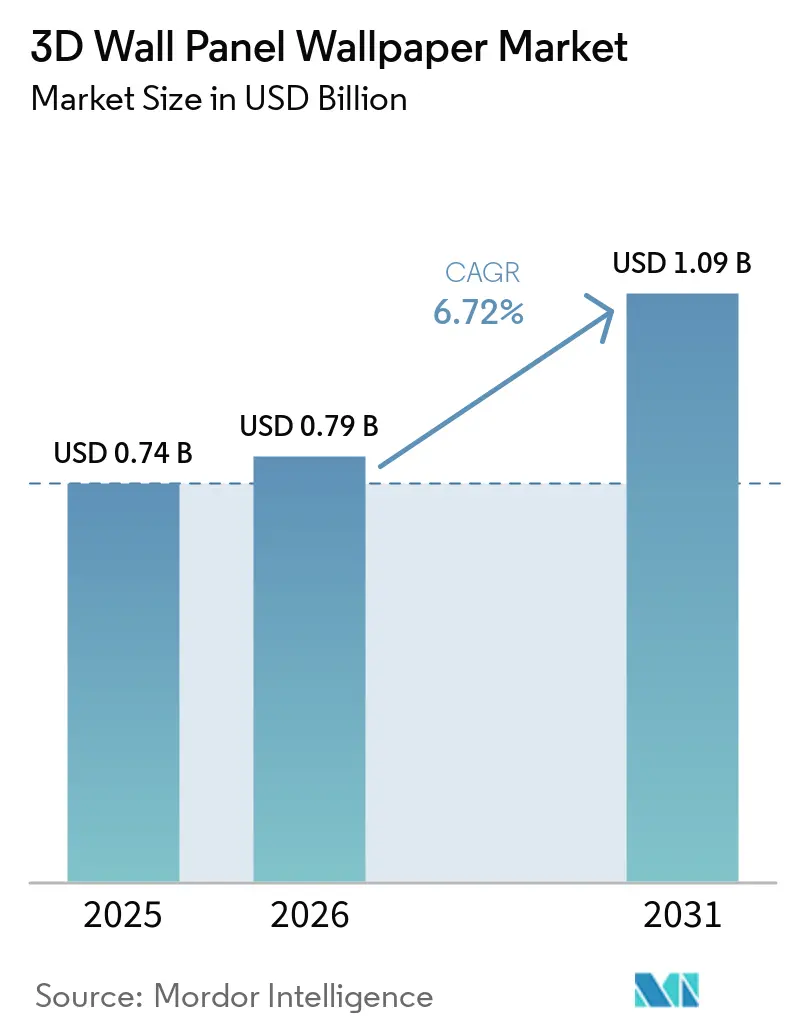
| Market Size (2026) | USD 0.79 Billion |
| Market Size (2031) | USD 1.09 Billion |
| Growth Rate (2026 - 2031) | 6.72 % |
| Fastest Growing Market | Middle East and Africa |
| Largest Market | Asia-Pacific |
| Market Concentration | Low |
Major Players *Disclaimer: Major Players sorted in no particular order Image © Mordor Intelligence. Reuse requires attribution under CC BY 4.0. | |
3D Wall Panel Wallpaper Market Analysis by Mordor Intelligence
The 3D wall panel wallpaper market was valued at USD 743.28 million in 2025, is estimated at USD 792.86 million in 2026, and is forecast to reach USD 1,097.34 million by 2031, growing at a 6.72% CAGR during 2026–2031. The 3D wall panel wallpaper market is supported by renovation spending, changing interior preferences, and demand for surfaces that combine decoration with acoustic or low-emission performance. Renovation activity can favor products that change a room without extensive structural work, especially where homeowners and property managers seek shorter installation cycles. Regulatory requirements for energy upgrades and material documentation also connect interior refurbishment with wider building improvement programs in Europe. Producers are responding through material reformulation, digital design tools, documented environmental attributes, and broader installation choices. The 3D wall panel wallpaper market also faces uneven input costs and higher certification requirements, which can favor suppliers with established testing, documentation, and project-sales capabilities.
Key Report Takeaways
- By material, PVC and Vinyl held 33.8% of the 3D wall panel wallpaper market share in 2025, while Plant Fiber and Bagasse are forecast to grow at a 7.6% CAGR during 2026-2031.
- By installation method, Clip/Interlocking held 47.3% of the 3D wall panel wallpaper market share in 2025, while Self-Adhesive and Peel-and-Stick are forecast to grow at an 8.3% CAGR during 2026-2031.
- By end user, Residential held 64.2% of the 3D wall panel wallpaper market share in 2025, while Commercial is forecast to grow at a 7.1% CAGR during 2026-2031.
- By distribution channel, B2C Channels held 72.6% of the 3D wall panel wallpaper market share in 2025, while B2B Channels are forecast to grow at a 6.9% CAGR during 2026-2031.
- By geography, Asia-Pacific held 34.8% of the 3D wall panel wallpaper market share in 2025, while the Middle East and Africa are forecast to grow at an 8.5% CAGR during 2026-2031.
Note: Market size and forecast figures in this report are generated using Mordor Intelligence’s proprietary estimation framework, updated with the latest available data and insights as of January 2026.
Global 3D Wall Panel Wallpaper Market Trends and Insights
Drivers Impact Analysis*
| Driver | (~) % Impact on CAGR Forecast | Geographic Relevance | Impact Timeline |
|---|---|---|---|
| Renovation and Remodeling Demand | +2.0% | Global, highest impact in North America, Europe, and the Asia-Pacific | Medium term (2-4 years) |
| Digital Printing and Design Customization | +1.0% | Global, with early traction in North America and Europe | Long term (≥ 4 years) |
| Hospitality and Experiential Commercial Interiors | +0.8% | Global, with the Middle East and Africa, and Asia-Pacific leading in project volume | Short term (≤ 2 years) |
| Sustainable and Low-VOC Interior Materials | +0.7% | Europe and North America, with growing relevance in the Asia-Pacific | Medium term (2-4 years) |
| Peel-and-Stick and DIY Installation Adoption | +1.0% | North America and Europe, with growing relevance in the Asia-Pacific | Short term (≤ 2 years) |
| Acoustic Performance in Decorative Surfaces | +0.5% | Europe, North America, and urban Asia-Pacific | Long term (≥ 4 years) |
| Source: Mordor Intelligence | |||
Renovation and Remodeling Demand Anchors a Structural Demand Base
The 3D wall panel wallpaper market benefits when renovation spending shifts toward visible interior upgrades. Harvard University projected the United States home improvement and repair market at USD 509 billion in 2025, USD 30 billion above its earlier outlook after a revised American Housing Survey baseline[1]https://www.jchs.harvard.edu/blog/modest-gains-2025-outlook-home-remodeling. This spending base supports wall treatments that can alter a room without a full redesign. Accent walls and feature surfaces can offer homeowners a design-led alternative to larger structural projects. That choice can shorten the decision cycle for decorative finishes and support replacement demand. In Europe, building renovation programs can create related surface replacement work when upgrades involve occupied homes and commercial properties. The Energy Performance of Buildings Directive creates a pathway for deeper renovation across the European building stock[2]https://energy.ec.europa.eu/news/commission-sets-eus-building-sector-pathway-towards-greater-energy-efficiency-and-decarbonisation-2025-06-30_en. The 3D wall panel wallpaper market, therefore, has demand linked to refurbishment schedules as well as discretionary decoration.
Digital Printing and Design Customization Expand Design Choice
Digital printing is widening the range of finishing available in the 3D wall panel wallpaper market. Large-format equipment can support smaller custom orders that were less practical under conventional production methods. Designers can specify more texture, color, and pattern options without relying only on large standard runs. This changes competition because design range and order speed can matter alongside factory scale. Digital configuration tools and augmented reality visualization can help customers assess a wall treatment before purchase. These tools can also improve communication between designers, retailers, installers, and end users. Eco-solvent, latex, and UV-curable ink systems support the shift by addressing durability and indoor air quality requirements. The result is broader access to customized surface solutions for independent designers and lifestyle-focused consumers.
Hospitality and Commercial Interior Upgrades Support Project Specifications
Commercial renovation brings a distinct form of demand to the 3D wall panel wallpaper market. Hotels, offices, and healthcare facilities often require surfaces that meet design, cleaning, acoustic, and safety expectations at the same time. This can make a performance-verified panel more relevant than a purely decorative wall covering. In hospitality projects, a product with documented fire performance and acoustic properties can reduce the need to combine separate decorative and acoustic components. Project specifications may then involve interior designers, acoustic consultants, and safety managers. That process raises the technical requirements for suppliers, but it can also support premium pricing where a single product addresses several project needs. Commercial demand can be especially valuable because project orders are larger and repeat work can follow renovation cycles. The 3D wall panel wallpaper market gains when suppliers can provide the samples, certifications, and documentation required for this channel.
Sustainable Materials and Easier Installation Broaden Adoption
Low-emission materials and easier installation formats are expanding the addressable base for 3D wall panel wallpaper products. Italy’s CAM Edilizia 2025 lowered the total VOC limit for interior building materials from 1,500 µg/m³ to 1,000 µg/m³, with compliance required from February 2026. This change increases the importance of plant fiber, gypsum, fiber cement, and other products supported by clear emissions documentation. PVC-based products can remain relevant, but suppliers may need reformulated materials and stronger evidence of indoor air quality performance. Easier installation is also widening consumer use, as 84% of the United States adults surveyed said they would use peel-and-stick products for interior wall surfaces, increasing to 92% among Millennial and Generation Z respondents. Low-VOC products with repositionable adhesive systems can therefore support renovation, rental, and smaller home-improvement projects where professional installation is less practical.
Restraints Impact Analysis*
| Restraint | (~) % Impact on CAGR Forecast | Geographic Relevance | Impact Timeline |
|---|---|---|---|
| Fire-Safety and Building-Code Compliance Costs | -0.9% | Global commercial markets, with the highest relevance in North America and the European Union | Medium term (2-4 years) |
| Raw-Material Price and Supply Volatility | -0.7% | Global, particularly acute in Asia-Pacific and Europe | Short term (≤ 2 years) |
| Installation Quality and Substrate-Preparation Risk | -0.3% | Emerging markets in the Middle East, Africa, and South America | Long term (≥ 4 years) |
| Limited End-of-Life Recycling for Multilayer Panels and Wallpapers | -0.3% | Europe and North America, where regulatory scrutiny is highest | Long term (≥ 4 years) |
| Source: Mordor Intelligence | |||
Fire-Safety and Building-Code Compliance Costs Limit Commercial Access
Fire-safety compliance can restrict access to commercial projects in the 3D wall panel wallpaper market. United States commercial wall and ceiling finishes must meet ASTM E84 flame-spread and smoke-development requirements under the International Building Code framework. Class A performance requires a flame spread index of 25 or below and a smoke developed index of 450 or below. Achieving this result can require fire-retardant treatment, laboratory testing, and documentation for each relevant product configuration. A colorway or panel construction may need separate evidence rather than relying on another product in the same range. European entrants must also address Euroclass requirements and related test frameworks. The European Union's Construction Products Regulation entered into force with stronger safety and sustainability provisions for construction products. These requirements increase the burden on smaller producers and can concentrate commercial channel access among larger suppliers.
Raw Material Volatility and Product Life-Cycle Limits Pressure Margins
Input volatility remains a restraint for the 3D wall panel wallpaper market because PVC, pigments, fire-retardant additives, and veneers have different supply conditions. Chinese PVC export prices fell to USD 695 per ton CIF in August 2025 amid oversupply and trade measures, creating different cost positions across sourcing locations[3]https://catas.com/en/news/publication-of-the-new-cam-edilizia-2025. Low prices can help converters in the short term, but rapid movement makes retail repricing and margin planning more difficult. Mid-sized manufacturers may be less able to use forward purchasing arrangements during price changes. Installation quality is another constraint where walls need extensive preparation or installers have limited familiarity with the product. Poor alignment, weak bonding, and unsuitable substrates can reduce customer confidence in some regions. Multilayer panels and wallpapers also present end-of-life recycling challenges, particularly where regulators are increasing scrutiny of material life cycles. These factors can slow adoption when buyers prioritize predictable cost, easy installation, and disposal options.
*Our forecasts treat driver/restraint impacts as directional, not additive. The impact forecasts reflect baseline growth, mix effects, and variable interactions.
Segment Analysis
By Material: PVC and Vinyl Lead While Plant Fiber and Bagasse Grow Fastest
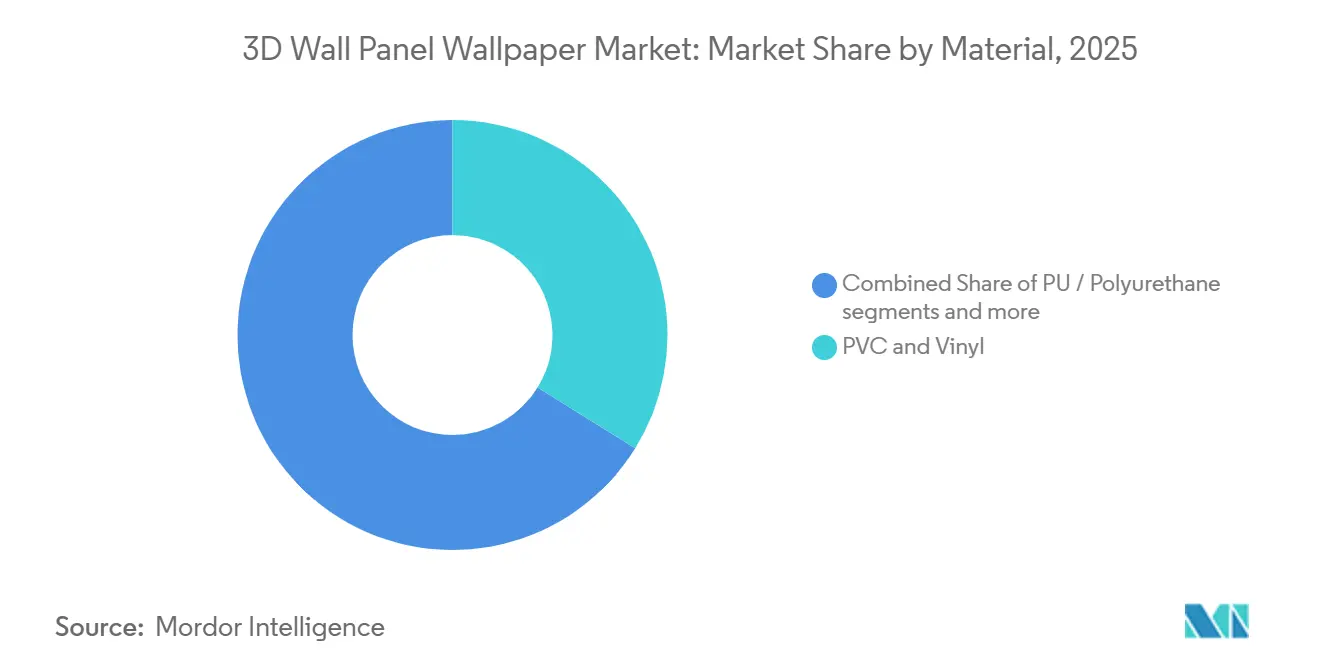
PVC and Vinyl held 33.8% of the 3D wall panel wallpaper market share in 2025, making it the leading material category. Its position reflects dimensional stability, moisture resistance, paintability, and cost-effective production. PVC and Vinyl products can remain practical for broad residential and commercial use because they offer familiar handling characteristics. However, the material faces greater scrutiny where plasticizers and emissions documentation affect selection. Italy's tighter TVOC threshold and low-emitting material credits can favor alternative formulations in commercial specifications[3]. This can lead manufacturers to invest in lower-emission formulations, testing, and clearer environmental documentation. Polyurethane panels retain a premium position where a softer surface and detailed design are valued. Wood, MDF, and HDF products also benefit from interest in wood-grain finishes and biophilic interior design.
Fiber Cement and Metal panels serve more specialized uses, including humid commercial environments and exterior-interior facade applications. Gypsum and plaster remain relevant where labor familiarity and cost efficiency are important. Plant Fiber and bagasse represent the fastest-growing material category, with a forecast CAGR of 7.6% through 2031. The 3D wall panel wallpaper market size for plant fiber and bagasse can benefit from demand for low-VOC and bio-based surfaces. Research described for sugarcane bagasse acoustic boards reported sound absorption coefficients up to 0.98 at 1,500 to 1,600 Hz and Class B-s1,d0 fire performance without synthetic resins. This makes bagasse-based panels a credible option in acoustic and emissions-sensitive projects. The category still needs reliable supply, product consistency, and project documentation to scale beyond specialized specifications.



By Installation Method: Clip Systems Lead While Peel-and-Stick Grows Faster
Clip/Interlocking systems accounted for 47.3% of the 3D wall panel wallpaper market share in 2025. Contractors and commercial specifiers use these systems where panel alignment and long-term structural reliability are important. The method suits professional installation in commercial properties and contractor-led residential projects. It can also support heavy panels that need a secure fixing approach. Adhesive-mounted products remain common in mid-range residential work because they can suit irregular walls. Mechanical fixing and mortar or cement-based installation remain relevant for heavy panels and wet or high-load applications. Each of these formats depends on substrate preparation and installer skill. This keeps professional installation important across much of the category.
Self-Adhesive and Peel-and-Stick products are forecast to grow at an 8.3% CAGR through 2031, the fastest rate among installation methods. The 3D wall panel wallpaper market size for this format is supported by demand for more accessible installation. Avery Dennison's United States survey found broad willingness to use peel-and-stick wall solutions, particularly among Millennial and Generation Z respondents[4]https://tapes.averydennison.com/na/en/home/insights/news/news-release-peel-and-stick.html. Repositionable, lower-VOC, and humidity-resistant adhesives can make these systems more useful in a wider set of interior conditions. These features can appeal to renters and urban households seeking reversible personalization. Some commercial uses may also become feasible as adhesive performance improves. The mix is therefore moving toward lower labor dependency, with innovation focused on adhesive quality and substrate compatibility.
By End User: Residential Volume Supports a Faster Commercial Opportunity
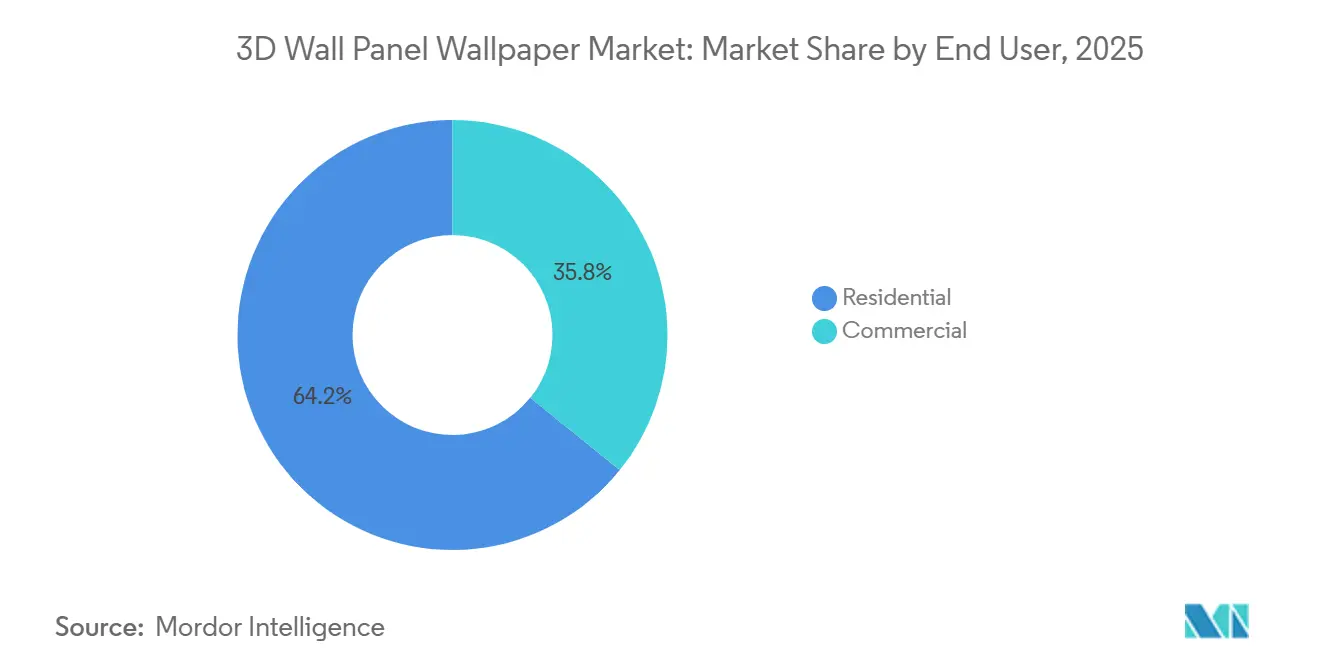
Residential users accounted for 64.2% of the 3D wall panel wallpaper market share in 2025. This position reflects the large base of home renovation activity and the category's established role in consumer interiors. Wall panels and wallpaper can offer a visible change without the cost and disruption of broader renovation. The U.S. home improvement and repair outlook of USD 509 billion in 2025 provides a relevant backdrop for interior upgrades. Feature walls can attract spending when consumers prefer a design change to structural work. Retail availability, online discovery, and peel-and-stick formats support residential access. Product choices range from low-cost decorative finishes to more durable moisture-resistant panels. This breadth helps maintain residential demand across different budgets.
Commercial applications are forecast to grow at a 7.1% CAGR through 2031, ahead of the overall rate. The 3D wall panel wallpaper market size for commercial applications can rise with hospitality renovation, office redesign, and healthcare facility upgrades. Commercial buyers often require materials that meet several conditions in one specification. Antimicrobial-coated panels with Class A fire performance can be relevant to clinical settings where infection control and patient surroundings are both considered. Acoustic performance may also matter in offices, hotels, and public areas. These needs create a clear distinction between commercial-grade and residential-grade product development. A commercial Class A product with an NRC above 0.75 requires different materials and testing from a residential peel-and-stick panel. Manufacturers, therefore, need parallel product strategies to address both demand profiles.
By Distribution Channel: B2C Remains Larger While B2B Gains from Projects
B2C Channels accounted for 72.6% of the 3D wall panel wallpaper market share in 2025. Hypermarkets, home improvement stores, specialty retailers, online platforms, and local hardware stores all contribute to this channel. B2C remains important because consumers can purchase many products for a single room or home project. Online sales can shorten the path from design research to purchase. Digital configuration tools and augmented reality visualization can help shoppers assess patterns and textures in their own spaces. Retailers can also use samples and easy-install products to reduce uncertainty before purchase. Social content can expand product awareness, although purchase decisions still depend on price, installation confidence, and delivery reliability. These characteristics keep B2C central to category volume.
B2B Channels are forecast to grow at a 6.9% CAGR through 2031. The 3D wall panel wallpaper market benefits from B2B purchasing because commercial projects create larger orders and repeat specification cycles. Contractors, architects, interior designers, and institutional procurement teams are the principal buyers in this route. A single design specification can commit large panel volumes for a hotel, office, or institutional project. Suppliers can strengthen their position through sample programs, showrooms, and digital specification libraries. BIM-compatible files and Environmental Product Declarations can reduce friction in project selection. Armstrong's acquisition of Geometrik in September 2025 reflected demand for wood-grain and biophilic surfaces in architectural applications. The channel can reward producers who combine design support with credible technical documentation.
Geography Analysis
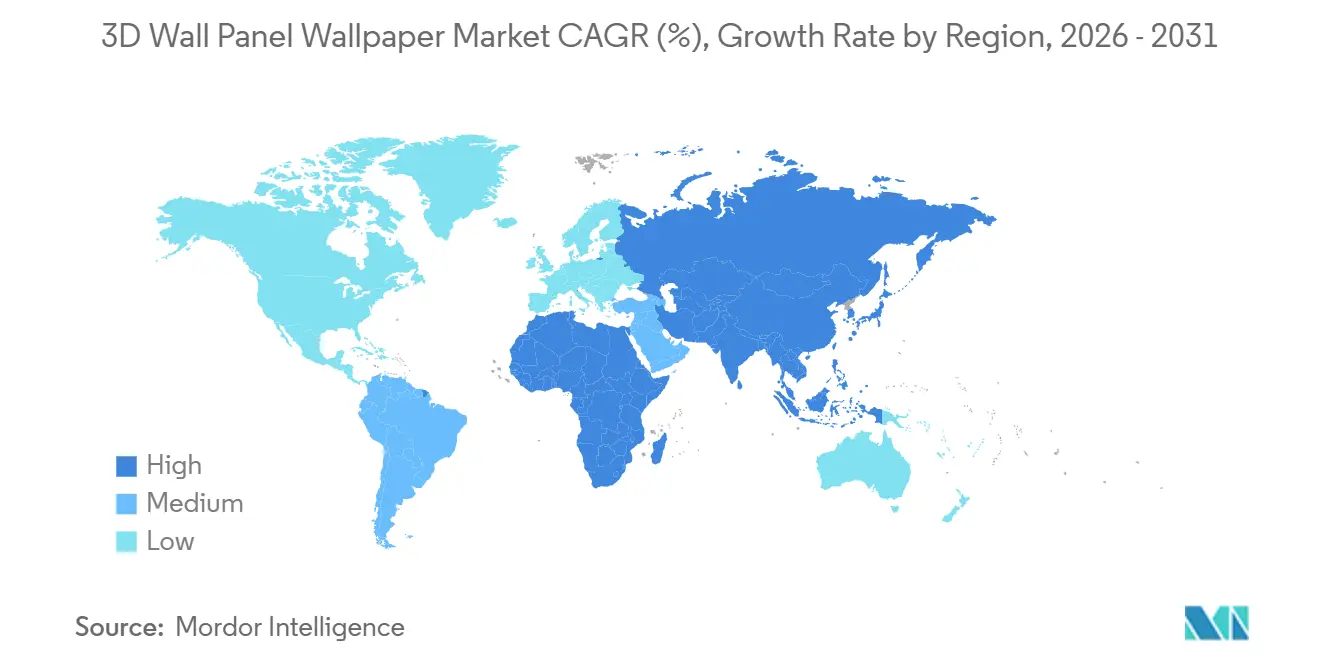
Asia-Pacific accounted for 34.8% of the 3D wall panel wallpaper market share in 2025. The region combines substantial interior materials production with residential construction activity and growing renovation demand. China supports demand through upgrades to its existing apartment stock, while India generates first-cycle interior demand through urban housing development. Southeast Asia contributes through condominium and hospitality construction. Japan and South Korea are mature markets with established design standards and performance specifications, supporting demand for both basic decorative products and higher-value acoustic or documented surfaces.
Building regulations and renovation policies shape the European market. The Energy Performance of Buildings Directive supports renovation projects that may include wall and ceiling upgrades, while the Construction Products Regulation increases the importance of life-cycle and product-performance documentation. Germany, France, the United Kingdom, and the BENELUX countries are key specification markets for low-emission materials. Italy may signal changing preferences as CAM Edilizia will tighten the TVOC limit in 2026. North America also benefits from strong renovation spending, low-carbon interior manufacturing demand, fire-code compliance requirements, DIY adoption, and commercial renovation activity.
The Middle East and Africa are forecast to grow at an 8.5% CAGR through 2031, the highest regional growth rate. Large real estate and infrastructure projects, particularly Gulf commercial and hospitality developments, support this outlook. Dubai, Abu Dhabi, and Saudi Arabia's Vision 2030 projects, including NEOM, Diriyah, and New Murabba, create demand for premium interior materials. South Africa and Nigeria offer developing opportunities, while South America has long-term potential through investments in light construction systems and plasterboard capacity. Suppliers must adapt products to local installation capabilities, codes, climate conditions, and distribution networks, favoring manufacturers that offer durable products, training, local support, and clear performance information.

Competitive Landscape
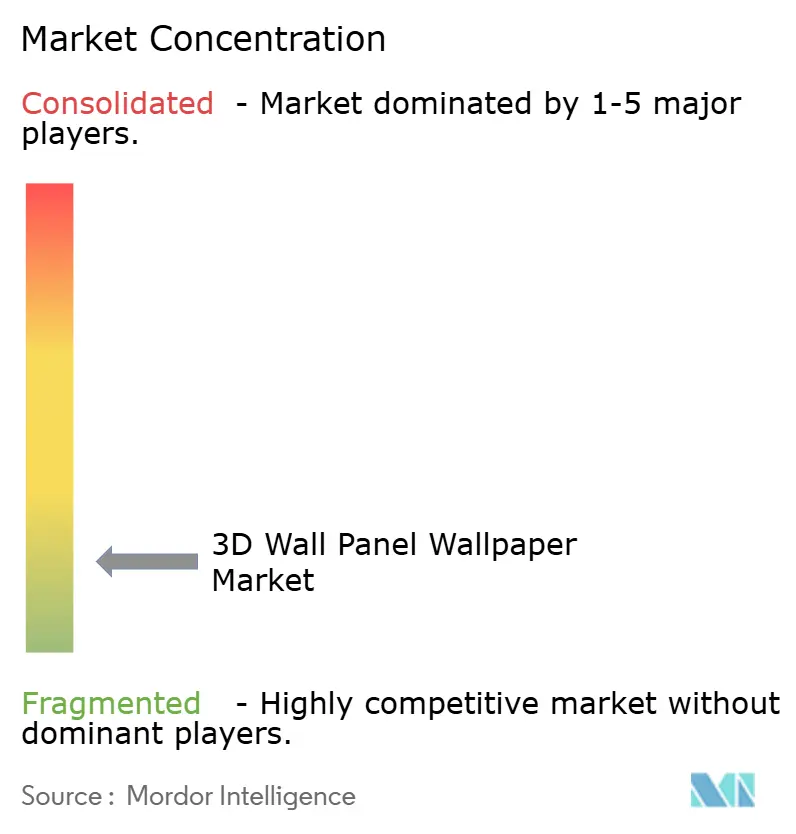
The 3D wall panel wallpaper market is fragmented, with no participant holding a dominant disclosed share. Competition is becoming more structured as larger architectural building materials groups acquire specialty wall-surface capabilities. Armstrong World Industries is expected to report record Architectural Specialties net sales of USD 590 million for FY2025, up 28% year over year. Since 2017, the company has completed 15 acquisitions in Architectural Specialties. Its planned acquisitions of Geometrik in September 2025 and Eventscape in February 2026 are expected to add wood acoustical systems and complex architectural feature walls, ceilings, and facade fabrication capabilities, respectively. These initiatives demonstrate the value of combining product portfolios with architectural design and fabrication services. Larger suppliers can maintain broader testing, sales, and product development capabilities, although local availability, design support, and installer relationships continue to influence project-level selection.
Saint-Gobain is expanding its position in acoustical wall panels and documented interior materials. In August 2026, Saint-Gobain North America is expected to acquire MCM Acoustical to expand CertainTeed Architectural's custom acoustical panel capabilities. The company is also expected to publish seven Environmental Product Declarations across its Decoustics and Symphony wall panel lines in June 2026.
These initiatives can support faster product rotation, a broader design library, and adoption in projects requiring sustainability documentation. Greater European Union emphasis on construction product safety and sustainability information creates differentiation between low-cost decorative products and compliance-sensitive commercial offerings. Products with incomplete supporting information may face limitations in institutional projects, while documented products can be more readily included in tender lists and specification libraries.
3D Wall Panel Wallpaper Industry Leaders
Art3d
Ekena Millwork
WallArt
CSI Creative
Profile VOX
- *Disclaimer: Major Players sorted in no particular order

Recent Industry Developments
- February 2026: Armstrong World Industries acquired Eventscape, Inc., a New York City and Toronto-based design and fabrication company specializing in complex architectural feature walls, ceilings, and facades. The acquisition marks Armstrong's 15th Architectural Specialties acquisition since 2017, adding high-design wall fabrication capacity to its North American commercial portfolio.
- September 2025: Armstrong World Industries acquired Geometrik Manufacturing Inc. in Kelowna, British Columbia, a designer and manufacturer of wood acoustical ceiling and wall systems across multiple wood species, including Western Hemlock. Armstrong cited growing designer demand for wood grain and biophilic surfaces as the primary rationale for the acquisition.


Global 3D Wall Panel Wallpaper Market Report Scope
| PVC and Vinyl |
| PU / Polyurethane |
| Natural Wood, MDF, and HDF |
| Gypsum/Plaster |
| Fiber Cement |
| Plant Fiber and Bagasse |
| Metal |
| Other Materials |
| Adhesive-mounted |
| Mechanical fixing |
| Clip/interlocking |
| Mortar/cement-based installation |
| Self-adhesive / peel-and-stick |
| Residential |
| Commercial |
| B2C Channels | Hypermarkets and Supermarkets |
| Specialty Stores | |
| Home Improvement Stores | |
| Online | |
| Local Hardware Shops | |
| Other Distribution Channels | |
| B2B Channels (Contractors and Installers, Interior Designers and Architects, Project Procurement and Institutional Sales) |
| North America | Canada |
| United States | |
| Mexico | |
| South America | Brazil |
| Peru | |
| Chile | |
| Argentina | |
| Rest of South America | |
| Europe | United Kingdom |
| Germany | |
| France | |
| Spain | |
| Italy | |
| BENELUX (Belgium, Netherlands, Luxembourg) | |
| NORDICS (Denmark, Finland, Iceland, Norway, Sweden) | |
| Rest of Europe | |
| Asia-Pacific | India |
| China | |
| Japan | |
| Australia | |
| South Korea | |
| South-East Asia | |
| Rest of Asia-Pacific | |
| Middle East & Africa | United Arab Emirates |
| Saudi Arabia | |
| South Africa | |
| Nigeria | |
| Rest of Middle East & Africa |
| By Material | PVC and Vinyl | |
| PU / Polyurethane | ||
| Natural Wood, MDF, and HDF | ||
| Gypsum/Plaster | ||
| Fiber Cement | ||
| Plant Fiber and Bagasse | ||
| Metal | ||
| Other Materials | ||
| By Installation Method | Adhesive-mounted | |
| Mechanical fixing | ||
| Clip/interlocking | ||
| Mortar/cement-based installation | ||
| Self-adhesive / peel-and-stick | ||
| By End User | Residential | |
| Commercial | ||
| By Distribution Channel | B2C Channels | Hypermarkets and Supermarkets |
| Specialty Stores | ||
| Home Improvement Stores | ||
| Online | ||
| Local Hardware Shops | ||
| Other Distribution Channels | ||
| B2B Channels (Contractors and Installers, Interior Designers and Architects, Project Procurement and Institutional Sales) | ||
| By Geography | North America | Canada |
| United States | ||
| Mexico | ||
| South America | Brazil | |
| Peru | ||
| Chile | ||
| Argentina | ||
| Rest of South America | ||
| Europe | United Kingdom | |
| Germany | ||
| France | ||
| Spain | ||
| Italy | ||
| BENELUX (Belgium, Netherlands, Luxembourg) | ||
| NORDICS (Denmark, Finland, Iceland, Norway, Sweden) | ||
| Rest of Europe | ||
| Asia-Pacific | India | |
| China | ||
| Japan | ||
| Australia | ||
| South Korea | ||
| South-East Asia | ||
| Rest of Asia-Pacific | ||
| Middle East & Africa | United Arab Emirates | |
| Saudi Arabia | ||
| South Africa | ||
| Nigeria | ||
| Rest of Middle East & Africa | ||


Key Questions Answered in the Report
What is the projected value of the 3D wall panel wallpaper market by 2031?
The category is forecast to reach USD 1,097.3 million by 2031, growing at a 6.7% CAGR from 2026.
Which material leads to 3D wall panel wallpaper sales?
PVC and Vinyl led material revenue with a 33.8% share in 2025 because of its dimensional stability, moisture resistance, and cost-effective production.
Which installation format is growing fastest?
Self-Adhesive and Peel-and-Stick panels are forecast to grow at an 8.3% CAGR through 2031, supported by demand for more accessible installation.
Why are low-VOC wall panels becoming more important?
Tighter emissions requirements and green-building specifications increase demand for documented low-emission materials, including plant fiber, gypsum, and fiber cement alternatives.
Which region will grow fastest through 2031?
The Middle East and Africa is forecast to grow at an 8.5% CAGR through 2031, supported by major real estate, hospitality, and infrastructure activity.
Page last updated on:


 Your data is secure and never sold or shared.


