
Luxury Wallpaper Market Size and Share
Market Overview
| Study Period | 2020 - 2031 |
|---|---|
| Market Size (2026) | USD 1.98 Billion |
| Market Size (2031) | USD 2.72 Billion |
| Growth Rate (2026 - 2031) | 6.51 % |
| Fastest Growing Market | Asia-Pacific |
| Largest Market | Europe |
| Market Concentration | Low |
Major Players *Disclaimer: Major Players sorted in no particular order Image © Mordor Intelligence. Reuse requires attribution under CC BY 4.0. | |
Luxury Wallpaper Market Analysis by Mordor Intelligence
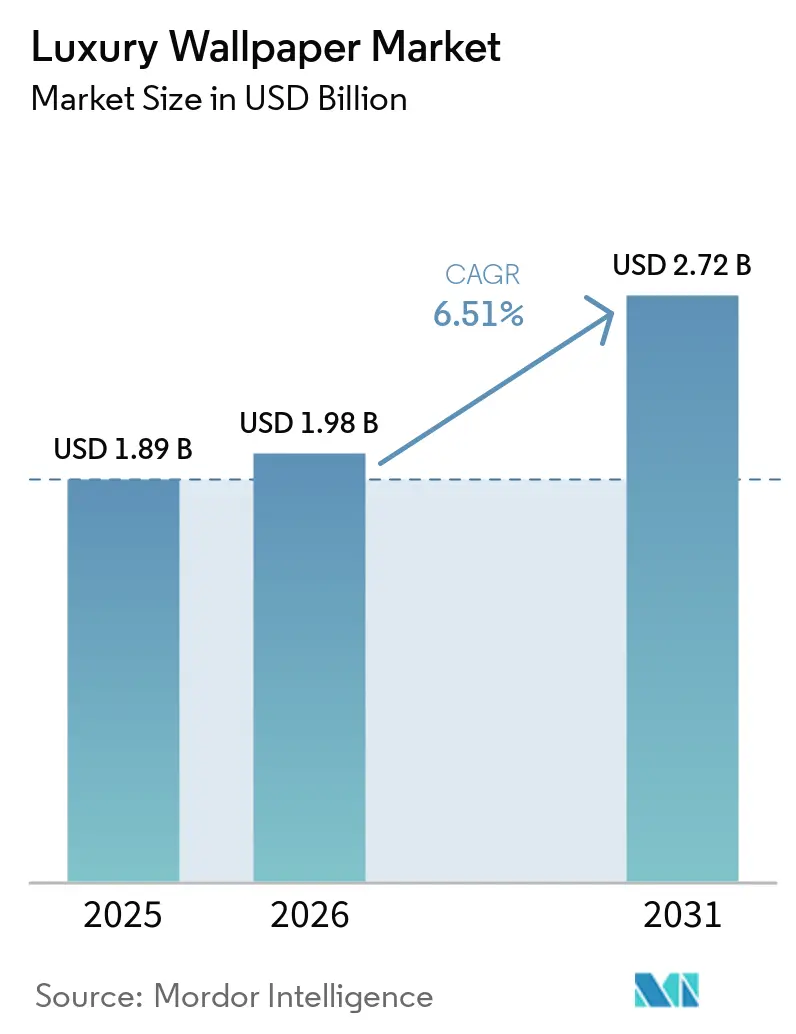
The luxury wallpaper market size was valued at USD 1.89 billion in 2025 and estimated to grow from USD 1.98 billion in 2026 to reach USD 2.72 billion by 2031, at a CAGR of 6.5% during the forecast period (2026-2031). The luxury wallpaper market is part of the global wallpaper market. It is a premium subset comprising designer wallpapers, fabric/textile wallpapers, silk, grasscloth, metallic, handcrafted, bespoke, and high-end digitally printed wallpapers. Demand is supported by affluent residential remodeling, hotel refurbishment programs, and greater use of wall surfaces as a visible part of interior design. Buyers increasingly seek distinctive patterns, tactile finishes, and customized dimensions rather than standard decorative products. This supports suppliers that can combine design archives, flexible production, and reliable trade distribution. Product choices are also being shaped by indoor air standards, material documentation, and the ability to meet project-level sustainability requirements[1]. The luxury wallpaper market, therefore, favors brands with credible design positioning and specification capabilities across residential and contract work.
Key Report Takeaways
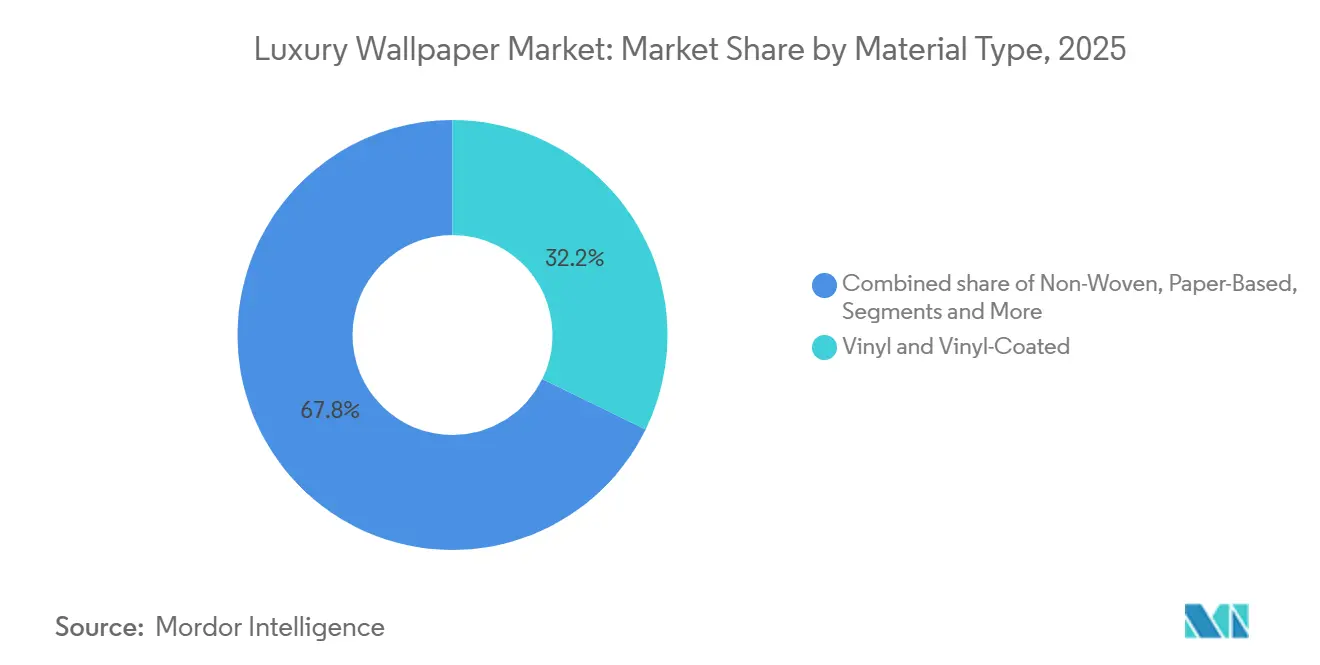
- By material type, vinyl and vinyl-coated products held 32.24% of the luxury wallpaper market share in 2025, while fabric and textile products are forecast to grow at a 7.05% CAGR through 2031.
- By installation type, traditional and non-self-adhesive formats held 59.42% of the luxury wallpaper market share in 2025, while self-adhesive and peel-and-stick products are forecast to grow at a 7.41% CAGR through 2031.
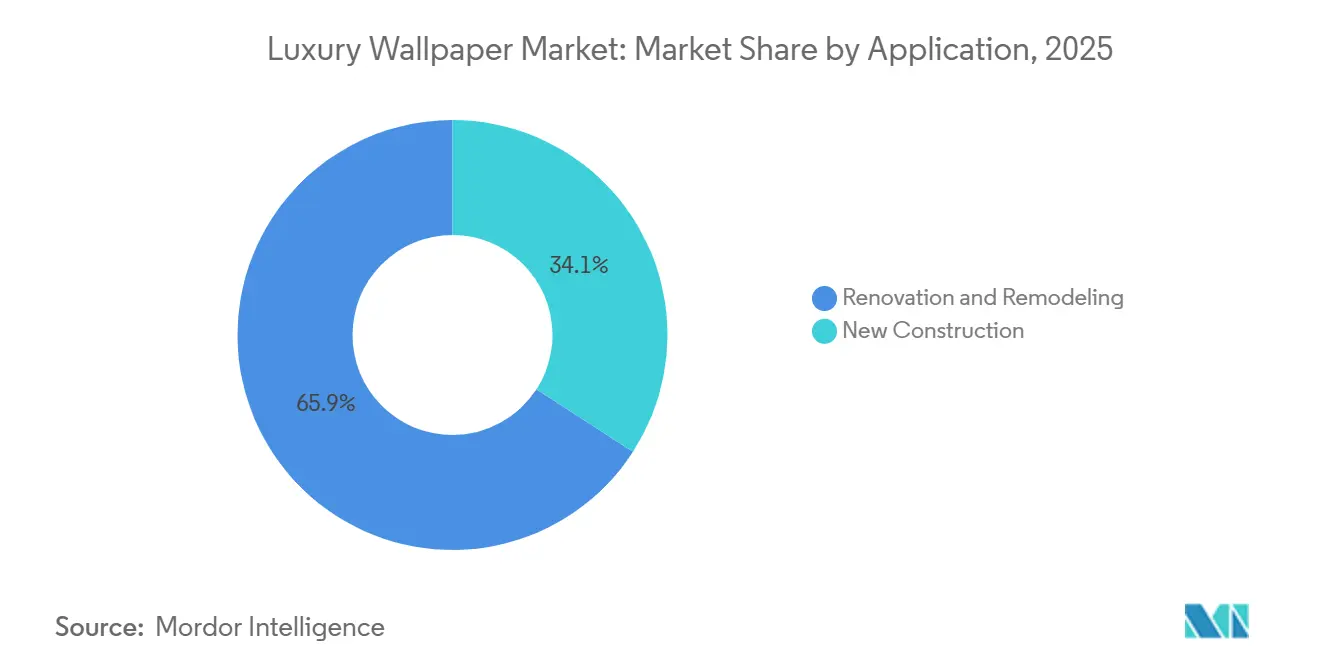
- By application, renovation and remodeling accounted for 65.86% of the luxury wallpaper market size in 2025 and are forecast to grow at a 6.73% CAGR through 2031.
- By end user, residential users held 71.77% of the luxury wallpaper market share in 2025, while commercial users are forecast to grow at a 6.85% CAGR through 2031.
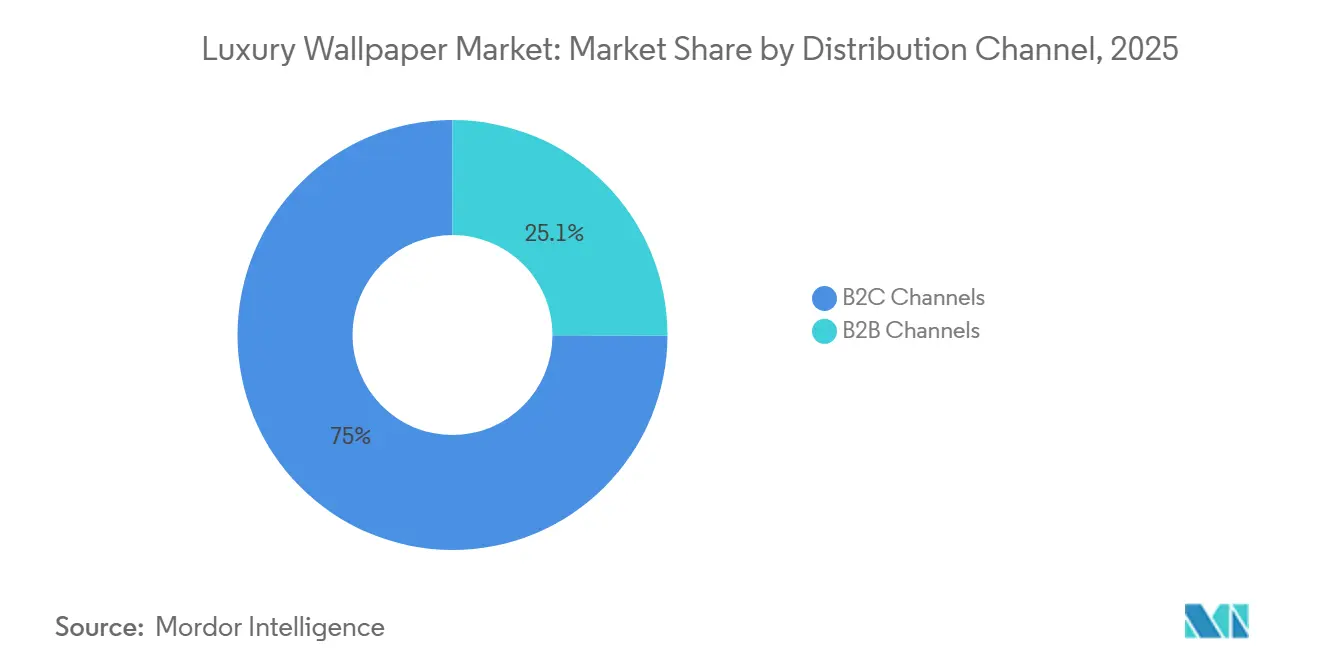
- By distribution channel, B2C channels held 74.95% of 2025 sales, while online B2C sales are forecast to grow at a 6.62% CAGR through 2031.
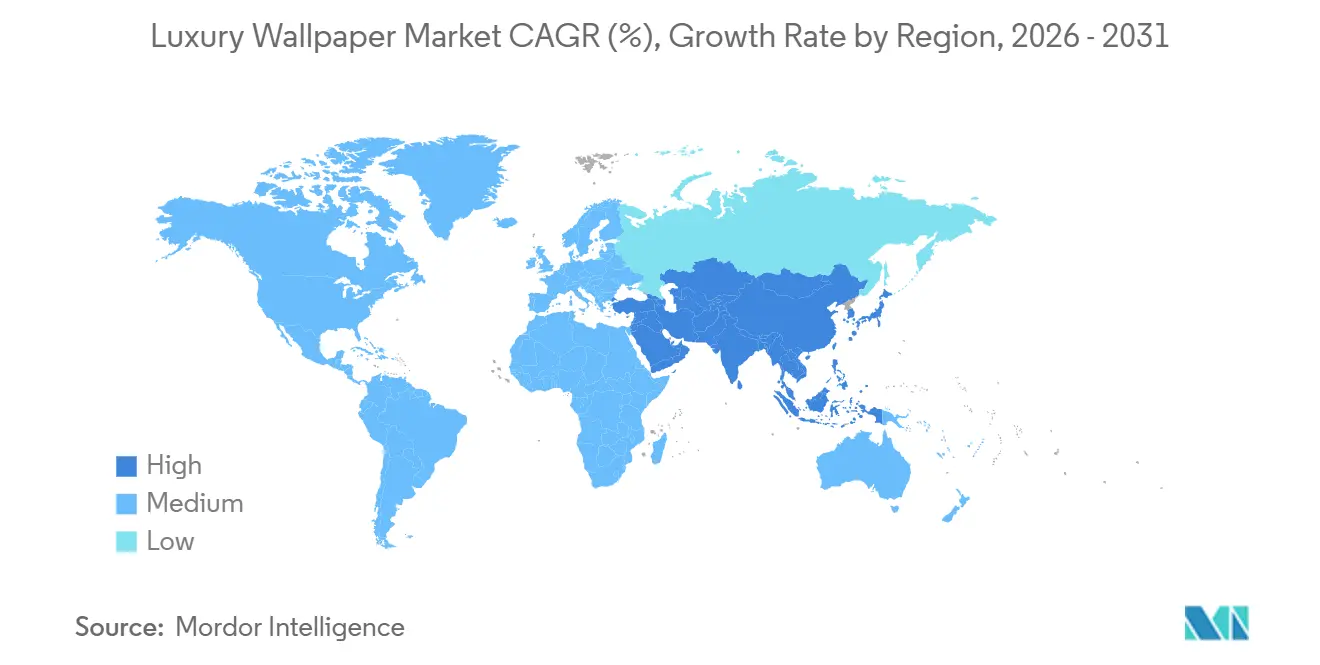
- By geography, Europe held 39.63% of the luxury wallpaper market share in 2025, while Asia-Pacific is expected to record the highest regional CAGR at 7.20% through 2031.
Note: Market size and forecast figures in this report are generated using Mordor Intelligence’s proprietary estimation framework, updated with the latest available data and insights as of January 2026.
Market Trends and Insights
Drivers Impact Analysis of Luxury Wallpaper Market*
| Driver | (~) % Impact on CAGR Forecast | Geographic Relevance | Impact Timeline |
|---|---|---|---|
| Demand for Bespoke and Digitally Printed Interior Statements | +1.6% | Global, concentrated in North America, Europe, and Asia-Pacific core markets | Short term (≤ 2 years) |
| Luxury Hospitality and Branded-Experience Renovation Cycles | +1.4% | Middle East and Africa, Asia-Pacific, and the North American hotel market | Medium term (2-4 years) |
| Premium Material and Tactile-Surface Innovation | +0.9% | Europe and North America, with spillover into Gulf and Asia-Pacific markets | Medium term (2-4 years) |
| Designer Collaboration and Intellectual-Property-Led Collections | +0.7% | Europe-led, with global retail and licensing distribution | Long term (≥ 4 years) |
| E-Commerce Visualization and Made-to-Measure Ordering | +0.7% | Global, strongest in North America and digital-first Asia-Pacific markets | Short term (≤ 2 years) |
| Sustainable Luxury Specifications in High-End Projects | +0.5% | Europe and North America | Medium term (2-4 years) |
| Source: Mordor Intelligence | |||
Demand for Bespoke and Digitally Printed Interior Statements
The luxury wallpaper market benefits when brands can produce smaller, customized orders without the high minimum volumes of conventional production. Digital printing enables studios to serve designers who need a specific scale, color treatment, or room dimension. Canon UVgel equipment used by Caro Group supports 200 to 300 unique custom orders each day and dispatches individual orders within 48 hours[2]. This operating model can make a bespoke order commercially practical for both the studio and the client. It also gives the trade channel a faster way to test designs for hospitality and residential projects. The luxury wallpaper market gains when customization is paired with reliable production and verified indoor air performance.
Luxury Hospitality, Collaboration, and Sustainable Project Demand
Luxury hotel renovation programs create recurring opportunities for premium wallcovering suppliers because guestrooms and public spaces require coordinated material specifications. Renovations are often scheduled around property standards, brand repositioning, and the need to refresh guest-facing interiors. Such programs can create larger order sizes than individual residential projects and can support repeat work through hotel portfolios. The luxury wallpaper market benefits where suppliers can meet project timing, fire requirements, and design consistency across multiple rooms. Trade relationships with architects and interior designers become important because these professionals influence material selection early in a project. The demand is especially relevant in destinations where branded hospitality development and refurbishment are active.
Designer Collaboration and Intellectual-Property-Led Collections
The luxury wallpaper market benefits when heritage design archives are translated into collections with a clear contemporary purpose. Collaborations give designers a structured way to refresh established motifs while preserving the provenance that distinguishes a premium wallcovering from a broadly distributed pattern. Sanderson launched the Highgrove by Sanderson collection in May 2025 in partnership with Highgrove Gardens and The King's Foundation, using materials from the company's 165-year archive. The collection comprised 108 wallpapers, fabrics, weaves, and embroideries, demonstrating how intellectual property can support a coordinated interior offering[3]. For trade customers, this type of collection provides a recognizable narrative that can be carried from a feature wall into related furnishings and decorative elements. It also helps suppliers maintain value when digital production makes pattern reproduction more accessible.
E-Commerce Visualization and Made-to-Measure Ordering
Online visualization helps customers assess pattern scale, color, and placement before ordering a premium wall surface. This reduces a practical barrier for buyers who cannot visit a showroom or view a full installation sample. Made-to-measure ordering can also reduce avoidable waste by aligning the product with room dimensions and pattern repeats. For design professionals, digital configuration can shorten the period between specification and production approval. The luxury wallpaper market can reach more clients when digital tools complement rather than replace physical samples and trade advice. These tools are especially useful for smaller brands that need access to customers beyond their local retail footprint.
Restraints Impact Analysis of Luxury Wallpaper Market*
| Restraint | (~) % Impact on CAGR Forecast | Geographic Relevance | Impact Timeline |
|---|---|---|---|
| Paint and Decorative Panel Substitution | -0.7% | Global, most acute in cost-sensitive residential markets in Asia-Pacific and South America | Short term (≤ 2 years) |
| Skilled Installation Cost and Availability | -0.5% | North America, Europe, and urban Asia-Pacific | Medium term (2-4 years) |
| Volatility in Vinyl, Textile, and Specialty-Fiber Inputs | -0.4% | Global, most acute for European manufacturers and Asian exporters | Short term (≤ 2 years) |
| Compliance and End-of-Life Complexity for Multi-Layer Wallcoverings | -0.3% | Europe and North America | Long term (≥ 4 years) |
| Source: Mordor Intelligence | |||
Substitution From Paint and Decorative Panels
Paint and decorative panels can compete with wallcovering when buyers prioritize simple installation, reduced project complexity, or flexibility for reconfiguration. Paint suppliers have expanded their functional performance claims to include washability and antimicrobial properties. Decorative panels can also appeal to corporate and healthcare projects that need acoustic features or replaceable components. The luxury wallpaper market is more exposed, where buyers see wallcovering as a functional surface rather than a design-led material. This is particularly relevant in price-sensitive projects where installed cost carries more weight than uniqueness. At the highest tier, hand-finished surfaces and established design archives still offer differentiation that substitute products do not easily reproduce.
Installation, Input Costs, and Compliance Complexity
Skilled installation remains a material restraint because luxury products often require precise pattern matching, careful handling, and experience with natural fibers. Input costs and compliance needs add another layer of complexity for suppliers. Vinyl, textile, and specialty-fiber products depend on materials with different price movements and supply conditions. Multi-layer products can also be harder to document, recycle, or manage at the end of life. European project specifications increasingly require evidence on emissions and material composition, which can favor suppliers with established certification systems. The European Commission's Energy Performance of Buildings Directive supports greater renovation activity across the region and increases the importance of compliant interior products[4]. The luxury wallpaper market can manage this restraint through product transparency, fewer unnecessary layers of material, and clear specification documentation.
*Our forecasts treat driver/restraint impacts as directional, not additive. The impact forecasts reflect baseline growth, mix effects, and variable interactions.
Luxury Wallpaper Market Segment Analysis
By Material Type:
Vinyl Retains Scale as Natural Fibers Define the Growth EdgeVinyl and vinyl-coated products accounted for 32.24% of the luxury wallpaper market share in 2025, driven by their durability, low maintenance, and wide design versatility. Their ability to withstand frequent cleaning makes them a preferred choice for both residential interiors and high-traffic commercial environments such as hotels, healthcare facilities, and corporate offices. The broad availability of patterns and finishes enables designers to maintain visual consistency across large projects, while compatibility with standard installation methods supports efficient execution. Despite challenges related to raw material costs, sustainability, and end-of-life disposal, manufacturers are introducing lower-emission and PVC-free alternatives to meet evolving environmental requirements. Alongside vinyl, non-woven wallpapers remain popular for their dimensional stability and ease of installation, while paper-based, metallic, and specialty finishes continue to serve heritage, luxury, and feature-wall applications.
Fabric and textile wallcoverings are projected to record the highest CAGR of 7.05% through 2031, supported by increasing demand for authentic, natural, and handcrafted interior finishes. Materials such as grasscloth and woven natural fibers offer distinctive textures and visible variations that enhance exclusivity and justify premium pricing. Their appeal is strengthened by growing consumer preference for warm, tactile, and materially authentic interiors rather than uniform synthetic surfaces. Although these products require careful installation and are more sensitive to environmental conditions, their limited scalability and craftsmanship help maintain strong pricing power. The use of bio-based substrates and sustainable materials further enhances their attractiveness, positioning fabric and textile wallcoverings as a key premium segment within the luxury wallpaper market.

By Installation Type:
Peel-and-Stick Gains Structural MomentumTraditional and non-self-adhesive formats accounted for 59.42% of the 2025 installation segment because permanent application remains common in high-value residential and contract projects. Premium rolls, fabric-backed materials, and detailed pattern matching continue to depend on professional preparation and installation. Many luxury clients view a carefully executed permanent installation as part of the product's quality proposition. This format is appropriate for projects where the interior is intended to remain in place for several years. It also supports larger panels and complex patterns that require close alignment across walls. The luxury wallpaper market retains this base because established trade channels understand these methods and can manage their technical requirements.
Traditional formats are less convenient for tenants, short-term users, or clients with limited renovation budgets. Labor availability can also increase the total project cost. Suppliers are responding with non-woven products and better-cut panels that reduce handling difficulty without compromising the finished appearance. This approach can protect the traditional format where designers still want a durable, professionally installed result. The luxury wallpaper market is not replacing permanent installations outright, because hospitality, luxury residential, and institutional projects still need long service life. Instead, installation choices are widening as suppliers match formats to project duration and user needs.
By Application:
Renovation Demand Anchors Market FundamentalsRenovation and remodeling accounted for 65.86% of the luxury wallpaper market in 2025. This application leads because owners of established homes and hospitality properties often refresh interiors without changing the broader building structure. Wallcovering can change the visual identity of a room without the disruption of a complete reconstruction project. In mature markets, affluent households may choose remodeling when property transactions are less attractive or less convenient. This directs spending toward finishes that visibly improve everyday living spaces. The luxury wallpaper market benefits when renovation decisions favor durable, personalized materials over standard decorative treatments.
New construction accounted for 34.14% of 2025 application revenue. This segment matters in locations with luxury residential development, hotel openings, and mixed-use projects. Wallcovering can be selected at the design-intent stage, allowing a developer to incorporate it into a broader premium positioning strategy. Such projects can create substantial contract orders when a property includes numerous units or guestrooms. The luxury wallpaper market gains from these projects when architects specify surface materials early enough to protect them from later value engineering. This makes trade relationships and reliable technical data essential during design development.
By End User:
Commercial Specifications Outpace Residential Growth RateResidential users represented 71.77% of the 2025 end-user mix. Affluent primary residences and vacation homes drive the greatest demand for designer, bespoke, and heritage wallcoverings. Buyers often engage interior designers to select products that complement furniture, art, lighting, and architecture. This makes sampling and trade support important parts of the buying process. Collector-oriented products can command high prices where a client values hand printing, limited editions, or artist collaborations. The luxury wallpaper market remains anchored in residential use because the home offers the broadest range of settings for design-led wall surfaces.
Commercial users are forecast to grow at 6.85% CAGR through 2031, faster than the total market. Hospitality is particularly important because hotels use interior surfaces to create distinct guest experiences across rooms, corridors, restaurants, and public areas. Healthcare presents a distinct opportunity in which wallcoverings require documented cleanability, indoor air performance, and durability. Workplace and co-working projects also use surface design to support brand identity and distinguish common areas. The luxury wallpaper market can serve these users when its products meet both commercial standards and visual expectations. Contract sales can also provide meaningful order visibility once a project is approved.
By Distribution Channel:
B2C Scale Masks B2B Specification PowerB2C channels accounted for 74.95% of the 2025 distribution volume. Specialty stores, home centers, and online platforms each play different roles in the customer journey. Specialty stores remain valuable for clients who want to compare samples and receive informed advice on finish, texture, and installation. General retailers may offer a broader reach, but cannot always provide the same level of design guidance. Online channels help brands display complete collections and connect with customers beyond their physical retail footprint. The luxury wallpaper market uses B2C distribution to build awareness, facilitate discovery, and support smaller residential purchases.
Online B2C sales are forecast to grow at 6.62% CAGR through 2031. High-resolution images, room visualization, and sample requests can improve confidence before a client commits to a full order. Digital channels are most effective when they give clear information on scale, material, lead time, and required installation conditions. They can also help established brands introduce new collections to international audiences. The luxury wallpaper market gains when online shopping is supported by physical samples and clear customer service. This preserves the tactile experience that remains important for a premium wall surface.
Geography Analysis
Europe Luxury Wallpaper Market
Europe held 39.63% of the luxury wallpaper market share in 2025. The region combines heritage manufacturers, design-aware consumers, mature trade channels, and a strong culture of renovation. The United Kingdom, Germany, France, Italy, BENELUX, and the Nordic countries each contribute different strengths to demand and supply. Germany is important for contract specifications where fire performance and REACH-compliant formulations influence product selection. The luxury wallpaper market size in Europe is also supported by a large stock of buildings that can be upgraded rather than replaced. This environment favors suppliers with long design archives and strong documentation.
APAC Luxury Wallpaper Market
Asia-Pacific is forecast to grow at 7.2% CAGR through 2031, the fastest regional rate in the supplied market model. China is moving from a volume-led construction pattern toward renovation and upgrade spending as earlier urban housing enters a new refurbishment cycle. India's major cities are developing a more formal culture of premium interior specifications alongside luxury residential growth. Japan and South Korea provide sophisticated interior markets with distinct preferences for texture, restrained color, and imported heritage collections. Southeast Asia adds demand through branded hospitality development in Vietnam, Thailand, and Indonesia. The luxury wallpaper market can grow across the region by adapting collections, lead times, and trade support to local project needs.
The Americas and MEA Luxury Wallpaper Market
North America remains important because of luxury home remodeling, established trade distribution, and hotel refurbishment activity. The United States offers a broad base of interior designers, installers, and specialty retail channels. The Middle East and Africa contribute to a smaller absolute demand but to high renovation intensity in the UAE and Saudi luxury hotels. South America remains an emerging opportunity, with premium residential and hospitality projects concentrated in Brazil and Chile. These regions do not have identical demand patterns, so suppliers need to choose channel partners carefully. The luxury wallpaper market benefits from geographic diversification because renovation-led and new-build-led demand can offset one another.
Competitive Landscape
In the luxury wallpaper market, European heritage houses are prominent in the premium tier. Sanderson Design Group, Arte International, Omexco, Osborne and Little, The Romo Group, Elitis, and other specialist houses compete through design rights, craftsmanship, and trade distribution. Their position depends less on low-cost manufacturing than on their ability to offer a recognizable creative point of view. Design archives can provide an advantage by allowing brands to reinterpret established motifs for current collections. This is especially valuable when clients seek products that appear distinctive rather than standardized. The luxury wallpaper market remains open to regional specialists and digital studios, but established names retain credibility with designers and premium buyers.
Material performance is a further competitive factor. Vescom's Purefin line illustrates how low-VOC documentation and alignment with standards can support specification for projects with sustainability requirements. Suppliers that combine this evidence with a refined surface design can compete for commercial and public-facing projects. Digital studios can compete by offering short runs, responsive customization, and direct configuration tools. Heritage houses can respond through their archives, designer relationships, and experience in complex installations. The luxury wallpaper market therefore includes more than a contest between large and small brands, because each group can occupy a different part of the specification process.
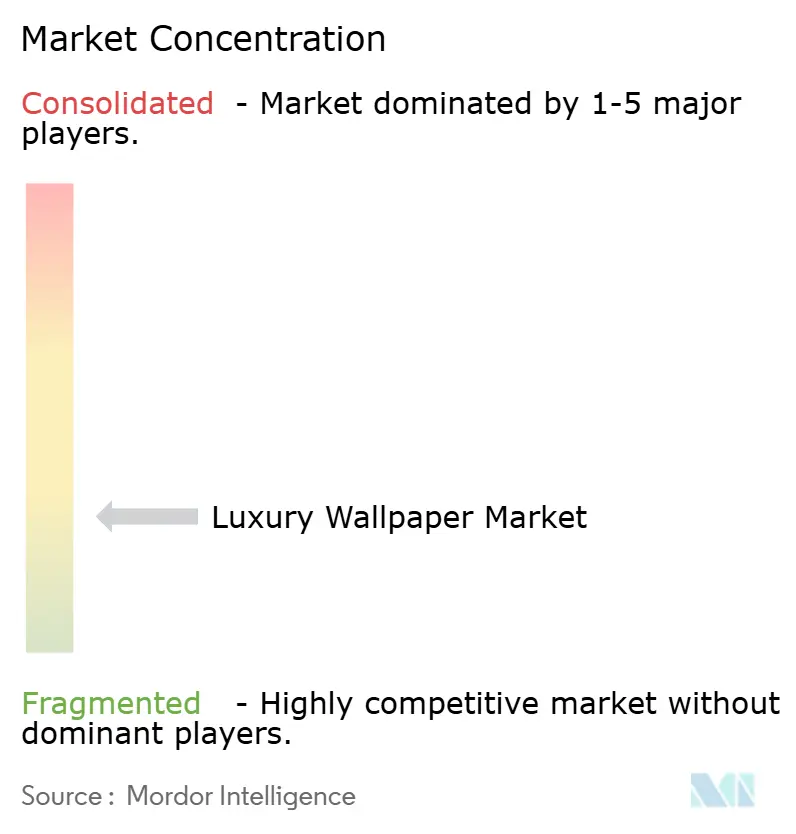
Private investment and portfolio development may influence the competitive structure when established brands seek broader distribution or digital capability. The most defensible positions are likely to combine proprietary design, reliable technical service, and clear material credentials. Brands also need to manage the tension between exclusivity and accessibility as online channels broaden consumer reach. A collection can lose part of its premium appeal if distribution becomes too broad or if customization is difficult to manage. The luxury wallpaper industry remains differentiated by service quality because buyers often need support before and after installation. Market concentration score: 5, because the available material identifies several leading houses but provides no combined top-player share that would support a higher concentration rating.
Luxury Wallpaper Industry Leaders
-
Sangetsu Corporation
-
A.S. Création Tapeten AG
-
York Wallcoverings Inc.
-
F. Schumacher & Co.
-
Sanderson Design Group plc
- *Disclaimer: Major Players sorted in no particular order
Luxury Wallpaper Market Companies Covered in this Report
- Sangetsu Corporation
- A.S. Création Tapeten AG
- York Wallcoverings Inc.
- F. Schumacher & Co.
- Sanderson Design Group plc
- de Gournay
- Grandeco Wallfashion Group NV
- Graham and Brown Ltd.
- Tapetenfabrik Gebr. Rasch GmbH and Co. KG
- Arte International
- Omexco NV
- Osborne and Little
- The Romo Group
- Marburger Tapetenfabrik
- Erismann and Cie. GmbH
- Thibaut, Inc
- Elitis
- Vescom B.V.
- Phillip Jeffries Ltd.
- Wall and Deco Srl
- Flavor Paper
- Muraspec Group
- Tecnografica
- GLAMORA
- Komar Products GmbH*
Recent Industry Developments in Luxury Wallpaper Market
- May 2025: Sanderson Design Group launched the Highgrove by Sanderson collection, a collaboration with Highgrove Gardens and The King's Foundation, drawing on the brand's 165-year archive to produce more than 100 wallpapers, fabrics, weaves, and embroideries.
- March 2025: Newmor invested in Canon Colorado M5W and Neolt finishing equipment to expand digital production capacity for bespoke custom-print solutions.
Global Luxury Wallpaper Market Report Scope
| Vinyl and Vinyl-Coated |
| Non-Woven |
| Paper-Based |
| Fabric and Textile |
| Metallic & Specialty Wallpaper |
| Other Materials |
| Traditional/Non Self-Adhesive |
| Self-Adhesive / Peel-and-Stick |
| New Construction |
| Renovation and Remodeling |
| Residential | |
| Commercial | Hospitality |
| Healthcare | |
| Corporate Offices and Co-Working Spaces | |
| Retail and Shopping Centers | |
| Education and Institutional Buildings | |
| Transportation and Marine Interiors | |
| Other End Users (Public Buildings and Government Facilities, Leisure and Other Commercial Facilities) |
| B2C Channels | Hypermarkets and Supermarkets |
| Specialty Stores | |
| Home Centers | |
| Online | |
| Local Shops | |
| Other Distribution Channels | |
| B2B Channels (Contractors and Installers, Interior Designers and Architects, Project Procurement and Institutional Sales) |
| North America | Canada |
| United States | |
| Mexico | |
| South America | Brazil |
| Peru | |
| Chile | |
| Argentina | |
| Rest of South America | |
| Europe | United Kingdom |
| Germany | |
| France | |
| Spain | |
| Italy | |
| BENELUX (Belgium, Netherlands, Luxembourg) | |
| NORDICS (Denmark, Finland, Iceland, Norway, Sweden) | |
| Rest of Europe | |
| Asia-Pacific | India |
| China | |
| Japan | |
| Australia | |
| South Korea | |
| South-East Asia | |
| Rest of Asia-Pacific | |
| Middle East & Africa | United Arab Emirates |
| Saudi Arabia | |
| South Africa | |
| Nigeria | |
| Rest of Middle East & Africa |
| By Material Type | Vinyl and Vinyl-Coated | |
| Non-Woven | ||
| Paper-Based | ||
| Fabric and Textile | ||
| Metallic & Specialty Wallpaper | ||
| Other Materials | ||
| By Installation Type | Traditional/Non Self-Adhesive | |
| Self-Adhesive / Peel-and-Stick | ||
| By Application | New Construction | |
| Renovation and Remodeling | ||
| By End User | Residential | |
| Commercial | Hospitality | |
| Healthcare | ||
| Corporate Offices and Co-Working Spaces | ||
| Retail and Shopping Centers | ||
| Education and Institutional Buildings | ||
| Transportation and Marine Interiors | ||
| Other End Users (Public Buildings and Government Facilities, Leisure and Other Commercial Facilities) | ||
| By Distribution Channel | B2C Channels | Hypermarkets and Supermarkets |
| Specialty Stores | ||
| Home Centers | ||
| Online | ||
| Local Shops | ||
| Other Distribution Channels | ||
| B2B Channels (Contractors and Installers, Interior Designers and Architects, Project Procurement and Institutional Sales) | ||
| By Geography | North America | Canada |
| United States | ||
| Mexico | ||
| South America | Brazil | |
| Peru | ||
| Chile | ||
| Argentina | ||
| Rest of South America | ||
| Europe | United Kingdom | |
| Germany | ||
| France | ||
| Spain | ||
| Italy | ||
| BENELUX (Belgium, Netherlands, Luxembourg) | ||
| NORDICS (Denmark, Finland, Iceland, Norway, Sweden) | ||
| Rest of Europe | ||
| Asia-Pacific | India | |
| China | ||
| Japan | ||
| Australia | ||
| South Korea | ||
| South-East Asia | ||
| Rest of Asia-Pacific | ||
| Middle East & Africa | United Arab Emirates | |
| Saudi Arabia | ||
| South Africa | ||
| Nigeria | ||
| Rest of Middle East & Africa | ||
Key Questions Answered in the Report
What is the projected value of luxury wallpaper by 2031?
The luxury wallpaper market size is forecast to reach USD 2.72 billion by 2031, rising from USD 1.98 billion in 2026 at a 6.5% CAGR.
Which luxury wallpaper material is growing fastest?
Fabric and textile wallcoverings are forecast to expand at a 7.05% CAGR through 2031, supported by demand for natural fibers and tactile finishes.
Why are peel-and-stick luxury products growing?
Self-adhesive and peel-and-stick formats are forecast to grow at a 7.41% CAGR because they reduce installation barriers for flexible residential and commercial uses.
Which application accounts for the most demand?
Renovation and remodeling represented 65.86% of 2025 demand, reflecting ongoing residential and hospitality refurbishment activity.