
Non-Woven Wallpaper Market Size and Share
Market Overview
| Study Period | 2020 - 2031 |
|---|---|
| Market Size (2026) | USD 2.67 Billion |
| Market Size (2031) | USD 3.49 Billion |
| Growth Rate (2026 - 2031) | 5.50 % |
| Fastest Growing Market | Asia-Pacific |
| Largest Market | North America |
| Market Concentration | Low |
Major Players *Disclaimer: Major Players sorted in no particular order Image © Mordor Intelligence. Reuse requires attribution under CC BY 4.0. | |
Non-Woven Wallpaper Market Analysis by Mordor Intelligence
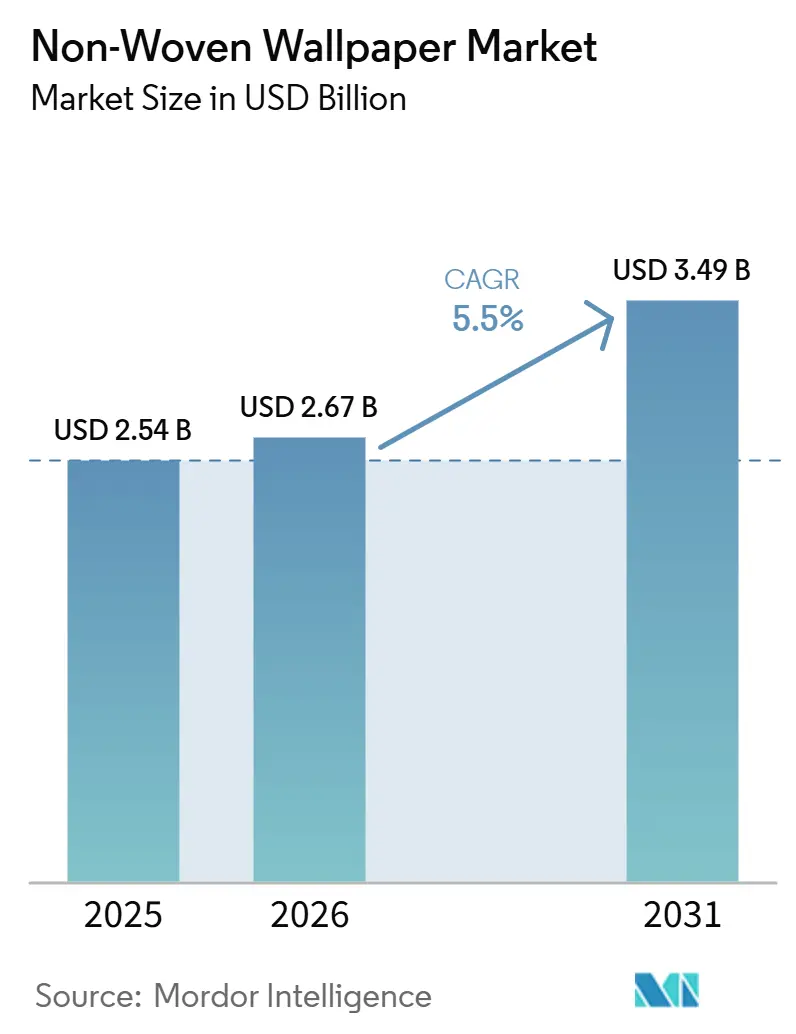
The non-woven wallpaper market size is projected to expand from USD 2.54 billion in 2025 to USD 2.67 billion in 2026, and to USD 3.49 billion by 2031, registering a CAGR of 5.5% between 2026 and 2031. The non-woven wallpaper market is benefiting from the move away from traditional paper substrates in mid-priced and premium residential and contract projects. Paste-the-wall formats eliminate the need for pre-soaking during installation and support clean removal, making wallpaper more practical for professional installers and first-time DIY users. Renovation activity, digital printing, murals, and certified materials are supporting higher-value product sales. Commercial buyers are also specifying products that can meet material-health, fire-safety, and low-emission requirements. These conditions create opportunities for suppliers to pair design choices with reliable installation and verified product performance.
Key Report Takeaways
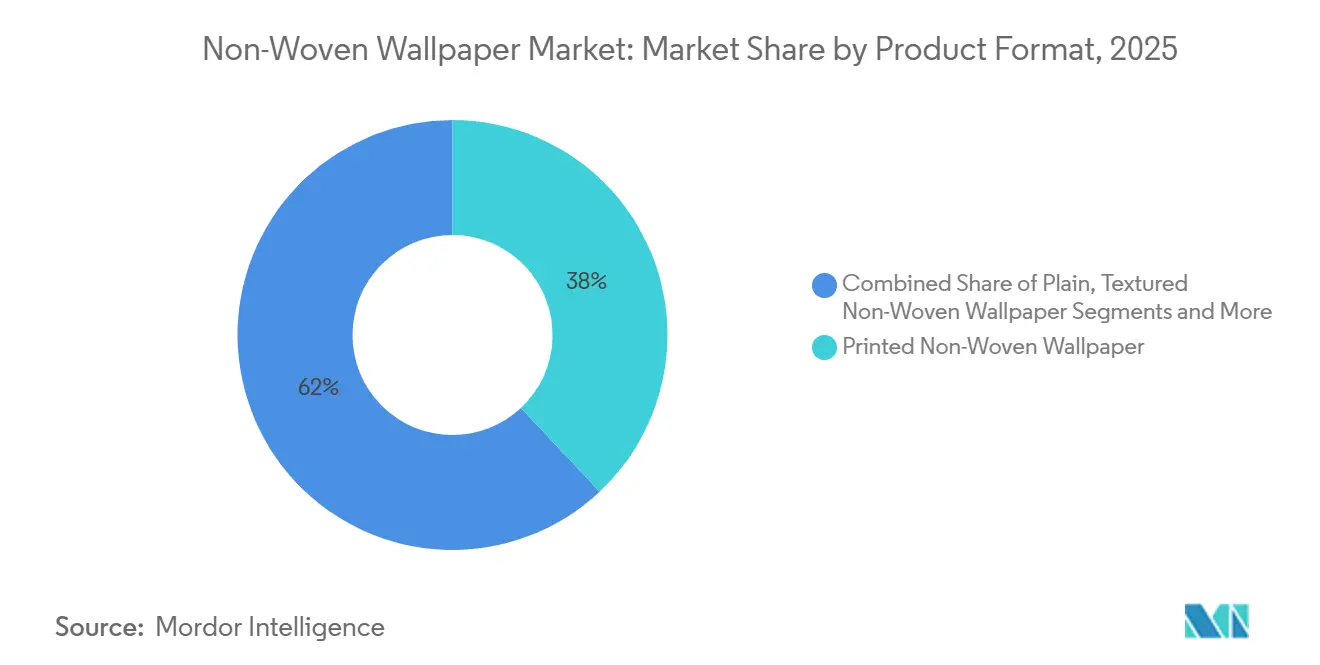
- By product format, printed non-woven wallpaper held 38% of the non-woven wallpaper market share in 2025, while mural and panoramic wallpaper are forecast to grow at a 6.3% CAGR through 2031.
- By installation type, traditional/non-self-adhesive wallpaper held 75% of the market share in 2025, while self-adhesive and peel-and-stick wallpaper are forecast to grow at a 6.6% CAGR through 2031.
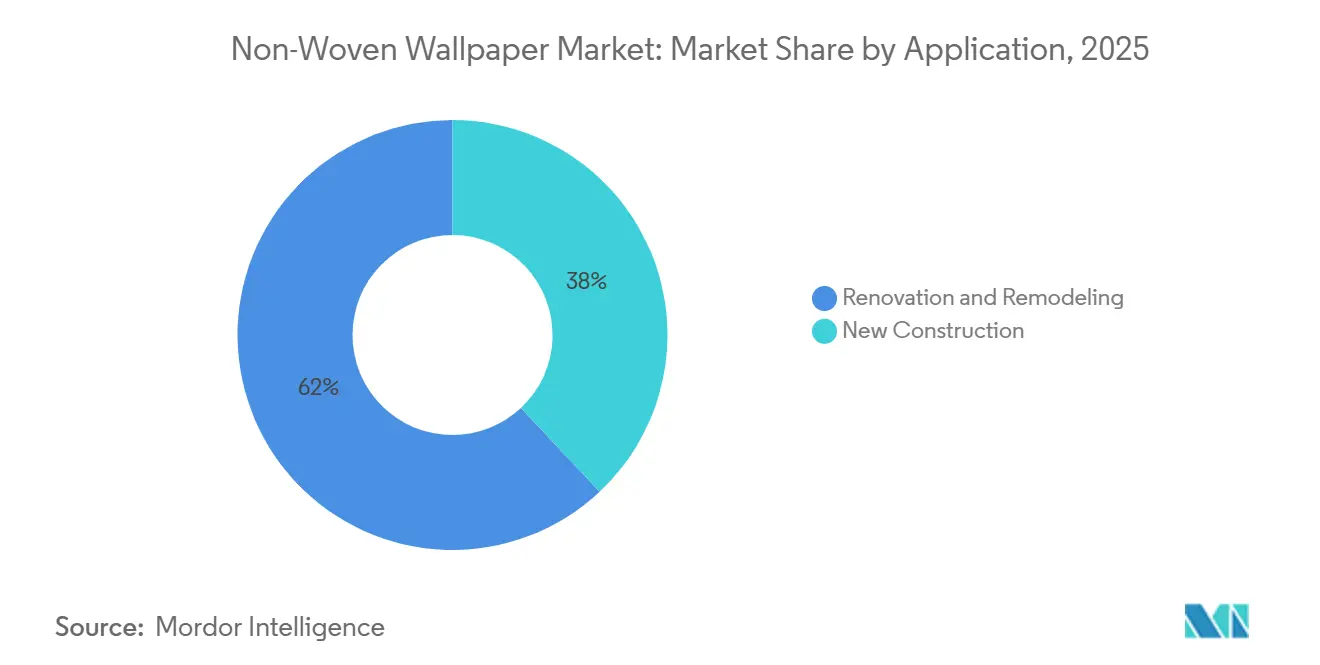
- By application, renovation and remodeling accounted for 62% of the non-woven wallpaper market share in 2025 and is forecast to grow at a 5.8% CAGR through 2031.
- By end user, residential users held 71.25% share in 2025, and are forecast to grow at a 5.9% CAGR through 2031.
- By distribution channel, B2C channels held 76.38% share in 2025 and are forecast to grow at a 5.7% CAGR through 2031.
- By geography, North America held 33.7% share in 2025, while the Asia-Pacific is forecast to grow at a 6.2% CAGR through 2031.
Note: Market size and forecast figures in this report are generated using Mordor Intelligence’s proprietary estimation framework, updated with the latest available data and insights as of January 2026.
Global Non-Woven Wallpaper Market Trends and Insights
Drivers Impact Analysis*
| Driver | (~) % Impact on CAGR Forecast | Geographic Relevance | Impact Timeline |
|---|---|---|---|
| Paste-the-Wall Installation and DIY Adoption | +1.2% | Global, concentrated in North America, the United Kingdom, and the DACH region | Medium term (2-4 years) |
| Renovation and Rental Demand for Removable Wallcoverings | +1.0% | North America and Europe, expanding into Japan and Australia | Medium term (2-4 years) |
| Digital Printing and Customization | +0.9% | Global, with Asia-Pacific manufacturing capacity extending reach | Long term (≥ 4 years) |
| Commercial Demand for Durable Low-Emission Products | +0.8% | Middle East and Africa, Southeast Asia, and Western Europe | Medium term (2-4 years) |
| Certified PVC-Free and Recyclable Materials | +0.6% | European Union, North America, and Oceania | Short term (≤ 2 years) |
| AI-Assisted Design and On-Demand Printing | +0.5% | North America, Europe, and the Asia-Pacific digital markets | Long term (≥ 4 years) |
| Source: Mordor Intelligence | |||
Paste-the-Wall Installation and DIY Adoption
Paste-the-wall wallpaper installation has reduced two common barriers to wallpaper use: soaking time and the risk of substrate damage. Adhesive is applied directly to the wall rather than to the wallpaper, reducing handling time and making the process easier for less experienced installers. Dimensional stability can reduce bubbling and shrinkage, making pattern alignment more manageable. Dry-strippable removal is important in rental homes because it allows occupants to remove wall decoration without wetting the wall surface. EMICODE and EN 15102 performance requirements also give designers and installers greater confidence when selecting these systems for occupied buildings. The label guides consumers, craftsmen, and architects in deciding which materials offer maximum safety against indoor air pollution, ensure optimal health protection, and provide high environmental compatibility.
Renovation and Rental Demand for Removable Wallcoverings
Renovation and remodeling accounted for 62% of the non-woven wallpaper market in 2025, making it the largest application area in the supplied research. United States renovation and repair spending is projected to reach USD 519 billion annually through mid-2027, which provides a broad base for demand for interior surface materials [1].Harvard Joint Center for Housing Studies, “Leading Indicator of Remodeling Activity,” Harvard Joint Center for Housing Studies, jchs.harvard.edu The United States has more than 45 million renter-occupied housing units, creating recurring demand for decoration that can be removed when occupants move [2]Federal Reserve Bank of St. Louis, “Federal Reserve Economic Data,” Federal Reserve Bank of St. Louis, fred.stlouisfed.org. This renter base is less directly tied to home purchase activity than owner-occupied renovation spending. Peel-and-stick non-woven wallpaper can therefore serve a demand pool that continues even when housing transactions slow. The non-woven wallpaper market also benefits from this trend, as rental users often value simple installation and clean removal alongside appearance.
Digital Printing and Customization Expanding Design Choice
Digital inkjet printing has changed the economics of design and production for the non-woven wallpaper market. Dimensional stability under UV, latex, and eco-solvent inks can help maintain print registration and reduce color variation on large designs. This supports single-piece murals and project-specific designs for individual walls. Sanderson Design Group reported that digital printing represented 54% of output at its Anstey Wallpaper factory in the fiscal year ended January 2025. Short-run production reduces the need for high minimum order quantities and lowers the risk of unsold stock. It also allows designers to specify limited-run patterns with shorter lead times for residential and contract projects.
Commercial Demand for Durable Low-Emission Products
Hospitality, healthcare, and corporate offices are expanding the use of nonwoven wallpaper for commercial applications. These buyers often consider fire performance, washability, low-emission credentials, and moisture management when selecting wallcoverings. The supplied research identifies EN 13501-1 Euroclass B and ASTM E84 Class A as relevant benchmarks for occupied spaces. Zambaiti Parati presented 8 technical substrates at Milan Design Week in 2026, including sound-absorbing, fire-retardant, and rice-starch-based materials. This product direction shows why commercial demand extends beyond printed decoration into acoustic, fire-safety, and moisture-related needs. PVC-free and recyclable material choices can also support procurement requirements in the European Union, North America, and Oceania, while on-demand printing and AI-assisted design can shorten the product-development cycle in digitally advanced markets.
Restraints Impact Analysis*
| Restraint | (~) % Impact on CAGR Forecast | Geographic Relevance | Impact Timeline |
|---|---|---|---|
| Higher Cost Than Paint and Commodity Vinyl Wallpaper | -0.8% | Global, most acute in price-sensitive South and Southeast Asian markets | Short term (≤ 2 years) |
| Cellulose, Polyester, and Coating Cost Volatility | -0.7% | Global, with supply-chain exposure in China, Scandinavia, and Southeast Asia | Medium term (2-4 years) |
| Installation Skill Needs for Pattern Matching and Preparation | -0.6% | Emerging markets in Africa, South America, and South and Southeast Asia | Medium term (2-4 years) |
| Limited Recycling Infrastructure for Composite Products | -0.5% | Europe and North America's sustainability policy jurisdictions | Long term (≥ 4 years) |
| Source: Mordor Intelligence | |||
Higher Cost Versus Commodity Alternatives
Non-woven wallpaper carries a 40-60% price premium over commodity vinyl wallpaper per square meter. This gap limits adoption in price-sensitive parts of South and Southeast Asia, Africa, and South America. Non-woven substrates use cellulose, polyester, and binders, and their production requires more controlled fiber formation than vinyl calendering. Buyers comparing wallpaper with a 2-coat paint finish may not always place enough value on design or durability to accept the higher price. Plain rolls also face direct competition from digital print-on-demand vinyl products sold online at closely competing price points. Export-grade production capacity in China could narrow the premium over commodity substrates during the forecast period.
Raw-Material Volatility and Supply Chain Exposure
Cellulose, polyester, specialty coatings, and acrylic binders create several input-cost exposures for the non-woven wallpaper market. Cellulose costs follow forestry and softwood-pulp cycles, while polyester costs are linked to PET resin and crude-oil derivatives. A 10% rise in pulp prices can add 3-5% to substrate manufacturing cost before coating and printing. Those movements can pressure margins in product lines sold under retail price ceilings. Erfurt & Sohn announced a USD 35 million manufacturing investment program in November 2024, covering new machinery, increased recycled content, energy-efficient processes, and IT modernization [3]Erfurt & Sohn, “Sustainable Manufacturing Investment Program,” Erfurt & Sohn, erfurt.com. Smaller producers may find it harder to absorb input volatility while also funding investments in design, digital printing, and recycling.
*Our forecasts treat driver/restraint impacts as directional, not additive. The impact forecasts reflect baseline growth, mix effects, and variable interactions.
Segment Analysis
By Product Format: Digital Printing Reshaping the Format Hierarchy
Printed formats held 38% of the non-woven wallpaper market share in 2025, reflecting broad design libraries across residential and contract price points. Mural and panoramic products are forecast to grow at a 6.3% CAGR from 2026 to 2031, the highest rate among product formats. Designers use large single-panel murals in hospitality lobbies, healthcare settings, and higher-value residential projects. Plain products remain an entry-level option for DIY buyers and a paint-over base. Textured and embossed products serve mid-priced demand where buyers want surface interest without complex printed artwork. Metallic formats remain a smaller premium option in Middle Eastern and Southeast Asian hospitality projects.
Designtex launched Borealis in April 2026 on a non-vinyl substrate with 50% biobased content for hospitality and healthcare interiors [4]Designtex, “Borealis,” Designtex, designtex.com. The collection reflects the overlap between design development and material choices in the non-woven wallpaper market. Commercial buyers also consider EN 15102 requirements, including fire behavior, washability, and dimensional stability. Fiber cohesion can help non-woven products meet these performance needs relative to paper formats. Digital printing enables smaller production runs and more customization, which supports projects that do not require a standard repeat pattern. Suppliers can therefore compete through both visual range and documented performance.



By Installation Type: Self-Adhesive Formats Expanding Beyond DIY
Traditional and non-self-adhesive wallpaper accounted for 75.0% and led the installation-type category in 2025. Self-adhesive, peel-and-stick non-woven wallpaper is forecast to grow at a 6.6% CAGR from 2026 to 2031. The format aligns with rental housing, as users can update walls without a permanent installation. More than 45 million renter-occupied housing units in the United States provide a substantial addressable base for removable decoration. Traditional installation remains important for renovation work in Europe and North America, where professional installers and experienced DIY users continue to use paste-applied products. The non-woven wallpaper market can serve both methods, as non-woven substrates are available in both conventional and self-adhesive formats.
Self-adhesive products began as residential DIY items but are now also used in retail and exhibition spaces. Frequent display changes favor products that can be installed dry and removed cleanly. These products have a strong relationship with online retail because simple instructions can reduce hesitation before purchase. A larger online share for self-adhesive products does not eliminate the role of installers, particularly where walls need preparation or patterns require close alignment. The requirement for skilled preparation can still limit adoption in emerging regions. Suppliers that clearly explain the conditions for wall preparation and removal can reduce returns and improve customer confidence.
By Application: Renovation and Remodeling Remain the Main Demand Base
Renovation and remodeling accounted for 62% of the non-woven wallpaper market in 2025 and is forecast to grow at a 5.8% CAGR through 2031. Existing-home upgrades in China are boosting wallpaper demand as the property sector shifts from new construction to refurbishment. United States renovation and repair expenditure is expected to remain above USD 500 billion annually through 2027. Kitchen and bathroom upgrades can create demand for interior finishes when buyers want materials that offer a distinct visual change. The non-woven wallpaper market benefits where wallpaper is included as part of a broader room renovation rather than a stand-alone purchase.
New construction is a smaller application, but it can support higher-value specification work. Projects in Asia-Pacific and the Middle East may use premium wallcoverings as a standard interior finish to differentiate residential or hospitality developments. This application is particularly relevant where developers seek coordinated designs across multiple rooms. Commercial construction can also support murals and technically rated surfaces, especially in hospitality settings. New-build demand is more exposed to project cycles than renovation work. A balanced supplier portfolio can therefore combine renovation-oriented products with specified products for new developments.
By End User: Residential Volume With Commercial Specification Value
Residential users held 71.25% of the non-woven wallpaper market in 2025 and are forecast to grow at a 5.9% CAGR through 2031. Living rooms, bedrooms, kitchens, and bathrooms are the main residential settings identified in the supplied research. Moisture tolerance, cleanability, and dry-strippable removal provide practical benefits over paper alternatives. Feature walls in living rooms and bedrooms are helping printed and mural formats gain attention. Improved moisture-resistant coatings support use in kitchen and bathroom areas. Residential demand also includes renters who prefer temporary or removable design changes.
Commercial projects can achieve higher margins because architects and interior designers often specify wallcoverings based on required performance attributes rather than unit price. Healthcare and education facilities are steady commercial users where low-VOC content, washability, and GREENGUARD Gold certification are relevant. REACH requirements and NSF/ANSI 342 can provide material-health benchmarks for products with verified content declarations. These requirements can narrow the field toward certified systems. Hospitality, healthcare, and office projects may also use technically rated products that address fire behavior or acoustics. The non-woven wallpaper industry has an opportunity to serve these buyers with evidence that is easy for specifiers to review.
By Distribution Channel: B2C Scale Reflects Widening Consumer Accessibility
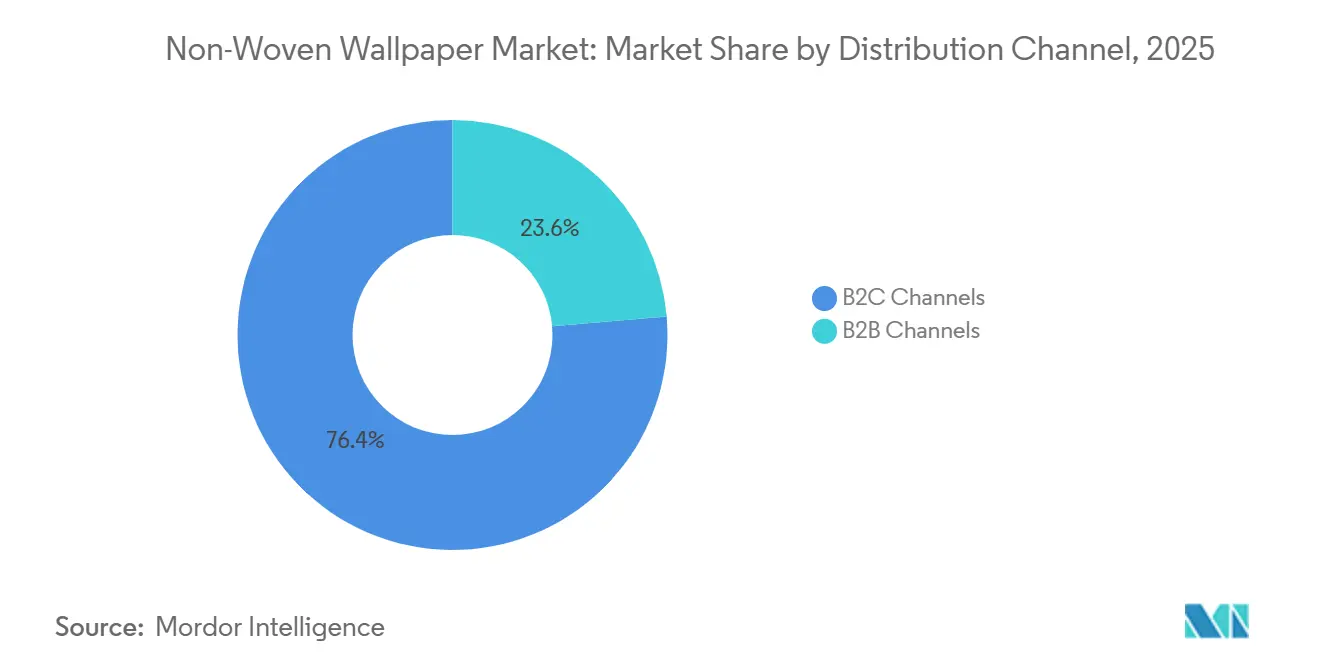
B2C channels accounted for 76.38% of the global non-woven wallpaper market in 2025. That figure spans a wide range of touchpoints, online platforms, specialty stores, home improvement centers, and branded showrooms, and it reflects how much the category has moved toward direct consumer access over the past few years. Growth here is not slowing down either; B2C is projected at a 5.69% CAGR through 2026–2031, the fastest of any distribution channel. Digital room-visualization tools and augmented-reality previews have played a larger role than most industry watchers credit; they have quietly reduced the return rate and cart abandonment problem that once made online wallpaper sales economically fragile. On-demand digital printing now lets manufacturers skip minimum-order requirements entirely, meaning a consumer can order a single custom panel set and receive it at their door without any warehouse buffer in between. The structural renter economy sustains this demand: the Federal Reserve Bank of St. Louis reports that renter-occupied US housing units exceed 45 million, each a potential buyer of a removable, non-woven solution that does not void a tenancy deposit.
B2B channels account for the remaining 23.62% in 2025 and punch well above their volume-weighted margins. Procurement here is specification-driven: architects and interior designers select products before end users ever see them, so certified performance attributes carry more weight than price alone. GREENGUARD Gold and ASTM E84 documentation are now standard requirements in LEED v5 and WELL-rated project pipelines, effectively pre-qualifying which non-woven products can compete for commercial fit-outs in hospitality, healthcare, and corporate offices. Direct-to-trade digital platforms are starting to compress the distributor layer in B2B, giving manufacturers tighter margin control and faster turnaround on specifications. Sanderson Design Group runs both a mass DTC digital channel and a contract-grade specification pipeline in parallel. The 5.91% CAGR forecast for the residential end-user segment reinforces both channels simultaneously: DIY and rental-market purchases route through B2C. In contrast, the designer-assisted premium residential subset feeds the B2B trade channel.
Geography Analysis
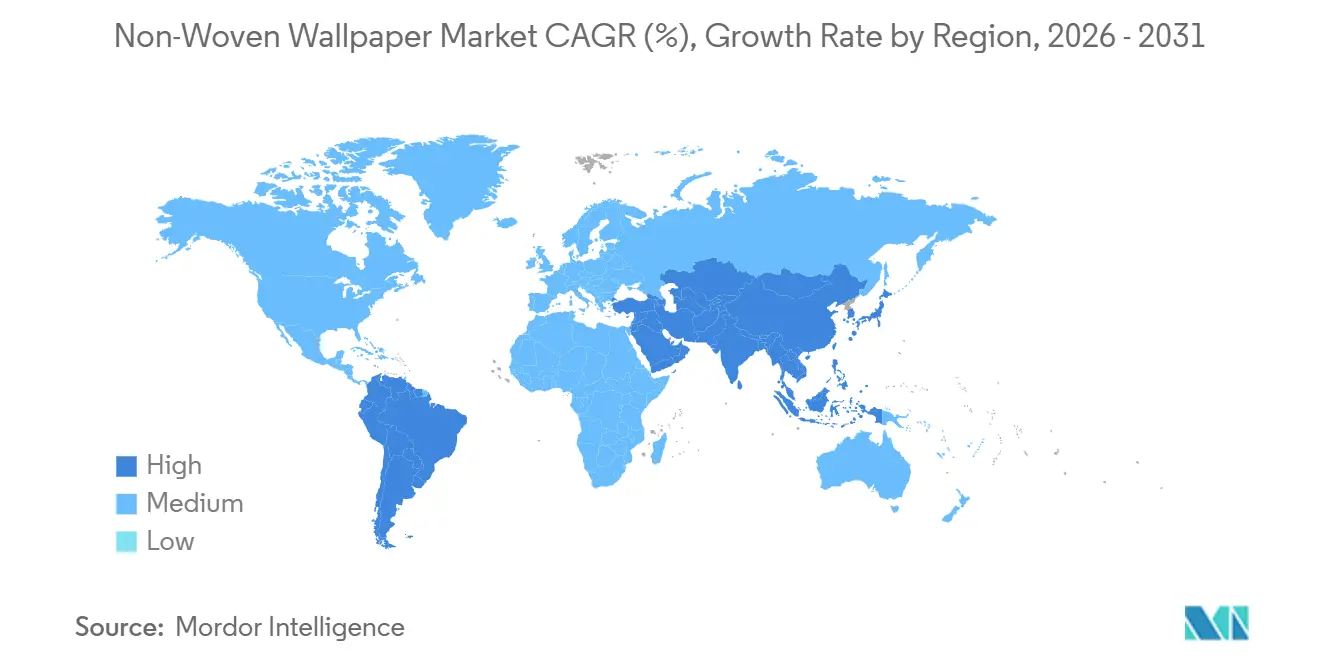
North America held 33.7% of the non-woven wallpaper market share in 2025. The region benefits from an aging housing stock and a large renter base, which supports both renovation and demand for removable wall coverings. Premium contract products exist alongside a growing online DIY category focused on self-adhesive formats. California Title 24 requirements and state low-VOC rules have encouraged suppliers to formulate lower-emission coatings. These requirements can favor non-woven systems with documented material credentials. The region, therefore, combines strong residential demand with specification requirements in commercial projects.
Asia-Pacific is forecasted to grow at a 6.2% CAGR through 2031, making it the fastest-growing geography in the supplied research. China is shifting from new-construction-led demand toward renovation and refurbishment, while India has an expanding urban residential base. India is projected to grow significantly as mid-income buyers in tier-1 and tier-2 cities improve interior finishes. South Korea, Southeast Asia, Japan, and Australia add further demand through design-focused interiors, hospitality construction, and housing renovation.

Competitive Landscape
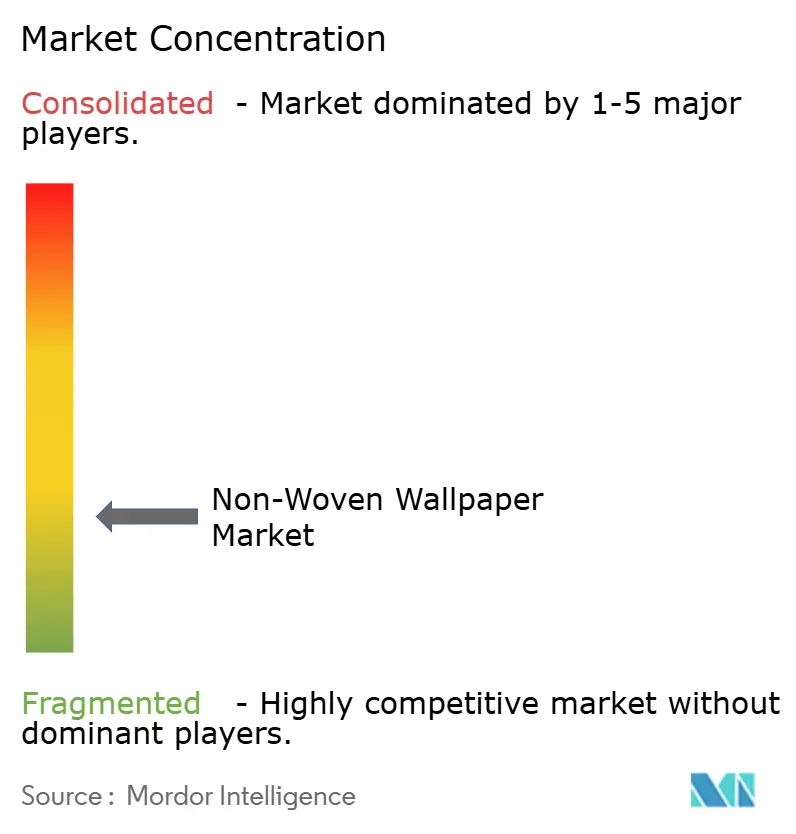
The non-woven wallpaper market is highly fragmented, and no manufacturer has enough scale to establish structural pricing leadership across the category. European heritage brands compete through design archives, retail recognition, and relationships with contract specifiers. Asian producers compete through manufacturing scale, product variety, and digital-commerce reach. Companies are also competing through product credentials, including low-emission, FSC-related, and recycled-content offerings. This competitive structure leaves scope for companies that can link design, technical performance, and dependable delivery.
Sanderson Design Group has shifted more production toward digital printing, which represented 54% of output at its Anstey Wallpaper factory in the fiscal year ended January 2025. This move reduces stock exposure and supports shorter production runs as design cycles become faster. Erfurt & Sohn announced a USD 35 million investment program in November 2024 to introduce new machinery, increase recycled content, improve energy efficiency, and modernize its IT systems. Zambaiti Parati presented technical substrates in 2026, including acoustic, fire-retardant, and rice-starch-based options. These actions show that manufacturers are investing in production capability, material development, and performance features. Such investment can help suppliers address commercial specification needs while protecting their position in premium formats.
Recyclable monomaterial products remain a relevant product development opportunity. AI-assisted design and on-demand printing can support customized patterns without the same inventory burden as conventional production. GREENGUARD Gold and FSC chain-of-custody certifications can strengthen suppliers' positions in commercial projects with material health expectations. LEED, BREEAM, and WELL-related project requirements can make formal documentation more important in North America and Europe. Digital tools can also help suppliers improve direct-to-trade workflows and online customer experience.
Non-Woven Wallpaper Industry Leaders
A.S. Création Tapeten AG
Sangetsu Corporation
York Wallcoverings, Inc.
Brewster Home Fashions LLC
Graham and Brown Limited
- *Disclaimer: Major Players sorted in no particular order

Recent Industry Developments
- May 2026: Zambaiti Parati presented waterproof wallpaper systems on fiberglass-based technical substrates for bathrooms, spas, and wellness spaces, extending its commercial offering for high-moisture applications.
- September 2025: Designtex launched Borealis, a digitally printed wallcovering on its DNA non-vinyl substrate with 50% biobased content, targeting hospitality and healthcare commercial interiors.


Global Non-Woven Wallpaper Market Report Scope
The non-woven wallpaper market covers wallcoverings manufactured with non-woven fiber substrates, including cellulose, polyester, and blended materials. It includes printed, plain, textured, embossed, metallic, mural, and panoramic wallpaper formats. The scope covers traditional paste-applied and self-adhesive (peel-and-stick) installation types. Applications include renovation and remodeling, new construction, and interior upgrades across residential, hospitality, healthcare, office, retail, education, and other commercial settings. Distribution channels include online platforms, specialty stores, home centers, direct-to-trade channels, contractors, architects, and institutional procurement. The assessment covers North America, Europe, Asia-Pacific, the Middle East and Africa, South America, and Russia.
| Printed Non-Woven Wallpaper |
| Plain Non-Woven Wallpaper |
| Textured Non-Woven Wallpaper |
| Embossed Non-Woven Wallpaper |
| Metallic Non-Woven Wallpaper |
| Mural and Panoramic Non-Woven Wallpaper |
| Traditional/Non Self-Adhesive |
| Self-Adhesive / Peel-and-Stick Wallpaper |
| New Construction |
| Renovation and Remodeling |
| Residential | Living Room |
| Kitchen | |
| Bedroom | |
| Bathroom | |
| Kids Room | |
| Other Areas | |
| Commercial |
| B2C Channels | Hypermarkets and Supermarkets |
| Specialty Stores | |
| Home Centers | |
| Online | |
| Local Shops | |
| Other Distribution Channels | |
| B2B Channels (Contractors and Installers, Interior Designers and Architects, Project Procurement and Institutional Sales) |
| North America | Canada |
| United States | |
| Mexico | |
| South America | Brazil |
| Peru | |
| Chile | |
| Argentina | |
| Rest of South America | |
| Europe | United Kingdom |
| Germany | |
| France | |
| Spain | |
| Italy | |
| BENELUX (Belgium, Netherlands, Luxembourg) | |
| NORDICS (Denmark, Finland, Iceland, Norway, Sweden) | |
| Rest of Europe | |
| Asia-Pacific | India |
| China | |
| Japan | |
| Australia | |
| South Korea | |
| South-East Asia | |
| Rest of Asia-Pacific | |
| Middle East & Africa | United Arab Emirates |
| Saudi Arabia | |
| South Africa | |
| Nigeria | |
| Rest of Middle East & Africa |
| By Product Format | Printed Non-Woven Wallpaper | |
| Plain Non-Woven Wallpaper | ||
| Textured Non-Woven Wallpaper | ||
| Embossed Non-Woven Wallpaper | ||
| Metallic Non-Woven Wallpaper | ||
| Mural and Panoramic Non-Woven Wallpaper | ||
| By Installation Type | Traditional/Non Self-Adhesive | |
| Self-Adhesive / Peel-and-Stick Wallpaper | ||
| By Application | New Construction | |
| Renovation and Remodeling | ||
| By End User | Residential | Living Room |
| Kitchen | ||
| Bedroom | ||
| Bathroom | ||
| Kids Room | ||
| Other Areas | ||
| Commercial | ||
| By Distribution Channel | B2C Channels | Hypermarkets and Supermarkets |
| Specialty Stores | ||
| Home Centers | ||
| Online | ||
| Local Shops | ||
| Other Distribution Channels | ||
| B2B Channels (Contractors and Installers, Interior Designers and Architects, Project Procurement and Institutional Sales) | ||
| By Geography | North America | Canada |
| United States | ||
| Mexico | ||
| South America | Brazil | |
| Peru | ||
| Chile | ||
| Argentina | ||
| Rest of South America | ||
| Europe | United Kingdom | |
| Germany | ||
| France | ||
| Spain | ||
| Italy | ||
| BENELUX (Belgium, Netherlands, Luxembourg) | ||
| NORDICS (Denmark, Finland, Iceland, Norway, Sweden) | ||
| Rest of Europe | ||
| Asia-Pacific | India | |
| China | ||
| Japan | ||
| Australia | ||
| South Korea | ||
| South-East Asia | ||
| Rest of Asia-Pacific | ||
| Middle East & Africa | United Arab Emirates | |
| Saudi Arabia | ||
| South Africa | ||
| Nigeria | ||
| Rest of Middle East & Africa | ||


Key Questions Answered in the Report
What is the projected value of non-woven wallpaper by 2031?
The market is forecast to reach USD 3.49 billion by 2031, rising from USD 2.67 billion in 2026 at a 5.5% CAGR.
Which product format is growing fastest?
Mural and panoramic non-woven wallpaper is forecast to grow at a 6.3% CAGR from 2026 to 2031.
Why are peel-and-stick formats gaining demand?
They offer simpler installation and clean removal, which fits the needs of renters and spaces that require frequent changes.
Which application generates the most demand?
Renovation and remodeling led with 62% share in 2025 and is forecast to grow at a 5.8% CAGR through 2031.
Which region is growing fastest?
Asia-Pacific is forecast to grow at a 6.2% CAGR through 2031, supported by refurbishment in China and urban housing demand in India.
What limits the wider adoption of non-woven wallpaper?
Higher prices than paint and commodity vinyl, input-cost volatility, installation skills, and limited recycling infrastructure remain key constraints.
Page last updated on:





