
Saudi Arabia Beauty And Personal Care Market Analysis by Mordor Intelligence
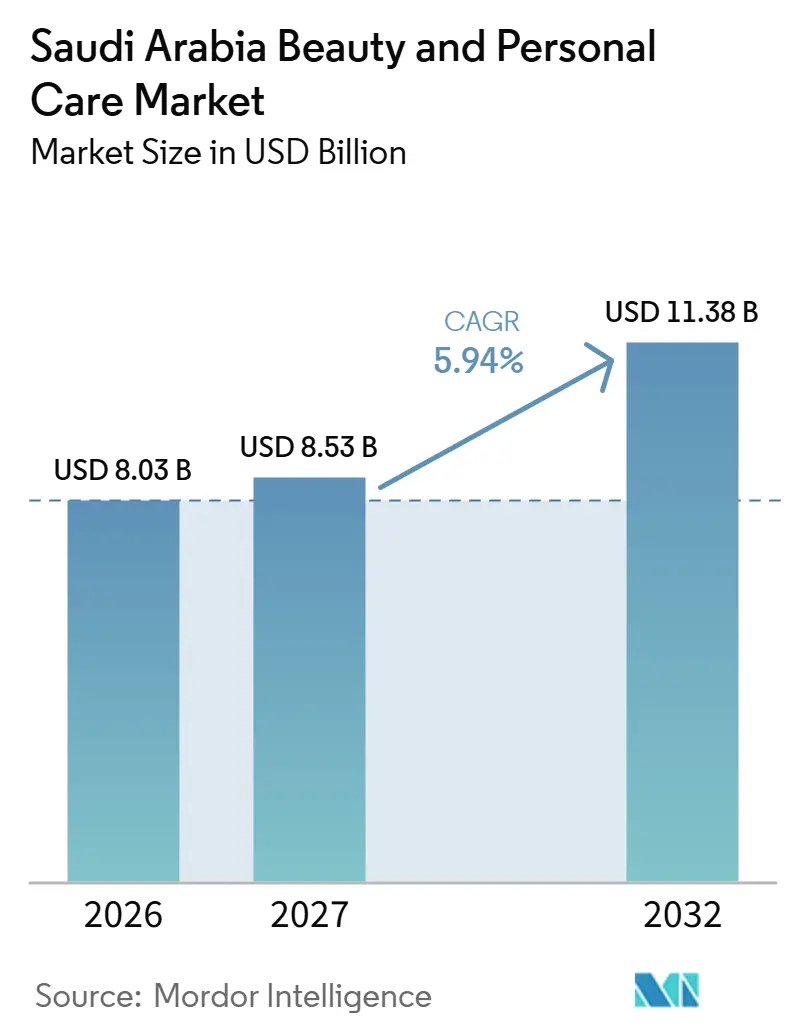
The Saudi Arabia beauty and personal care market size was valued at USD 8.03 billion in 2026 and estimated to grow from USD 8.53 billion in 2027 to reach USD 11.38 billion by 2032, at a CAGR of 5.94% during the forecast period (2027-2032).
Social discovery in Saudi Arabia can broaden product consideration, while skincare routines create several care needs for suppliers to address. Saudi Arabia proved resilient in the first half of 2026 as the Middle East conflict affected consumption elsewhere in the Gulf from that year. Service-led retail and local manufacturing of personal care products such as deodorant sticks provide different commercial responses to these buyers. Imported cosmetic ranges reach Saudi shelves only after SFDA listing and notification, so launch timing depends on documentation readiness as much as on shopper interest.
Key Report Takeaways
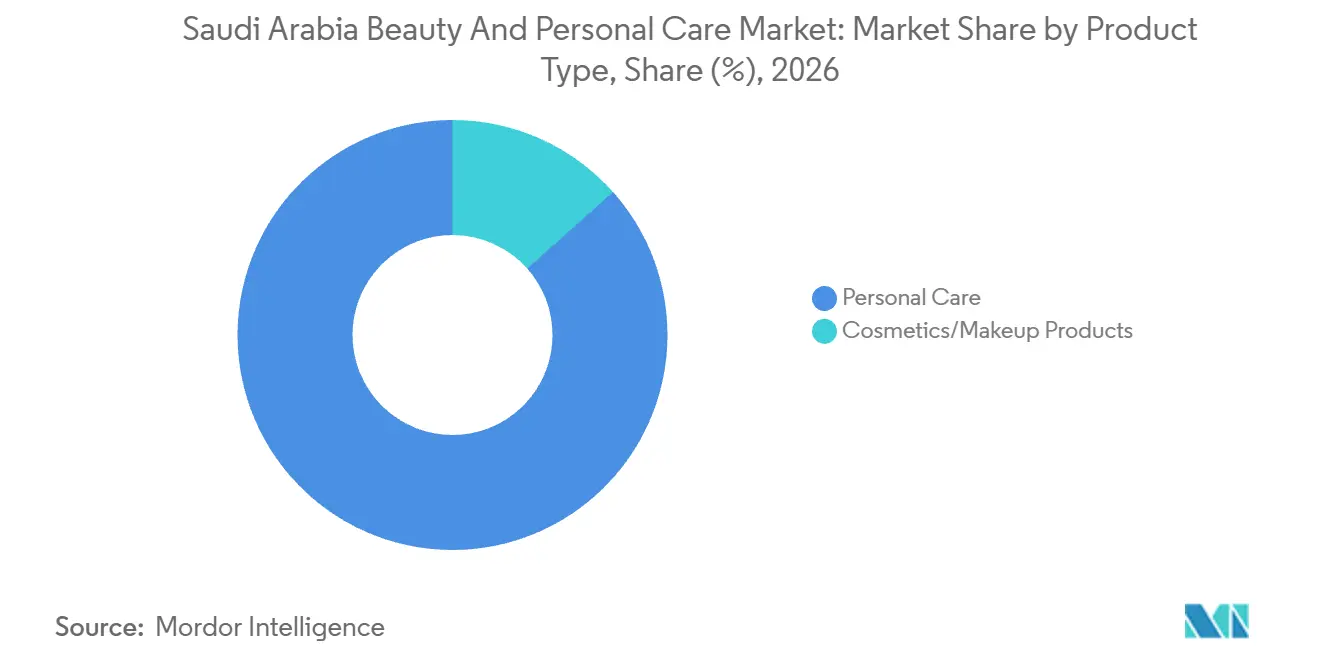
- By product type, personal care held an 86.58% Saudi Arabia beauty and personal care market share in 2026, while cosmetics/makeup products are forecast to grow fastest at a CAGR of 6.4% during 2027-2032.
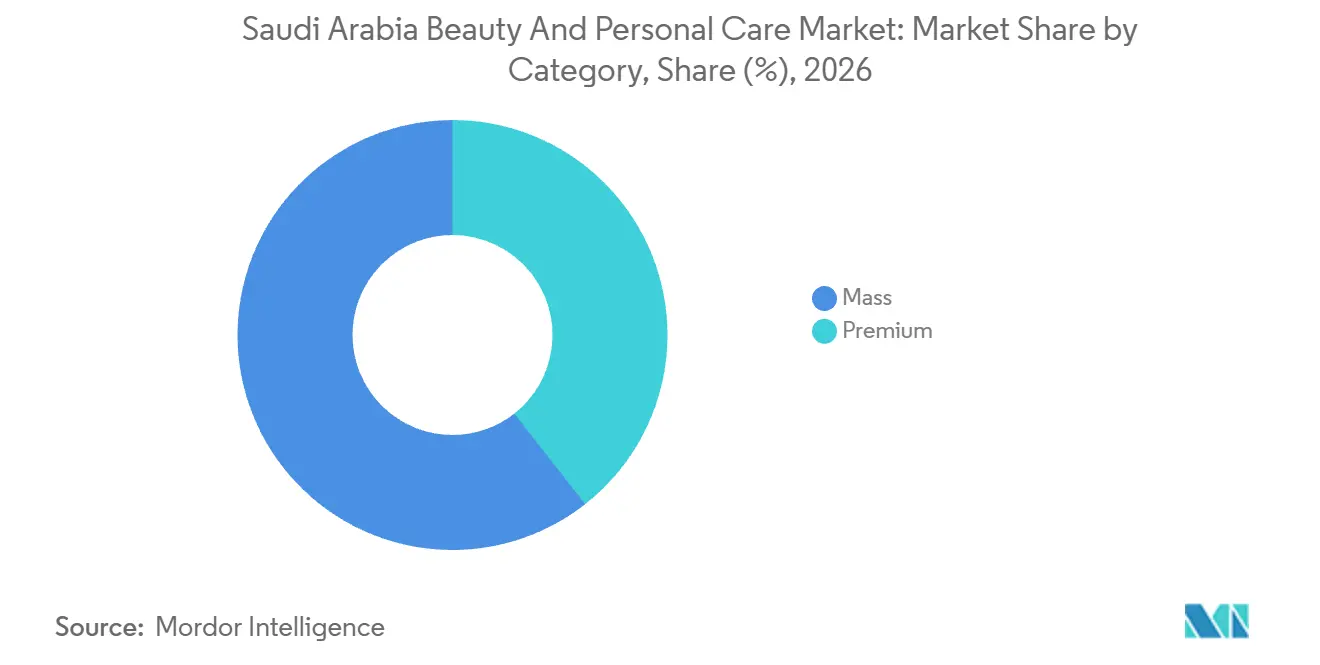
- Across categories, mass products held a 60.59% share of the Saudi Arabia beauty and personal care market size in 2026, while premium products are forecast to grow fastest at a CAGR of 6.45% during 2027-2032.
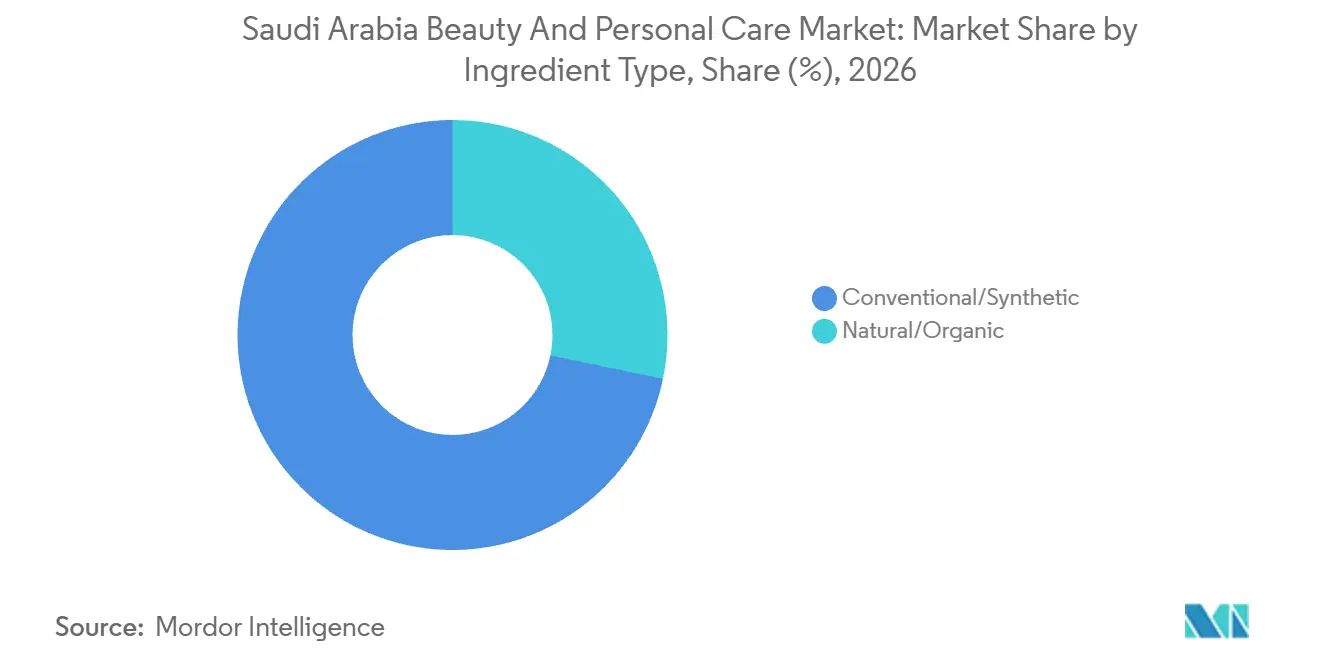
- Within ingredient types, conventional/synthetic products accounted for 71.73% of sales in 2026, with natural/organic products forecast to grow fastest at a CAGR of 6.5% during 2027-2032.
- Distribution channels were led by specialty stores with 56.75% of sales in 2026, and online retail is forecast to grow fastest at a CAGR of 7.45% during 2027-2032.
Note: Market numbers in this report are based on Mordor Intelligence's proprietary estimation framework, which combines nine months of actuals with Q4 projections for base year 2026.
Market Trends and Insights
Drivers Impact Analysis of Saudi Arabia Beauty And Personal Care Market*
| Driver | (~) % Impact on CAGR Forecast | Geographic Relevance | Impact Timeline |
|---|---|---|---|
| High social-media influence on beauty trends | +2% | Nationwide | Short term (≤ 2 years) |
| Rising demand for halal-certified cosmetics | +1.4% | Nationwide | Medium term (2-4 years) |
| Expanding men’s grooming and personal care usage | +1.3% | Nationwide | Medium term (2-4 years) |
| Rising female workforce participation and grooming needs | +1.2% | Nationwide | Medium term (2-4 years) |
| Preference for premium, dermatologically tested products | +0.9% | Nationwide | Short term (≤ 2 years) |
| Younger, digitally-savvy consumer base | +0.8% | Nationwide | Long term (≥ 4 years) |
| Source: Mordor Intelligence | |||
High social-media influence on beauty trends
Beauty brands can develop demand through the relationship between their own content and consumers’ willingness to share it. A study of 341 Saudi female Generation Z TikTok users surveyed in the second half of 2025 found positive relationships between social-media marketing, viral behavioral intention and purchase intention.[1] The study also linked the value of a brand page and consumers’ connection with a brand positively to viral behavioral intention. Together, these relationships give suppliers a reason to develop brand pages that consumers find useful and personally relevant. Investment in those pages can support the sharing pathway itself, making the brand’s own content an active part of product consideration.
Rising demand for halal-certified cosmetics
DinarStandard estimated Saudi halal-cosmetics consumer spending at SAR 8.1 billion (USD 2.2 billion) in 2023 and projected SAR 10.1 billion (USD 2.7 billion) by 2027, at a 5.4% CAGR during 2023-2027. That projected spending base creates an opportunity for suppliers offering product-specific halal assurance. A certified range can connect the finished cosmetic with its ingredients and production process, making the assurance part of the product proposition. For buyers seeking certification, the commercial distinction is a verifiable assurance attached to the individual product rather than an undifferentiated halal claim. Maintaining that connection when formulations or production arrangements change protects the basis on which the certified offer is differentiated.
Expanding men’s grooming and personal care usage
Men’s grooming can add demand by separating a standalone odor-control purchase from an additional skincare step. For a male buyer seeking only odor control, deodorant provides a focused product proposition without requiring a wider regimen. Skincare can then become an optional second purchase that raises spending per buyer without displacing deodorant. Suppliers offering both products can seek that additional sale from existing deodorant buyers.
Rising female workforce participation and grooming needs
Female employment offers beauty suppliers a defined audience for products organized around workday grooming needs. In Q2 2026, Saudi Arabia had 3.94 million female workers across GOSI-registered employees, Civil Services employees and domestic workers. Separately, L’Oréal’s 2025 Facecare U&A reported that Saudi women used up to 8 skincare products in their routines. The workforce base gives suppliers a reason to develop workday assortments, while the broader skincare finding indicates room for products with complementary care roles. A multi-step offer aimed at employed women can give each product a clear purpose without requiring an elaborate regimen for every workday.
Restraints Impact Analysis of Saudi Arabia Beauty And Personal Care Market*
| Restraint | (~) % Impact on CAGR Forecast | Geographic Relevance | Impact Timeline |
|---|---|---|---|
| Stringent regulatory requirements hinder growth | -0.7% | Nationwide | Medium term (2-4 years) |
| Risk of counterfeit and low-quality products undermining trust | -0.5% | Nationwide | Short term (≤ 2 years) |
| Fragmented consumer preferences hindering brand loyalty | -0.3% | Nationwide | Medium term (2-4 years) |
| Logistic and import constraints for international brands | -0.2% | Nationwide | Short term (≤ 2 years) |
| Source: Mordor Intelligence | |||
Stringent regulatory requirements hinder growth
Cosmetic suppliers face an administrative barrier when launches require coordinated information from the notifier and its manufacturing or distribution partner. The Saudi Food and Drug Authority (SFDA) requires cosmetic-product notifiers to submit manufacturer or distributor authorization, artwork and label images, and ingredient lists identifying concentrations and roles. These inputs link the commercial presentation of a product with detailed formulation information, making a complete submission more demanding than a brand description. A supplier extending its assortment must coordinate the relevant authorization and product-specific records before completing each notification. The constraint falls on the readiness of individual products for entry, creating preparation work that can slow the conversion of a broad international range into a locally available assortment.
Risk of counterfeit and low-quality products undermining trust
Product-quality failures constrain legitimate beauty sales when uncertainty over a product’s usable life makes its safety harder to establish. In July 2025, the Saudi Food and Drug Authority reported finding about 1.5 million cosmetic containers with altered expiry dates at one residential facility.[2] The authority reported closing the facility and referring it to the Public Prosecution. Altered dates compromise a basic piece of information that buyers and retailers need to assess whether cosmetics remain suitable for sale. Removing affected stock protects consumers, but it also interrupts the commercial availability of those products. Distributors bear the cost of maintaining dependable expiry records, while deficient records expose stock to removal from sale.
*Our forecasts treat driver/restraint impacts as directional, not additive. The impact forecasts reflect baseline growth, mix effects, and variable interactions.
Saudi Arabia Beauty And Personal Care Market Segment Analysis
By Product Type:
Local Production Supports Everyday CarePersonal care accounted for an 86.58% share of the Saudi Arabia beauty and personal care market size in 2026. Unilever’s September 2025 announcement stated annual deodorant-stick capacity of 30 million units at Binzagr Unilever Limited’s Jeddah factory, a joint venture with Binzagr Group. The facility was intended to serve Saudi Arabia while exporting most output.
Cosmetics/makeup products are the fastest-growing segment, with a forecast CAGR of 6.4% during 2027-2032. In 2026, Sephora Middle East’s managing director said makeup was Sephora Saudi Arabia’s fastest-growing category. The retailer’s experience makes specialized beauty selling a relevant route for makeup suppliers, whose product development and retail presentation can focus on a different buying occasion from routine personal care. That creates a commercial reason to develop makeup-specific assortments and retailer relationships alongside the broader care portfolio, with product-level selling approaches shaped around the needs of each offer.

By Category:
Mass Affordability Meets Premium TrialMass products represented a 60.59% Saudi Arabia beauty and personal care market share in 2026. The price tier creates a commercial boundary for product development, because adding features that materially raise the selling price can weaken the affordability on which the offer is based. In supermarkets and hypermarkets, a mass offer can focus on a small number of useful benefits that justify its price within an everyday-care purchase. Suppliers can therefore drop features whose extra cost cannot be recovered within the intended shelf price.
Premium is the fastest-growing segment, with a forecast CAGR of 6.45% during 2027-2032. In a February 2025 beauty survey covering 1,000 to 1,500 respondents per market, 25% of Saudi respondents said high-end positioning motivated them to try something new. This creates a route to product trial in which the higher-end proposition itself can give a shopper a reason to consider an unfamiliar offer. For suppliers, the opportunity is to make that proposition concrete through the finished product and its presentation at the point of selection. The challenge is converting initial trial into a credible product experience that can justify the position after the first purchase.
By Ingredient Type:
Functional Consistency Meets Natural PositioningConventional/synthetic products were the largest segment, accounting for 71.73% of beauty and personal care sales in Saudi Arabia in 2026. Unilever’s September 2025 Jeddah deodorant-line investment included local sourcing of petroleum-based materials. The investment links a synthetic-input sourcing decision with finished-deodorant production, making the material supply part of that operation’s manufacturing proposition. Input suppliers’ sales prospects therefore hinge on production volumes at the deodorant line, linking the value of local sourcing to factory utilization.
Natural/organic products are the fastest-growing segment, with a forecast CAGR of 6.5% during 2027-2032. For the 2026 season, Saudi brand Ajaweed introduced perfume and skincare products using Qatif almonds, including soap, moisturizer and lotion. In March 2025, MZN Bodycare’s natural skincare products were stocked by premium retailers, spas and pharmacies across Saudi Arabia and the United Arab Emirates. This distribution pattern shows a natural brand reaching different commercial settings, allowing its product proposition to be evaluated through several routes to buyers. Channel acceptance can turn a natural ingredient proposition into a repeatable business in finished beauty products.
By Distribution Channel:
Specialty Presence Meets Digital DiversificationSpecialty stores were the largest segment, with 56.75% of beauty and personal care sales in 2026. Lush Saudi Arabia opened a store at Westfield Dammam on September 12, 2026, offering bath, body, haircare, skincare and fragrance products. Adding a physical point of sale puts this assortment within a local shopping destination, giving the specialty format a geographically specific way to reach buyers. The commercial task is to make that location work across several product categories, so the store’s role extends beyond selling a single care product. Category breadth can help a specialist develop the value of each location while preserving the identity of the brand it represents.
Online retail is the fastest-growing segment, with a forecast CAGR of 7.45% during 2027-2032. Nice One’s 2025 business combined online commerce in perfumes, cosmetics, soap and incense with expansion into offline outlets and marketing services. Nice One’s move extends an online seller’s route to buyers into stores, making physical retail an additional operating capability. Supermarkets/hypermarkets had a separate store-based development in 2025, when BinDawood Holding integrated 27 Zahrat Al Rawdah pharmacy outlets into existing BinDawood and Danube stores. The pharmacy-counter model places a specialist outlet inside the grocery format, a distinct store-based route from Nice One’s online-origin expansion.
Geography Analysis
Riyadh’s branded boutique format links beauty products with a service setting in which shoppers can evaluate a single house’s range. Guerlain opened its first Saudi boutique at Riyadh Park in 2025, combining a women’s spa with perfumes, cosmetics and skincare products. Bringing these activities together can make the store a setting for a fuller product encounter, extending consideration across the brand’s products through their connection with an identifiable service experience. For a brand entering the country, this format offers a way to establish its identity through both products and service, with the trade-off of supporting a specialized location.
A large-format beauty destination in Jeddah brings expertise and personalization into a retail setting with space devoted to product discovery. Faces, part of Chalhoub Group, opened its 1,100-square-meter Jeddah Vibes flagship on February 20, 2026, its largest flagship in the Gulf Cooperation Council. The format emphasizes expertise, personalization and immersive discovery, making service part of the store’s proposition alongside beauty products. The commercial challenge is to turn space devoted to discovery into product selection, so service use and selling-floor productivity need to develop together for this format to justify its footprint.
Secondary-city and rural expansion requires a separate decision about how buyers reach products and how quickly orders can arrive. Lush gives estimated standard Saudi delivery windows of 5 to 7 working days and 7 to 10 working days for remote areas. These are delivery estimates that can be difficult to meet in some circumstances. For expansion into secondary cities and rural areas, a seller can compare the role of a local outlet with an online offer that carries an explicit delivery window. Matching the sales proposition to that service commitment can reduce the risk of offering speed that the fulfillment arrangement cannot consistently support.
Regulatory Framework and Outlook
These selected jurisdictions are compared from the perspective of a cosmetics supplier assessing product entry and licensed sales through women’s beautification establishments in Riyadh. Saudi Arabia’s implementing regulation bars importing or trading a cosmetic product until SFDA has listed it and issued a listing certificate. The Ministry of Municipalities and Housing permits women’s beautification shops to sell cosmetics and personal-care products after adding that activity to their license, administered locally by Riyadh Municipality. Product entry and local sales authorization address different commercial decisions for the same supplier.
Regulatory Table of Saudi Arabia Beauty And Personal Care Market
| Decision factor | Saudi Arabia | Riyadh |
|---|---|---|
| Primary authority | Saudi Food and Drug Authority | Riyadh Municipality under the national municipal framework |
| Key instruments or direction | Cosmetic Products Law Implementing Regulation; ingredient-list update applied June 24, 2026 | National rules for women’s beautification establishments and municipal licensing |
| Commercial effect | Listing certificate required before cosmetic-product import or trade | Cosmetics and personal-care sales permitted after adding the activity to the women’s beautification establishment’s license |
| Current policy attractiveness | Medium | Medium |
| Future direction of policy attractiveness | Easing | No change |
| Source: Mordor Intelligence | ||
Saudi Arabia’s Medium rating reflects the implementing regulation’s listing requirement and the June 24, 2026 ingredient-list update, both separately in force. Easing reflects SFDA’s August 4, 2026 circular lifting a ban on cosmetics marketed in pharmaceutical forms, scheduled to apply January 1, 2027. Riyadh’s Medium rating reflects municipal administration of the national ministry’s licensed route for product sales through women’s beautification establishments. No change for that municipal pathway follows from its standing activity-license conditions, with the scheduled SFDA measure addressing product forms at the national level.
Value Chain Stages
The value chain compares how brand management, manufacturing and retail turn product ranges into supplier revenue. Brand owners such as L’Oréal capture value through branded product sales, while manufacturers such as Binzagr Unilever Limited capture it through sales of finished deodorants. Retailers such as Faces and Nice One Beauty Digital Marketing Company capture value through product sales to shoppers, with retail and fulfillment costs determining how much revenue becomes profit.
Value Chain Analysis Table of Saudi Arabia Beauty And Personal Care Market
| Primary activity | Key participants | Value capture | Bottleneck | Resilience response |
|---|---|---|---|---|
| Brand and assortment management | Beauty brand owners such as L’Oréal S.A. | Branded product sales | Coordinating distinct product ranges | Assign clear responsibility for each range |
| Product manufacturing | Deodorant manufacturers such as Binzagr Unilever Limited | Manufactured product sales | Mismatch between batch output and order requirements | Adjust batch sizes and production schedules |
| Retail and fulfillment | Beauty retailers such as Faces and Nice One Beauty Digital Marketing Company | Retail product sales | Fulfillment, store ramp-up and administrative costs | Phase new capacity against demonstrated throughput |
| Source: Mordor Intelligence | ||||
Nice One attributed its 8.6% gross-profit decline in 2025 primarily to higher logistics costs following the start of its Jeddah warehouse and direct costs of retail-store expansion during ramp-up. Its general and administrative expenses rose 33.14% year over year in Q2 2026, mainly from administrative and overhead costs supporting offline store expansion. These results place expansion costs in both gross profit and central overheads. New-store throughput needs to cover product-handling costs and the administrative structure supporting a wider network.
Competitive Landscape
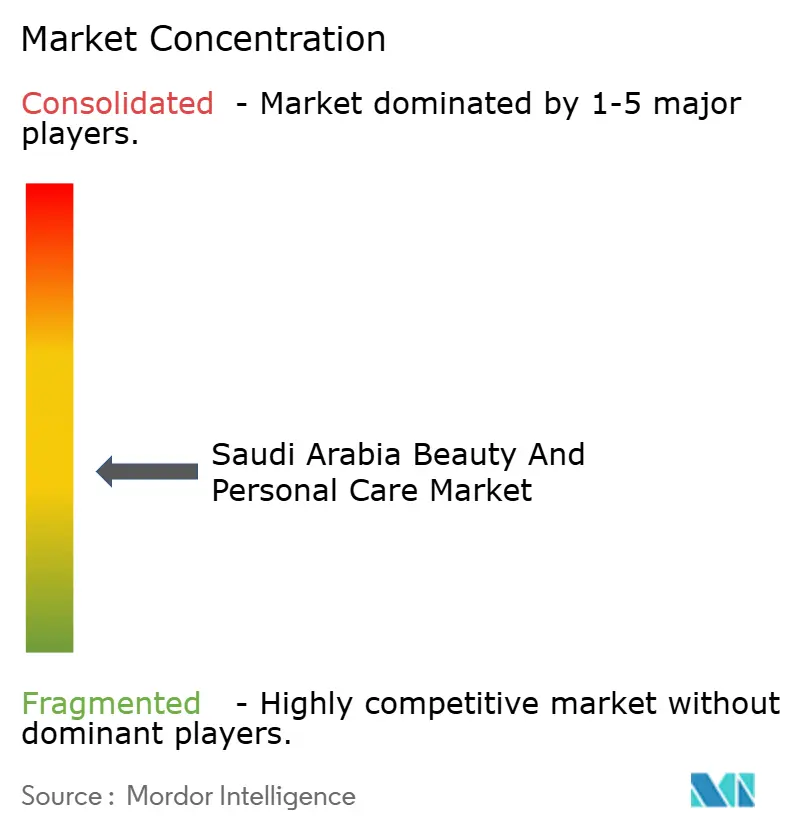
The competitive field comprises several international brand groups with different routes to Saudi business, including L’Oréal S.A.’s Saudi market subsidiary within its Middle East structure. Beiersdorf AG reported positive sales development in Saudi Arabia in 2025 within its Consumer Business Segment reporting. Unilever PLC participates in Jeddah manufacturing through the Binzagr Unilever Limited joint venture with Binzagr Group. The Procter & Gamble Company operates a global Beauty segment, while Kenvue Inc. operates a global Skin Health and Beauty segment. The field combines dedicated Saudi market management and joint-venture manufacturing with international beauty portfolios, giving competitors distinct operating models.
Beiersdorf’s Eucerin entered Saudi Arabia in 2025, extending the parent company’s brand presence in the country. Kimberly-Clark said in October 2026 that its pending acquisition of Kenvue was expected to close in the fourth quarter of 2026, subject to regulatory approvals and other customary conditions. The proposed acquisition covers Kenvue’s global business, including a Skin Health and Beauty segment with Neutrogena, Aveeno and OGX.
Kenvue’s global Skin Health and Beauty segment reported USD 2.17 billion in net sales for the six months ended June 28, 2026. Over the same 6 months, its organic sales grew 4.4% year over year, including price/mix growth of 1.8% and volume growth of 2.6%. Volume contributed more than price/mix to that global segment’s organic growth. SFDA’s February 14, 2025 circular barred cosmetics and perfumery labels suggesting products were primarily or exclusively made for another market, with noncompliant products risking customs non-clearance. International groups and challengers using those geographic designations would need to revise export labels before translating wider portfolio growth into Saudi sales.
Saudi Arabia Beauty And Personal Care Industry Leaders
-
L’Oréal S.A.
-
Beiersdorf AG
-
Unilever PLC
-
The Procter & Gamble Company
-
Kenvue Inc.
- *Disclaimer: Major Players sorted in no particular order
Saudi Arabia Beauty And Personal Care Market Companies Covered in this Report
- L’Oréal S.A.
- Unilever PLC
- The Procter & Gamble Company
- The Estée Lauder Companies Inc.
- Beiersdorf AG
- Coty Inc.
- Shiseido Company, Limited
- Kao Corporation
- Henkel AG & Co. KGaA
- Revlon, Inc.
- Avon Cosmetics Ltd.
- Colgate-Palmolive Company
- LVMH Moët Hennessy Louis Vuitton SE
- Natura & Co
- Mary Kay Inc.
- The Body Shop International Ltd.
- Bath & Body Works, Inc.
- Wella Company
- Godrej Consumer Products Ltd.
- Kenvue Inc.
Key Opportunities for Market Participants
The opportunities compare finished-product offers that respond to documented concerns about cosmetic suitability and credibility. Among 425 adult women surveyed online in Al-Qunfudah governorate from January to March 2025, 214 reported cosmetic side effects, and 177 of those women attributed them to haircare products.[3] The Saudi Central Bank launched an e-commerce payments interface on July 7, 2025, linking mada with global payment networks and enabling e-commerce providers to use national infrastructure. Online product listings also offer suppliers a place to present ingredient and use information to women considering a haircare purchase.
Market Opportunities Table of Saudi Arabia Beauty And Personal Care Market
| Opportunity | Why now | Buyer / lead segment | Recommended play | Main barrier | Likely beneficiaries |
|---|---|---|---|---|---|
| Haircare product suitability | Self-reported haircare reactions in the Al-Qunfudah survey | Women seeking suitable haircare products | Sell haircare with clear ingredient and use information | Substantiating suitability claims | Beauty-product producers such as L’Oréal S.A. |
| Hair dyes supported by use guidance | Sensitivity-testing practice reported in the same survey | Women selecting hair-dye products | Pair finished hair dyes with product-specific testing and use directions | Connecting guidance to the individual formulation | Beauty-product sellers such as L’Oréal S.A. |
| Credibility-led face cosmetics online | Brand credibility identified as a selection consideration in the same survey | Women considering face cosmetics | Present clear brand and product information alongside online offers | Converting stated credibility concerns into product choice | Brand owners such as L’Oréal S.A. |
| Source: Mordor Intelligence | |||||
In the Al-Qunfudah survey, 348 of 425 women said brand credibility influenced their choice of face cosmetics. L’Oréal identified e-commerce as a key growth driver in its Gulf Cooperation Council business in the first half of 2026. For women with the concerns reported in that survey, the opening is online haircare offers with clear ingredient and use guidance, alongside face cosmetics supported by product-specific brand information.
Recent Industry Developments in Saudi Arabia Beauty And Personal Care Market
- Sep 2026: Lush Saudi Arabia opened a store at Westfield Dammam on September 12, offering bath, body, haircare, skincare and fragrance products.
- Aug 2026: The Saudi Food and Drug Authority published a circular lifting a ban on cosmetics marketed in pharmaceutical forms, scheduled to apply on January 1, 2027.
Saudi Arabia Beauty And Personal Care Market Report Scope and Research Methodology
Market Definition and Coverage
Saudi Arabia beauty and personal care market measures annual value of beauty and personal care products sold at point of sale in Saudi Arabia. The total covers finished product sales across distribution channels.
Scope exclusions: Professional salon services and clinical procedures, and devices not primarily sold as consumable beauty or personal care products, are excluded.
Segments Covered in This Report
- By Product Type
- Personal Care
- Cosmetics/Makeup Products
- By Category
- Mass
- Premium
- By Ingredient Type
- Natural/Organic
- Conventional/Synthetic
- By Distribution Channel
- Specialty Stores
- Supermarkets/Hypermarkets
- Online Retail
- Other Distribution Channels
Data Sources, Market Sizing, and Validation
Desk Research
Desk research would draw on public Saudi market and regulatory material, such as the Capital Market Authority-hosted Al Majed for Oud and Nice One prospectuses for retail sales, channel structure and category coverage, the Saudi Food and Drug Authority's cosmetic product regulation and cosmetics notification service for product classification and market entry requirements, and General Authority for Statistics labor market and ICT access publications for employment and online commerce indicators. These sources help frame consumer demand, distribution and regulatory conditions for finished cosmetics in Saudi Arabia.
Company annual reports, issuer financial statements, investor materials and reputable Saudi business press provide supplementary evidence on product portfolios, local production, retail expansion and reported sales, while independent market signals help check the scale and timing of changes. These named sources are illustrative, not exhaustive, and further sources inform collection, validation and clarification.
Primary Interviews and Surveys
Primary interviews would include Saudi Arabia-based beauty and personal care brand, importer, distributor and retail leaders, with functional experts able to discuss product sales, channels, pricing and category changes. Their input would test secondary evidence and explain gaps where public data do not separate finished product point-of-sale value from wholesale flows or service revenue. Analysts would compare each account with company disclosures, market studies and retail indicators, then investigate unresolved differences through targeted follow-up and independent cross-checks.
Distribution of primary research fieldwork respondents
| Company type | Respondent position | Region |
|---|---|---|
| Top tier: 33% | CXOs: 20% | |
| Mid tier: 42% | Functional/Unit leaders: 35% | |
| Smaller Players: 25% | Managers: 45% |
Market-Sizing & Forecasting
The analyst would estimate Saudi Arabia's annual point-of-sale value from a top-down view of consumer beauty and personal care spending, then check selected totals against sampled retail price times volume and channel or supplier roll-ups. Inputs would include household and population growth to size the consumer base, retail sales and category spending to establish demand, online and specialty channel indicators to allocate sales by route, and import, local production and company disclosures to check product availability and value. Segment shares would follow the product, price tier, ingredient positioning and channel classifications in the market definition, with each sale assigned once and reconciled to the total. A multivariate regression can relate historical market value to population, retail activity, income and channel development, while scenario analysis can adjust the forecast for premium trading up, digital growth, regulation or supply constraints. Experts would review the direction and reasonableness of variable-level forecasts. If public evidence is incomplete, analysts would triangulate the available indicators, use the closest observed category or channel evidence, and document assumptions for follow-up rather than treating a single proxy as a measured total.
Data Validation & Update Cycle
Analysts would triangulate the model against independent signals from issuer disclosures, retail channels, import and production activity, and relevant public statistics, checking that all figures refer to Saudi Arabia and finished product retail sales. They would investigate anomalies, year-to-year breaks and material differences among estimates, verify units and periods, and complete source, model and senior analyst reviews before sign-off. Respondents would be contacted again when an explanation conflicts with later disclosures or when a material data gap changes the model. The evidence base would be refreshed annually, checked again before delivery and revisited between cycles after a material market or regulatory event.
Mordor Intelligence's Saudi Arabia Beauty and Personal Care Market Size Compared Against Other Published Estimates
Published estimates can differ in the transactions and products they count and the inputs used to model demand. Saudi Arabia beauty and personal care market measures annual value of beauty and personal care products sold at point of sale in Saudi Arabia.
Key Gap Drivers include the study's defined coverage and market-specific modeling choices. Inputs would include household and population growth to size the consumer base, retail sales and category spending to establish demand, online and specialty channel indicators to allocate sales by route, and import, local production and company disclosures to check product availability and value.
Benchmark comparison
| Source | Market Size | Gaps in Research Methodology |
|---|---|---|
| Mordor Intelligence | USD 8.53 B (2027) | |
| Global Consultancy A | USD 7.05 B (2025) | At its 2025 base, this estimate is 17.4% below this report's 2027 value of USD 8.53 B, 2 years later. The published 5.20% forecast from its 2025 base gives a lower trajectory than this report's later year estimate. |
| Global Consultancy B | USD 4.8 B (2025) | At its 2025 base, this estimate is 43.7% below this report's 2027 value of USD 8.53 B, 2 years later. Its published 3.55% forecast from 2026 indicates a slower growth path. |
Mordor Intelligence's analysts would triangulate the model against independent signals from issuer disclosures, retail channels, import and production activity, and relevant public statistics, checking that all figures refer to Saudi Arabia and finished product retail sales.
Key Questions Answered in the Report
What is the Saudi Arabia beauty and personal care market size and growth outlook?
The size is estimated at USD 8.53 billion in 2027 and forecast to reach USD 11.38 billion by 2032, at a CAGR of 5.94% during 2027-2032.
What is driving beauty and personal-care demand in Saudi Arabia?
Social discovery and skincare routines support product consideration. L’Oréal’s 2025 study reported that Saudi women used up to 8 skincare products.
Which product type leads beauty and personal-care sales?
Personal care led with 86.58% of sales in 2026. Cosmetics/makeup products are forecast to grow fastest at a CAGR of 6.4% during 2027-2032.
Which companies are major competitors in Saudi beauty and personal care?
L’Oréal S.A., Beiersdorf AG, Unilever PLC, The Procter & Gamble Company and Kenvue Inc. are major competitors.
What challenges shape the beauty and personal-care outlook?
Cosmetic-product notification documentation burdens suppliers, while quality failures can interrupt sales. In July 2025, the Saudi Food and Drug Authority reported about 1.5 million cosmetic containers with altered expiry dates at one facility.
How does location affect access to beauty products in Saudi Arabia?
Riyadh and Jeddah offer boutique shopping through Guerlain’s 2025 Riyadh Park store and Faces’ February 2026 flagship. For remote-area delivery, Lush estimates a wait of 7 to 10 working days.