

Zimbabwe Fruits And Vegetables Market Analysis by Mordor Intelligence
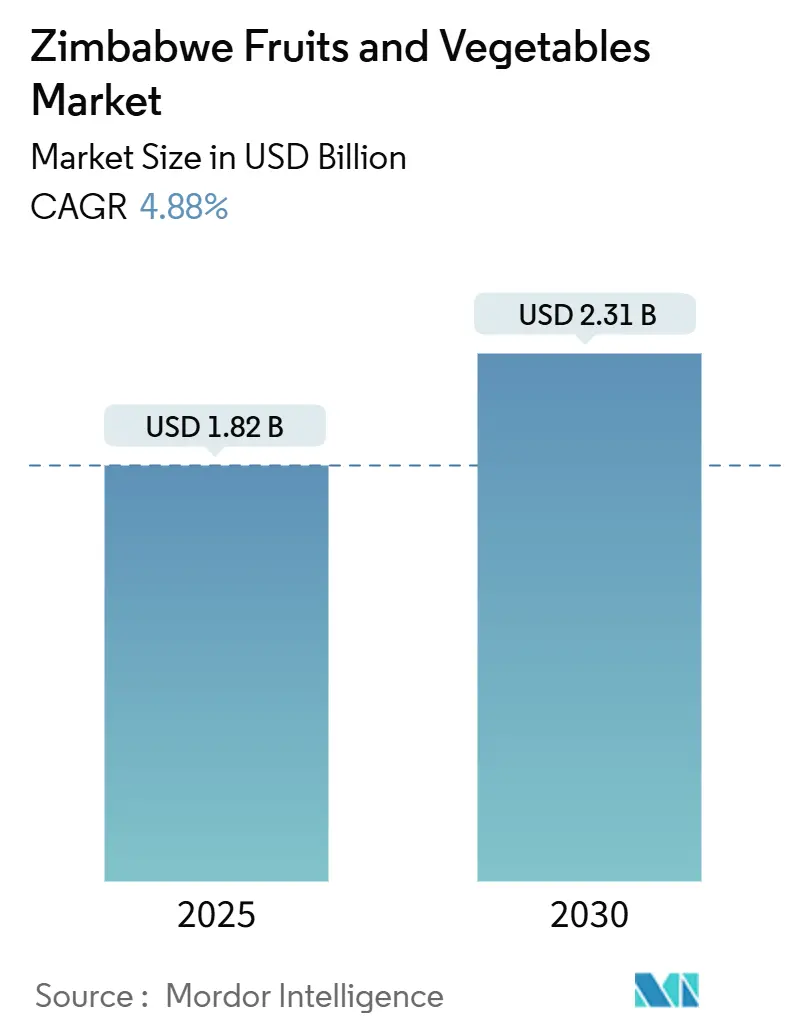
The Zimbabwe fruits and vegetables market size reached USD 1.82 billion in 2025 and is projected to grow to USD 2.31 billion by 2030, at a CAGR of 4.88%. The market expansion is driven by consistent domestic demand, rising export opportunities, and the adoption of climate-smart irrigation systems. The implementation of contract farming, solar-powered water systems, and government irrigation initiatives enables smallholder farmers to increase year-round production while meeting premium market quality standards. While vegetables remain the primary urban consumption category, fruit production clusters are shifting toward higher-value products. According to the Food and Agriculture Organization (FAO), in 2023, vegetable production totaled 2.1 million metric tons, and fruit production reached 1.0 million metric tons. Despite challenges from power shortages, inflation, and pest outbreaks, investments in renewable energy and enhanced extension services are reducing operational risks across the value chain.
Key Report Takeaways
- By commodity, vegetables led with a 55.8% of the Zimbabwe fruits and vegetables market share in 2024; fruits are projected to expand at a 5.1% CAGR through 2030.
Zimbabwe Fruits And Vegetables Market Trends and Insights
Drivers Impact Analysis
| Driver | (~) % Impact on CAGR Forecast | Geographic Relevance | Impact Timeline |
|---|---|---|---|
| Expansion of contract-farming schemes by food and beverage processors | +1.2% | National, concentrated in Mashonaland and Manicaland | Medium term (2-4 years) |
| Growth of informal urban fresh-produce markets | +0.8% | Harare, Bulawayo, provincial capitals | Short term (≤ 2 years) |
| Government-backed horticulture recovery program | +1.5% | National, priority communal areas | Medium term (2-4 years) |
| Rising adoption of drip irrigation and solar pumps | +0.9% | Semi-arid regions; scaling nationwide | Long term (≥ 4 years) |
| Development-agency funding for climate-smart farming | +0.7% | Rural areas country-wide | Long term (≥ 4 years) |
| Emergence of export clusters for premium fruits and vegetables | +0.6% | Manicaland and eastern highlands | Long term (≥ 4 years) |
| Source: Mordor Intelligence | |||
Expansion of Contract-Farming Schemes by Food and Beverage Processors
Contract farming is driving growth in Zimbabwe's fruits and vegetables market by providing reliable purchasing agreements and technical support to smallholder farmers. Under these arrangements, processors supply seeds, fertilizers, and agricultural guidance, then purchase the produce at predetermined prices. This system reduces market risks for farmers while ensuring a steady supply of raw materials for processors. The adoption of contract farming expanded following the implementation of climate-smart programs under the Pfumvudza initiative, which engaged over 1.8 million households, many of whom are now integrated into processor supply chains[1]Source: United Nations Development Programme, “The Impact of the Climate Adaptation Water Energy Programme (CAWEP),” undp.org. These partnerships improve rural access to agricultural inputs, enhance quality standards compliance, and facilitate private financing, as banks accept delivery contracts as collateral.
Growth of Informal Urban Fresh-Produce Markets
Informal markets like Harare's Mbare Musika handle 70-80% of daily horticultural trade in cities. The market's flexible stall system reduces transaction costs and enables real-time price adjustments. Women occupy most retail positions, supporting household income and maintaining urban food security during economic instability. Cross-border traders export surplus produce to South Africa and import agricultural inputs, strengthening regional supply networks[2]Source: Observatory of Economic Complexity, “Zimbabwe Country Profile,” oec.world. The adoption of mobile payments is improving transaction efficiency while preserving the social networks that support fruit and vegetable market operations.
Government-Backed Horticulture Recovery Program
The Zimbabwe government's agricultural recovery initiatives, guided by the National Development Strategy and supported by international partners, aim to restore and expand fruit and vegetable production capacity. The Presidential Rural Solarisation Project, approved in December 2024, plans to provide solar power to one million rural households over five years. This initiative supports agricultural productivity by enabling reliable energy access for irrigation pumps and post-harvest processing. The irrigation infrastructure expansion targets 496,000 hectares by 2025, more than doubling current capacity and addressing water availability constraints in semi-arid regions. These programs integrate climate-smart agriculture principles, drought-tolerant varieties, and water-efficient technologies to strengthen resilience against weather variability and support market growth.
Rising Adoption of Drip Irrigation and Solar Pumps
The declining costs of photovoltaic systems and increasing fuel prices have driven fruit and vegetable growers to adopt solar-powered drip irrigation systems, which provide returns on investment within three to seven years. Field studies in Mazowe demonstrate that irrigated tomato yields increased by 70-75%, while potato yields improved by 190-210% compared to rain-fed cultivation. The United Nations Development Programme's Climate Adaptation Water Energy Programme implemented solar mini-grids and irrigation systems in vulnerable communities in 2024, facilitating crop production during droughts and supporting continuous cultivation throughout the year.
Restraints Impact Analysis
| Restraint | (~) % Impact on CAGR Forecast | Geographic Relevance | Impact Timeline |
|---|---|---|---|
| Chronic power outages affecting cold storage | -1.8% | Urban processing centers nation-wide | Short term (≤ 2 years) |
| Volatile macroeconomic environment and inflation | -1.2% | National; heavier on import-dependent firms | Short term (≤ 2 years) |
| Limited access to affordable working capital | -0.9% | Rural smallholder zones | Medium term (2-4 years) |
| Growing pest outbreaks | -0.7% | Communal farming belts | Medium term (2-4 years) |
| Source: Mordor Intelligence | |||
Chronic Power Outages Affecting Cold Storage
Inconsistent electricity supply increases post-harvest losses for fresh fruits and vegetables that require continuous refrigeration to maintain export-grade quality. Large packhouses utilize diesel generators at USD 1.20 per liter, which adds 8-12% to operating costs. Small cooperatives frequently operate without cold storage facilities, resulting in up to 50% loss of harvest volume during peak summer[3]Source: Food and Agriculture Organization of the United Nations, “Post-Harvest Losses in Sub-Saharan Africa,” fao.org. Solar power implementation and battery storage initiatives reduce power supply risks, but the substantial initial investment prevents many small-scale operators from adopting these solutions.
Volatile Macroeconomic Environment and Inflation
Zimbabwe's macroeconomic instability, characterized by currency volatility and inflation, presents significant challenges for fruit and vegetable market operations. The fluctuating costs of fertilizers, pesticides, and equipment impede production planning and diminish profit margins. Although the multi-currency system provides relative stability, it complicates pricing mechanisms and cross-border trade for exports. Foreign exchange shortages and regulatory changes affect import-dependent operations, restricting access to essential inputs such as specialized seeds, irrigation equipment, and processing machinery.
Segment Analysis
By Commodity: Vegetables Lead Market Share Despite Fruit Growth Acceleration
Vegetables held 55.8% of the Zimbabwe fruits and vegetables market size in 2024, with tomatoes, brassicas, and onions as the primary crops supplying urban centers. The segment shows growth potential through increased irrigation investments and expanding protected cultivation adoption. Market stability is supported by urbanization trends, school feeding programs, and industrial demand for processed soups, while tomato paste and frozen chip processors provide guaranteed purchasing agreements.
The fruits segment is anticipated to grow at a 5.1% CAGR through 2030. High-value export crops, including blueberries, macadamias, and avocados, generate farm-gate prices three times higher than traditional crops like bananas. Growers are increasingly adopting GLOBALG.A.P. and organic certifications to access premium European retail markets. The segment's success has attracted private equity investments in cold chain infrastructure, indicating potential for increased Zimbabwe fruits and vegetables market share by 2030.

Note: Segment shares of all individual segments available upon report purchase
Get Detailed Market Forecasts at the Most Granular Levels
Download PDF
Geography Analysis
Mashonaland Central and Mashonaland East produce significant amounts of national vegetable tonnage due to fertile soils, extensive irrigation schemes, and proximity to Harare's fresh-produce depots. The planned canal rehabilitation will increase regional yields and extend crop cycles into traditionally dry months, strengthening provincial dominance within the Zimbabwe fruits and vegetables market. Government loan guarantees and processor-led input credit support commercial tomato and potato clusters that supply national quick-service restaurant chains.
Manicaland Province specializes in premium export horticulture, securing Zimbabwe's fruit foreign-exchange receipts. Chipinge macadamia estates average 3.4 metric tons per hectare, while Nyanga blueberry orchards reach full bearing within three seasons under drip lines. The province's share of Zimbabwe fruits and vegetables market size is projected to increase as new orchards mature and airport cargo facilities reduce transit time to Europe.
Matabeleland and Midlands show significant growth potential as solar-powered boreholes enable year-round cultivation in dry Natural Regions IV-V. Demonstration plots under the Climate Adaptation Water Energy Programme have shown that diversified vegetable gardens remain viable during prolonged dry spells, reducing local dependence on imported produce. Cross-border trade routes through Plumtree and Beitbridge provide outlets for surplus tomatoes and leafy greens to neighboring markets, supporting commercial irrigation adoption.
Recent Industry Developments
- May 2025: Zimbabwe increased its exports of blueberries, avocados, chillies, and citrus to Singapore, aiming to capture a share of the country's USD 15 billion food market. The export initiative was presented during a market scan dissemination program in Harare, organized by ZimTrade.
- September 2024: Zimbabwe gained approval to export avocados to China through a trade agreement established at the Forum on China-Africa Cooperation (FOCAC) summit. The agreement requires Zimbabwean exporters to meet specific phytosanitary standards, including mandatory methyl bromide fumigation for pest control.
- February 2024: Zimbabwean companies exhibited fresh fruits and vegetables at the Fruit Logistica trade fair in Berlin, Germany. This participation followed their successful attendance in the previous year, where they secured orders valued at USD 5 million during the event.
Zimbabwe Fruits And Vegetables Market Report Scope
The report defines fruit and vegetable products in terms of end users. For the purpose of this report, the market scope includes only fresh fruits and vegetables. The scope does not include fruit and vegetable products processed in any other form, such as frozen, freeze-dried, cooked, canned, etc. The Zimbabwe fruits and vegetables market is segmented by fruits and vegetables. The report also includes the production analysis (volume), consumption analysis (value and volume), import analysis (value and volume), export analysis (value and volume), and price trend analysis. The report offers market estimation and forecast in value (USD) and volume (metric tons).
By Commodity (Production Analysis (Volume), Consumption Analysis (Volume and Value), Import Analysis (Volume and Value), Export Analysis (Volume and Value), and Price Trend Analysis)
| Fruits | Bananas |
| Oranges | |
| Watermelons | |
| Avocados | |
| Lemons and limes | |
| Other Fruits (Apples, Grapes, Pineapples, Peaches and nectarines, Strawberries, etc.) | |
| Vegetables | Tomatoes |
| Brassicas | |
| Onions and Shallots | |
| Cucurbits (Pumpkin, Cucumber, Squash and Gourds) | |
| Okra | |
| Chillies | |
| Potatoes | |
| Other Vegetables (Leafy Greens, Carrot, Beans, Garlic, etc.) |
| By Commodity (Production Analysis (Volume), Consumption Analysis (Volume and Value), Import Analysis (Volume and Value), Export Analysis (Volume and Value), and Price Trend Analysis) | Fruits | Bananas |
| Oranges | ||
| Watermelons | ||
| Avocados | ||
| Lemons and limes | ||
| Other Fruits (Apples, Grapes, Pineapples, Peaches and nectarines, Strawberries, etc.) | ||
| Vegetables | Tomatoes | |
| Brassicas | ||
| Onions and Shallots | ||
| Cucurbits (Pumpkin, Cucumber, Squash and Gourds) | ||
| Okra | ||
| Chillies | ||
| Potatoes | ||
| Other Vegetables (Leafy Greens, Carrot, Beans, Garlic, etc.) | ||
Need A Different Region or Segment?
Customize Now
Key Questions Answered in the Report
How large is the Zimbabwe fruits and vegetables market in 2025?
It is valued at USD 1.82 billion and is projected to grow to USD 2.31 billion by 2030.
What is driving contract farming uptake in horticulture?
Guaranteed off-take, input supply, and technical support from processors are reducing risk for smallholders and stabilizing raw-material flows for industry.
Which province is expanding the fastest in premium fruit exports?
Manicaland Province, leveraging macadamia, avocado, and blueberry clusters, is forecast to grow through 2030.
How are power shortages being mitigated in cold storage?
Commercial estates are adopting solar mini-grids and battery systems while government programs subsidize renewable energy solutions for packhouses.
Page last updated on:


