
Condom Market Size and Share
Market Overview
| Study Period | 2022 - 2031 |
|---|---|
| Market Size (2026) | USD 12.77 Billion |
| Market Size (2031) | USD 18.18 Billion |
| Growth Rate (2026 - 2031) | 7.32 % |
| Fastest Growing Market | Asia Pacific |
| Largest Market | North America |
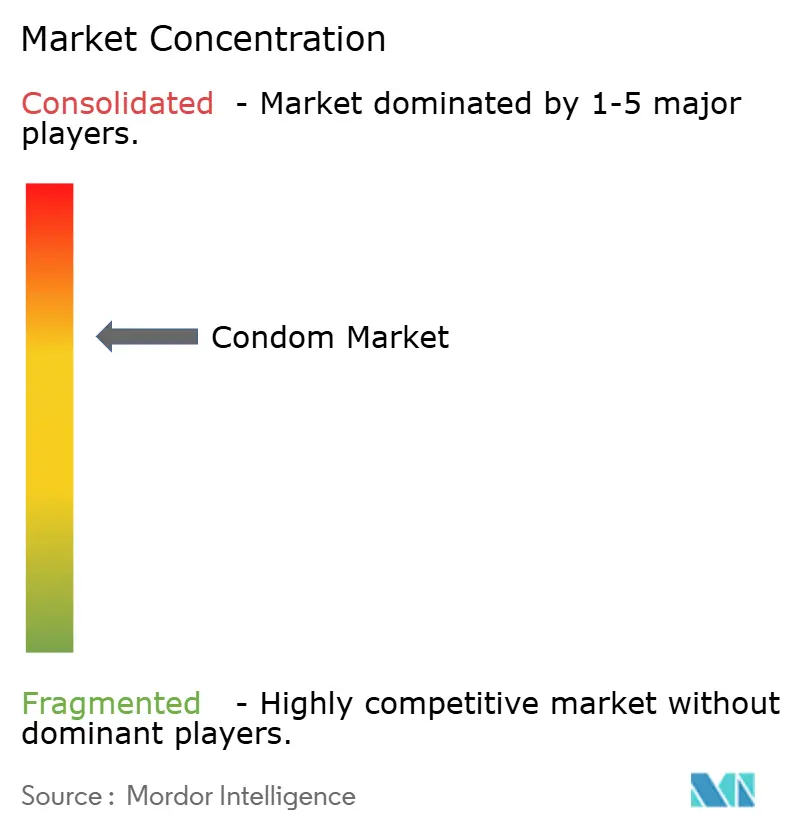
| Market Concentration | High |
Major Players *Disclaimer: Major Players sorted in no particular order Image © Mordor Intelligence. Reuse requires attribution under CC BY 4.0. | |
Condom Market Analysis by Mordor Intelligence
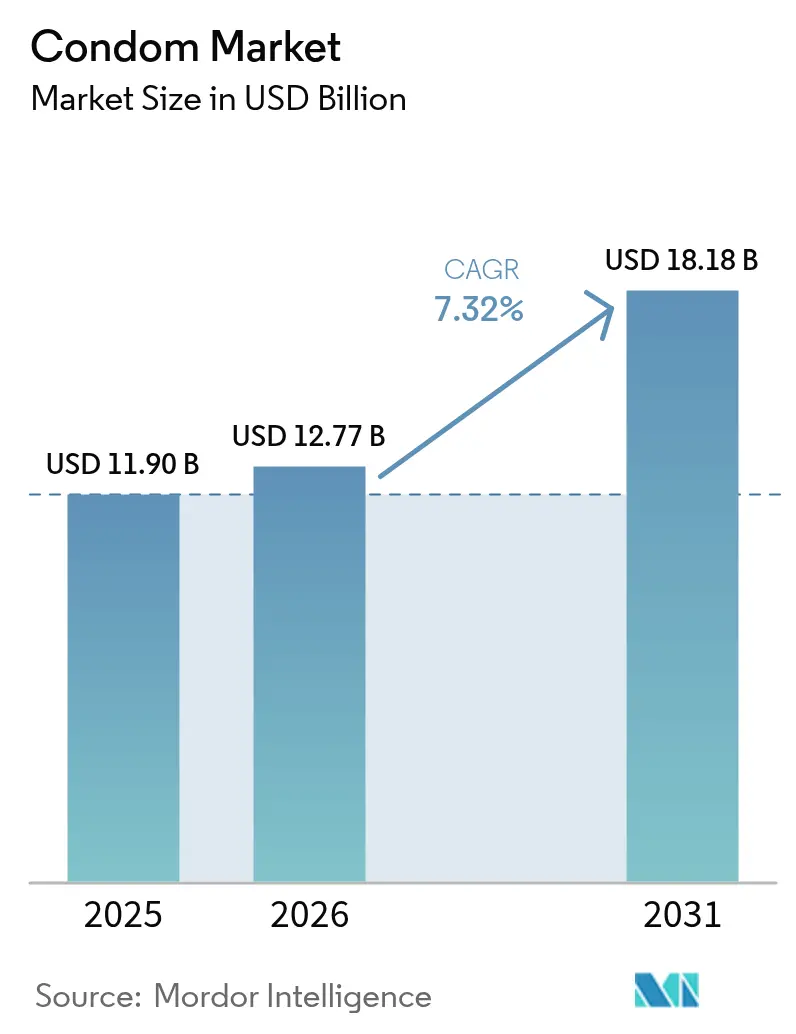
The condom market size in 2026 is estimated at USD 12.77 billion, growing from 2025 value of USD 11.90 billion with 2031 projections showing USD 18.18 billion, growing at 7.32% CAGR over 2026-2031. The condom market growth is driven by increased awareness of sexually transmitted infections (STIs), expanded public health prevention budgets, and advancements in material technology. Government initiatives and educational programs worldwide have significantly contributed to raising awareness about safe sexual practices. While latex products maintain their cost advantage, non-latex alternatives gain market share due to enhanced comfort and hypoallergenic properties. The rise of e-commerce platforms reduces purchase barriers and improves accessibility, compelling traditional manufacturers to adopt hybrid distribution strategies combining pharmacy and direct-to-consumer (DTC) channels. North America maintains market leadership, while the Asia-Pacific region demonstrates the highest growth rate, fueled by urbanization and evolving social attitudes. The market remains highly competitive, with established manufacturers maintaining their market position while new entrants target premium segments through innovative materials like graphene, biodegradable options, and female-focused products. The increasing focus on sustainable and eco-friendly products has led manufacturers to develop environmentally conscious packaging and manufacturing processes in the condom market.
Key Report Takeaways
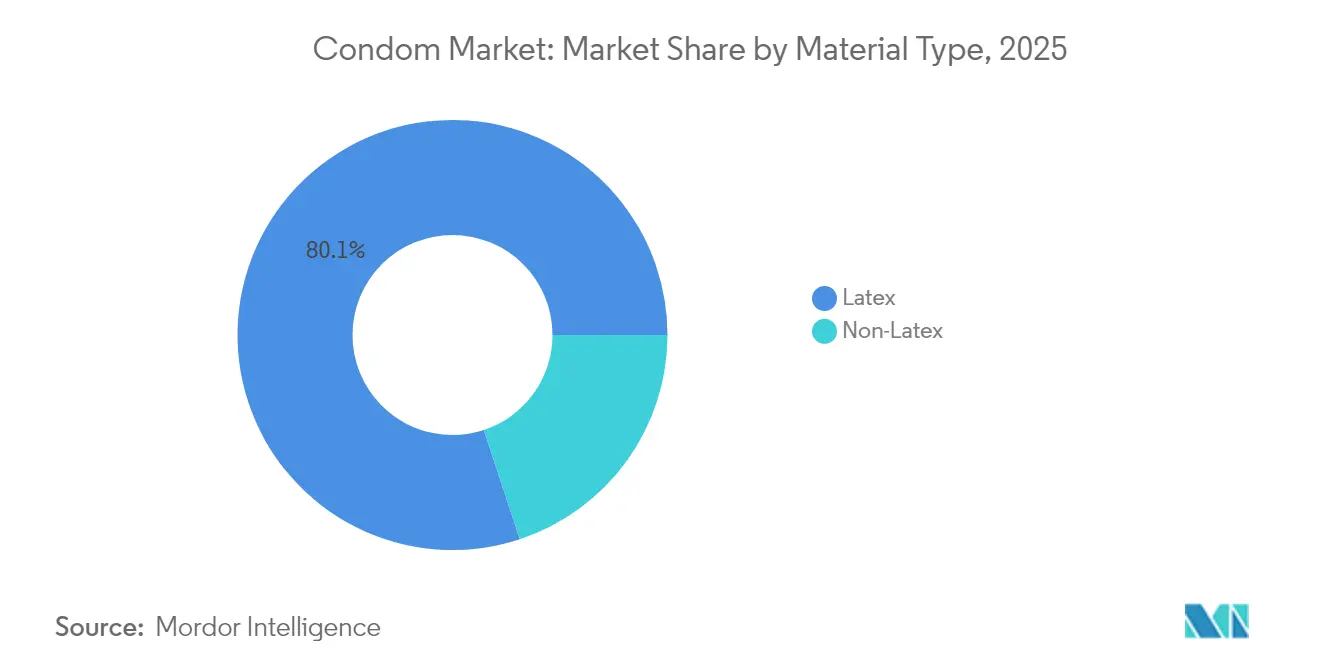
- By material type, latex held 80.07% of condom market share in 2025; non-latex is projected to expand at a 10.02% CAGR through 2031.
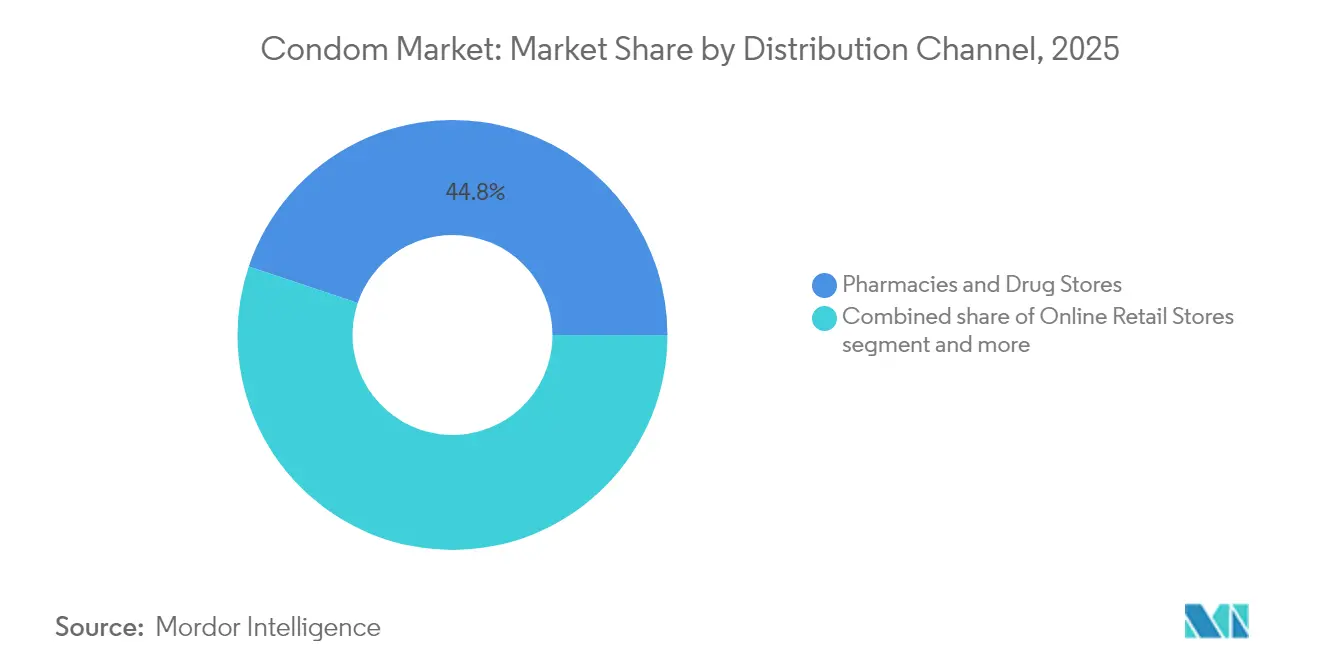
- By distribution channel, pharmacies and drug stores controlled 44.83% of the condom market size in 2025; online retail stores is advancing at a 10.25% CAGR.
- By end user, men accounted for 89.05% of sales in 2025; the women’s segment is forecast to rise at a 9.41% CAGR.
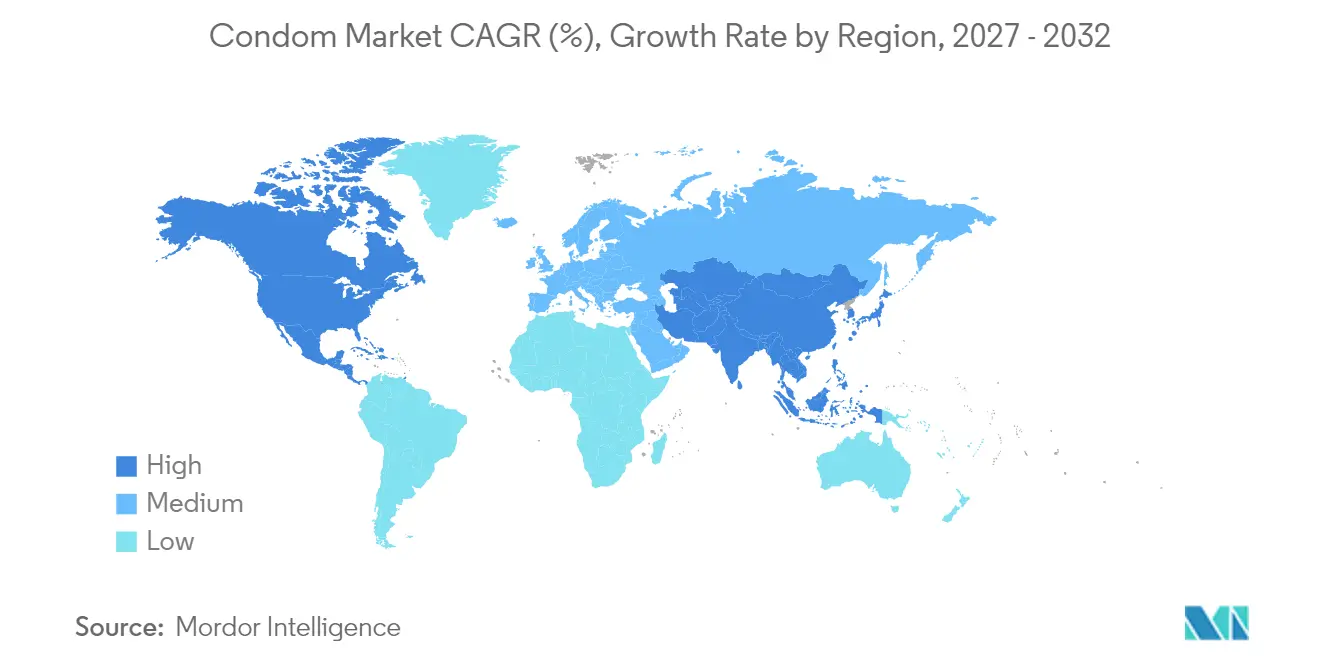
- By geography, North America captured 35.12% revenue in 2025, while Asia-Pacific is set to grow at a 10.29% CAGR to 2031.
Note: Market size and forecast figures in this report are generated using Mordor Intelligence’s proprietary estimation framework, updated with the latest available data and insights as of 2026.
Market Trends and Insights
Drivers Impact Analysis of Condom Market*
| Driver | (~) % Impact on CAGR Forecast | Geographic Relevance | Impact Timeline |
|---|---|---|---|
| Growing awareness about sexually transmitted infections (STIs) | +1.8% | Global, with concentration in North America and Europe | Medium term (2-4 years) |
| Sex education initiatives in schools and communities | +1.2% | North America, Europe, Asia-Pacific urban centers | Long term (≥ 4 years) |
| Rise in government and public health campaigns | +1.5% | Global, particularly Sub-Saharan Africa and Asia-Pacific | Short term (≤ 2 years) |
| Innovation in latex-free condoms | +2.1% | North America, Europe, Asia-Pacific developed markets | Medium term (2-4 years) |
| Growing adoption of female condoms | +0.9% | Global, with early adoption in North America and Europe | Long term (≥ 4 years) |
| Rising acceptance of casual relationships and dating apps | +1.3% | Global urban centers, strongest in North America and Europe | Short term (≤ 2 years) |
| Source: Mordor Intelligence | |||
Growing awareness about sexually transmitted infections (STIs)
Health agencies intensify prevention messages after condom use among U.S. high-school students declined, with 52% reporting no condom use during last intercourse in 2023, according to CDC (Centers for Disease Control and Prevention)[1] . The United Kingdom's Public Health England [2] expanded digital campaigns targeting 16-to-24-year-olds after data revealed 47% engaged in unprotected sex with new partners. Government initiatives focus on educational programs in schools and universities to raise awareness about safe sex practices and STI prevention. Australia's [3]national STI strategy combines regular testing with condom promotion, citing 119,000 notifiable STI cases in 2021. These programs increase public funding for free distribution and normalize condoms as primary protection. The combination of consistent messaging, free supply, and diagnostic services strengthens market demand. Additionally, increased global travel and dating-app usage enhance the need for accessible protection, supporting condom market growth in regions with established public health infrastructure. The rise in sexually transmitted infections globally has prompted healthcare providers to emphasize the importance of barrier protection methods, further driving condom adoption rates in the condom market.
Sex education initiatives in schools and communities
The integration of comprehensive condom education in schools has significantly influenced the condom market. The CDC's Condom Availability Programs operated in schools across 21 states by 1995, achieving 90% student acceptance rates when combined with counseling services. These programs have proven particularly effective in urban areas, where access to sexual health resources is crucial for public health outcomes. The Los Angeles Unified School District demonstrates the sustainability of such programs, having provided free condoms since 1992 through county health partnerships. Research indicates that school-based distribution programs increase protected sexual activity without raising overall sexual activity rates, establishing lasting condom usage habits. The market reach has expanded further through digital education platforms, including virtual peer tutoring, which connects students to direct-to-consumer condom brands and strengthens market distribution channels. Additionally, the success of these educational initiatives has encouraged more schools nationwide to implement similar programs, creating new opportunities for growth in the condom market.
Rise in government and public health campaigns
Government-led distribution networks and public health initiatives significantly influence the condom market by reducing cost barriers and promoting condom use as a public health necessity. New York City distributes over 30 million free condoms annually through 3,500 locations, including bars and clinics according to NYC Department of Health [4]. In London, the HIV Prevention Programme provides 1.5 million condoms and lubricants through the "Do It London" campaign, focusing on men who have sex with men according to Public Health England[5]. The Minnesota Department of Health supplies condoms to Tribal and Federally Qualified Health Centers. These programs generate consistent institutional demand, stabilizing market fluctuations. Public health organizations also conduct educational campaigns to raise awareness about safe sex practices and sexually transmitted infections. Additionally, they establish consumer expectations for free or subsidized access, encouraging manufacturers to pursue both public-sector contracts and retail sales. The success of these initiatives has led to increased collaboration between government agencies and condom manufacturers to ensure sustainable supply chains in the condom market.
Innovation in latex-free condoms
Material science developments expand the premium segment as consumers seek latex alternatives due to allergy concerns. The global condom market continues to evolve with significant investments in research and development. The University of Manchester, supported by the Bill & Melinda Gates Foundation, develops graphene-enhanced composites to create thinner and stronger condoms. ONE Condoms introduced FDA-cleared ONE Flex, which transfers 85% more body heat than latex, enhancing sensation. Multi-site clinical trials demonstrate the comparable safety of synthetic nitrile alternatives, facilitating global regulatory approvals. Japanese manufacturers offer 0.01 mm polyurethane products as premium options at higher price points. The emergence of biodegradable prototypes adds environmental benefits. These material advancements increase consumer willingness to purchase premium products, maintaining the market's upward pricing trend through innovation. The integration of smart technologies and antimicrobial coatings further expands product differentiation in the premium segment within the condom market.
Restraints Impact Analysis of Condom Market*
| Restraint | (~) % Impact on CAGR Forecast | Geographic Relevance | Impact Timeline |
|---|---|---|---|
| Cultural and religious stigma | -1.4% | Sub-Saharan Africa, Middle East, South Asia | Long term (≥ 4 years) |
| Misconceptions about condom efficacy | -0.8% | Sub-Saharan Africa, rural areas globally | Medium term (2-4 years) |
| Accessibility issues in rural and remote areas | -1.1% | Sub-Saharan Africa, rural Asia, remote communities | Medium term (2-4 years) |
| Competition from alternative contraception | -0.7% | Developed markets, urban centers globally | Short term (≤ 2 years) |
| Source: Mordor Intelligence | |||
Cultural and religious stigma
Cultural norms in Malawi, Uganda, and Tanzania associate condom use with infidelity, reducing adoption rates even when products are available at no cost. Studies in Lebanon indicate only 7% usage among married couples, primarily due to religious and moral objections. Research in the Philippines and Iran identifies comparable obstacles stemming from gender dynamics and restricted decision-making autonomy. These cultural barriers impede program adoption, necessitating extended community outreach and collaboration with religious leaders. The resistance to condom use is particularly strong in rural areas, where traditional beliefs and practices remain deeply rooted. Manufacturers incur additional expenses in communication and culturally-appropriate packaging design, which restricts condom market expansion in traditional societies. Educational initiatives and awareness campaigns often face significant pushback from community elders and religious institutions, further complicating market penetration efforts in the condom market.
Misconceptions about condom efficacy
In rural Tanzania, the persistent misconception that condoms "contain worms" negatively impacts adoption rates. While scientific evidence demonstrates that condoms provide over 90% protection against HIV when used properly, knowledge gaps remain significant. Religious and cultural beliefs in many regions further complicate acceptance and distribution efforts. In Ghana, BMC Contraception reports that female condom awareness among women remains below 50%. According to PubMed Central, Rohingya refugee populations demonstrate limited understanding of condom usage and safety, primarily due to literacy challenges and language barriers. These widespread misconceptions increase educational program costs and extend implementation timelines, particularly affecting the adoption of new condom materials that require additional consumer trust. Limited access to healthcare facilities and inadequate sexual health education in developing regions compound these challenges in the condom market.
*Our forecasts treat driver/restraint impacts as directional, not additive. The impact forecasts reflect baseline growth, mix effects, and variable interactions.
Condom Market Segment Analysis
By Material Type:
Non-Latex Innovation Drives Premium GrowthLatex products accounted for 80.07% of 2025 revenue due to their cost advantages. While latex maintains a substantial market share, non-latex alternatives are expected to grow at a 10.02% CAGR, driven by consumer demand for allergy-free products and enhanced sensation. Japanese manufacturers supply polyurethane condoms with 0.01 mm thickness, attracting premium urban consumers. The ultra-thin design has particularly resonated in Asian markets, where consumer preferences lean toward enhanced sensitivity. Nitrile condoms appeal to latex-sensitive users and institutional buyers due to their medical-grade consistency. The incorporation of graphene improves thermal conductivity and strength, creating product differentiation opportunities. Biodegradable options remain a small segment but appeal to environmentally conscious millennials. Recent studies indicate these eco-friendly alternatives could capture up to 15% of the market by 2031. Manufacturers are investing in automated production for synthetic materials to reduce costs, aiming to establish non-latex as a mainstream option and increase market adoption in the condom market.
Market competition increases as companies develop their intellectual property portfolios. ONE Condoms uses its graphene patents to secure distribution in Walmart while maintaining a direct-to-consumer platform, combining retail presence with consumer data collection. Okamoto maintains market position through its SHEERLON latex technology, which optimizes thickness and strength parameters. While new companies explore plant-based polymers, they face challenges in scaling production and obtaining certifications. The focus on material advancement supports premium pricing strategies, contributing to market value growth.

By End User:
Female Uptake Accelerates Despite Male DominanceMen accounted for 89.05% of condom sales in 2025, while the women's segment is expected to grow at a 9.41% CAGR. Educational initiatives focusing on gender equality and reproductive autonomy drive this transformation. Programs in Zambia show increased adoption of female condoms when accompanied by training and sample distribution, indicating that accessibility remains a key barrier. The success of these programs has led to their replication in neighboring countries, showing promising early results. NGO collaborations facilitate the distribution of women-controlled contraceptives in low-income areas, expanding beyond conventional retail channels. Improvements in design that address insertion challenges and reduce noise during use have increased user satisfaction, leading to higher repeat purchases and market expansion for female-oriented products.
Manufacturers are adapting their marketing approach to emphasize mutual pleasure and dual protection benefits. The higher price points of female condoms offer better profit margins, encouraging manufacturers to increase production capacity. Retailers are expanding shelf space and online visibility for women's products, while subscription services ensure consistent supply and discretion. Despite ongoing cultural barriers in certain Asian and African regions, urban adoption is increasing, supported by social media influencers and telehealth services. This growing consumer base helps diversify revenue sources and reduces dependence on male consumer patterns. Recent market research indicates that younger demographics are more receptive to female condoms, suggesting a potential shift in future consumption patterns in the condom market.
By Distribution Channel:
Digital Transformation Reshapes AccessibilityPharmacies and drug stores maintain a dominant 44.83% channel share in 2025, driven by consumer trust in pharmacists and immediate product availability. Online retail channels are experiencing significant growth at a 10.25% CAGR, transforming the condom market through data-driven and subscription-based commerce. The widespread adoption of e-pharmacy services during COVID-19 has extended to sexual wellness products, with consumers prioritizing discreet shipping and expanded product selection. Direct-to-consumer brands incorporate product quizzes and educational content to guide size and material selection, improving conversion rates. Online marketplaces now offer same-day delivery options, addressing immediate needs while maintaining privacy in the condom market. Hypermarkets and convenience stores continue to serve impulse purchases and maintain a presence in suburban areas with limited delivery services.
Retailers are implementing vending machines at nightlife establishments and university campuses, equipped with digital payment systems and age verification technology. These automated solutions provide 24/7 accessibility while reducing operational costs for retailers. The integration of smart inventory management systems in vending machines enables real-time stock monitoring and automated reordering. Public health programs complement commercial distribution channels through free product distribution, particularly at major events. Companies are adopting integrated distribution strategies, with established brands developing online stores while maintaining their pharmacy presence to reach new customers. Marketing strategies are evolving from traditional advertising to targeted digital campaigns, focusing on customer acquisition and retention through data analytics.
Geography Analysis
North America Condom Market
North America generated 35.12% of global revenue in 2025, supported by comprehensive sex-education programs and high per-capita spending. The United States maintains strong market presence through school and community distribution networks, while sustaining volume through online channels. Canada's public insurance coverage and Mexico's manufacturing clusters strengthen regional supply chains. Consumer preference for non-latex and ultrathin variants increases average selling prices, reinforcing the region's market position.
APAC Condom Market
Asia-Pacific exhibits 10.29% CAGR, driven by increasing disposable income and young, digitally connected populations. China's 100% Condom Use Programmes demonstrated success in reducing HIV prevalence in pilot areas while normalizing e-commerce purchases. Japan focuses on domestic production of ultrathin polyurethane products, establishing its position in product innovation. India expands rural accessibility through public-private initiatives and mobile clinics, despite social barriers outside metropolitan areas. Australia implements comprehensive STI prevention strategies combining testing with condom distribution. Urban middle-class growth and widespread smartphone adoption continue to drive market expansion in the region within the condom industry.
EMEA and South America Condom Market
Europe demonstrates steady growth through progressive health policies and universal healthcare systems. The United Kingdom implements targeted digital campaigns for young adults, maintaining demand despite lower birth rates. France and Germany develop migrant health programs with multilingual condom education. Southern European markets benefit from tourism and nightlife consumption. South America shows gradual growth, with Brazil focusing on female condom distribution through community clinics. In the Middle East and Africa, adoption varies significantly: South Africa demonstrates successful community outreach programs, while cultural factors restrict growth in Gulf regions. Development funding and region-specific communication strategies remain essential for market growth.
Regulatory Landscape
Condoms are regulated primarily as medical devices, which requires manufacturers to align product design, testing, and labeling with national requirements and widely used international standards. In the United States, latex condoms are Class II medical devices subject to special controls, including specific labeling requirements under 21 CFR 801.435 and 21 CFR 801.437 (notably latex allergy cautions). Internationally, ISO standards remain important for procurement and market access, with ISO 4074:2026 setting the current international requirements and test methods for natural rubber latex male condoms.
Country-specific conformity and registration requirements also influence market entry sequencing and compliance operations. In the United Kingdom, the Medicines and Healthcare products Regulatory Agency (MHRA) manages device registration processes, with April 2026 guidance emphasizing structured submissions and self-certification conformity declarations where applicable. Trade classification and tariff treatment can vary by material composition (for example, rubber versus polyurethane classifications), and policy changes such as Brazil's Gecex Resolution No. 818 (November 2025) reducing import tariffs for female condoms add another planning dimension for global brands and tender-focused suppliers.
Competitive Landscape
The condom market is concentrated, characterized by dominant multinational brands and innovative companies. Some of the major players include Reckitt Benckiser Group (Durex), Church & Dwight Co., Inc., and Karex Berhad, among others. Reckitt's Durex maintains market leadership through global brand recognition, latex-free product development, and expansion in emerging markets. Karex Berhad strengthened its market position by acquiring Global Protection Corp, improving cost management, and North American distribution capabilities in the condom industry.
Companies focus on premium product development to maintain a competitive advantage. ONE Condoms established market differentiation through its graphene-enhanced products, enabling premium pricing in online and retail channels. Okamoto maintains its market position in ultrathin latex products through manufacturing improvements and consumer feedback integration. New market entrants focus on environmental sustainability, offering biodegradable latex and eco-friendly packaging to attract environmentally conscious consumers.
Digital capabilities have become essential for market success. Major companies develop subscription services and use consumer data to optimize replenishment programs. Social media marketing through influencers increases brand awareness and engagement, particularly among younger consumers. Companies strengthen supply chain operations through automation, quality control technology, and regional distribution centers. Research and development focuses on developing compliant materials in anticipation of stricter regulations on PFAS and other chemicals. The market maintains a balance between industry consolidation and product innovation to ensure sustained consumer interest and prevent product commoditization across the condom industry.
Condom Industry Leaders
-
Reckitt Benckiser Group
-
Church & Dwight Co., Inc.
-
Karex Berhad
-
LifeStyles Healthcare Pte. Ltd.
-
Okamoto Industries,Inc.
- *Disclaimer: Major Players sorted in no particular order
Condom Market Companies Covered in this Report
- Reckitt Benckiser Group PLC
- LifeStyles Healthcare Pte. Ltd.
- Church & Dwight Co., Inc.
- Karex Berhad
- Fuji Latex Co. Ltd
- Cupid Limited
- Okamoto Industries,Inc.
- The Female Health Company
- Mankind Pharma Limited
- Mayer Laboratories, Inc
- Ansell Limited
- Thai Nippon Rubber Industry Public Company Limited
- HLL Lifecare Limited
- Global Protection Corp
- Australian Therapeutic Supplies PTY Ltd.
- Richter Rubber Technology Sdn. Bhd.
- Ritex GmbH
- RFSU AB
- Unique Condom Corp.
- Caution Wear Corp.
Market Opportunities and Future Outlook
Non-latex and female condom supply expansion is an identifiable opportunity as public health programs, premiumization, and allergy-driven switching broaden demand beyond traditional latex male condoms. ISO 4074:2026 publication (March 2026) reinforces the need for updated compliance programs, and it creates differentiation space for manufacturers with validated testing and documentation for institutional procurement and cross-border trade. Innovation also supports premium segmentation, with examples such as FDA-cleared non-latex offerings (e.g., ONE Flex) and ultrathin polyurethane products in Japan reflecting consumer willingness to pay for sensation and comfort attributes.
Operational investment is also shaping near-term availability. Capacity and capability upgrades in India provide a concrete basis for broader access across materials and formats. In April 2026, HLL Lifecare commissioned a technologically upgraded 3-Dip condom manufacturing machine at Irapuram, Kochi to support ultrathin and multi-textured products, and it launched a lube augmentation project to strengthen its ability to supply differentiated SKUs. Cupid Limited also disclosed an integrated dual-polymer manufacturing facility for nitrile and natural rubber latex condoms and announced a nitrile female condom development program (March 2026), aiming to address constraints in female-controlled barrier methods; these steps support diversification of product mix and responsiveness to both retail and tender demand.
Recent Industry Developments in Condom Market
- May 2026: Karex Berhad reported in its interim filing for the quarter ended March 31, 2026 that sales were affected by tariffs on exports to the United States and lower sales in the tender market. The update highlights how trade measures and public-sector procurement cycles can quickly change volume and margin outcomes for large, export-oriented manufacturers.
- May 2026: Church & Dwight stated that its TROJAN G.O.A.T. non-latex condom, launched in Q4 2025, became the #1 rated TROJAN branded condom on Amazon (4.7-star rating). The performance signals rising consumer traction for non-latex formats in e-commerce, reinforcing the role of digital shelves and reviews in premium condom adoption.
- September 2024: Durex launched the Close Fit Invisible Condom in India, positioned around an ultra-thin design and snug fit. The launch underscores the strategic importance of India for major brands and the continued focus on sensation-led innovation to expand use cases beyond basic protection.
Condom Market Report Scope and Research Methodology
Market Definition and Coverage
For this study, the condom market covers the value of male and female condoms sold through retail and institutional channels, counted at the point of sale in each country and then rolled up to regional and global totals.
Scope exclusions: Excludes other contraceptive devices (such as oral pills, IUDs, implants) and broader sexual wellness products that do not meet the definition of a condom.
Segments Covered in This Report
- Material Type
- Latex
- Non-latex
- End User
- Men
- Women
- Distribution Channel
- Hypermarkets/Supermarkets
- Convenience Stores
- Pharmacies and Drug Stores
- Online Retail Stores
- Other Distribution Channels
- Geography
- North America
- United States
- Canada
- Mexico
- Rest of North America
- Europe
- Spain
- United Kingdom
- Germany
- Russia
- France
- Italy
- Rest of Europe
- Asia-Pacific
- China
- Japan
- India
- Australia
- Rest of Asia-Pacific
- South America
- Brazil
- Argentina
- Rest of South America
- Middle East and Africa
- South Africa
- Saudi Arabia
- Rest of Middle East and Africa
- North America
Data Sources, Market Sizing, and Validation
Desk Research
Desk work starts by setting a clean demand picture for condoms by country and then checking what supply and trade signals indicate. We reference public health and population indicators from sources such as the World Health Organization, UN Population Division, and the World Bank to understand the at-risk and reproductive-age cohorts that shape demand.
We also review category and channel context using sources such as national health ministry publications, customs and trade statistics portals, and peer-reviewed public health journals that cover contraceptive use and STI prevention trends. In parallel, company annual reports, investor presentations, and credible press are used to sense-check product mix shifts like latex versus non-latex and the pace of online retail. Where helpful, we use paid subscriptions for company financials and for patent databases to confirm innovation direction, but the desk source list here is not exhaustive, and many other references were used for data collection, validation, and clarification.
Primary Interviews and Surveys
Primary work is used to pressure-test assumptions that desk sources cannot settle, especially around average selling prices, channel margins, and how public sector tenders flow versus private retail. We spoke with a mix of manufacturers, distributors, pharmacies, online sellers, and public health procurement voices across APAC, EMEA, and the Americas so the model reflects both demand pull and supply realities.
Distribution of primary research fieldwork respondents
| Company type | Respondent position | Region |
|---|---|---|
| Top tier: 30% | CXOs: 17% | APAC: 46% |
| Mid tier: 49% | Functional/Unit leaders: 26% | EMEA: 35% |
| Smaller Players: 21% | Managers: 57% | Americas: 19% |
Market-Sizing & Forecasting
Sizing is built using a top-down path where population and sexual health indicators are converted into an annual condom consumption pool, then shaped by contraceptive prevalence, awareness programs, and channel access. The totals are corroborated with selective bottom-up approximations using supplier and distributor roll-ups, plus sampled pricing checks across key channels, before adjustments are made.
Inputs that mattered in this market include condom usage incidence and contraceptive adoption rates, public sector distribution intensity, online retail penetration, latex versus non-latex mix shifts, and average selling price movement by channel. Where data is patchy for smaller countries, we bridge gaps using proxy markets with similar income bands and health program coverage, then confirm the direction through interviews.
For forecasting, scenario analysis is used with a short list of drivers that experts can validate, such as changes in sexual health funding, e-commerce growth, and pricing pass-through. These driver paths are kept consistent across countries so the regional build is traceable and can be reproduced with the same public inputs.
Data Validation & Update Cycle
Model outputs are checked against independent signals, including trade flows where relevant, public procurement cues, and the implied per-capita consumption levels that should make sense for each geography. When a country shows a sharp jump that the drivers do not explain, we reopen assumptions and trigger follow-up calls to confirm whether the change is real or a data artifact.
Before sign-off, results go through a multi-step analyst review, and key tables are re-tallied to catch currency timing issues and unit conversion errors. Reports are refreshed annually, and interim updates are made when material events occur, after which a final pre-delivery review is completed so clients receive the latest view.
Mordor Intelligence's Condom Market Size Versus Other Published Estimates
Published market sizes for condoms can look far apart even when they refer to the same product, because the underlying evidence and counting point differ. The biggest sources of spread usually come from what is treated as retail value versus manufacturer revenue, the anchor year used, and how public sector distribution is translated into a market value.
Country-level channel pricing checks and cross-region validation using the implied per-capita consumption pattern provide the evidence that links Mordor Intelligence to a 2026 value that fits the defined global demand pool, without mixing in broader sexual wellness items or non-condom contraceptives.
Benchmark comparison
| Source | Market Size | Gaps in Research Methodology |
|---|---|---|
| Mordor Intelligence | USD 12.77 B (2026) | |
| Global Consultancy A | USD 12.56 B (2024) | Uses a different base year and may emphasize historical shipment and revenue reporting through 2024, which can undercount later channel mix changes and price progression in online and pharmacy retail. |
| Industry Publisher B | USD 6.35 B (2025) | Likely applies a narrower value capture, closer to selected retail categories or a constrained geography and channel set, which can leave out parts of institutional distribution and cross-border supply effects. |
The table shows that timing and value capture are doing most of the work behind the differences. By keeping the demand pool logic visible, and then checking it against pricing and channel signals that practitioners recognize, we arrive at a balanced number that can be explained and rechecked country by country.
Key Questions Answered in the Report
What is the current size of the condom market?
The condom market is estimated at USD 12.77 billion in 2026 and is projected to reach USD 18.18 billion by 2031.
Which material type is growing fastest?
Non-latex condoms, including polyurethane, nitrile, and graphene blends, are advancing at a 10.02% CAGR through 2031 as consumers seek allergy-free and ultra-thin options.
How quickly is online retail expanding for condoms?
Online channels are forecast to grow at a 10.25% CAGR, outpacing traditional pharmacy outlets due to privacy, assortment breadth, and subscription convenience.
Which region leads in revenue, and which grows fastest?
North America leads with 35.12% of 2025 revenue, while Asia-Pacific is the fastest-growing region at a 10.29% CAGR.
Are female condoms gaining traction?
Yes. Although men still account for 89.05% of sales, the women’s segment is expected to grow at a 9.41% CAGR as design improvements and empowerment messages boost adoption.