
Polyolefin (PO) Shrink Films Market Size and Share
Market Overview
| Study Period | 2020 - 2031 |
|---|---|
| Market Size (2026) | USD 8.55 Billion |
| Market Size (2031) | USD 10.80 Billion |
| Growth Rate (2026 - 2031) | 4.79 % |
| Fastest Growing Market | Asia Pacific |
| Largest Market | Asia Pacific |
| Market Concentration | Medium |
Major Players *Disclaimer: Major Players sorted in no particular order Image © Mordor Intelligence. Reuse requires attribution under CC BY 4.0. | |
Polyolefin (PO) Shrink Films Market Analysis by Mordor Intelligence
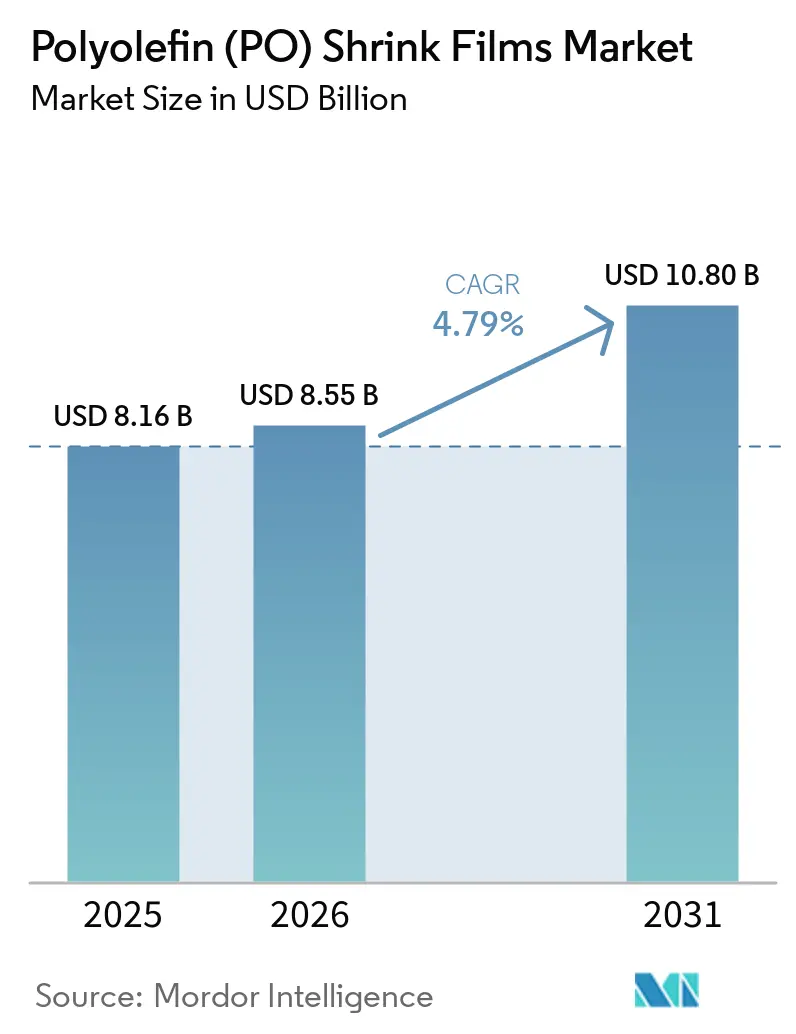
The Polyolefin Shrink Films Market size is expected to grow from USD 8.16 billion in 2025 to USD 8.55 billion in 2026 and is forecast to reach USD 10.8 billion by 2031 at 4.79% CAGR over 2026-2031. Growth reflects the material’s versatility, rising preference for recyclable solutions, and the steady replacement of PVC in food-contact applications. Surging e-commerce volumes, brand demand for 360-degree graphics, and the rapid roll-out of automation-ready thin-gauge cross-linked grades are expanding addressable use-cases for the polyolefin shrink film market. Across regions, Asian manufacturers scale capacity to serve export-oriented consumer goods, while North American converters emphasize tamper-evident wraps that build consumer trust. In Europe, policy pressure accelerates adoption of films containing post-consumer recycled (PCR) feedstock, encouraging proprietary blends that match both performance and recycling targets.
Key Report Takeaways
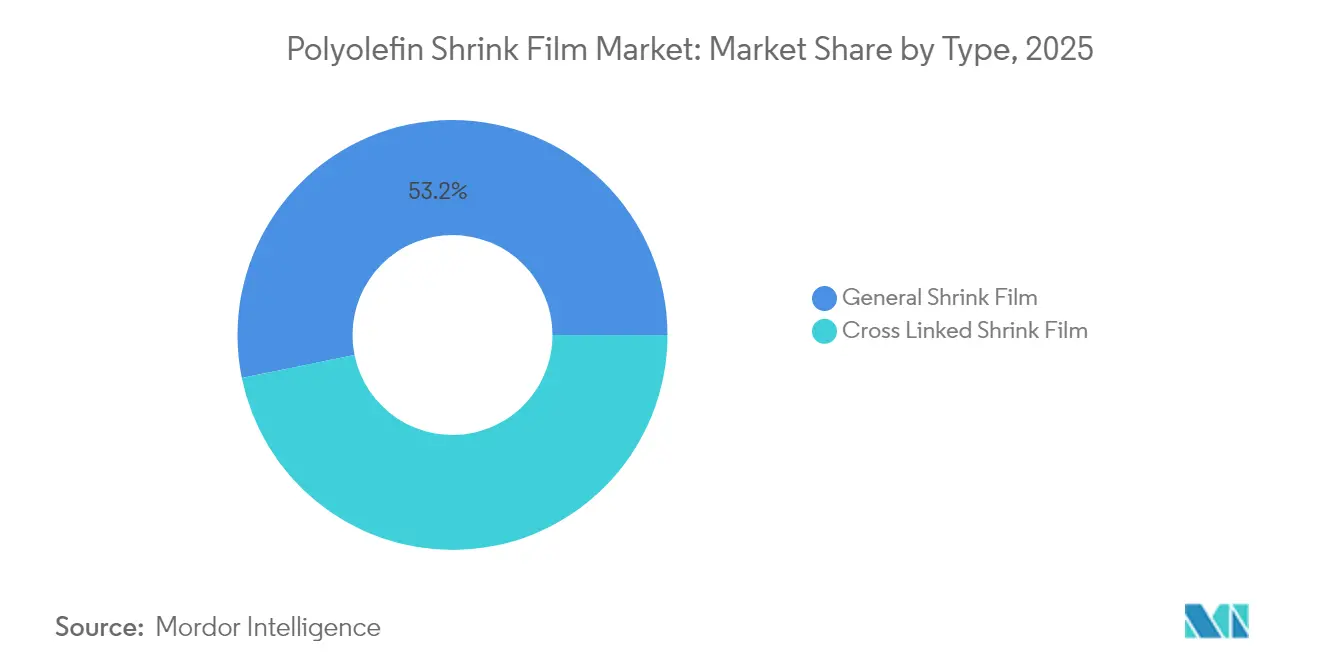
- By type, general shrink film led with 53.20% of polyolefin shrink film market share in 2025; cross-linked grades are projected to post a 6.55% CAGR through 2031.
- By material type, polyethylene controlled 56.40% of polyolefin shrink film market share in 2025, while polypropylene is set to register a 6.92% CAGR to 2031.
- By layer structure, multilayer constructions captured 51.40% share of the polyolefin shrink film market size in 2025 and are forecast to expand at a 6.62% CAGR to 2031.
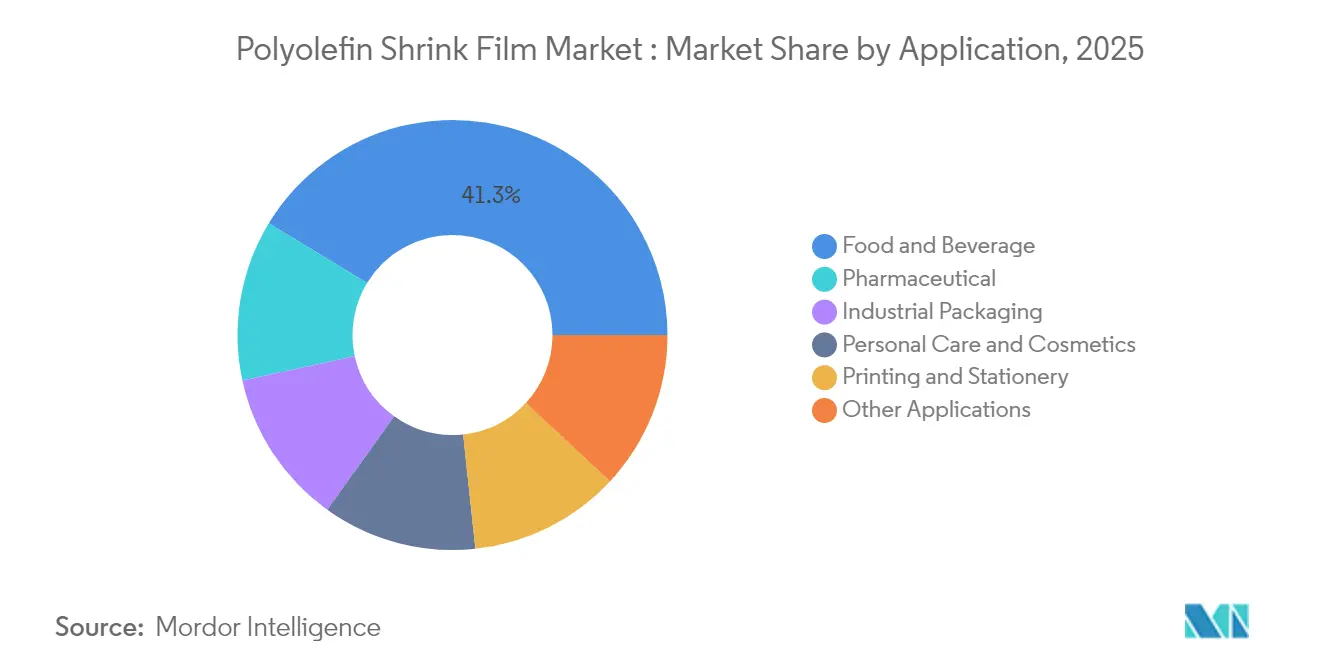
- By application, food and beverage accounted for 41.30% share of the polyolefin shrink film market size in 2025, whereas pharmaceuticals will advance at an 8.47% CAGR between 2026 and 2031.
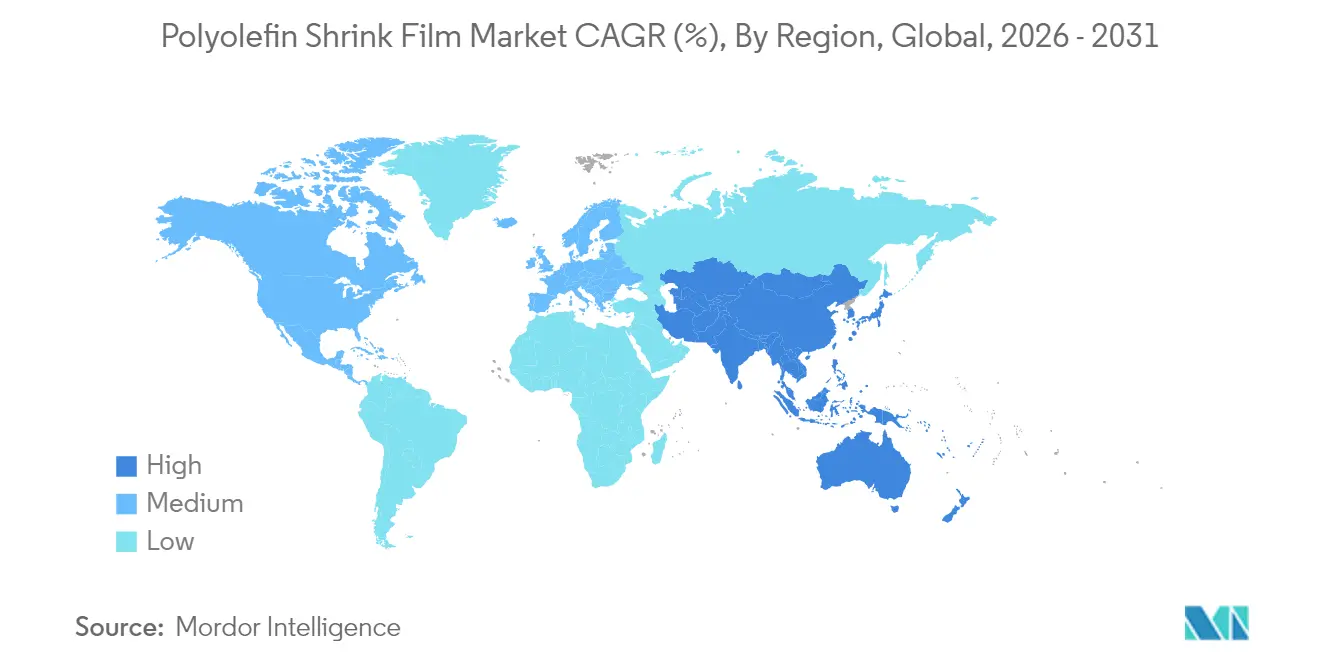
- By geography, Asia Pacific commanded 37.60% of polyolefin shrink film market share in 2025 and is poised for 6.82% CAGR growth through 2031.
Note: Market size and forecast figures in this report are generated using Mordor Intelligence’s proprietary estimation framework, updated with the latest available data and insights as of 2026.
Market Trends and Insights
Drivers Impact Analysis of Polyolefin (PO) Shrink Films Market*
| Driver | ~ (%) Impact on CAGR Forecast | Geographic Relevance | Impact Timeline |
|---|---|---|---|
| E-commerce demand for tamper-evident wrap accelerating small-pack use in North America | +1.2% | North America, with spillover to Europe | Medium term (3-4 yrs) |
| Shift from PVC to eco-safer POF in European food-contact films | +0.9% | Europe, with global adoption following | Long term (≥ 5 yrs) |
| Demand for High-Quality Printing and Branding | +0.7% | Global, strongest in North America and Europe | Medium term (3-4 yrs) |
| Cost-Effectiveness Compared to Alternatives | +0.6% | Global, particularly impactful in emerging markets | Short term (≤ 2 yrs) |
| Automation-ready thin-gauge cross-linked films driving high-speed lines in Asia | +1.0% | Asia-Pacific, particularly China, India, and Japan | Medium term (3-4 yrs) |
| Source: Mordor Intelligence | |||
E-commerce tamper-evidence demand in North America
E-commerce growth has driven demand for tamper-evident polyolefin shrink films to secure products during transit. North American retailers use these films to protect goods and build consumer trust, with 78% of online shoppers valuing visible tamper-evidence. Intertape Polymer Group's ExlfilmPlus PCR, a polyolefin shrink film with 35% recycled content, addresses security and sustainability needs[1]Intertape Polymer Group, “IPG to Showcase Automation, Consumable and Service Solutions at Pack Expo International 2024,” itape.com. The film combines high clarity with post-consumer recycled content, meeting e-commerce packaging challenges.
PVC-to-POF switch in European food-contact films
European food manufacturers pivot towards recyclable polyolefin films after April 2024 packaging legislation targeting a 5% waste reduction by 2030 [2]European Parliament, “New EU Rules to Reduce, Reuse and Recycle Packaging,” europarl.europa.eu. Parallel plastic taxes in the UK, Spain and Italy penalize films with under 30% recycled content. Clysar’s Store-Drop-Off-qualified EV-HPG illustrates how converters combine food safety, clarity and recyclability.
High-definition printing & branding
Beverage producers such as Anadolu Efes launched 77 new SKUs in 2024, each wrapped in vivid 360-degree graphics to maximize shelf impact. Digital presses speed changeovers, letting converters satisfy shorter promotional runs without plate inventories. The result is a virtuous cycle in which converters invest in wider web, high-opacity white inks, and matte-gloss contrasts that boost brand storytelling in the polyolefin shrink film market.
Cost advantage over alternatives
Film optimisation projects saved Heineken EUR 0.6 billion in 2024 as the brewer cut resin usage and simplified secondary packaging. Producers in emerging regions further curb spend by installing wide-width lines, such as UFlex’s 18,000 MTPA CPP unit, which improves economies of scale.
Restraints Impact Analysis of Polyolefin (PO) Shrink Films Market*
| Restraint | ~ (%) Impact on CAGR Forecast | Geographic Relevance | Impact Timeline |
|---|---|---|---|
| PE & PP resin price volatility | -0.8% | Global, acute in North America | Short term (≤ 2 years) |
| Single-use-plastic levies on over-wrap | -1.1% | Europe, potential global echo | Long term (≥ 4 years) |
| Trade-off between downgauging & shrink force limiting adoption in heavy-duty industrial packs | -0.5% | Global, particularly in industrial applications | Medium term (3-4 yrs) |
| Source: Mordor Intelligence | |||
PE & PP resin price volatility
Shale-feedstock disruptions in the United States heighten raw-material swings that already represent up to 70% of finished film cost. The OECD warns that plastic production may hit 736 million tonnes by 2040, intensifying feedstock competition[3]OECD, “Policy Scenarios for Eliminating Plastic Pollution by 2040,” oecd.org. Converters hedge risks via multi-sourcing, shorter resin contracts, and recipes that dilute virgin inputs with PCR pellets.
Single-use-plastic levies on over-wrap
Germany’s January 2024 levy obliges firms to report units sold and finance litter clean-up schemes, raising administrative and monetary burden. EU rules also require 90% separate collection of single-use beverage containers by 2029. These policies accelerate R&D into store-drop-off-ready sleeves and mono-material bundles within the polyolefin shrink film market.
*Our forecasts treat driver/restraint impacts as directional, not additive. The impact forecasts reflect baseline growth, mix effects, and variable interactions.
Polyolefin (PO) Shrink Films Market Segment Analysis
By Type:
Cross-linked films redefine performance expectationsGeneral shrink film held the largest 53.20% polyolefin shrink film market share in 2025, underpinned by affordability and wide processing windows. The segment’s clarity and ease of printing keeps it entrenched in food multipacks and promotional bundles across supermarkets. Yet converters increasingly upsell cross-linked grades where puncture resistance, scuff holdout and thinner profiles allow faster line speeds without wrap failure in stretch and shrink film applications.
Cross-linked output is forecast to grow at a 6.55% CAGR from 2026 to 2031 as pharmaceutical blister bundles, boxed cosmetics and electronics seek lower sealing temperatures that protect heat-sensitive contents. Expanded capacity in Asia and North America narrows the price delta, encouraging switchovers that stretch the polyolefin shrink film market beyond traditional displays.



By Material Type:
Polypropylene accelerates premium adoptionPolyethylene maintained a commanding 56.40% stake within the polyolefin shrink film market size in 2025, driven by transparency and cost competitiveness. Multi-layer PE blends permit tight seals even at low oven dwell times, making them a staple in beverage can dernests and produce trays, alongside polyethylene terephthalate shrink films. Processors now incorporate PCR streams to comply with brand circularity pledges without diluting optical properties.
Polypropylene is expected to rise 6.92% annually to 2031, buoyed by higher stiffness, chemical inertness and elevated heat-deflection points desirable for retorted foods and medical kits. New five-layer co-extruders co-blend PP with elastomer tie layers, retaining gloss while boosting tear resistance. This premium mix separates converters from commoditised PE offerings within the polyolefin shrink film market.
By Layer Structure:
Multilayer engineering multiplies functionalityMultilayer architectures captured 51.40% of the polyolefin shrink film market size in 2025, supported by 6.62% CAGR prospects through 2031. Tailored barrier layers block oxygen or moisture, while surface skins dial in sealability and high-definition ink anchorage. Brands use proprietary barrier cocktails to extend ambient shelf life for sauces and dairy sticks without secondary cartons.
Monolayer films remain cost-efficient for low-risk parcels but struggle when cross-border shipping demands superior toughness. Advances in co-extrusion allow seven-layer films that still qualify for mechanical recycling streams when kept within the polyolefin family, as demonstrated by Woolworths’ recyclable beverage sleeves. This balance positions multilayer solutions as the go-to choice for next-generation compliance within the polyolefin shrink film market.
By Application:
Pharmaceuticals take growth spotlightFood and beverage preserved 41.30% share of the polyolefin shrink film market size in 2025 by wrapping multipacks, fresh produce punnets and shelf-ready trays. Processors continually down-gauge gauge to cut resin usage while adding anti-fog additives that maintain see-through appeal. Regulatory bans on PVC cling in Europe accelerate substitution toward cleaner-burning polyolefin grades.
Pharmaceutical use will surge at an 8.47% CAGR as blister cards, injectable vials and diagnostic kits mandate tamper evidence and readability of barcodes through clear film. COVID-19 vaccine rollout elevated packaging scrutiny, cementing polyolefin as the secure yet transparent enclosure for unit doses. Brand owners also exploit the expansive printable area to communicate authentication holograms, adding intangible value in the polyolefin shrink film market.
Geography Analysis
APAC Polyolefin (PO) Shrink Films Market
Asia Pacific dominated the polyolefin shrink film market with 37.60% revenue contribution in 2025, and its projected 6.82% CAGR remains the fastest globally. China’s entrenched extruder base partners with multinational FMCG packers, while India’s rigid packaging boom responds to urban retail growth. Regional converters foster in-house plateless digital presses, enabling swift private-label promotion campaigns that capture domestic e-commerce surges.
Japan and South Korea Polyolefin (PO) Shrink Films Market
Japan and South Korea focus on high-barrier multilayer technology, supplying niche cross-linked rolls for export pharmaceuticals; domestic demand leans on automation-ready thin gauges that fit compact factory footprints. Association grants channel R&D tax credits toward energy-efficient shrink ovens, reinforcing adoption inside the polyolefin shrink film market.
North America Polyolefin (PO) Shrink Films Market
North America constitutes a mature yet innovation-led arena powered by the United States’ omnichannel retail ecosystem. Canada and Mexico complement regional supply through proximity to resin production and tariff-favoured trade corridors, anchoring resilience against price swings.
Europe Polyolefin (PO) Shrink Films Market
Europe balances stringent regulatory oversight with high purchasing power. Circular economy directives push converters to certify recyclability and shift toward PCR blends by 2027. Germany, Italy and the United Kingdom represent core demand clusters owing to strong beverage, confectionery and pharmaceutical output. Southern and Eastern member states gradually catch up as retail chains harmonise packaging briefs across the bloc.
MEA and South America Polyolefin (PO) Shrink Films Market
South America and the Middle East & Africa present smaller but increasingly attractive frontiers. Brazil leverages a robust petrochemical base to serve Mercosur neighbours, while Saudi Arabia’s Vision 2030 encourages downstream polymer investments that extend the reach of the polyolefin shrink film market into Gulf Cooperation Council markets.

Value Chain Analysis
The value chain starts with upstream olefin and polyolefin suppliers providing PE and PP resins (including LDPE and specialty metallocene-based grades) and, increasingly, recycled feedstocks used to formulate PCR-containing shrink films. Additives, inks, and process technologies (such as electron-beam cross-linking equipment for higher-performance grades) sit alongside resin supply, while converter know-how in co-extrusion, orientation, and print/lamination shapes film clarity, shrink force, and machinability for high-speed lines.
Midstream participants include film extruders producing master rolls (general and cross-linked, mono- and multilayer) and downstream slitting and converting hubs that tailor roll widths, gauges, and print to brand and retailer specifications. These inputs feed regional just-in-time networks serving food, beverage, personal care, and pharmaceutical bundles. Converters point to constraints that can slow switchovers, including specialized labor for orientation and process technicians, lengthy validation cycles for dual compliance programs (often extending 14-18 months for FDA and REACH-aligned requirements), and single-source dependencies for certain cross-linking and process equipment. As a result, technical service and qualification support carry more weight in supplier selection.
Competitive Landscape
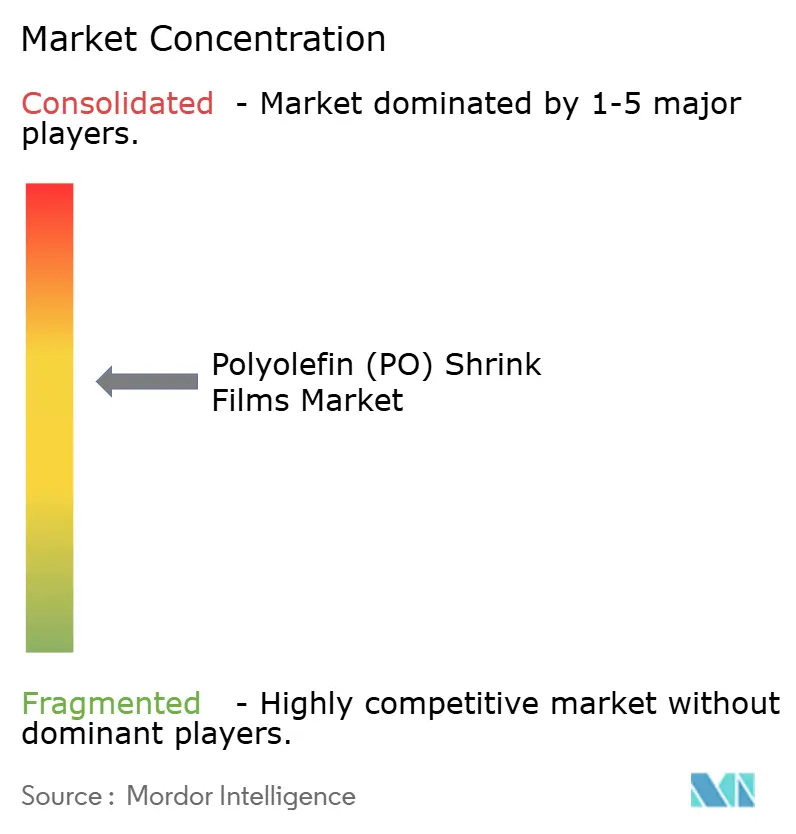
The polyolefin shrink film market is moderately consolidated, with the top five players holding less than 50% market share. Key players like Berry Global, Sealed Air, and Klockner Pentaplast integrate extrusion and in-house printing to offer turnkey solutions, emphasizing sustainability through initiatives like Berry's closed-loop pilot. Intertape Polymer Group focuses on PCR content and service networks, while UFlex expands CPP and biaxially oriented polyolefin capacity. Asian competitors leverage local resin but face certification challenges. Strategic alliances in recycled feedstock, co-extrusion, and digital printing are growing. Converters secure resin supplies to manage volatility, and OEMs innovate oven designs for thinner gauges. Success increasingly depends on balancing cost efficiency with sustainability credentials.
Polyolefin (PO) Shrink Films Industry Leaders
Berry Global Inc.
Sigma Plastics Group
SABIC
Bollore Group
IPG
- *Disclaimer: Major Players sorted in no particular order
Polyolefin (PO) Shrink Films Market Companies Covered in this Report
- Allen Plastic Industries Co., Ltd.
- Berry Global Inc.
- Bolloré Group
- Bonset America Corporation
- Clysar, LLC
- Cosmo Films
- Coveris
- FlexiPack
- Innovia Films
- IPG
- Harwal Group of Companies
- Hubei HYF Packaging Co., Ltd.
- Kaneka Corporation
- Klockner Pentaplast
- Polyplex Corporation
- SABIC
- Sealed Air Corporation
- Sigma Plastics Group
- SYFAN USA
- Traco Packaging
- Winpak Ltd.

Market Opportunities and Future Outlook
Sustainability-driven reformulation and qualification work is creating whitespace for shrink films that combine recyclability with measurable recycled content while maintaining optical and mechanical performance. Recent company actions reflect that shift. In January 2026, PAC Machinery launched ReviveWrap with up to 30% certified pre-consumer recycled resin. In February 2026, NOVA Chemicals commercialized SYNDIGO rPE-IN3 and rPE-IN4 recycled polyethylene grades for shrink film and other flexible packaging applications, coming from its Connersville, Indiana facility. Together, these steps expand the options available to converters addressing retailer and brand requirements for tamper evidence, clarity, and downgauging, while improving circularity credentials.
A second opportunity track involves scaling pathways that increase the supply of high-quality recycled PE for film-to-film applications and aligning material platforms with policy pressure behind the PVC-to-polyolefin substitution. In February 2026, OSTI.GOV published work on the STRAP process for recycling post-consumer shrink wrap into high-quality polyethylene films, highlighting continued investment in advanced recycling routes that manage contamination and property retention challenges in post-consumer flexibles. Policy momentum in Europe also reinforces chlorine-free packaging choices, which supports polyolefin-based shrink structures where converters can document recyclability and recycled-content performance for overwrap and bundling use cases.
Recent Industry Developments in Polyolefin (PO) Shrink Films Market
- March 2026: NOVA Chemicals delivered the first order of its SYNDIGO rPE-IN3 recycled polyethylene to Sigma Plastics Group in Shelbyville, Kentucky, for use in Sigma's Sustain360 PCR stretch film line. The qualification and supply of recycled PE designed for film applications helps broaden access to recycled-content feedstock and supports converters standardizing formulations across shrink and stretch film portfolios.
- February 2026: Amcor announced the combination with Berry Global, forming a broader North American polyethylene shrink and overwrap portfolio with integrated manufacturing and print capabilities. The consolidation increases scale and can simplify supplier qualification and national account coverage for brand owners that source shrink film, printed overwrap, and related packaging services across multiple sites.
- August 2024: SABIC collaborated with Lamb Weston and Opackgroup to launch frozen potato product packaging using bio-renewable SABIC polyethylene and reported a 30% lower carbon footprint for the packaging solution. The introduction of bio-based polyolefin feedstock into commercial flexible packaging programs strengthens the set of options available for shrink and overwrap applications pursuing lower-carbon material footprints.


Polyolefin (PO) Shrink Films Market Report Scope and Research Methodology
Market Definition and Coverage
This market covers polyolefin shrink films made mainly from polyethylene and polypropylene that shrink under heat to wrap, bundle, or protect products in transit and on shelf. The value includes film sold as rolls and pre-formed formats used across common packaging uses.
Scope exclusions: We exclude stretch wrapping films, PVC shrink sleeves, barrier liners, and collation stretch hoods when sizing this market.
Segments Covered in This Report
- By Type
- General Shrink Film
- Cross-Linked Shrink Film
- By Material Type
- Polyethylene (PE)
- Polypropylene (PP)
- By Layer Structure
- Monolayer
- Multilayer
- By Application
- Food & Beverage
- Industrial Packaging
- Personal Care & Cosmetics
- Pharmaceutical
- Printing & Stationery
- Other Applications
- By Geography
- Asia-Pacific
- China
- India
- Japan
- South Korea
- Rest of Asia-Pacific
- North America
- United States
- Canada
- Mexico
- Europe
- Germany
- United Kingdom
- Italy
- France
- Rest of Europe
- South America
- Brazil
- Argentina
- Rest of South America
- Middle East and Africa
- Saudi Arabia
- South Africa
- Rest of Middle East and Africa
- Asia-Pacific
Data Sources, Market Sizing, and Validation
Desk Research
Desk research was used to build the initial demand and supply picture, and to set realistic boundaries around shrink film versus adjacent film types. We relied on public sources such as UN Comtrade trade statistics, the US International Trade Commission data portal, Eurostat, and national statistical offices for packaging and polymer related indicators. For resin context and upstream linkages, we also reviewed sources such as the International Energy Agency and US Energy Information Administration where relevant, to reflect feedstock and energy driven cost movement.
In parallel, we reviewed company annual reports, investor presentations, product catalogs, and updates from packaging associations and trade publications to understand where shrink films are being adopted and how film specifications are changing. We also used a paid subscription covering company financials and another paid dataset focused on shipment level import and export signals to cross-check directional volume movement and company exposure where public disclosure was thin. The sources listed here are illustrative and not exhaustive, and additional public materials were consulted to collect data, validate assumptions, and clarify open questions.
Primary Interviews and Surveys
Primary work was used to validate the split between general and cross-linked shrink films, typical thickness and yield assumptions, and how pricing moves with resin and energy costs. We spoke with a mix of film producers, converters, distributors, and packaging buyers to stress-test the desk research assumptions, and we ensured coverage across APAC, EMEA, and the Americas so regional packaging mix differences were not averaged out too early.
Distribution of primary research fieldwork respondents
| Company type | Respondent position | Region |
|---|---|---|
| Top tier: 35% | CXOs: 14% | APAC: 41% |
| Mid tier: 45% | Functional/Unit leaders: 29% | EMEA: 35% |
| Smaller Players: 20% | Managers: 57% | Americas: 24% |
Market-Sizing & Forecasting
The market size is built using a top-down and bottom-up blend. First, we reconstruct packaging film demand from end-use packaging activity, then filter to the portion that uses polyolefin shrink films. In practice, we link demand to indicators such as packaged food and beverage output, consumer goods shipment activity, pharmaceutical packaging volumes, and regional manufacturing and export activity that drives bundling and protective wrap needs. Pricing is modeled using an ASP logic that follows resin cost movement, typical conversion spreads, and mix shifts between standard and cross-linked film, and then applied to the implied volume pool.
To keep totals realistic, results are corroborated with selective bottom-up checks such as sampled producer capacity and utilization signals, distributor channel checks, and a volume-times-ASP sanity test for a few high-consumption applications. Where direct visibility is limited in smaller markets, we fill gaps through regional proxy ratios, including packaging output per capita and trade intensity, and then re-check implied per-user film consumption with interview feedback. Forecasting uses scenario analysis anchored to expected changes in packaged goods output, lightweighting trends, adoption of recyclable polyolefin packaging structures, and the pace of industrial and e-commerce logistics activity. The scenarios are then reviewed with industry participants before finalizing the curve.
Data Validation & Update Cycle
Model outputs are compared against independent signals such as resin price direction versus film ASP movement, regional trade flows for relevant film categories, and the pace of packaged goods production growth. When large variances show up, we re-check the underlying assumptions, trace outliers back to a specific input, and run follow-up calls to confirm whether a structural change is real or only a short-term shock.
Before sign-off, the work is reviewed in steps so calculations, units, and currency conversion timing are consistent across regions and years. Reports are refreshed annually, and interim updates are made when material events occur, such as sharp resin price swings, policy shifts affecting packaging, or meaningful capacity additions. Right before delivery, a fresh analyst pass is done so clients receive the latest updated view rather than an older snapshot.
Mordor Intelligence's Polyolefin Shrink Films Market Size Compared With Other Published Estimates
It is normal to see different market values for polyolefin shrink films because publishers do not always line up on the same year, the same product boundaries, and the same way they treat pricing over time. The gaps usually show up when one estimate is built from a different demand pool, or when currency conversion and inflation assumptions are applied at different points in the model.
In fast-moving resin cycles, the timing of annual average pricing and the currency timestamp can shift the final USD value, especially when cross-linked film mix changes in parallel. Those refresh-led checks, including reconciliation against packaging output and trade direction, are a key reason the 2026 number published by Mordor Intelligence does not exactly match estimates anchored in 2024.
Benchmark comparison
| Source | Market Size | Gaps in Research Methodology |
|---|---|---|
| Mordor Intelligence | USD 8.55 B (2026) | |
| Global Consultancy A | USD 8.77 B (2024) | Uses a 2023 base with a 2024 estimate and a 2030 horizon, which can carry forward a different resin price deck and end-use weight set than a later-year refresh. |
| Industry Data Publisher B | USD 8.94 B (2024) | Anchors sizing in 2024 and applies a 2025-2032 window, which can embed different application coverage and a different currency conversion timestamp for the same nominal year. |
Looking across the table, most of the spread is explained by year selection and how ASP movement is carried forward from resin cost changes, rather than a disagreement that shrink films are growing. By tying the value build to visible packaging activity, checking implied volumes with industry feedback, and keeping currency timing consistent by year, the final number stays traceable to clear steps that can be repeated.


Key Questions Answered in the Report
What is driving the fastest growth segment in the polyolefin shrink film market?
The pharmaceutical segment leads with an 8.47% CAGR to 2031 as stricter tamper-evidence rules and demand for barcode visibility boost adoption of high-clarity, security-grade films.
Which region offers the highest expansion opportunity?
Asia Pacific accounted 37.60% share in 2025, and will leads with a 6.82% CAGR from 2026-2031, powered by e-commerce, industrialization and capacity additions in China and India.
How are converters addressing sustainability pressures?
Leading firms integrate PCR resin, develop recyclable mono-material multilayers and partner with retailers on store-drop-off schemes to align with EU waste-reduction targets.
Why are cross-linked polyolefin films gaining popularity?
They deliver puncture resistance and allow faster, lower-temperature sealing, which cuts energy use and supports high-speed automation lines in industries such as electronics and pharmaceuticals.
What impact do European plastic taxes have on film demand?
Levies on single-use over-wrap accelerate the shift from PVC to recyclable polyolefin grades and push converters to certify films that exceed 30% recycled content thresholds.
How are resin price fluctuations mitigated?
Producers diversify feedstock sources, negotiate shorter contracts and redesign formulations to use less virgin material, buffering the -0.8% CAGR impact attributed to volatility.
What is the current market size of polyolefin shrink films market?
The Polyolefin Shrink Films Market size is estimated at USD 8.55 billion in 2026, and is expected to reach USD 10.8 billion by 2031, at a CAGR of 4.79% during the forecast period (2026-2031).
Page last updated on:


 Your data is secure and never sold or shared.


