Walk any retailer’s kids’ helmet aisle and every model carries the same sticker showing it meets bicycle helmet standards, “CPSC certified” in the US or “EN 1078” in Europe. The entry-level helmet has one. So does the premium model priced several tiers above it.
For years, that sticker has been enough to get a kids’ helmet sourced, listed and sold. All it proves is that the helmet passed a minimum test. Think of an exam where the student who scraped through and the one who topped the class walk away with the same certificate. A category buyer comparing two suppliers, or a brand trying to justify a higher price, gets no help from it at all.
That’s starting to change. A few independent schemes already test kids’ helmets beyond that minimum, including Folksam’s assessments in Sweden, the government-run Helmet STAR ratings in Australia and Consumer Reports’ lab tests in the US. Virginia Tech, whose ratings shape the adult helmet business, is now building youth ratings of its own. As those comparisons spread, the brands, suppliers and retailers behind children’s helmets will be judged on how their helmets perform as well as whether they passed.
Executive Summary
Bicycle helmet safety standards are about to get tougher. Europe is adding a rotational-impact test to EN 1078, and the lab behind the best-known helmet ratings is building a version for kids. US recall data complicates things further. Most recent children’s helmet recalls came down to fit, which no sticker measures.
Our view is that certification is about to become the bare minimum buyers expect, and brands will lose it as a selling point. Brands, suppliers and retailers that build real test evidence for their kids’ range over the next 18 months will be in a far stronger position once helmets start being compared. Everyone else will be responding to scores somebody else published.
Key Takeaways
- A “CPSC certified” or “EN 1078” sticker means a helmet passed a minimum test. It says nothing about how that helmet performs against others on the shelf.
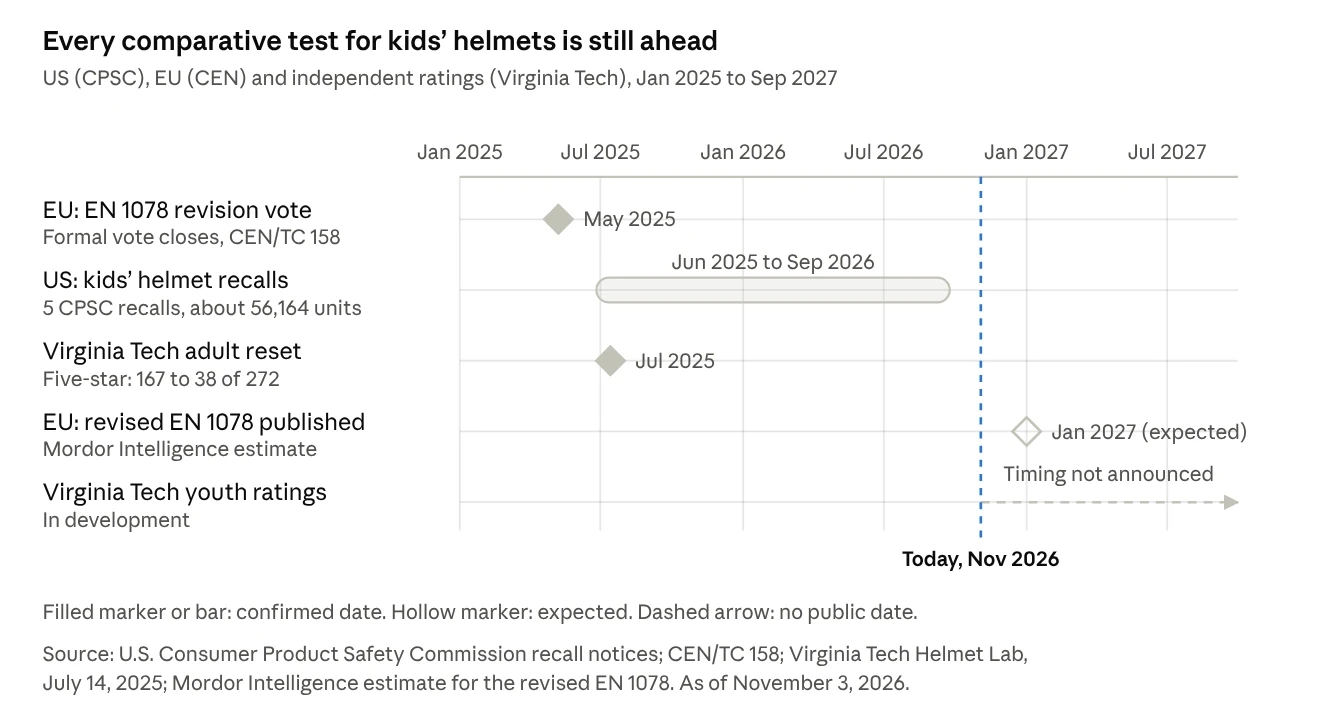
- The revised EN 1078 adds a rotational-impact test, and Mordor Intelligence expects it to be published around January 2027.
- Four of the five US recalls of children’s bike helmets between June 2025 and September 2026 cited fit or retention failures.
- Brands, suppliers and retailers that start collecting real performance data now will be ready when helmets are compared side by side.
The Adult Helmet World Already Showed Where This Goes
The adult helmet world has already been through this. When Virginia Tech started rating adult bike helmets in 2018, only 4 of the 30 it tested earned five stars. Brands designed to the test, and it worked. By 2025, 167 of the 272 helmets it had rated were five-star.
With most tested helmets sitting at five stars, the ratings had stopped telling buyers much. So on July 14, 2025, the lab raised its thresholds, and the five-star list shrank to 38.
Those scores carry commercial weight. According to Mordor Intelligence’s cycling helmet research, Virginia Tech’s ratings influence both retail placement and consumer purchasing decisions across the category.
Kids’ helmets are much earlier in that journey. Some schemes already test them, but none yet carries the commercial weight Virginia Tech’s scores have with adult helmets. Every kids’ helmet on the shelf is already certified, so once youth ratings arrive, buyers will start asking how one compares with another, and a certificate has nothing to say about that.
What Bicycle Helmet Certification Standards Actually Tell You
CPSC 1203 in the US
Every bike helmet sold in the US and made since March 10, 1999, has had to meet a federal rule, 16 CFR 1203, usually shortened to CPSC 1203. Manufacturers and importers certify that their helmets pass it, and the label inside says so.
EN 1078 in Europe
In the EU, cycling helmets are certified to EN 1078:2012 to show they meet the Personal Protective Equipment Regulation (EU) 2016/425. That’s why you’ll usually see the CE mark printed next to the standard number.
The tests behind both are broadly similar. A lab drops the helmet onto a hard surface and measures how much of the blow reaches the head, then checks that the straps hold, that the helmet doesn’t roll off, and that it covers enough of the skull.
What the Sticker Can’t Tell You
- How much margin there is. A helmet that clears the impact limit comfortably and one that barely scrapes past get the same sticker.
- How it handles an angled fall. Children rarely fall straight down. When a head hits the ground at an angle it twists, and that twisting is what independent raters use to estimate concussion risk. Neither the US rule nor the current EU standard measures it.
So when a product page describes a kids’ helmet as “safety-rated,” it almost always means certified, which is simply the legal minimum for being on sale at all.
Two Changes Coming to Bicycle Helmet Standards and Ratings
Neither of the next two changes has a confirmed date, but both are well underway.
The Revised EN 1078 and Rotational-Impact Testing
The revised EN 1078 adds a pass/fail test for rotational impact, the twisting described above, on top of the straight-drop tests in use since 2012. The formal vote on the new standard closed on May 8, 2025, and Mordor Intelligence expects it to be published around January 2027, though that timing is still provisional.
EN standards are technically voluntary. The legal requirement is the PPE Regulation, and a new standard becomes the accepted route to meeting it once it’s cited in the EU’s Official Journal, usually with a transition period before the old edition is withdrawn.
What Is MIPS, and Where Does It Fit?
You’ll often see MIPS mentioned in the same breath. It’s the best-known of several liner systems built into helmets to reduce rotational forces in an angled impact, and brands license it from the Swedish company behind it. Because it’s a design feature, a helmet with MIPS still has to be certified, and the revised EN 1078 will test how the finished helmet performs whichever system a brand uses.
EN 1080 and Young Children’s Helmets
EN 1080 is the European standard for helmets worn by young children. Its buckle is designed to release under load, which reduces the risk of strangulation if a helmet catches on play equipment. A matching revision is following the new EN 1078, using the same angled-impact test headforms.
Virginia Tech’s Youth Bike Helmet Ratings
Virginia Tech’s Helmet Lab is developing youth bike helmet ratings, with release expected around spring 2028. That timetable is provisional and hasn’t been announced publicly. Once those ratings exist, buyers will be able to compare tested helmets directly, with no change in the law required.
Sources: U.S. CPSC recall notices; CEN/TC 158; Virginia Tech Helmet Lab memorandum, July 14, 2025; Mordor Intelligence estimate for revised EN 1078 · as of November 3, 2026
Most of what will separate one kids’ helmet from another falls to the right of today’s line, so preparation has to start well before those dates.
Most Kids’ Helmet Recalls Come Down to Fit
Recall data shows where kids’ helmets go wrong in real life. Between June 2025 and September 2026, the US Consumer Product Safety Commission (CPSC) announced five recalls of children’s bike helmets, covering about 56,164 units.
In August 2025, CPSC also issued a separate warning covering about 19,100 Wisekiddy helmets after the seller declined to agree to a recall.
The biggest, Bell Sports’ 31,200 units in June 2025, failed the impact test (that recall also covered two adult models). The other four all failed on fit, with helmets that wouldn’t stay in place or straps and buckles that didn’t hold. Two of those failed impact as well.
Source: U.S. Consumer Product Safety Commission recall notices 25-359, 26-122, 26-239, 26-749 and 26-789 · US market, June 26, 2025 to September 24, 2026
Where the Helmet Retention System Fails
Four of the five recalls cited positional stability, meaning the helmet could roll off the head in testing. Two cited the retention system itself, the chin strap and buckle that hold the helmet in place. Both are fit failures, and neither shows up on a certification sticker.
All five sold for USD 36 or less, mostly through Amazon and Walmart. And this isn’t only a kids’ problem. In February 2026, Todson recalled 40,245 adult-size Concord light-up helmets, sold at Walmart for about USD 30, for the same kind of strap and stability failures.
Why Bike Helmet Fit Matters More for Children
Fit matters even more for kids because their heads keep growing. A helmet that fit snugly in spring can sit loose by autumn if the adjustment system isn’t good enough. If it slides back in a fall, the forehead is exposed, however good the foam is. Think of a seatbelt nobody bothered to tighten.
It shows up at the checkout too. As per Mordor Intelligence’s cycling helmet research, youth helmets have a high return rate, driven mainly by sizing, and it’s worst when parents buy without the child there to try one on.
Certification tests and most rating schemes focus on impact protection. How well a helmet fits a growing child, and how easily it adjusts as they grow, gets far less attention. Brands that measure and publish fit performance will have something most competitors can’t show.
Three Ways the Next 18 Months Could Play Out
Nobody knows yet which of these will happen first, so a good plan should work in all three.
Three scenarios for kids’ helmet safety requirements, US and EU, November 2026 to May 2028
| Scenario 1: EU recognition first | Scenario 2: Ratings first | Scenario 3: Neither milestone arrives | |
| What happens | The revised EN 1078 is published and cited under the PPE Regulation before Virginia Tech releases youth ratings | Virginia Tech releases youth ratings before the revised standard is cited in the EU |
Neither EU citation of the revised standard nor Virginia Tech’s youth ratings arrive by May 2028
|
| What changes for you | Review the cited requirements, their scope and any transition period with your conformity-assessment partner | Tested models become publicly comparable, creating commercial pressure without any change in the law |
Existing compliance obligations stay the same, and neither milestone adds immediate pressure
|
| Your posture | Measure rotational performance early and plan any product, testing and documentation updates | Have product-specific test evidence and a clear explanation of performance ready before the ratings come out |
Use the extra time to improve fit, validate protection and build a credible evidence base
|
Source: Mordor Intelligence analysis. Scenario timing reflects Mordor Intelligence estimates as of November 2026. None of these dates has been officially announced.
Planning Your 2027 to 2028 Range?
If you want to know how your helmets would compare once rotational tests and youth ratings arrive, our research team can benchmark your range, and your suppliers’ test evidence, against competitors.
Talk to an analyst.
What Each Group Should Do Now
A kids’ helmet passes through a lot of hands before it reaches a child, and each of them carries a different risk.
Helmet and Kids’ Bike Brands
Prepare for independent scrutiny of your safety claims. Work with a qualified bicycle helmet testing laboratory to assess rotational-impact performance across your current range, using EN 17950:2024 where it suits the helmet sizes and the assessment you need. Treat the results as development evidence, since there’s no published future standard to prove compliance against yet. Then check that every safety claim on your packaging reflects the testing, certification or rating actually behind it.
Sourcing Teams and OEM or ODM Suppliers
A certificate shows that one sample passed once. It says nothing about the next production lot. Ask suppliers for measured test results, write lot-by-lot retesting into your 2027 contracts, and pay particular attention to straps and buckles, since that’s where most of the recent recalls failed.
Retailers and Marketplaces
Every recall above went through a major retailer or marketplace, and the news coverage named them. Asking suppliers for impact and strap test results, on top of the certificate, costs a great deal less than handling a recall.
Advisors, Investors and Analysts
Treat “certified” as the floor. Once the gap between merely compliant and genuinely good helmets becomes visible, brands holding real performance data should gain ground across sports protective equipment more broadly. It’s worth factoring in before your next category review or due-diligence call.
Where This Leaves You
For more than 25 years, certification has been enough to get a kids’ helmet onto the shelf. Once helmets start getting compared, it won’t be enough to stand out. The next 18 months are a good window to build that evidence yourself, before a new standard or a rating body does the comparing for you.
What Could Change This
The EU timing could slip again. The revised EN 1078 cleared its vote in May 2025 and still hadn’t been published by November 2026. A long delay, with youth ratings also on hold, would ease the pressure, though the overall direction would stay the same. The two things to watch are the EN 1078 publication and any announcement from Virginia Tech on youth ratings.
The Next Layer of Intelligence
The helmet story also raises a wider question about what happens to kids’ products once their performance can be compared. Mordor Intelligence’s cycling helmet coverage tracks how rotational-impact technology is moving into mid-priced helmets and how ratings are shaping retail placement. It sits alongside our research on the kids’ bicycle and e-bike categories these helmets are sold with, so you have hard numbers to plan around as the gap between certified and genuinely safer helmets starts to show.
Go Deeper
Explore our Cycling Helmet Market report for a closer look at how safety technology, sales channels and regional rules are changing the category.