
Kid's Bicycle Market Size and Share
Market Overview
| Study Period | 2022 - 2032 |
|---|---|
| Market Size (2027) | USD 6.90 Billion |
| Market Size (2032) | USD 9.03 Billion |
| Growth Rate (2027 - 2032) | 5.52 % |
| Fastest Growing Market | Asia-Pacific |
| Largest Market | North America |
| Market Concentration | Low |
Major Players *Disclaimer: Major Players sorted in no particular order Image © Mordor Intelligence. Reuse requires attribution under CC BY 4.0. | |
Kid's Bicycle Market Analysis by Mordor Intelligence
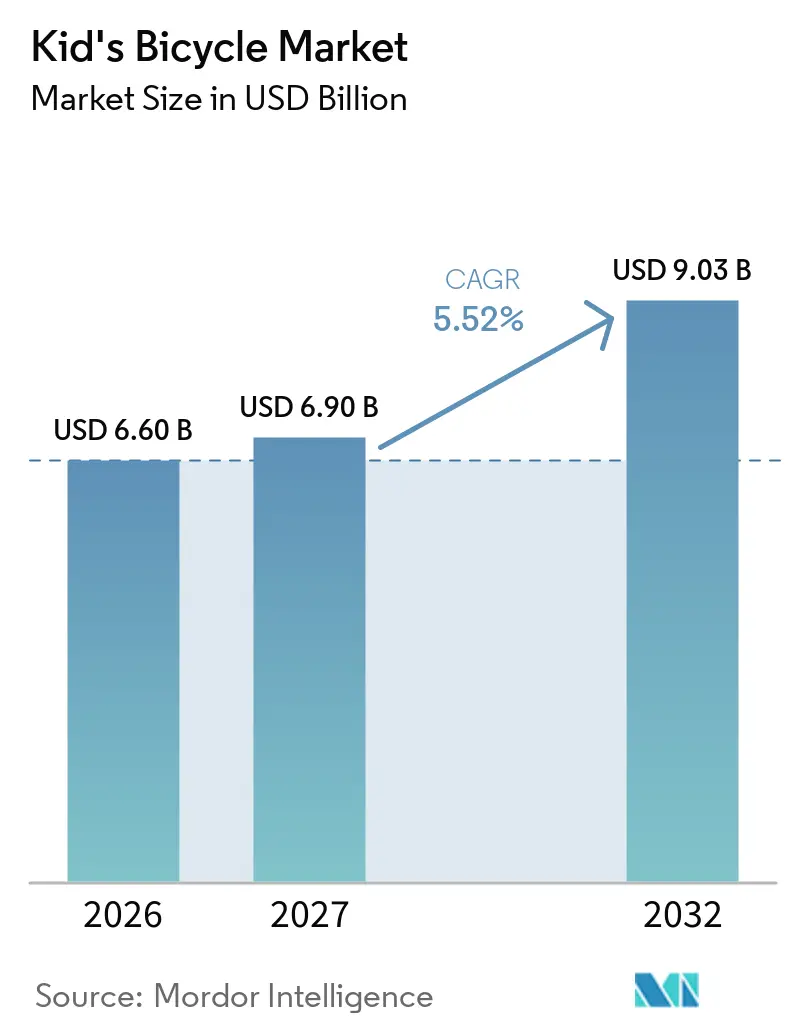
The Kid's Bicycle Market size was valued at USD 6.6 billion in 2026 and is projected to expand from USD 6.9 billion in 2027 to USD 9.03 billion by 2032, is projected to grow at a CAGR of 5.52% between 2027 and 2032. Demand is supported by parents who treat cycling as part of a child’s physical development rather than only as a seasonal purchase. The Centers for Disease Control and Prevention recommends 60 minutes of daily moderate-to-vigorous activity for children aged 6-17, and includes cycling among qualifying aerobic activities. Evidence on active mobility also links regular cycling with stronger well-being among children. The Kid's Bicycle Market also benefits when safe routes, training, and retail access make cycling easier for families. Competition remains fragmented, so product design, direct relationships with families, and age-based replacement purchases shape commercial outcomes.
Key Report Takeaways
- By bicycle type, conventional bicycles held 98.7% of the Kid's Bicycle Market share in 2026, while e-bikes recorded the highest projected CAGR at 6.4% through 2032.
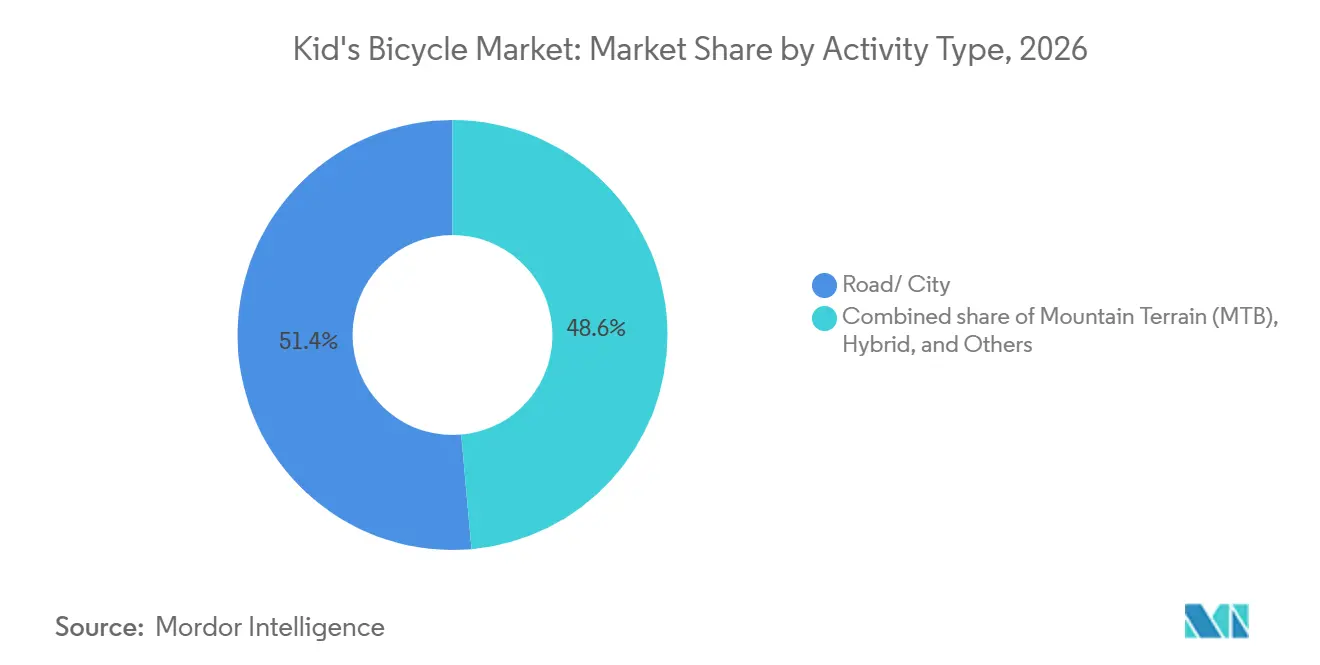
- By activity type, road/city bikes held 51.4% of the Kid's Bicycle Market share in 2026, while hybrid bikes recorded the highest projected CAGR at 7.2% through 2032.
- By mode of operation, pedal bicycles held 86.7% of the Kid's Bicycle Market share in 2026, while balance bicycles recorded the highest projected CAGR at 7.5% through 2032.
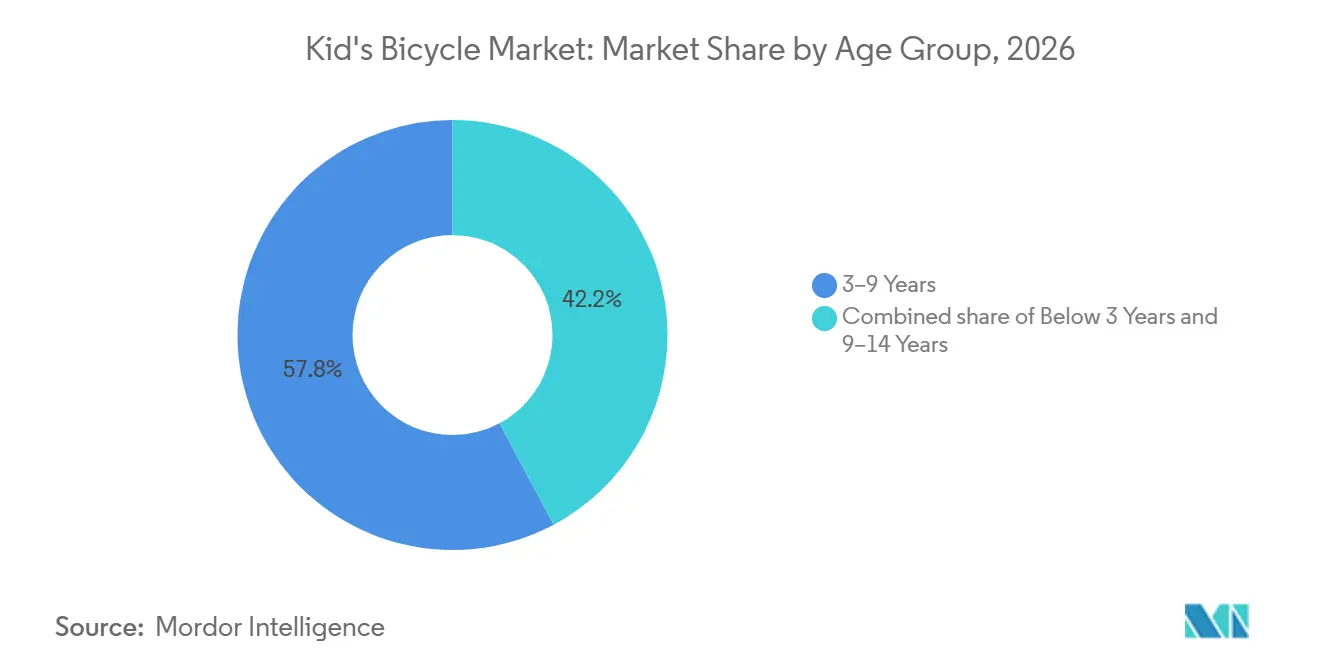
- By age group, children aged 3-9 years held 57.8% share in 2026, while the below-3 years segment recorded the highest projected CAGR at 6.3% through 2032.
- By end user, unisex bicycles held 80.2% share in 2026, while the girls’ segment recorded the highest projected CAGR at 6.8% through 2032.
- By distribution channel, offline channels held 76.3% share in 2026, while online channels recorded the highest projected CAGR at 7.7% through 2032.
- By geography, North America held 38.9% share in 2026, while Asia-Pacific recorded the highest projected CAGR at 7.1% through 2032.
Note: Market numbers in this report are based on Mordor Intelligence's proprietary estimation framework, which combines nine months of actuals with Q4 projections for base year 2026.
Market Trends and Insights
Drivers Impact Analysis of Kid's Bicycle Market*
| Driver | (~) % Impact on CAGR Forecast | Geographic Relevance | Impact Timeline |
|---|---|---|---|
| Rising Parental Focus on Children’s Health and Fitness | +1.2% | Global | Medium term (2–4 years) |
| Expansion of Cycling Infrastructure and Safe Routes | +0.9% | North America and Europe; spill-over to Asia-Pacific | Long term (≥ 4 years) |
| Customization and Personalization Trends | +0.6% | Global; early gains in North America, Europe, East Asia | Medium term (2–4 years) |
| Influence of Social Media, Parenting Forums, and Peer Trends | +0.5% | Global; concentrated in urban markets | Short term (≤ 2 years) |
| Advancements in Bicycle Safety Technology | +0.7% | North America, Europe, East Asia | Medium term (2–4 years) |
| Expansion of E-Commerce And Direct-To-Consumer Channels | +0.8% | Global | Short term (≤ 2 years) |
| Source: Mordor Intelligence | |||
Rising Parental Focus on Children’s Health and Fitness
Health and fitness considerations give parents a practical reason to purchase bicycles as children grow. The CDC identifies cycling as an aerobic activity that can help children aged 6-17 meet recommended daily activity levels[1]. A 2025 position statement on active outdoor play also associated outdoor activity with lower sedentary behavior and better sleep outcomes. Bikeability training in Oxfordshire reached more than 7,000 children by October 2025. A cohort study found that Bikeability participants reported stronger well-being and more sustained active travel than those without training. These programs can turn parental concern about activity levels into a reason to buy an appropriately sized bicycle and later replace it.
Expansion of Cycling Infrastructure and Safe Routes
Infrastructure helps families use bicycles more often and can support repeat replacement demand in the Kid's Bicycle Market. The United Kingdom committed nearly GBP 300 million to walking, wheeling, and cycling programs in February 2025, including safer routes near schools. The European Commission reported EUR 4.5 billion in cycling investment for 2021-2027 and more than 12,000 km of new cycling paths across member states[2]. Colorado awarded nearly USD 8 million for Safe Routes to School projects in fiscal 2025/2026. Santa Barbara County also approved USD 4.3 million for bicycle, pedestrian, and safe-route projects in July 2025. Safer routes and structured training reduce a key concern for caregivers and make regular use more feasible after the initial purchase.
Customization and Personalization Trends
Customization gives brands a way to offer choice without maintaining separate gender-based product lines. woom refreshed its GO range in March 2025 with mix-and-match frame, helmet, and accessory colors across four size grades for children aged 1.5-8 years. The approach allows a family to select a bicycle that feels personal while keeping a common product platform. Accessories can also extend the customer relationship after the bicycle sale. A coordinated color system can make it easier for a household to continue with the same brand when the child needs a larger size. This factor supports the Kid's Bicycle Market because replacement decisions are made repeatedly as children develop.
Expansion of E-Commerce and Direct-to-Consumer Channels
Online channels are projected to grow at a 7.7% CAGR, the highest rate among the reported segmentation types. woom reported 101% growth in direct-to-consumer revenue in Northern Europe and 120% growth in the UK during 2025. The company’s April 2026 woom Exchange marketplace added authenticated resale listings for pre-owned bicycles. Direct retail gives manufacturers access to families that may not be served by a local specialist dealer. It also provides a channel for service information, accessories, and a later size upgrade. The resale model can widen access for budget-conscious families while preserving a brand relationship across more than one purchase cycle.
Restraints Impact Analysis of Kid's Bicycle Market*
| Restraint | (~) % Impact on CAGR Forecast | Geographic Relevance | Impact Timeline |
|---|---|---|---|
| Seasonal Demand Fluctuations | -0.4% | Global, pronounced in temperate North America and Europe | Short term (≤ 2 years) |
| Regulatory Compliance and Safety Standards | -0.5% | Global | Medium term (2-4 years) |
| Competition from Digital Entertainment Devices | -0.6% | Global, most acute in urban North America, Europe, and East Asia | Short term (≤ 2 years) |
| Short Product Lifecycle Due to Rapid Growth | -0.3% | Global | Long term (≥ 4 years) |
| Source: Mordor Intelligence | |||
Seasonal Demand Fluctuations
Sales are concentrated in spring and the pre-holiday period in many temperate markets. This pattern requires manufacturers and retailers to commit to inventory before they have confirmed in-season demand. Independent dealers may face greater markdown pressure because their capacity to hold a broad inventory is more limited. The seasonal pattern also makes off-peak introductions harder because new products need time for customers to understand their benefits. Southeast Asia and some Middle Eastern markets face less weather-driven compression because cycling can take place through more of the year. These differences help explain why the Kid's Bicycle Market has varied demand conditions across geographies.
Competition from Digital Entertainment Devices
Screen time competes directly with time available for outdoor activity and family cycling. A CDC study found that 50.4% of United States (U.S.) teenagers reported at least 4 hours of daily screen time in 2025. The same study found infrequent physical activity among 45.6% of high-screen-time teenagers, compared with 32.1% of low-screen-time peers. OECD analysis similarly noted that digital activity can affect physical development when it replaces active outdoor leisure. Manufacturers are responding with products that incorporate features such as tracking and app-linked progress monitoring, although these additions can raise cost and complexity. The restraint is strongest where families must actively choose cycling over readily available digital entertainment.
*Our forecasts treat driver/restraint impacts as directional, not additive. The impact forecasts reflect baseline growth, mix effects, and variable interactions.
Kid's Bicycle Market Segment Analysis
By Bicycle Type:
Conventional Models Underpin Volume, E-Bikes Build a New Use CaseConventional bicycles accounted for 98.7% of the Kid's Bicycle Market share in 2026, making them the core format across age groups and price points. Their broad use in neighborhood riding, school travel, and family recreation supports demand across retail formats. woom updated its GO models in 2025 with revised geometry, lightweight construction, and coordinated colors. The product refresh shows that established pedal formats still receive design investment. Children commonly need a new frame as they grow, which creates a recurring replacement cycle. Conventional models also remain the least complex choice for parents who value familiar operation and straightforward maintenance.
E-bikes are forecast to grow at a 6.4% CAGR through 2032 within the Kid's Bicycle Market. Their appeal is strongest among older children who need assistance over longer distances or more demanding terrain. woom introduced its EXPLORE e-bike in 2025 and identified children’s e-mobility as a priority for 2026. The American College of Surgeons called in June 2025 for age, speed, and helmet policies that reflect local conditions for children using e-bikes. Those safety expectations can increase compliance work for brands. They can also give parents clearer criteria for considering e-bikes for older riders.
By Activity Type:
Road/City Bikes Support Everyday Riding, Hybrids Add FlexibilityRoad/city bikes represented 51.4% of the Kid's Bicycle Market share by activity type in 2026. Their position reflects practical uses such as school travel, urban recreation, and family rides. More than 16,000 children took part in cycle training in Wales during 2024-25. School-route programs favor bicycles that perform reliably on paved streets and everyday routes. Mountain terrain products serve a narrower group of older children seeking off-road capability. Other formats continue to draw demand around gifting occasions and specialist interests.
Hybrid bikes are forecast to expand at a 7.2% CAGR through 2032. They address parents who want one bicycle for school runs, family rides, and light trail use. Frog Bikes introduced its road and gravel range in September 2025 for children aged 5-13, with 20-inch, 24-inch, and 26-inch wheel options. The range supports a product progression as children gain confidence and need larger frames. Hybrid designs may reduce the need for separate purchases across activity settings. This makes versatility a meaningful purchase factor in the Kid's Bicycle Market.

By Mode of Operation:
Pedal Bikes Lead, Balance Bikes Extend the Entry AgePedal bicycles accounted for 86.7% of the Kid's Bicycle Market share by mode of operation in 2026. They are the primary format for children aged 3-14 and are supported by public health guidance on activity. Australia’s health department includes cycling within moderate-to-vigorous activity for children aged 5-17. Manufacturers use lighter frames, improved braking systems, and size-specific geometry to maintain value across this large base. Pedal products serve mass-market buyers while also supporting premium sales. The broad age range helps make this format the base of most children’s bicycle portfolios.
Balance bicycles are projected to grow at a 7.5% CAGR through 2032. This growth is tied to products designed for children below 3 years old. woom launched the WOW self-balancing bike in October 2025 for children from 9 months, with input from pediatricians and developmental psychologists. Syensqo and woom introduced circular polymers with 98% recycled content for WOW frame components in May 2026. Syensqo stated that the material can lower the component carbon footprint by up to 72% compared with conventional materials. These products broaden the category from a first bicycle purchase into early developmental mobility.
By Age Group:
Children Aged 3-9 Years Drive Volume, Younger Riders Broaden DemandThe 3-9 years group held 57.8% of the Kids Bicycle Market share in 2026. Children in this range commonly progress from a balance bicycle to a pedal bike and then to larger or geared models. That sequence can create several separate purchases over a relatively short period. Bikeability’s focus on school-age children supports cycling habits during this phase. Product planning therefore depends on clear size steps and a practical transition between models. The 9-14 years group tends to carry higher average selling prices because it requires more advanced components and larger frames.
The below-3 years group is forecast to grow at a 6.3% CAGR through 2032. Developmental mobility products are bringing younger children into the customer base. The WOW illustrates the overlap between a developmental toy and an entry-level cycling product. Brands serving this group must address very low weight, age-appropriate safety requirements, and sales through baby-focused retailers. woom expanded its presence in specialist baby retail during 2025. The earlier entry point can give brands a chance to establish family loyalty before the higher-value pedal bike purchase.
By End User:
Unisex Designs Dominate, Girls’ Products Gain AttentionUnisex products held 80.2% share in 2026, reflecting a shift toward neutral platforms rather than parallel gender-specific designs. A common platform reduces design duplication and inventory complexity across frame sizes. The Kid's Bicycle Market also uses coordinated colors and accessories to provide choice without defining the product by gender. woom’s 2025 GO relaunch used a mix-and-match system for frames, helmets, and accessories. This supports personalization while retaining a consistent design language. For retailers, a unisex assortment can simplify stock management across age and size ranges.
The girls’ segment is forecast to grow at a 6.8% CAGR through 2032. Targeted activity promotion and parental interest in outdoor participation support demand in this segment. Tandem Group announced an exclusive partnership with Sir Chris Hoy in 2025 for a lightweight junior bike range. Athlete-led partnerships can increase interest in cycling among children and families. Product promotion needs to encourage participation without limiting the range of styles available to riders. This is consistent with the broader move toward flexible, inclusive product choices.
By Distribution Channel:
Offline Retail Remains Important, Online Sales Grow FasterOffline channels accounted for 76.3% share in 2026 because many parents want to check size, handling, and safety in person. Specialist retailers can explain fit and help families select accessories. Physical stores also remain important for assembly, service, and local trust. Decathlon expanded its offline network by more than 15 stores in April 2025, with children’s bicycles included in the assortment. Independent dealers retain a role in premium sales where advice and post-purchase support affect the buying decision. The offline base will remain relevant even as the Kid's Bicycle Market becomes more digitally connected.
Online channels are forecast to grow at a 7.7% CAGR through 2032. Direct-to-consumer sales allow manufacturers to reach households beyond established dealer networks. woom’s direct sales growth in Northern Europe and the UK demonstrates the scale possible through this model. The woom Exchange platform also places resale within an official brand environment. Online channels can pair a new-bike sale with sizing guidance, accessories, and a later trade-in option. They do not remove the need for service, but they widen the customer reach of specialist brands.
Geography Analysis
North America
North America held 38.9% of the Kid's Bicycle Market share in 2026. High discretionary spending per child and a developed specialty retail base support demand across entry, mass, and premium products. Colorado awarded nearly USD 8 million for Safe Routes to School projects in fiscal 2025/2026. Santa Barbara County approved USD 4.3 million in bicycle, pedestrian, and safe-route funding in July 2025. Canada also committed CAD 3.96 million, equivalent to USD 2.9 million, to New Westminster active transportation infrastructure in July 2025. woom stated that its U.S. business grew five to 7 times faster than the regional category during 2025. The U.S. Consumer Product Safety Commission’s work on e-bike battery rulemaking adds a compliance factor for products directed at older children. Conventional models remain less exposed to this particular requirement.
Asia-Pacific
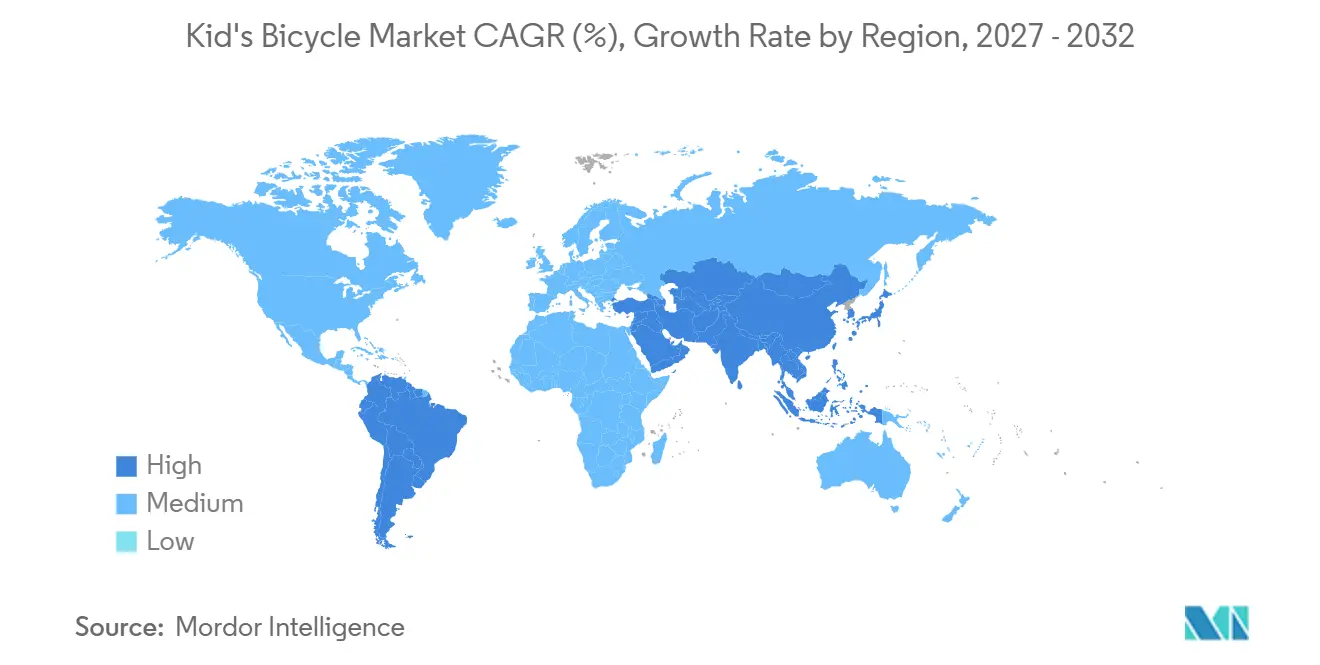
Asia-Pacific is forecast to grow at a 7.1% CAGR through 2032, the highest regional rate in the Kid's Bicycle Market. Rising urban incomes and e-commerce access are expanding the addressable customer base in China, India, and Southeast Asia. China combines a large domestic customer base with a strong manufacturing ecosystem serving domestic and export demand. India’s urban households can be reached more readily as online retail extends beyond established city markets. South Korea shows the role of product presentation and local relevance in premium purchases. This regional structure supports both affordable products and differentiated offerings for urban families. Balance bikes are also gaining attention as parents introduce outdoor mobility at an earlier age. The region’s varied retail conditions require companies to match product range and service models to local purchasing behavior.
Europe, South America, Middle East, and Africa
Europe combines premium product adoption with a strong cycling culture and formal infrastructure support. The European Commission’s EUR 4.5 billion program and the UK’s nearly GBP 300 million active-travel commitment support safer cycling conditions. woom reported 101% direct-to-consumer growth in Northern Europe during 2025. Germany, the Netherlands, and Poland support European volume, while France, Italy, and Spain provide additional mid-tier demand. South American demand is developing through online access and regional retail expansion, although the evidence does not provide a comparable regional growth figure. The Middle East and Africa remain early-stage markets, with the UAE and Saudi Arabia positioned as premium entry points. Nigeria, South Africa, and Egypt have longer-term potential linked to infrastructure and household income. Across these mixed geographies, safe routes and reliable retail support remain important conditions for wider adoption.
Competitive Landscape
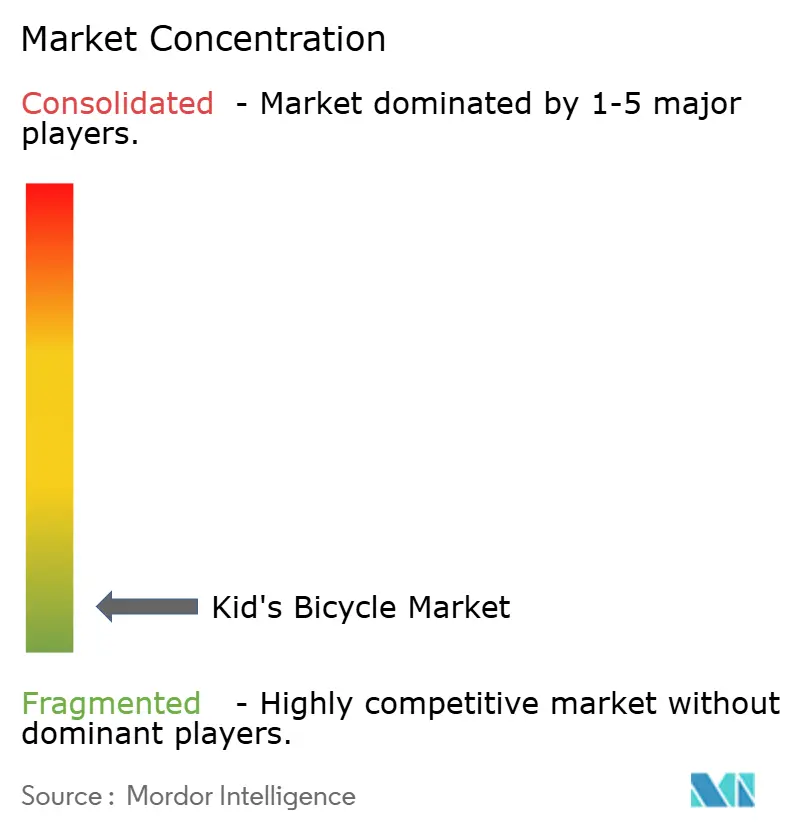
The Kid's Bicycle Market is fragmented, with no single company identified as holding a dominant share. Dorel Industries and Decathlon operate portfolios that address mass and mid-market buyers. woom shows how a focused premium offer can perform through lightweight engineering and direct sales. The company reported EUR 149 million in 2025 revenue, equivalent to USD 175.9 million, after 27% growth. Its result demonstrates the value of direct customer relationships and a product range built around child-specific sizing. Product design, availability, and family retention are more important competitive levers than broad scale alone.
Brands are also looking beyond a one-time bicycle sale. woom introduced a resale marketplace in April 2026 with Archive to support authenticated pre-owned purchases. The model can make branded products more affordable and help families return when a larger size is needed. woom’s WOW uses a self-balancing mechanism and circular polymer components with 98% recycled content. This move places materials choice alongside weight, safety, and ease of use in product competition. Connected features such as GPS tracking or progress monitoring may add value for some families, but they also add cost and compliance considerations.
Competitive structures are changing through acquisitions and distribution agreements. Frasers Group acquired Frog Bikes through its Evans Cycles subsidiary in May 2026 after Frog entered administration in March 2026. The acquisition combines Frog’s children’s product focus with the group’s retail and digital resources. Strider became the exclusive U.S. retailer for Kellys children’s bicycles in July 2026, adding three NAGA Air models for children aged 5-12. This agreement gives families a progression from balance bikes to multi-speed pedal bicycles within a related offering. Such arrangements show how brands can extend customer relationships across several stages of childhood.
Kid's Bicycle Industry Leaders
-
Decathlon SA
-
woom GmbH
-
Trek Bicycle Corporation
-
Huffy Corporation
-
Giant Manufacturing Co. Ltd.
- *Disclaimer: Major Players sorted in no particular order
Kid's Bicycle Market Companies Covered in this Report
- BrandLine Group Sp. z o.o.
- Decathlon SA
- woom GmbH
- Trek Bicycle Corporation
- Huffy Corporation
- Giant Manufacturing Co. Ltd.
- Hero Cycles Ltd.
- Merida Industry Co. Ltd.
- RoyalBaby Cycle Beijing Co. Ltd.
- PUKY GmbH & Co. KG
- Shanghai Phoenix Enterprise
- Shanghai Forever Bicycle
- TI Cycles of India Ltd.
- Strider Sports International Inc.
- Guardian Bikes
- ByK Bikes
- Early Rider Ltd.
- Prevelo Bikes
- Haro Bikes
- Islabikes
Recent Industry Developments in Kid's Bicycle Market
- July 2026: Strider Sports International became the exclusive US retailer for Kellys children's bikes, introducing three NAGA Air models (18- to 24-inch wheels) for children aged 5-12 to provide a brand-curated progression path after balance bikes. The partnership leverages Strider's D2C platform and 75-country distribution network to expand Kellys' North American reach.
- May 2026: Syensqo announced a strategic partnership with woom to introduce Omnix® 1030 ECHO RPRF circular polymer, 98% recycled content, up to 72% lower carbon footprint, into the woom WOW toddler bike's front fork, rear fork, and handlebar, marking a significant circular materials milestone in children's bicycle manufacturing.
- April 2026: woom launched woom Exchange, an official branded resale marketplace built in partnership with Archive, enabling authenticated pre-owned woom bike listings and purchases via woom.com. The platform extends product lifecycles, reduces waste, and broadens affordability for price-sensitive buyers.
Global Kid's Bicycle Market Report Scope
The Kid's Bicycle Market refers to the market for bicycles designed for children, including products developed with age-appropriate frame sizes, safety features, and riding mechanisms to support learning, recreation, and cycling activities. By bicycle type, the market is segmented into e-bikes and conventional bicycles. By activity type, the market is divided into road/city, mountain terrain (MTB), hybrid, and other types. By mode of operation, the market is segmented into pedal bicycles and balance bicycles. By age group, the market is divided into below 3 years, 3–9 years, and 9–14 years. By end-user, the market is segmented into boys, girls, and unisex products. By distribution channel, the market is divided into online and offline channels. Geographically, the market covers North America, Europe, Asia-Pacific, South America, and the Middle East and Africa, with country-level coverage across major markets within each region. Market size and growth forecasts are presented in terms of value (USD) and volume (Units).
Segmentation Overview
| E-Bikes |
| Conventional Bicycles |
| Road/ City |
| Mountain Terrain (MTB) |
| Hybrid |
| Others |
| Pedal Bicycles |
| Balance Bicycles |
| Below 3 Years |
| 3–9 Years |
| 9–14 Years |
| Boys |
| Girls |
| Unisex |
| Online Channels |
| Offline Channels |
| North America | United States |
| Canada | |
| Mexico | |
| Rest of North America | |
| Europe | Germany |
| United Kingdom | |
| Italy | |
| France | |
| Spain | |
| Netherlands | |
| Poland | |
| Belgium | |
| Sweden | |
| Rest of Europe | |
| Asia-Pacific | China |
| India | |
| Japan | |
| Australia | |
| Indonesia | |
| South Korea | |
| Thailand | |
| Singapore | |
| Rest of Asia-Pacific | |
| South America | Brazil |
| Argentina | |
| Colombia | |
| Chile | |
| Peru | |
| Rest of South America | |
| Middle East and Africa | South Africa |
| Saudi Arabia | |
| United Arab Emirates | |
| Nigeria | |
| Egypt | |
| Morocco | |
| Turkey | |
| Rest of Middle East and Africa |
| By Bicycle Type | E-Bikes | |
| Conventional Bicycles | ||
| By Activity Type | Road/ City | |
| Mountain Terrain (MTB) | ||
| Hybrid | ||
| Others | ||
| By Mode Of Operation | Pedal Bicycles | |
| Balance Bicycles | ||
| By Age Group | Below 3 Years | |
| 3–9 Years | ||
| 9–14 Years | ||
| By End User | Boys | |
| Girls | ||
| Unisex | ||
| By Distribution Channel | Online Channels | |
| Offline Channels | ||
| By Geography | North America | United States |
| Canada | ||
| Mexico | ||
| Rest of North America | ||
| Europe | Germany | |
| United Kingdom | ||
| Italy | ||
| France | ||
| Spain | ||
| Netherlands | ||
| Poland | ||
| Belgium | ||
| Sweden | ||
| Rest of Europe | ||
| Asia-Pacific | China | |
| India | ||
| Japan | ||
| Australia | ||
| Indonesia | ||
| South Korea | ||
| Thailand | ||
| Singapore | ||
| Rest of Asia-Pacific | ||
| South America | Brazil | |
| Argentina | ||
| Colombia | ||
| Chile | ||
| Peru | ||
| Rest of South America | ||
| Middle East and Africa | South Africa | |
| Saudi Arabia | ||
| United Arab Emirates | ||
| Nigeria | ||
| Egypt | ||
| Morocco | ||
| Turkey | ||
| Rest of Middle East and Africa | ||
Key Questions Answered in the Report
What is the projected value of the Kid's Bicycle Market by 2032?
The Kid's Bicycle Market is projected to reach USD 9.03 billion by 2032, growing at a 5.52% CAGR from 2027.
Which bicycle type is growing fastest for children?
E-bikes are the fastest-growing bicycle type, with a projected CAGR of 6.4% through 2032.
Why are balance bicycles gaining demand?
Balance bicycles are projected to grow at a 7.5% CAGR as brands introduce products for children below 3 years old.
Which region is growing fastest for children’s bicycles?
Asia-Pacific is projected to grow at a 7.1% CAGR through 2032, supported by urban incomes and expanding access to online retail.
What is shaping competition among kids bicycle brands?
Product fit, direct customer relationships, resale options, safety features, and age-based product progression shape competition in a fragmented category.