
Zinc Bromide Market Size and Share
Market Overview
| Study Period | 2021 - 2031 |
|---|---|
| Market Size (2026) | USD 378.68 Million |
| Market Size (2031) | USD 510.83 Million |
| Growth Rate (2026 - 2031) | 6.17 % |
| Fastest Growing Market | Asia-Pacific |
| Largest Market | Asia-Pacific |
| Market Concentration | Medium |
Major Players *Disclaimer: Major Players sorted in no particular order Image © Mordor Intelligence. Reuse requires attribution under CC BY 4.0. | |
Zinc Bromide Market Analysis by Mordor Intelligence
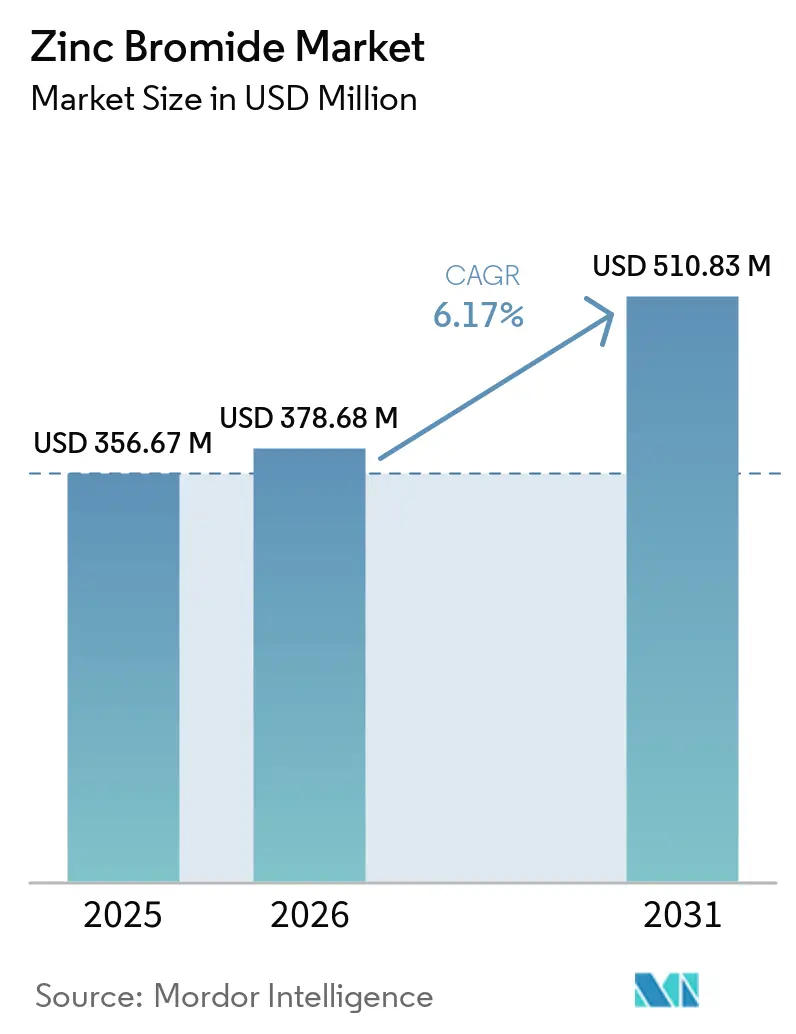
The Zinc Bromide Market size was valued at USD 356.67 million in 2025 and is estimated to grow from USD 378.68 million in 2026 to reach USD 510.83 million by 2031, at a CAGR of 6.17% during the forecast period (2026-2031). The zinc bromide market serves both high-density clear brines for deepwater well completion and electrolyte requirements for zinc-bromine long-duration energy storage systems. These demand streams follow different investment cycles, which can reduce reliance on a single end market. Offshore activity responds to drilling budgets and project schedules, whereas storage procurement follows utility planning and manufacturing capacity decisions. Oil and gas activity still shapes near-term purchasing because well-completion fluids are bought for specific projects. This makes order timing uneven and places a premium on dependable local inventory near major offshore basins. Battery-grade material creates an opportunity for suppliers that can meet tighter purity requirements and secure long-term supply arrangements. The zinc bromide market also depends on reliable bromine feedstock, quality control, and safe handling across regional supply chains. These requirements keep formulation capability, transport readiness, and customer qualification central to competitive performance.
Key Report Takeaways
- By product type, liquid held 63.37% of the zinc bromide market share in 2025, while solid is projected to advance at a 6.94% CAGR through 2031.
- By purity grade, technical grade held 57.16% of the zinc bromide market share in 2025, while battery grade is projected to advance at a 7.73% CAGR through 2031.
- By application, oil and gas held 48.22% of the zinc bromide market share in 2025, while energy storage is projected to advance at a 7.61% CAGR through 2031.
- By geography, Asia-Pacific held 34.74% of the zinc bromide market share in 2025 and is projected to advance at a 7.47% CAGR through 2031.
Note: Market size and forecast figures in this report are generated using Mordor Intelligence’s proprietary estimation framework, updated with the latest available data and insights as of January 2026.
Global Zinc Bromide Market Trends and Insights
Drivers Impact Analysis*
| Driver | (~) % Impact on CAGR Forecast | Geographic Relevance | Impact Timeline |
|---|---|---|---|
| Deepwater and Ultra-Deepwater Well-Completion Activity | +2.1% | Global; high intensity in Gulf of America, Brazil pre-salt, West Africa, and Southeast Asia | Short term (≤ 2 years) |
| Zinc-Bromine Flow-Battery Deployment for Long-Duration Storage | +1.4% | North America and EU core, spillover to APAC | Medium term (2–4 years) |
| Pharmaceutical and Active-Ingredient Synthesis Demand | +0.8% | Global, with concentration in Europe, North America, and APAC | Long term (≥ 4 years) |
| Specialty-Chemical and High-Purity Reagent Consumption | +0.6% | APAC core, established demand in North America and Europe | Long term (≥ 4 years) |
| Regionalization of Bromide Supply and Local Inventory Hubs | +0.3% | Global; early gains in North America, APAC, and Europe | Medium term (2–4 years) |
| Source: Mordor Intelligence | |||
Deepwater and Ultra-Deepwater Well-Completion Activity
Deepwater projects support the zinc bromide market because operators need solids-free fluids with high density for demanding completion work. The zinc bromide market benefits where wells combine high pressure, high temperature, and narrow operating margins. In June 2026, TETRA Technologies, Inc. introduced TETRA Neptune Z-Lite, which delivers densities up to 17.5 lbm/gal and reduces zinc-ion concentration by up to 60%[1]. The product was selected for a 3-well, 20,000 psi contract for Beacon Offshore Energy's Shenandoah and Monument projects in the Gulf of America. Lower zinc content can help operators manage handling and disposal requirements, which may improve the position of zinc bromide formulations in offshore projects. It also responds to customers seeking high-density performance with less zinc returned during the completion process.
Zinc-Bromine Flow-Battery Deployment for Long-Duration Storage
Energy storage is projected to be the fastest-growing application in the zinc bromide market at a 7.61% CAGR through 2031. Eos Energy Enterprises launched commercial production at its second Pennsylvania facility in June 2026 and targets 4 GWh of combined annual zinc-based battery capacity by year-end. The company disclosed a USD 303.5 million Department of Energy loan guarantee that closed in late 2024 to support its manufacturing expansion. The funding provides a clearer basis for the company to build manufacturing capacity that can consume qualified zinc-based electrolyte material over several years. It also gives upstream suppliers more visibility when they assess the volume, purity, delivery, and inventory requirements that follow from an expanding battery production program. TETRA Technologies, Inc. supplies battery-grade PureFlow zinc bromide electrolyte to Eos Energy Enterprises, linking bromine production and battery supply needs.
Pharmaceutical and Active-Ingredient Synthesis Demand
The zinc bromide market also serves pharmaceutical synthesis, where the material is used as a Lewis acid catalyst in selected organometallic reactions. This use supports the production of active pharmaceutical ingredients, including compounds used in neurological, cancer, and other therapeutic applications. In these routes, buyers value a catalyst that can support required reactions at controlled process conditions without introducing unsuitable trace contaminants. Pharmaceutical manufacturers require controlled impurity levels and repeatable batch performance. They also need supplier records that can support customer audits, internal release procedures, and documentation of the material used in each production lot. These requirements make supplier qualification more important than spot pricing in regulated procurement. European manufacturing locations in Ireland, Germany, and Switzerland reinforce demand for material with documented quality controls. Suppliers with established testing systems can therefore retain a stronger position in this part of the zinc bromide market. Long qualification cycles also make it harder for a low-cost entrant to displace a vendor after material is incorporated into a validated process.
Specialty-Chemical and High-Purity Reagent Consumption
Fine chemical and agrochemical producers use zinc bromide in reactions including Friedel-Crafts acylations, aldol condensations, and asymmetric transformations. The zinc bromide market gains from applications that value batch flexibility and catalytic performance under moderate process conditions. A higher-purity product is also required by electronics, laboratory, and specialty synthesis customers. Producers that improve separation and purification processes can pursue more specification-driven tenders. This shift places greater emphasis on stable quality, technical support, and trace-metal control. It also increases pressure on distributors that do not have access to an integrated bromine supply or advanced purification capabilities. Customers in these applications increasingly assess documentation, lot consistency, and the ability to resolve technical issues alongside the delivered material.
Restraints Impact Analysis*
| Restraint | (~) % Impact on CAGR Forecast | Geographic Relevance | Impact Timeline |
|---|---|---|---|
| Oil Price and Offshore-Capex Cyclicality | -1.5% | Global; acute exposure in Gulf of America, North Sea, and West Africa | Short term (≤ 2 years) |
| Environmental, Safety, and Disposal Compliance Burden | -1.0% | North America and Europe primarily; expanding to APAC | Medium term (2–4 years) |
| Bromine and Zinc Feedstock Concentration Risk | -0.7% | Global; concentrated in Dead Sea (Israel) and Arkansas (USA) | Long term (≥ 4 years) |
| Source: Mordor Intelligence | |||
Oil Price and Offshore-Capex Cyclicality
Oil and gas held 48.22% of the zinc bromide market demand in 2025, leaving suppliers exposed to changes in offshore capital spending. Completion-fluid purchases can be delayed when operators reduce drilling and completion programs. Albemarle Corporation identified reduced clear-brine-fluid demand from weaker oil and gas conditions as a headwind for its 2026 adjusted earnings before interest, taxes, depreciation, and amortization (EBITDA). A January 2026 flooding event also interrupted production at Albemarle Corporation's Jordan Bromine Company Ltd joint venture before normal operating rates resumed. Reduced-zinc and zinc-free formulations can further lower material use per well, even when activity levels remain stable. Suppliers must balance exposure to fluctuating completion programs with opportunities in less cyclical storage and specialty chemical applications.
Environmental, Safety, and Disposal Compliance Burden
Environmental management raises the total cost of zinc bromide use in offshore operations. The U.S. Environmental Protection Agency identifies zinc bromide in its Substance Registry Services and records a Comprehensive Environmental Response, Compensation, and Liability Act (CERCLA) reportable quantity of 1,000 pounds[2]. This regulatory context requires users to plan chemical movement and waste management before field operations begin. Operators must manage containment, waste characterization, and disposal procedures when using zinc-bearing brines. These obligations can favor alternatives where local permits impose stricter discharge conditions. Importers in South Korea and Japan also place stronger attention on trace-metal documentation, which increases compliance needs for exporters. The zinc bromide market, therefore, requires suppliers to provide consistent technical documentation alongside the product itself. Compliance effort can influence supplier selection even where comparable brine density or chemical performance is available from more than one provider.
*Our forecasts treat driver/restraint impacts as directional, not additive. The impact forecasts reflect baseline growth, mix effects, and variable interactions.
Segment Analysis
By Product Type: Liquid Anchors Demand, While Solid Accelerates on Storage Buildout
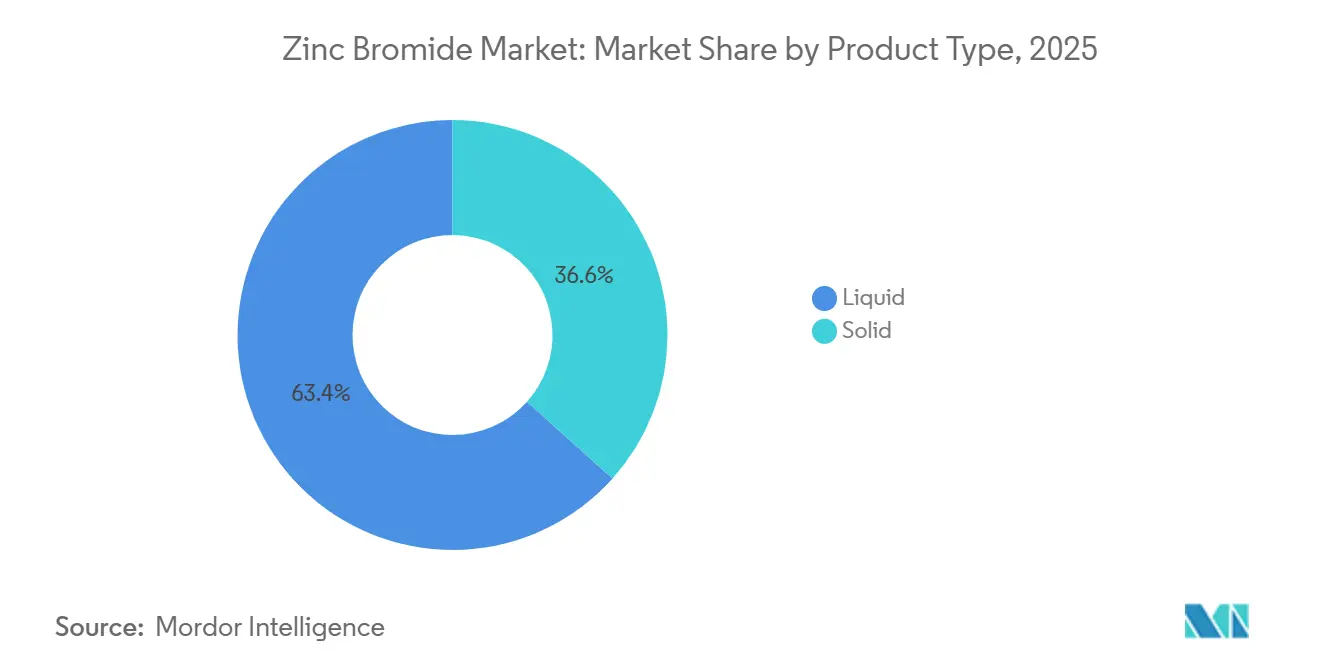
Liquid held 63.37% of the zinc bromide market revenue in 2025. Its lead reflects direct compatibility with completion-fluid blending and electrolyte filling. Users can apply liquid material without an additional dissolution stage at the point of use. This reduces handling steps in established oilfield and battery supply systems. Liquid supply also suits customers with local blending infrastructure and recurring operational needs. The format is particularly practical when customers require immediate fluid preparation rather than shipment, storage, and subsequent dissolution of a solid product. It can also simplify coordination between material suppliers, field-service teams, and the customer operating the completion or battery filling process.
Solid is projected to advance at a 6.94% CAGR through 2031. The format suits locations without local brine blending facilities and pharmaceutical customers that need measured dry-weight inputs. Storage developers in Germany, South Korea, and India can use solid imports for local dissolution while their regional electrolyte infrastructure develops. This allows early projects to proceed before large-scale regional facilities for receiving, mixing, and storing liquid electrolyte become available. Strict liquid spill controls can also encourage solid packaging in some markets. As local preparation capacity expands, some procurement may shift toward liquid products, which could narrow the current format premium. Until then, solid material gives new storage markets a workable route to secure zinc bromide without waiting for regional brine processing assets.
By Purity Grade: Technical Grade Dominates Revenue, While Battery Grade Expands
Technical grade held 57.16% of the zinc bromide market revenue in 2025. The grade remains important for completion fluids, where density and crystallization behavior guide procurement. Oilfield customers often assess material against operating needs for a specific well, which makes performance consistency as important as the nominal chemical specification. Technical requirements differ from those in battery and pharmaceutical supply chains. Producers must maintain this base business while deciding where additional purification investment can create better returns from smaller but more demanding volumes.
Battery grade is projected to advance at a 7.73% CAGR through 2031. Zinc-bromine storage systems require low metallic impurity levels to help protect electrodes and sustain battery performance. Suppliers must demonstrate that the electrolyte will behave consistently during repeated charge and discharge cycles, rather than simply meeting a broad technical-grade specification. A 2026 study showed that an ammonium supporting electrolyte enabled zinc-bromine flow batteries to cycle for more than 1,600 cycles at minus 20 °C and more than 3,300 hours at room temperature. The zinc bromide market is consequently separating between technical-grade volume and higher-value material for energy storage and regulated applications. The difference affects plant design, quality assurance, customer contracts, and the commercial importance of trace-metal testing.
By Application: Oil and Gas Holds Primacy as Energy Storage Redraws the Growth Map
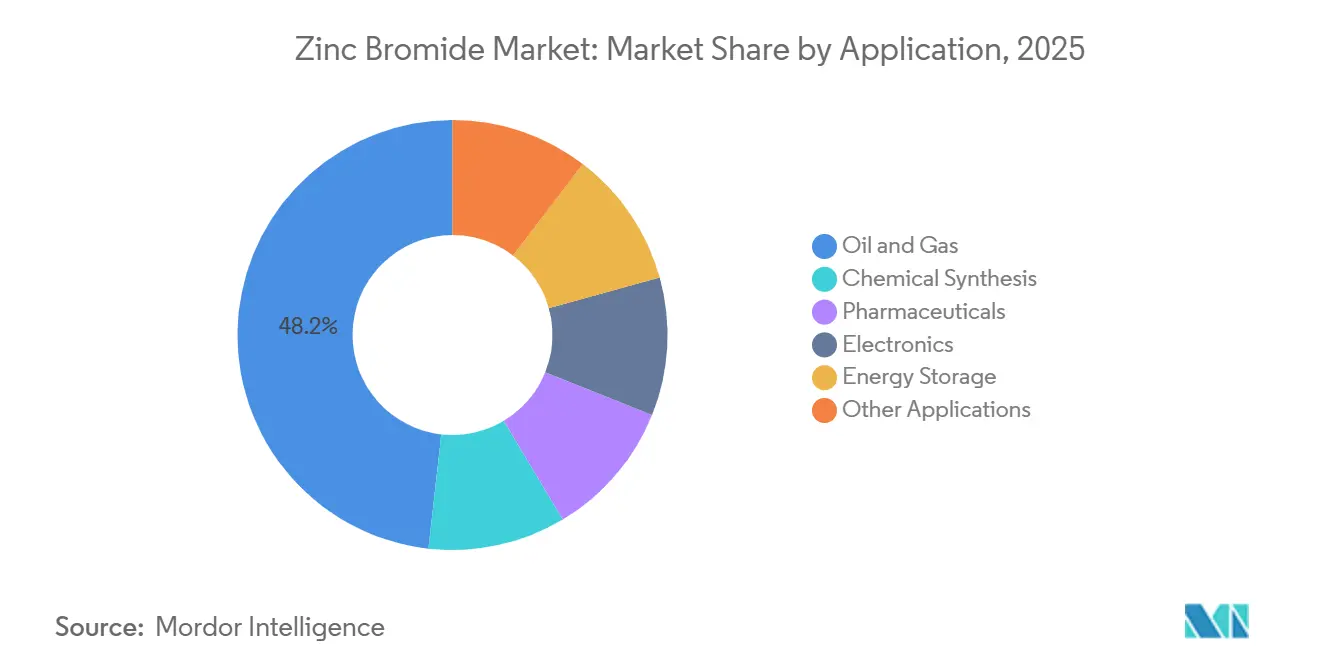
Oil and gas held 48.22% of the zinc bromide market revenue in 2025. The application relies on high-density, solids-free brines for high-pressure, high-temperature, and deepwater completions. Zinc bromide remains relevant where reservoir pressures are high and fluid performance requirements are demanding. These conditions limit the practical use of lower-density brines and make formulation choices critical to well completion planning. Purchase volumes remain project-based, which ties short-term demand to offshore completion schedules. The sector, therefore, provides the largest application base while also creating cyclical exposure. Producers serving this segment need responsive logistics because demand can rise or fall quickly when operators change individual project plans.
Energy storage is projected to advance at a 7.61% CAGR through 2031. Utility-scale zinc-bromine battery deployments are moving beyond demonstration projects in North America and Europe. Chemical synthesis and pharmaceuticals provide durable demand through contract manufacturing and specialized catalytic processes. These applications are smaller than oil and gas but can support more stable procurement when customers need repeatable quality and documented specifications. Electronics customers also require high-purity material for uses connected to semiconductor photolithography and imaging chemicals. The zinc bromide market is likely to give greater priority to purity qualification as energy storage expands relative to traditional applications. This does not displace oilfield demand, but it broadens the technical and commercial capabilities needed from major suppliers.

Geography Analysis
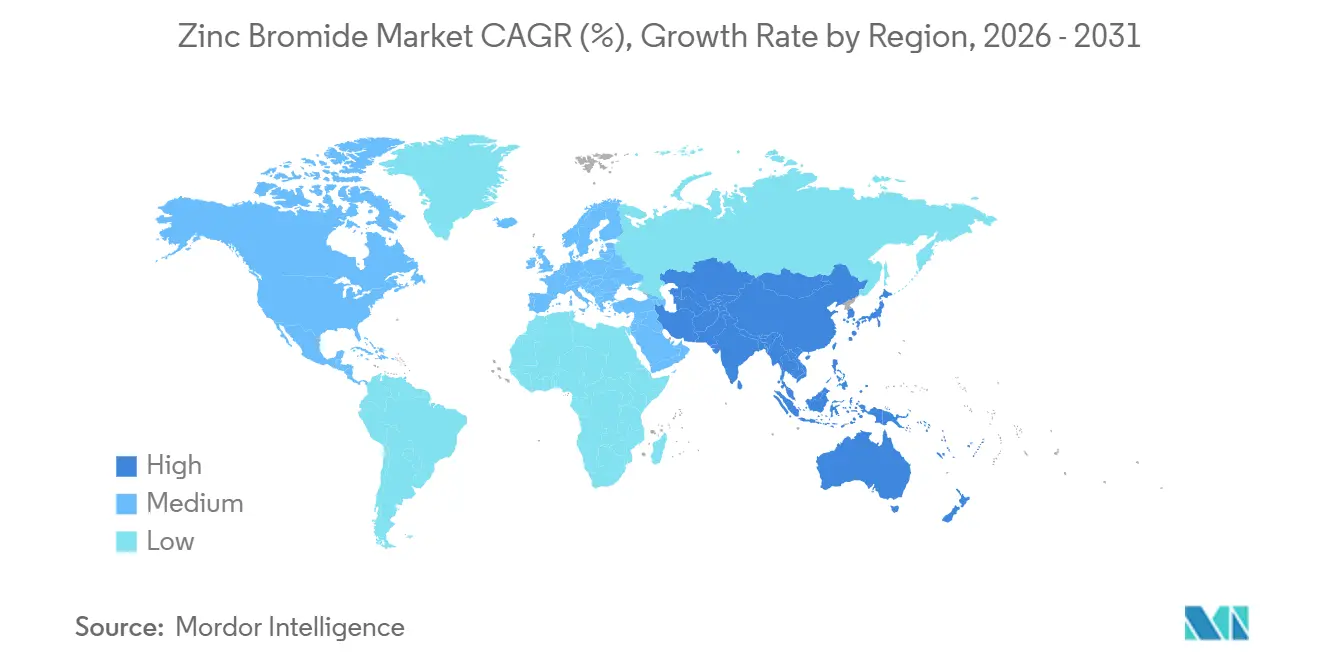
Asia-Pacific held 34.74% of the zinc bromide market revenue in 2025 and is projected to advance at a 7.47% CAGR through 2031. China supports both production and consumption, with Chinese producers supplying technical-grade material while the country still imports battery-grade and pharmaceutical-grade products. India adds demand from active pharmaceutical ingredient manufacturing. South Korea supports demand through battery energy storage systems and semiconductor supply chains. Indonesia and Malaysia add demand from offshore activity in the Natuna Sea and Sabah Basin, extending the region's use beyond China's production base.
North America is a significant regional market for the zinc bromide market because it combines Gulf of America completion work with domestic battery manufacturing. TETRA Technologies, Inc. approved the Final Investment Decision for its Arkansas Bromine Production Facility in May 2026. The facility is targeted for mechanical completion by year-end 2026 and first production in early 2028. Management expects the project to contribute USD 100 million in annual EBITDA by 2030. The investment signals an effort to support local supply for both completion fluids and battery electrolyte as domestic demand requirements develop. It also reduces the strategic importance of relying only on distant feedstock routes for customers that need reliable domestic deliveries.
Europe combines declining North Sea completion activity with growing interest in long-duration storage. This mix changes the regional demand profile from one based mostly on offshore fluid use toward one that gives greater weight to qualified battery electrolyte supply. Eos Energy Enterprises and Capac Energy agreed to supply up to 2 GWh of zinc-based battery systems through 2031 for Germany, Austria, and Switzerland. Their Bruchsal battery energy storage system of 22 MWh is targeted for commissioning by year-end 2026. Brazil supports South American demand through pre-salt completions, while the Middle East and Africa remain important to feedstock supply through Dead Sea bromine operations. ICL reported that bromine reached peak prices in April 2026, highlighting the supply risk faced by the zinc bromide market. Feedstock concentration can transmit price and availability pressure to buyers across regions, making inventory planning an important procurement consideration.
Competitive Landscape
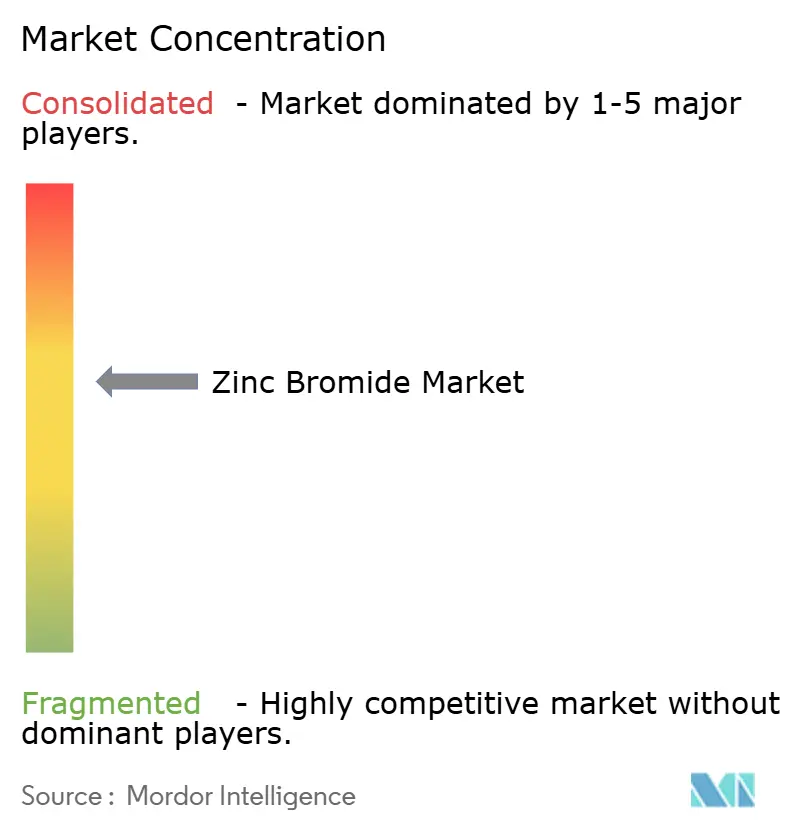
The zinc bromide market is moderately concentrated, with the top five players including Albemarle Corporation, ICL, TETRA Technologies, Inc., LANXESS, and Halliburton Company. Albemarle Corporation, ICL, and TETRA Technologies, Inc. combine bromine access with downstream zinc bromide products. TETRA Technologies serves conventional completion fluids and battery-grade PureFlow material from a common operating base. Halliburton Company and SLB compete through engineered completion-fluid programs and global field support. Their service position depends on secure raw material supply from integrated or qualified producers. This means service providers can differentiate through field execution, but their ability to scale zinc bromide programs remains connected to upstream availability.
Merck KGaA, Thermo Fisher Scientific Inc., Fujifilm Wako Pure Chemical Corporation, American Elements, GFS Chemicals, Strem Chemicals, Inc., and Spectrum Chemical serve reagent and specialty distribution needs. These suppliers compete on certification, application support, and supply reliability rather than low price alone. Their customer relationships often depend on whether they can provide certificates, quality records, and responsive technical assistance for specialized use cases. Nanjing Taiye Chemical Industry Co., Ltd. and Weifang Taihexing Chemical Industry Co., Ltd. compete in technical-grade supply with cost-competitive output. Their participation in battery-grade and pharmaceutical-grade tenders remains constrained by extensive qualification requirements. Demonstrating repeatable purity and lot-to-lot consistency can take 12 to 24 months, which protects established suppliers in regulated and performance-sensitive uses.
In April 2025, LANXESS completed the sale of its Urethane Systems business, supporting its focus on specialty chemical activities. TETRA Technologies, Inc. launched TETRA Neptune Z-Lite in June 2026 for deepwater completions. Eos Energy Enterprises also established Capac Energy as its exclusive distribution partner for DACH (Germany, Austria, and Switzerland) markets under a supply agreement through 2031. These moves show how technology suppliers and material producers are using product development, capacity investment, and channel partnerships to serve different demand streams. The competitive pattern favors companies that can connect upstream material availability to reliable service for offshore, storage, and high-purity customers. That capability matters because each customer group has different purchasing cycles, product specifications, and requirements for logistics, handling, or documentation.
Zinc Bromide Industry Leaders
-
Albemarle Corporation
-
ICL
-
TETRA Technologies, Inc.
-
LANXESS
-
Halliburton Company
- *Disclaimer: Major Players sorted in no particular order
Recent Industry Developments
- July 2026: Archean Chemical Industries Limited announced the inauguration of the first zinc-bromide-based battery pilot manufacturing facility in the United Kingdom through its investment in Offgrid Energy Labs Inc. The development supported the zinc bromide market by expanding the use of zinc bromide electrolytes in long-duration energy storage and advancing commercial-scale zinc-bromine battery applications.
- June 2026: TETRA Technologies, Inc. launched TETRA Neptune Z-Lite, combining high-purity zinc bromide with its patented Neptune chemistry. The product supported the zinc bromide market by expanding high-density zinc bromide applications in deepwater oil and gas operations.
Global Zinc Bromide Market Report Scope
Zinc bromide is an inorganic bromide compound used as a source of bromide ions and zinc in industrial, chemical, energy, and specialized applications. Its properties, such as high solubility, density, and ionic conductivity, make it suitable for applications requiring concentrated bromide solutions and specialized chemical performance.
The Zinc Bromide Market is segmented by product type, purity grade, application, and geography. By product type, the market is segmented into liquid and solid. By purity grade, the market is segmented into technical grade, battery grade, and pharmaceutical and reagent grade. By application, the market is segmented into oil and gas, chemical synthesis, pharmaceuticals, energy storage, electronics, and other applications. The report also covers the market size and forecasts for zinc bromide across 15 countries. For each segment, the market sizing and forecasts have been done on the basis of value (USD).
| Liquid |
| Solid |
| Technical Grade |
| Battery Grade |
| Pharmaceutical and Reagent Grade |
| Oil and Gas |
| Chemical Synthesis |
| Pharmaceuticals |
| Energy Storage |
| Electronics |
| Other Applications |
| Asia-Pacific | China |
| India | |
| Japan | |
| South Korea | |
| ASEAN Countries | |
| Rest of Asia-Pacific | |
| North America | United States |
| Canada | |
| Mexico | |
| Europe | Germany |
| United Kingdom | |
| France | |
| Italy | |
| NORDIC Countries | |
| Rest of Europe | |
| South America | Brazil |
| Argentina | |
| Rest of South America | |
| Middle East and Africa | Saudi Arabia |
| South Africa | |
| Rest of Middle East and Africa |
| By Product Type | Liquid | |
| Solid | ||
| By Purity Grade | Technical Grade | |
| Battery Grade | ||
| Pharmaceutical and Reagent Grade | ||
| By Application | Oil and Gas | |
| Chemical Synthesis | ||
| Pharmaceuticals | ||
| Energy Storage | ||
| Electronics | ||
| Other Applications | ||
| By Geography | Asia-Pacific | China |
| India | ||
| Japan | ||
| South Korea | ||
| ASEAN Countries | ||
| Rest of Asia-Pacific | ||
| North America | United States | |
| Canada | ||
| Mexico | ||
| Europe | Germany | |
| United Kingdom | ||
| France | ||
| Italy | ||
| NORDIC Countries | ||
| Rest of Europe | ||
| South America | Brazil | |
| Argentina | ||
| Rest of South America | ||
| Middle East and Africa | Saudi Arabia | |
| South Africa | ||
| Rest of Middle East and Africa | ||
Key Questions Answered in the Report
What is the size of the zinc bromide market?
The zinc bromide market stands at USD 378.68 million in 2026 and is projected to reach USD 510.83 million by 2031.
What is driving demand for zinc bromide?
Deepwater well completion activity and zinc bromine battery deployment support demand for high-density brines and high-purity electrolyte material.
Which product type held the largest share in 2025?
Liquid held 63.37% of the market share in 2025 because it is compatible with completion-fluid blending and electrolyte filling.
Which purity grade is expected to grow fastest through 2031?
Battery grade is projected to advance at a 7.73% CAGR through 2031 as energy storage systems require controlled impurity levels.