
Xylose Market Size and Share
Market Overview
| Study Period | 2022 - 2032 |
|---|---|
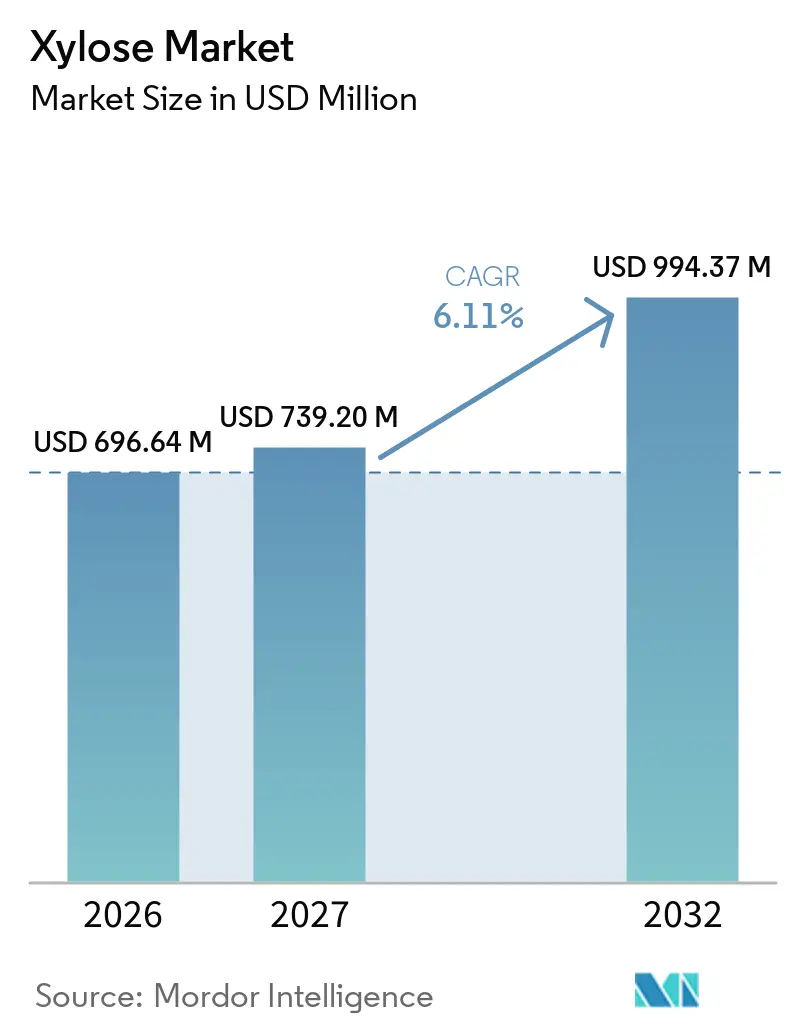
| Market Size (2027) | USD 739.20 Million |
| Market Size (2032) | USD 994.37 Million |
| Growth Rate (2027 - 2032) | 6.11 % |
| Fastest Growing Market | Middle East and Africa |
| Largest Market | Asia-Pacific |
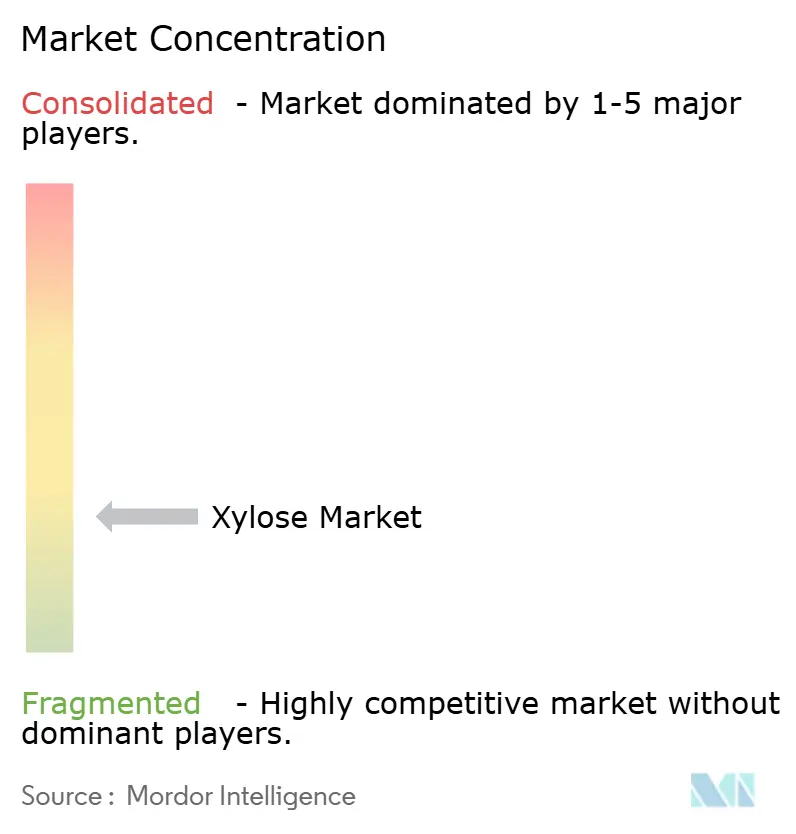
| Market Concentration | Low |
Major Players *Disclaimer: Major Players sorted in no particular order Image © Mordor Intelligence. Reuse requires attribution under CC BY 4.0. | |
Xylose Market Analysis by Mordor Intelligence
The Xylose Market size is projected to expand from USD 696.64 million in 2026 to reach USD 994.37 million by 2032, registering a CAGR of 6.11% between 2027 and 2032. Demand is supported by the use of xylose in reduced-sugar foods, pharmaceutical diagnostics, and ingredient systems that require controlled purity. Producers are increasingly separating food-grade and pharmaceutical-grade supply because the two customer groups apply different qualification requirements. Integrated plants can use corncob feedstock for several products, which supports cost recovery across the production chain. Competition remains centered on Chinese integrated producers in bulk grades and specialty suppliers in regulated applications. Energy use, feedstock collection, and competition from established sweeteners continue to limit wider adoption in some food uses.
Key Report Takeaways
- By product type, D-Xylose accounted for the largest share of the Xylose Market, at 87.65% in 2026, while L-Xylose is projected to grow at the fastest CAGR of 7.65% during 2027-2032.
- By source, Corncobs accounted for the largest share of the Xylose Market, at 68.17% in 2026, while Sugarcane Bagasse is projected to grow at the fastest CAGR of 8.96% during 2027-2032.
- By form, Powder accounted for the largest share of the Xylose Market, at 64.28% in 2026, while Crystals are projected to grow at the fastest CAGR of 8.16% during 2027-2032.
- By application, Food and Beverages accounted for the largest share of the Xylose Market, at 59.12% in 2026, while Biofuels and Industrial Chemicals are projected to grow at the fastest CAGR of 7.72% during 2027-2032.
- By geography, Asia-Pacific accounted for the largest share of the Xylose Market, at 54.61% in 2026, while the Middle East and Africa is projected to grow at the fastest CAGR of 8.31% during 2027-2032.
Note: Market numbers in this report are based on Mordor Intelligence's proprietary estimation framework, which combines nine months of actuals with Q4 projections for base year 2026.
Market Trends and Insights
Drivers Impact Analysis of Xylose Market*
| Driver | (~) % Impact on CAGR Forecast | Geographic Relevance | Impact Timeline |
|---|---|---|---|
| Rising Demand for Natural and Low-Calorie Sweeteners | +1.5% | Global, with core demand in North America, Europe, and Asia-Pacific | Short term (≤ 2 years) |
| Growth in D-Xylose Use for Pharmaceutical Diagnostics and Excipients | +1.0% | North America and Europe, with spillover to Asia-Pacific | Medium term (2-4 years) |
| Integrated Biorefineries and Feedstock Diversification | +0.8% | Asia-Pacific core, with emerging activity in the Middle East, Africa, and South America | Medium term (2-4 years) |
| Xylose-Derived Prebiotics and Specialty Biochemicals | +0.7% | Global, with leading uptake in Asia-Pacific and Europe | Medium term (2-4 years) |
| Feedstock Diversification Through Forestry and Agricultural Residues | +0.5% | South America, Middle East and Africa, Southeast Asia | Long term (≥ 4 years) |
| EU Novel Food Reclassification Creating a Premium for Compliance-Ready Supply | +0.4% | EU, spill-over to GCC and export-oriented Asia-Pacific producers | Short term (≤ 2 years) |
| Source: Mordor Intelligence | |||
Rising Demand for Natural and Low-Calorie Sweeteners
Reduced-sugar food and beverage formulations support demand for D-xylose because it can serve both sweetening and browning functions. Its metabolic pathway supports interest in products designed for consumers managing dietary sugar intake, and it can be used where formulators need flavor development as well as sweetness. Food formulators need ingredients that can be documented as plant-derived and traced to a named feedstock, particularly when customers request clear supply-chain records. This requirement increases the value of supplier records covering corncob or sugarcane bagasse origin and can favor producers with consistent batch documentation. The Xylose Market benefits when food producers seek ingredients that meet both formulation and traceability requirements without requiring a completely new manufacturing process. These needs are most visible in bakery, dairy, supplements, and reduced-sugar beverage applications, where reformulation work must balance taste, processing behavior, and labeling needs.
Growth in Pharmaceutical Diagnostics and Excipients
D-xylose remains relevant for intestinal malabsorption testing, while pharmaceutical demand extends beyond food-grade applications to excipient and diagnostic supply. Suppliers serving this segment must comply with stringent quality requirements and prevent pharmaceutical-grade material from coming into contact with lower-grade supply, as customer qualification depends on documented controls. On May 1, 2025, Roquette completed its acquisition of IFF Pharma Solutions, integrating the businesses into a larger health and pharmaceutical excipient platform. IFF separately confirmed the completed divestiture of its Pharma Solutions business on the same date. The combined platform encompasses more than 40 manufacturing sites and 11,000 employees, highlighting the importance of scale, technical support, and customer qualification in pharmaceutical ingredient supply. FDA diagnostic reagent requirements and European Medicines Agency expectations for excipients can support premium pricing for materials with comprehensive technical documentation and a consistent quality history.
Integrated Biorefineries and Feedstock Diversification
Corncob-based plants use a feedstock stream that can produce xylose, xylitol, furfural, and energy products instead of relying on the sale of a single ingredient. This integrated model reduces dependence on revenue from one product while improving the economics of feedstock collection, purification, and residue utilization across the facility. A 2025 life-cycle and techno-economic study published in Science of the Total Environment assessed a corncob-based xylitol biorefinery processing 20 metric tons of corncob feedstock and identified a payback period of less than five years under the study’s assumptions. The study also reported greenhouse gas emissions of 7.67 kg of carbon dioxide equivalent per kilogram of xylitol crystals, highlighting the importance of energy integration in plant economics. Similar developments are emerging around alternative residues, including sugarcane bagasse and grain-processing by-products, where local feedstock availability can support new conversion pathways. The xylose market offers opportunities for regional supply development when producers integrate residue collection, processing, co-product sales, and energy recovery within a single operating model.
Xylose-Derived Prebiotics and Specialty Biochemicals
Xylooligosaccharides are produced from xylose-rich biomass, providing processors with a higher-value outlet from the same raw material base. A 2025 review published in A Food and Function evaluated the potential of xylooligosaccharides to influence gut microbiota and health outcomes, including studies using corncob-derived material. The controlled studies reviewed used daily doses of 1.4–2.8 g and reported a 21% increase in Bifidobacterium counts from baseline after four weeks. A 2026 study published in Scientific Reports also investigated prebiotic xylooligosaccharides in a metabolic dysfunction-associated steatotic liver disease model. These findings support continued research into clinical nutrition and dietary supplement applications; however, product claims must comply with local regulations and be supported by product-specific evidence. In February 2026, Xi'an Healthway Biotech announced an expansion of its XOS capacity from feed-grade to ultra-pure food-grade material, highlighting commercial interest in serving multiple quality tiers.
Restraints Impact Analysis of Xylose Market*
| Restraint | (~) % Impact on CAGR Forecast | Geographic Relevance | Impact Timeline |
|---|---|---|---|
| High Extraction, Purification, and Feedstock Logistics Costs | -1.0% | Global, most acute in non-integrated plants in Europe and South America | Short term (≤ 2 years) |
| Competition From Alternative Sweeteners and Regulatory Access Limits | -0.8% | North America and Europe, with spillover to European Union-aligned markets | Short term (≤ 2 years) |
| Seasonal Feedstock Variability and Residue Logistics | -0.5% | APAC (corncob harvest seasonality), South America (bagasse) | Medium term (2–4 years) |
| Regulatory Uncertainty for Human-Food Applications | -0.4% | EU, with spill-over to GCC and EU-aligned regulatory markets | Medium term (2–4 years) |
| Source: Mordor Intelligence | |||
High Extraction, Purification, and Feedstock Logistics Costs
Producing xylose from lignocellulosic biomass involves pretreatment, separation, purification, and energy-intensive finishing processes. These requirements can constrain margins for plants that cannot share equipment and feedstock costs across multiple products, particularly when energy or transportation costs increase. A 2025 assessment of rice straw biorefineries published in Biomass and Bioenergy evaluated the cost implications of pretreatment and co-production routes and identified dilute-acid pretreatment and steam consumption as significant operating cost factors. Seasonal availability also affects corncobs, sugarcane bagasse, and other agricultural residues, requiring plants to implement timely collection and stable storage practices. Producers need collection systems that minimize transportation distances, preserve feedstock quality after harvest, and ensure predictable volumes throughout the operating year. The xylose market is more favorable for facilities located near large residue streams and supported by reliable energy, logistics, and co-product infrastructure.
Competition From Alternative Sweeteners and Regulatory Access Limits
Erythritol, stevia, and sucralose have strong buyer awareness and widespread use across reduced-sugar product categories. As a result, food-grade xylose suppliers face challenges in securing new applications based solely on technical functionality, even when xylose provides beneficial browning and formulation properties. The U.S. Department of Commerce issued a final affirmative determination in its 2025 erythritol investigation involving imports from China. Although trade measures may alter short-term price dynamics, they do not eliminate the need for clear product positioning, customer education, and reliable formulation support. Food producers must also assess approval pathways and documentation requirements when using xylose in regulated applications, particularly for products intended for multiple export markets. These requirements may extend customer qualification cycles and delay adoption across export-focused supply chains.
*Our forecasts treat driver/restraint impacts as directional, not additive. The impact forecasts reflect baseline growth, mix effects, and variable interactions.
Xylose Market Segment Analysis
By Product Type:
D-Xylose Dominance Limits L-Xylose's Commercial InroadsD-Xylose held 87.65% of the Xylose Market share in 2026, supported by broad availability and established downstream customer use. Its leading position reflects hydrolysis methods built around corncob and wheat-straw feedstocks, which are already used at commercial scale. Food manufacturers use D-xylose in reduced-sugar formulations and for Maillard reaction control in baked and confectionery products. Pharmaceutical customers also use high-purity D-xylose in diagnostic and excipient applications that require more demanding documentation. Established production routes, procurement arrangements, and customer qualifications support repeat ordering and help limit switching in this segment.
L-Xylose is forecast to expand at a 7.65% CAGR during 2027-2032, the fastest rate in this product grouping. Its low metabolic relevance supports interest in specialized diabetic nutrition and weight-management products where formulators seek distinct ingredient profiles. Wider commercial adoption depends on scalable production, clear regulatory pathways, and sufficient technical evidence for food use. DL-Xylose retains a narrower industrial role and does not command the same purity premiums as the two individual isomers. Technology that lowers conversion costs could improve the commercial case for L-Xylose, especially in higher-value nutrition applications.
By Source:
Corncob Infrastructure Entrenches APAC Pricing PowerCorncobs represented 68.17% of the Xylose Market share in 2026, reflecting their importance as an established industrial feedstock. Producers in Shandong, Henan, Jilin, and Inner Mongolia can link residue procurement with refining and downstream conversion. China National Radio reported on agricultural-waste processing that created new income opportunities for rural areas in 2025[1]. This operating structure supports reliable feedstock access, lower handling costs, and efficient use of large residue volumes. It also makes it difficult for suppliers using less-developed residue networks to match delivered feedstock costs and collection reliability.
Sugarcane bagasse is projected to grow at an 8.96% CAGR during 2027-2032, the fastest rate among sources. Brazil and Argentina have sugar and ethanol systems that can support bagasse-based conversion projects alongside existing operations. Bagasse offers a route for regional supply closer to South American food and pharmaceutical customers with shorter delivery paths. Its expansion depends on whether operators can fit xylose recovery into broader sugarcane biorefinery operations without disrupting core output. Processing performance and seasonal collection practices will determine how quickly new capacity reaches commercial scale and achieves steady yields.
By Form:
Powder and crystals Holds Share as Liquid and Syrup Unlock New Market TiersPowder and crystals accounted for 64.28% of the Xylose Market share in 2026, making it the preferred format for broad ingredient use. Crystal form blends easily into dry food products, premixes, pharmaceutical intermediates, and feed formulations. Its storage and transportation characteristics make it suitable for distributed customer networks, including buyers that lack dedicated liquid-handling infrastructure. Suppliers serving international ingredient buyers in regulated food and pharmaceutical channels must maintain robust food safety and quality systems. Crystal form also supports precise dosing across multiple dry product lines and manufacturing sites. It is suitable for applications that require visual purity, controlled particle characteristics, consistent handling, and a premium-grade presentation. In October 2025, Hegang City reported that its 1,000-metric-ton crystal pilot line had achieved stable production and secured international orders[2].
Liquid and Syrup are expected to grow at an 8.16% CAGR during 2027-2032, supported by applications that need in-line dosing and easy incorporation into liquid systems. The format is used in beverage blending, commercial baking, and feed applications where dry handling or reconstitution would add process steps. Suppliers can tailor concentration and delivery characteristics to customer equipment and batch requirements. Growth is supported where manufacturers prioritize efficient mixing, controlled flow, and simplified processing. Powder remains the larger format, while Liquid and Syrup provide the faster-growing option for operations built around liquid formulation.
By Application:
Food and Beverages Holds Ground While Industrial Demand Diversifies RevenueFood and Beverages held 59.12% of the Xylose Market share in 2026, providing the main volume base for suppliers. The segment uses xylose as a low-glycemic sweetening ingredient and as a flavor-development aid in baked goods, confectionery, and reduced-sugar beverages. Producers commonly combine xylose with other functional carbohydrates, which raises formulation complexity and strengthens the position of qualified suppliers. Demand remains sensitive to ingredient cost, consumer familiarity, regulatory access, and the performance of finished products in consumer testing. This volume base gives producers a broad customer pool even when individual product launches remain selective and qualification periods are lengthy.
Biofuels and Industrial Chemicals are forecast to grow at a 7.72% CAGR during 2027-2032, the fastest application-level rate. Xylose is a C5 sugar platform for xylitol, xylonic acid, and other bio-based chemical routes. A 2025 study demonstrated concurrent production of xylonic acid and xylitol from xylose through bipolar membrane electrodialysis[3]. Industrial demand adds growth that is less dependent on consumer sweetener preferences and food ingredient purchasing cycles. It can also help integrated processors diversify revenue during periods of weaker food ingredient demand or changing formulation preferences.
Geography Analysis
Asia-Pacific Leads Global Xylose Market Expansion
Asia-Pacific accounted for 54.61% of the Xylose Market share in 2026, making it the largest regional production and consumption base. China anchors regional supply through corncob-integrated xylose and xylitol plants that supply domestic customers and export markets. Processing clusters in Shandong, Henan, Jilin, and Inner Mongolia bring residue collection, refining, and downstream conversion close together. This concentration supports production scale, while Japan, South Korea, and India contribute high-purity demand and research into alternative biomass streams.
The Middle East and Africa Xylose Market size is forecast to grow at an 8.31% CAGR during 2027-2032, the fastest regional rate. Pharmaceutical manufacturing investment and interest in biotechnology are broadening demand beyond conventional food uses across several countries. South Africa has sugarcane bagasse resources that could support future biomass-conversion facilities as commercial processes mature. Imported supply remains exposed to freight and currency movements, which can affect procurement costs and favor gradual development of local processing capacity.
North America is supported by sugar-reduction demand, pharmaceutical diagnostics, and interest in bio-based chemicals derived from agricultural feedstocks. Domestic supply projects could reduce dependence on imported material where sufficient feedstock, logistics capacity, and specialized customer demand are available. Europe has demand for pharmaceutical excipients and specialty biotechnology ingredients, but food applications require close attention to regulatory documentation and customer qualification requirements. South America can draw on sugarcane bagasse and established sugar-ethanol operations for potential integrated xylose recovery at biorefinery sites. These regions differ in feedstock access, buyer requirements, and industry structure, so suppliers must adapt production and qualification strategies to local conditions. Europe favors suppliers that can meet strict customer and regulatory requirements, while South America may gain from bagasse processing linked to established biorefinery assets.
Competitive Landscape
The Xylose Market has a fragmented concentration, with Chinese integrated producers holding strong positions in commodity and mid-grade material. Zhejiang Huakang Pharmaceutical, Shandong Futaste, Healtang Biotech, and Shandong Longlive Biotechnology operate in a supply environment shaped by corncob access and downstream conversion. Their integrated models can include xylose, other functional sugar products, which improves utilization of the same feedstock. This structure spreads feedstock and processing costs across several revenue streams and gives larger integrated producers greater flexibility in product mix.
Process efficiency remains important because extraction and purification use significant energy, water, equipment, and technical control. Continuous processing, better separation, and higher co-product recovery can reduce cost exposure and improve production consistency over longer operating cycles. ISO 9001, HACCP, and food safety systems help suppliers demonstrate consistency to international buyers with formal vendor approval systems. FDA documentation and European Medicines Agency expectations also matter when customers use xylose in regulated pharmaceutical applications or diagnostic products.
Roquette’s May 2025 acquisition of IFF Pharma Solutions added scale to its health and pharmaceutical ingredient business. Xi'an Healthway Biotech expanded its XOS offering in February 2026 from 35% feed-grade to 98% ultra-pure food-grade material. Hegang’s crystal pilot secured international orders in October 2025, indicating continued supplier interest in premium crystal grades. These actions favor higher-value derivatives, pharmaceutical-adjacent supply, and export-ready formats that require greater process control. Large-scale bulk supply remains important for volume customers and producers with integrated feedstock systems serving food ingredients. Product differentiation provides a route to stronger margins where suppliers can sustain quality, technical support, and customer-specific documentation.
Xylose Industry Leaders
-
Zhejiang Huakang Pharmaceutical Co., Ltd.
-
Shandong Futaste Pharmaceutical Co., Ltd.
-
Shandong Thomson Bio-Tech Co., Ltd.
-
Healtang Biotech Co., Ltd.
-
Shandong Longlive Bio-Technology Co., Ltd.
- *Disclaimer: Major Players sorted in no particular order
Xylose Market Companies Covered in this Report
- Zhejiang Huakang Pharmaceutical Co., Ltd.
- Shandong Futaste Pharmaceutical Co., Ltd.
- Shandong Thomson Bio-Tech Co., Ltd.
- Healtang Biotech Co., Ltd.
- Shandong Longlive Bio-Technology Co., Ltd.
- Shandong Xieli Bio-Tech Co., Ltd.
- Roquette Frères
- Danisco A/S
- International Flavors and Fragrances Inc.
- Cargill, Incorporated
- Ingredion Incorporated
- Gulshan Polyols Ltd.
- Toyota Tsusho Corporation
- Yucheng Lujian Biological Technology Co., Ltd.
- Hangzhou Shouxing Biotechnology Co., Ltd.
- Suvchem
- Ardilla Technologies Limited
- Merck KGaA
- Stora Enso Oyj
- Mitsubishi Corporation Life Sciences Limited
Recent Industry Developments in Xylose Market
- October 2026: Stora Enso partnered with Shanshan Technology to establish a lignin-derived hard carbon demonstration line in Ningbo, China. The initiative aims to industrialize its Lignode® battery anode material and supports lignin valorization, reinforcing the strategic importance of integrated wood biorefinery models across the broader hemicellulose, cellulose, and lignin value chain.
- December 2025: Hegang’s Dongshan District installed a 1,000-ton fermentation-based xylitol pilot line in 2025 as the first phase of a planned 50,000-ton-per-year project. In a December 2025 interview, the government indicated that the 50,000-ton-per-year facility started operations in 2026.
- July 2025: Qore, the USD 300 million joint venture between Cargill and HELM, began commercial production of QIRA® at its 66,000-metric-ton-per-year facility in Eddyville, Iowa, in 2024. The facility, the world's largest bio-based 1,4-butanediol (BDO) plant, validates the commercial-scale viability of converting agricultural biomass into bio-based chemicals near xylose supply chains.
Global Xylose Market Report Scope
The xylose market refers to the market for xylose, a five-carbon sugar derived mainly from the hemicellulose fraction of agricultural biomass. The xylose market is segmented by product type, source, form, application and geography. Based on product type, the market is segmented into D-xylose, L-xylose and DL-xylose. Based on source, the market is segmented into corncobs, wheat straw, sugarcane bagasse, and other sources. Based on form, the market is segmented into powder and crystal, and liquid and syrup. Based on application, the market is segmented into food and beverages, pharmaceuticals and diagnostics, animal feed and pet food, cosmetics and personal care, biofuels and industrial chemicals, and other applications. By geography, the market is segmented into North America, Europe, Asia-Pacific, South America, and the Middle East and Africa. For each segment, the market sizing and forecasting have been done in value terms (USD million).
Segmentation Overview
| D-Xylose |
| L-Xylose |
| DL-Xylose |
| Corncobs |
| Wheat Straw |
| Sugarcane Bagasse |
| Other Sources |
| Powder and Crystal |
| Liquid and Syrup |
| Food and Beverages |
| Pharmaceuticals and Diagnostics |
| Animal Feed and Pet Food |
| Cosmetics and Personal Care |
| Biofuels and Industrial Chemicals |
| Other Applications |
| North America | United States |
| Canada | |
| Mexico | |
| Rest of North America | |
| Europe | Germany |
| France | |
| United Kingdom | |
| Italy | |
| Spain | |
| Russia | |
| Rest of Europe | |
| Asia-Pacific | China |
| India | |
| Japan | |
| South Korea | |
| Australia | |
| Rest of Asia-Pacific | |
| South America | Brazil |
| Argentina | |
| Rest of South America | |
| Middle East and Africa | Saudi Arabia |
| South Africa | |
| Rest of Middle East and Africa |
| By Product Type | D-Xylose | |
| L-Xylose | ||
| DL-Xylose | ||
| By Source | Corncobs | |
| Wheat Straw | ||
| Sugarcane Bagasse | ||
| Other Sources | ||
| By Form | Powder and Crystal | |
| Liquid and Syrup | ||
| By Application | Food and Beverages | |
| Pharmaceuticals and Diagnostics | ||
| Animal Feed and Pet Food | ||
| Cosmetics and Personal Care | ||
| Biofuels and Industrial Chemicals | ||
| Other Applications | ||
| By Geography | North America | United States |
| Canada | ||
| Mexico | ||
| Rest of North America | ||
| Europe | Germany | |
| France | ||
| United Kingdom | ||
| Italy | ||
| Spain | ||
| Russia | ||
| Rest of Europe | ||
| Asia-Pacific | China | |
| India | ||
| Japan | ||
| South Korea | ||
| Australia | ||
| Rest of Asia-Pacific | ||
| South America | Brazil | |
| Argentina | ||
| Rest of South America | ||
| Middle East and Africa | Saudi Arabia | |
| South Africa | ||
| Rest of Middle East and Africa | ||
Key Questions Answered in the Report
What is driving demand for xylose?
Demand comes from reduced-sugar food formulations, pharmaceutical diagnostics, excipients, and bio-based chemical uses. These demand pools have different quality needs, which gives integrated producers and documented specialty suppliers separate routes to grow. The report forecasts a 6.11% CAGR for 2027-2032.
Which xylose product type has the largest share?
D-Xylose leads product demand with an 87.65% share in 2026. Established corncob and wheat-straw hydrolysis routes support availability, while food and pharmaceutical uses provide a broad customer base. L-Xylose is the faster-growing product type at a projected 7.65% CAGR.
Which xylose source is growing fastest?
Sugarcane bagasse is projected to grow at an 8.96% CAGR during 2027-2032. Growth depends on its integration into sugar and ethanol processing systems, especially in South America, where bagasse can support regional ingredient and specialty-material supply.
Which application is expanding fastest for xylose?
Biofuels and Industrial Chemicals are projected to grow at a 7.72% CAGR during 2027-2032. Xylose can serve as a C5 platform for xylitol, xylonic acid, and related chemical routes, which gives producers a source of growth beyond consumer sweetener demand.