
Wood Bio-Products Market Size and Share
Market Overview
| Study Period | 2022 - 2032 |
|---|---|
| Market Size (2027) | USD 394.13 Billion |
| Market Size (2032) | USD 591.27 Billion |
| Growth Rate (2027 - 2032) | 8.45 % |
| Fastest Growing Market | Asia-Pacific |
| Largest Market | Asia-Pacific |
| Market Concentration | Low |
Major Players *Disclaimer: Major Players sorted in no particular order Image © Mordor Intelligence. Reuse requires attribution under CC BY 4.0. | |
Wood Bio-Products Market Analysis by Mordor Intelligence
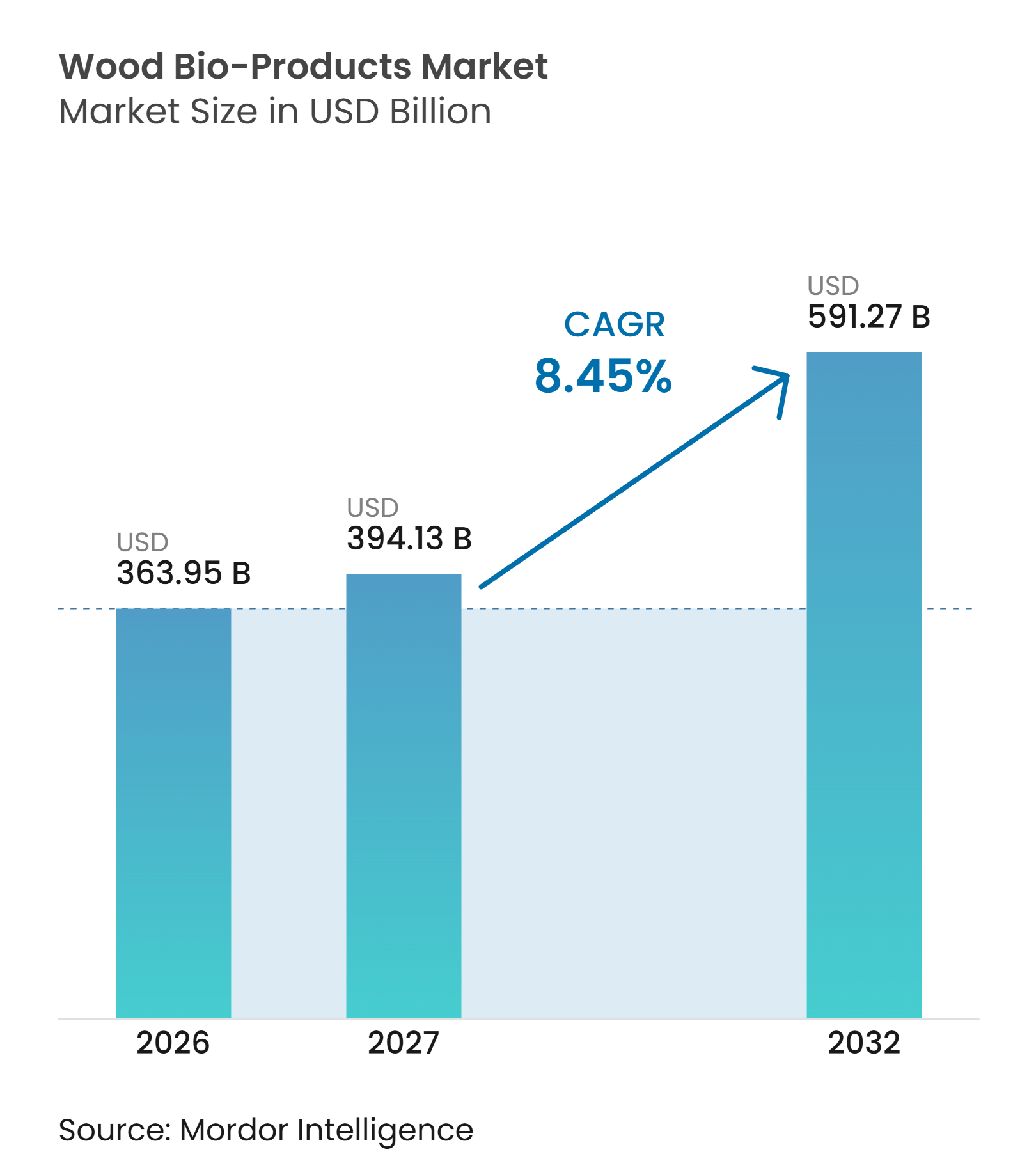
The Wood Bio-Products Market size was valued at USD 363.95 billion in 2026 and is estimated to grow from USD 394.13 billion in 2027 to reach USD 591.27 billion by 2032, at a CAGR of 8.45% during the forecast period (2027-2032). The wood bio-products market is supported by wider use of engineered materials in construction, furniture, and specialty applications. Green-building requirements are increasing demand for traceable products with environmental declarations, while renovation activity supports demand for panels, doors, flooring, and interior components. Producers are also directing investment toward residue use, higher-value manufactured materials, and digital ordering tools. These moves can reduce exposure to commodity cycles and strengthen customer access across the wood bio-products market. Trade measures, fiber costs, and tighter emissions requirements remain important constraints because they affect input prices, production processes, and cross-border supply arrangements.
Key Report Takeaways
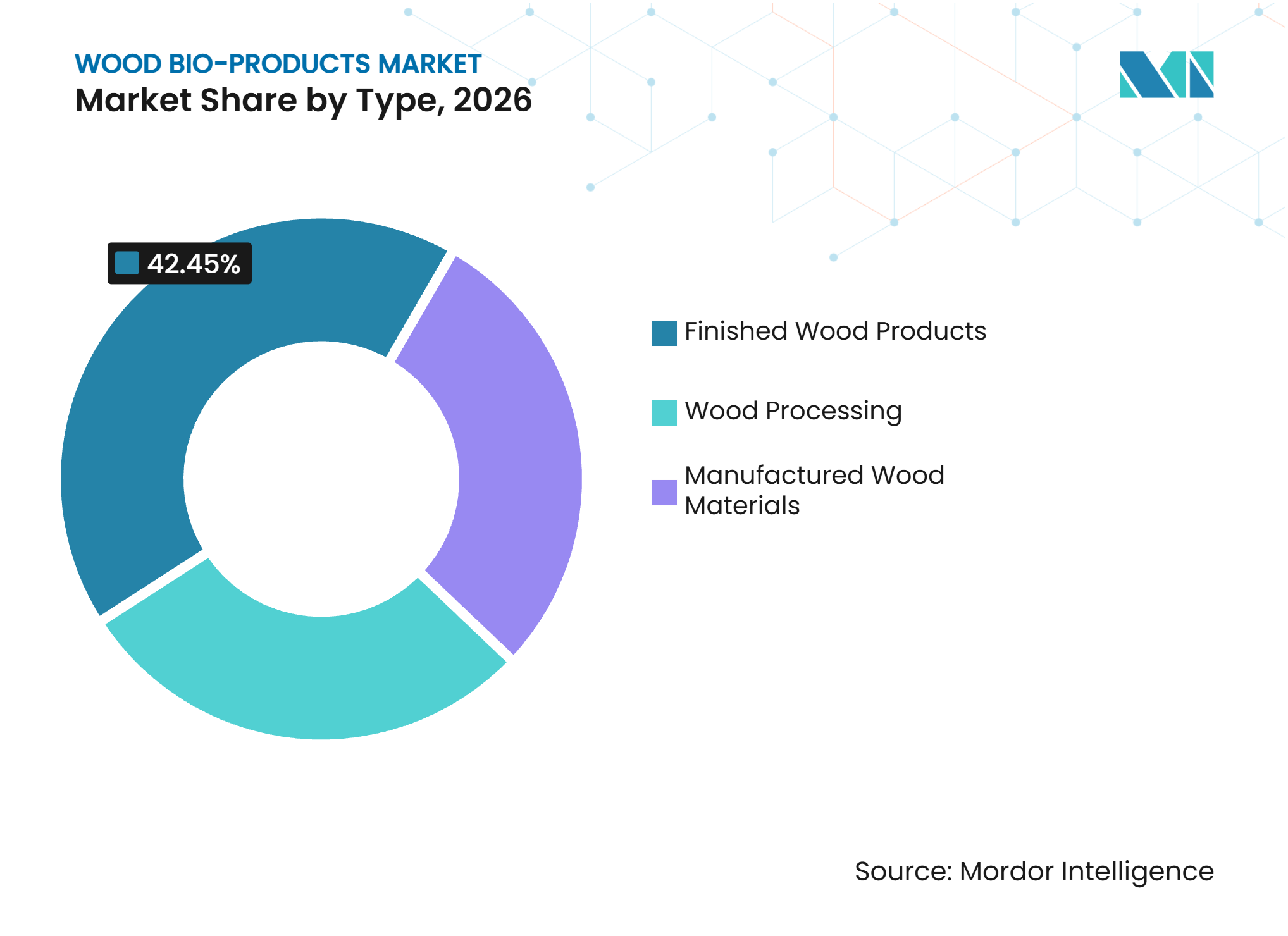
- By type, finished wood products held 42.45% of the wood bio-products market share in 2026, while manufactured wood materials are forecast to advance at a 9.56% CAGR through 2032.
- By distribution channel, offline held 75.13% of the wood bio-products market share in 2026, while online is forecast to advance at a 9.45% CAGR through 2032.
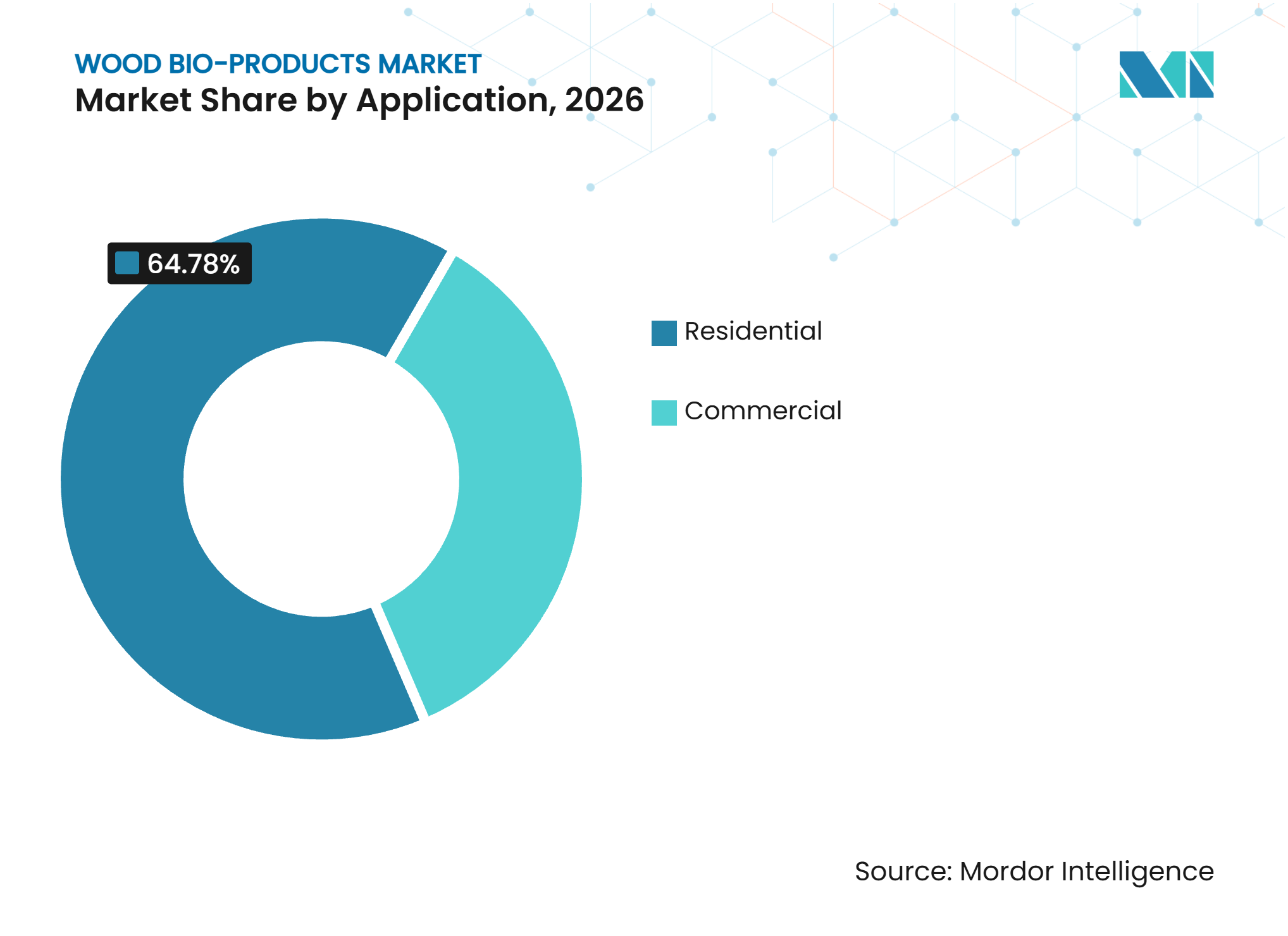
- By application, residential held 64.78% of the wood bio-products market share in 2026, while commercial is forecast to advance at a 10.27% CAGR through 2032.
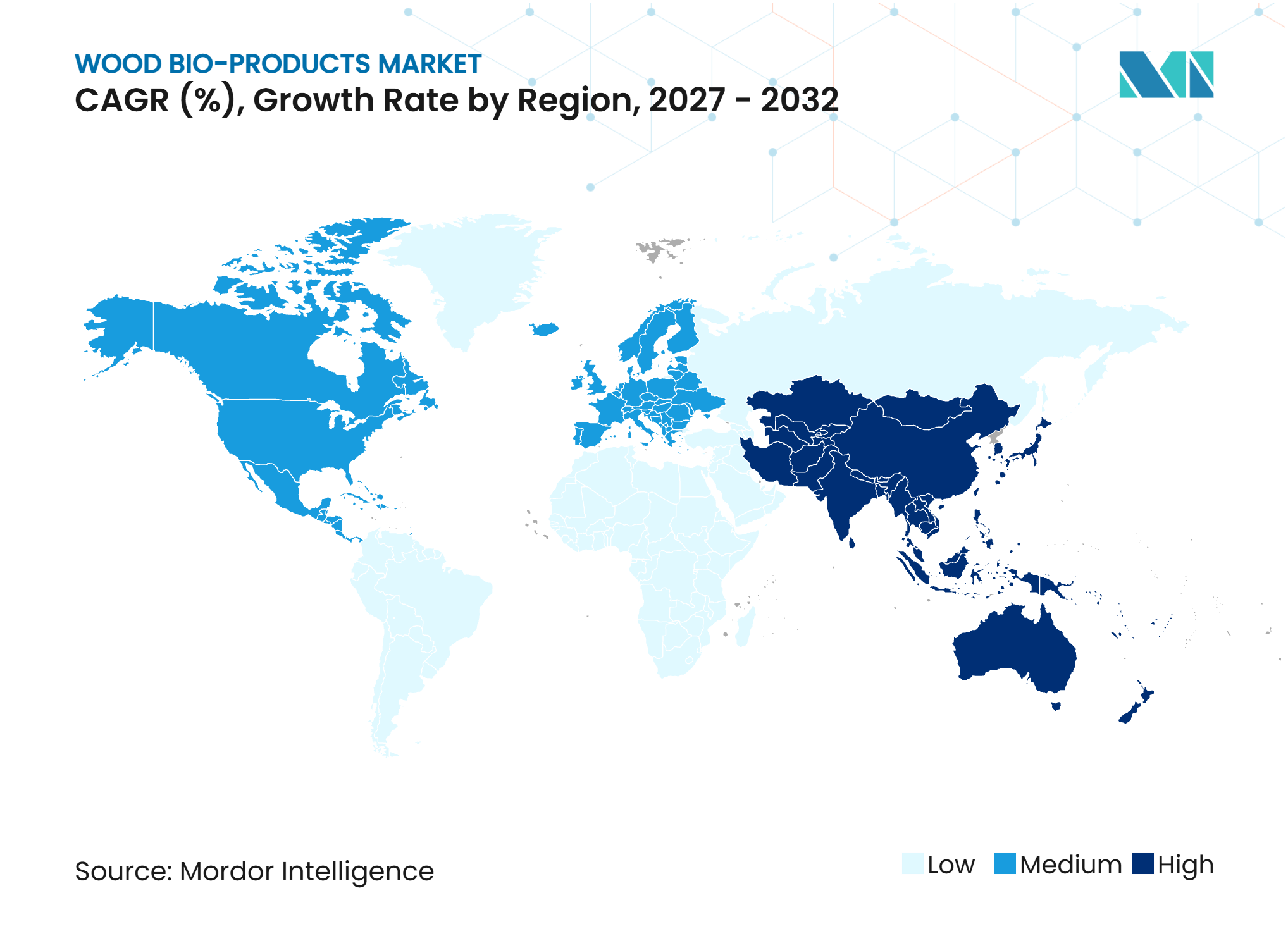
- By geography, Asia-Pacific held 35.27% of the wood bio-products market share in 2026 and is forecast to advance at a 10.02% CAGR through 2032.
Note: Market numbers in this report are based on Mordor Intelligence's proprietary estimation framework, which combines nine months of actuals with Q4 projections for base year 2026.
Market Trends and Insights
Drivers Impact Analysis of Wood Bio-Products Market*
| Driver | (~) % Impact on CAGR Forecast | Geographic Relevance | Impact Timeline |
|---|---|---|---|
| Rising Demand for Engineered and Manufactured Wood Materials | +2.0% | Global, concentrated in North America & Europe; spillover to APAC | Medium term (2-4 years) |
| Expansion of Residential Construction and Renovation | +1.8% | APAC core, spillover to North America & MEA | Short term (≤ 2 years) |
| Green-Building Adoption and Embodied-Carbon Reduction | +1.5% | Europe & North America core, emerging in APAC | Medium term (2-4 years) |
| Increasing Utilization of Wood Residues and Smaller-Diameter Logs | +1.0% | Global, with largest gain in Europe & North America | Long term (≥ 4 years) |
| Digital Procurement and E-Commerce Access to Finished Wood Products | +0.7% | APAC (Japan, India, Southeast Asia) & Europe | Short term (≤ 2 years) |
| Source: Mordor Intelligence | |||
Rising Demand for Engineered and Manufactured Wood Materials
Manufactured wood is becoming more relevant to the wood bio-products market as builders use cross-laminated timber, laminated veneer lumber, and prefabricated systems in larger projects. More than 2,500 mass timber projects were built or under development in the United States in late 2025, and the project base was growing at 20% annually. The Softwood Lumber Board generated 438 million board feet of incremental demand in the second quarter of 2025 across mass timber, light-frame, and hybrid projects. These systems use engineered components that require consistent specifications and dependable supply, which favors producers with processing capacity and quality controls. Metsä Group began test production at its Äänekoski Kerto laminated veneer lumber mill in 2025, with full production expected by the end of 2026. Boise Cascade also modernized its Oakdale mill and advanced an I-joist production line in Alabama, extending North American supply for manufactured wood materials.
Expansion of Residential Construction and Renovation
Residential construction and renovation support a broad base of demand for the wood bio-products market because they require structural products, interior finishes, doors, and panels. Canada recorded 259,028 housing starts in 2025, a 5.6% increase from 2024, and rental housing represented more than half of urban starts[1]. Renovation demand also benefits from requirements for better insulation and energy performance in existing buildings. The European Union Construction Products Regulation, Regulation (EU) 2024/3110, establishes updated rules for construction-product information and performance declarations. These compliance requirements support the use of treated wood panels, engineered wall systems, and wood-based insulation where they meet stated performance requirements. The wood bio-products market can therefore benefit from both new housing demand and upgrades to the existing building stock.
Green-Building Adoption and Embodied-Carbon Reduction
Wood products are increasingly assessed through life-cycle information rather than purchase price alone, which changes procurement decisions in the wood bio-products market. ISO 14025:2026 strengthened requirements for Environmental Product Declarations, including verifier independence and clearer comparability between declarations. ISO Technical Report 25078:2025 provides examples for calculating greenhouse-gas displacement potential for wood-based products. In Europe, the Construction Products Regulation requires environmental and sustainability information for selected products and connects CE marking with life-cycle assessment requirements. These rules make documented sourcing, verified declarations, and credible product data more important in commercial purchasing. The European Union Deforestation Regulation also encourages suppliers to strengthen traceability and certification practices for wood supply chains. Producers that can provide complete documentation are better placed to serve projects where material transparency is a condition of procurement.
Increasing Utilization of Wood Residues and Smaller-Diameter Logs
Residue use can improve the cost position of the wood bio-products market by turning sawmill by-products and lower-value fiber into useful inputs. EGGER reported that recycled material and sawmilling by-products accounted for 66% of its wood input in fiscal year 2025/2026 and 76% of particleboard input. This approach reduces reliance on fresh logs and can support more stable raw-material planning. UPM Biochemicals inaugurated its Leuna biorefinery in October 2026 to process beechwood thinnings and sawmill residues into renewable glycols and lignin-based functional fillers. China’s National Reserve Forest Construction Implementation Plan for 2025-2028 also calls for wood-processing residue recycling for bioenergy and composite materials[2]. These investments add outlets for materials that were once treated as waste. They also give integrated producers more ways to capture value from every part of the wood stream.
Restraints Impact Analysis of Wood Bio-Products Market*
| Restraint | (~) % Impact on CAGR Forecast | Geographic Relevance | Impact Timeline |
|---|---|---|---|
| Timber Price and Logistics Volatility | -1.2% | Global, concentrated in North America & Europe | Short term (≤ 2 years) |
| Competition from Plastics, Metals, Concrete, Bamboo and Hemp | -0.9% | Global, most acute in APAC & MEA | Long term (≥ 4 years) |
| Tightening Formaldehyde, VOC and Indoor-Air-Quality Requirements | -0.6% | Europe (EU) & North America; compliance factors spreading to APAC | Medium term (2-4 years) |
| Source: Mordor Intelligence | |||
Timber Price and Logistics Volatility
Timber price and logistics volatility can restrict the wood bio-products market because wood producers must make forward commitments before input costs are clear. Combined antidumping and countervailing duties on Canadian softwood lumber increased during 2025, and the United States applied an additional Section 232 tariff in October 2025. Canfor Corporation permanently closed its Estill and Darlington mills in South Carolina during August 2025, removing 350 million board feet of annual capacity. The disruption affects sawmills, fabricators, distributors, and engineered-wood producers that depend on cross-border fiber flows. It also makes price setting more difficult for mid-sized businesses without their own timberlands or long-term supply arrangements. Stable procurement relationships and diversified fiber sources are therefore important safeguards for companies serving the wood bio-products market.
Competition from Plastics, Metals, Concrete, Bamboo and Hemp
Alternative materials compete with wood where customers prioritize durability, cost, fire performance, or a different sustainability profile. Bamboo composites are being developed for construction, transport, and infrastructure applications. Hemp-based insulation, fiberboards, and natural-fiber composites are also entering low-carbon construction discussions in Europe. This competition raises the value of consistent performance, clear environmental documentation, and reliable certification in the wood bio-products market. Forest Stewardship Council and Programme for the Endorsement of Forest Certification credentials can no longer serve only as premium features when buyers treat them as basic requirements.
*Our forecasts treat driver/restraint impacts as directional, not additive. The impact forecasts reflect baseline growth, mix effects, and variable interactions.
Wood Bio-Products Market Segment Analysis
By Type:
Finished Wood Products Lead on Scale, Manufactured Wood Materials ExpandFinished wood products held 42.45% of the wood bio-products market share in 2026, supported by doors, flooring, cabinetry, decorative panels, and other replacement-driven categories. These products benefit from residential renovation as well as new construction, which spreads demand across several purchase cycles. JELD-WEN, Inc. reported USD 3.21 billion in 2025 net revenue from its door and window portfolio. Finished wood product makers compete on design, durability, lead times, and installation support. Demand is less dependent on large structural projects than demand for engineered components. This gives the category a broad connection to both professional renovation and consumer replacement spending.
Manufactured wood materials are projected to advance at a 9.56% CAGR through 2032. Cross-laminated timber, laminated veneer lumber, I-joists, and prefabricated systems are being adopted for projects that need predictable structural performance. The United States mass timber project base exceeded 2,500 completed or in-progress projects in late 2025. Boise Cascade’s Oakdale modernization and planned I-joist capacity expansion show how suppliers are aligning capacity with this demand. Wood processing remains essential because it supplies fiber and intermediate materials to both finished and manufactured products. ARAUCO continued work on medium density fiberboard (MDF) and oriented strand board capacity projects in Mexico and Chile during 2025.



By Distribution Channel:
Offline Channels Lead, While Online Channels Expand GrowthOffline channels held 75.13% of the wood bio-products market share in 2026 because bulky products depend on contractor purchasing, wholesalers, home centers, and direct delivery. Dimensional lumber, roof trusses, panels, and large building orders require service models that combine inventory, transport, and technical support. UFP Industries, Inc. reported that it produces 35% of roof trusses used in United States factory-built housing and 28% of residential treated wood. These product flows remain closely linked to builder relationships and established distribution networks. Physical outlets also allow customers to assess materials and coordinate large or urgent purchases. This supports continued importance for the offline model across the wood bio-products market.
Online channels are projected to advance at a 9.45% CAGR through 2032 as buyers use digital catalogs and self-service tools for smaller, more standardized purchases. The model is better suited to furniture components, renovation products, hardware, and pre-finished panels than to full truckloads of structural lumber. UFP Industries, Inc. uses digital order and shipment monitoring to connect its services with builder workflows. Vietnam’s wood exporters reported that digital sales represented 10%-15% of total sales for firms that shifted toward e-commerce. Digital access can lower search costs for buyers who previously relied on fragmented dealer networks. It can also give suppliers better data on demand patterns, preferred specifications, and delivery needs in the wood bio-products market.
By Application:
Residential Leads in Scale, While Commercial ExpandsResidential held 64.78% of the wood bio-products market share in 2026, reflecting wood use in houses, low-rise multifamily projects, repairs, and interior upgrades. The segment purchases framing materials, doors, windows, flooring, cabinetry, insulation systems, and decorative products. Residential construction can absorb products across a wide range of price points and performance specifications. Renovation activity adds resilience because older properties require replacement components even when new construction slows.
Commercial applications are projected to advance at a 10.27% CAGR through 2032 as offices, hospitality projects, institutional buildings, and data centers consider engineered wood systems. Building code provisions in the International Building Code (IBC) in the United States permit qualifying mass timber buildings up to 18 stories. Material transparency is also relevant for projects using Leadership in Energy and Environmental Design (LEED) and WELL requirements. Canfor Corporation identified high-value engineered wood products as a priority for residential, commercial, and industrial mass timber applications in its 2025 reporting. Commercial buyers tend to require detailed engineering, certification, and documentation, which can favor experienced suppliers. This makes the application a relevant outlet for manufacturers that can meet higher technical and compliance requirements.

Geography Analysis
Asia-Pacific
Asia-Pacific held 35.27% of the wood bio-products market share in 2026 and is projected to advance at a 10.02% CAGR through 2032. China’s National Reserve Forest Construction Implementation Plan for 2025-2028 supports industrial raw-material forests, large-diameter timber cultivation, and wood-processing residue use. This policy provides a supply-side foundation for panels, composites, and other processed wood applications. Japan’s revised Building Standards Act took effect in April 2025 and increased structural and energy-efficiency requirements for relevant buildings. The change supports demand for Japan Agricultural Standards-certified structural timber and high-specification products. Digital tools are also improving buyer access in parts of the region, which helps suppliers serve smaller construction and renovation customers. These developments give the region a combination of construction demand, processing investment, and stronger product-performance expectations.
North America
North America remains a major production and consumption center for the wood bio-products market, supported by established timberlands, manufacturing capacity, and builder distribution. United States housing starts reached 1.36 million units in 2025, while Canada recorded 259,028 housing starts. Cross-border lumber duties continue to affect fiber costs and investment decisions. Canfor Corporation also closed two mills in South Carolina in 2025. Weyerhaeuser Company reported USD 4.957 billion in 2025 Wood Products net sales and identified operational efficiency and product mix as key priorities. Georgia-Pacific LLC also committed USD 140 million to modernize and expand its Englehart oriented strand board mill in Ontario. These investments show continued confidence in manufactured wood capacity despite volatile trade conditions.
Europe, South America, and Middle East and Africa
Europe is shaped by product certification, environmental disclosure, and investments in engineered wood production. Stora Enso started a strategic review of its Central European sawmills and building solutions operations in 2026, covering sawmills and cross-laminated timber facilities. Binderholz GmbH expanded its European production base and added Nordic spruce supply through acquisitions, supporting its integrated cross-laminated timber and glulam operations. South America is adding supply capacity through ARAUCO’s MDF project in Mexico and oriented strand board project in Chile. In the Middle East and Africa, packaging and paper-based applications are important outlets for wood fiber. Sappi Limited responded to weak dissolving-pulp conditions in fiscal 2025 by converting capacity at its Somerset Mill toward paperboard. Across these regions, compliance factors and product mix decisions influence investment more strongly than a single demand driver.
Competitive Landscape
Market Concentration
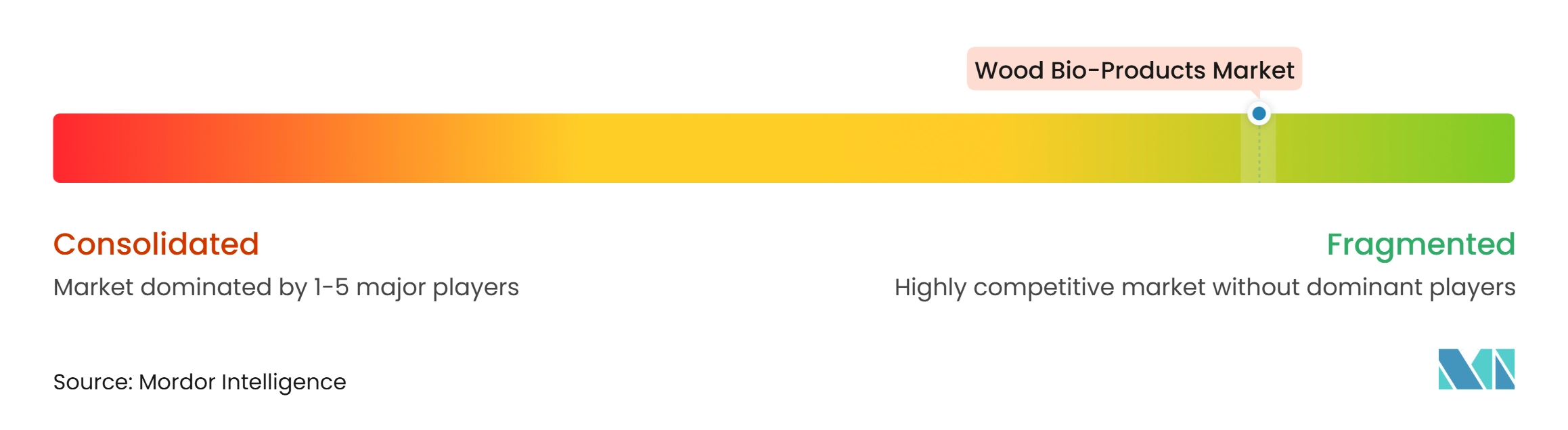
The wood bio-products market is highly fragmented, with the top five players including West Fraser Timber Co., Georgia-Pacific LLC, ARAUCO, Weyerhaeuser Company, and Stora Enso. West Fraser Timber Co. operated 28 lumber mills, 15 oriented strand board facilities, and 9 engineered wood mills at the end of 2025. European suppliers such as Binderholz GmbH, Metsä Group, EGGER, and Stora Enso compete through engineered products, sustainable sourcing, and specialized processing. ARAUCO, Canfor Corporation, Roseburg Forest Products, JELD-WEN, Inc., UFP Industries, Inc., Sappi Limited, and UPM Biochemicals extend the competitive field across pulp, panels, finished building products, industrial wood, and biochemicals. The wood bio-products market is therefore characterized by varied business models rather than a uniform group of suppliers.
Companies are investing in capacity and higher-value products to protect margins and meet changing demand. Georgia-Pacific LLC’s USD 140 million Englehart mill investment is expected to add log-processing and warehousing capability, with higher output planned after completion. Boise Cascade completed a major plywood-mill modernization in Louisiana and progressed its Alabama I-joist line ahead of commercial production. EGGER reported EUR 450 million (approximately USD 520 million) in fiscal 2025/2026 investment, including panel, recycling, and renewable-power projects. These actions indicate that producers are focusing on process efficiency, engineered materials, and more complete use of available fiber. They also raise the competitive importance of capital access and technical capability.
Residue conversion and digital services create additional areas of competition in the wood bio-products market. UPM Biochemicals opened its Leuna facility in October 2026 to produce renewable chemicals from wood-based feedstocks. The move demonstrates how low-value residual streams can become inputs for industrial products outside traditional lumber and panel categories. UFP Industries, Inc. uses digital tools to support order visibility and build closer links with construction customers. Roseburg Forest Products restarted construction of its Dillard medium-density fiberboard project in Oregon during 2026, targeting late 2028 commissioning. Competitive outcomes will depend on fiber security, compliance readiness, product performance, and the ability to provide dependable service across construction and industrial applications.
Wood Bio-Products Industry Leaders
-
West Fraser Timber Co.
-
Georgia-Pacific LLC
-
ARAUCO
-
Weyerhaeuser Company
-
Stora Enso
- *Disclaimer: Major Players sorted in no particular order
Wood Bio-Products Market Companies Covered in this Report
- ARAUCO
- Binderholz GmbH
- Boise Cascade
- Canfor Corporation
- EGGER
- Georgia-Pacific LLC
- JELD-WEN, Inc.
- LP Building solutions
- Metsä Group
- Roseburg Forest Products
- Sappi Limited
- Stora Enso
- UFP Industries, Inc.
- UPM Biochemicals
- West Fraser Timber Co.
- Weyerhaeuser Company
Recent Industry Developments in Wood Bio-Products Market
- October 2026: Fibenol's SWEETWOODS biorefinery in Imavere, Estonia, reached technology readiness level 8, demonstrating the industrial-scale conversion of hardwood residues into lignin and wood sugars. The facility converts more than 90% of its feedstock into valuable biomaterials, supporting the wood bio-products market by improving the commercial utilization of forestry waste in chemicals, construction, and polymer applications.
- June 2025: The European Union launched the WoodVALOR research and innovation project to develop technologies for recycling contaminated waste wood into bio-based chemicals and polymers. The initiative is expected to run through May 2028 and received funding from the Circular Bio-based Europe Joint Undertaking, supporting the wood bio-products market through research into circular feedstock recovery and renewable material production.
Global Wood Bio-Products Market Report Scope
Wood bio-products are materials and products derived from wood and processed biomass for use in construction, manufacturing, and other applications. They utilize renewable wood resources and support the production of value-added materials through processing and conversion.
The Wood Bio-Products Market is segmented by type, distribution channel, application, and geography. By type, the market is segmented into finished wood products, manufactured wood materials, and wood processing. By distribution channel, the market is segmented into online and offline. By application, the market is segmented into residential and commercial. The report also covers the market size and forecasts for wood bio-products across 16 countries. For each segment, the market sizing and forecasts have been done on the basis of value (USD).
Segmentation Overview
| Finished Wood Products |
| Manufactured Wood Materials |
| Wood Processing |
| Online |
| Offline |
| Residential |
| Commercial |
| Asia-Pacific | China |
| India | |
| Japan | |
| South Korea | |
| ASEAN Countries | |
| Rest of Asia-Pacific | |
| North America | United States |
| Canada | |
| Mexico | |
| Europe | Germany |
| United Kingdom | |
| France | |
| Italy | |
| NORDIC Countries | |
| Russia | |
| Rest of Europe | |
| South America | Brazil |
| Argentina | |
| Rest of South America | |
| Middle East and Africa | Saudi Arabia |
| South Africa | |
| Rest of Middle East and Africa |
| By Type | Finished Wood Products | |
| Manufactured Wood Materials | ||
| Wood Processing | ||
| By Distribution Channel | Online | |
| Offline | ||
| By Application | Residential | |
| Commercial | ||
| By Geography | Asia-Pacific | China |
| India | ||
| Japan | ||
| South Korea | ||
| ASEAN Countries | ||
| Rest of Asia-Pacific | ||
| North America | United States | |
| Canada | ||
| Mexico | ||
| Europe | Germany | |
| United Kingdom | ||
| France | ||
| Italy | ||
| NORDIC Countries | ||
| Russia | ||
| Rest of Europe | ||
| South America | Brazil | |
| Argentina | ||
| Rest of South America | ||
| Middle East and Africa | Saudi Arabia | |
| South Africa | ||
| Rest of Middle East and Africa | ||
Key Questions Answered in the Report
What is the size of the wood bio-products market?
The wood bio-products market size was valued at USD 363.95 billion in 2026 and is estimated to grow from USD 394.13 billion in 2027 to reach USD 591.27 billion by 2032, at a CAGR of 8.45% during the forecast period (2027-2032).
What is driving demand for wood bio-products?
Engineered wood adoption, residential construction and renovation, green-building requirements, residue utilization, and digital procurement support demand.
Which type is projected to advance fastest through 2032?
Manufactured wood materials are projected to advance at a 9.56% CAGR through 2032, supported by mass timber and prefabricated construction.
Which application held the largest share in 2026?
Residential held 64.78% of the wood bio-products market share in 2026, supported by housing construction, repairs, and interior upgrades.