
Wine Vinegar Market Size and Share
Market Overview
| Study Period | 2022 - 2032 |
|---|---|
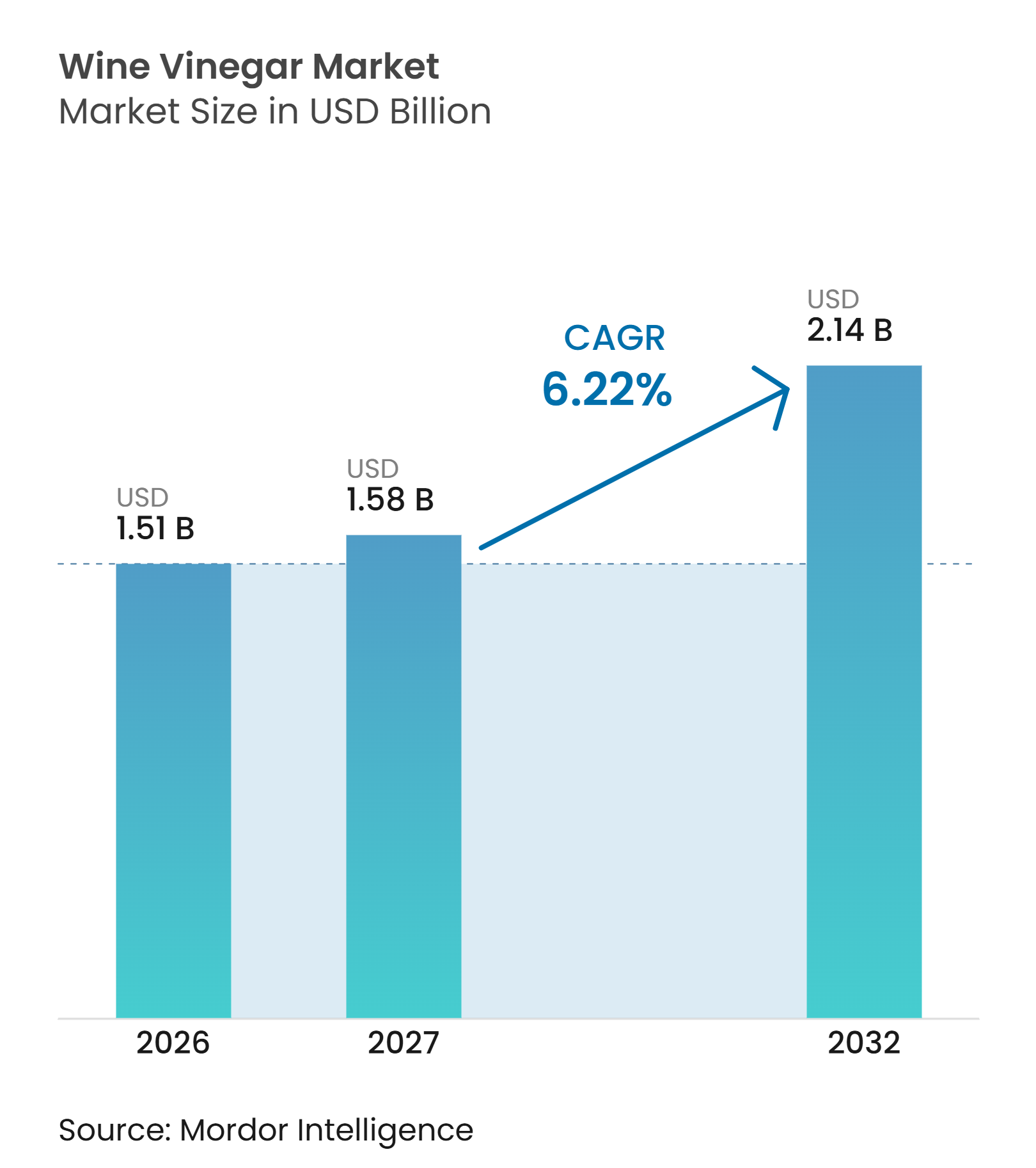
| Market Size (2027) | USD 1.58 Billion |
| Market Size (2032) | USD 2.14 Billion |
| Growth Rate (2027 - 2032) | 6.22 % |
| Fastest Growing Market | Asia-Pacific |
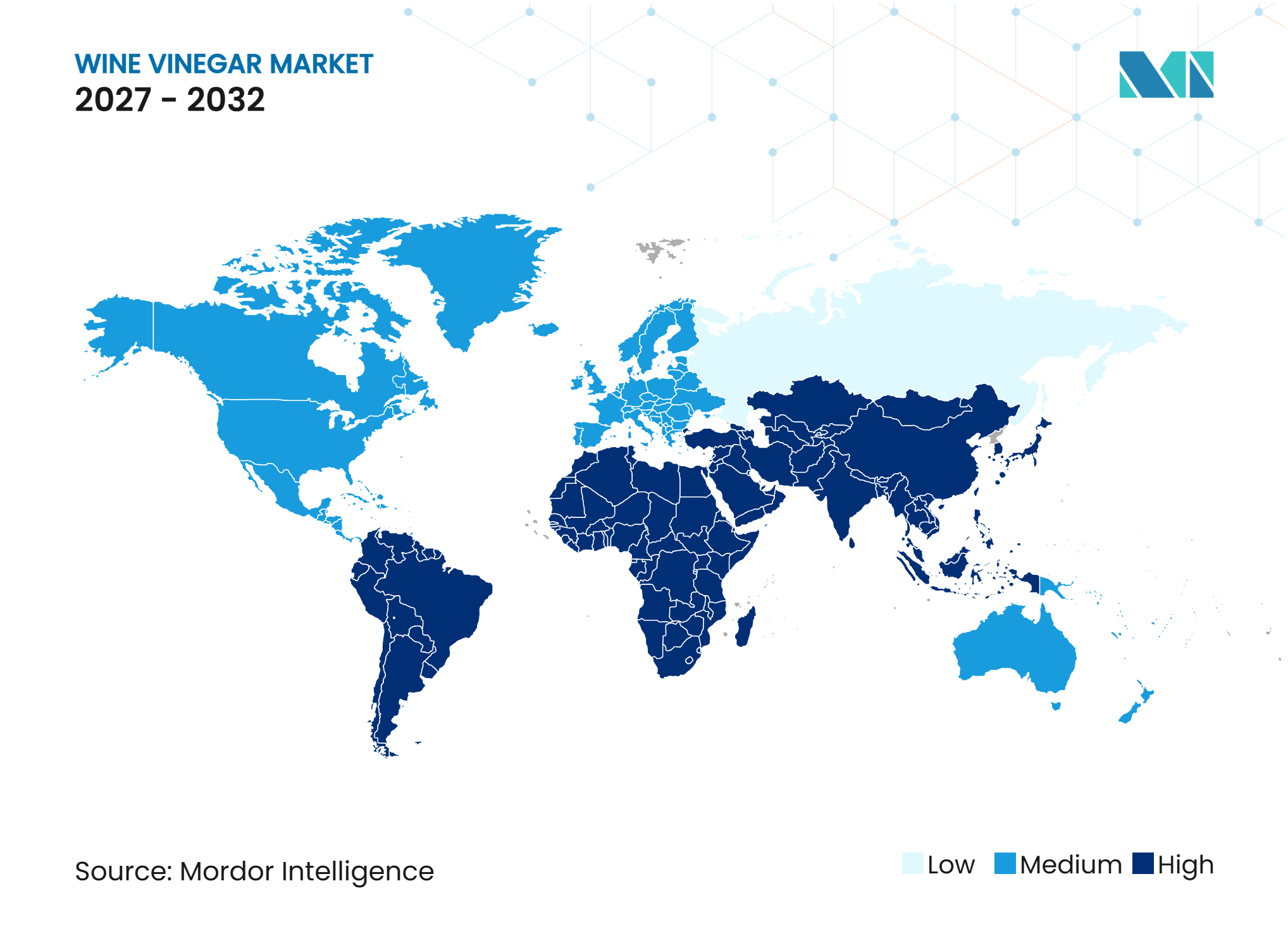
| Largest Market | Europe |
| Market Concentration | Low |
Major Players *Disclaimer: Major Players sorted in no particular order Image © Mordor Intelligence. Reuse requires attribution under CC BY 4.0. | |
Wine Vinegar Market Analysis by Mordor Intelligence
The wine vinegar market size was valued at USD 1.51 billion in 2026 and is projected to reach USD 2.14 billion by 2032, at a CAGR of 6.2% during the forecast period from 2027 to 2032. The wine vinegar market is supported by packaged-food reformulation, premium condiment demand, and continued home cooking in major consumer countries. Naturally fermented products can serve both flavor and preservation needs, which gives suppliers a role in sauces, dressings, marinades, and other prepared foods. Premium and origin-linked products create a separate opportunity from price-led retail products, especially where producers can demonstrate quality and traceability. Competition remains strongest in undifferentiated products, where lower-cost vinegars and other acidulants limit pricing flexibility.
Key Report Takeaways
-
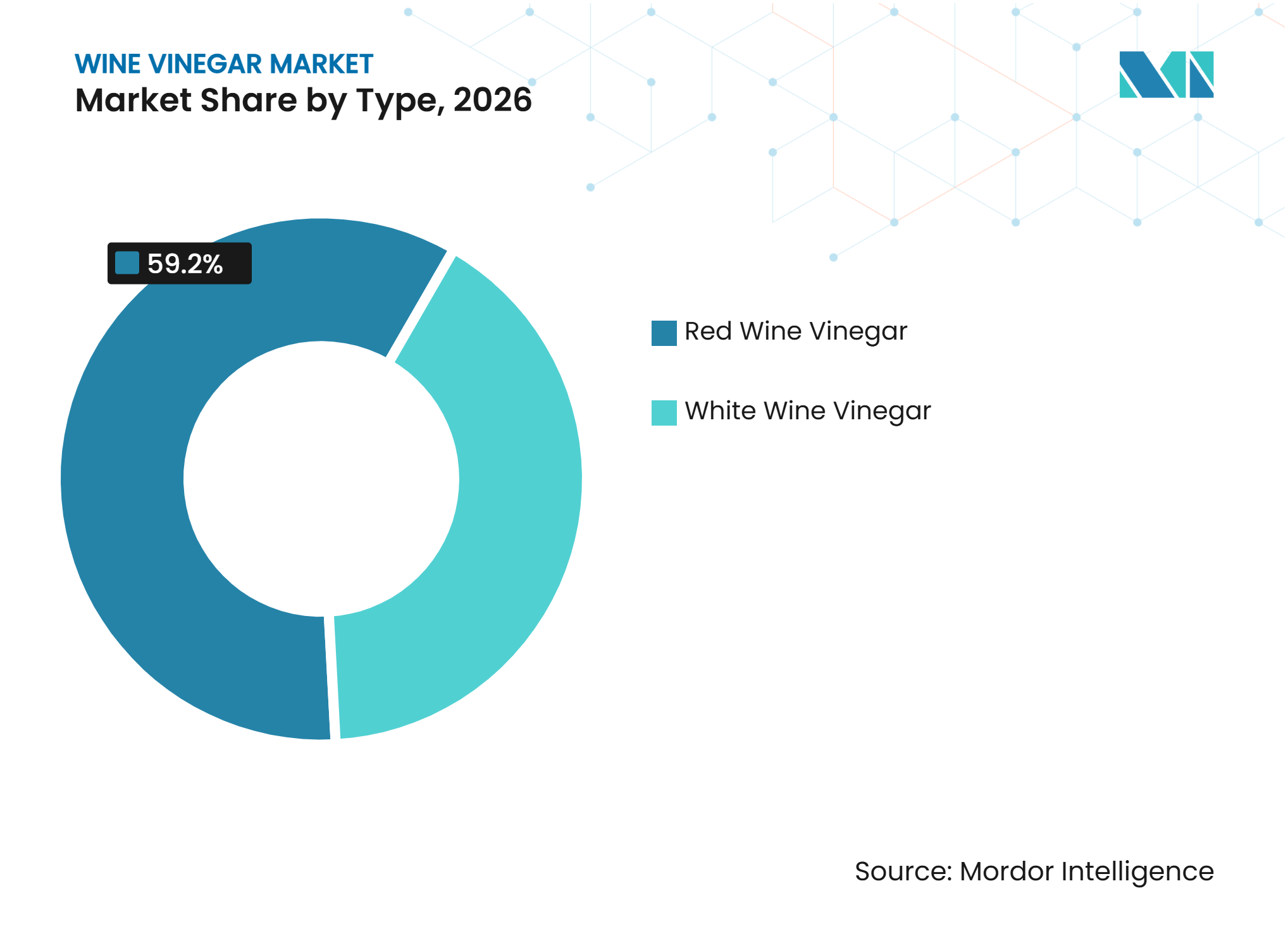
By type, red wine vinegar held 59.2% of the wine vinegar market share in 2026, while white wine vinegar is projected to grow at a 7.3% CAGR through 2032.
-
By category, conventional wine vinegar held 85.3% of revenue in 2026, while organic wine vinegar is projected to grow at an 8.2% CAGR through 2032.
-
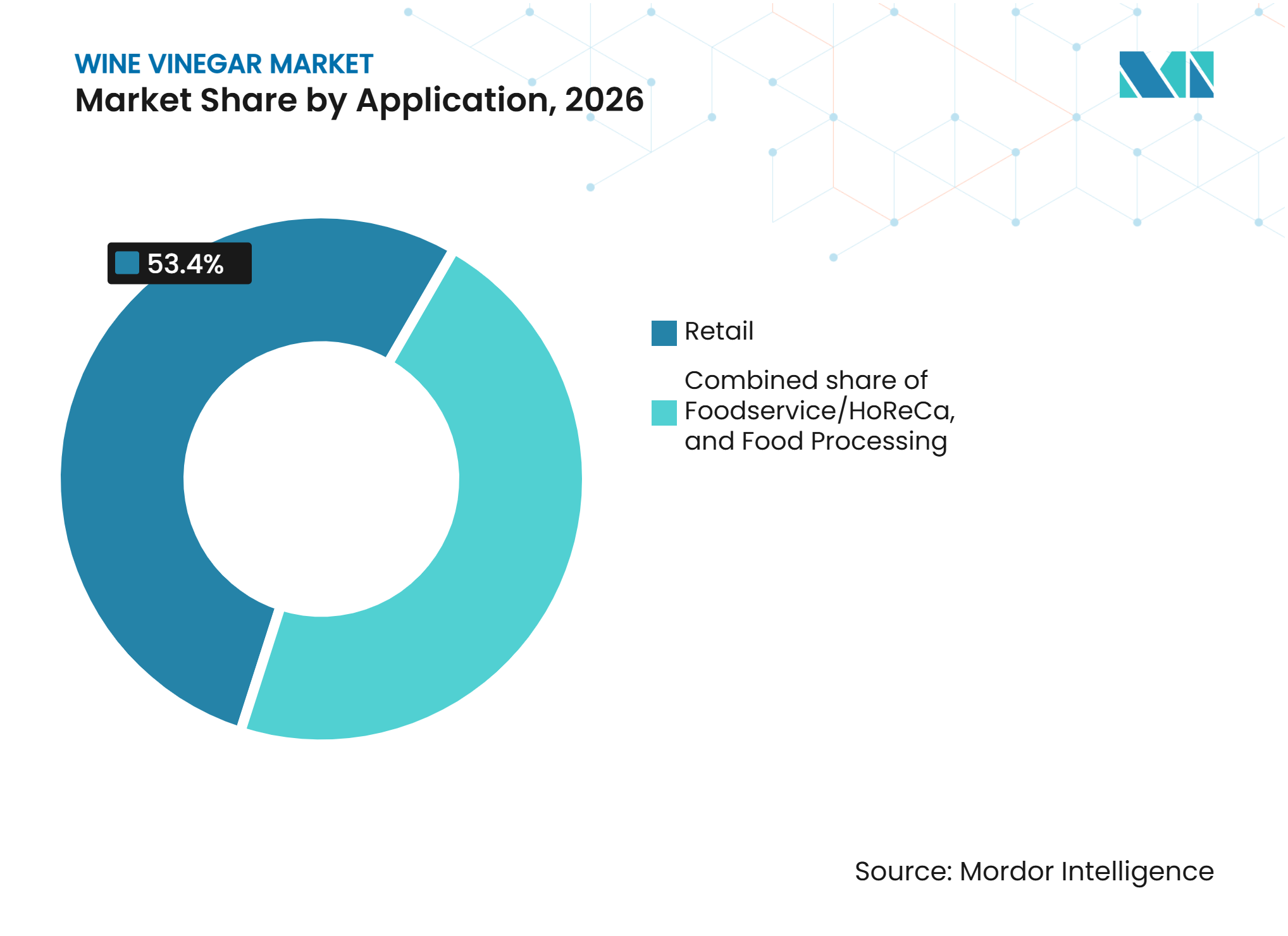
By application, retail accounted for 53.4% of revenue in 2026, while foodservice and HoReCa are projected to grow at an 8.5% CAGR through 2032.
-
By geography, Europe held 57.3% of revenue in 2026, while Asia-Pacific is projected to grow at a 9.2% CAGR through 2032.
Note: Market numbers in this report are based on Mordor Intelligence's proprietary estimation framework, which combines nine months of actuals with Q4 projections for base year 2026.
Market Trends and Insights
Drivers Impact Analysis of Wine Vinegar Market*
| Driver | (~) % Impact on CAGR Forecast | Geographic Relevance | Impact Timeline |
|---|---|---|---|
| Broader Incorporation of Wine Vinegar into Packaged Sauces, Dressings and Other Processed Foods | +1.3% | Global, strongest in North America and Europe | Medium term (2-4 years) |
| Growing Multi-application Use of Wine Vinegar in Home Cooking | +1.0% | North America, Europe, and emerging Asia-Pacific | Short term (≤ 2 years) |
| Increasing Use of Wine Vinegar as a Differentiated Acidulant | +0.8% | Global, particularly North America and Europe | Medium term (2-4 years) |
| Expansion of the culinary and food service industry | +1.1% | Asia-Pacific core, with spillover to the Middle East and Africa | Medium term (2-4 years) |
| Growth of Premium and Artisanal Culinary Segments | +0.9% | Europe and North America | Long term (≥ 4 years) |
| Growing Demand for Clean-label and Authentic Food Products | +0.7% | Europe, North America, and Asia-Pacific | Short term (≤ 2 years) |
| Source: Mordor Intelligence | |||
Broader Incorporation of Wine Vinegar Into Packaged Sauces, Dressings and Other Processed Foods
Food manufacturers use fermented vinegar where recipes require acidity, flavor, and a recognizable ingredient name. This supports use in shelf-stable sauces, dressings, condiments, and ready-to-eat preparations. Wine vinegar can support preservation objectives while remaining visible on labels as a familiar food ingredient. That positioning matters as food companies place greater emphasis on clear ingredient lists and certified inputs. Organic supply can add certification value to this functional role, particularly for products aimed at premium retail shelves. The wine vinegar market can therefore benefit when manufacturers make longer-term changes to recipes rather than short-term promotional changes.
Growing Multi-application Use of Wine Vinegar in Home Cooking
Home cooking supports demand for condiments that can be used in several recipes rather than one narrow occasion. A 2025 survey of 5,000 U.S. adults by HelloFresh found that 93% expected to cook at home as much as or more than in the prior year during the following 12 months. Among respondents cooking more, 85% cited economic pressure and 81% cited health goals. Wine vinegar fits dressings, marinades, pickling, deglazing, and cooking sauces, which gives households practical reasons to keep it in the kitchen. Economic pressure also raises the value of ingredients that perform more than one role in meal preparation. The wine vinegar market benefits when shoppers move beyond salad dressing and use the product in preservation and everyday cooking.
Increasing Use of Wine Vinegar as a Differentiated Acidulant
Food formulators can use wine vinegar where an acidulant must also add a distinct flavor profile. Different wine varietals can give red and white vinegar different aromatic and visual characteristics. This gives product developers more scope than a neutral acidulant provides in marinades, sauces, and prepared foods. Fermented inputs can also support traceability stories when buyers need clarity on ingredient origin and processing. The wine vinegar industry can use this role to compete on formulation value rather than on acidity alone. Its relevance is strongest in products where the final taste and the ingredient declaration both influence the buyer decision.
Growth of Premium and Artisanal Culinary Segments
Premium vinegar demand is linked to greater interest in provenance, production method, and ingredient quality. Small-batch and varietal-specific products can command higher prices in specialty retail, e-commerce, and fine-dining procurement. This separates artisanal products from standard products that compete chiefly on price and volume. European producers benefit from established production heritage and protected origin systems in this part of the wine vinegar market. Acetum reported product launches for its Mazzetti L'Originale range in the United Kingdom and United States, including a Modena PGI glaze with Habanero chili pepper. Chef relationships and culinary education can further strengthen placement where menu value supports premium pricing.
Restraints Impact Analysis of Wine Vinegar Market*
| Restraint | (~) % Impact on CAGR Forecast | Geographic Relevance | Impact Timeline |
|---|---|---|---|
| Competition from Lower-Cost Vinegar Alternatives | -0.9% | Global, strongest in Asia-Pacific and emerging markets | Short term (≤ 2 years) |
| Stringent Product Specifications and Regulatory Requirements | -0.5% | Europe and North America | Medium term (2-4 years) |
| Volatility In Wine and Grape-Material Costs | -0.6% | Global, especially European Union and Australian wine-producing regions | Short term (≤ 2 years) |
| Limited Suitability for Neutral, High-Volume Industrial Applications | -0.4% | Global | Long term (≥ 4 years) |
| Source: Mordor Intelligence | |||
Competition From Lower-cost Vinegar Alternatives
Wine vinegar competes with rice vinegar, apple cider vinegar, distilled vinegar, and acidulant blends that can cost less to produce. This pressure is strongest in foodservice formats where high heat or strong seasonings reduce the importance of a specific vinegar flavor. Some upscale restaurants also use lemon concentrate, citric acid, pomegranate molasses, tamarind, or yuzu for menu differentiation. These alternatives can displace wine vinegar without being direct substitutes in every recipe. Authenticity requirements in Europe distinguish genuine fermented vinegar from products using synthetic acetic acid. Mid-tier producers without a strong brand, protected origin, or distinctive flavor profile face the greatest pressure on margins.
Volatility in Wine and Grape-material Costs
Wine vinegar producers depend on wine and grape-derived inputs, so changes in wine production conditions affect procurement decisions. The global vineyard area fell to 7.0 million hectares in 2025, marking the sixth consecutive annual decline. Lower vineyard area can eventually tighten the availability of suitable wine materials, even when some bulk markets experience temporary oversupply. Smaller producers may be particularly exposed because they often rely on contracted supply and cannot spread purchasing risk across large volumes. The contrast between bulk-grade availability and premium input costs creates difficult planning conditions for the middle of the wine vinegar market. It can also widen the operating gap between large processors and artisanal producers that require defined grape quality or origin.
*Our forecasts treat driver/restraint impacts as directional, not additive. The impact forecasts reflect baseline growth, mix effects, and variable interactions.
Wine Vinegar Market Segment Analysis
By Type:
Red Wine Leads, White Vinegar Broadens Application RangeRed wine vinegar held 59.2% of the wine vinegar market share in 2026, driven by its established use in Mediterranean-style cooking. It is commonly used in marinades, dressings, tomato-based sauces, and braised meat preparations. Its fuller flavor works well with herbs, tomatoes, and other strong ingredients. Food processors use red wine vinegar in sauces and condiments where both flavor and acidity matter. Production is concentrated in major wine regions in Italy, Spain, and France, giving conventional red wine vinegar a supply advantage. European protected designation rules support the identity of higher-value products from these regions.
White wine vinegar is projected to grow at a 7.3% CAGR from 2027 to 2032, making it the faster-growing type. Its lighter color and milder flavor make it suitable for dishes where red wine vinegar could alter appearance or overpower taste. Key applications include white-meat and seafood marinades, hollandaise sauces, herb vinaigrettes, and light vegetable pickles. These uses align with the growth of European-influenced foodservice in Asian markets. Artisanal producers can differentiate with Chardonnay, Pinot Grigio, and Sauvignon Blanc variants, offering specialty retailers a product story based on varietal origin. Though smaller in volume, this niche sits outside commodity pricing and gives producers a route to premium placement in the wine vinegar market.


By Category:
Conventional Scale Sustains, Organic Gains Structural MomentumConventional wine vinegar accounted for 85.3% of revenue in 2026, driven by its established position in mass retail and industrial food production. Foodservice operators and private-label buyers favor it for its lower cost per liter. Large processors rely on it for pickled foods, sauces, condiments, dressings, and marinades. The segment benefits from established supply networks, fewer input constraints, and no organic certification requirements. National food safety standards for food-grade acidity and fermentation still apply. These advantages keep conventional wine vinegar as the preferred choice for high-volume buyers across mass-market channels and high-turnover grocery sales.
Organic wine vinegar is projected to grow at an 8.2% CAGR from 2027 to 2032, the highest growth rate in the category. Ingredion's 2025 research found that Gen Z and Millennial consumers were willing to pay 20–30% more for clean-label and organic products, with 45% citing health and wellness as their primary purchase priority. In European markets, the Centre for the Promotion of Imports noted rising demand for natural ingredients and transparent product claims. Organic certification is increasingly a listing requirement in premium and specialty retail. However, producers must manage higher sourcing, documentation, and audit costs. This growth gives the wine vinegar market access to higher-value demand and favors producers with established traceable organic supply relationships.
By Application:
Retail Anchors the Base, HoReCa Propels the Next WaveRetail accounted for 53.4% of revenue in 2026, making it the dominant application channel. Home cooking continues to drive purchases through supermarkets, specialty stores, and online channels, with a 2025 U.S. consumer survey citing financial and health considerations as primary reasons. Wine vinegar is sold as a staple in Mediterranean-style cooking and as a specialty item for more exploratory recipes. The retail channel also gives small producers a route to market artisanal, protected-origin, and organic products at higher price points. Food processing represents another significant outlet, covering sauces, dressings, marinades, pickled products, and condiments. The premium retail tier allows producers to grow revenue without a proportional rise in sales volume, supporting a broader price ladder. Retailers can carry everyday products alongside those differentiated by varietal, certification, or regional origin, serving both regular household use and occasional premium purchases.
The foodservice and HoReCa segment is projected to grow at an 8.5% CAGR from 2027 to 2032. Restaurant expansion and increased dining-out activity are expected to drive professional demand, particularly in Asia-Pacific markets. European culinary methods incorporate wine vinegar across sauces, marinades, dressings, and preservation techniques. According to the International Organisation of Vine and Wine, Japan's wine consumption grew 6.8% in 2025 to 3.3 million hectoliters, reflecting continued engagement with wine-related products and European dining formats[1]. Professional kitchens prioritize product quality over price, making the channel relevant for both standard and premium suppliers. Foodservice buyers use common products for everyday preparation and distinctive variants for menu-specific dishes, while restaurant use can further support retail visibility by introducing consumers to new wine vinegar varieties.

Geography Analysis
Europe
Europe held 57.3% of revenue in 2026, giving the region the leading wine vinegar market size by share. Italy, France, and Spain combine wine production, established culinary use, and long-standing vinegar processing traditions. Italy remains important for Balsamic Vinegar of Modena PGI production and exports. Certified production and export activity show the global reach of the region's premium vinegar products. Spain also has established protected vinegar designations, including Jerez, Condado de Huelva, and Montilla-Moriles. Spain's food market authority identifies vinegar as a distinct category within its national food-market reporting. The European Union's geographical indication framework protects qualifying names and production links, strengthening authenticity in export markets. These compliance factors support premium pricing and provide a barrier against misleading origin claims.
Asia-Pacific
Asia-Pacific is projected to grow at a 9.2% CAGR from 2027 to 2032, the fastest rate among the reported regions. Urbanization, rising incomes, and more European-influenced restaurant formats support interest in imported and differentiated condiments. China, Japan, Southeast Asia, and India have different consumption patterns, but each offers routes through foodservice, premium stores, or e-commerce. Japan's wine consumption reached 3.3 million hectoliters in 2025 after 6.8% growth. This provides a relevant setting for European-style foodservice and wine-related culinary ingredients. India remains an early-stage opportunity where premium supermarkets and online retailers serve consumers exploring international foods. China's wine consumption declined 13% in 2025 to 4.8 million hectoliters. That decline shows that premium demand can remain sensitive to consumer spending conditions, even as wine vinegar availability may benefit from local wine supply.
North America, South America, Middle East and Africa
North America is supported by bottled dressings, marinades, specialty condiments, and foodservice formats that use Mediterranean and European recipes. The United States provides the largest base, while Canada follows similar premium consumption patterns on a smaller scale. Mexico can expand demand through organized retail, foodservice development, and cross-border distribution. South America combines production potential with changing wine consumption patterns. Argentina's wine consumption fell for the fifth consecutive year to 7.5 million hectoliters in 2025, while Brazil's consumption rose 41.9% to 4.4 million hectoliters. Argentina may have scope to use available wine stocks for domestic vinegar processing. Middle East and Africa demand is earlier-stage and is mainly tied to premium hospitality and specialty retail. South Africa offers a regional wine-production base, while the United Arab Emirates, Saudi Arabia, and Morocco provide hospitality-led import opportunities. These mixed regions remain dependent on retail development, restaurant demand, and access to premium imported products.
Competitive Landscape
Market Concentration
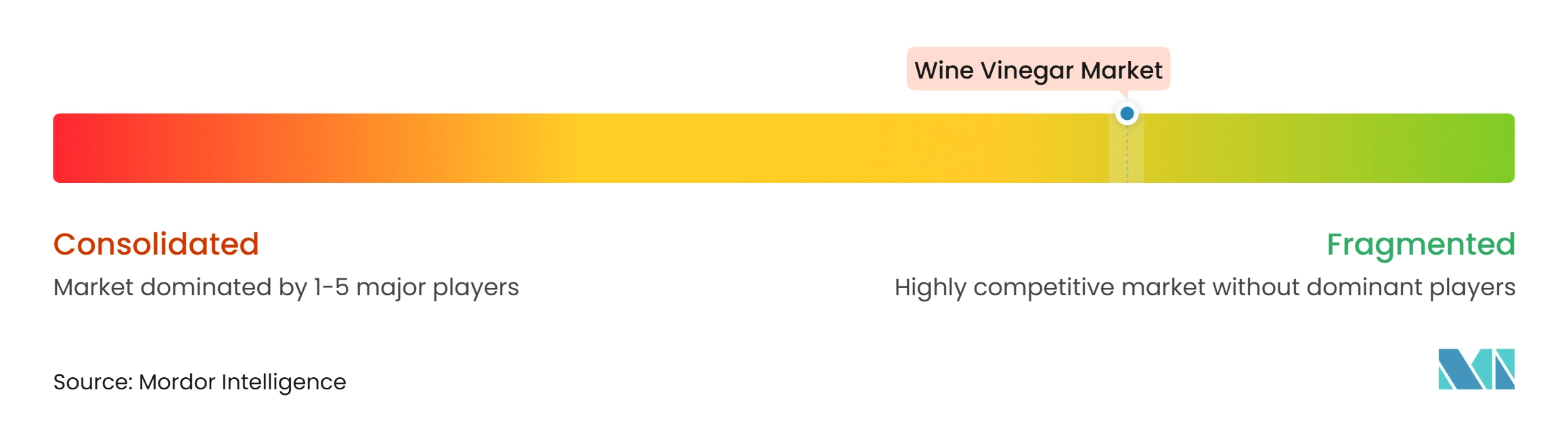
The wine vinegar market exhibits a fragmented structure with no single player holding a dominant global position. Italian heritage producers, Japanese vinegar groups, private-label suppliers, and regional artisanal businesses serve different price and distribution tiers. Acetum, a notable Italian producer, differentiates its premium portfolio through origin, product development, and sustainability initiatives. Its 2024-2025 sustainability report highlighted product launches in the United Kingdom, United States, and Germany, along with B Corporation recertification and supplier engagement through sustainability questionnaires and workshops. These actions show how governance and product innovation can reinforce premium positioning. Other suppliers compete on manufacturing scale, retailer access, and broad condiment portfolios, while the fragmented structure continues to create room for regional specialists with credible product stories.
Premium organic, protected-origin, and formulation-grade products are the principal areas for differentiation. Organic products appeal where health and clean-label expectations influence specialty-store listings. Protected-origin products are relevant to direct-to-consumer channels, gift purchases, and restaurants that value culinary heritage. Formulation-grade products give suppliers access to processed food applications requiring traceable fermented acidulants. Smaller producers emphasizing single-varietal sourcing and small-batch methods offer claims that broad commodity portfolios struggle to replicate consistently. Supply chain transparency is increasingly important as buyers seek verifiable fermentation origin and documented inputs. European geographical indication rules support product protection and consumer confidence.
Price competition remains significant in mass retail, food processing, and budget foodservice. Rice vinegar, distilled vinegar, apple cider vinegar, and synthetic acidulants can limit price increases for standard products. Premium suppliers must demonstrate taste, origin, certification, or formulation performance to justify higher price points. Acetum expanded recycled-plastic packaging for its Fini glaze range, introduced a tamper-evident cap design, and reported real-time water monitoring, a 25% expansion in photovoltaic generation, and an 8% reduction in natural gas use per liter of finished product during 2025. These measures strengthen supplier credibility with customers that review packaging and operational practices. Competitive success will depend on balancing reliable supply, product authenticity, and price discipline.
Wine Vinegar Industry Leaders
-
Ponti S.P.A
-
Carl Kühne KG
-
Acetificio Marcello De Nigris
-
Mizkan America, Inc.
-
The Kraft Heinz Company
- *Disclaimer: Major Players sorted in no particular order
Wine Vinegar Market Companies Covered in this Report
- Acetum S.p.A.
- De Nigris 1889 S.r.l.
- Mizkan Holdings Co., Ltd.
- Pompeian, Inc.
- Colavita S.p.A.
- The Kraft Heinz Company
- Curation Foods, Inc.
- Spectrum Organic Products, LLC
- Borges International Group, S.L.U.
- Lucini Italia Company
- Sparrow Lane Vinegars
- Holland House
- Ponti S.P.A
- Carl Kühne KG
- Aspall Cyder Ltd.
- Burg Groep B.V.
- Castelo Alimentos S/A
- Eden Foods, Inc.
- Australian Vinegar Pty Ltd
- Acetificio Marcello De Nigris
Recent Industry Developments in Wine Vinegar Market
- May 2026: Acetum S.p.A. published its 2024–2025 Sustainability Report extract, confirming that Mazzetti L'Originale expanded its product range with a Balsamic Vinegar of Modena PGI and Habanero Chilli Pepper glaze launched in the UK and USA, and an Insalata Italiana condiment developed specifically for the German market, strengthening its European premium portfolio.
- February 2026: Acetum began re-certification as a B Corporation under new, more rigorous evaluation criteria, while simultaneously initiating a responsible procurement program engaging 50 strategic wine, must, and packaging suppliers through structured ESG questionnaires and two dedicated sustainability workshops, marking a significant supply-chain governance upgrade.
- January 2026: Acetum's Fini brand introduced rPET packaging incorporating 50% recycled plastic for its glaze range, alongside a new tamper-evident cap design, as part of the group's commitment to lower-impact packaging and circular material use.
Global Wine Vinegar Market Report Scope
The Wine Vinegar Market refers to the market for vinegar produced through the fermentation of wine, in which alcohol is converted into acetic acid, resulting in a product used as an ingredient in food preparation, seasoning, preservation, and culinary applications. By type, the market is segmented into red wine vinegar and white wine vinegar. By category, the market is divided into conventional and organic products. By application, the market is segmented into food processing, retail, and foodservice/HoReCa. The food processing segment is further divided into sauces and condiments, salad dressings and vinaigrettes, marinades, pickle products, and others. Geographically, the market covers North America, Europe, Asia-Pacific, South America, and the Middle East and Africa, with country-level coverage across major markets, including the United States, Canada, Mexico, Germany, the United Kingdom, Italy, France, Spain, the Netherlands, Poland, Belgium, Sweden, China, India, Japan, Australia, Indonesia, South Korea, Thailand, Singapore, Brazil, Argentina, Colombia, Chile, Peru, South Africa, Saudi Arabia, the United Arab Emirates, Nigeria, Egypt, Morocco, and Turkey, along with the respective regional rest-of-country categories. Market size and growth forecasts are presented in terms of value (USD) and volume (Liters).
Segmentation Overview
| Red Wine Vinegar |
| White Wine Vinegar |
| Conventional |
| Organic |
| Food Processing | Sauces and Condiments |
| Salad dressings and vinaigrettes | |
| Marinades | |
| Pickle Products | |
| Others | |
| Retail | |
| Foodservice/HoReCa |
| North America | United States |
| Canada | |
| Mexico | |
| Rest of North America | |
| Europe | Germany |
| United Kingdom | |
| Italy | |
| France | |
| Spain | |
| Netherlands | |
| Poland | |
| Belgium | |
| Sweden | |
| Rest of Europe | |
| Asia-Pacific | China |
| India | |
| Japan | |
| Australia | |
| Indonesia | |
| South Korea | |
| Thailand | |
| Singapore | |
| Rest of Asia-Pacific | |
| South America | Brazil |
| Argentina | |
| Colombia | |
| Chile | |
| Peru | |
| Rest of South America | |
| Middle East and Africa | South Africa |
| Saudi Arabia | |
| United Arab Emirates | |
| Nigeria | |
| Egypt | |
| Morocco | |
| Turkey | |
| Rest of Middle East and Africa |
| By Type | Red Wine Vinegar | |
| White Wine Vinegar | ||
| By Category | Conventional | |
| Organic | ||
| By Application | Food Processing | Sauces and Condiments |
| Salad dressings and vinaigrettes | ||
| Marinades | ||
| Pickle Products | ||
| Others | ||
| Retail | ||
| Foodservice/HoReCa | ||
| By Geography | North America | United States |
| Canada | ||
| Mexico | ||
| Rest of North America | ||
| Europe | Germany | |
| United Kingdom | ||
| Italy | ||
| France | ||
| Spain | ||
| Netherlands | ||
| Poland | ||
| Belgium | ||
| Sweden | ||
| Rest of Europe | ||
| Asia-Pacific | China | |
| India | ||
| Japan | ||
| Australia | ||
| Indonesia | ||
| South Korea | ||
| Thailand | ||
| Singapore | ||
| Rest of Asia-Pacific | ||
| South America | Brazil | |
| Argentina | ||
| Colombia | ||
| Chile | ||
| Peru | ||
| Rest of South America | ||
| Middle East and Africa | South Africa | |
| Saudi Arabia | ||
| United Arab Emirates | ||
| Nigeria | ||
| Egypt | ||
| Morocco | ||
| Turkey | ||
| Rest of Middle East and Africa | ||
Key Questions Answered in the Report
What is the projected value of the wine vinegar sector by 2032?
The wine vinegar market is projected to reach USD 2.14 billion by 2032, growing at a 6.2% CAGR from 2027.
Which type leads wine vinegar sales?
Red wine vinegar leads by type with 59.2% share in 2026, while white wine vinegar has the faster projected growth rate of 7.3% through 2032.
Why is organic wine vinegar growing faster than conventional products?
Organic wine vinegar is projected to grow at 8.2% CAGR as clean-label, health, wellness, and certification requirements gain importance in premium channels.
Which sales channel is growing fastest for wine vinegar?
Foodservice and HoReCa are projected to grow at 8.5% CAGR through 2032, supported by restaurant expansion and wider use of European culinary techniques.