
Windows Integrated Single Sign-On Market Size and Share
Market Overview
| Study Period | 2021 - 2032 |
|---|---|
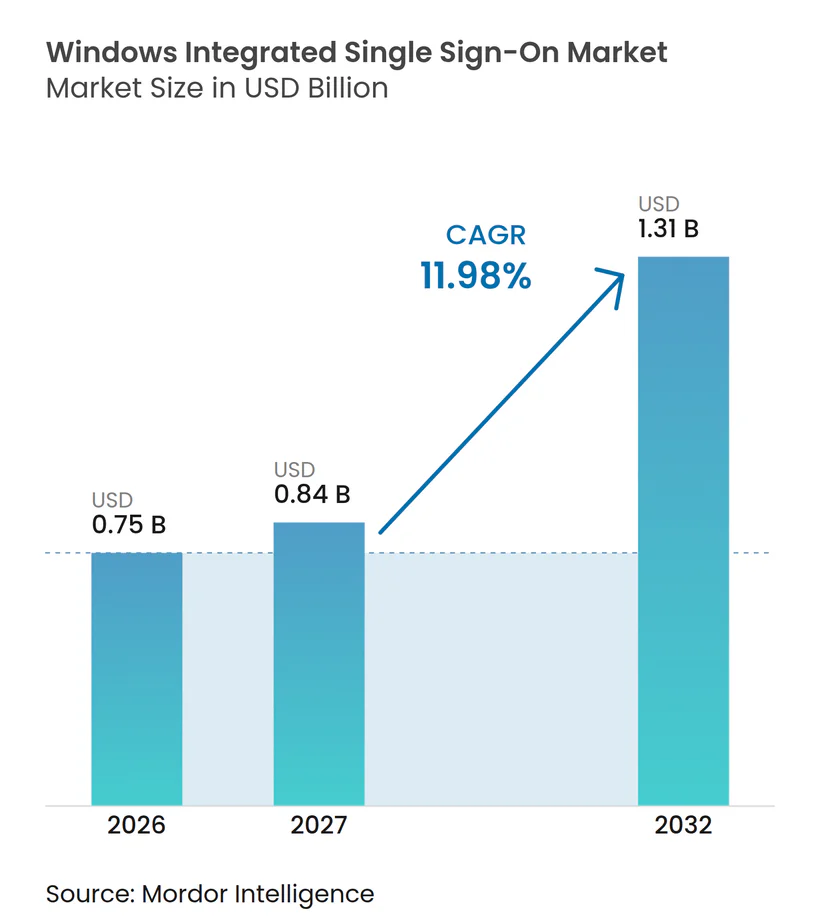
| Market Size (2027) | USD 0.84 Billion |
| Market Size (2032) | USD 1.31 Billion |
| Growth Rate (2027 - 2032) | 11.98 % |
| Fastest Growing Market | Asia-Pacific |
| Largest Market | North America |
| Market Concentration | Medium |
Major Players *Disclaimer: Major Players sorted in no particular order Image © Mordor Intelligence. Reuse requires attribution under CC BY 4.0. | |
Windows Integrated Single Sign-On Market Analysis by Mordor Intelligence
The Windows integrated single sign-on market size was valued at USD 0.75 billion in 2026 and is estimated to expand to USD 1.31 billion by 2032, at a CAGR of 11.98% during the forecast period 2027-2032. The Windows integrated single sign-on market is being shaped by the retirement of older NTLM-based authentication, the need to protect a wider range of user sessions, and the requirement to secure access across hybrid work environments. Enterprises are connecting on-premises Active Directory environments with cloud applications, which makes seamless authentication a continuing operating requirement across employee, partner, and administrator access. Regulatory expectations for auditable and phishing-resistant identity controls are also raising the priority of identity modernization, particularly where organizations need clearer evidence of authentication and session governance. Microsoft’s NTLMv1 hardening changes add urgency because affected organizations must review MS-CHAPv2-dependent Wi-Fi, VPN, and remote-access configurations before legacy methods create operational disruption. The Windows integrated single sign-on market also faces longer deployment cycles where legacy applications have undocumented authentication dependencies, directory structures are mixed, and identity engineering resources are limited.
Key Report Takeaways
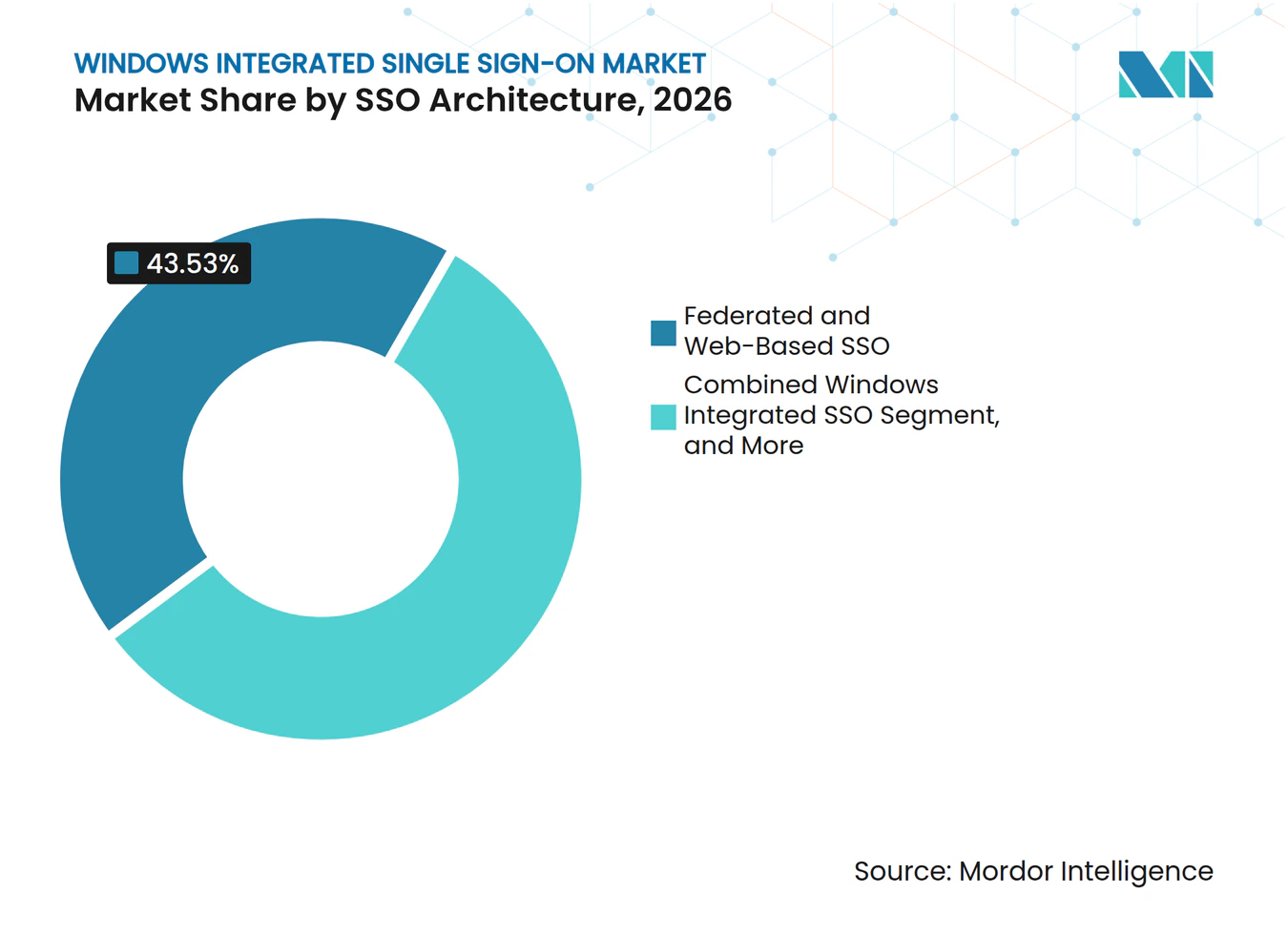
- By SSO architecture, Federated and Web-Based SSO held 43.53% of 2026 revenue, while Windows Integrated SSO is projected to expand at a 12.45% CAGR through 2032.
- By organization size, large enterprises accounted for 74.42% of 2026 revenue, while SMEs are projected to expand at a 12.84% CAGR through 2032.
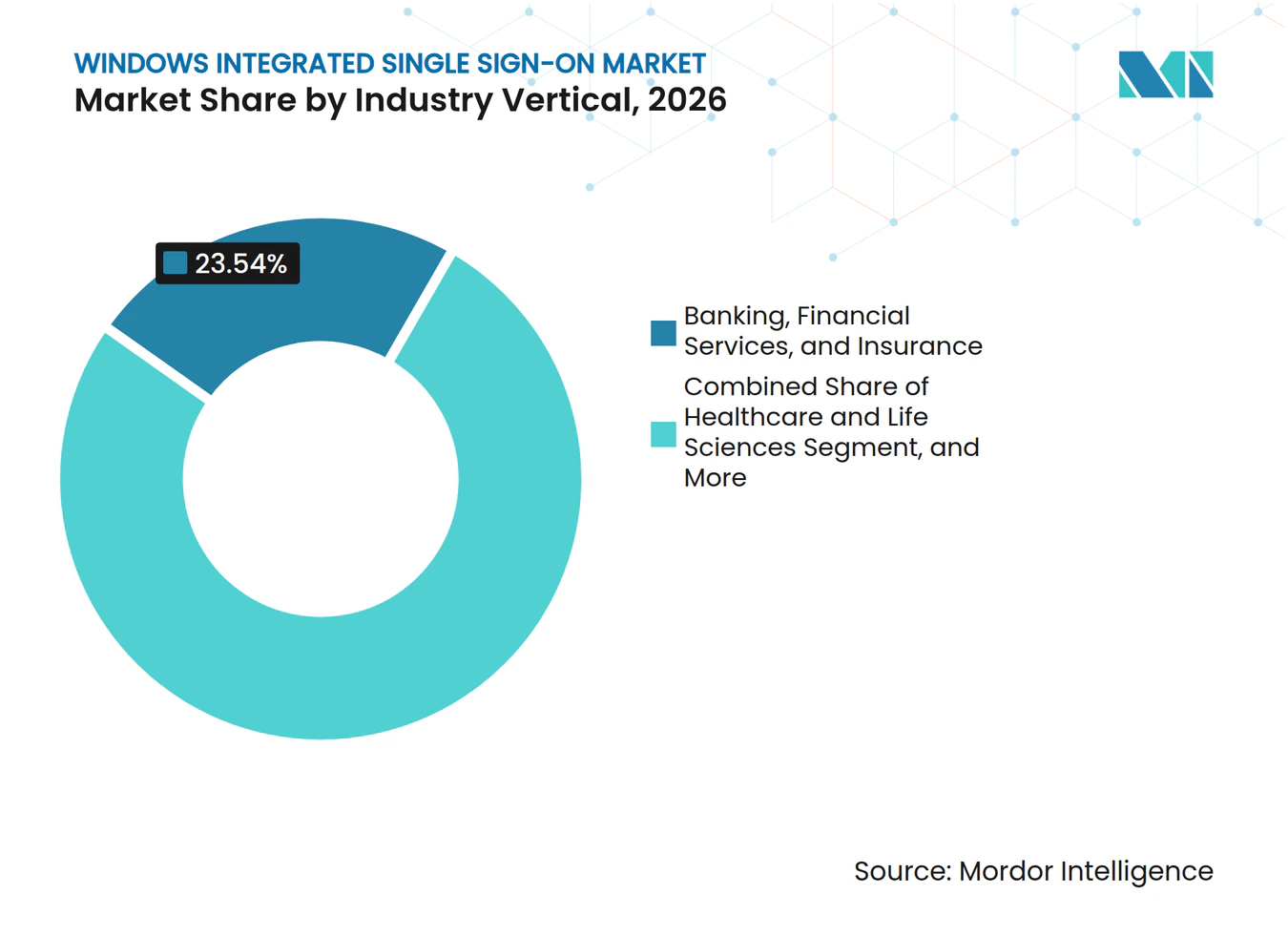
- By industry vertical, BFSI held 23.54% of 2026 revenue, while Healthcare and Life Sciences is projected to expand at a 12.67% CAGR through 2032.
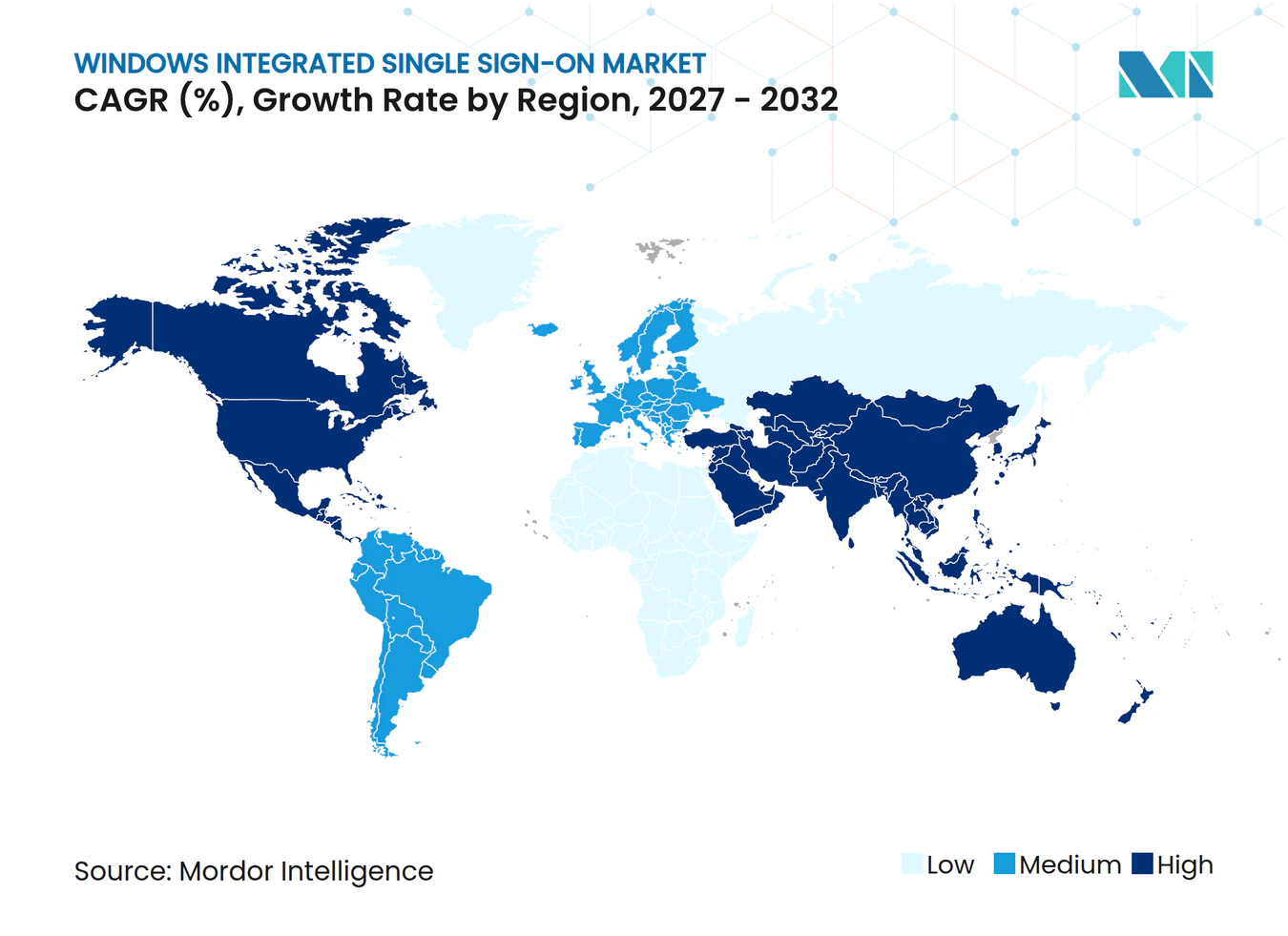
- By geography, North America accounted for 39.21% of the Windows integrated single sign-on market share in 2026, while Asia-Pacific is projected to expand at a 12.74% CAGR through 2032.
Note: Market numbers in this report are based on Mordor Intelligence's proprietary estimation framework, which combines nine months of actuals with Q4 projections for base year 2026.
Market Trends and Insights
Drivers Impact Analysis of Windows Integrated Single Sign-On Market*
| Driver | (~) % Impact on CAGR Forecast | Geographic Relevance | Impact Timeline |
|---|---|---|---|
| Accelerating Cloud and Hybrid Workforce Adoption | +2.8% | Global, with concentrated gains in North America and Europe | Short term (≤ 2 years) |
| Expansion of Zero-Trust Access Controls | +2.4% | Global, strongest in North America, Europe, and Asia-Pacific | Medium term (2-4 years) |
| Rising Passwordless Windows Login Adoption | +1.8% | North America and Europe, with spillover to Asia-Pacific | Medium term (2-4 years) |
| Increasing Modernization of Legacy Windows Applications | +1.5% | Global, pronounced in Asia-Pacific and South America | Long term (≥ 4 years) |
| Windows Identity Integration With SaaS and On-Premises Applications | +1.2% | Global | Medium term (2-4 years) |
| Growing Exposure of Remote Desktop Protocol Environments | +1.0% | Global | Short term (≤ 2 years) |
| Source: Mordor Intelligence | |||
Accelerating Cloud and Hybrid Workforce Adoption
Hybrid cloud deployment has changed the way organizations manage Windows identity because users need access to on-premises applications and cloud services in the same working session, often from managed and remote devices. The Windows integrated single sign-on market benefits when organizations need a consistent sign-in experience across Active Directory, cloud directories, and software-as-a-service applications without separate credentials or repeat authentication prompts. Microsoft Entra seamless SSO automatically signs in eligible users on corporate devices connected to a corporate network through Kerberos authentication.[1] This capability does not require extra on-premises components, which helps organizations use it within existing hybrid Entra Connect designs and reduce disruption during cloud adoption. Many enterprises retain legacy applications and regulated data stores that cannot be moved without substantial redesign, so hybrid identity remains an ongoing operating requirement rather than a short transition. Organizations with 50 to 150 employees are also moving away from fully on-premises directory environments, creating demand below the traditional large-enterprise buyer base and increasing interest in simpler managed deployment models.
Expansion of Zero-Trust Access Controls
Zero-trust programs place identity verification at the center of access decisions, which increases the importance of Windows-integrated authentication across workforce applications and infrastructure. The Windows integrated single sign-on market is supported when buyers connect authentication data with ongoing risk assessment for devices, sessions, user behavior, and changing access conditions. SANS documented the use of behavioral analytics to assess session risk by considering factors such as login timing, device health, and geography.[2]The U.S. Department of Labor integrated more than 200 applications with Microsoft Entra ID for SSO as part of its zero-trust program. The same program replaced privileged-account passwords with device-bound passkeys and reported faster sign-ins in Microsoft testing, showing how identity modernization can address both security and access experience. NIST SP 800-63-4 provides current digital identity guidance, giving organizations a common reference point when they select authentication methods, define assurance practices, and document controls.
Rising Passwordless Windows Login Adoption
Windows Hello for Business and FIDO2 passkeys are replacing password-plus-MFA flows in enterprise Windows environments, particularly where organizations want to reduce dependence on reusable credentials. The Windows integrated single sign-on market gains from this change because passwordless sign-in needs to work across endpoints, applications, remote access, privileged sessions, and shared administrative processes. RSA introduced mobile passkeys and QR-code Windows Desktop Login in 2025 through RSA ID Plus enhancements.[3] RSA stated that its platform serves more than 9,000 high-security organizations managing over 60 million identities. Ping Identity introduced Just-in-Time Privileged Access through PingOne Privilege, providing passwordless access to RDP, SSH, and IAM resources with Trusted Platform Module protection and audit support. Microsoft’s work to move Windows authentication away from older Kerberos encryption methods further reduces the role of legacy password-dependent configurations and requires active remediation planning.
Increasing Modernization of Legacy Windows Applications
Legacy Windows applications often depend on NTLM, LDAP, or WS-Federation configurations that were not documented when those applications were deployed or later updated. The Windows integrated single sign-on market has a clear role when organizations need to identify these dependencies, assign ownership, and connect older applications to current identity controls. Microsoft has stated that network NTLM authentication is planned for default disablement in future major Windows Server and client releases. Microsoft also described the move beyond RC4 as part of a broader effort to strengthen Windows authentication and reduce the use of less secure methods. Organizations can publish legacy applications through Microsoft Entra Application Proxy, use Azure Virtual Desktop with Entra Kerberos, or re-platform applications with modern protocols. Each route requires application discovery, policy design, testing, remediation, and ongoing maintenance, which sustains implementation demand across the migration lifecycle.
Restraints Impact Analysis of Windows Integrated Single Sign-On Market*
| Restraint | (~) % Impact on CAGR Forecast | Geographic Relevance | Impact Timeline |
|---|---|---|---|
| Concentration of Identity Infrastructure Around Microsoft Platforms | -1.4% | Global | Long term (≥ 4 years) |
| High Integration Complexity Across Legacy Windows Estates | -1.2% | Global, most acute in South America, Europe, and Asia-Pacific | Medium term (2-4 years) |
| Identity Engineering and Implementation Talent Shortages | -0.8% | Global | Medium term (2-4 years) |
| Data Residency and Audit Requirements for Hybrid Authentication | -0.5% | Europe and Asia-Pacific, with spillover to the Middle East | Long term (≥ 4 years) |
| Source: Mordor Intelligence | |||
Concentration of Identity Infrastructure Around Microsoft Platforms
Microsoft provides the core Windows authentication stack through Active Directory, Entra ID, and Entra Connect, giving it a central position in many buyers’ identity architecture. This concentration can limit the room for independent vendors to differentiate products in environments that are already standardized on Microsoft tools and operating practices. The Windows integrated single sign-on market therefore has a more limited opening for third-party providers in single-directory deployments. Buyers can face high switching costs when they evaluate complementary platforms, which may lengthen procurement cycles and narrow the scope of some engagements. NTLM and RC4 retirement programs support modernization, but they can also direct existing Microsoft customers toward Entra Kerberos and Entra seamless SSO because those options fit their current environment. Independent providers retain the strongest opportunity in multi-directory, multi-cloud, and cross-partner federation settings where native tools need protocol translation, extended orchestration, or specialized deployment support.
High Integration Complexity Across Legacy Windows Estates
Older Windows estates may contain unrecorded NTLM fallback settings in Wi-Fi, VPN, print-server, or application environments, even when teams believe Kerberos is the primary method. Microsoft warned that organizations may not know NTLM is active because some applications silently use it when Kerberos fails. The Windows integrated single sign-on market can be delayed when project teams must first discover those dependencies, identify affected services, and establish a realistic migration plan. Mixed directory structures and multi-vendor federation configurations add testing requirements and can increase implementation costs across business applications. Identity orchestration platforms can help by brokering authentication translation at runtime without application code changes, but they do not remove the need for careful inventory, validation, and operational planning. These conditions keep demand intact while extending the time needed to move from a technology decision to production deployment.
*Our forecasts treat driver/restraint impacts as directional, not additive. The impact forecasts reflect baseline growth, mix effects, and variable interactions.
Windows Integrated Single Sign-On Market Segment Analysis
By SSO Architecture:
Federation Leads While Windows Integration AcceleratesFederated and Web-Based SSO held 43.53% of the Windows integrated single sign-on market share in 2026, reflecting the broad use of SAML 2.0 and OpenID Connect for cloud application access across varied business systems. Federation is used across software-as-a-service applications, partner portals, and business-to-business environments where browser-based sign-in has become a familiar access pattern. Its position comes from its ability to link diverse applications and external organizations without relying on a single device, network context, or Windows endpoint configuration. Enterprise and Legacy SSO remains relevant for organizations that run on-premises Windows applications requiring NTLM or Kerberos fallback authentication. These environments still need an SSO layer that can work around established application dependencies while maintaining continuity for users and administrators.
Windows Integrated SSO is projected to expand at a 12.45% CAGR from 2027 to 2032. The Windows integrated single sign-on industry is being supported by Entra Kerberos and the Primary Refresh Token model used with Windows 10 and later endpoints, which links device management with cloud application access. Microsoft describes hybrid Microsoft Entra join as an approach that lets organizations maintain access to on-premises resources while using cloud capabilities. Microsoft’s guided work for moving applications from AD FS to Entra SSO, together with RC4-related review activity, directs attention to identity modernization and surfaces previously unmapped dependencies. These reviews can turn passive legacy estates into defined migration programs that require planned testing, application ownership, and phased deployment.



By Organization Size:
Large Enterprises Lead While SMEs Gain AccessLarge enterprises accounted for 74.42% of 2026 revenue because they manage broad application portfolios, sizable identity populations, and complex directory structures across business units. Their procurement programs often combine SSO, MFA, lifecycle management, and governance within longer-term platform contracts that require coordination among security, infrastructure, and application teams. Large organizations also need to manage cross-subsidiary trust relationships when acquired businesses use separate Windows domains. These circumstances create substantial integration requirements that smaller deployments do not usually face. The Windows integrated single sign-on market size for large enterprises is reinforced by compliance-focused procurement in regulated sectors and by the operational cost of fragmented access controls.
SMEs are projected to expand at a 12.84% CAGR through 2032, supported by cloud-delivered identity subscriptions priced at USD 2 to USD 7 per user per month. Managed identity service models can also reduce the need for in-house specialists by moving platform operation, policy monitoring, and routine administration to a third-party provider. The Windows integrated single sign-on industry is becoming more accessible to organizations that previously viewed identity platforms as a large-enterprise purchase. Larger buyers can impose SOC 2 and zero-trust requirements on smaller suppliers, extending demand through supply chains in manufacturing, retail, and professional services. The result is a broader commercial buyer base, although implementation support remains important for smaller organizations that have limited dedicated identity resources.
By Industry Vertical:
Regulated Buyers Drive Deployment DensityBFSI held 23.54% of 2026 revenue because financial institutions operate under strong access-control, audit, and privileged-account requirements. This vertical’s revenue position is supported by MFA requirements and the need to preserve operational visibility across desktop, remote, and bring-your-own-device access. Financial institutions must secure desktop SSO and remote employees without creating separate access processes that increase administrative burden. RSA documented a large U.S. bank’s use of hybrid passwordless authentication with RSA and Microsoft Entra ID. IT and telecommunications also represents a significant area of demand because these organizations manage multi-cloud environments, hybrid network infrastructure, and distributed technical workforces.
Healthcare and Life Sciences is projected to expand at a 12.67% CAGR from 2027 to 2032. The proposed HIPAA Security Rule updates published in 2025 call for stronger authentication controls for electronic protected health information, including unique user identification, automatic logoff, and audit controls. These requirements align with centralized authentication and session-control capabilities used in Windows SSO deployments, particularly where clinical workers use shared devices and applications. Government and public-sector demand is influenced by zero-trust programs and federal identity modernization, while manufacturing demand is linked to supply-chain requirements and established Windows application estates. Retail, consumer packaged goods, and education remain relevant because distributed users, shared devices, and varied application environments can create a need for unified access management.

Geography Analysis
North America Windows Integrated Single Sign-On Market
North America accounted for 39.21% of 2026 revenue and retained the largest position in the Windows integrated single sign-on market. The region has a high concentration of Active Directory environments, early institutional adoption of zero-trust security practices, and established security procurement processes. U.S. federal programs provide visible examples of enterprise identity modernization, including the Department of Labor’s integration of more than 200 applications with Entra ID for SSO. NIST SP 800-63-4 also provides a current identity reference for organizations that need documented assurance approaches and defensible authentication decisions. This combination supports continued demand from enterprises that have large Windows device populations and mature governance expectations.
North America and Europe Windows Integrated Single Sign-On Market
Canada’s demand is influenced by provincial data-residency considerations and cross-border workforce access patterns, while Mexico is developing as a mid-enterprise opportunity as supply-chain partners require stronger access controls. Europe is the second-largest regional area, with the UK, Germany, and France generating much of the demand across regulated and industrial organizations. Germany’s manufacturing base and BFSI sector operate extensive Windows environments, where SAP and manufacturing-execution dependencies intersect with the need for detailed audit logging. These conditions make Entra-integrated SSO relevant across both industrial and regulated enterprise settings with complex application portfolios.
APAC, South America and MEA Windows Integrated Single Sign-On Market
Asia-Pacific is projected to expand at a 12.74% CAGR through 2032. Cloud migration, expanding digital workforces, and national identity requirements across China, India, Japan, South Korea, and Singapore support this outlook. The Windows integrated single sign-on market size in the region is influenced by the need to operate across jurisdictions with different authentication and data-handling requirements. India’s enterprise cloud adoption among large IT services organizations supports a fast-developing identity opportunity. South America remains less developed, with Brazil and Argentina accounting for initial banking and government deployments, while the Middle East is emerging through digitalization programs and Africa remains at an earlier stage, with South African financial-services modernization adding demand.
Competitive Landscape
Market Concentration
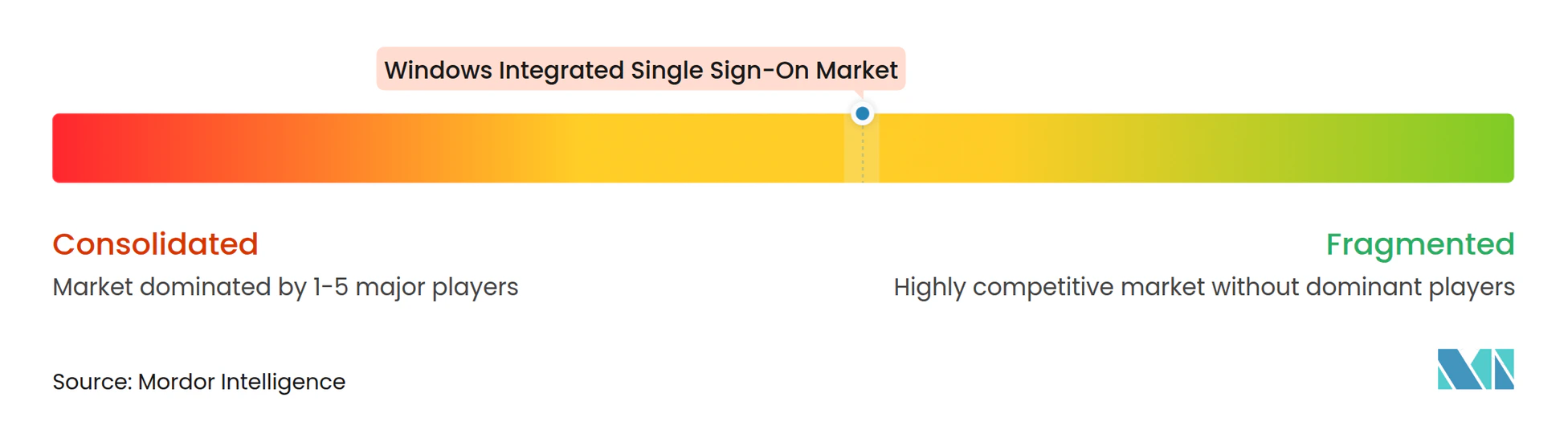
The Windows integrated single sign-on market is moderately consolidated and includes large platform vendors such as Okta, CyberArk, Ping Identity, and Entrust. Focused providers including JumpCloud, SecureAuth, Beyond Identity, Intercede, and miniOrange address enterprise, mid-market, and sector-specific requirements. Competition is increasingly shaped by platform breadth, with vendors extending SSO control planes into identity governance, privileged access management, identity threat detection and response, and AI-agent identity controls. This approach can help buyers connect SSO session data with wider identity, access, and security workflows across their technology estate.
CyberArk made its Identity Threat Detection and Response module generally available in April 2026, extending detection for lateral movement, credential misuse, and privilege escalation through Active Directory. Ping Identity introduced Just-in-Time Privileged Access in August 2025 through PingOne Privilege. The capability provides passwordless access to RDP, SSH, and IAM resources with device-level protection. RSA added mobile passkeys and QR-code Windows Desktop Login through its 2025 RSA ID Plus enhancements. These moves show how vendors are connecting passwordless authentication with broader security, privileged-access, and access-management needs.
The Windows integrated single sign-on market has openings in complex multi-directory environments where native tools need federation or protocol-translation support. A second opportunity is the SME segment below 500 seats, where managed identity delivery is still less developed among major platform providers. Intercede, Secfense, and COMTARSIA compete through protocol expertise at the smart-card, FIDO2, and Windows Credential Provider layers. Vendors can use SOC 2 Type II attestation, FedRAMP authorization, and ISO/IEC 27001 certification to support credibility in regulated sectors. Microsoft’s Windows and Entra ecosystem remains a central force because it provides the underlying directory and authentication environment for many enterprise buyers, making interoperability, migration support, and operational simplicity important competitive considerations.
Windows Integrated Single Sign-On Industry Leaders
-
Okta, Inc.
-
Ping Identity Corporation
-
OneLogin, Inc.
-
CyberArk Software Ltd.
-
miniOrange, Inc.
- *Disclaimer: Major Players sorted in no particular order
Windows Integrated Single Sign-On Market Companies Covered in this Report
- Okta, Inc.
- Ping Identity Corporation
- OneLogin, Inc.
- CyberArk Software Ltd.
- SailPoint, Inc.
- JumpCloud, Inc.
- RSA Security LLC
- SecureAuth Corporation
- Entrust Corporation
- miniOrange, Inc.
- Intercede Group plc
- My1Login Limited
- GraphOn Corporation
- Secfense sp. z o.o.
- COMTARSIA IT SERVICES GmbH
- Keeper Security, Inc.
- Bitwarden Inc.
- Beyond Identity, Inc.
- LoginRadius Inc.
- Auth0, Inc.
Recent Industry Developments in Windows Integrated Single Sign-On Market
- October 2026: Microsoft enforced NTLMv1 hardening changes across Windows 11 versions 26H2, 25H2, and 24H2 through its October 2026 security update, restricting NTLMv1-derived SSO credentials by default and directing enterprises to migrate MS-CHAPv2-dependent Wi-Fi, VPN, and remote access configurations to certificate-based authentication.
- October 2026: CyberArk has completed one year since the expansion of its Machine Identity Security portfolio with advanced discovery and context capabilities, delivering greater visibility and control over non-human identity credentials in mixed Windows and cloud environments.
- September 2026: Ping Identity launched Identity Agents on the Google Cloud Marketplace, expanding runtime identity controls availability for enterprise customers operating multi-cloud environments alongside Windows-centric on-premises stacks.
- August 2026: Ping Identity completed one year after its unveiling of Just-in-Time Privileged Access capabilities through PingOne Privilege, built following its acquisition of Procyon, delivering passwordless access to RDP, SSH, and IAM resources with TPM device-level protection and audit logs supporting SOX, SOC 2, GDPR, HIPAA, and PCI-DSS compliance for hybrid Windows infrastructure.
Global Windows Integrated Single Sign-On Market Report Scope
The Windows Integrated Single Sign-On (SSO) Market refers to the ecosystem of software platforms, authentication solutions, identity and access management (IAM) tools, and associated services that enable users to securely access multiple enterprise applications, systems, networks, and cloud resources through a single set of Windows credentials.
The Windows Integrated Single Sign-On Market Report is Segmented by SSO Architecture (Enterprise and Legacy SSO, Federated and Web-Based SSO, and Windows Integrated SSO), Organization Size (Large Enterprises and Small and Medium-Sized Enterprises), Industry Vertical (Banking, Financial Services, and Insurance, IT and Telecommunications, Healthcare and Life Sciences, Government and Public Sector, Manufacturing and Industrial, Retail and Consumer Packaged Goods, Education, and Other Industry Verticals), and Geography (North America [United States, Canada, and Mexico], South America [Brazil, Argentina, Chile, and Rest of South America], Europe [United Kingdom, Germany, France, Italy, Spain, Russia, and Rest of Europe], Asia-Pacific [China, India, Japan, South Korea, Australia, Singapore, and Rest of Asia-Pacific], Middle East [Saudi Arabia, United Arab Emirates, Turkey, Israel, and Rest of Middle East], and Africa [South Africa, Nigeria, Egypt, and Rest of Africa]). The Market Forecasts are Provided in Terms of Value (USD).
Segmentation Overview
| Enterprise and Legacy SSO |
| Federated and Web-Based SSO |
| Windows Integrated SSO |
| Large Enterprises |
| Small and Medium-Sized Enterprises |
| Banking, Financial Services, and Insurance |
| IT and Telecommunications |
| Healthcare and Life Sciences |
| Government and Public Sector |
| Manufacturing and Industrial |
| Retail and Consumer Packaged Goods |
| Education |
| Other Industry Verticals |
| North America | United States |
| Canada | |
| Mexico | |
| South America | Brazil |
| Argentina | |
| Chile | |
| Rest of South America | |
| Europe | United Kingdom |
| Germany | |
| France | |
| Italy | |
| Spain | |
| Russia | |
| Rest of Europe | |
| Asia-Pacific | China |
| India | |
| Japan | |
| South Korea | |
| Australia | |
| Singapore | |
| Rest of Asia-Pacific | |
| Middle East | Saudi Arabia |
| United Arab Emirates | |
| Turkey | |
| Israel | |
| Rest of Middle East | |
| Africa | South Africa |
| Nigeria | |
| Egypt | |
| Rest of Africa |
| By SSO Architecture | Enterprise and Legacy SSO | |
| Federated and Web-Based SSO | ||
| Windows Integrated SSO | ||
| By Organization Size | Large Enterprises | |
| Small and Medium-Sized Enterprises | ||
| By Industry Vertical | Banking, Financial Services, and Insurance | |
| IT and Telecommunications | ||
| Healthcare and Life Sciences | ||
| Government and Public Sector | ||
| Manufacturing and Industrial | ||
| Retail and Consumer Packaged Goods | ||
| Education | ||
| Other Industry Verticals | ||
| By Geography | North America | United States |
| Canada | ||
| Mexico | ||
| South America | Brazil | |
| Argentina | ||
| Chile | ||
| Rest of South America | ||
| Europe | United Kingdom | |
| Germany | ||
| France | ||
| Italy | ||
| Spain | ||
| Russia | ||
| Rest of Europe | ||
| Asia-Pacific | China | |
| India | ||
| Japan | ||
| South Korea | ||
| Australia | ||
| Singapore | ||
| Rest of Asia-Pacific | ||
| Middle East | Saudi Arabia | |
| United Arab Emirates | ||
| Turkey | ||
| Israel | ||
| Rest of Middle East | ||
| Africa | South Africa | |
| Nigeria | ||
| Egypt | ||
| Rest of Africa | ||
Key Questions Answered in the Report
What is the value of the Windows integrated single sign-on market?
The Windows integrated single sign-on market was valued at USD 0.75 billion in 2026 and is estimated to reach USD 1.31 billion by 2032, at an 11.98% CAGR for 2027-2032. The forecast reflects modernization of legacy authentication and the continuing need to connect on-premises and cloud applications.
Which SSO architecture has the largest revenue share?
Federated and Web-Based SSO held 43.53% of 2026 revenue, while Windows Integrated SSO is projected to record the fastest growth at a 12.45% CAGR through 2032. Federation remains critical for browser-based applications, partner ecosystems, and multi-cloud access environments requiring seamless authentication.
Why are enterprises modernizing Windows authentication?
Organizations are modernizing Windows authentication to address legacy NTLM and Kerberos dependencies, support hybrid application environments, and enable passwordless security initiatives. These transformations often require extensive application discovery, compatibility testing, and coordination among identity, security, networking, and application teams.
Which buyer group is adopting Windows SSO most quickly?
SMEs are expected to grow at a 12.84% CAGR through 2032 as cloud-based identity platforms and managed services reduce deployment complexity and operational costs. Adoption is also being driven by supplier security requirements and digital transformation initiatives across multiple industries.
Which vertical has the highest Windows SSO demand?
BFSI accounted for 23.54% of 2026 revenue, driven by stringent access-control, compliance, auditing, and privileged-account management requirements. Financial institutions also require consistent authentication across desktop, mobile, remote, and hybrid work environments.
Which region is expanding most quickly?
Asia-Pacific is projected to expand at a 12.74% CAGR through 2032, supported by accelerated cloud migration, digital workforce expansion, and enterprise modernization programs. Diverse regulatory environments across the region are increasing demand for flexible identity and authentication solutions.