
Whole Grain Food Market Size and Share
Market Overview
| Study Period | 2022 - 2032 |
|---|---|
| Market Size (2027) | USD 46.74 Billion |
| Market Size (2032) | USD 66.36 Billion |
| Growth Rate (2027 - 2032) | 7.26 % |
| Fastest Growing Market | Asia-Pacific |
| Largest Market | North America |
| Market Concentration | Medium |
Major Players *Disclaimer: Major Players sorted in no particular order Image © Mordor Intelligence. Reuse requires attribution under CC BY 4.0. | |
Whole Grain Food Market Analysis by Mordor Intelligence
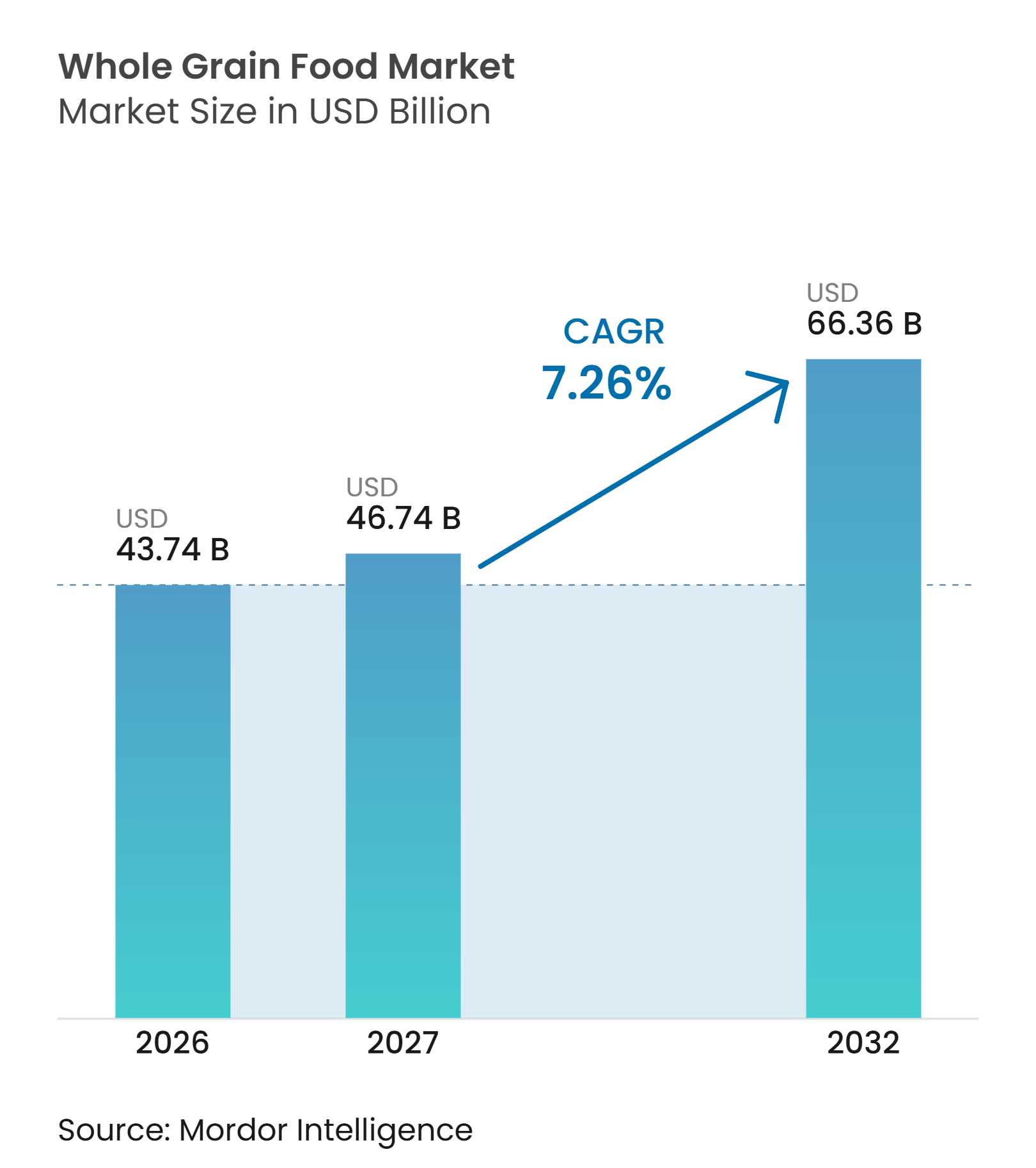
The whole grain food market size is valued at USD 43.74 billion in 2026 to USD 46.74 billion in 2027, and is forecast to reach USD 66.36 billion by 2032, is expected to reach a CAGR of 7.26% from 2027 to 2032. The whole grain food market is supported by consumers seeking foods with naturally occurring fiber and familiar ingredients. Dietary guidance and health research are strengthening demand for products that replace refined grains in everyday meals. According to the United States Department of Agriculture, the updated U.S. Dietary Guidelines for Americans prioritize fiber-rich whole grains and recommend lower intake of refined carbohydrates, which can affect food procurement, product formulation, and retail labeling decisions[1]. A 2025 systematic review from Springer Nature found a dose-dependent association between whole-grain intake and lower hypertension risk, which gives manufacturers support for nutrition-led communication when it meets applicable rules. Competition remains fragmented, so established food groups and smaller specialists are emphasizing protein, organic certification, grain diversity, and more transparent ingredient claims.
Key Report Takeaways
-
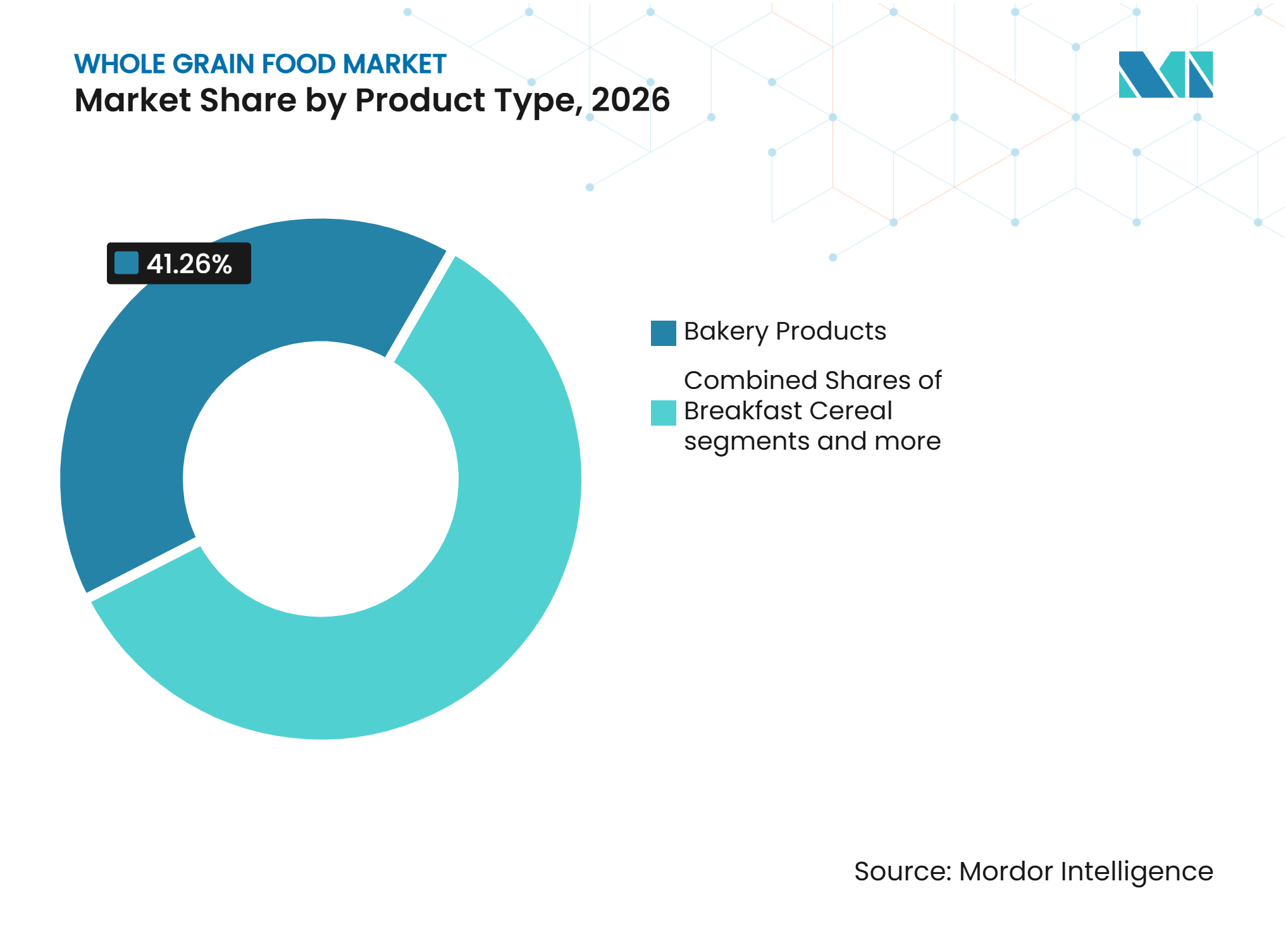
By product type, bakery products held 41.26% of the whole grain food market in 2026, while breakfast cereals are forecast to expand at an 8.57% CAGR through 2032.
-
By nature, conventional products held 63.47% of the whole grain food market in 2026, while organic products are forecast to expand at a 9.77% CAGR through 2032.
-
By grain type, wheat held 38.72% of the whole grain food market in 2026, while quinoa is forecast to expand at a 9.02% CAGR through 2032.
-
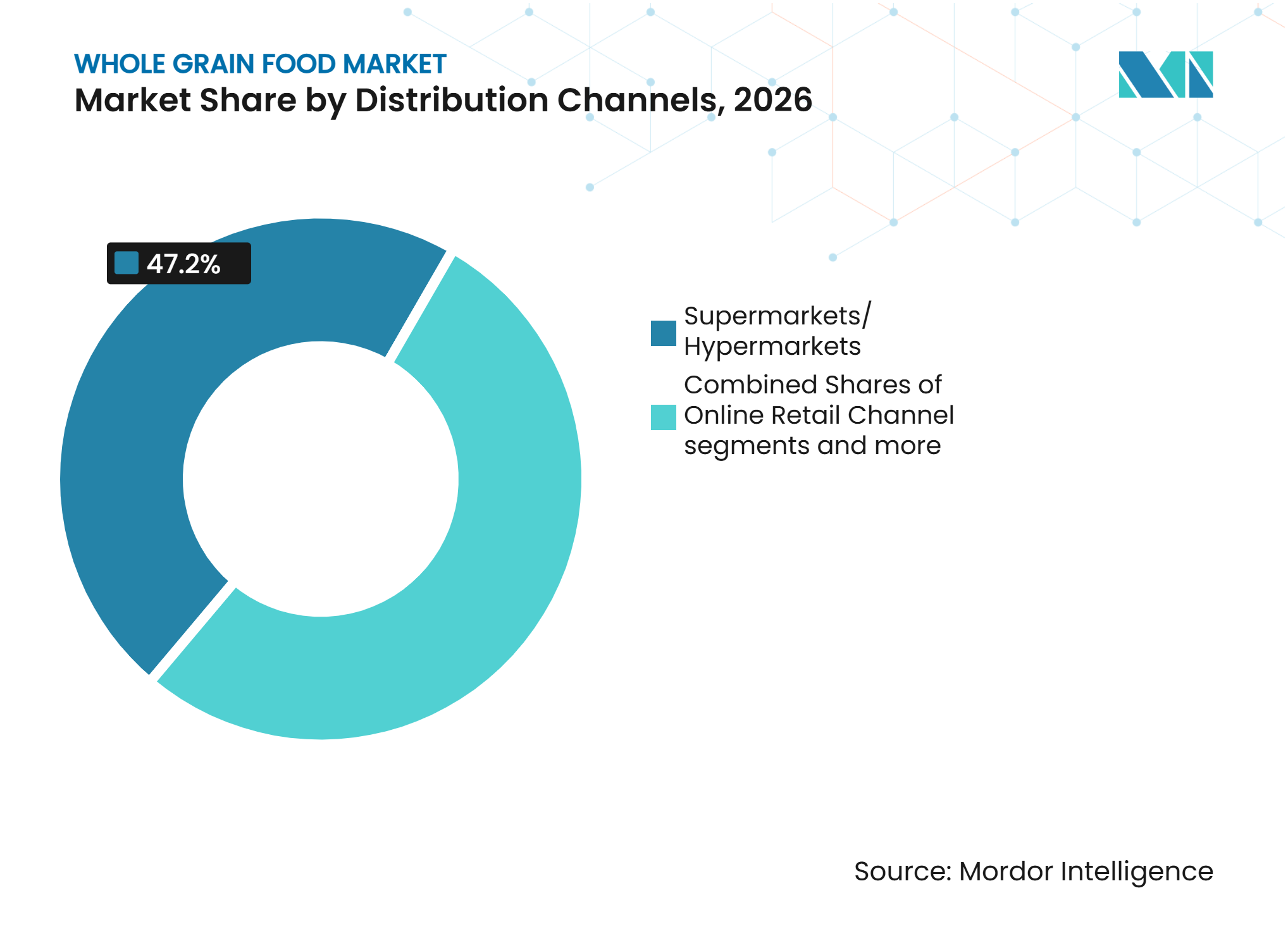
By distribution channel, supermarkets and hypermarkets held 47.20% of the whole grain food market in 2026, while online retail is forecast to expand at an 8.36% CAGR through 2032.
-
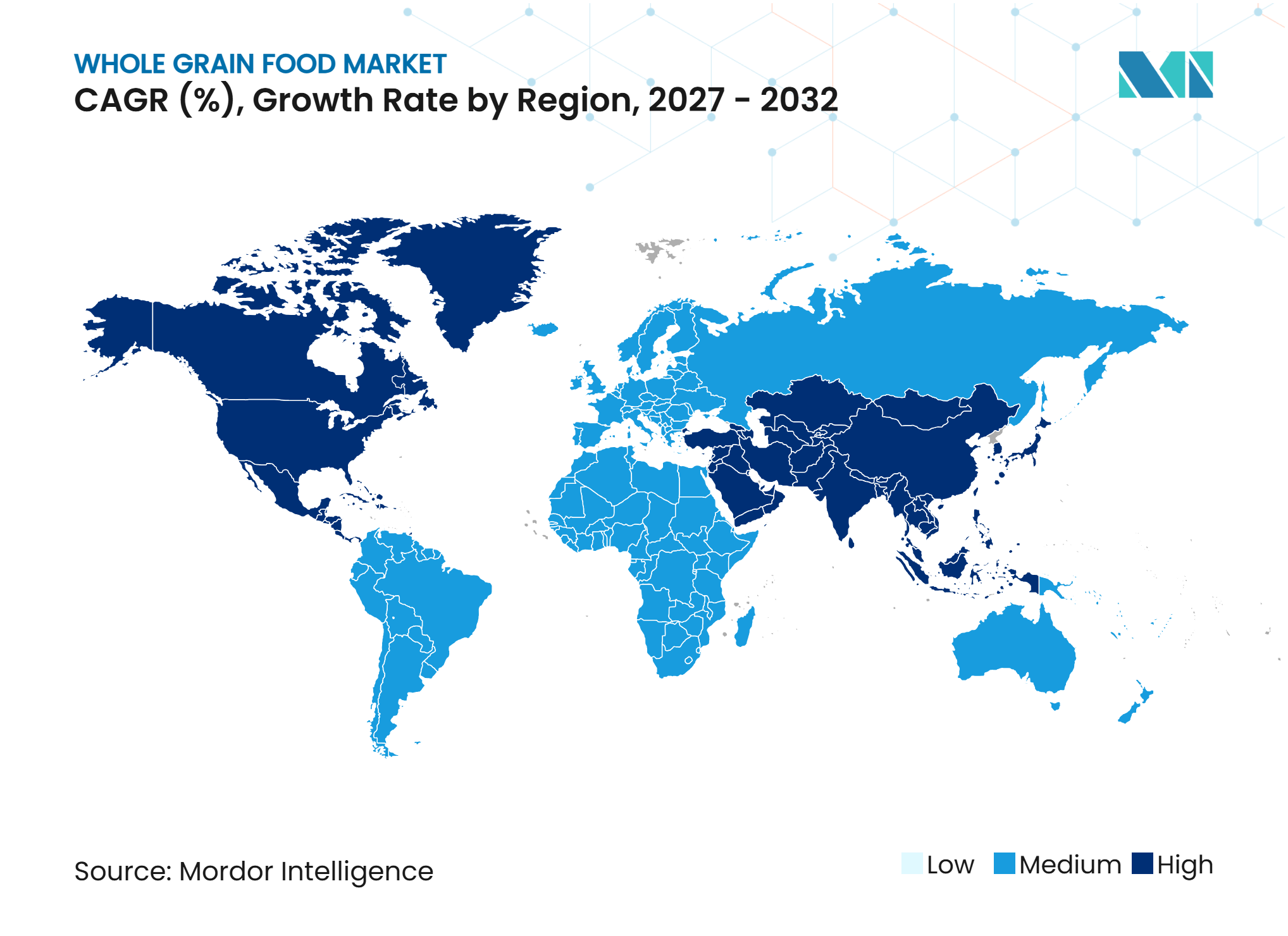
By geography, North America held 39.21% of the whole grain food market in 2026, while Asia-Pacific is forecast to expand at an 8.62% CAGR through 2032.
Note: Market numbers in this report are based on Mordor Intelligence's proprietary estimation framework, which combines nine months of actuals with Q4 projections for base year 2026.
Market Trends and Insights
Drivers Impact Analysis of Whole Grain Food Market*
| Driver | (~) % Impact on CAGR Forecast | Geographic Relevance | Impact Timeline |
|---|---|---|---|
| Growing awareness of health benefits of whole grains | +1.8% | Global | Medium term (2–4 years) |
| Rising prevalence of lifestyle-related diseases | +1.5% | Global, with strong pull in North America and European Union | Long term (≥ 4 years) |
| Increasing demand for high-fibre foods | +1.2% | Asia-Pacific core, spill-over to Middle East and Africa | Medium term (2–4 years) |
| Product innovation and portfolio expansion | +0.9% | North America and European Union | Short term (≤ 2 years) |
| Government initiatives promoting healthy diets | +0.7% | Global | Long term (≥ 4 years) |
| Growing demand for plant-based and natural foods | +0.6% | North America, European Union, Asia-Pacific | Medium term (2–4 years) |
| Source: Mordor Intelligence | |||
Growing Awareness of Health Benefits of Whole Grains
Consumer understanding of nutritional value is becoming a direct purchasing factor for the whole grain food market. The Whole Grains Council reported that 57% of United States adults chose whole-grain options at least half the time in 2025, while 72% wanted to eat more whole grains[2]. Taste was cited by 43% of respondents, indicating that better flavor can broaden demand beyond highly health-focused shoppers. The World Health Organization advises that carbohydrates should come mainly from whole grains, vegetables, and pulses, with at least 25.00g of naturally occurring dietary fiber each day. This alignment between dietary advice and product messaging helps brands make whole grains easier to understand in regular food choices. It also supports demand across bread, cereal, and snacks rather than limiting the category to specialist health products.
Rising Prevalence of Lifestyle-Related Diseases
Lifestyle-related disease prevention is strengthening the health rationale for the whole grain food market. The 2025 to 2030 U.S. Dietary Guidelines put fiber-rich whole grains at the center of a dietary pattern intended to improve food quality and reduce reliance on refined carbohydrates. In China, the National Whole Grain Action Plan addresses a low current level of whole-grain intake and calls for stronger consumption, product standards, and public education. Japan also has an opportunity to improve intake through clearer dietary guidance and public-health approaches, according to a 2025 public-health review from the National Institute of Health. These measures can make whole-grain foods more relevant to household spending decisions and institutional food programs.
Increasing Demand for High-Fiber Foods
Demand for fiber-rich foods creates a larger consideration set for the whole grain food market. Whole grains offer both soluble and insoluble dietary fiber within a familiar food ingredient, which supports product claims when local rules permit them. A 2025 review in MDPI described how whole-grain fibers contribute to dietary fiber intake and have functional properties relevant to food formulation[3]. This evidence gives manufacturers a stronger basis to develop breads, cereals, and snacks around naturally occurring fiber. Products can also respond to interest in digestive wellness without relying only on isolated fiber ingredients. The result is a clearer distinction between whole-grain staples and highly refined products that add fiber after processing.
Product Innovation and Portfolio Expansion
New formats are extending the whole grain food market into more meal and snack occasions. Product development is combining whole grains with protein, organic ingredients, and recognizable grain blends. Flowers Foods introduced new Dave’s Killer Bread products in 2025, including whole-grain sandwich rolls and organic snack bites, which expanded the brand into additional eating occasions. In 2026, the company also introduced Regenerative Organic Certified mixes through Simple Mills, using oat flour and coconut sugar. These launches show that companies are seeking higher-value positions through ingredient sourcing and certification. Grain diversification can also lessen dependence on wheat when supply conditions are uncertain.
Restraints Impact Analysis of Whole Grain Food Market*
| Restraint | (~) % Impact on CAGR Forecast | Geographic Relevance | Impact Timeline |
|---|---|---|---|
| Limited understanding of whole grain identification, labelling, and nutritional differences | -0.5% | Global, most acute in Asia-Pacific and Middle East and Africa | Medium term (2–4 years) |
| Supply chain and raw material price fluctuations | -0.8% | Global, with heightened exposure in Middle East and Africa and Asia-Pacific | Short term (≤ 2 years) |
| Competition from refined grain products | -0.4% | Global, most intense in Asia-Pacific | Long term (≥ 4 years) |
| Cross-contamination and gluten-related concerns | -0.2% | North America and European Union | Long term (≥ 4 years) |
| Source: Mordor Intelligence | |||
Limited Understanding of Whole Grain Identification and Labeling
Consumer confusion about definitions and labels can constrain conversion in the whole grain food market. A 2025 German industry symposium identified inconsistent definitions, limited health awareness, and processing constraints as barriers to higher whole-grain use in bread. The same source noted that 85% of bread purchases in Germany use light-flour products. A 2025 review in the National Institutes of Health noted that the ISO whole-grain standard was still at the Draft International Standard stage, leaving national definitions uneven across markets. The Whole Grain Stamp offers a voluntary signal and is trusted by 84% of United States consumers, according to the Whole Grain Council Organization. Clearer labeling can reduce hesitation on the shelf and make cross-border brand communication more consistent.
Supply Chain and Raw Material Price Fluctuations
Ingredient availability and cost volatility remain a near-term challenge for the whole grain food market. The World Bank expects grain prices to rise 14% in 2026 and 9% in 2027 because of tighter supplies, trade disruption, and weather-related losses. Its 2026 outlook also points to a 23% year-over-year decline in United States wheat output. The Organisation for Economic Co-operation and Development (OECD) and the Food and Agriculture Organization expect nominal cereal prices to trend upward over the outlook period, even where productivity gains limit increases in real terms. Manufacturers must therefore manage purchasing, formulation, and inventory more carefully. These pressures can be especially difficult for smaller brands with limited ability to absorb input-cost changes.
*Our forecasts treat driver/restraint impacts as directional, not additive. The impact forecasts reflect baseline growth, mix effects, and variable interactions.
Whole Grain Food Market Segment Analysis
By Product Type:
Bakery Anchors Volume While Cereals Lead GrowthBakery products held 41.26% of the whole grain food market share in 2026. Bread, rolls, flatbreads, and related foods remain part of frequent meal occasions across income groups and regions. This everyday use gives bakery products a broader consumer base than narrower specialist categories. Whole-grain sandwich rolls and snack products introduced by Flowers Foods in 2025 illustrate continued investment in bakery formats. Regenerative Organic Certified baking mixes introduced by Simple Mills in 2026 add a sourcing and certification dimension to the category. Bakery producers can maintain relevance by improving taste, convenience, and label transparency while adding whole-grain content.
Breakfast cereals are forecast to record an 8.57% CAGR through 2032, the strongest rate among product types. The whole grain food market size for breakfast cereals benefits from reformulation toward higher fiber and protein content. Cereal makers are also pursuing institutional distribution, where school meal standards can open demand for qualifying products. WK Kellogg launched Kashi and Frosted Mini-Wheats cereal products for the K-12 channel in November 2025, with Kashi providing 15g of whole grains per serving. Snacks and other products, including pasta and noodles, can benefit from more frequent snacking and prepared-food use. Their opportunity is strongest where companies can create products suited to local taste and foodservice needs.



By Nature:
Conventional Scale Meets Organic MomentumConventional products held 63.47% of the whole grain food market share in 2026. Their position reflects broad retail availability, cost accessibility, and large-scale milling capacity. Major packaged-food companies can bring whole-grain offerings to mainstream price points because they already operate established sourcing and distribution networks. Conventional products also provide a lower-risk entry point for shoppers moving away from refined grains. This is important in markets where awareness is still developing, and household budgets remain sensitive. The segment is likely to retain scale as companies increase whole-grain content in familiar mass-market brands.
Organic products are forecast to expand at a 9.77% CAGR through 2032. The organic segment benefits from buyers who link health priorities with environmental and sourcing concerns. United States Department of Agriculture's National Organic Program certification remains a key compliance factor for products marketed as organic in the United States. Brands such as Dave’s Killer Bread and Nature’s Path use recognized certification to distinguish their offerings from broad natural claims. The segment can sustain stronger growth when it combines certified organic ingredients with products that still meet everyday affordability expectations.
By Grain Type:
Wheat Anchors Volume While Quinoa Leads Alternative GrainsWheat held 38.72% of the whole grain food market in 2026 by grain type. It remains central to bread, pasta, cereal, and other processed food systems around the world. Its scale gives manufacturers established supply chains and production knowledge. Research from the University of Hohenheim examined colored wheat varieties as a way to increase whole-wheat consumption in Germany. The work points to a route for improving product appeal in markets where light-flour bread remains dominant. However, wheat-based producers remain exposed to supply disruptions and rising input costs.
Quinoa is forecast to expand at a 9.02% CAGR through 2032, the fastest growth among grain types. Its gluten-free position, complete amino acid profile, and clean-label fit support use in premium bakery, breakfast, and snack products. Supply diversification is becoming more important as buyers seek to reduce reliance on a small group of producing countries. A 2025 trade report from Mundus Agri stated that European Union quinoa imports rose 26.00% from July through November 2025. Companies using quinoa need to balance product differentiation with the cost and availability risks associated with premium ingredients. Expanding regional sourcing may improve resilience if it can meet pesticide and organic compliance requirements.
By Distribution Channel:
Supermarkets Dominate While Online AcceleratesSupermarkets and hypermarkets held 47.20% of the whole grain food market in 2026 through distribution channels. These stores remain important because shoppers can compare packaging, certification marks, and prices on the shelf. This is especially helpful for consumers who are still learning how to identify whole-grain products. According to the Whole Grains Council Organization, the Whole Grain Stamp appears on more than 12,000 products in 65 countries and is recognized as a useful purchase signal by many consumers. Convenience stores serve immediate consumption needs, while specialist retailers address buyers seeking certified organic and health-focused ranges. Retail execution remains important because good shelf placement can turn awareness into purchase.
Online retail is forecast to grow at an 8.36% CAGR through 2032. Digital retail expands access to specialist brands and allows subscription or direct-to-consumer models. Base Food surpassed 1 million cumulative subscribers for its whole-grain complete-nutrition bread series in November 2025. Online channels can make it easier for consumers to repeat purchases after finding a product that meets taste and dietary needs. However, brands must still manage delivery economics and build trust without relying on physical shelf visibility.

Geography Analysis
North America
North America held 39.21% of the whole grain food market share in 2026. The region benefits from mature retail infrastructure, established foodservice channels, and long-standing public nutrition programs. The U.S. Food and Drug Administration also finalized an updated Healthy nutrient content claim in 2025, adding compliance considerations for grain products using that claim. General Mills has linked whole-grain cereal innovation with products designed for consumers using GLP-1 medicines, including expanded Cheerios protein variants.
Asia-Pacific
Asia-Pacific is forecast to grow at an 8.62% CAGR through 2032. Rising incomes, preventive-nutrition interest, and government action support demand in a region where whole-grain adoption remains uneven. China’s National Whole Grain Action Plan seeks to increase consumption from a level below 1% of grain intake and develop product and food-safety standards. The plan identifies schoolchildren, government employees, and military personnel as important early users. In Japan, Base Food’s subscriber milestone shows that a digitally led whole-grain bread model can attract recurring buyers. South Korea’s CJ CheilJedang reported sales of more than 10.00 million units for its Hetbahn Rice Plan range within 1 year. Structured education, local product formats, and food-safety standards will shape how quickly the region moves beyond small health-oriented niches.
Europe, Middle East and Africa, and South America
Europe is the second-largest regional area in the whole grain food market, led by Northern European countries with stronger whole-grain consumption. According to the German Trade Association, Germany remains mixed because whole-grain bread represented only 11% of bread sales in 2025 despite growth in whole-grain breakfast cereals. South America has a role in quinoa supply and higher-value processing for products such as pasta, snack bars, and baby food. The Middle East and Africa remain at an earlier stage, where public dietary guidance and urbanization can support future packaged-food demand. Regional development will depend on affordable products, local grain preferences, and clearer labeling systems.
Competitive Landscape
Market Concentration
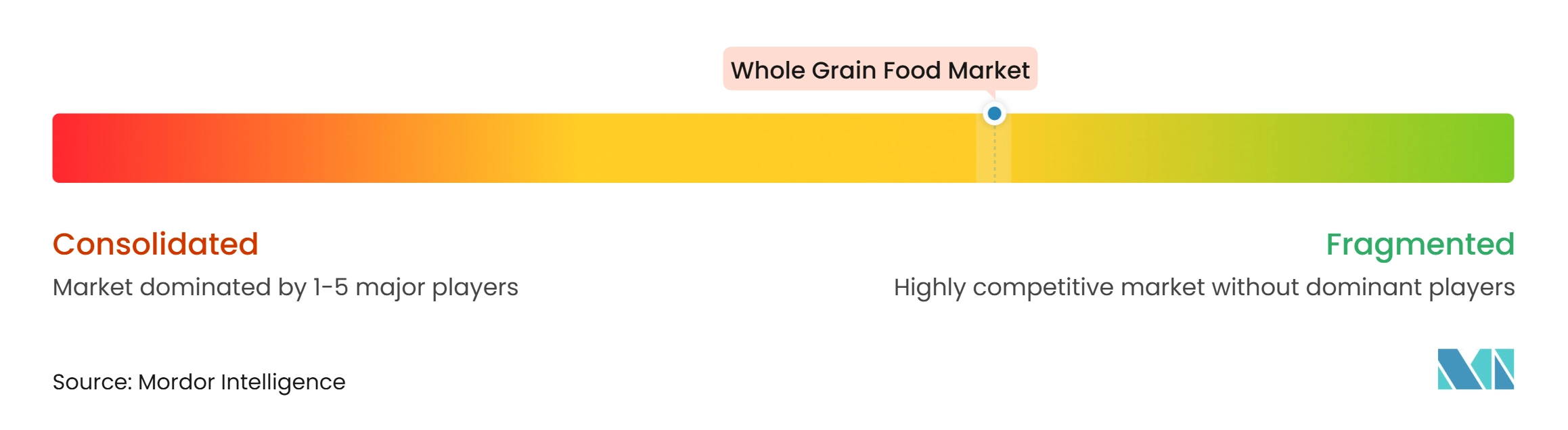
The whole grain food market is moderately consolidated. General Mills, Nestlé, and PepsiCo have strong positions in breakfast cereals, while Flowers Foods and Associated British Foods are important in bakery. Their scale helps them secure shelf space and invest in brand communication. Smaller organic and sprouted-grain producers occupy a premium position but have more limited distribution. Ingredient suppliers such as Ardent Mills and Grain Millers differentiate through milling expertise and clean-label specifications. The competitive structure gives large groups incentives to acquire specialist brands rather than build every capability internally.
Ferrero completed its USD 3.10 billion acquisition of WK Kellogg Co. in September 2025, adding breakfast brands including Kashi, Raisin Bran, and Frosted Mini-Wheats to its U.S. portfolio. The transaction gives Ferrero greater exposure to cereal formats that include whole-grain and plant-based options. General Mills has positioned whole-grain cereals as part of its approach to nutrition needs connected with GLP-1 medicine use. These moves show how portfolio breadth and differentiated sourcing can help companies compete without relying only on price.
The whole grain food market still has open opportunities in pasta, noodles, and grain-based snacks for Asia-Pacific foodservice and institutions. Companies that establish local supplier relationships may gain an advantage in these segments. Processing technology can also become a source of differentiation when it protects grain components and improves texture. Biofortified grain varieties may create additional product options where micronutrient needs are important. Digital supply-chain systems can support multi-grain sourcing, but they do not remove exposure to agricultural price volatility. The strongest competitors will combine reliable sourcing, credible certification, and products that fit ordinary eating habits.
Whole Grain Food Industry Leaders
-
General Mills, Inc.
-
Nestlé S.A.
-
The Kraft Heinz Company
-
Conagra Brands, Inc.
-
The Hain Celestial Group, Inc.
- *Disclaimer: Major Players sorted in no particular order
Whole Grain Food Market Companies Covered in this Report
- Cargill, Incorporated
- General Mills, Inc.
- Nestlé S.A.
- PepsiCo, Inc.
- WK Kellogg Co
- The Kraft Heinz Company
- Post Holdings, Inc.
- Conagra Brands, Inc.
- The Hain Celestial Group, Inc.
- Associated British Foods plc
- Barilla G. e R. Fratelli S.p.A.
- Nature's Path Foods, Inc.
- Bob's Red Mill Natural Foods, Inc.
- Ardent Mills
- Grain Millers, Inc.
- Flowers Foods, Inc.
- Mondelez International, Inc.
- Weetabix Food Company
- Silver Hills Bakery
- Food For Life Baking Co., Inc.
Recent Industry Developments in Whole Grain Food Market
- July 2026: Perfect Snacks launched Oaties, its first oat-based protein bar range. The bars contain 8 g of organic whole-grain oats, 8 g of protein, and more than 20 superfood ingredients. Available in Oatmeal Cookie Dough and Brownie Batter flavors, the products target consumers seeking convenient, fiber-rich snacks.
- January 2026: Mars introduced Nutri-Grain Crunchy in Chocolate Chip Chia and Honey Oat Flax variants. Each bar contains at least 23 g of whole grains, including oats, barley, buckwheat, rye, and quinoa, and provides a good source of fiber.
- January 2026: Dave's Killer Bread introduced three organic breakfast bar varieties: Strawberry Crumble, Boomin' Blueberry Muffin, and Apple Cinnamon Crisp. Made with organic oats and fruit, the bars provide 4 g of fiber and 3 g of protein.
- February 2025: Bonn introduced TRUE ZERO MAIDA Wholewheat Brown Bread in India. The product is made with whole wheat and positioned as a high-fiber bread without palm oil or preservatives. The company highlighted its trans-fat-free and cholesterol-free formulation as part of its healthier bakery product portfolio.
Global Whole Grain Food Market Report Scope
The whole grain food market comprises food products manufactured using whole grains or ingredients that retain all three components of the grain kernel: the bran, germ, and endosperm. The whole grain food market is segmented by product type, nature, grain type, distribution channel, and geography. By product type, the market is segmented into bakery products, breakfast cereals, snacks, and other products. Bakery products include bread, rolls and bagels, tortillas and flatbreads, cookies, biscuits and crackers, and other products. Breakfast cereals comprise ready-to-eat cereals and hot cereals, while snacks include snack bars and savory snacks. By nature, the market is segmented into conventional and organic products. By grain type, it is categorized into wheat, rice, maize, quinoa, and other grains. By distribution channel, the market is divided into supermarkets and hypermarkets, convenience stores, online retail channels, and other distribution channels. Geographically, the market covers North America, Europe, Asia-Pacific, South America, and the Middle East and Africa. The market sizing has been done in value terms in USD for all the abovementioned segments.
Segmentation Overview
| Bakery Products | Bread |
| Rolls and Bagels | |
| Torillas and Flatbreads | |
| Cookies, Biscuits, and Crackers | |
| Others (Muffins, Wraps) | |
| Breakfast Cereals | Ready-to-Eat Cereals |
| Hot Cereals | |
| Snacks | Snack Bars |
| Savory Snacks | |
| Other Products (Pasta, Noodles) |
| Conventional |
| Organic |
| Wheat |
| Rice |
| Maize |
| Quinoa |
| Others |
| Supermarkets/Hypermarkets |
| Convenience Stores |
| Online Retail Channels |
| Other Distribution Channels |
| North America | United States |
| Canada | |
| Mexico | |
| Rest of North America | |
| Europe | Germany |
| United Kingdom | |
| France | |
| Italy | |
| Spain | |
| Netherlands | |
| Sweden | |
| Poland | |
| Belgium | |
| Rest of Europe | |
| Asia-Pacific | China |
| India | |
| Japan | |
| Australia | |
| South Korea | |
| Vietnam | |
| Indonesia | |
| Rest of Asia-Pacific | |
| South America | Brazil |
| Argentina | |
| Chile | |
| Peru | |
| Colombia | |
| Rest of South America | |
| Middle East and Africa | United Arab Emirates |
| Saudi Arabia | |
| South Africa | |
| Nigeria | |
| Rest of Middle East and Africa |
| Product Type | Bakery Products | Bread |
| Rolls and Bagels | ||
| Torillas and Flatbreads | ||
| Cookies, Biscuits, and Crackers | ||
| Others (Muffins, Wraps) | ||
| Breakfast Cereals | Ready-to-Eat Cereals | |
| Hot Cereals | ||
| Snacks | Snack Bars | |
| Savory Snacks | ||
| Other Products (Pasta, Noodles) | ||
| Nature | Conventional | |
| Organic | ||
| Grain Type | Wheat | |
| Rice | ||
| Maize | ||
| Quinoa | ||
| Others | ||
| Distribution Channels | Supermarkets/Hypermarkets | |
| Convenience Stores | ||
| Online Retail Channels | ||
| Other Distribution Channels | ||
| By Geography | North America | United States |
| Canada | ||
| Mexico | ||
| Rest of North America | ||
| Europe | Germany | |
| United Kingdom | ||
| France | ||
| Italy | ||
| Spain | ||
| Netherlands | ||
| Sweden | ||
| Poland | ||
| Belgium | ||
| Rest of Europe | ||
| Asia-Pacific | China | |
| India | ||
| Japan | ||
| Australia | ||
| South Korea | ||
| Vietnam | ||
| Indonesia | ||
| Rest of Asia-Pacific | ||
| South America | Brazil | |
| Argentina | ||
| Chile | ||
| Peru | ||
| Colombia | ||
| Rest of South America | ||
| Middle East and Africa | United Arab Emirates | |
| Saudi Arabia | ||
| South Africa | ||
| Nigeria | ||
| Rest of Middle East and Africa | ||
Key Questions Answered in the Report
What is the value of the whole grain food market in 2026?
The whole grain food market is valued at USD 43.74 billion in 2026 and is forecast to reach USD 66.36 billion by 2032.
What is the expected growth rate through 2032?
The market is forecast to expand at a CAGR of 7.26% from 2027 to 2032.
Which whole grain food product type has the largest share?
Bakery products lead product types with a 41.26% share in 2026, supported by their presence in frequent meal occasions.
Why are organic whole-grain foods growing faster?
Organic products are forecast to grow at a 9.77% CAGR through 2032, supported by buyers seeking certified ingredients, health benefits, and transparent sourcing.