
Weld Inspection Imaging Systems Market Size and Share
Market Overview
| Study Period | 2020 - 2031 |
|---|---|
| Market Size (2026) | USD 588.28 Million |
| Market Size (2031) | USD 950.57 Million |
| Fastest Growing Market | Asia-Pacific |
| Largest Market | North America |
| Market Concentration | Medium |
Major Players *Disclaimer: Major Players sorted in no particular order Image © Mordor Intelligence. Reuse requires attribution under CC BY 4.0. | |
Weld Inspection Imaging Systems Market Analysis by Mordor Intelligence
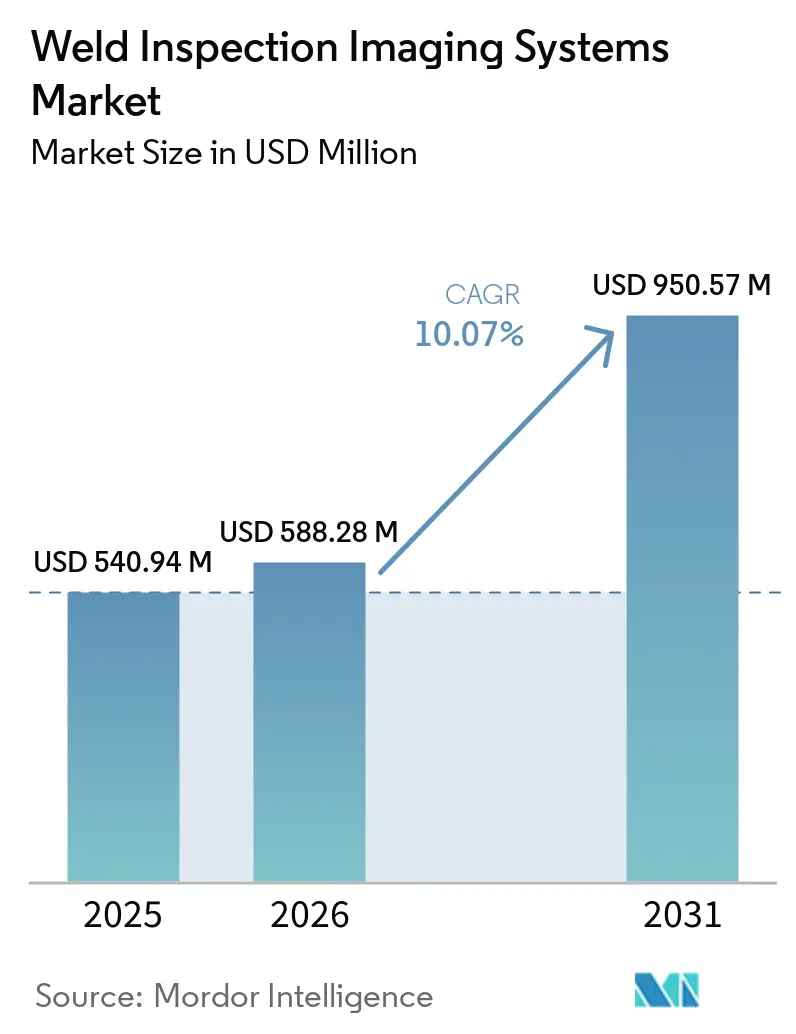
The Weld Inspection Imaging Systems Market size is expected to grow from USD 540.94 million in 2025 to USD 588.28 million in 2026 and is forecast to reach USD 950.57 million by 2031 at 10.07% CAGR over 2026-2031.
The weld inspection imaging systems market is moving from film radiography toward direct radiography, computed radiography, and computed tomography systems that provide faster image availability and support digitally managed inspection records. Higher silver costs and the limited fit of physical film with modern records are strengthening this shift, particularly for users with recurring inspection work across multiple locations. Weld documentation requirements are also increasing demand for images that can be retained, searched, reviewed, and transferred across quality workflows and customer supply chains. AI-supported defect identification and faster computed tomography are reducing inspection time for high-volume production settings where manufacturers need consistent decisions without slowing output. These conditions make the weld inspection imaging systems market more relevant to operators that need continuous inspection, controlled records, digital audit readiness, and equipment that can connect with wider quality and compliance programs, support clearer acceptance decisions, and retain evidence throughout a component’s manufacturing, maintenance, or asset-management cycle.
Key Report Takeaways
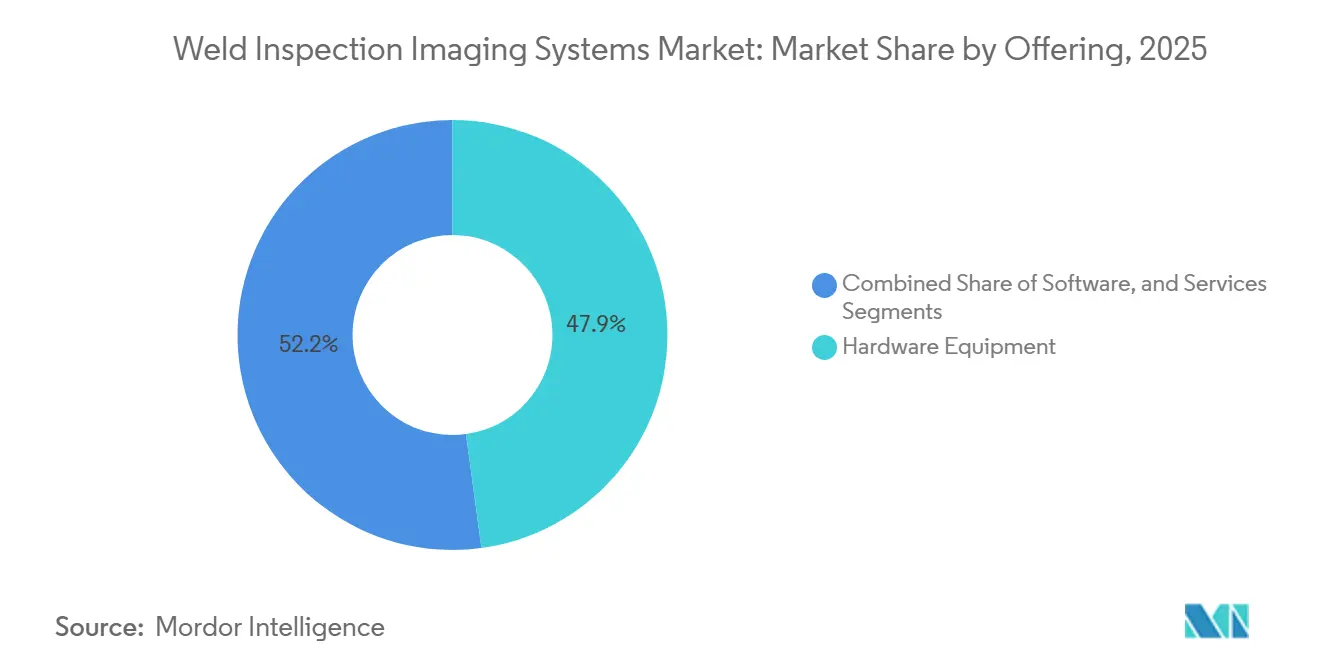
- By offering, hardware equipment held 47.85% of the weld inspection imaging systems market share in 2025, while software is projected to expand at a 13.85% CAGR through 2031.
- By technology, direct radiography accounted for 45.10% of the weld inspection imaging systems market size in 2025, while computed tomography is projected to advance at a 12.18% CAGR through 2031.
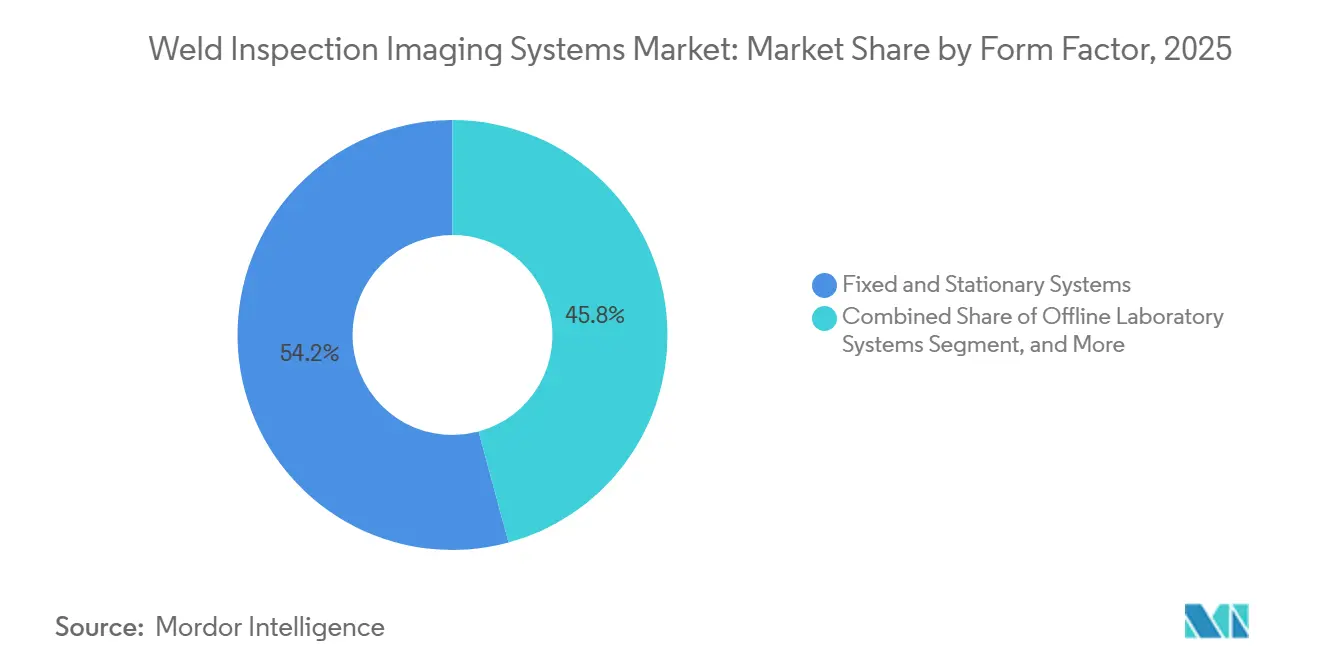
- By form factor, fixed and stationary systems held 54.20% revenue share in 2025, while portable and handheld systems are projected to expand at a 13.45% CAGR through 2031.
- By end-user industry, oil and gas held 26.40% revenue share in 2025, while aerospace and defense is projected to advance at a 12.65% CAGR through 2031.
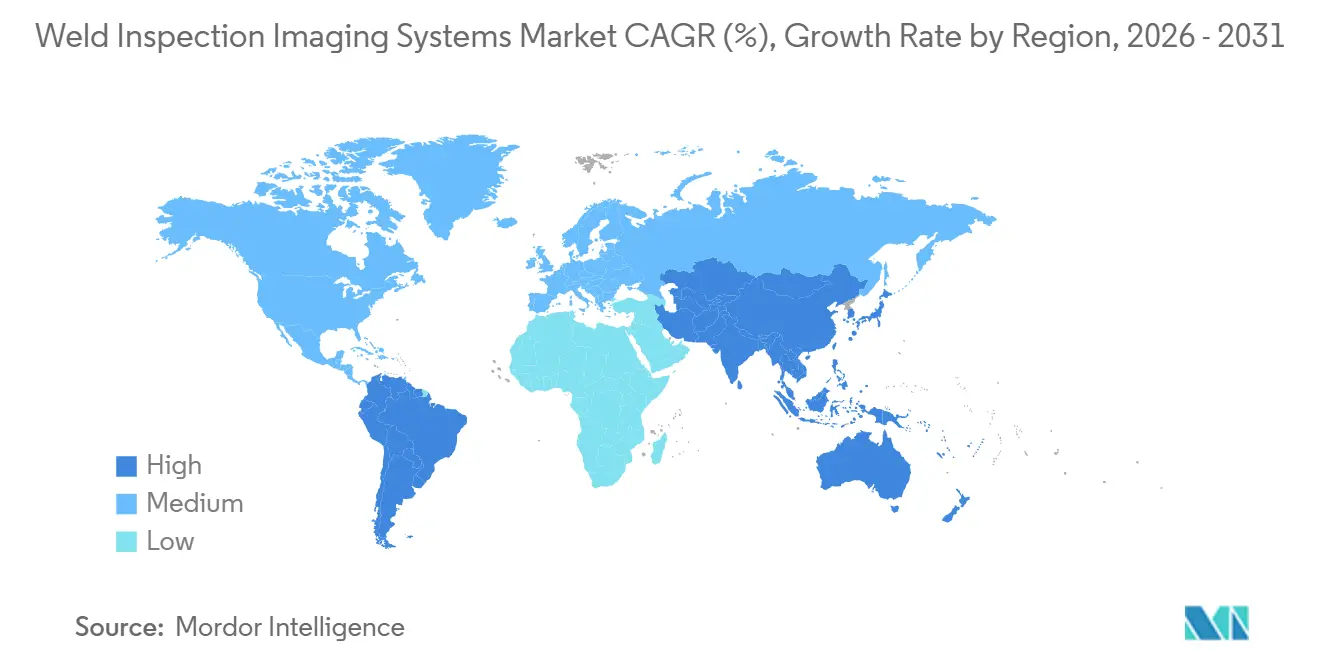
- By geography, North America held 35.75% revenue share in 2025, while Asia-Pacific is projected to expand at a 13.90% CAGR through 2031.
Note: Market size and forecast figures in this report are generated using Mordor Intelligence’s proprietary estimation framework, updated with the latest available data and insights as of January 2026.
Global Weld Inspection Imaging Systems Market Trends and Insights
Drivers Impact Analysis*
| Driver | (~) % Impact on CAGR Forecast | Geographic Relevance | Impact Timeline |
|---|---|---|---|
| Digital Migration from Film to Direct and Computed Radiography | +3.2% | Global, with faster adoption in North America and Europe | Short term (≤ 2 years) |
| Tightening Weld Integrity and Traceability Requirements | +2.0% | Global, with greater relevance in Asia-Pacific and North America | Medium term (2-4 years) |
| Industrial Automation and 100% Inline Inspection Adoption | +1.5% | North America, Europe, and Asia-Pacific, including China, South Korea, and Japan | Medium term (2-4 years) |
| Aerospace, Energy, and Advanced Manufacturing NDT Intensity | +1.0% | North America and Europe, with spillover to the Middle East | Long term (≥ 4 years) |
| Portable Digital Radiography for Field Pipeline Inspection | +0.6% | Global, with early gains in the Middle East, South America, and Asia-Pacific | Medium term (2-4 years) |
| Battery and Semiconductor Weld-Quality Verification | +0.5% | Asia-Pacific, with spillover to North America and Europe | Medium term (2-4 years) |
| Source: Mordor Intelligence | |||
Digital Migration From Film to Direct and Computed Radiography
The weld inspection imaging systems market is moving away from film radiography because operating costs, document handling, and customer quality requirements now favor digital processes. Silver, a core input for X-ray film, reached historic highs in 2025 and continued rising in 2026, adding a material cost pressure to inspection programs that still rely on frequent film purchases. This change weakens the long-term economics of film, especially for organizations that perform repeat work and need a predictable supply of consumables. Several suppliers are directing development investment toward digital products, which reduces the incentive to maintain and upgrade traditional film workflows. Digital images carry embedded metadata and can be retained in asset management systems, giving authorized teams a record that is easier to locate, share, review, and compare with later inspections. The weld inspection imaging systems market benefits when operators need accessible inspection records that can support remote review, documentation control, predictive maintenance workflows, and faster quality decisions.
Tightening Weld Integrity and Traceability Requirements
The weld inspection imaging systems market benefits from stronger requirements for traceable weld records across regulated industrial programs and increasingly complex supply arrangements. Pipeline, process piping, aerospace, and other high-consequence applications need clear inspection evidence that can be associated with a component, procedure, operator, and approval decision. Digital radiographic records can be stored, reviewed, transferred, and searched more readily than physical film, which is important when several organizations share responsibility for fabrication and final acceptance. Electronic submission is becoming more relevant as regulated operators use digital portals and formal record systems to manage inspection documentation. Large aerospace contractors are extending DICONDE record requirements to lower-tier fabricators, so equipment replacement may be required even when an individual supplier has not planned a technology upgrade. The weld inspection imaging systems market can gain from this downstream effect because traceability needs spread through the supply chain rather than remaining limited to the prime contractor.
Industrial Automation and 100% Inline Inspection Adoption
The shift from end-of-line sampling toward 100% inline inspection is changing equipment requirements in the weld inspection imaging systems market because manufacturers need repeatable decisions without interrupting production flow. Automotive body assembly, battery production, and energy equipment plants require faster image capture, automated analysis, and clear accept-or-reject decisions for each relevant weld. Research presented at ECNDT 2026 reported full three-dimensional battery cell scans in less than 10 seconds using high-speed computed tomography, liquid-metal X-ray targets, and photon-counting detectors.[1]ECNDT 2026 Proceedings, “High-Speed X-Ray CT for Inline Battery Inspection,” NDT.net, ndt.net. That throughput can support large cell production lines where thousands of units require inspection each day and where conventional sampling may not provide sufficient production assurance. Faster systems also make computed tomography more practical for welds that need internal examination, including applications with complex geometries or material combinations. The weld inspection imaging systems market is becoming more closely linked to factory automation plans, equipment uptime, quality targets, and the ability to document every inspected part.
Aerospace, Energy, and Advanced Manufacturing NDT Intensity
Aerospace, energy, and advanced manufacturing are increasing the need for detailed nondestructive testing because component design, material use, and quality requirements are becoming more demanding. Composite-heavy aircraft programs and additive manufacturing use parts with internal structures that can require volumetric inspection before the component is accepted for service. Surface methods and two-dimensional images may not provide the information needed where a defect’s depth, geometry, or connection to surrounding material must be understood. Italian aerospace specialists presented guidelines in 2026 for standardizing industrial computed tomography inspection under ASTM E3375, giving users a clearer qualification framework for aeronautical applications.[2]ECNDT 2026 Proceedings, “Computed Tomographic Inspection in the Aerospace Industry,” NDT.net, ndt.net. These guidelines can lower an adoption barrier for computed tomography in series production, while supporting more consistent inspection methods among qualified providers. The weld inspection imaging systems market has a stronger role where manufacturers must verify complex internal features, retain evidence of inspection, and meet demanding safety requirements before parts enter service.
Restraints Impact Analysis*
| Restraint | (~) % Impact on CAGR Forecast | Geographic Relevance | Impact Timeline |
|---|---|---|---|
| High Capital and Facility Preparation Costs for CT Systems | -0.8% | Global, with greater pressure in South America, Africa, and Southeast Asia | Long term (≥ 4 years) |
| Radiation Safety, Licensing, and Exposure-Control Burden | -0.5% | Global, with variation across national nuclear regulatory frameworks | Medium term (2-4 years) |
| Shortage of Certified Radiographic Testing Personnel | -0.4% | Global, with greater pressure in North America and Europe | Medium term (2-4 years) |
| Isotope Supply Exposure and Digital-System Cybersecurity Risk | -0.3% | Global, with greater cybersecurity concern in North America and Europe | Long term (≥ 4 years) |
| Source: Mordor Intelligence | |||
High Capital and Facility Preparation Costs for CT Systems
Industrial computed tomography remains the highest-value equipment category in the weld inspection imaging systems market, but its adoption is limited by costs that extend beyond the scanner purchase price. A complete installation may require a purpose-built shielded enclosure, high-capacity electrical supply, vibration isolation, climate control, safe material handling, and specialized operating procedures. Together, these requirements can double the total installed cost, which makes a purchase difficult to justify for mid-sized fabricators or independent inspection firms serving only one project contract. The financial commitment is especially challenging where access to infrastructure, specialist engineering support, or long-term financing is more limited. These conditions are more pronounced in parts of Southeast Asia, South America, and Africa than in mature nondestructive testing centers. The weld inspection imaging systems market consequently retains a concentration of high-value computed tomography installations among large manufacturers, conglomerates, and specialist service providers that can spread the cost across multiple programs.
Radiation Safety, Licensing, and Exposure-Control Burden
Radiation safety rules create recurring costs for organizations that use gamma-source radiography, particularly when inspection work is mobile, and source handling occurs across several sites. Licensing, secure storage, transport controls, source tracking, and personnel dosimetry requirements apply regardless of inspection volume, so they can weigh more heavily on lower-utilization programs. Periodic shortages of iridium-192 and selenium-75 can also disrupt pipeline and refinery inspection schedules, creating uncertainty for clients that depend on timely project completion. These pressures encourage some operators to consider digital X-ray alternatives that reduce their dependence on radioactive sources while still meeting inspection needs. Networked direct radiography systems create a separate concern because images may contain sensitive information on the condition and construction of critical infrastructure. The weld inspection imaging systems market must address operational compliance, secure handling of images, and confidence that digital records cannot be accessed or changed without authorization.
*Our forecasts treat driver/restraint impacts as directional, not additive. The impact forecasts reflect baseline growth, mix effects, and variable interactions.
Segment Analysis
By Offering: Software Platforms Redefine Long-Term Value Capture
Hardware equipment held 47.85% of the weld inspection imaging systems market share in 2025, reflecting the high value of flat-panel detector arrays, X-ray tubes, computed tomography gantries, and related imaging infrastructure. Physical equipment remains essential because every digital workflow depends on reliable image capture at the inspection point. Hardware purchases also involve qualification, installation, and integration work that can extend beyond the base equipment order. Services form a significant secondary source of revenue through field calibration, tube replacement, radiation source management, and inspection bureau contracts. These activities continue after a system is installed and help customers maintain performance against the required inspection procedures.
Software is projected to record a 13.85% CAGR through 2031, the fastest rate among offerings, as AI-enabled defect recognition, cloud-based image management, and DICONDE-compliant archiving become more central to enterprise inspection programs. Automated tools can reduce routine manual review by helping operators identify and characterize indications from digital images. Cloud systems allow approved records to be shared across facilities, while controlled archiving supports customer, auditor, and supplier access. Research presented at ECNDT 2026 described computed tomography and AI frameworks that extracted crack geometry, orientation, and connectivity from tomographic data and linked findings with structural models. The weld inspection imaging systems market gives software providers a route to recurring relationships because image management and analysis remain relevant through the operating life of installed hardware.



By Technology: Computed Tomography Gains Ground in High-Value Applications
Direct radiography commanded 45.10% of the weld inspection imaging systems market size in 2025, as users valued immediate on-screen review, broad procedural compatibility, and faster decisions than film-based methods can provide. The technology serves inspection teams that need to check images during production, maintenance, or field work without waiting for film processing. Its established use in digital inspection procedures also supports adoption across a broad set of industrial settings. Computed radiography retains a significant installed base among inspection service bureaus because imaging plates can be reused, and existing workflows remain familiar to operators. Film radiography still has a role in narrow applications with client-mandated legacy processes or archive continuity needs, although the installed base is declining as film costs rise.
Computed tomography is projected to advance at a 12.18% CAGR through 2031 because it can examine internal geometry and difficult material combinations that need more information than two-dimensional radiography provides. The approach is increasingly relevant for assemblies that contain copper, aluminum, and steel close together, including components used in EV powertrains and battery production. Photon-counting detector platforms and AI-driven reconstruction are reducing artifact burden in these multi-material parts. Varex Imaging presented TrueSpectrum in 2026 as a dual-energy photon-counting approach that it said can eliminate beam-hardening artifacts without calibration materials or separate processing steps.[3]Varex Imaging Corporation, “Tackling CT Artifacts in Multi-Material Parts,” Varex Imaging, vareximaging.com. Faster scanning and clearer reconstructions improve the fit of computed tomography for production applications that require internal weld verification. The weld inspection imaging systems market is consequently seeing computed tomography move from specialized analysis toward higher-value manufacturing use cases.
By Form Factor: Portable Systems Capture Field Inspection Momentum
Fixed and stationary systems held 54.20% revenue share in 2025, supported by their use in high-throughput production lines, aerospace qualification bays, and laboratory computed tomography environments. These systems are installed where inspection volumes are predictable and where image quality, repeatability, and integration with plant workflows are more important than mobility. Fixed equipment can also be matched with shielding, material handling, and analysis tools that are designed for one defined application. Offline laboratory systems serve research, failure analysis, and additive manufacturing qualification work, where lower throughput can be balanced by more detailed investigation. This configuration remains important in the weld inspection imaging systems market for customers who need complete system integration and stable operating conditions.
Portable and handheld systems are projected to expand at a 13.45% CAGR through 2031, as pipeline obligations, aging midstream assets, and structural inspection programs increase the need for imaging at remote sites. Inspection service providers can move these systems between customer locations, which improves equipment use across project-based work. Portable direct radiography gives teams immediate image review and can support on-the-spot decisions on weld acceptance. It also avoids the processing and chemistry delays associated with film and some computed radiography workflows. Field users need durable equipment that can operate under changing site conditions while preserving documented inspection results. The weld inspection imaging systems market is therefore gaining opportunities where mobility, quick deployment, and digital image availability are central to the work.
By End-User Industry: Aerospace and Defense Displaces Conventional Volume Leaders
Oil and gas held 26.40% revenue share in 2025, which reflected continuing demand for pipeline girth weld inspection, refinery turnarounds, and subsea infrastructure work in major producing regions. Pipeline operators need documented examinations before assets enter service, while refinery operators need verified weld conditions during planned maintenance cycles and pressure-vessel requalification work. The segment also includes field programs that must inspect difficult locations under time, safety, and access limits. Chemicals and petrochemicals, energy and power generation, and manufacturing and heavy engineering represent much of the remaining installed base. These users rely on asset integrity programs that require recurring weld inspection, reliable image records, and equipment that can meet site-specific procedures.
Aerospace and defense is projected to advance at a 12.65% CAGR through 2031, supported by strict requirements for safety-critical parts and a widening need to verify internal features in additive-manufactured components. Aircraft manufacturers, maintenance organizations, and their suppliers require qualified nondestructive testing processes before parts can be accepted for use. Composite-intensive aircraft programs add inspection work because complex structures can require volumetric evidence rather than only surface examination. The sector also places value on accredited testing capability, clear documentation, and repeatable interpretation of images across supplier sites. These needs shift purchasing attention toward digital systems, computed tomography capacity, and software that supports controlled inspection records. The weld inspection imaging systems market can gain as aerospace programs extend detailed inspection requirements through their tiered supply base.
Geography Analysis
North America held 35.75% revenue share in 2025, supported by a dense base of pipeline operators, aerospace original equipment manufacturers, maintenance providers, and refinery assets that require continuing nondestructive testing programs. High labor costs increase the value of automation and AI-supported defect review, while pipeline safety requirements and refinery turnarounds support recurring imaging expenditure. Canada adds demand through oil sands and midstream infrastructure, while Mexico adds demand through petrochemical and automotive facilities. The region also has mature inspection service networks and customers that can invest in integrated digital equipment. These factors keep North America a major installed base for the weld inspection imaging systems market.
Asia-Pacific is projected to advance at a 13.90% CAGR through 2031, supported by China’s battery manufacturing expansion, petrochemical projects, and heavy industrial construction. China’s gigafactory build-out is creating demand for inline computed tomography inspection of tab welds and busbar connections, while ECNDT 2026 research showed that high-speed systems can support thousands of full-cell scans per day.[4]ECNDT 2026 Proceedings, “High-Speed X-Ray CT for Inline Battery Inspection,” NDT.net, ndt.net. New industrial facilities also need field imaging for weld verification during construction and commissioning. The regional weld inspection imaging systems market therefore has demand across battery manufacturing, refineries, and heavy industry.
Europe retained a technically advanced position in 2025, with Germany’s automotive and aerospace base, France’s nuclear fleet, and the United Kingdom’s offshore energy and nuclear decommissioning work supporting detailed weld inspection. Italy’s aerospace composite cluster is using computed tomography for complex geometries, while the Middle East draws demand from refinery upgrades and LNG infrastructure in Saudi Arabia and the United Arab Emirates. These activities require both fixed systems for controlled facilities and portable equipment for field programs. They keep the weld inspection imaging systems market relevant across mature industrial economies and energy investment areas.

Competitive Landscape
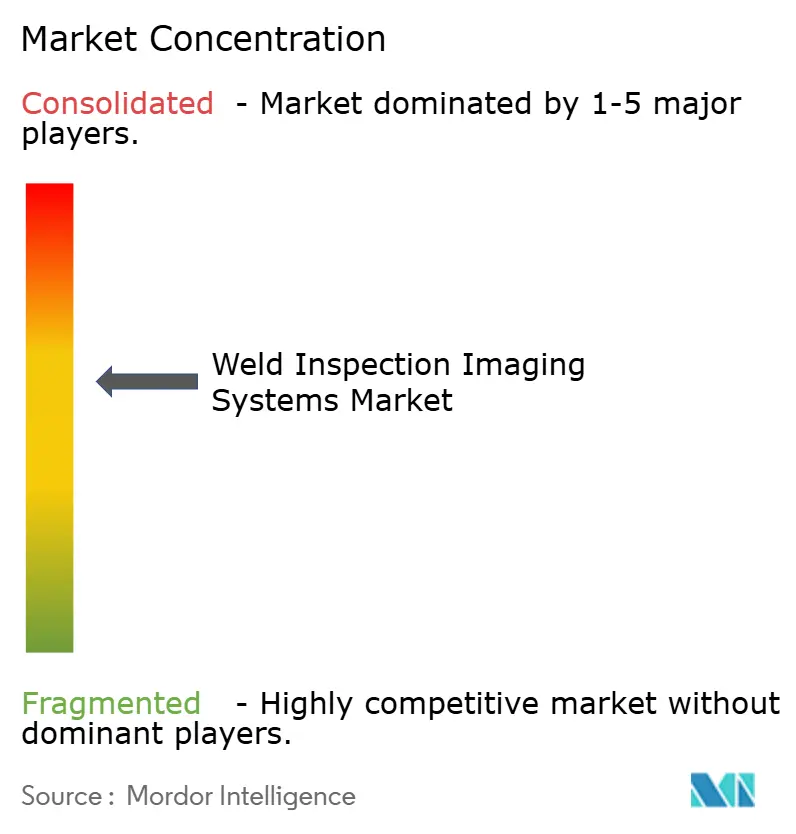
The weld inspection imaging systems market is moderately concentrated, with Baker Hughes’ Waygate Technologies, Comet Technologies AG, and Nikon Metrology holding positions through broad computed tomography, digital radiography, and software portfolios. Larger suppliers are seeking to provide connected quality data systems rather than separate inspection devices, combining surface measurement, internal imaging, analysis, and record retention. This approach can make switching suppliers more difficult after equipment and software are integrated into a customer’s quality workflow. The weld inspection imaging systems market is therefore becoming more centered on platform capability, software compatibility, and the ability to connect inspection data across operations. Customers may favor suppliers that can support several nondestructive testing needs through one operating relationship.
In April 2026, Baker Hughes announced the sale of Waygate Technologies to Hexagon AB for USD 1.45 billion, covering computed tomography, radiography, remote visual inspection, and ultrasound portfolios. Baker Hughes reported that the acquired business generated USD 630 million in fiscal year 2025 revenue, and the deal is expected to close in the second half of 2026, subject to regulatory approvals. The transaction shows how the weld inspection imaging systems market is attracting companies that want a broader measurement portfolio. It also reinforces the move toward integrated offerings rather than point inspection tools.
Specialist suppliers compete through application knowledge, certifications, software, and local service coverage. Software that manages image records and supports digital inspection workflows can help suppliers build recurring relationships around installed imaging equipment. Teledyne Technologies also agreed in 2026 to acquire Varex Imaging for USD 1.1 billion, with closing expected in early 2027. These actions support further consolidation in the weld inspection imaging systems market.
Weld Inspection Imaging Systems Industry Leaders
Baker Hughes Company
Comet Technologies AG
FUJIFILM Holdings Corporation
Teledyne DALSA, Inc.
DÜRR NDT GmbH & Co. KG
- *Disclaimer: Major Players sorted in no particular order

Recent Industry Developments
- April 2026: Baker Hughes announced the sale of Waygate Technologies to Hexagon AB in an all-cash transaction valued at USD 1.45 billion. The deal covers Waygate’s computed tomography, radiography, remote visual inspection, and ultrasound portfolios, and is expected to close in H2 2026 subject to regulatory approvals.
- September 2025: Comet Technologies joined the JOINT3 Consortium for advanced semiconductor inspection. The company contributed X-ray systems expertise to extend computed laminography capabilities toward chiplet and high-bandwidth memory stack inspection.


Global Weld Inspection Imaging Systems Market Report Scope
Weld Inspection Imaging Systems are advanced quality control solutions that utilize industrial cameras, sensors, and specialized lighting to capture high-resolution visual data of welded joints. These automated systems real-time analyze surface geometry and internal integrity to detect defects, ensuring compliance with strict manufacturing standards.
The Weld Inspection Imaging Systems Market Report is Segmented by Offering (Hardware Equipment, Software, and Services), Technology (Direct Radiography, Computed Radiography, Film Radiography, and Computed Tomography), Form Factor (Fixed and Stationary Systems, Portable and Handheld Systems, and Offline Laboratory Systems), End-User Industry (Oil and Gas, Chemicals and Petrochemicals, Aerospace and Defense, Automotive and Transportation, Energy and Power Generation, Manufacturing and Heavy Engineering, Construction and Infrastructure, Electronics and Semiconductors, Marine and Shipbuilding, and Other End-User Industries), and Geography (North America, Europe, Asia-Pacific, Middle East, and Africa). The Market Forecasts are Provided in Terms of Value (USD).
| Hardware Equipment |
| Software |
| Services |
| Direct Radiography |
| Computed Radiography |
| Film Radiography |
| Computed Tomography |
| Fixed and Stationary Systems |
| Portable and Handheld Systems |
| Offline Laboratory Systems |
| Oil and Gas |
| Chemicals and Petrochemicals |
| Aerospace and Defense |
| Automotive and Transportation |
| Energy and Power Generation |
| Manufacturing and Heavy Engineering |
| Construction and Infrastructure |
| Electronics and Semiconductors |
| Marine and Shipbuilding |
| Other End-User Industries |
| North America | United States |
| Canada | |
| Mexico | |
| South America | Brazil |
| Argentina | |
| Rest of South America | |
| Europe | Germany |
| United Kingdom | |
| France | |
| Italy | |
| Spain | |
| Rest of Europe | |
| Asia-Pacific | China |
| Japan | |
| India | |
| South Korea | |
| ASEAN | |
| Rest of Asia-Pacific | |
| Middle East | Saudi Arabia |
| United Arab Emirates | |
| Turkey | |
| Rest of the Middle East | |
| Africa | South Africa |
| Nigeria | |
| Rest of Africa |
| By Offering | Hardware Equipment | |
| Software | ||
| Services | ||
| By Technology | Direct Radiography | |
| Computed Radiography | ||
| Film Radiography | ||
| Computed Tomography | ||
| By Form Factor | Fixed and Stationary Systems | |
| Portable and Handheld Systems | ||
| Offline Laboratory Systems | ||
| By End-User Industry | Oil and Gas | |
| Chemicals and Petrochemicals | ||
| Aerospace and Defense | ||
| Automotive and Transportation | ||
| Energy and Power Generation | ||
| Manufacturing and Heavy Engineering | ||
| Construction and Infrastructure | ||
| Electronics and Semiconductors | ||
| Marine and Shipbuilding | ||
| Other End-User Industries | ||
| By Geography | North America | United States |
| Canada | ||
| Mexico | ||
| South America | Brazil | |
| Argentina | ||
| Rest of South America | ||
| Europe | Germany | |
| United Kingdom | ||
| France | ||
| Italy | ||
| Spain | ||
| Rest of Europe | ||
| Asia-Pacific | China | |
| Japan | ||
| India | ||
| South Korea | ||
| ASEAN | ||
| Rest of Asia-Pacific | ||
| Middle East | Saudi Arabia | |
| United Arab Emirates | ||
| Turkey | ||
| Rest of the Middle East | ||
| Africa | South Africa | |
| Nigeria | ||
| Rest of Africa | ||


Key Questions Answered in the Report
What is the weld inspection imaging systems market size?
The weld inspection imaging systems market is estimated at USD 588.28 million in 2026 and is forecast to reach USD 950.57 million by 2031. The forecast reflects the stated 10.07% CAGR for 2026-2031 and does not calculate values for individual segments.
What is driving demand for weld inspection imaging systems?
Demand is supported by the shift from film to digital radiography, stronger requirements for traceable records, automation needs, and increased inspection activity in aerospace, energy, battery production, and advanced manufacturing. Digital image availability also supports remote review and controlled documentation.
Which technology leads weld inspection imaging systems?
Direct radiography held the leading 45.10% share in 2025 because it supports immediate on-screen review and broad industrial use. Computed tomography is projected to record the fastest technology CAGR of 12.18% through 2031 because it supports detailed internal inspection of complex assemblies.
Which end-user sector has the strongest growth outlook?
Aerospace and defense is projected to expand at a 12.65% CAGR through 2031. The sector needs qualified inspection for safety-critical components and additive-manufactured structures, where internal geometry and documented testing results can be important for acceptance.
Which region is expanding fastest for weld imaging equipment?
Asia-Pacific is projected to advance at a 13.90% CAGR through 2031. Battery manufacturing, petrochemical expansion, and heavy industrial construction are supporting equipment demand, especially for applications that need faster inline or field inspection.
Why are portable digital radiography systems gaining adoption?
Portable and handheld systems are projected to expand at a 13.45% CAGR through 2031 because pipeline, infrastructure, and field projects need mobile equipment, immediate image review, and faster on-site decisions. Redeployable systems also help inspection service providers use equipment across multiple project locations, avoid film-processing delays, preserve digital inspection records, and respond to changing project schedules without depending on permanent laboratory capacity at each job site.
Page last updated on:





