
Webbing Market Size and Share
Market Overview
| Study Period | 2021 - 2031 |
|---|---|
| Market Size (2026) | USD 4.85 Billion |
| Market Size (2031) | USD 6.10 Billion |
| Growth Rate (2026 - 2031) | 4.68 % |
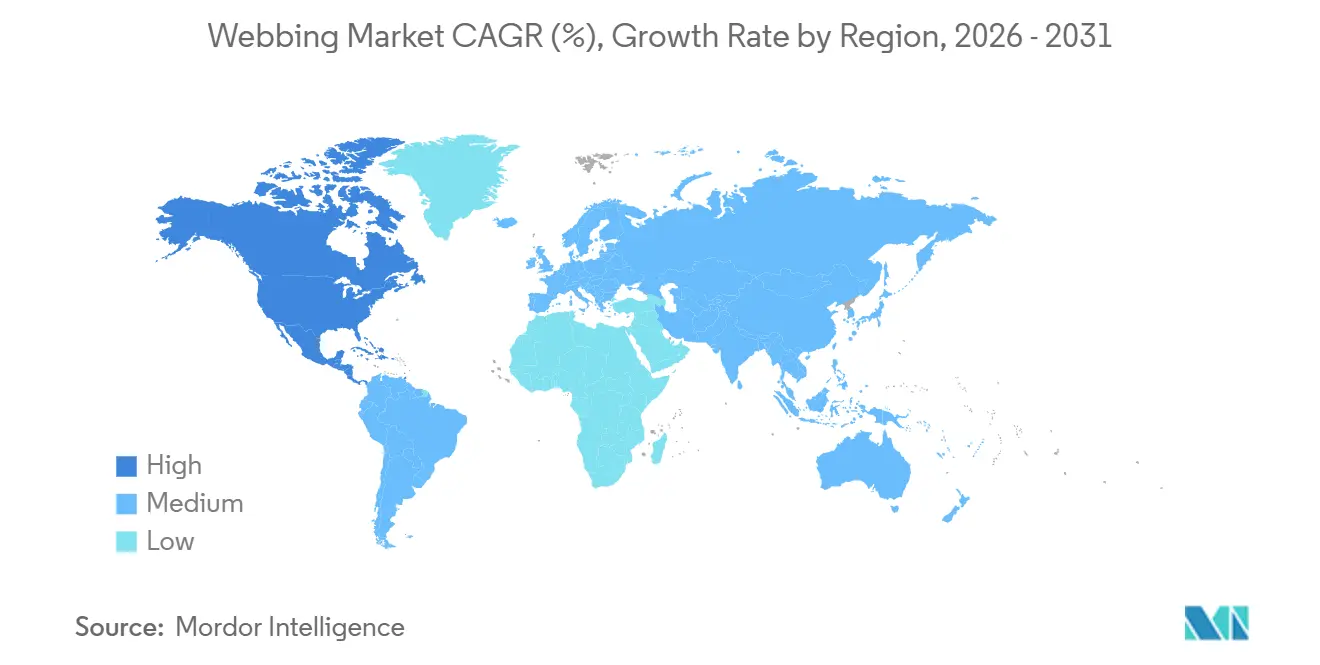
| Fastest Growing Market | North America |
| Largest Market | Asia-Pacific |
| Market Concentration | Medium |
Major Players *Disclaimer: Major Players sorted in no particular order Image © Mordor Intelligence. Reuse requires attribution under CC BY 4.0. | |
Webbing Market Analysis by Mordor Intelligence
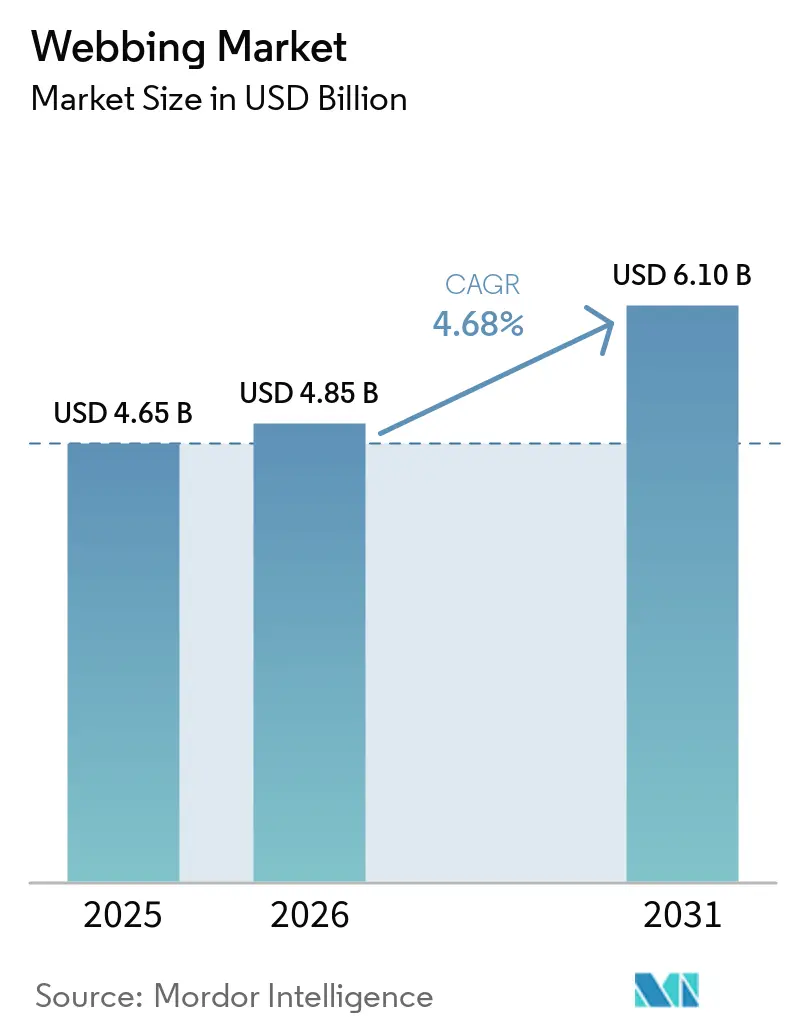
The webbing market size was estimated at USD 4.65 billion in 2025 and is estimated to grow from USD 4.85 billion in 2026 to USD 6.10 billion by 2031, at a CAGR of 4.68% during the forecast period (2026-2031). The webbing market comprises narrow woven structures manufactured from polyester, nylon, polypropylene, carbon fiber, para-aramid, and ultra-high-molecular-weight polyethylene (UHMWPE). Each fiber offers a distinct balance of strength, weight, durability, chemical resistance, elongation, cost, and qualification requirements. These materials serve automotive restraint systems, industrial safety, defense, outdoor recreation, and furniture applications, generating demand across segments with varying purchasing cycles and performance priorities for standardized products and high-specification systems. Regulatory requirements increase the importance of technical textiles in safety-critical applications, as automotive and personal-protection buyers validate material performance rather than select products based on price alone. Commodity polypropylene products face price competition, while para-aramid and UHMWPE products address specialized defense and industrial requirements, where certified strength, low weight, and reliable performance can limit the supplier base. Feedstock price volatility and recycled-fiber qualification requirements remain constraints. However, vehicle safety regulations, workplace compliance requirements, defense spending, and the development of functional automotive restraint systems support demand in the webbing market.
Key Report Takeaways
- By product type, polyester held 46.56% of the webbing market share in 2025, while para-aramid synthetic fibers are forecast to grow at a CAGR of 5.11% through 2031.
- By application, automotive accounted for 34.78% of the webbing market size in 2025, while military and aerospace are forecast to grow at a CAGR of 5.75% through 2031.
- By geography, Asia-Pacific held 41.31% of the webbing market share in 2025, while North America is forecast to grow at a CAGR of 5.34% through 2031.
Note: Market size and forecast figures in this report are generated using Mordor Intelligence’s proprietary estimation framework, updated with the latest available data and insights as of January 2026.
Market Trends and Insights
Drivers Impact Analysis of Webbing Market*
| Drivers | (~) % Impact on CAGR Forecast | Geographic Relevance | Impact Timeline |
|---|---|---|---|
| Mandatory Automotive Safety and Restraint Adoption | +1.3% | Global, concentrated in Asia-Pacific, Europe, and North America | Medium term (2-4 years) |
| Industrialization and Workplace Fall-Protection Demand | +0.8% | Asia-Pacific, North America, Europe | Medium term (2-4 years) |
| Defense and Aerospace Procurement of High-Strength Webbing | +0.7% | North America, Europe, APAC, South Korea, and Japan | Long term (≥ 4 years) |
| Outdoor Recreation and Sporting-Goods Participation | +0.5% | North America, Europe, APAC | Short term (≤ 2 years) |
| EV Lightweighting and Integrated Restraint Systems | +0.6% | Global, led by China, Europe, and North America | Medium term (2-4 years) |
| Source: Mordor Intelligence | |||
Mandatory Automotive Safety and Restraint Adoption
Seatbelt webbing is a regulation-driven segment of the webbing market, as every new vehicle requires restraint assemblies and compliance with mandatory materials standards. UNECE R16 and China’s QC/T 946-2024 standard establish measurable requirements for color fastness, low-temperature elongation, and friction durability. China’s revised standard took effect on January 1, 2025[1]Ministry of Industry and Information Technology, “QC/T 946-2024 Safety Belt Strap,” Chinese Automotive Industry Standard, July 5, 2024, guifanku.com. These testing requirements increase the importance of high-tenacity yarn quality and precise weaving control while limiting competition from suppliers focused only on price. Autoliv produced more than 560,500 km of seatbelt webbing in 2025, underscoring demand for automotive restraint systems and the need for a stable, qualified supply. In June 2026, Autoliv presented its InfraRed Webbing concept, which integrates noncontact occupant sensing into the seatbelt structure and demonstrates that the textile can perform a system function. Suppliers that meet current safety-testing requirements and support functional designs can address OEM demand as OEMs shift from standard restraint components toward integrated safety systems. Every material change must maintain established load, durability, and occupant-protection performance. Existing qualifications differentiate basic woven straps from webbing developed to meet evolving vehicle safety program requirements.
Industrialization and Workplace Fall-Protection Demand
Industrial safety webbing is used in full-body harnesses, lanyards, and lifting slings. Its replacement cycle supports recurring demand across construction, manufacturing, and energy sites. OSHA revised 29 Code of Federal Regulations (CFR) 1926.95 in December 2024, and the amendment took effect in January 2025. The rule introduces explicit requirements for properly fitted personal protective equipment in construction. This requirement increases demand for suitable fall-arrest harnesses and supports inspection and replacement activities, even when workforce numbers remain unchanged. ANSI/ASSP Z359.1-2024 also links harness webbing performance to anchor points and connecting devices, increasing the system-level engineering requirements for compliant equipment. Proper-fit requirements may require employers to stock a broader range of harness sizes, increasing unit purchases even when site staffing remains stable. The formalization of construction safety regulations in Indonesia, Vietnam, and Bangladesh is shifting usage from informal rope-and-hook practices toward certified synthetic harness systems in the webbing market. This shift expands the addressable customer base beyond established construction markets, while recurring inspection and replacement requirements can make demand less dependent on one-time site purchases or short-term capital projects.
Defense and Aerospace Procurement of High-Strength Webbing
Defense and aerospace programs require para-aramid, ultra-high-molecular-weight polyethylene (UHMWPE), and high-tenacity nylon webbing for parachute bridles, body armor carriers, crew restraints, and cargo tie-down nets. The Stockholm International Peace Research Institute (SIPRI) reported global military expenditure of USD 2.44 trillion in 2024, with spending continuing to increase through 2025 as modernization programs advanced. These programs require certified strength, weight, and durability characteristics, limiting the use of lower-grade materials in safety-critical equipment. In July 2026, Bally Ribbon Mills announced Kevlar EXO webbing for defense, aerospace, and industrial safety applications. The company stated that the product offers 40-50% higher strength and 15-40% weight savings compared to legacy Kevlar webbing at equivalent tenacity targets. Lower production quantities, long program lead times, and Berry Amendment requirements support demand for compliant domestic suppliers in high-specification segments of the webbing market. These requirements differentiate defense procurement from price-led automotive and general industrial purchasing, as suppliers must demonstrate domestic compliance, reliable production, tested material performance, and supply continuity throughout the program life cycle.
Electric Vehicle (EV) Lightweighting and Integrated Restraint Systems
Electric vehicle (EV) platforms are changing restraint placement and material requirements, particularly where flat-floor battery structures affect vehicle geometry. The International Energy Agency (IEA) stated that global electric car sales exceeded 17 million units in 2024 and projected continued growth through the late 2020s. Seat-integrated restraints and belt-in-seat designs move retractors to the seat backrest, requiring shorter webbing lengths, tighter force transfer, and more controlled elongation. In September 2025, ZF LIFETEC introduced Heat Belt 2.0, which integrates thermal management into seatbelt webbing and can improve the range of battery-electric vehicles by up to 6%. This development positions webbing as an active system component rather than solely a passive safety element. It creates demand in the webbing market for sensing, thermal, and structural features that require more extensive qualification than standard automotive materials. The development process involves material behavior, restraint-system integration, and performance validation, requiring suppliers to collaborate with OEM engineering teams throughout development and qualification.
Restraints Impact Analysis of Webbing Market*
| Restraints | (~) % Impact on CAGR Forecast | Geographic Relevance | Impact Timeline |
|---|---|---|---|
| Synthetic-Fiber Feedstock Price Volatility | -0.5% | Global, acute in Asia-Pacific supply chains | Short term (≤ 2 years) |
| Environmental Pressure on Petrochemical Fibers | -0.4% | Europe, North America, with spillover to Asia-Pacific (APAC) exporters | Medium term (2-4 years) |
| Recycled-Fiber Qualification and Safety-Certification Gaps | -0.3% | Global | Long term (≥ 4 years) |
| Source: Mordor Intelligence | |||
Synthetic-Fiber Feedstock Price Volatility
Polyester accounted for nearly half of the webbing market’s product value in 2025. Fluctuations in purified terephthalic acid (PTA) and monoethylene glycol (MEG) costs directly affect producers' margins. Reuters reported in April 2026 that geopolitical disruptions affected Asian polyester supply chains, while Filatex India reported a 30% increase in its PTA and MEG costs. Standard suppliers have limited ability to pass these increases on to customers, who typically benchmark commodity purchases against spot prices. The margin impact is significant for polypropylene slings and standard cargo straps, where conversion margins are thin and product differentiation is limited. Vertically integrated producers can absorb a larger share of cost fluctuations, increasing pressure on independent weavers in Southeast Asia and Europe. This gap can drive consolidation, as independent producers must manage sudden input-cost increases, maintain customer service levels, and protect operating margins without comparable access to upstream material capacity.
Environmental Pressure on Petrochemical Fibers
Retail brands, outdoor equipment manufacturers, and automotive original equipment manufacturers (OEMs) are increasingly incorporating recycled-content requirements into supplier contracts, alongside lifecycle emissions targets and European sustainability reporting obligations. The Global Recycled Standard (GRS) establishes chain-of-custody and recycled-content requirements. GRS 4.0 requires traceability from post-consumer polyethylene terephthalate (PET) collection through spinning, weaving, and finishing[2]Textile Exchange, “Global Recycled Standard Version 4.0, Chain-of-Custody and Recycled Content Certification Requirements,” Textile Exchange, Version 4.0, textileexchange.org. These documentation requirements increase costs and extend qualification timelines, particularly for automotive and defense products that already undergo multiple safety approval stages. The additional requirements can delay adoption when certified recycled yarn is unavailable at the required performance level. Recycled PET fiber costs have, at times, approached those of virgin polyester on a cost-per-unit-performance basis. Improved economic conditions can support the webbing market as certification capacity and safety qualifications align with customer requirements. Until then, suppliers must balance traceability requirements, recycled-content claims, customer procurement expectations, and established safety-testing protocols. These factors may result in a longer transition period than customers anticipate when setting sustainability targets.
*Our forecasts treat driver/restraint impacts as directional, not additive. The impact forecasts reflect baseline growth, mix effects, and variable interactions.
Webbing Market Segment Analysis
By Product:
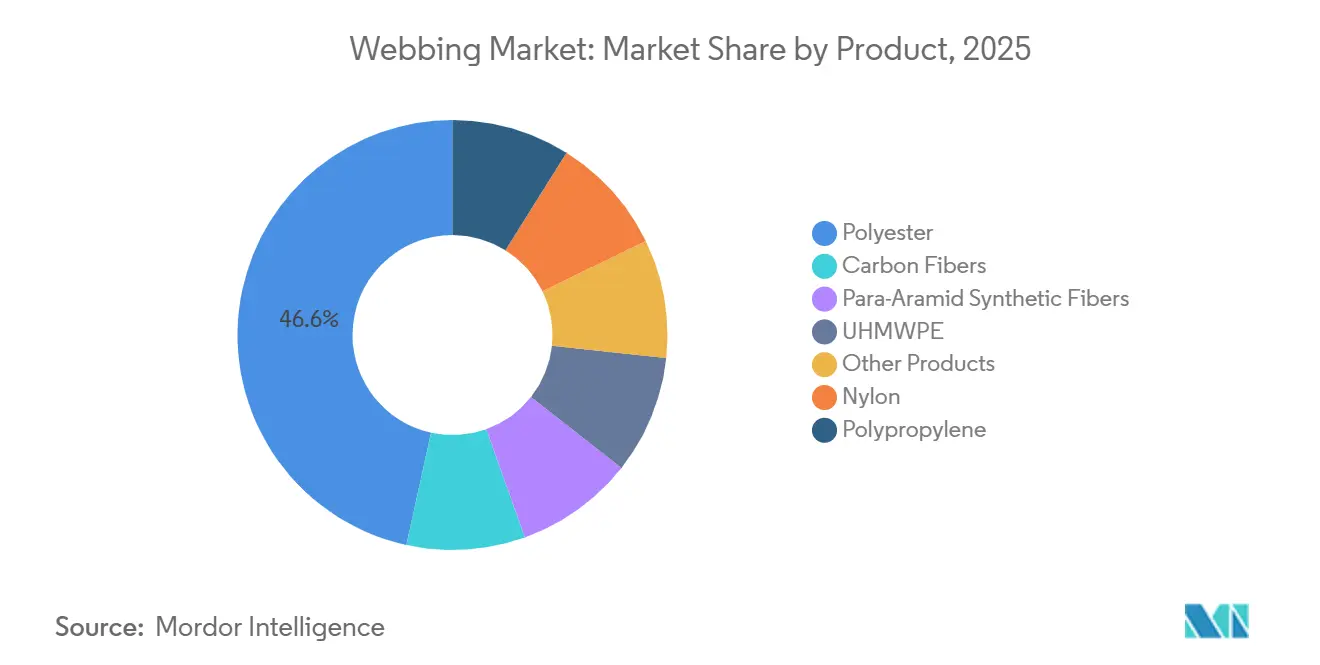
Technical-Grade Fibers Gain Share Within a Polyester-Dominated BasePolyester accounted for 46.56% of global product value in 2025, maintaining its leading position across product types. Its widespread use reflects mechanical versatility, cost efficiency, and established automotive qualifications. Available evidence indicates that polyester constructions can withstand tensile loads of 3,000-6,000 pounds per inch. Automotive buyers evaluate polyester against the requirements of QC/T 946-2024 for tenacity, elongation, and color fastness. Nylon held the second-largest product share due to its elasticity and abrasion resistance. Manufacturers use it in sporting goods, harnesses, and cargo-lashing systems, where comfort under load is important. Polypropylene is used in light-duty agricultural strapping and logistics packaging applications because of its chemical inertness and lower cost. Carbon fiber webbing remains a niche material for aerospace structural reinforcement and motorsport restraints, where its price limits adoption despite its performance characteristics.
Para-aramid synthetic fibers are forecast to grow at a CAGR of 5.11% through 2031, representing the highest growth rate among material groups in the webbing market. Defense modernization supports demand for body armor, crew harnesses, parachute systems, and heavy-lift products. The material also supports civilian applications, including climbing systems and electric vehicle (EV) battery containment webbing. Source material indicates that capacity additions in Asia intensified competition in the performance fiber market between 2020 and 2025. It also notes that Teijin closed its Arnhem para-aramid pulp facility in early 2025 because of cost pressures from Asian competition. Ultra-high-molecular-weight polyethylene (UHMWPE) completes the specialized product range, with applications in marine, military ballistic, and heavy-lift systems. However, processing complexity and higher input costs limit its broader adoption relative to para-aramid. Product selection depends on the required balance of load performance, weight, durability, processing feasibility, and purchase cost for each end-use application. Polyester maintains its broad market base by meeting common performance requirements, while manufacturers select specialized fibers when applications cannot accommodate the limitations of standard materials.



By Application:
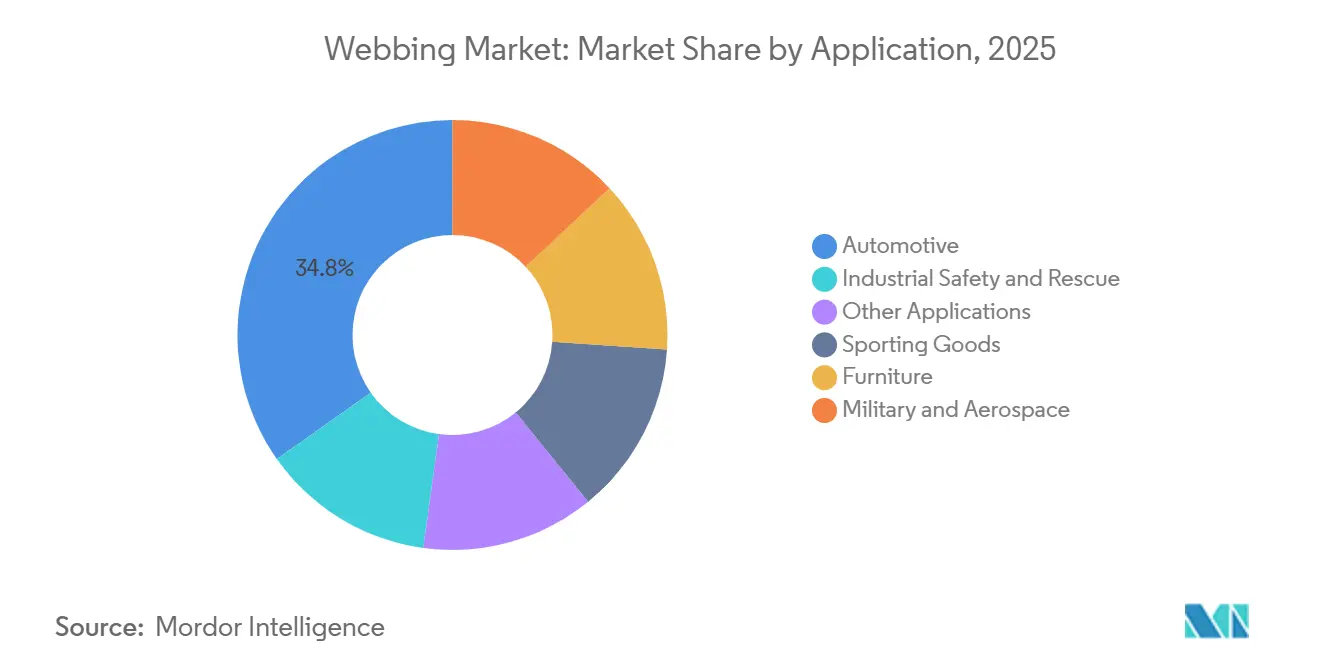
Defense Leads in Growth Rate While Automotive Dominates in OutputAutomotive accounted for 34.78% of the global market value in 2025, making it the largest application segment. Each vehicle requires webbing for seatbelt assemblies, airbag tether modules, and interior cargo nets. According to the Organization Internationale des Constructeurs d'Automobiles (OICA), global light-vehicle production is expected to reach 95 million units in 2026. The transition to electric vehicles is increasing demand for webbing with lower elongation, thermal stability, and dimensional consistency. Belt-in-seat configurations and active tensioner integration favor suppliers capable of meeting these more stringent specifications. Sporting goods represented the second-largest application segment by value, supported by growing participation in outdoor activities. The Outdoor Industry Association reported that the United States outdoor recreation economy generated USD 1.1 trillion in annual activity in 2024. Furniture, industrial safety, and rescue products provide stable replacement-driven and compliance-driven demand across the webbing market.
Military and aerospace applications are forecast to grow at a 5.75% CAGR through 2031, the highest growth rate among applications in the webbing market. Defense budget commitments by NATO members support multiyear procurement of body armor carriers, parachute bridles, and crew restraint systems. These applications require para-aramid and UHMWPE materials, as lower-grade products do not meet the required specifications. Bally Ribbon Mills develops E-WEBBINGS that integrate narrow fabrics with conductivity, light transmission, and sensor elements for stress and strain sensing in NASA Artemis programs. This work demonstrates the growing role of functional capabilities in aerospace textile development. Berry Amendment requirements differentiate the United States defense supply chain from lower-cost Asian supply. As a result, this application segment has higher qualification barriers and longer supplier relationships. Automotive retains the larger production base because restraint components are installed across new-vehicle production, while defense and aerospace buyers procure smaller quantities of highly specified equipment. These distinct demand patterns reduce dependence on a single application cycle and create different requirements for product design, certification, production planning, and supplier selection.
Geography Analysis
APAC Webbing Market
Asia-Pacific accounted for 41.31% of global webbing value in 2025, supported by a large manufacturing base and automotive and industrial demand across China, India, South Korea, and Japan. China is the region’s primary manufacturing and consumption center, with Zhejiang, Jiangsu, and Fujian serving as key locations for polyester yarn and woven seatbelt production. China’s QC/T 946-2024 standard raised requirements for color fastness, thermal durability, and tensile performance in January 2025, increasing quality requirements for domestic producers. India is expanding as a buyer and producer of high-performance webbing; however, domestic producers meet less than 65% of demand, while imports from China, Taiwan, and South Korea meet 35–40% of specialized requirements. This supply gap creates localization opportunities across Karnataka, Tamil Nadu, and Gujarat. South Korea and Japan also contribute to regional demand through automotive production and advanced occupant-protection systems aligned with the Japan New Car Assessment Program (JNCAP) and Korea New Car Assessment Program (KNCAP) frameworks.
North America and Europe Webbing Market
North America is forecast to grow at a CAGR of 5.34% through 2031, the highest regional growth rate in the webbing market. Defense procurement, construction fall-protection requirements, and electric vehicle restraint development support this growth. Demand for para-aramid in aerospace and defense remains central to the region’s high-performance product mix. Bally Ribbon Mills, American Cord & Webbing, and Murdock Webbing benefit from domestic-content protections within Department of Defense supply chains. Europe maintains OEM-led demand across Germany, France, and the United Kingdom, although lower vehicle production constrains growth. The Fédération des Industries des Équipements pour Véhicules (FIEV) reported 401,558 new passenger vehicle registrations in France during the first quarter of 2026, down 2.1% year over year. REACH, Euro NCAP, and sustainability requirements continue to support demand for high-specification products, while recycled-content obligations increase costs and complexity for regional suppliers.
EMEA and South America Webbing Market
South America, the Middle East, and Africa account for smaller shares of global value but exhibit distinct demand patterns. In Brazil, automotive manufacturing, construction activity, and recycled-content use in packaging and logistics strapping support demand. Saudi Arabia supports demand through defense modernization, while South Africa supports demand through infrastructure construction. Fall-protection standards are adopted earlier than in established markets, creating opportunities for certified synthetic-harness products as compliance requirements expand and buyers shift toward formal safety practices. In July 2026, Euro Sandow invested in internalizing plastics injection to strengthen its automotive position, reflecting a European supplier’s response to pricing competition from Asian suppliers.

Competitive Landscape
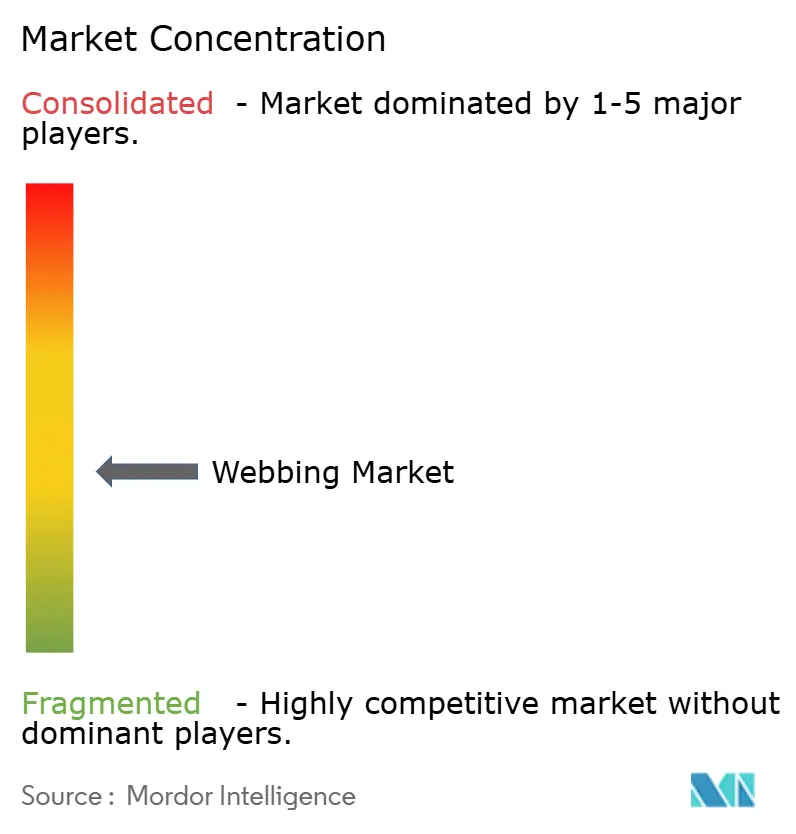
The webbing market is moderately fragmented, as no company leads across every product and application segment. Autoliv holds a strong position in automotive seatbelt webbing, Bally Ribbon Mills serves the United States defense and aerospace narrow-fabrics market, and BioThane supplies coated specialty webbing. Qualification barriers, rather than scale alone, protect these positions, particularly in applications where product testing, material traceability, and end-use approvals determine supplier access. Chinese and Vietnamese suppliers compete aggressively in polypropylene cargo strapping and standard polyester slings, placing downward pressure on average commodity selling prices in export channels. Established producers respond by focusing on differentiated products and qualified end-use applications that are less directly comparable with basic woven straps. This market structure supports price competition in standard products while protecting specialized suppliers with technical capabilities and validated customer relationships.
Autoliv has moved toward integrated safety functions rather than conventional textile supply. The company disclosed its Thermal Webbing concepts, which incorporate heating and cooling functionality, on LinkedIn in May 2026. It also disclosed InfraRed Webbing in June 2026, a sensing concept designed to enable occupant detection through the seatbelt structure. These initiatives aim to secure OEM design positions that commodity products cannot easily replicate, as functional webbing requires coordinated material development, restraint-system engineering, and validation. Autoliv opened its Wuhan technical center in 2026 to support development activities in China, while its sales to Chinese OEMs grew by 23% in 2025. This strategy combines local development capabilities with a broader shift toward differentiated restraint systems in the webbing market.
Consolidation has reshaped the middle segment of the webbing market. Pewag acquired Aberdeen Web in April 2025, Inka Oy acquired Manilla Oy in October 2025, and Michelin completed its acquisition of Tex Tech Industries in July 2026. These transactions expanded the companies' lifting, distribution, and specialty textile capabilities. Electric and autonomous vehicle applications remain open opportunities, as functional qualification requirements continue to develop. ISO 9001:2015 and International Automotive Task Force (IATF) 16949 standards influence automotive supplier selection, while Berry Amendment compliance remains a primary requirement for United States defense contracts.
Webbing Industry Leaders
Autoliv
E. Oppermann GmbH
Bally Ribbon Mills
American Cord & Webbing Co., Inc.
Murdock Webbing Company, Inc.
- *Disclaimer: Major Players sorted in no particular order
Webbing Market Companies Covered in this Report
- American Cord & Webbing Co., Inc.
- American Webbing and Fittings, Inc.
- Autoliv
- Bally Ribbon Mills
- Belt-tech
- Berger GmbH & Co. Holding KG
- BioThane
- Bowmer Bond Narrow Fabrics Ltd
- E. Oppermann GmbH
- Jiangsu Daxin Ribbon Co., Ltd.
- Leedon Webbing
- Marling Leek Limited
- Murdock Webbing Company, Inc.
- Narrowtex Australia Pty Ltd
- National Webbing Products Co.
- Ohio Plastics Belting Co.

Recent Industry Developments in Webbing Market
- July 2026: Bally Ribbon Mills announced the availability of Kevlar EXO webbing for defense, aerospace, and industrial safety applications. The product is engineered to deliver 40-50% higher strength than legacy Kevlar webbing and 15-40% weight savings at equivalent tenacity targets, enabling lighter body armor carriers and aerospace harnesses.
- June 2026: Autoliv disclosed its InfraRed Webbing concept, which integrates infrared-enabled sensing functionality directly into the seatbelt webbing structure to enable non-contact occupant detection and classification without external sensors.


Global Webbing Market Report Scope
Webbing is a strong fabric woven as a flat strip or tube of varying width and fiber composition, often used in place of rope. It is a versatile component used across multiple applications, including climbing, slacklining, furniture manufacturing, automobile safety, auto racing, towing, parachuting, military apparel, and load securing, among others.
The webbing market is segmented by product, application, and geography. By product, the market is segmented into polyester, nylon, polypropylene, carbon fibers, para-aramid synthetic fibers, UHMWPE, and other products. By application, the market is segmented into automotive, sporting goods, furniture, military and aerospace, industrial safety and rescue, and other applications. The report also covers market size and forecasts for the webbing across 15 countries in major regions. The market sizes and forecasts are provided in terms of value (USD).
| Polyester |
| Nylon |
| Polypropylene |
| Carbon Fibers |
| Para-Aramid Synthetic Fibers |
| UHMWPE |
| Other Products |
| Automotive |
| Sporting Goods |
| Furniture |
| Military and Aerospace |
| Industrial Safety and Rescue |
| Other Applications |
| Asia-Pacific | China |
| India | |
| Japan | |
| South Korea | |
| Rest of Asia-Pacific | |
| North America | United States |
| Canada | |
| Mexico | |
| Europe | Germany |
| United Kingdom | |
| France | |
| Italy | |
| Rest of Europe | |
| South America | Brazil |
| Argentina | |
| Rest of South America | |
| Middle East and Africa | Saudi Arabia |
| South Africa | |
| Rest of Middle East and Africa |
| By Product | Polyester | |
| Nylon | ||
| Polypropylene | ||
| Carbon Fibers | ||
| Para-Aramid Synthetic Fibers | ||
| UHMWPE | ||
| Other Products | ||
| By Application | Automotive | |
| Sporting Goods | ||
| Furniture | ||
| Military and Aerospace | ||
| Industrial Safety and Rescue | ||
| Other Applications | ||
| By Geography | Asia-Pacific | China |
| India | ||
| Japan | ||
| South Korea | ||
| Rest of Asia-Pacific | ||
| North America | United States | |
| Canada | ||
| Mexico | ||
| Europe | Germany | |
| United Kingdom | ||
| France | ||
| Italy | ||
| Rest of Europe | ||
| South America | Brazil | |
| Argentina | ||
| Rest of South America | ||
| Middle East and Africa | Saudi Arabia | |
| South Africa | ||
| Rest of Middle East and Africa | ||


Key Questions Answered in the Report
What is current market size of Webbing Market?
The webbing market size was estimated at USD 4.65 billion in 2025 and is estimated to grow from USD 4.85 billion in 2026 to USD 6.10 billion by 2031, at a CAGR of 4.68% during the forecast period (2026-2031).
Which product leads to global webbing demand?
Polyester leads global webbing demand with a 46.56% share in 2025 because it combines cost efficiency, strength, and broad automotive qualification. It is widely used in seatbelts and cargo-securing applications where buyers require consistent performance in tenacity, elongation, and colorfastness.
Which webbing application will grow fastest through 2031?
The military and aerospace sector is forecast to grow at a 5.75% CAGR through 2031, supported by the procurement of protective equipment and aircraft systems. These uses require tested para-aramid, UHMWPE, or high-tenacity nylon constructions for critical load-bearing functions.
Which region has the largest position in webbing?
Asia-Pacific held a 41.31% share in 2025, supported by China’s manufacturing capacity and regional automotive and industrial demand. India also has a supply gap for specialized products, which supports local investment across major manufacturing corridors.
Page last updated on:





