
Waterproof Tapes Market Size and Share
Market Overview
| Study Period | 2021 - 2031 |
|---|---|
| Market Size (2026) | USD 17.28 Billion |
| Market Size (2031) | USD 23.62 Billion |
| Growth Rate (2026 - 2031) | 6.45 % |
| Fastest Growing Market | Asia-Pacific |
| Largest Market | Asia-Pacific |
| Market Concentration | Low |
Major Players *Disclaimer: Major Players sorted in no particular order Image © Mordor Intelligence. Reuse requires attribution under CC BY 4.0. | |
Waterproof Tapes Market Analysis by Mordor Intelligence
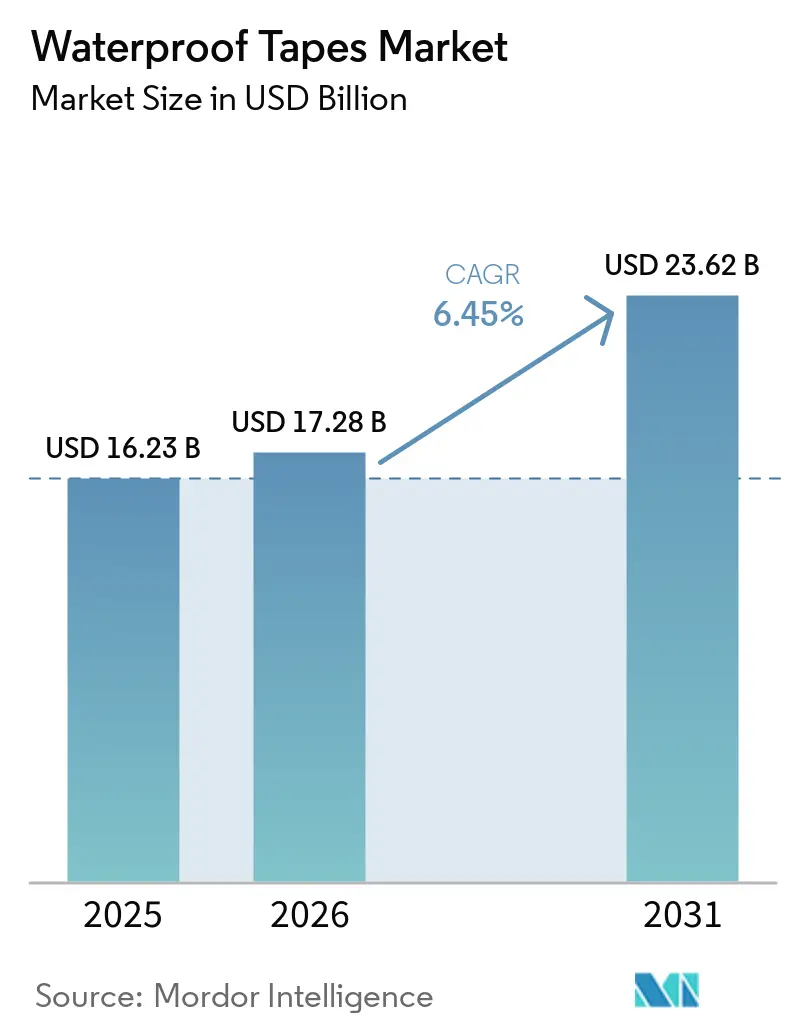
The Waterproof Tapes Market size was valued at USD 16.23 billion in 2025 and is estimated to grow from USD 17.28 billion in 2026 to reach USD 23.62 billion by 2031, at a CAGR of 6.45% during the forecast period (2026-2031). Demand is supported by repairs to aging building envelopes, expanded transport electrification, and more care delivered outside hospitals. These uses favor tapes that provide durable sealing, electrical insulation, or reliable skin contact. Products designed into building assemblies and battery modules can command higher pricing than general-purpose grades. This shifts revenue toward validated performance formulations as buyers place greater value on dependable, long-duration sealing. Suppliers are therefore investing in adhesive chemistry, product approvals, and manufacturing capacity for technically demanding applications. Their commercial focus is increasingly on materials that can meet defined performance requirements during installation and use. This emphasis favors suppliers that can combine formulation knowledge, reliable converting processes, and long-term customer support.
Key Report Takeaways
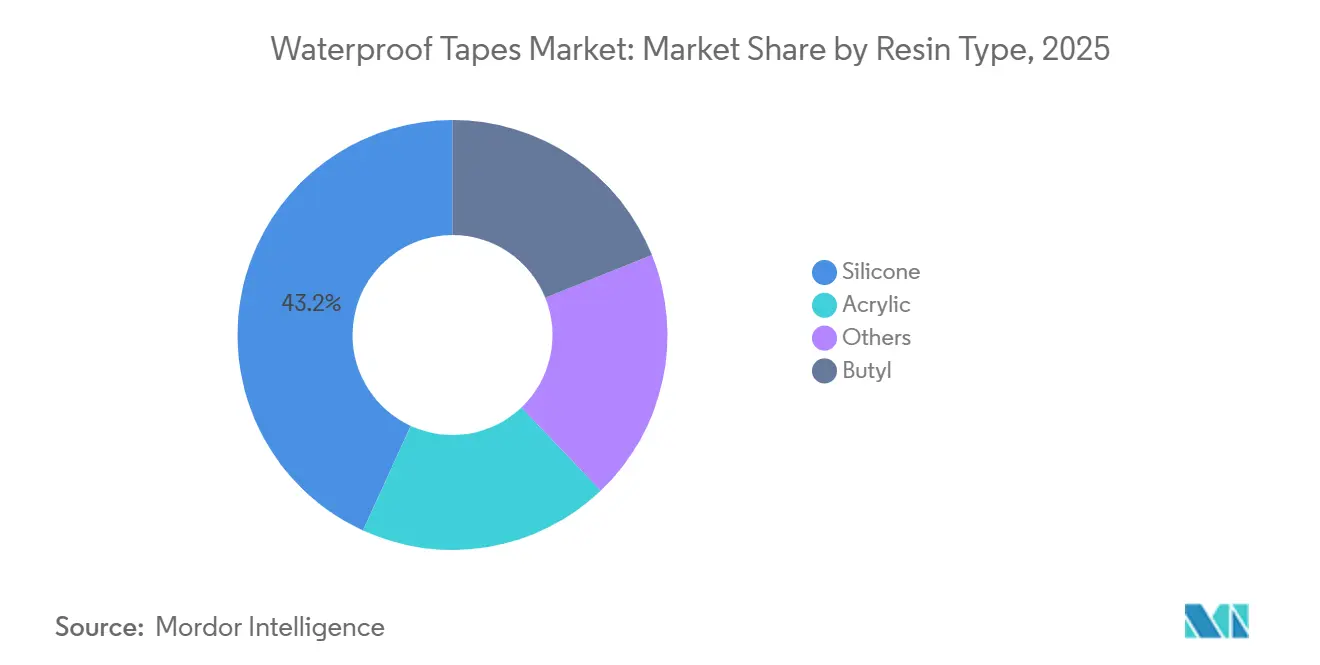
- By resin type, silicone held 43.16% of the waterproof tapes market share in 2025 and is projected to advance at a 7.04% CAGR through 2031.
- By substrate type, plastic held 35.23% of the waterproof tapes market share in 2025, while rubber is projected to advance at a 7.15% CAGR through 2031.
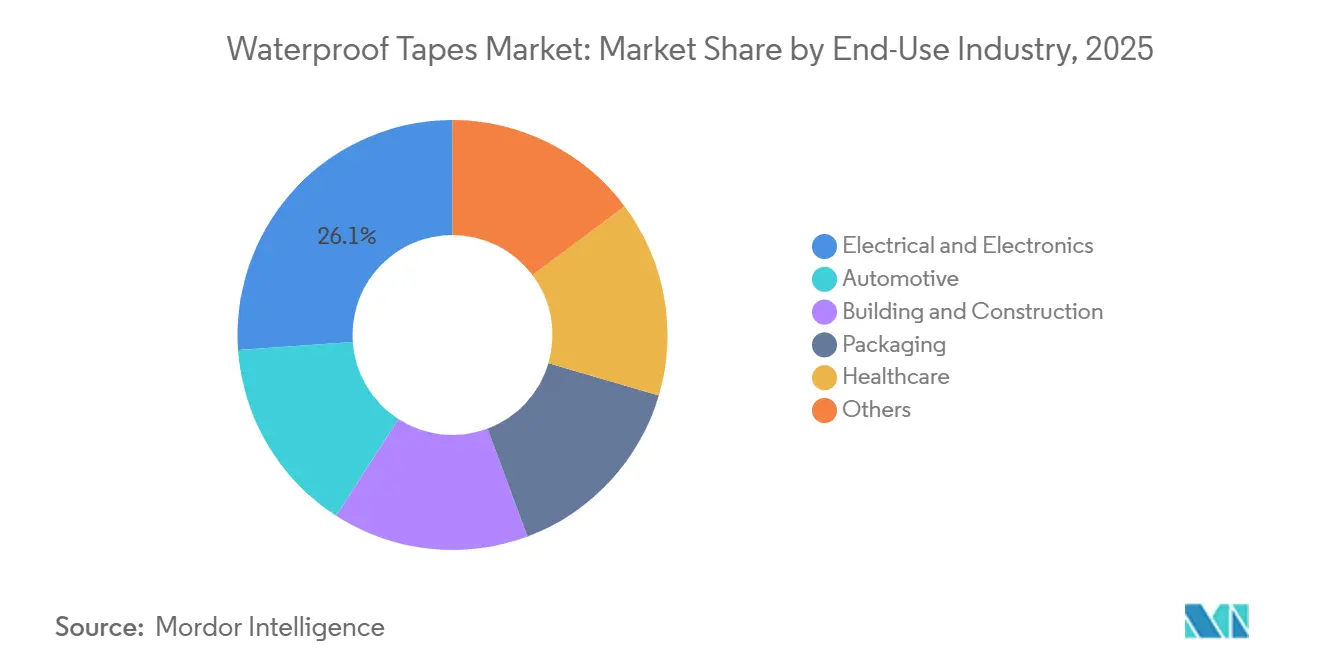
- By end-use industry, electrical and electronics held 26.12% of the waterproof tapes market share in 2025, while healthcare is projected to advance at a 7.32% CAGR through 2031.
- By geography, Asia-Pacific held 36.57% of the waterproof tapes market share in 2025 and is projected to advance at a 7.68% CAGR through 2031.
Note: Market size and forecast figures in this report are generated using Mordor Intelligence’s proprietary estimation framework, updated with the latest available data and insights as of January 2026.
Global Waterproof Tapes Market Trends and Insights
Drivers Impact Analysis*
| Driver | (~) % Impact on CAGR Forecast | Geographic Relevance | Impact Timeline |
|---|---|---|---|
| Expansion of Building Waterproofing and Infrastructure Maintenance | +1.7% | Global, with concentrated gains in North America, Europe, and APAC construction corridors | Medium term (2-4 years) |
| Rising Moisture-Protection Requirements in Electronics and Electric Vehicles | +1.5% | APAC core (China, South Korea, Japan), spill-over to North America and Germany | Short term (≤ 2 years) |
| Growth of Healthcare Wearables and Waterproof Medical Fixation | +1.2% | North America & EU leading, with fast-growing uptake in APAC and South America | Medium term (2-4 years) |
| Preference for Fast, Clean, Lightweight Sealing over Liquid Sealants | +0.9% | Global, strongest in high-labor-cost markets (North America, EU, Japan) | Medium term (2-4 years) |
| E-Commerce and Do-It-Yourself Repair Adoption | +0.6% | North America, Europe, and urban APAC markets | Long term (≥ 4 years) |
| Source: Mordor Intelligence | |||
Expansion of Building Waterproofing and Infrastructure Maintenance
Infrastructure renewal gives the waterproof tapes market a steadier source of demand than new construction activity alone. Repairs to older roofs, facades, and joints require moisture-management products that can be fitted around existing structures. In the United States, older housing creates recurring work on building envelopes and supports demand for repair-oriented sealing systems. Tape products can be applied in a single pass, without the cure periods associated with liquid alternatives. This makes them useful in commercial projects and prefabricated construction, where installation speed affects scheduling. The waterproof tapes market benefits where contractors value reduced preparation, simpler handling, and dependable performance on complex surfaces. These conditions are common in repair work, prefabricated projects, and installations with limited access or narrow scheduling windows. Tape can also simplify sequencing because the installer does not need to wait for a wet-applied material to cure before the next task begins.
Rising Moisture-Protection Requirements in Electronics and Electric Vehicles
Transport electrification changes tape requirements because battery modules need insulation, moisture protection, and thermal stability at the same time. Silicone and high-performance acrylic formulations are favored where conventional grades cannot withstand repeated thermal cycling. These applications support demand for thinner materials that retain adhesion under sustained operating stress. The waterproof tapes market also gains from device designs that need precision die-cut parts for tight spaces. European repair requirements for smartphones can add sealing demand when devices are opened and reassembled. Manufacturers must balance thin construction with resistance to moisture, heat, and repeated handling after repair. This gives high-performance tapes a role in maintaining device protection without adding the weight or space associated with more complex sealing approaches.
Growth of Healthcare Wearables and Waterproof Medical Fixation
Continuous glucose monitors, cardiac patches, and remote-monitoring systems need adhesives that remain attached during bathing, exercise, and extended use. This requirement favors skin-compatible products that limit trauma when removed. The World Health Organization reported that more than 300 million surgical procedures were performed worldwide each year, which supports ongoing demand for wound-dressing fixation[1]World Health Organization, “Global Health Observatory,” World Health Organization, who.int. Medical applications also require manufacturers to meet biocompatibility and quality expectations before products can enter clinical supply chains. These requirements increase the importance of established technical expertise and validation processes. The waterproof tapes market, therefore, has an expanding opportunity in long-wear fixation and outpatient care settings. Products must combine secure adhesion with comfort across normal daily activities, which makes performance consistency important for device makers and care providers. The need for reliable attachment also raises the value of suppliers that understand skin contact, wear time, and removal characteristics.
Preference for Fast, Clean, Lightweight Sealing over Liquid Sealants
Tape systems avoid mixing, curing, cleanup, and containment work that liquid sealants usually require. The difference is important in modular construction, where off-site liquid application can need controlled curing conditions. Shurtape launched FrogTape Pro Grade Deck and Joist Flashing Tape in July 2025 with solventless ultraviolet-cured acrylic adhesive, no primer requirement, and American Architectural Manufacturers Association (AAMA) 711-22 compliance. The product was designed to self-heal around nail penetrations, helping installers manage common deck and ledger details. Such features can reduce installation steps while preserving the value of a moisture barrier. The waterproof tapes market gains where contractors and original equipment manufacturers need lighter assemblies and repeatable application processes. The appeal extends beyond speed because a cleaner application can reduce material handling and support more consistent outcomes across installation teams. This makes tape a practical choice where work must continue without the drying time and cleanup demands of a liquid system.
Restraints Impact Analysis*
| Restraint | (~) % Impact on CAGR Forecast | Geographic Relevance | Impact Timeline |
|---|---|---|---|
| Raw Material Price Volatility | -1.8% | Global, most acute for non-integrated converters in APAC and Eastern Europe | Short term (≤ 2 years) |
| Competition from Liquid Sealants, Membranes, and Mechanical Fasteners | -1.5% | Price-sensitive markets in South America, Southeast Asia, and Middle East & Africa | Medium term (2-4 years) |
| Product Differentiation and Certification Complexity | -1.0% | North America & EU, where medical and EV qualification cycles are longest | Long term (≥ 4 years) |
| Source: Mordor Intelligence | |||
Raw Material Price Volatility
Waterproof tape production depends on films, acrylic monomers, butyl rubber, and silicone inputs whose prices can change quickly. This exposure is most difficult for converters that do not have supply contracts or internal resin capacity. Frequent input adjustments can require several price-list changes within a quarter and make project budgeting harder for customers. Larger manufacturers can manage some of this risk through longer purchasing arrangements and broader sourcing options. Smaller converters may have to pass through cost movements using shorter customer contracts. The waterproof tapes market remains exposed to this uneven cost position, especially where price competition limits a producer’s ability to recover higher input costs. The resulting pressure can affect product selection, contract terms, and the timing of customer purchases. It also encourages manufacturers to improve sourcing discipline and to prioritize applications where technical value supports more stable pricing.
Competition from Liquid Sealants, Membranes, and Mechanical Fasteners
Liquid coatings and membranes can retain an installed-cost advantage in labor-abundant and price-sensitive construction projects. Project owners may choose familiar materials when they prioritize initial cost over installation speed or lifecycle performance. Mechanical fasteners also serve industrial and infrastructure uses that need adjustable or reversible connections. Tape suppliers respond with self-healing, primer-free, and ultraviolet-resistant materials that create stronger differentiation in premium uses. The waterproof tapes market consequently faces a more limited opportunity in construction categories that do not reward performance or labor savings. In these settings, familiar installation practices can outweigh the benefits of faster application or a more specialized formulation. Suppliers must clearly demonstrate practical advantages if they are to move customers away from low-cost, established waterproofing materials.
*Our forecasts treat driver/restraint impacts as directional, not additive. The impact forecasts reflect baseline growth, mix effects, and variable interactions.
Segment Analysis
By Resin Type: Silicone Consolidates Dominance Across High-Value Verticals
Silicone held 43.16% of the waterproof tapes market share in 2025 and is projected to advance at a 7.04% CAGR through 2031. Its position reflects the alignment between silicone performance and requirements in electronics, electric vehicle assembly, and skin-contact medical uses. The material can maintain function across temperatures from -50 °C to 200 °C, which is important for battery enclosures and power electronics. It also supports moisture protection and dielectric performance in applications subject to sustained thermal cycling. These combined needs restrict the suitability of commodity products in high-value assemblies.
Acrylic remains widely used in building and construction, packaging, and general industrial applications because it provides ultraviolet stability and works with water-based carrier systems. Butyl tapes remain important for underground waterproofing, pipe-joint sealing, and roofing penetrations where irregular or wet surfaces require cold-applied adhesion. Other resins, including rubber-based hot-melt and hybrid chemistries, address food-contact packaging and high-humidity industrial conditions. Resin demand is gradually separating between premium silicone and advanced acrylic formulations, and value-focused products used in infrastructure applications. This keeps silicone central to the waterproof tapes industry, where validated performance matters more than initial material cost. Buyers in these uses are less likely to change materials without evidence that an alternative can maintain insulation, sealing, and durability requirements. As a result, resin selection is closely tied to the operating conditions and approval needs of the finished assembly.



By Substrate Type: Plastic Leads, Rubber Accelerates on Performance Demand
Plastic substrates held 35.23% of the waterproof tapes market share in 2025 because polyethylene, polypropylene, and polyester films offer low density and chemical resistance. They also work with a broad range of adhesive chemistries. Plastic-backed products support applications from packaging and construction flashing to electronics protection, creating a broad demand base. This coverage makes replacement by one alternative substrate unlikely across the full waterproof tapes market. Film substrates also provide a practical format for converted die-cut parts used in electronics and automotive assemblies.
Rubber is projected to advance at a 7.15% CAGR through 2031, supported by applications that need stretch, recovery, and adhesion on irregular surfaces. They are suited to electric vehicle underbody sealing, automotive panel gaps, and large pipe joints where films can buckle or lose contact. Metal substrates, mainly aluminum and lead foil, retain a specialized role in roofing, heating, ventilation, and air conditioning duct sealing, and hazardous-area electrical protection. Other substrates include woven fabric and nonwoven carriers that add tear resistance for construction and pipe-wrapping work. Shurtape’s T-Rex Waterproof and Repair Tape uses a multilayer polyolefin film and Flex-to-Fit Technology for conformability on curved and rough surfaces. This illustrates how backing design can determine whether a tape maintains contact when an application has bends, texture, or changing contours. The choice of substrate, therefore, affects both installation behavior and the product’s ability to deliver the intended waterproofing function.
By End-Use Industry: Electrical and Electronics Anchors Revenue, While Healthcare Leads Growth
Electrical and electronics held 26.12% of the waterproof tapes market share in 2025, supported by device-level sealing requirements. These tapes must often be precisely die-cut and capable of withstanding repeated thermal cycles without delamination. Their value per unit area can exceed that of construction products because failure can affect device reliability. Nitto Denko Corporation’s Industrial Tape segment grew in fiscal year (FY) March 2026 as electronics sealing tape demand increased. This supports continued demand for specification-grade materials within the waterproof tapes market. Electronics producers require controlled dimensions, dependable adhesion, and stable performance within compact product designs. The need to protect internal components from moisture and temperature changes makes material selection a direct part of device reliability planning.
Healthcare is projected to advance at a 7.32% CAGR through 2031 as wearable devices and home-based care become more common. Surgical wound fixation provides a stable base, while glucose monitors, cardiac patches, and remote-monitoring devices add new long-wear applications. Automotive uses are also expanding as electric vehicles replace some mechanical connections with adhesive tape assemblies. Building and construction demand grows where installation speed and labor efficiency are valued against legacy waterproofing systems. Packaging applications include tamper-evident, cold-chain, and outdoor-durability uses where ordinary carton tape may not retain seal integrity under humidity or temperature changes. Marine, aerospace, military, and agricultural equipment uses also require specialized sealing in lower-volume applications. These categories can support premium unit values because the tape must operate under conditions that exceed those faced by standard consumer products.
Geography Analysis
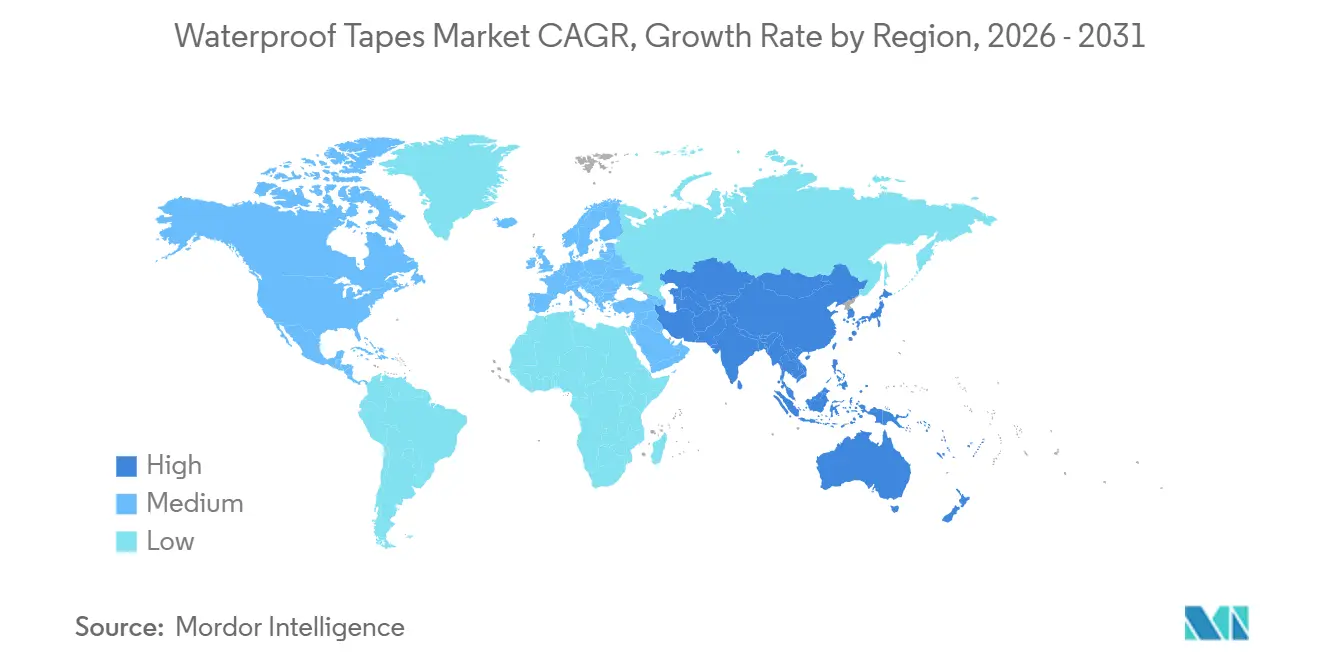
Asia-Pacific held 36.57% of the waterproof tapes market share in 2025 and is projected to advance at a 7.68% CAGR through 2031. The region is both a large electronics manufacturing center and a major construction market. China supports regional demand through electronics production, infrastructure work, and electric vehicle assembly. Japan and South Korea emphasize precision formats for display, automotive, and advanced device applications. Nitto Denko Corporation completed a Kaohsiung manufacturing and research facility in July 2026 after a TWD 4.48 billion (approximately USD 140.3 million) investment.
The facility produces polyvinyl chloride tapes and electronic adhesive tapes for semiconductor and automotive customers. India, the Association of Southeast Asian Nations countries, and South Korea add growth across healthcare, infrastructure, and automotive production. This supports broad demand for both commodity and mid-performance grades. North America benefits from infrastructure repair, a large automotive aftermarket, and broad retail distribution for repair products. Mexico contributes to industrial demand through automotive assembly and manufacturing investment. Canada provides a separate niche for butyl and advanced acrylic products that retain adhesion during cold-weather installation. Across North America, mature repair channels and established contractor practices support recurring demand for products used in maintenance as well as new construction.
Europe is influenced by building rules that favor airtight and moisture-managed envelopes in new construction and deep renovation. South America is led by Brazil and Argentina, where housing, infrastructure, and packaging support demand. Chile has a need for flexible waterproofing solutions in new construction and repairs to earthquake-affected structures. The Middle East and Africa demand is supported by construction in Gulf Cooperation Council countries and industrial maintenance in South Africa. Saudi Arabia’s Vision 2030 infrastructure pipeline and continued commercial real estate development in the United Arab Emirates represent concentrated sources of construction-related demand. The regional opportunity remains tied to the pace of project execution and the ability of tape suppliers to meet local performance and distribution requirements.

Competitive Landscape
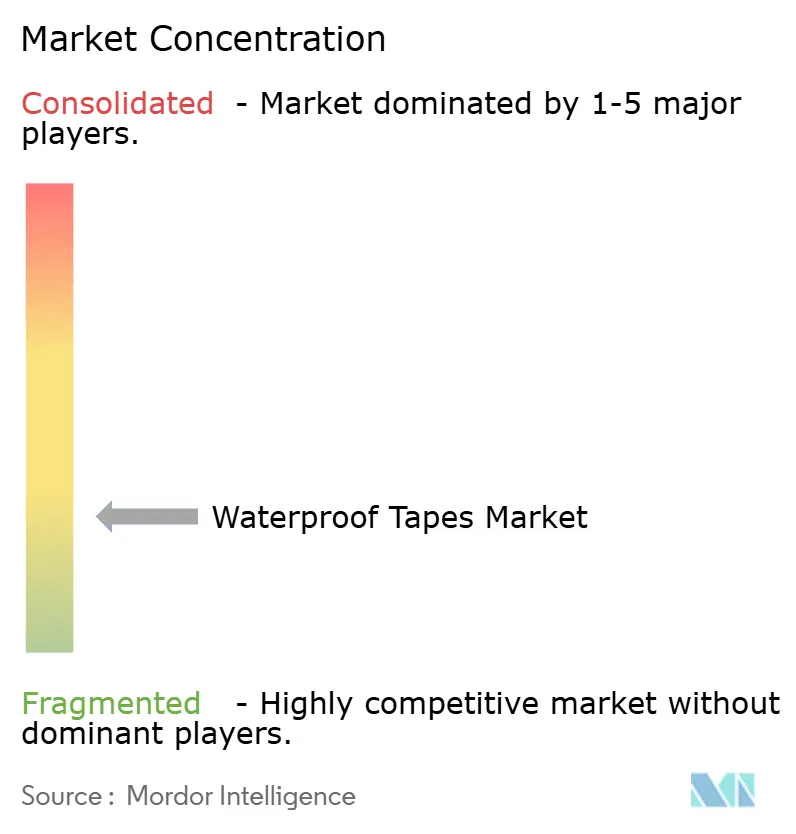
The waterproof tapes market is highly fragmented, with the top five players including 3M, Nitto Denko Corporation, tesa SE, Henkel AG & Co. KGaA, and Avery Dennison Corporation. 3M, Nitto Denko Corporation, Henkel AG & Co. KGaA, tesa SE, and Avery Dennison Corporation have strong positions in performance and specialty applications. Their products compete through adhesive chemistry, reliability, and the ability to secure customer specifications, with consistent converting quality also important because variation can reduce confidence in an approved tape. Regional manufacturers often compete on cost and delivery in less demanding applications. Qualification requirements can protect established suppliers in medical and electric vehicle uses because customers need proven materials and consistent production, while approval cycles of 6-18 months limit rapid entry and preserve the position of suppliers that meet material and manufacturing expectations.
Henkel AG & Co. KGaA signed an agreement in January 2026 to acquire ATP Adhesive Systems, a Swiss producer of high-performance water-based specialty tapes[2]Henkel AG & Co. KGaA, “Henkel to Acquire ATP Adhesive Systems, a Leading Expert in High-Performance Water-Based Specialty Tapes,” Henkel Investor Relations News, henkel.com. The transaction broadened Henkel AG & Co. KGaA’s tape portfolio beyond liquid adhesive formats and strengthened its position in water-based specialty tape technologies, giving the company complementary products and customer relationships while addressing interest in lower-volatility organic compound adhesive technologies.
Nitto Denko invested in new manufacturing and research capacity in Taiwan for semiconductor and automotive clients. Avery Dennison announced a USD 390 million agreement in August 2025 to acquire Meridian Adhesives Group’s U.S. flooring adhesives business. These moves show a focus on specialized adhesive technologies and adjacent applications. The waterproof tapes market offers room for suppliers that can develop thin, skin-compatible, silicone formulations for long-wear medical devices, where secure connection, movement, and removal characteristics are essential. Competition is likely to remain strongest where customers require technical validation, while price competition remains intense in basic construction and packaging grades, with larger suppliers differentiating through formulation capability and specialized capacity.
Waterproof Tapes Industry Leaders
3M
Nitto Denko Corporation
tesa SE
Henkel AG & Co. KGaA
Avery Dennison Corporation
- *Disclaimer: Major Players sorted in no particular order

Recent Industry Developments
- August 2026: Nitto Denko Corporation completed its new manufacturing and R&D facility in Kaohsiung, Taiwan, expanding its regional production and product-development capabilities. The investment strengthens Nitto Denko Corporation’s capacity to develop and supply specialty adhesive and sealing solutions used in waterproofing applications.
- January 2026: Henkel AG & Co. KGaA signed an agreement to acquire Swiss-based ATP Adhesive Systems from Arsenal Capital Partners, expanding its pressure-sensitive adhesive and specialty tape portfolio. The acquisition strengthened Henkel AG & Co. KGaA’s capabilities in adhesive tape solutions, supporting applications that require waterproofing, sealing, and durable bonding.


Global Waterproof Tapes Market Report Scope
Waterproof tapes are pressure-sensitive or adhesive-backed materials designed to create water-resistant or water-tight seals between surfaces, joints, and components. They protect against moisture ingress while also supporting bonding, insulation, sealing, and surface protection in demanding environments.
The Waterproof Tapes Market is segmented by resin type, substrate type, end-use industry, and geography. By resin type, the market is segmented into silicone, acrylic, butyl, and others. By substrate type, the market is segmented into plastic, metal, rubber, and others. By end-use industry, the market is segmented into electrical and electronics, automotive, building and construction, healthcare, packaging, and others. The report also covers the market size and forecasts for waterproof tapes in 15 countries across major regions. For each segment, the market sizing and forecasts have been done on the basis of value (USD).
| Silicone |
| Acrylic |
| Butyl |
| Others |
| Plastic |
| Metal |
| Rubber |
| Others |
| Electrical and Electronics |
| Automotive |
| Building and Construction |
| Healthcare |
| Packaging |
| Others |
| Asia-Pacific | China |
| India | |
| Japan | |
| South Korea | |
| ASEAN Countries | |
| Rest of Asia-Pacific | |
| North America | United States |
| Canada | |
| Mexico | |
| Europe | Germany |
| United Kingdom | |
| France | |
| Italy | |
| NORDIC Countries | |
| Rest of Europe | |
| South America | Brazil |
| Argentina | |
| Rest of South America | |
| Middle East and Africa | Saudi Arabia |
| South Africa | |
| Rest of Middle East and Africa |
| By Resin Type | Silicone | |
| Acrylic | ||
| Butyl | ||
| Others | ||
| By Substrate Type | Plastic | |
| Metal | ||
| Rubber | ||
| Others | ||
| By End-Use Industry | Electrical and Electronics | |
| Automotive | ||
| Building and Construction | ||
| Healthcare | ||
| Packaging | ||
| Others | ||
| By Geography | Asia-Pacific | China |
| India | ||
| Japan | ||
| South Korea | ||
| ASEAN Countries | ||
| Rest of Asia-Pacific | ||
| North America | United States | |
| Canada | ||
| Mexico | ||
| Europe | Germany | |
| United Kingdom | ||
| France | ||
| Italy | ||
| NORDIC Countries | ||
| Rest of Europe | ||
| South America | Brazil | |
| Argentina | ||
| Rest of South America | ||
| Middle East and Africa | Saudi Arabia | |
| South Africa | ||
| Rest of Middle East and Africa | ||


Key Questions Answered in the Report
What is the size of the waterproof tapes market?
The waterproof tapes market stands at USD 17.28 billion in 2026 and is projected to reach USD 23.62 billion by 2031.
What is driving demand for waterproof tapes?
Demand is supported by building-envelope repairs, electronics sealing, electric vehicle assembly, and long-wear medical fixation applications.
Which resin type led the market demand in 2025?
Silicone held 43.16% of the waterproof tapes market share in 2025.
Which substrate type is expected to grow fastest through 2031?
Rubber is projected to advance at a 7.15% CAGR through 2031, supported by conformable sealing needs in automotive, industrial, and pipe-joint applications.
Page last updated on:





