
Water Storage Systems Market Size and Share
Market Overview
| Study Period | 2022 - 2032 |
|---|---|
| Market Size (2027) | USD 23.5 Billion |
| Market Size (2032) | USD 33.76 Billion |
| Growth Rate (2027 - 2032) | 7.51 % |
| Fastest Growing Market | Asia-Pacific |
| Largest Market | North America |
| Market Concentration | Low |
Major Players *Disclaimer: Major Players sorted in no particular order Image © Mordor Intelligence. Reuse requires attribution under CC BY 4.0. | |
Water Storage Systems Market Analysis by Mordor Intelligence
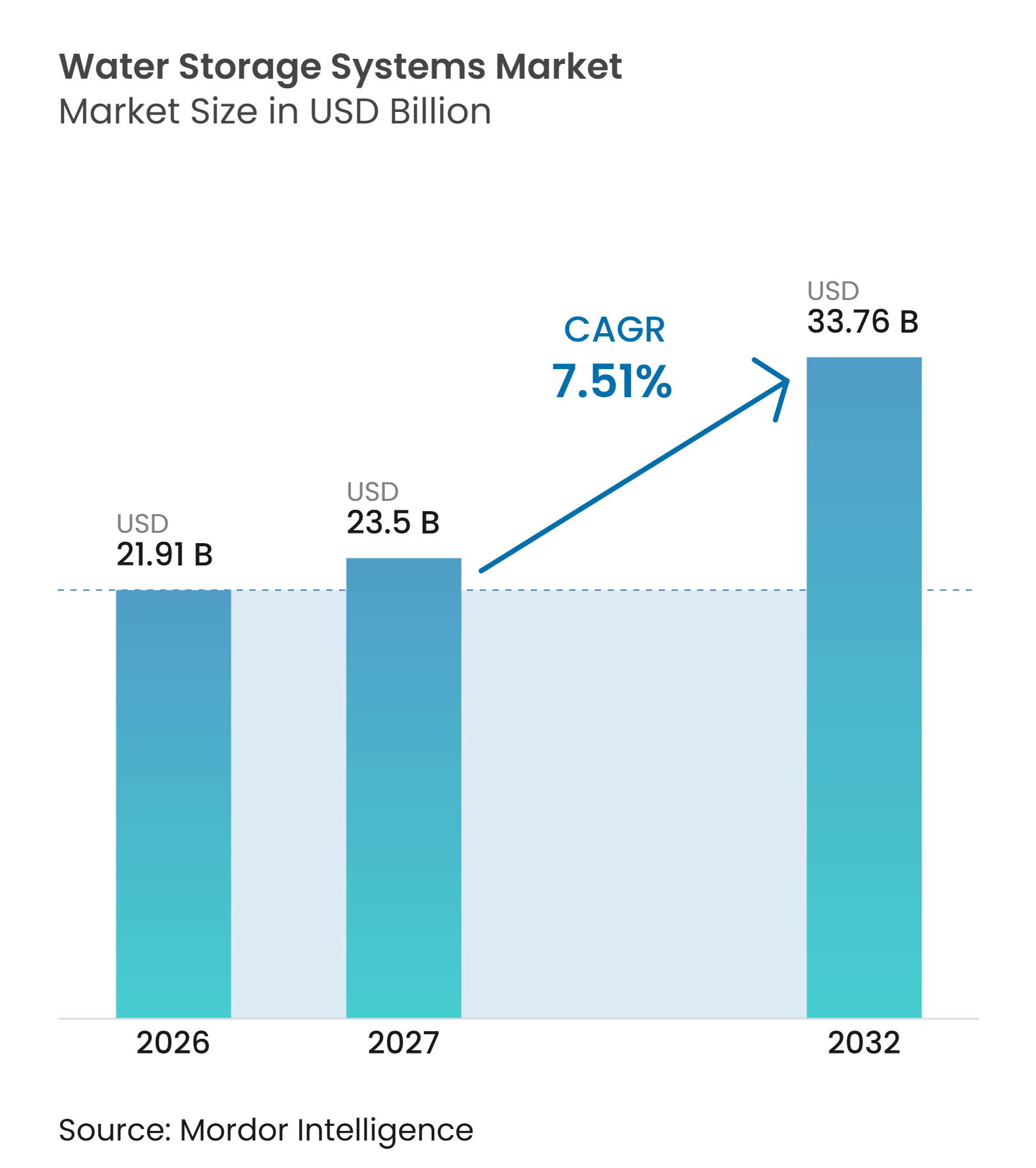
The Water Storage Systems Market size was valued at USD 21.91 billion in 2026 and is estimated to grow from USD 23.50 billion in 2027 to reach USD 33.76 billion by 2032, at a CAGR of 7.51% during the forecast period (2027-2032). Freshwater stress is making reserve capacity a core part of utility and industrial water planning, rather than an optional addition. Public investment is also moving toward the replacement of aging municipal assets, which supports a longer pipeline for tank construction and rehabilitation. Industrial facilities, including data centers, semiconductor plants, and chemical processors, need dedicated water reserves when public networks face disruption. Climate resilience requirements are encouraging distributed storage at building and district level. These conditions support demand across the water storage systems market while making compliance capability, lead time, and lifecycle cost central to supplier selection for water storage systems market suppliers.
Key Report Takeaways
- By material, concrete held 32.45% of the water storage systems market share in 2026, while fiberglass is forecast to advance at a 7.97% CAGR through 2032.
- By installation location, aboveground held 45.67% of the water storage systems market share in 2026, while underground is forecast to advance at an 8.16% CAGR through 2032.
- By application, onsite water and wastewater collection held 30.21% of the water storage systems market share in 2026, while rainwater harvesting and collection is forecast to advance at an 8.34% CAGR through 2032.
- By end user, municipal held 33.56% of the water storage systems market share in 2026, while industrial is forecast to advance at an 8.93% CAGR through 2032.
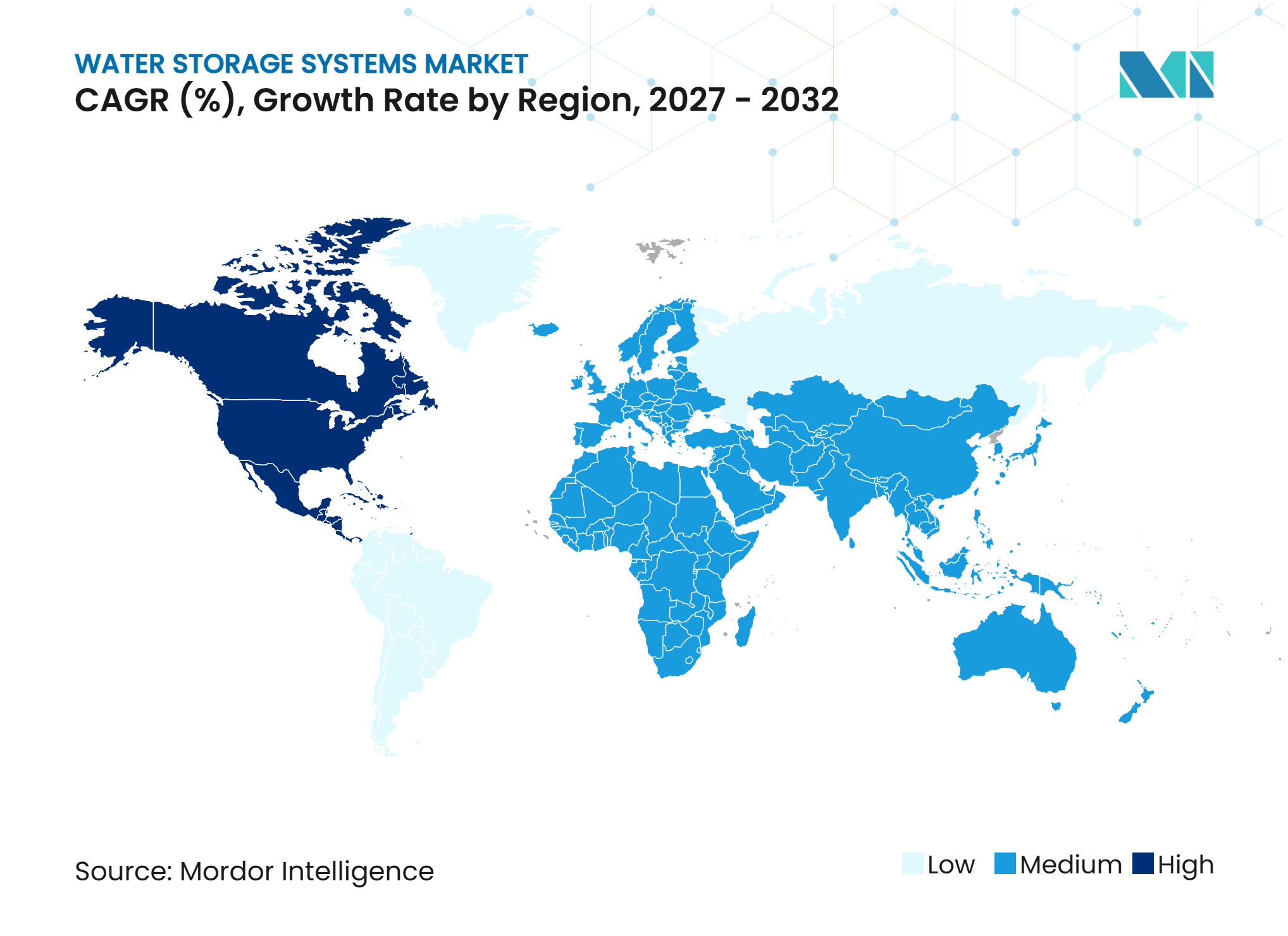
- By geography, Asia-Pacific held 34.89% of the water storage systems market share in 2026, while North America is forecast to advance at an 8.77% CAGR through 2032.
Note: Market numbers in this report are based on Mordor Intelligence's proprietary estimation framework, which combines nine months of actuals with Q4 projections for base year 2026.
Market Trends and Insights
Drivers Impact Analysis of Water Storage Systems Market*
| Driver | (~) % Impact on CAGR Forecast | Geographic Relevance | Impact Timeline |
|---|---|---|---|
| Freshwater Scarcity and Reliability Requirements | +2.3% | Global, with concentration in APAC and MEA | Long term (≥ 4 years) |
| Municipal and Industrial Water-Infrastructure Investment | +1.8% | North America & Europe; spillover to APAC | Medium term (2-4 years) |
| Expansion of Rainwater Harvesting and Decentralized Storage | +1.4% | APAC core; growing uptake in Europe and North America | Medium term (2-4 years) |
| Fire-Safety Reserve Mandates and Resilient Building Design | +1.0% | Global, especially North America and Middle East | Short to medium term (≤ 4 years) |
| Smart Monitoring and Predictive Maintenance Adoption | +0.7% | North America & Europe, early uptake in APAC | Short term (≤ 2 years) |
| Source: Mordor Intelligence | |||
Freshwater Scarcity and Reliability Requirements
Water stress is reshaping investment priorities in both higher-income and emerging economies. The Food and Agriculture Organization (FAO) reports that more than 40% of the global population lives in water-scarce conditions, which increases the value of storage that separates supply availability from immediate demand. Utilities and industrial operators are therefore treating dedicated storage as a risk-management asset. In August 2025, California approved nearly USD 219 million in additional funding for the Sites Reservoir project, whose total estimated cost is up to USD 6.8 billion[1]. The project shows how public funding is being directed toward large reservoirs during periods of supply stress. The water storage systems market benefits when assets are designed for extended shortages rather than short operating interruptions, strengthening water storage systems market requirements for resilient capacity.
Municipal and Industrial Water-Infrastructure Investment
Deferred maintenance is bringing more municipal water projects into public procurement pipelines. The U.S. Environmental Protection Agency announced USD 7 billion in Water Infrastructure Finance and Innovation Act funding availability in 2026 for critical water infrastructure[2]. Pennsylvania Infrastructure Investment Authority awarded USD 547.1 million in a single funding round in 2025. Pennsylvania American Water also committed USD 18.5 million to rehabilitate 7 tanks and construct 5 new tanks in 2025. Larger, multi-year procurement programs favor suppliers with a broad product range and service capability. American Water Works Association (AWWA) C652-2025 establishes requirements for disinfecting water storage facilities, which ties new tank commissioning to a defined compliance process.
Expansion of Rainwater Harvesting and Decentralized Storage
Rainwater harvesting is becoming part of urban water-security planning in several markets. Shanghai issued a 2025 regulation that provides subsidies of up to CNY 15 per cubic meter (approximately USD 2.1 per cubic meter) for qualifying nonconventional water projects that include rainwater collection and storage. Zhejiang Province also published a 2025 rural water supply regulation that identifies backup water sources, reservoir tanks, and storage pools as emergency supply solutions. These measures support decentralized systems in residential and commercial settings. Such projects generally have shorter procurement cycles than large municipal contracts.
Fire-Safety Reserve Mandates and Resilient Building Design
Building resilience requirements are increasing demand for dedicated on-site fire-water reserves. American Society of Civil Engineers/Structural Engineering Institute (ASCE/SEI) 24-2025 sets minimum flood-resistant design requirements that apply to water storage infrastructure in flood hazard areas. The AWWA placed its composite elevated tank standard, AWWA D107, under public review in 2025. AWWA D140 for cast-in-place concrete tanks also entered a comment period in 2026. These standards shape the specifications used for new facilities and upgrades. Property owners in fire-prone locations are also giving greater attention to autonomous reserves when municipal supply may be disrupted.
Restraints Impact Analysis of Water Storage Systems Market*
| Restraint | (~) % Impact on CAGR Forecast | Geographic Relevance | Impact Timeline |
|---|---|---|---|
| High Capital and Installation Cost | -2.1% | Global; most acute in developing markets and remote locations | Long term (≥ 4 years) |
| Raw Material Price Volatility | -1.4% | Global, most acute in North America and Europe | Short to medium term (≤ 4 years) |
| Fragmented Rainwater-Harvesting Standards | -0.8% | Global; most acute in Asia and South America | Medium to long term (2-5 years) |
| Source: Mordor Intelligence | |||
High Capital and Installation Cost
Large storage projects can exceed the budgets available to smaller utilities and municipalities. The Passaic Valley Water Commission financed a USD 52.98 million project to replace an open-air reservoir with covered concrete storage tanks through a dedicated infrastructure bank loan. Remote projects add site preparation, foundations, and logistics costs to the tank purchase. These conditions can lead smaller users to delay investment or choose temporary alternatives. Safe Drinking Water Act requirements and American Water Works Association (AWWA) standards create a need for compliant systems, but implementation schedules can still extend capital planning periods. The water storage systems market faces slower project conversion when borrowing costs rise, or local budgets tighten, which can delay water storage systems market orders.
Raw Material Price Volatility
Steel and Portland cement are important inputs for aboveground and elevated tanks. Changes in input costs can narrow fabricator margins, especially on fixed-price municipal contracts. Fiberglass suppliers also face exposure to the cost of glass fiber, resin, and petrochemical feedstocks. Smaller regional fabricators can have less capacity to manage sudden price changes than diversified manufacturers. In January 2026, TerraVest Industries acquired KBK Industries for USD 90 million, adding a manufacturer of fiberglass and steel storage tanks to its portfolio. The transaction shows why access to capital and a broader supply base can matter when materials costs remain unstable.
*Our forecasts treat driver/restraint impacts as directional, not additive. The impact forecasts reflect baseline growth, mix effects, and variable interactions.
Water Storage Systems Market Segment Analysis
By Material:
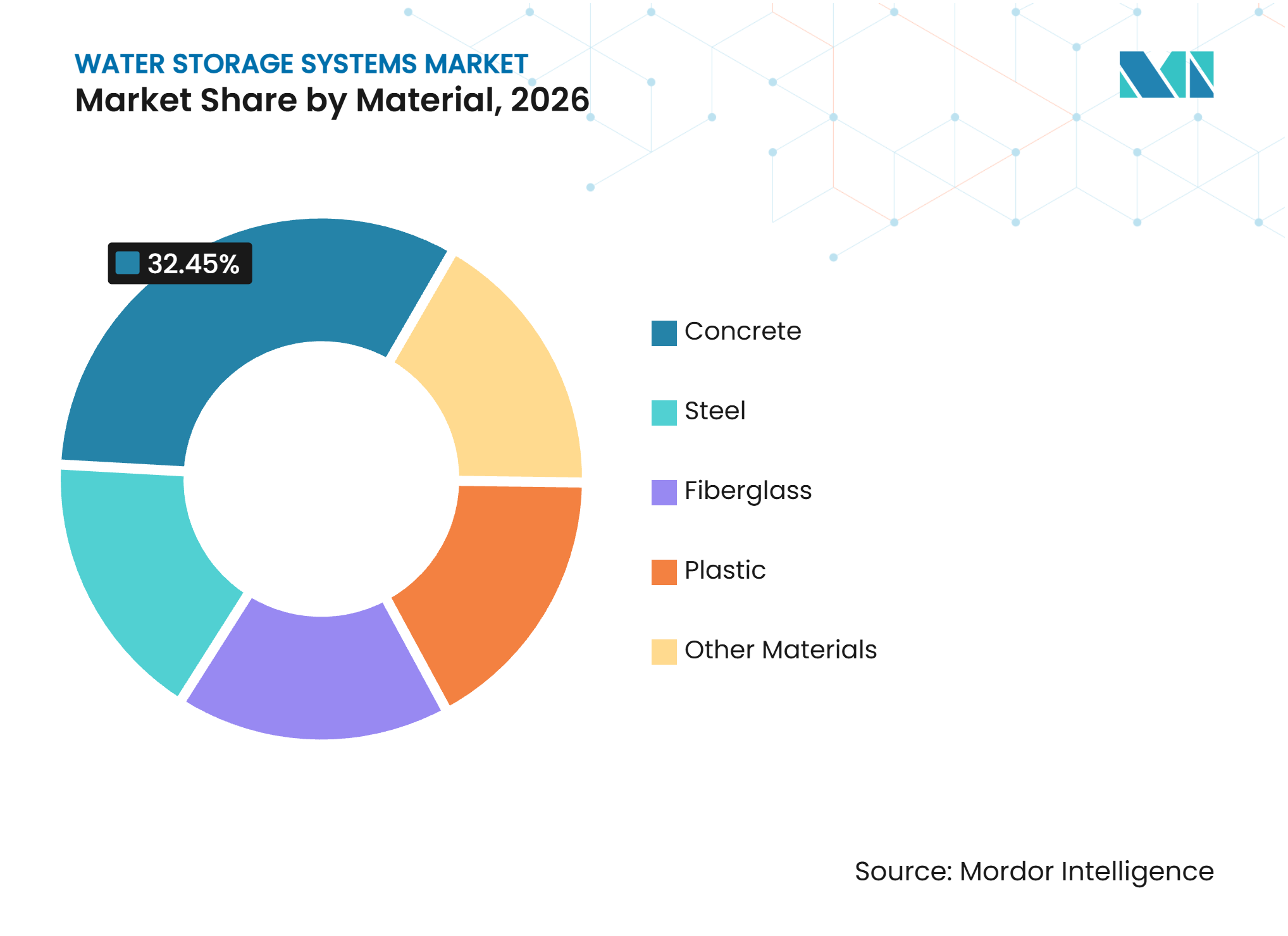
Concrete Retains Scale While Fiberglass Gains Wider UseConcrete held 32.45% share in 2026, supported by its established role in large municipal projects. Municipal engineers are familiar with reinforced concrete designs for high-capacity storage. Long operating lives can also make replacement cycles less frequent in mature networks. The water storage systems industry continues to use concrete where project scale and local construction capability favor the material.
Fiberglass is projected to advance at a 7.97% CAGR through 2032. Its resistance to corrosion and lower maintenance requirements suit wastewater and chemically demanding locations. NOV Fiber Glass Systems reported composite water infrastructure projects in California, Oregon, and Chile during 2025. Steel remains relevant for elevated tanks and large bolted systems, while plastic supports smaller residential and commercial installations. Glass-fused-to-steel and engineered composites serve applications where lifecycle maintenance is important. AWWA D120 was reaffirmed in 2025, retaining a standards reference for thermosetting fiberglass-reinforced plastic tanks used in water supply service.



By Installation Location:
Aboveground Leads, While Underground ExpandsAboveground held a 45.67% share in 2026 because its is generally straightforward to construct and access. They remain common in municipal and commercial projects where land is available. Surface systems also allow operators to inspect and service equipment with fewer site constraints. Their use is supported by established engineering practices for standard storage requirements. The water storage systems market size for aboveground applications remains tied to ongoing replacement of visible municipal assets.
Underground is projected to advance at an 8.16% CAGR through 2032. Higher urban land values make belowground storage more attractive where surface space is limited. Buried installations can also protect potable water from temperature changes, algae growth, and surface contamination. Minnesota appropriated USD 734,000 in 2025 for underground water storage tank replacement in Kennedy. Indoor systems serve hospitals, commercial buildings, and data centers that need controlled reserve capacity. Balmoral Tanks Ltd reported in 2025 that data center projects made up 20% of export sales, indicating demand for engineered cooling and fire-protection storage.
By Application:
Onsite Water and Wastewater Collection Support Revenue, While Rainwater Harvesting and Collection ExpandOnsite water and wastewater collection held a 30.21% share in 2026. The segment supports treated-water buffering before distribution and is linked to core municipal service delivery. Population growth and network expansion continue to support installation requirements in developing cities. Utilities also need storage-to-demand capacity that cannot be reduced without affecting service resilience.
Rainwater harvesting and collection is projected to advance at an 8.34% CAGR through 2032. Stormwater rules and water-reuse measures are increasing interest in storage that can capture nonpotable supply. Shanghai’s 2025 support measure provides subsidies for eligible nonconventional water projects, including rainwater storage. Hydraulic fracture storage and collection continues to depend on energy-sector capital cycles. Potable water storage requires contact materials that meet NSF International and American National Standards Institute Standard 61, commonly written as NSF/ANSI 61, in North American procurement. Fire suppression reserve systems also require inspection and capacity management under relevant building and fire protection requirements.
By End-User:
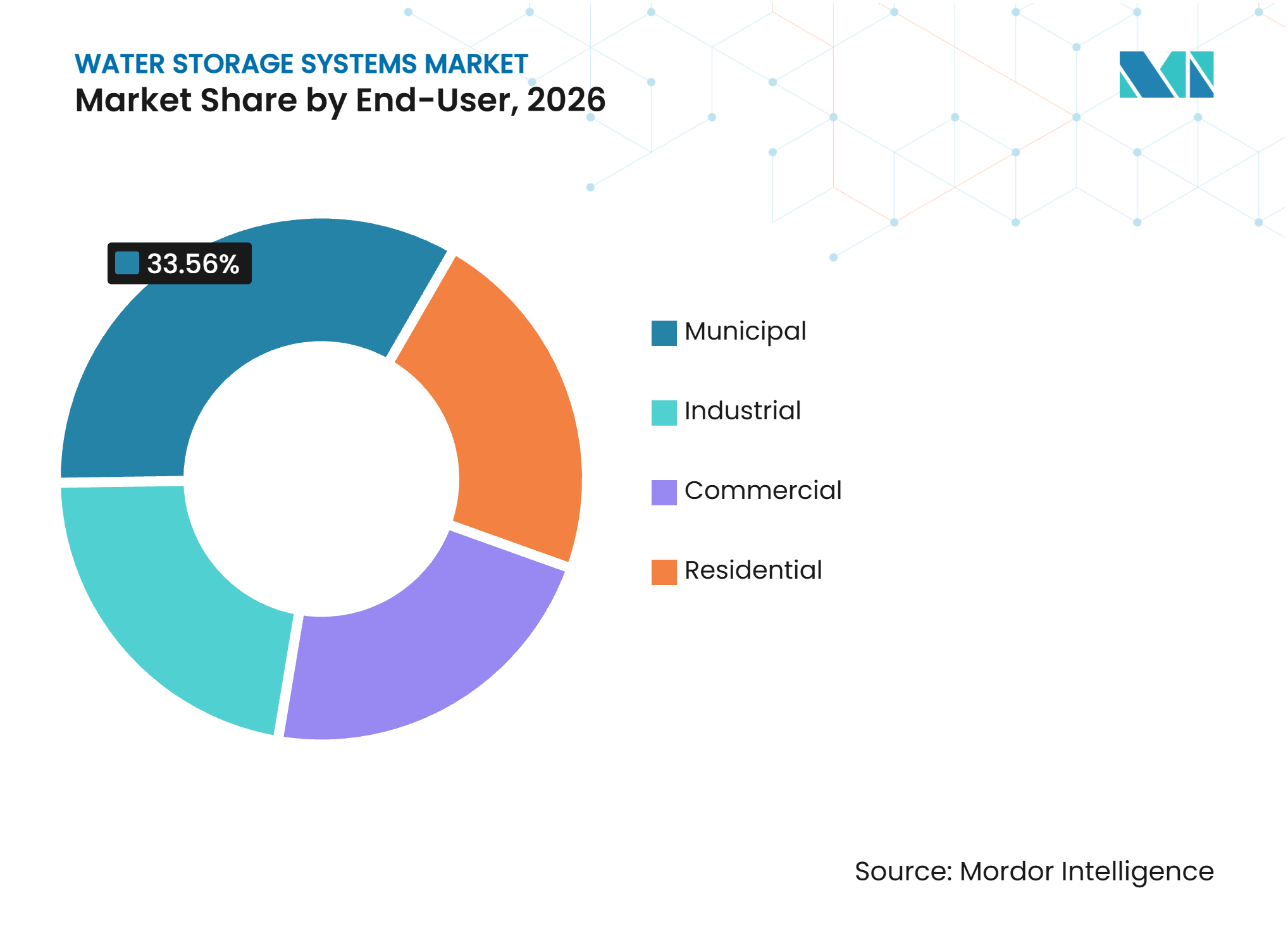
Municipal Leads, While Industrial AcceleratesMunicipal held a 33.56% share in 2026. Public water networks rely on distribution tanks across multiple service areas. This creates repeat demand when facilities are rehabilitated or when new capacity is constructed. Federal and state funding programs help utilities address deferred maintenance. The water storage systems market size for municipal buyers is supported by the essential nature of water service and compliance obligations.
Industrial is projected to advance at an 8.93% CAGR through 2032. Semiconductor fabrication, pharmaceutical production, and large data centers require reliable, dedicated water reserves. Closed-loop cooling designs often need insulated or high-purity tanks that can maintain service continuity. In May 2026, NOV and TerraFlow Energy announced a collaboration to evaluate fiberglass composite solutions for AI-scale power infrastructure. Commercial buyers respond to local codes, insurance requirements, and sustainability certifications. Residential demand remains centered on lower-volume polyethylene tanks, especially where household supply is unreliable.

Geography Analysis
Asia-Pacific
Asia-Pacific held a 34.89% share in 2026. China and India support regional demand through large water access and supply reliability programs. China’s Ministry of Water Resources advanced the rural water supply “3+1” standardization program in 2025, targeting 96% rural tap water penetration and 69% scalable supply system coverage. Chongqing’s 2025 to 2027 action plan includes 611 source enhancement projects and 1,480 water plant upgrades. India’s Jal Jeevan Mission and related state programs also support utility storage needs. Japan’s resilience planning following the 2024 Noto Peninsula earthquake has strengthened the focus on storage and continuity measures. Industrial zones and denser urban areas in South Korea and Southeast Asia add demand for integrated building and district systems.
North America
North America is projected to advance at an 8.77% CAGR through 2032. The U.S. Environmental Protection Agency made USD 7 billion in Water Infrastructure Finance and Innovation Act funding available in 2026. Pennsylvania Infrastructure Investment Authority issued USD 547.1 million in a single round during 2025. Oklahoma approved USD 1.76 million for Westville’s 350,000-gallon elevated storage tank in 2025. The Environmental Protection Agency’s 2025 order for the Los Angeles Department of Water and Power to inspect nearly 100 reservoirs and tanks highlights deferred maintenance in large systems. Data center construction and wildfire resilience needs are widening the buyer base beyond traditional municipal users. Compliance under the Safe Drinking Water Act and American Water Works Association standards continues to shape specifications.
Europe, South America, and the Middle East and Africa
Europe, South America, and the Middle East and Africa show distinct project drivers. Europe is supported by asset renewal and data center requirements for cooling and fire-protection storage. Balmoral Tanks Ltd reported that data center projects increased their share of its export sales in 2025. In South America, Brazil combines agricultural and municipal demand with industrial requirements for composite tanks. NOV supplied 4 earthquake-resistant fiberglass-reinforced plastic tanks for an industrial site in Chile during 2025. The Middle East and Africa demand includes water-security programs, aging municipal assets, and mining or industrial projects. Hunan Construction Investment Group signed a 2025 contract for 45,000 cubic meters of storage tanks for mining infrastructure in Guinea. The water storage systems market across these regions depends on local funding capacity, water risk, and project-specific compliance conditions that shape water storage systems market project timing.
Competitive Landscape
Market Concentration
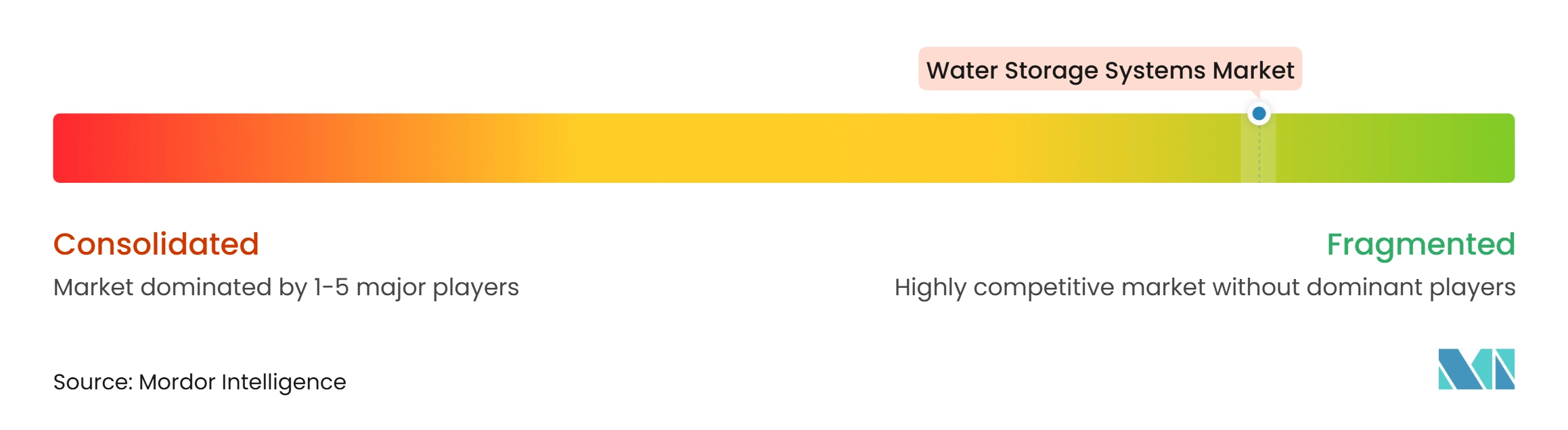
The water storage systems market is highly fragmented, with the top five players including CST Industries, Caldwell Tanks, Tank Holding Corp., McDermott, and Xerxes Corporation. Scale suppliers differentiate through material range, certified production, coatings, and dealer networks. Balmoral Tanks Ltd launched U.S. operations in Ohio in April 2025 to produce epoxy-coated steel tanks for water storage and biogas applications. Certification requirements under AWWA D107, AWWA D120, and NSF/ANSI 61 can act as qualification thresholds in municipal procurement.
Balmoral Tanks Ltd, Caldwell Tanks, CST Industries, and NOV compete through specialized products and project experience. Superior Tank Co., Inc., Tank Connection, Tank Holding Corp., Xerxes Corporation, Fiber Technology Corporation, Maguire Iron, Inc., and National Storage Tank address a mix of manufacturing, distribution, and service requirements. The water storage systems market also rewards manufacturers that can meet municipal documentation and installation requirements across water storage systems market projects.
Smart monitoring and aftermarket service remain areas where suppliers can broaden customer relationships. Operators increasingly need inspection, cleaning, remote monitoring, and maintenance services alongside tank supply. NOV positions composite systems for long-life water infrastructure applications and reported active projects across multiple regions in 2025. TerraVest Industries acquired KBK Industries in January 2026 for USD 90 million, adding fiberglass and steel storage capability. The transaction demonstrates continued interest in established manufacturing capacity. Competition remains shaped by local execution, material specialization, and the ability to provide compliant systems over a tank’s service life.
Water Storage Systems Industry Leaders
-
CST Industries
-
Caldwell Tanks
-
Tank Holding Corp.
-
McDermott
-
Xerxes Corporation
- *Disclaimer: Major Players sorted in no particular order
Water Storage Systems Market Companies Covered in this Report
- Ag Growth International Inc.
- Balmoral Tanks Ltd
- BH Tank, Inc.
- Caldwell Tanks
- CST Industries
- DN LLC
- Fiber Technology Corporation
- Maguire Iron, Inc.
- McDermott
- National Storage Tank
- NOV
- Superior Tank Co., Inc.
- Tank Connection
- Tank Holding Corp.
- Xerxes Corporation
Recent Industry Developments in Water Storage Systems Market
- October 2026: OWL Services acquired Tanks Direct and Shelters Direct, US-based supplier and installer of aboveground and underground fuel and water storage tanks serving commercial, healthcare, government, and data center customers. The acquisition supports the water storage systems market by expanding OWL Services' tank installation, custom fabrication, maintenance, and service capabilities for commercial and critical infrastructure applications.
- June 2026: Videx Tanks completed twin cylindrical steel fire water storage tanks and a dedicated pump house for the Leratong City Mall development in Gauteng, South Africa. The project supports the water storage systems market by demonstrating demand for engineered steel reservoirs and integrated fire protection water storage solutions in commercial infrastructure.
Global Water Storage Systems Market Report Scope
Water storage systems are engineered structures and tanks designed to store water for potable supply, industrial operations, fire protection, and wastewater management. They support reliable water availability and distribution across municipal, commercial, residential, and industrial settings.
The Water Storage Systems Market is segmented by material, installation location, application, end-user, and geography. By material, the market is segmented into concrete, steel, fiberglass, plastic, and other materials. By installation location, the market is segmented into aboveground, underground, and indoor systems. By application, the market is segmented into hydraulic fracture storage and collection, onsite water and wastewater collection, potable water storage systems, fire suppression reserve and storage, rainwater harvesting and collection, and other applications. By end-user, the market is segmented into municipal, industrial, commercial, and residential. The report also covers the market size and forecasts for water storage systems across 15 countries. For each segment, the market sizing and forecasts have been done on the basis of value (USD).
Segmentation Overview
| Concrete |
| Steel |
| Fiberglass |
| Plastic |
| Other Materials |
| Aboveground |
| Underground |
| Indoor |
| Hydraulic Fracture Storage and Collection |
| Onsite Water and Wastewater Collection |
| Potable Water Storage Systems |
| Fire Suppression Reserve and Storage |
| Rainwater Harvesting and Collection |
| Other Applications |
| Municipal |
| Industrial |
| Commercial |
| Residential |
| Asia-Pacific | China |
| India | |
| Japan | |
| South Korea | |
| ASEAN Countries | |
| Rest of Asia-Pacific | |
| North America | United States |
| Canada | |
| Mexico | |
| Europe | Germany |
| United Kingdom | |
| France | |
| Italy | |
| NORDIC Countries | |
| Rest of Europe | |
| South America | Brazil |
| Argentina | |
| Rest of South America | |
| Middle East and Africa | Saudi Arabia |
| South Africa | |
| Rest of Middle East and Africa |
| By Material | Concrete | |
| Steel | ||
| Fiberglass | ||
| Plastic | ||
| Other Materials | ||
| By Installation Location | Aboveground | |
| Underground | ||
| Indoor | ||
| By Application | Hydraulic Fracture Storage and Collection | |
| Onsite Water and Wastewater Collection | ||
| Potable Water Storage Systems | ||
| Fire Suppression Reserve and Storage | ||
| Rainwater Harvesting and Collection | ||
| Other Applications | ||
| By End-User | Municipal | |
| Industrial | ||
| Commercial | ||
| Residential | ||
| By Geography | Asia-Pacific | China |
| India | ||
| Japan | ||
| South Korea | ||
| ASEAN Countries | ||
| Rest of Asia-Pacific | ||
| North America | United States | |
| Canada | ||
| Mexico | ||
| Europe | Germany | |
| United Kingdom | ||
| France | ||
| Italy | ||
| NORDIC Countries | ||
| Rest of Europe | ||
| South America | Brazil | |
| Argentina | ||
| Rest of South America | ||
| Middle East and Africa | Saudi Arabia | |
| South Africa | ||
| Rest of Middle East and Africa | ||
Key Questions Answered in the Report
What is the size of the water storage systems market?
The water storage systems market size was valued at USD 21.91 billion in 2026 and is estimated to grow from USD 23.50 billion in 2027 to reach USD 33.76 billion by 2032, at a CAGR of 7.51% during the forecast period (2027-2032).
What factors are supporting demand for water storage systems?
Freshwater scarcity, municipal asset renewal, industrial water reliability needs, rainwater harvesting, and fire-reserve requirements support demand.
Which material held the largest share in 2026?
Concrete held a 32.45% share in 2026.
Which installation location is expected to advance fastest through 2032?
Underground is projected to advance at an 8.16% CAGR through 2032, supported by urban land constraints and resilience requirements.