
Water Heater Market Size and Share
Market Overview
| Study Period | 2021 - 2032 |
|---|---|
| Market Size (2027) | USD 36.57 Billion |
| Market Size (2032) | USD 46.80 Billion |
| Growth Rate (2027 - 2032) | 5.06 % |
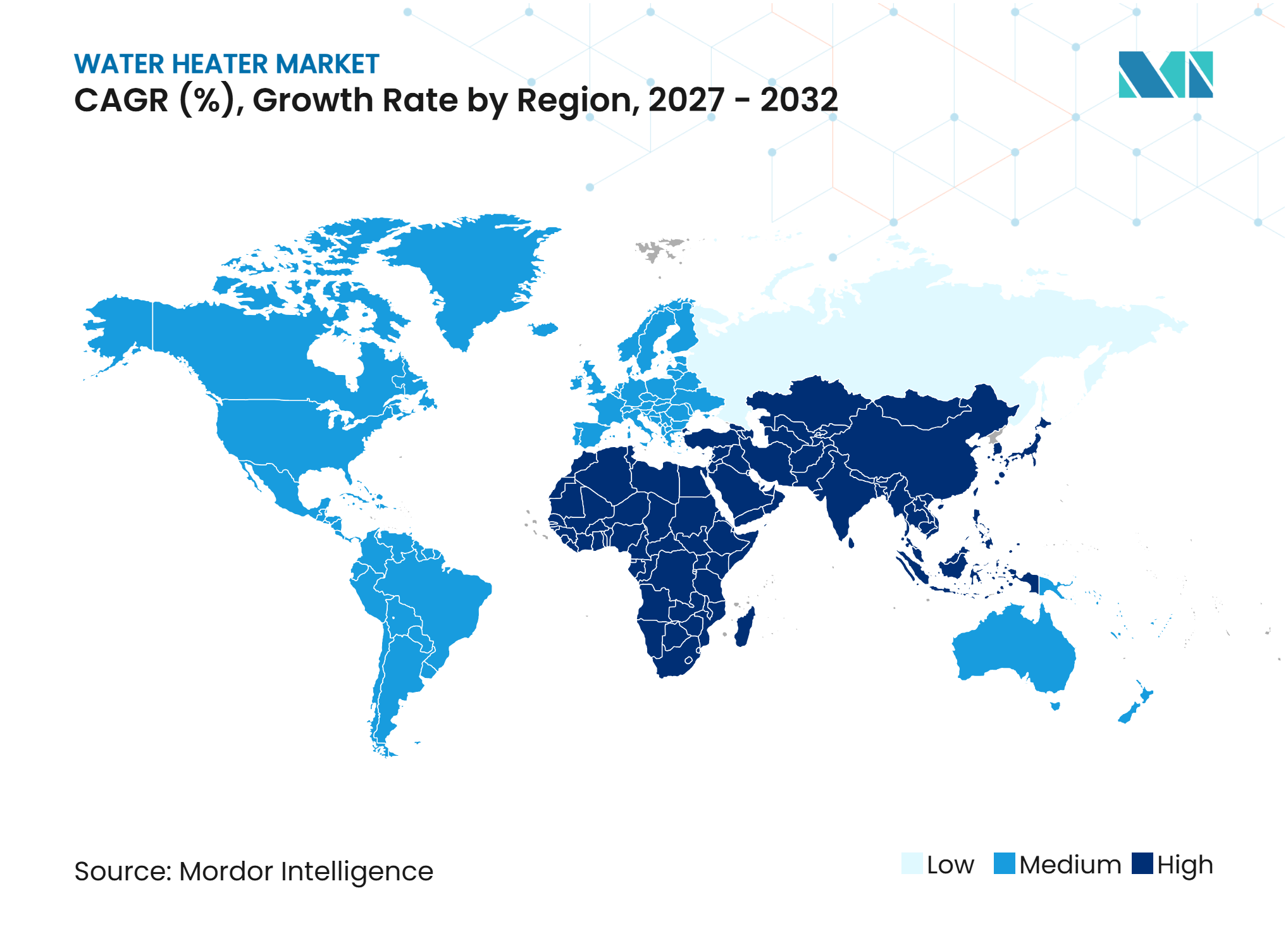
| Fastest Growing Market | Asia-Pacific |
| Largest Market | Asia-Pacific |
| Market Concentration | Medium |
Major Players *Disclaimer: Major Players sorted in no particular order Image © Mordor Intelligence. Reuse requires attribution under CC BY 4.0. | |
Water Heater Market Analysis by Mordor Intelligence
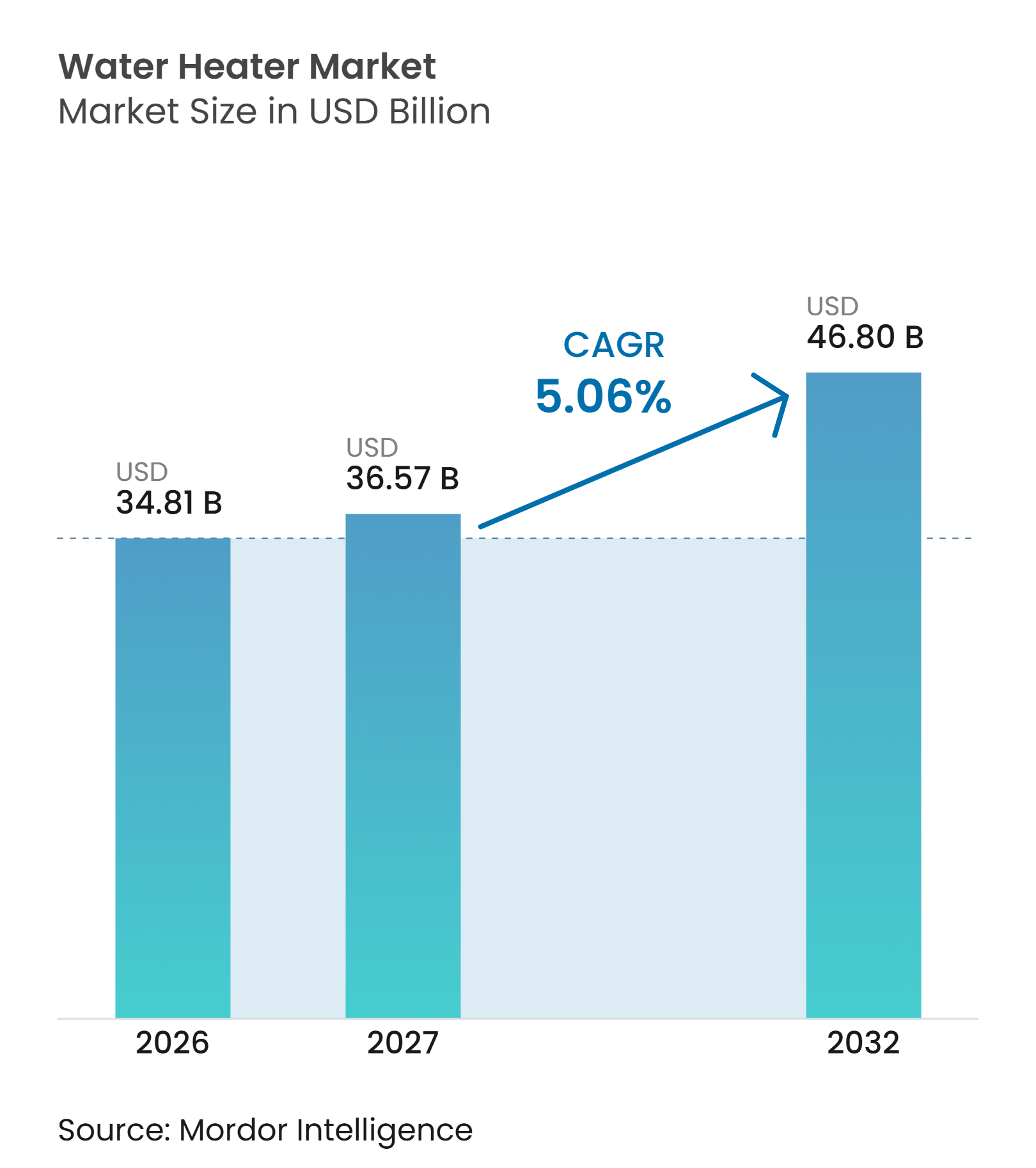
The water heater market was valued at USD 34.81 billion in 2026, is estimated at USD 36.57 billion in 2027, and is forecast to reach USD 46.80 billion by 2032, growing at a 5.06% CAGR during 2027-2032. The water heater market is being shaped by replacement demand, housing development, and policies that favor efficient electric and hybrid equipment. Product planning is increasingly tied to compliance schedules, installer capability, and the availability of local incentives. Manufacturers are also positioning connected products for utility programs, which gives water heating a role in demand management as well as household comfort. Competitive activity centers on heat pump performance, channel coverage, connected controls, and commercial replacement products that address changing standards.
Key Report Takeaways
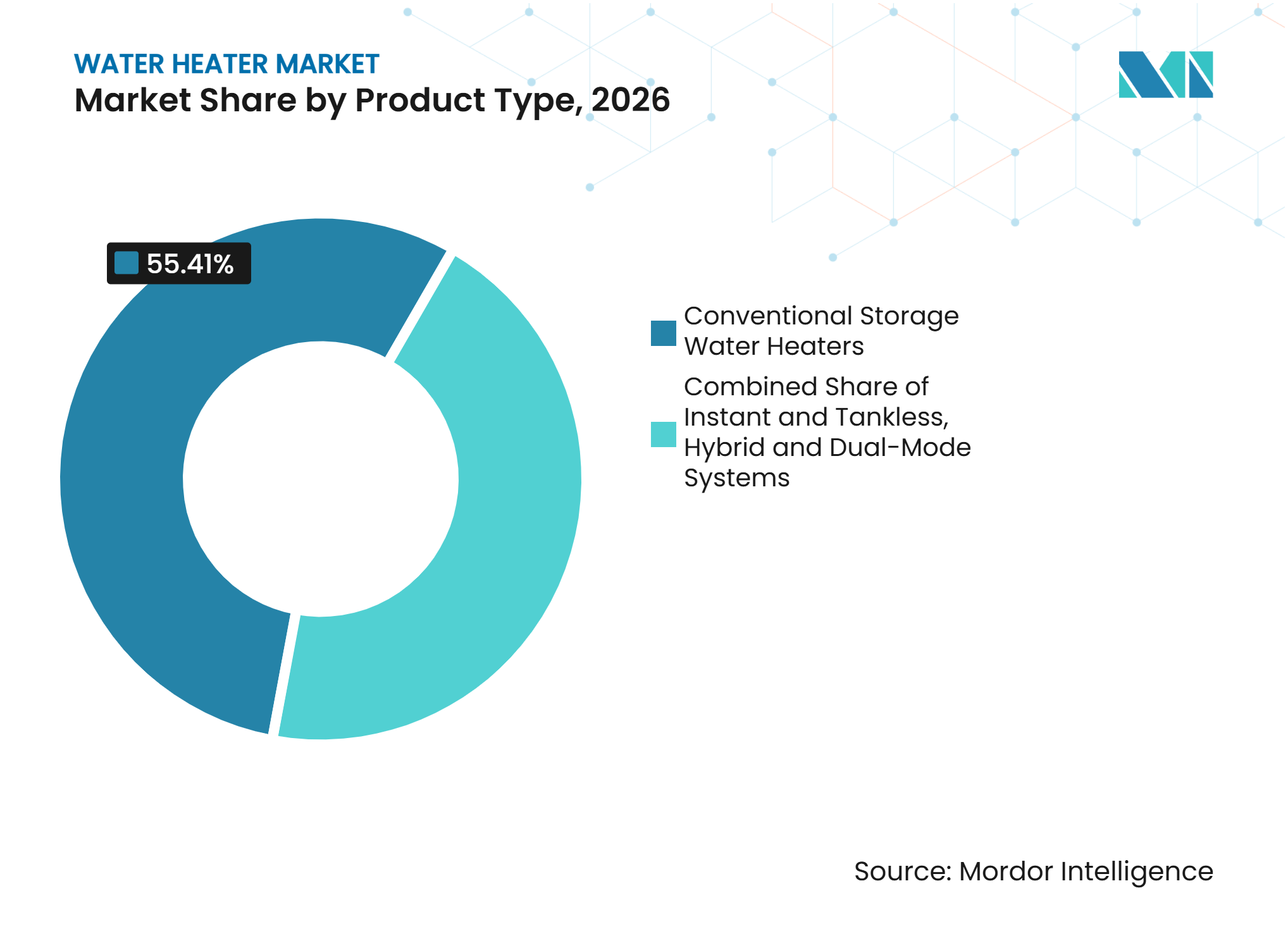
- By product type, conventional storage water heaters accounted for the largest market value share at 55.41% in 2026, while heat pump and hybrid water heaters are projected to grow at the fastest CAGR of 7.72% through 2032.
- By energy source, electric accounted for the largest market value share at 50.64% in 2026, while solar is projected to grow at the fastest CAGR of 6.54% through 2032.
- By capacity, 30-100 liters accounted for the largest market value share at 30.15% in 2026, while above 400 liters is projected to grow at the fastest CAGR of 5.81% through 2032.
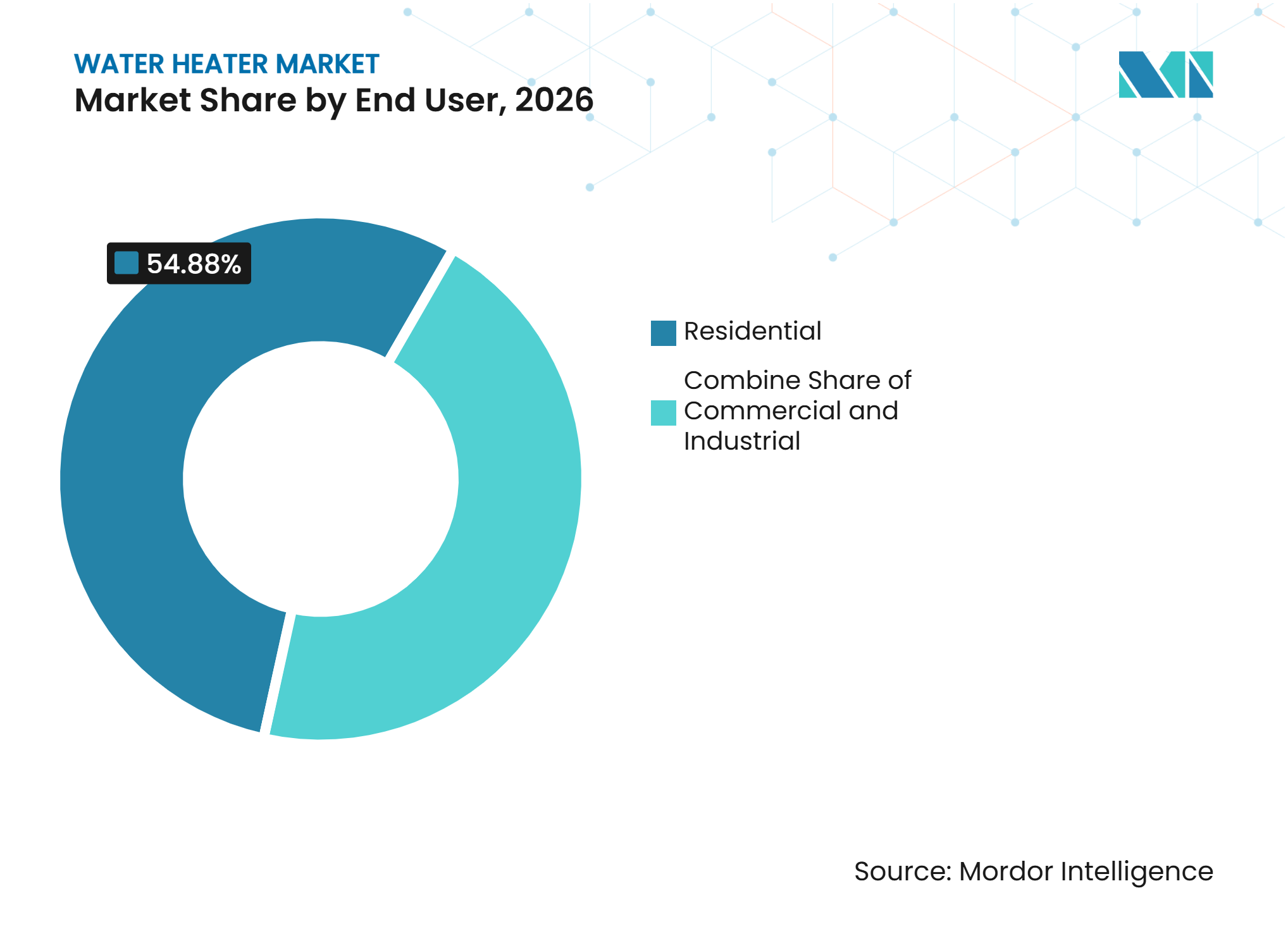
- By end user, residential accounted for the largest market value share at 54.88% in 2026, while commercial is projected to grow at the fastest CAGR of 5.53% through 2032.
- By distribution channel, B2C/Retail accounted for the largest market value share at 57.72% in 2026, while B2B and Project are projected to grow at the fastest CAGR of 5.67% through 2032.
- By geography, Asia-Pacific accounted for the largest market value share at 37.90% in 2026 and is projected to grow at the fastest CAGR of 5.76% through 2032.
Note: Market numbers in this report are based on Mordor Intelligence's proprietary estimation framework, which combines nine months of actuals with Q4 projections for base year 2026.
Market Trends and Insights
Drivers Impact Analysis of Water Heater Market*
| Driver | (~) % Impact on CAGR Forecast | Geographic Relevance | Impact Timeline |
|---|---|---|---|
| Energy-Efficiency Standards and Appliance Replacement Cycles | +1.2% | Global, with concentrated near-term effect in North America and the European Union | Short term (≤ 2 years) |
| Urban Residential Construction and Housing Modernization | +1.1% | Asia-Pacific core, with spillover to the Middle East and Africa and South America | Medium term (2-4 years) |
| Heat-Pump, Solar, and Hybrid Electrification Incentives | +1.3% | North America, the European Union, and Asia-Pacific | Short term (≤ 2 years) |
| Smart Water Heating and Connected Energy Management | +0.5% | North America and Nordics, with emerging adoption in Asia-Pacific | Medium term (2-4 years) |
| Water Heaters as Thermal Batteries for Demand Response | +0.4% | North America and Europe | Long term (≥ 4 years) |
| Build-to-Rent and Centralized Heat-Pump Water Heater Banks | +0.3% | North America, the United Kingdom, and Australia | Long term (≥ 4 years) |
| Source: Mordor Intelligence | |||
Energy-Efficiency Standards and Appliance Replacement Cycles
The water heater market is responding to standards that require manufacturers and buyers to plan for higher-performing equipment. The United States Department of Energy final rule applies to non-small electric storage water heaters above 35 gallons and up to 120 gallons, with compliance required from May 2029[1]. The European Union Energy Efficiency Directive seeks an 11.7% reduction in final energy consumption by 2030 against 2020 projections. European Union member states approved a revised Ecodesign regulation for water heaters in April 2026, with application expected from around autumn 2028, subject to the remaining legislative process[2]. These requirements encourage earlier engineering work, product qualification, and installer preparation. They also raise the commercial value of equipment that can meet efficiency rules without substantial changes to building layouts.
Urban Residential Construction and Housing Modernization
New homes continue to support first-time installations in China, India, South-East Asia, and Gulf Cooperation Council countries. Apartment development favors compact electric storage products, while larger projects can use centralized hot-water systems. Urban growth also shifts buying decisions toward developers, property managers, and contractors rather than individual households. This supports the B2B and Project channel, where product availability, training, and after-sales support can determine supplier selection. Build-to-rent projects provide a related opportunity because owners can assess operating cost and building ratings across a long holding period. The water heater market therefore benefits from new construction as well as from replacement demand in mature housing stock.
Heat-Pump, Solar, and Hybrid Electrification Incentives
Incentives remain important for lowering the purchase barrier for heat pump, solar, and hybrid equipment. The former Section 25C credit provided up to USD 2,000 for eligible heat pump water heaters before the credit ended after December 31, 2025. State and utility programs can still change project economics where they include consumers, distributors, and contractors. Utility program design can also influence adoption by aligning customer, contractor, and distributor participation. The European Union Renewable Energy Directive supports a larger role for renewable heating and cooling across member states. Solar thermal systems remain relevant in high-irradiance areas where grid conditions and local economics favor them over grid-dependent alternatives.
Smart Water Heating and Connected Energy Management
Connected water heaters allow utilities to shift electric load while maintaining hot-water service. SMECO announced its FlexHome pilot in August 2025, while the pilot had been operating since September 2024 and was scheduled to run through 2026[3]. Hawaiian Electric and Aquanta began deploying connected controls to support 11 MW of demand-response capacity and fast frequency-response services on Oahu. A field study on Terceira Island reported 56% lower electricity cost and a 36 percentage-point increase in photovoltaic self-consumption for a controlled electric water heater. Portland State University simulation work found electricity-cost savings of 11-33% and peak-period load reductions of 86-91%, while total energy use increased by 6-8%[4]. Connected controls and CTA-2045 readiness therefore matter to product differentiation, utility procurement, and long-term service relationships.
Restraints Impact Analysis of Water Heater Market*
| Restraint | (~) % Impact on CAGR Forecast | Geographic Relevance | Impact Timeline |
|---|---|---|---|
| High Upfront Cost of Low-Carbon Water Heating Systems | -0.9% | Global, most acute in price-sensitive Asia-Pacific and Middle East and Africa segments | Short term (≤ 2 years) |
| Retrofit Complexity, Skills Gaps, and Limited Electrical Infrastructure | -0.7% | South America, Middle East and Africa, rural Asia-Pacific, and older North American housing stock | Medium term (2-4 years) |
| Emergency-Replacement Purchasing and Contractor Skills Gaps | -0.4% | North America and Europe | Short term (≤ 2 years) |
| Cybersecurity, Data Privacy, and Connected-Product Compliance Costs | -0.2% | European Union and North America, with an emerging compliance layer in Asia-Pacific | Long term (≥ 4 years) |
| Source: Mordor Intelligence | |||
High Upfront Cost of Low-Carbon Water Heating Systems
Purchase cost remains a significant barrier for low-carbon water heating options. The loss of the federal Section 25C credit after 2025 makes this issue more immediate in the United States. Consumers must consider equipment cost, installation labor, electrical work, and site conditions when comparing technologies. This can favor conventional electric storage and gas equipment in price-sensitive replacement decisions. Solar thermal systems also require collectors, storage equipment, and suitable installation conditions, which can limit adoption where subsidies are limited. These barriers leave the water heater market dependent on both product affordability and practical installation support.
Retrofit Complexity, Skills Gaps, and Limited Electrical Infrastructure
Retrofit projects can be difficult when a building lacks appropriate electrical capacity, installation space, ventilation, or qualified labor. Heat pump equipment requires installers who can manage electrical work, airflow, condensate, and refrigerant-related requirements. The loss of the federal tax credit has added to the difficulty of making heat pump equipment standard in price-sensitive new construction. Weak or variable grid conditions can limit equipment suitability in rural Asia-Pacific and parts of the Middle East and Africa. Building upgrades can add time and cost before equipment is installed. These constraints can delay adoption even when the equipment offers lower operating energy use.
*Our forecasts treat driver/restraint impacts as directional, not additive. The impact forecasts reflect baseline growth, mix effects, and variable interactions.
Water Heater Market Segment Analysis
By Product Type:
Conventional Storage Retains Scale While Heat Pump and Hybrid Products Gain PaceConventional storage water heaters held 55.41% of segment share in 2026 because they serve a broad installed base and remain familiar to consumers and installers. Their use spans compact units for apartments, standard household tanks, and larger commercial storage products. Lower initial cost continues to support replacement demand in markets with limited incentives. Conventional products also remain suitable where building electrical capacity limits heat pump installation. Instant and tankless equipment occupies a middle position, particularly where space savings, rapid delivery, and lifecycle maintenance are valued. A. O. Smith received a 2025 Silver Edison Award for its ADAPT tankless water heater with X3 Scale Prevention Technology.
Heat pump and hybrid water heaters are projected to expand at a 7.72% CAGR through 2032, supported by standards, incentives, and product development. The 2029 DOE rule is especially relevant to the most common sizes of electric storage equipment in the United States. Rheem presented its ProTerra hybrid electric heat pump water heater as using up to 75% less energy than standard electric water heaters. Ariston's NUOS Multi-Fit includes an i-Memory self-learning algorithm and CTA-2045 readiness, linking product performance to connected-home and utility applications. Product choice is widening as manufacturers invest in heat pump platforms, noise reduction, connectivity, and installation flexibility. The water heater industry is therefore competing on installation practicality, operating cost, control features, and supplier support rather than on energy source alone.



By Energy Source:
Electric Holds the Lead While Solar Expands in Suitable ClimatesElectric held a 50.64% segment share in 2026, supported by grid expansion and electrification activity in several regions. Within the water heater market, electric systems can complement rooftop photovoltaic systems where households seek to use more self-generated power. Heat pump products strengthen the electric proposition because they reduce energy use relative to resistance systems. Their uptake depends on electrical infrastructure, installation conditions, and available support. Gas retains a substantial installed base in North America and parts of Europe, particularly where existing infrastructure and contractor familiarity remain strong. DOE standards for commercial gas-fired equipment took effect on October 6, 2026, while an enforcement policy allows a one-year grace period for certain qualifying equipment manufactured between October 6, 2026, and October 6, 2027.
Solar is projected to expand at a 6.54% CAGR through 2032, with the strongest relevance in North Africa, the GCC, Australia, and South Asia. High irradiance and local renewable-energy priorities support solar thermal adoption in these locations. The European Union continues to frame renewable heating and cooling as part of its energy transition agenda. Commercial gas products remain relevant during the transition because many buildings require dependable high-capacity service. The water heater industry continues to balance electric and solar growth with the servicing needs of gas-based installed equipment.
By Capacity:
Mid-Range Products Serve Everyday Demand While Large Systems Support ProjectsThe 30-100 liters category accounted for 30.15% of the water heater market size in 2026 because it aligns with apartments, smaller homes, and moderate household needs. This capacity range is common in urban housing across Asia-Pacific and Europe. It also fits many replacement purchases where existing plumbing and available space influence product choice. Smaller below-30-liter units remain important in point-of-use applications and compact apartments. The 101-250 liters category supports premium homes and small commercial locations that need higher storage volume. The 251-400 liters category serves larger residences and commercial sites where demand exceeds typical household requirements.
Above 400 liters is projected to expand at a 5.81% CAGR through 2032, supported by hospitality, healthcare, and institutional projects. These settings give the water heater market demand for reliable delivery, large storage volumes, and service support. Rheem introduced STID Indirect Tank MAX products in September 2026, and the 119-gallon model falls within the above-400-liter range. The 80-gallon STID 80 MAX model, which is within the 251-400-liter range, provides up to 70% greater first-hour delivery and nearly 90% more continuous hot-water output than the standard STID 80 model. Project demand in the GCC and renovation activity in Europe make large systems commercially important. Suppliers in this part of the water heater market need to combine equipment performance with engineering, installation, and ongoing maintenance support.
By End User:
Residential Demand Anchors Volume While Commercial Projects Grow FasterResidential users held a 54.88% share in 2026 because household replacement and new housing continue to account for much of the demand. Product selection across this part of the water heater market is affected by upfront price, space limits, energy bills, and local installation capability. Conventional storage systems remain important where budgets are constrained. Connected heat pump products are gaining relevance for households with incentives, suitable electrical infrastructure, or solar generation. Residential distribution also depends heavily on contractors, local retailers, and installer recommendations. The Lennox-Ariston joint venture entered North American residential water heating through Lennox's dealer network in March 2026.
Commercial end users are projected to expand at a 5.53% CAGR through 2032, driven by hospitality, health care, education, and institutional facilities. These buyers often require centralized hot-water systems, high recovery rates, and dependable maintenance arrangements. Health care facilities also need reliable hot-water availability to support infection-control practices. GCC tourism and mixed-use construction encourage demand for high-capacity and solar-hybrid products. European renovation activity supports replacement work where building performance rules and energy targets are relevant. Industrial demand is smaller but can generate higher-value orders for large storage and instantaneous systems.

By Distribution Channel:
B2C/Retail Remains Broad While B2B and Project Procurement AdvancesB2C/Retail held a 57.72% share in 2026, reflecting its role in household replacement purchases across many regions. Across the water heater market, multi-brand stores, brand outlets, hardware retailers, and local dealers serve customers who need products quickly. Retail channels are especially useful for compact storage and point-of-use equipment. Online research and sales are becoming more relevant for smaller products, although installation remains a key part of the final purchase decision. The channel is shaped by product availability, retailer visibility, and the confidence consumers place in installer recommendations. A broad B2C presence remains important for suppliers seeking scale in the water heater market.
B2B and Project is projected to grow at a 5.67% CAGR through 2032 as multifamily construction, public buildings, and hospitality projects centralize procurement. Wholesalers and plumbing-HVAC distributors play a central role because they combine product access, technical assistance, and contractor networks. Large buyers also value warranties, service agreements, and training programs. The Lennox-Ariston venture gives dealers access to water heating products through an established HVAC channel. Direct manufacturer engagement can become more important for complex commercial specifications. The water heater industry benefits when its distribution partners can support product selection, installation, commissioning, and service.
Geography Analysis
Asia-Pacific
Asia-Pacific held a 37.90% regional share in 2026 and is projected to grow at a 5.76% CAGR through 2032. China provides a large installed base, while India, Southeast Asia, and South Korea add demand through urban development and apartment construction. Compact 30-100-liter electric storage units are well suited to many urban housing configurations. Solar systems remain relevant where solar resources are strong, and grid conditions are less reliable. Smart appliances and connected controls are gaining attention in more advanced residential markets. Heat pump adoption is also developing in Japan and Australia as energy policies influence new-build specifications. The Asia-Pacific water heater market requires products across a wide price range, from basic electric units to connected heat pump equipment.
North America
North America is shaped by the interaction of federal standards, state policy, utility programs, and replacement demand. DOE standards for covered commercial gas-fired units took effect on October 6, 2026, but the one-year enforcement grace period reduces the immediate need for fleet-wide replacement. The DOE electric storage rule also creates a future compliance milestone in May 2029 for non-small products above 35 gallons, about 132 liters, and up to 120 gallons, about 454 liters. On November 4, 2026, the Bay Area Air District Board voted to move forward with amendments to Rule 9-6 that would extend the compliance deadline and add affordability-related exemptions. State building codes and utility programs continue to support heat pump deployment after the federal tax credit ended. Canada remains important for contractor training and gas tankless products, while Mexico continues to favor price-sensitive conventional products. The North American water heater market is balancing compliance preparation with near-term affordability and installer capacity.
Europe, South America, and Middle East and Africa
The European Union Energy Efficiency Directive sets a binding 11.7% final-energy-consumption reduction target for 2030, supporting renovation-led demand in member states. The Energy Performance of Buildings Directive had a May 29, 2026 transposition deadline for European Union member states, not the United Kingdom. Germany, France, Italy, Spain, and the Nordics have a stronger renovation and heat pump context than many other markets. South America is centered on Brazil and Chile, where urbanization and household income growth support electric and gas water-heating demand. The Middle East and Africa sees project-led demand from GCC hospitality, tourism, and mixed-use development. Solar thermal products are relevant in Jordan, Morocco, Egypt, the UAE, and parts of sub-Saharan Africa where solar resources and energy-access needs align. The water heater market across these regions depends on local building activity, energy policy, grid conditions, and equipment affordability.
Competitive Landscape
Market Concentration
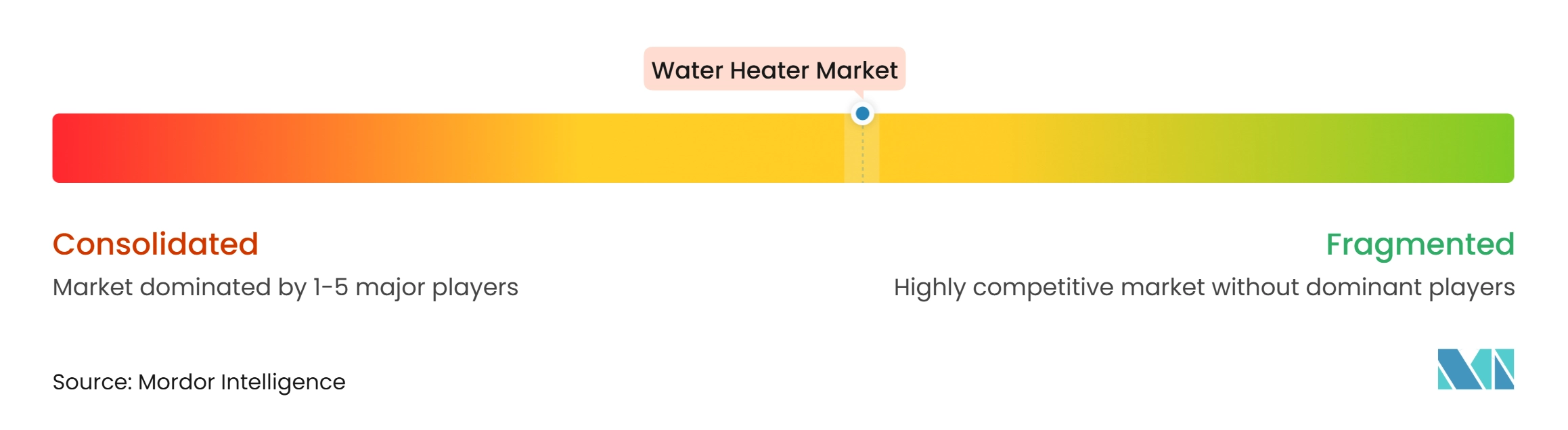
The water heater market is moderately concentrated, with global manufacturers such as A. O. Smith, Rheem, Ariston, Rinnai, Vaillant, Bosch Home Comfort, Groupe Atlantic, Viessmann Climate Solutions, and Haier competing alongside regional specialists. Bajaj Electricals, V-Guard, Havells, and FERROLI retain positions in their home markets through local product ranges and distribution. Competition in the water heater market is shaped by product efficiency, technology, manufacturing capability, channel access, and service capacity. Larger suppliers can support broad portfolios across residential and commercial applications. Regional suppliers can compete through price, local product fit, and established dealer relationships. This structure leaves room for both global platforms and focused domestic competitors.
Strategic moves in 2025 and 2026 show how suppliers are broadening their offerings. A. O. Smith completed its acquisition of Leonard Valve in January 2026. Bradford White acquired Bock Water Heaters in April 2025, extending its commercial offering. Lennox and Ariston announced their joint venture in May 2025, with Ariston USA holding 50.1% and Lennox holding 49.9%. Rheem broadened its hydronics range in September 2026 with combi boiler, high-output boiler, and indirect-tank products. These actions show that suppliers are seeking stronger positions in adjacent equipment, commercial projects, and dealer channels.
Technology provides another basis for competition in premium products. Heat pump platforms increasingly include connected controls, remote diagnostics, self-learning features, and grid-interaction capability. Ariston's NUOS Multi-Fit illustrates this direction with i-Memory and CTA-2045 readiness. Rheem uses the energy-performance position of ProTerra to support operating-cost comparisons with standard electric equipment. Utilities also create an alternative route to market through electrification programs. SMUD reported more than 20,000 gas space- and water-heating systems replaced through Advanced Home Solutions, a rebate-led electrification program.
Water Heater Industry Leaders
-
A. O. Smith Corporation
-
Rheem Manufacturing Company
-
Ariston Holding N.V.
-
Robert Bosch GmbH
-
Haier Smart Home Co., Ltd.
- *Disclaimer: Major Players sorted in no particular order
Water Heater Market Companies Covered in this Report
- A. O. Smith Corporation
- Rheem Manufacturing Company
- Ariston Holding N.V.
- Robert Bosch GmbH
- Haier Smart Home Co., Ltd.
- Rinnai Corporation
- Bradford White Corporation
- Vaillant Group
- Groupe Atlantic
- Viessmann Climate Solutions SE
- NIBE Industrier AB
- STIEBEL ELTRON GmbH & Co. KG
- BDR Thermea Group
- Midea Group Co., Ltd.
- Panasonic Corporation
- NORITZ Corporation
- Navien Inc.
- Daikin Industries, Ltd
- Bajaj Electricals Limited
- Havells India Limited
- FERROLI S.p.A.
- Lennox International Inc.
- V-Guard Industries Limited
Recent Industry Developments in Water Heater Market
- September 2026: Rheem expands its hydronics portfolio with the FT Series Combi Boiler, high-output boiler models, and STID Indirect Tank MAX solutions.
- March 2026: Lennox enters North American water heating through the Ariston joint venture. Lennox International began taking dealer orders for its branded water heater line on March 16, 2026, following the May 2025 joint venture announcement with Ariston Group, with Ariston USA holding 50.1% and Lennox holding 49.9%.
- August 2025: Virtual Peaker, SMECO, and ICF announce Maryland's FlexHome Pilot. The pilot had operated since September 2024 and was scheduled through 2026, targeting up to 500 grid-enabled water heaters over 3 years
- May 2025: Lennox and Ariston Group announce a joint venture to launch water heaters in North America. The joint venture is structured with Ariston USA holding 50.1% and Lennox holding 49.9%, with product distribution beginning in 2026 through Lennox stores, the direct-to-dealer network, and distributor channels
Global Water Heater Market Report Scope
The water heater market report is segmented by product type, including conventional storage, instant/tankless, and heat pump and hybrid water heaters. It also assesses energy source, including electric, gas, solar, and more, capacity from below 30 liters through above 400 liters, end user, distribution channel, and geography. Geographic coverage includes North America, South America, Europe, Asia-Pacific, and the Middle East and Africa. The water heater market forecasts are provided in terms of value (USD), allowing consistent value comparison across the stated product, channel, end-user, and regional categories.
Segmentation Overview
| Conventional Storage Water Heaters |
| Instant and Tankless Water Heaters |
| Heat Pump and Hybrid Water Heaters |
| Electric |
| Gas, Including Natural Gas and LPG |
| Solar |
| Other Energy Sources |
| Below 30 Liters |
| 30-100 Liters |
| 101-250 Liters |
| 251-400 Liters |
| Above 400 Liters |
| Residential | |
| Commercial | Hospitality |
| Healthcare | |
| Education and Institutional | |
| Offices and Retail | |
| Rest of Commercial End Users | |
| Industrial |
| B2C/Retail | Multi-Brand Stores |
| Exclusive Brand Outlets | |
| Online | |
| Local Hardware Stores | |
| Other B2C/Retail | |
| B2B and Project | Wholesale and Plumbing-HVAC Distributors |
| Direct from Manufacturers |
| North America | Canada |
| United States | |
| Mexico | |
| South America | Brazil |
| Peru | |
| Chile | |
| Argentina | |
| Rest of South America | |
| Europe | United Kingdom |
| Germany | |
| France | |
| Spain | |
| Italy | |
| BENELUX (Belgium, Netherlands, Luxembourg) | |
| NORDICS (Denmark, Finland, Iceland, Norway, Sweden) | |
| Rest of Europe | |
| Asia-Pacific | India |
| China | |
| Japan | |
| Australia | |
| South Korea | |
| South-East Asia | |
| Rest of Asia-Pacific | |
| Middle East & Africa | United Arab Emirates |
| Saudi Arabia | |
| South Africa | |
| Nigeria | |
| Rest of Middle East & Africa |
| By Product Type | Conventional Storage Water Heaters | |
| Instant and Tankless Water Heaters | ||
| Heat Pump and Hybrid Water Heaters | ||
| By Energy Source | Electric | |
| Gas, Including Natural Gas and LPG | ||
| Solar | ||
| Other Energy Sources | ||
| By Capacity | Below 30 Liters | |
| 30-100 Liters | ||
| 101-250 Liters | ||
| 251-400 Liters | ||
| Above 400 Liters | ||
| By End User | Residential | |
| Commercial | Hospitality | |
| Healthcare | ||
| Education and Institutional | ||
| Offices and Retail | ||
| Rest of Commercial End Users | ||
| Industrial | ||
| By Distribution Channel | B2C/Retail | Multi-Brand Stores |
| Exclusive Brand Outlets | ||
| Online | ||
| Local Hardware Stores | ||
| Other B2C/Retail | ||
| B2B and Project | Wholesale and Plumbing-HVAC Distributors | |
| Direct from Manufacturers | ||
| By Geography | North America | Canada |
| United States | ||
| Mexico | ||
| South America | Brazil | |
| Peru | ||
| Chile | ||
| Argentina | ||
| Rest of South America | ||
| Europe | United Kingdom | |
| Germany | ||
| France | ||
| Spain | ||
| Italy | ||
| BENELUX (Belgium, Netherlands, Luxembourg) | ||
| NORDICS (Denmark, Finland, Iceland, Norway, Sweden) | ||
| Rest of Europe | ||
| Asia-Pacific | India | |
| China | ||
| Japan | ||
| Australia | ||
| South Korea | ||
| South-East Asia | ||
| Rest of Asia-Pacific | ||
| Middle East & Africa | United Arab Emirates | |
| Saudi Arabia | ||
| South Africa | ||
| Nigeria | ||
| Rest of Middle East & Africa | ||
Key Questions Answered in the Report
What is the projected value of the global water heater market by 2032?
The global water heater market is projected to reach USD 46.80 billion by 2032, growing at a 5.06% CAGR during 2026-2032.
Which water heater product type is growing fastest?
Heat pump and hybrid water heaters are projected to record the highest growth, with a 7.72% CAGR through 2032.
Why do conventional storage water heaters remain widely used?
Conventional storage water heaters held 55.41% share in 2026 because they have a large installed base, familiar installation requirements, and lower upfront costs.
Which energy source leads water heater demand?
Electric held 50.64% share in 2026, supported by electrification, grid expansion, and the increasing availability of heat pump products.
Which region has the strongest growth outlook for water heaters?
Asia-Pacific held 37.90% share in 2026 and is projected to expand at a 5.76% CAGR through 2032.
What factors limit heat pump water heater adoption?
Upfront cost, electrical infrastructure, building conditions, contractor skills, and the expiry of the United States federal Section 25C credit can slow adoption.