
Water Blocking Tapes Market Size and Share
Market Overview
| Study Period | 2022 - 2032 |
|---|---|
| Market Size (2027) | USD 510.97 Million |
| Market Size (2032) | USD 674.49 Million |
| Growth Rate (2027 - 2032) | 5.71 % |
| Fastest Growing Market | Asia-Pacific |
| Largest Market | Asia-Pacific |
| Market Concentration | Medium |
Major Players *Disclaimer: Major Players sorted in no particular order Image © Mordor Intelligence. Reuse requires attribution under CC BY 4.0. | |
Water Blocking Tapes Market Analysis by Mordor Intelligence
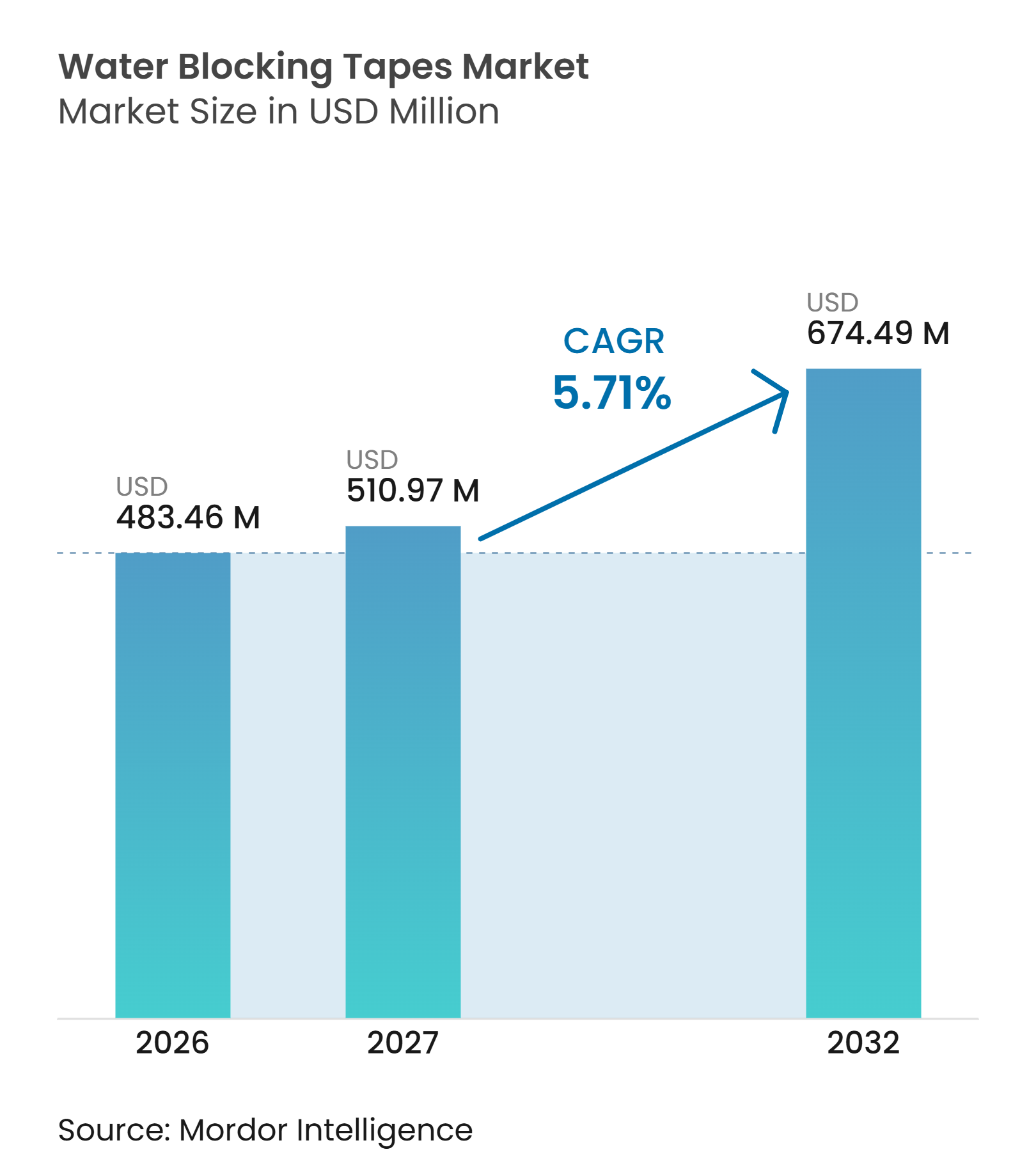
The Water Blocking Tapes Market size was valued at USD 483.46 million in 2026 and is estimated to grow from USD 510.97 million in 2027 to USD 674.49 million by 2032, at a CAGR of 5.71% during the forecast period (2027-2032). Demand in the water blocking tapes market is supported by fiber-optic networks, high-voltage power cables, and submarine interconnects that use water-swellable tapes as a structural moisture-control layer. Public investment in underground grids and offshore connections is increasing demand for cable systems capable of operating under more demanding conditions. The shift from gel-filled construction to dry cable systems also favors tape-based water blocking, as it reduces handling and disposal concerns during installation. Compliance requirements for high-voltage cable designs are driving demand, with longitudinal water blocking now part of approved construction standards. Suppliers with qualified products benefit from recurring orders, as cable manufacturers seldom change an approved tape during an active production program.
Key Report Takeaways
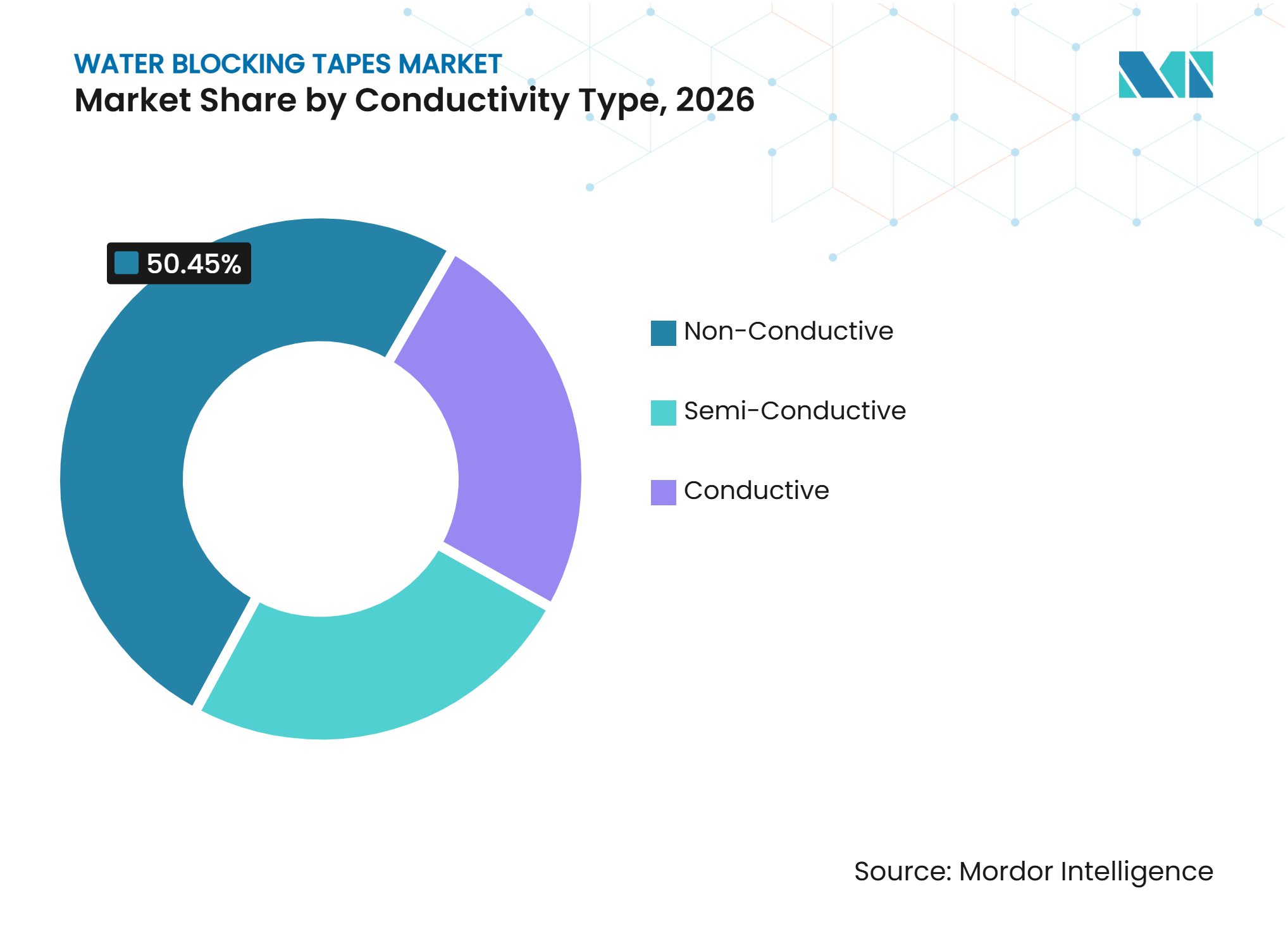
- By conductivity type, Non-Conductive tapes held 50.45% of the Water Blocking Tapes Market share in 2026, while Semi-Conductive tapes are forecast to grow at a 6.56% CAGR through 2032.
- By adhesive side, Single-Sided tapes held 70.56% of the Water Blocking Tapes Market in 2026, while Double-Sided tapes are forecast to grow at a 6.89% CAGR through 2032.
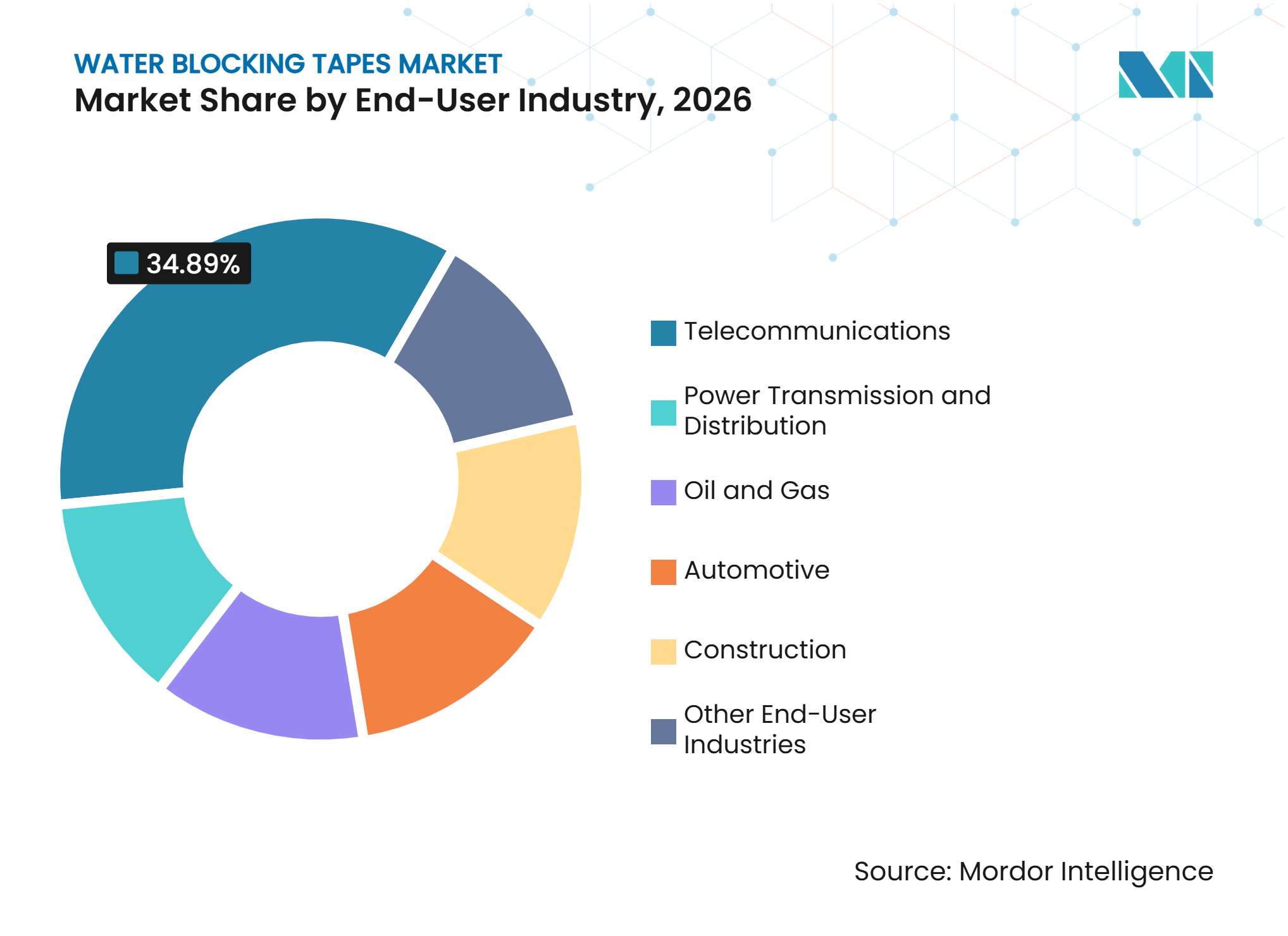
- By end-user industry, Telecommunications held 34.89% of the Water Blocking Tapes Market in 2026, while Power Transmission and Distribution is forecast to grow at a 7.17% CAGR through 2032.
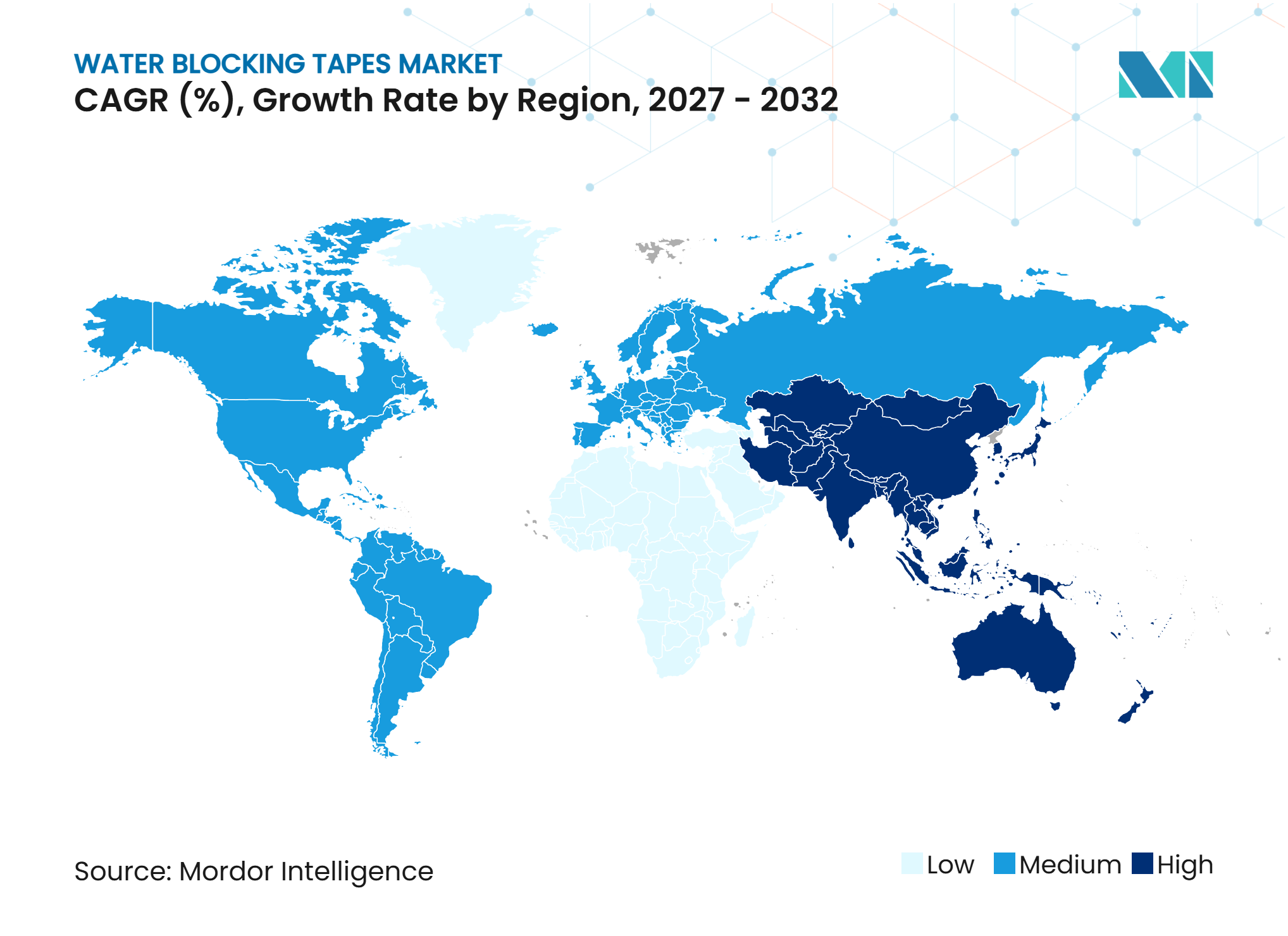
- By geography, Asia-Pacific held 45.61% of the Water Blocking Tapes Market share in 2026 and is forecast to grow at a 7.05% CAGR through 2032.
Note: Market numbers in this report are based on Mordor Intelligence's proprietary estimation framework, which combines nine months of actuals with Q4 projections for base year 2026.
Market Trends and Insights
Drivers Impact Analysis of Water Blocking Tapes Market*
| Drivers | (~) % Impact on CAGR Forecast | Geographic Relevance | Impact Timeline |
|---|---|---|---|
| Expansion of Fiber-to-the-Home, 5G, and Data Center Networks | +1.9% | Global, with intensity in China, India, Southeast Asia, and Western Europe | Short term (≤ 2 years) |
| Grid Modernization and Renewable-Energy Transmission | +1.4% | Global, strongest in Asia-Pacific and Europe, including offshore wind corridors, and North America | Medium term (2-4 years) |
| Growth in Submarine Power and Communication Cables | +0.9% | Global, with core demand in Indo-Pacific, transatlantic, and North Sea routes | Medium term (2-4 years) |
| Replacement of Flooding Compounds with Dry Water-Blocking Systems | +0.8% | Global, with the fastest conversion in South and Southeast Asia | Short term (≤ 2 years) |
| Qualification-Locked Recurring Demand from Cable Bills of Materials | +0.5% | Global cable manufacturing hubs in China, Germany, the United States, and South Korea | Long term (≥ 4 years) |
| Source: Mordor Intelligence | |||
Fiber-to-the-Home, 5G, and Data-Center Networks Underpin Baseline Demand
Fiber-optic construction remains the largest driver of demand in the Water Blocking Tapes Market. Higher fiber counts increase tape use per cable kilometer, even where total route length does not change. Cable designs now commonly use 288, 432, and 864 fibers, which increases the amount of water-blocking material required per cable. Government-supported broadband programs add to commercial carrier spending and extend the build cycle. Data center campus interconnects create an additional source of demand, as high-fiber-count ribbon cables require moisture protection. In 2025, the International Electrotechnical Commission (IEC) standard 60794-2-20:2025 updated the mechanical and environmental test parameters for indoor multi-fiber optical cables, supporting consistent performance requirements for building and data center cables.
The required tape function is not limited to protection against external water. Moisture can enter through small defects, damaged jackets, or connector areas, and water-swellable material is designed to restrict its movement along the cable. This functional role links tape demand to both fiber density and total cable mileage. Carriers and data center operators value reliable cable performance because repair work can disrupt network availability. Suppliers therefore need products that combine swelling behavior, tensile strength, and stable processing on cable lines. The Water Blocking Tapes Market benefits when fiber deployment shifts toward denser cable designs rather than only longer routes. This pattern supports steady demand across telecommunications programs in China, India, Southeast Asia, and Western Europe. The market also benefits when network operators favor qualified dry construction for new connections.
Grid Modernization and Renewable-Energy Transmission Lock in Power-Cable Demand
Grid modernization creates a separate and growing demand stream for water-blocking tapes. Offshore wind assets connect to onshore systems through high-voltage alternating-current and direct-current cables that require radial barriers and longitudinal water blocking. IEC 60840 applies to extruded-insulation power cables above 30 kV and is relevant to the cable systems used in these projects. The Water Blocking Tapes Market is supported as grid projects move underground or offshore, as these settings increase the importance of moisture management. Cable designs used in these systems must maintain performance throughout a long service life, making qualified materials more important than short-term price reductions.
The IEEE approved IEEE 1142-2025 in December 2025, providing a current reference for cable systems with radial moisture barriers and longitudinal water blocking. China's Ministry of Industry and Information Technology published a 2025 to 2026 plan calling for stable growth and quality improvements in power equipment, including electrical cable materials[1]. These actions encourage the procurement of materials that meet documented cable requirements. Tape producers that hold relevant compliance information for a cable design can be difficult to replace, as cable makers must validate a substitute before using it in high-voltage products. This supports recurring demand in the Water Blocking Tapes Market linked to approved bills of materials rather than isolated material purchases.
Submarine Cable Expansion Extends the Demand Frontier
Submarine power and communication cable projects are smaller in quantity than broad telecommunications programs, but they require demanding material performance. Water blocking is important because a cable must limit the effects of damage or water ingress over long installed lengths. Japan revised its inspection requirements for offshore wind facilities in April 2025, adding provisions for submarine transmission lines and communication cables. The change formalized inspection activity for these systems and supports a maintenance environment in which durable cable construction remains important.
The ITU-T issued Recommendation G.978 in May 2025 on the characteristics of optical fiber submarine cables. Such specifications provide a common reference for the construction of future cable systems. Water-blocking tape suppliers must meet tight requirements for swelling response, mechanical integrity, and compatibility with the surrounding cable structure. Once a material passes validation for a cable with a long design life, the supplier can remain involved in installation, maintenance, and replacement needs. That position makes submarine programs attractive even though qualification is demanding. The Water Blocking Tapes Market therefore benefits from higher investment in offshore generation, international interconnectors, and communication cable routes.
Dry Water-Blocking Systems Structurally Displace Flooding Compounds
Dry cable systems use superabsorbent polymer-impregnated nonwoven tapes rather than conventional flooding compounds. This approach can avoid gel handling and disposal issues while reducing cable weight. It can also improve splicing and field installation efficiency in fiber-to-the-home drop cables. The remaining conversion opportunity is concentrated in India, Vietnam, Indonesia, and the Middle East, where cable manufacturing capacity continues to expand. These regions can incorporate dry systems into new lines without modifying a large installed base of equipment. The Water Blocking Tapes Market benefits when new cable facilities select dry construction from the outset.
IEC 60794-1-216:2025 updated the compound-flow test method for optical fiber cables. The standard addresses the behavior of filling and flooding compounds, focusing on designs that meet the required performance using dry alternatives. Nantong Siber Communication Co., Ltd. filed a patent application for a self-crosslinking, water-based, water-blocking adhesive in December 2025, published in March 2026. The filing describes a faster swelling response and firmer adhesion compared to conventional superabsorbent polymer powder tape constructions. This activity indicates that suppliers are working to improve dry-system performance. Product development will remain important for the Water Blocking Tapes Market, as customers require both water control and stable processing during cable manufacture.
Restraints Impact Analysis of Water Blocking Tapes Market*
| Restraints | (~) % Impact on CAGR Forecast | Geographic Relevance | Impact Timeline |
|---|---|---|---|
| Raw-Material Price Volatility and Margin Pressure | -0.5% | Global, most acute for smaller producers in Asia with limited hedging capacity | Short term (≤ 2 years) |
| Long Qualification Cycles for Power and Submarine Cables | -0.4% | Global high-voltage and submarine programs, with greater limits in European Union and Japanese markets | Long term (≥ 4 years) |
| Swelling-Performance Variability in Saline and High-Temperature Conditions | -0.3% | Asia-Pacific submarine routes, Middle East underground distribution, and tropical fiber-to-the-home networks | Medium term (2-4 years) |
| Source: Mordor Intelligence | |||
Raw-Material Price Volatility Compresses Smaller Producers
Superabsorbent polymer is the active water-blocking material in many tape designs and is produced from acrylic acid derived from propylene. Propylene prices can shift with crude-oil cycles, plant maintenance, and logistics disruptions, creating immediate cost pressure for suppliers operating under fixed-price contracts. Polyester nonwoven substrates can also track changes in Polyethylene Terephthalate (PET) resin costs. When both polymer and substrate costs rise simultaneously, producers face compounded cost pressure. Smaller manufacturers are more exposed due to limited purchasing power and fewer options to hedge against supply risks.
Large suppliers can manage this risk through diversified supply chains and longer-term purchasing arrangements with chemical suppliers. Vertically integrated superabsorbent polymer impregnation can also reduce exposure to external processing costs. However, suppliers serving lower-margin applications may face temporary capacity constraints or margin compression during sharp commodity cost movements. Cost pressure can also affect the ability to maintain consistent quality. Performance consistency is particularly important in saline, high-temperature, and tropical cable environments, where swelling behavior must remain dependable. Insufficient performance evidence under these conditions can constrain the adoption of water-blocking tapes in the most demanding applications.
Qualification Cycles Slow Market Responsiveness
Qualification for power and submarine cable bills of materials can take 12 to 24 months. A cable manufacturer that has approved a non-conductive tape for a 220 kV underground feeder must repeat testing before replacing it with a revised formulation. This process can include partial-discharge tests and thermal cycling, creating substantial costs for the cable manufacturer. While this protects approved suppliers, it slows the adoption of material improvements that could reduce cost or enhance performance. New suppliers must participate in development work well before commercial cable production begins.
The International Electrotechnical Commission (IEC) Technical Committee 20 oversees standards for electrical cables and provides a framework for consistent product evaluation. Approved products carry a practical advantage, as buyers are reluctant to accept substitutes without equivalent qualification evidence. This effect is most pronounced in high-voltage and submarine applications, limiting rapid changes in market share within the water-blocking tapes market. Suppliers therefore require long planning horizons for research, testing, and customer engagement. While this qualification dynamic is structural, it can support long-term revenue stability for suppliers that already hold approved positions.
*Our forecasts treat driver/restraint impacts as directional, not additive. The impact forecasts reflect baseline growth, mix effects, and variable interactions.
Water Blocking Tapes Market Segment Analysis
By Conductivity Type:
Non-Conductive Share Dominates While Semi-Conductive Records Fastest GrowthNon-conductive tapes accounted for 50.45% of the global water-blocking tapes market in 2026. Their position reflects their broad use in fiber-optic cables, where electrical conductivity is unnecessary and can be undesirable. These tapes are compatible with widely used cable designs and have a substantial qualification base. Their production fits single-pass cable manufacturing processes, and their raw-material costs are lower than more specialized alternatives. These factors make non-conductive products the standard choice for much of the telecommunications cable base.
Conductive tapes serve narrower grounding and shielding applications that require electrical continuity along the tape. Semi-conductive tapes are used at the interface between moisture control and power-cable insulation. Semi-conductive tapes are expected to grow at a 6.56% CAGR through 2032, the highest rate within this classification. Their growth is linked to cross-linked polyethylene (XLPE)-insulated AC transmission and distribution cables that require both water blocking and controlled conductivity. Suppliers need stable carbon-black dispersion and controlled swelling performance to meet these cable requirements. High-voltage programs in North America and East Asia are driving increased specification activity for this class of materials.



By Adhesive Side:
Single-Sided Products Lead but Double-Sided Gains GroundSingle-sided tapes accounted for 70.56% of the global water-blocking tapes market in 2026. They are widely used due to lower costs and straightforward application mechanics. Standard fiber-optic and low- to medium-voltage power cable designs commonly use this format. Existing manufacturing lines are generally configured for single-sided tape payoff, and a shift to another configuration would require an operational benefit that justifies the investment. This installed base gives single-sided tapes a durable position in conventional cable production.
Double-sided tapes are forecast to grow at a 6.89% CAGR through 2032. Their higher growth reflects use on high-speed, automated cable lines where adhesion can reduce tape displacement during stranding. The format can provide more consistent bonding to inner jackets. New cable facilities in Asia are more likely to adopt this option as they invest in higher-throughput production systems. Chase Corporation introduced BlocH₂Ock High-Flow A162HF strand-block technology in July 2025, stating that it delivered 35% higher throughput and 10% less downtime than standard formulations in medium-voltage cable production. This launch illustrates why processing efficiency is becoming a key supplier differentiator as cable makers work with higher fiber counts and tighter tolerances.
By End-User Industry:
Telecommunications Leads, Power Grows FastestTelecommunications accounted for 34.89% of the global water-blocking tapes market in 2026, reflecting the long-standing role of water blocking in fiber-optic network protection. Fiber-to-the-home rollouts, 5G backhaul programs, and data-center interconnects sustain the underlying demand base. The segment can grow in absolute terms even as its percentage share declines relative to faster-growing end uses. Oil and gas and construction drive demand for subsea umbilicals, instrumentation cables, and direct-burial distribution feeders. Automotive remains a smaller application, employing water-resistant tape constructions for high-voltage battery interconnects.
Power Transmission and Distribution is forecast to grow at a 7.17% CAGR through 2032, supported by grid decarbonization programs, underground cable projects, and offshore connections. Compliance with high-voltage cable requirements makes water blocking a required component in many designs rather than a discretionary material choice. Freudenberg Performance Materials announced in February 2026 that it would participate in the Wire Düsseldorf trade fair in April 2026, featuring semi-conductive and non-conductive water-blocking tapes for HVDC, HVAC, and submarine cable applications. This focus reflects the commercial importance of power cable applications. The water-blocking tapes market is therefore becoming less dependent on telecommunications alone as grid infrastructure expands.

Geography Analysis
Asia-Pacific: Infrastructure Scale Creates a Self-Reinforcing Demand Engine
Asia-Pacific accounted for 45.61% of the global water blocking tapes market in 2026 and is expected to grow at a 7.05% CAGR through 2032. China supports regional demand through fiber network expansion, ultra-high-voltage grid programs, and submarine cable investment. China's Ministry of Industry and Information Technology published the 2025 to 2027 communication construction quality and safety action plan, which calls for higher-quality, safer communication construction. This regulatory influence increases the value of compliant cable materials. India adds demand through fiber-to-the-home deployment, offshore wind corridor development, and planned high-voltage connections between generation and load centers. Japan's 2025 offshore wind inspection update reinforces the importance of ongoing monitoring for submarine transmission and communication cables. The combination of telecommunications and power investment creates a broad base for suppliers. New cable factories can also adopt dry water-blocking systems and automated double-sided tape application as part of their initial equipment design. This regional buildout continues to support the water blocking tapes market.
North America: Grid Hardening and Data-Center Expansion Sustain Demand
North America's market is supported by grid hardening and data center expansion. Underground transmission and renewable energy interconnect projects increase the use of cable designs that require reliable moisture protection. IEEE 1142-2025 provides a current standards reference for cable systems with radial moisture barriers and longitudinal water blocking. This compliance factor supports demand for qualified materials in power cable programs. Chase Corporation's July 2025 product launch addressed throughput constraints in medium-voltage cable production and underscored the importance of manufacturing efficiency in the region. Hyperscale facilities in Virginia, Texas, and the Pacific Northwest are driving demand for high-fiber-count campus cables with dry water-blocking construction. Canada contributes through offshore wind licensing activity and underground distribution upgrades in cold-climate provinces. Freeze-thaw movement can increase the risk of jacket damage and subsequent moisture ingress. These conditions support the water blocking tapes market by driving reliability requirements in cable design.
Europe, South America, and the Middle East and Africa: Distinct Infrastructure Priorities Shape Demand
Europe's demand is linked to offshore wind export cable programs in the North Sea and Baltic. Projects in the United Kingdom, Germany, the Nordic countries, and France create demand for semiconductive and nonconductive materials. Verband der Elektrotechnik, Elektronik und Informationstechnik (VDE) testing and certification practices in Germany align closely with IEC-oriented cable requirements, supporting procurement from qualified suppliers. The IEC continues to position grid resilience as a key consideration for electricity systems[2]. South America is an emerging market for cable materials, driven by Brazil's grid extension and Argentina's offshore exploration activity. The Middle East and Africa remain at an earlier stage of demand, but underground fiber and power installations are expanding through infrastructure programs. Saudi Arabia's Vision 2030-related construction programs support the deployment of new cables. South Africa's grid rehabilitation work supports demand for the replacement of aging cable systems. These regions offer suppliers an opportunity to introduce dry water-blocking products where new manufacturing and installation practices are still being established.
Competitive Landscape
Market Concentration
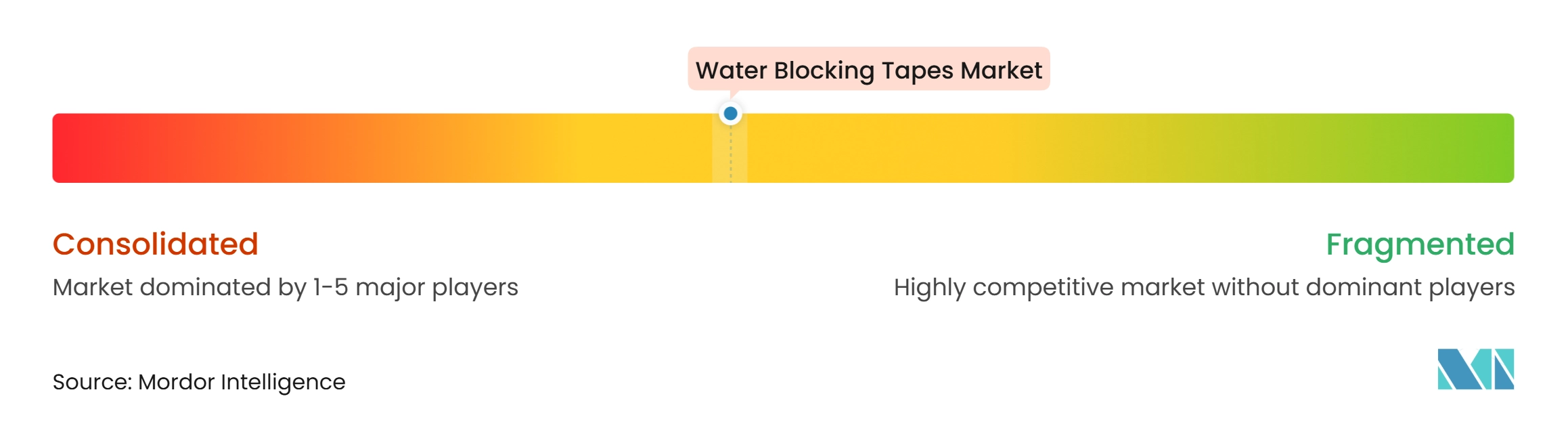
The water blocking tapes market is moderately consolidated. Freudenberg Performance Materials, Magnera's Geca-Tapes division, and Chase Corporation hold established positions in qualified power and submarine cable applications. Their products compete on swelling rate, tensile strength after hydration, superabsorbent polymer distribution, and thermal stability. Thermal stability is particularly important in HVDC designs that operate at sustained high conductor temperatures. Qualification records support customer retention by ensuring that cable manufacturers do not change an approved material during production. This makes performance evidence and process consistency more important than short-term price competition.
Freudenberg Performance Materials stated that its return to Wire Düsseldorf in April 2026 would feature water-blocking tape solutions for HVDC, high-voltage alternating current (HVAC), and submarine cable applications, reflecting a direct commercial focus on specialty power-cable applications. Chase Corporation's July 2025 launch of BlocH₂Ock High-Flow A162HF targeted higher throughput and lower downtime in medium-voltage cable production, indicating that process performance has become a competitive consideration alongside material properties. Nantong Siber Communication Co., Ltd. also filed a patent application for a self-crosslinking, water-based, water-blocking adhesive, indicating ongoing development by Chinese producers seeking improved dry-system performance.
Nantong Siber Communication Co., Ltd. and Nantong University opened a cable-material research and development center in March 2025. The center supports a capability-building approach that could help the company pursue future power-cable qualifications. Magnera identifies cable protection as a focus area for its Geca-Tapes offering, with product opportunities including flame-retardant water-blocking tape for underground tunneling and transit applications, as well as bio-based superabsorbent polymer constructions where sustainability criteria apply. ISO 9001 quality management practices and cable-specific IEC or IEEE qualification files remain important market-access credentials. Suppliers without documented process control may face difficulty being added to approved vendor lists. The competitive landscape, therefore, remains consistent with a market in which established specialists defend their positions through qualification, technical performance, and manufacturing reliability.
Water Blocking Tapes Industry Leaders
-
Chase Corporation
-
Scapa
-
Freudenberg Performance Materials Holding GmbH
-
3M
-
Magnera
- *Disclaimer: Major Players sorted in no particular order
Water Blocking Tapes Market Companies Covered in this Report
- 3M
- Berry Global, Inc.
- Chase Corporation
- Chhaperia Cable Material Pvt Ltd
- Freudenberg Performance Materials Holding GmbH
- Hanyu Cable Materials CO.,LTD.
- IPG
- Magnera
- Nantong Siber Communication Co., Ltd.
- Nichiban Co., Ltd.
- Nitto Denko Corporation
- Scapa
- Sika AG
- tesa SE
- Unitape Ltd
Recent Industry Developments in Water Blocking Tapes Market
- February 2026: Freudenberg Performance Materials announced its return to the Wire Düsseldorf trade fair (April 2026), showcasing semi-conductive and non-conductive water blocking tapes for HVDC, HVAC, and submarine cable applications. This marked the company's re-entry into the trade fair after a multi-year absence, reflecting increased commercial focus on power cable tape programs.
- August 2025: IEEE published IEEE 3150-2025, defining test methods and equipment setups for semi-conductive water blocking tapes used in XLPE-insulated AC power cables rated 110 kV to 500 kV. The standard addresses the prevention of ablation failure and provides a unified evaluation framework for cable manufacturers and tape suppliers in North America and international markets.
Global Water Blocking Tapes Market Report Scope
Water blocking tape is a specialized protective material used inside power, telecommunications, and fiber-optic cables to prevent moisture and water from traveling along the cable's interior. The tape is designed to swell upon contact with water, creating a seal that restricts water ingress and protects the cable's internal components from damage.
The water blocking tapes market is segmented by conductivity type, adhesive side, end-user industry, and geography. By conductivity type, the market is segmented into non-conductive, semi-conductive, and conductive. By adhesive side, the market is segmented into single-sided and double-sided. By end-user industry, the market is segmented into telecommunications, power transmission and distribution, oil and gas, automotive, construction, and other end-user industries. The report also covers market sizes and forecasts for water blocking tapes across 15 countries in major regions. The market sizes and forecasts are provided in terms of value (USD).
Segmentation Overview
| Non-Conductive |
| Semi-Conductive |
| Conductive |
| Single-Sided |
| Double-Sided |
| Telecommunications |
| Power Transmission and Distribution |
| Oil and Gas |
| Automotive |
| Construction |
| Other End-User Industries |
| Asia-Pacific | China |
| India | |
| Japan | |
| South Korea | |
| ASEAN Countries | |
| Rest of Asia-Pacific | |
| North America | United States |
| Canada | |
| Mexico | |
| Europe | Germany |
| United Kingdom | |
| France | |
| Italy | |
| NORDIC Countries | |
| Rest of Europe | |
| South America | Brazil |
| Argentina | |
| Rest of South America | |
| Middle East and Africa | Saudi Arabia |
| South Africa | |
| Rest of Middle East and Africa |
| By Conductivity Type | Non-Conductive | |
| Semi-Conductive | ||
| Conductive | ||
| By Adhesive Side | Single-Sided | |
| Double-Sided | ||
| By End-User Industry | Telecommunications | |
| Power Transmission and Distribution | ||
| Oil and Gas | ||
| Automotive | ||
| Construction | ||
| Other End-User Industries | ||
| By Geography | Asia-Pacific | China |
| India | ||
| Japan | ||
| South Korea | ||
| ASEAN Countries | ||
| Rest of Asia-Pacific | ||
| North America | United States | |
| Canada | ||
| Mexico | ||
| Europe | Germany | |
| United Kingdom | ||
| France | ||
| Italy | ||
| NORDIC Countries | ||
| Rest of Europe | ||
| South America | Brazil | |
| Argentina | ||
| Rest of South America | ||
| Middle East and Africa | Saudi Arabia | |
| South Africa | ||
| Rest of Middle East and Africa | ||
Key Questions Answered in the Report
What is current market size of Water Blocking Tapes Market?
The Water Blocking Tapes Market size was valued at USD 483.46 million in 2026 and is estimated to grow from USD 510.97 million in 2027 to USD 674.49 million by 2032, at a CAGR of 5.71% during the forecast period (2027-2032).
Which conductivity type drives water-blocking tape sales?
Non-Conductive tapes lead with a 50.45% share in 2026, supported by broad use in fiber-optic cable construction.
Which end-user application is growing fastest?
Power Transmission and Distribution is projected to expand at a 7.17% CAGR through 2032 as underground, offshore, and high-voltage projects increase.
Which region has the strongest outlook for water blocking tapes?
Asia-Pacific holds a 45.61% share in 2026 and is forecast to grow at a 7.05% CAGR through 2032.