
Waste Heat Recovery Systems Market Size and Share
Market Overview
| Study Period | 2022 - 2032 |
|---|---|
| Market Size (2027) | USD 102.16 Billion |
| Market Size (2032) | USD 146.88 Billion |
| Growth Rate (2027 - 2032) | 7.53 % |
| Fastest Growing Market | Asia-Pacific |
| Largest Market | Asia-Pacific |
| Market Concentration | Medium |
Major Players *Disclaimer: Major Players sorted in no particular order Image © Mordor Intelligence. Reuse requires attribution under CC BY 4.0. | |
Waste Heat Recovery Systems Market Analysis by Mordor Intelligence
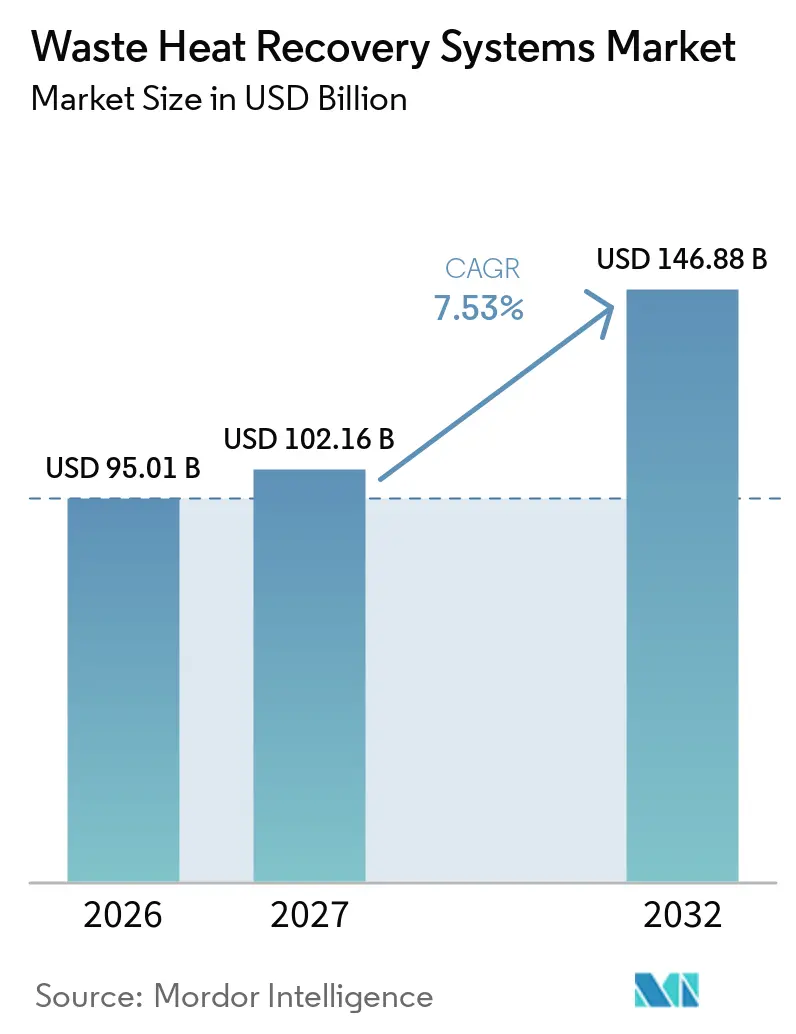
The Waste Heat Recovery Systems Market size is expected to grow from USD 95.01 billion in 2026 to USD 102.16 billion in 2027 and is forecast to reach USD 146.88 billion by 2032 at 7.53% CAGR over 2027-2032. The global waste heat recovery systems market is supported by industrial efforts to reduce fuel use and comply with tighter emissions rules. Waste heat is increasingly treated as an energy resource because it can support process heat, steam, electricity, and district heating. Regulatory action in Europe, China, India, and the United States is making efficiency projects more relevant to industrial investment planning. Suppliers are responding through equipment that can work with lower-temperature streams, difficult operating conditions, and existing plant layouts. The global waste heat recovery systems market also has an opportunity in data centers, where higher computing density is increasing the value of heat supplied to nearby networks.
Key Report Takeaways
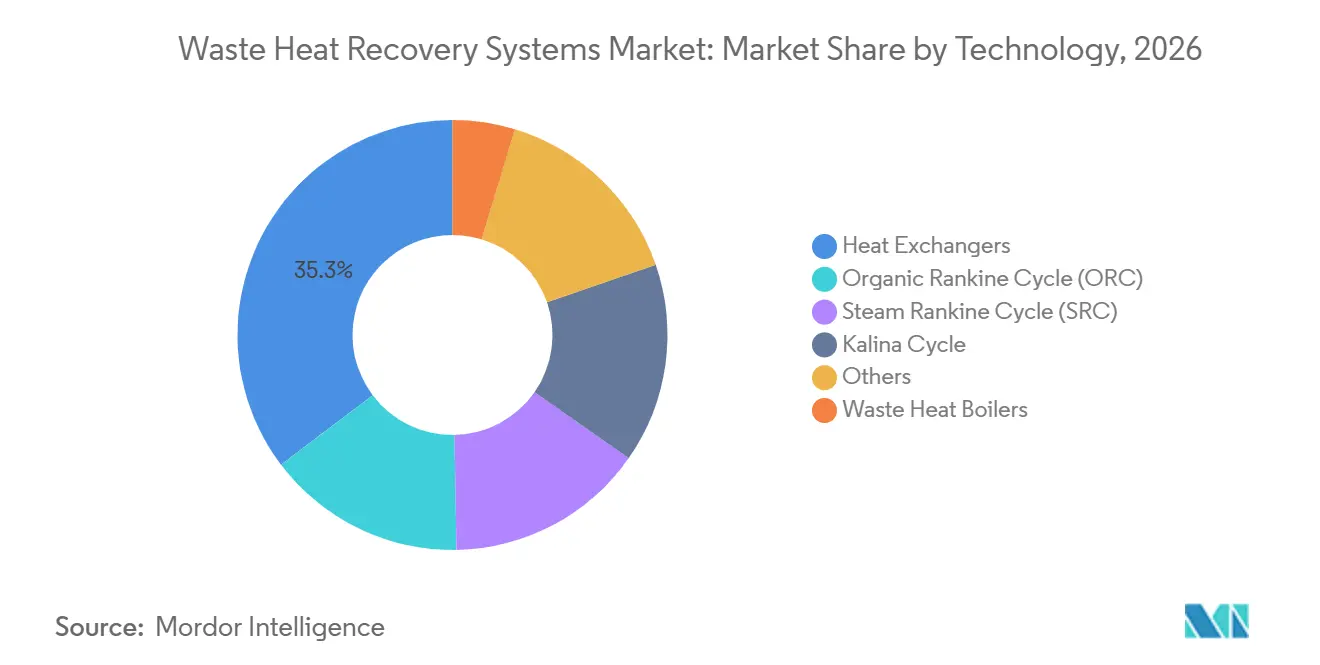
- By technology, heat exchangers held 35.3% share in 2026, while Organic Rankine Cycle systems are forecast to grow at an 8.3% CAGR through 2032.
- By temperature band, medium-temperature streams accounted for 45.6% share in 2026, while low-temperature streams are forecast to grow at a 7.8% CAGR through 2032.
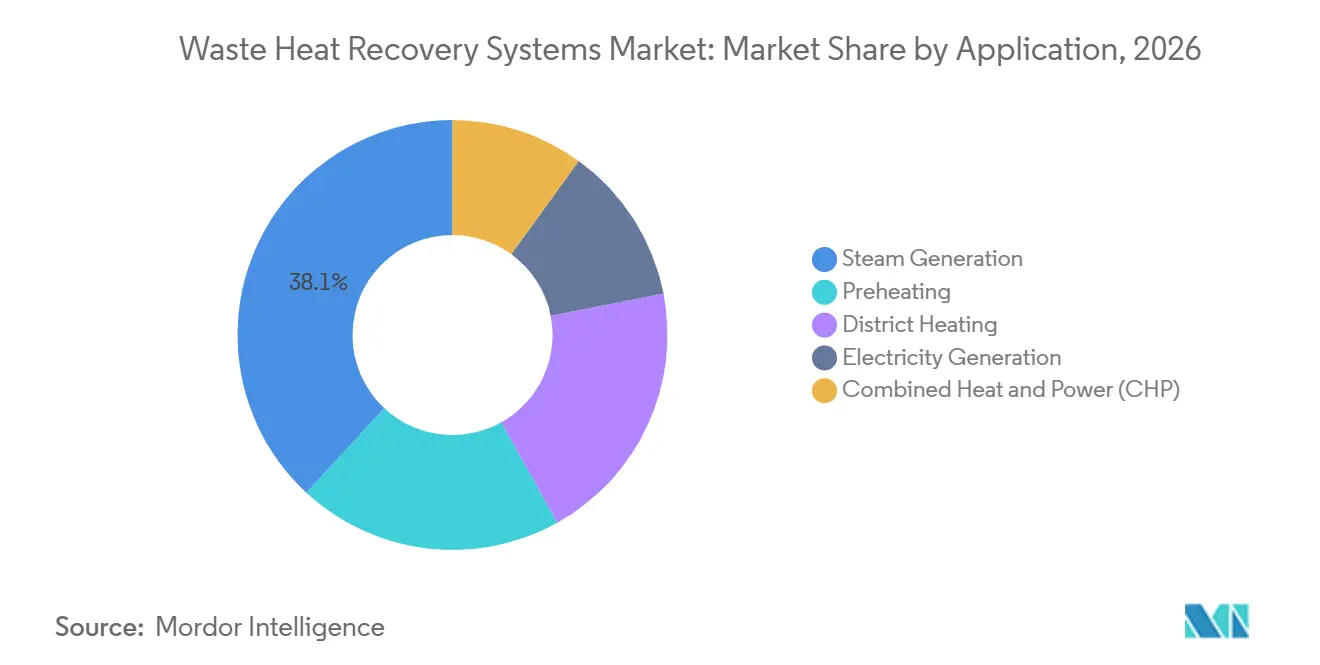
- By application, steam generation held 38.1% share in 2026, while electricity generation is forecast to grow at a 7.9% CAGR through 2032.
- By end-use industry, petroleum refining accounted for 21.4% share in 2026 and is forecast to grow at an 8.5% CAGR through 2032.
- By geography, Asia-Pacific held 41.3% share in 2026 and is forecast to grow at an 8.9% CAGR through 2032.
Note: Market numbers in this report are based on Mordor Intelligence's proprietary estimation framework, which combines nine months of actuals with Q4 projections for base year 2026.
Market Trends and Insights
Drivers Impact Analysis of Waste Heat Recovery Systems Market*
| Driver | (~) % Impact on CAGR Forecast | Geographic Relevance | Impact Timeline |
|---|---|---|---|
| Industrial Decarbonization Mandates and Emissions Compliance | +2.1% | Global, with highest intensity in EU and China | Short term (≤ 2 years) |
| Volatile Industrial Energy Prices and Fuel Substitution | +1.6% | Global, acute in Europe and South Asia | Short term (≤ 2 years) |
| Expansion of Energy-Intensive Industrial Production | +1.2% | Asia-Pacific core, spill-over to MEA and South America | Medium term (2-4 years) |
| Data-Center Heat Reuse and District-Energy Integration | +0.9% | Europe and North America, emerging in East Asia | Medium term (2-4 years) |
| Low-Grade Heat Conversion and High-Temperature Heat Pump Advances | +1% | EU, Japan, North America | Medium term (2-4 years) |
| Energy-as-a-Service, Microgrids and Distributed Energy Models | +0.7% | North America, EU, India | Long term (≥ 4 years) |
| Source: Mordor Intelligence | |||
Industrial Decarbonization Mandates Drive Statutory Demand for WHR
The global waste heat recovery systems market is benefiting as public policy moves from general efficiency targets toward specific planning requirements. The European Union requires member states to assess waste heat potential and incorporate the results into national planning under the Energy Efficiency Directive and Renewable Energy Directive. This approach places the subject in national energy planning rather than treating it as an isolated plant-level choice. It also requires industrial operators, local authorities, and network owners to consider how available heat could be used beyond the point where it is generated. The rules also require data center waste heat assessments, which brings a new class of heat source into policy planning. The European Commission published terms for the IF26 Heat Auction in September 2026, with EUR 1 billion financed through Emissions Trading System revenue and eligibility for industrial heat above 80 °C.[1] This lower threshold can widen the set of projects suited to lower-temperature recovery equipment. European policy can also influence exporters outside the region as customers place greater value on lower-carbon industrial production.
Volatile Energy Prices Accelerate Fuel Substitution Through Waste Heat Monetization
Energy price volatility has strengthened the commercial case for recovering energy that would otherwise be released from an industrial process. Recovered heat can displace purchased electricity, gas, or other fuel when it is used within the same facility. This makes the financial result depend on avoided energy purchases as well as equipment performance. The project case is strongest when the recovered energy can replace a recurring fuel purchase at the same location. It is weaker when heat cannot be used when it is available, which explains why plant operations and local demand need to be assessed together. The global waste heat recovery systems market therefore has relevance for operators that face uncertain energy costs in Europe and South Asia. Refining and petrochemical facilities can use heat recovery alongside process integration because their operations produce continuous thermal streams. The result is a shorter decision path for projects when companies can measure the fuel displaced by each unit of recovered heat. The global waste heat recovery systems market benefits when those energy savings can be verified within normal plant reporting.
Data Center Heat Reuse Opens a New Demand Source
The global waste heat recovery systems market is gaining a new source of demand from data centers that can connect to district heating systems. Helen signed an agreement with OnZero Finland in 2026 to use heat from a planned Helsinki data center in its district heating network. The planned connection targets more than 500,000 MWh of heat each year and is intended to serve 70,000 apartments when operations begin.[2] Liquid cooling can increase the temperature of the heat available from computing facilities compared with conventional air-cooled equipment. It can also create a more predictable thermal output when facilities operate at high utilization. A useful connection still depends on the distance to the network, the network temperature, and agreement on how the heat will be measured and supplied. This can improve the usefulness of recovered heat for a network that requires a reliable thermal supply. The policy requirement for data center heat assessments in the European Union may support similar projects where local heat networks are available.
High-Temperature Heat Pumps Extend Low-Grade Heat Use
High-temperature heat pumps can raise the temperature of lower-grade heat so it can serve more industrial duties. This makes them relevant to the global waste heat recovery systems market, even where direct heat recovery is not sufficient. New equipment can support hot-water supply for industrial users who are replacing fossil-fuel or electric boilers. Heat-pump equipment designed for industrial use can supply higher-temperature water than earlier systems. This gives project teams another option when recovered heat needs to be upgraded before it can be used in a process. The equipment needs to be assessed against the site’s heat source, electricity use, output requirement, and operating schedule. Design work also needs to consider refrigerant choice, the condition of the source stream, the temperature required by the receiving process, and the impact on existing utilities. These practical checks determine whether temperature upgrading can form part of a recovery project rather than becoming a separate and costly system. The suitability of the approach can vary across food processing, pharmaceuticals, chemicals, and other facilities with different heat demands. The technical development expands the range of lower-temperature heat streams that can be considered during project design. It allows industrial sites to assess streams that cannot directly meet process temperature requirements. The equipment can be especially relevant where a site has both a steady low-grade heat source and a nearby demand for hot water.
Restraints Impact Analysis of Waste Heat Recovery Systems Market*
| Restraint | (~) % Impact on CAGR Forecast | Geographic Relevance | Impact Timelin |
|---|---|---|---|
| High Upfront Capital Cost and Extended Payback Periods | -1.5% | Global, most acute in South America and MEA | Short term (≤ 2 years) |
| Retrofit Complexity, Production Downtime and Integration Risk | -1% | Global, highest in legacy-heavy EU and North America | Medium term (2-4 years) |
| Corrosive, Dust-Laden and Variable-Temperature Heat Streams | -0.7% | APAC industrial corridors, cement and glass globally | Long term (≥ 4 years) |
| Limited Local Heat Offtake and District-Heat Interconnection Constraints | -0.5% | Rural industrial sites globally, emerging markets broadly | Long term (≥ 4 years) |
| Source: Mordor Intelligence | |||
Capital Intensity Limits Adoption Beyond Core Anchor Markets
The global waste heat recovery systems market faces a capital constraint because recovery equipment is installed before savings are realized. Project sponsors need to assess the cost of equipment, engineering, installation, shutdown time, maintenance, and connection to the final heat or power use. Savings may accumulate over many years, but the investment decision is often made within a shorter capital-planning cycle. This difference can delay projects even where the long-term energy case is favorable. Major industrial groups can fund projects within broader plant investment programs, while smaller sites often need a clear and short payback period. This issue is more significant where public grants, tax incentives, and energy-service financing are limited. Energy-as-a-Service models can move part of the initial cost to a service provider instead of the equipment user. Such models can make projects more accessible, but their use remains less established outside North America and Western Europe. Contract terms must set out who carries performance, maintenance, and energy-price risk. Users also need confidence that the contract structure will not limit operating flexibility at a facility with changing production patterns. Capital competition also matters because operators may prioritize capacity expansion or reliability work during periods of weaker product margins.
Retrofit Complexity and Process Downtime Create Installation Barriers
Retrofit projects require equipment to fit within operating plants that were not designed for heat recovery. Engineers must match the heat exchanger network, piping, temperature pattern, and materials to the process in service. A plant shutdown can create a major barrier in continuous industries because lost production has a direct cost. Dust, corrosive gases, and variable heat flows can also reduce equipment performance over time. These conditions make performance guarantees, materials selection, and maintenance planning important to the global waste heat recovery systems market. Reference projects are valuable because they show that a system can maintain output under real process conditions. They help buyers assess cleaning needs, service intervals, and how output changes with the production schedule. This evidence can reduce uncertainty for a first-time adopter that is comparing recovery equipment with more familiar plant investments.
*Our forecasts treat driver/restraint impacts as directional, not additive. The impact forecasts reflect baseline growth, mix effects, and variable interactions.
Waste Heat Recovery Systems Market Segment Analysis
By Technology:
Heat Exchangers Lead While ORC Gains GroundHeat exchangers held 35.3% of the global waste heat recovery systems market in 2026. Their leading position reflects use across a wide range of temperature bands and industrial processes. Shell-and-tube equipment remains relevant for refinery preheating duties and large process services. Plate-and-frame equipment can offer a compact option where operators need high heat-transfer performance in a limited space. Corrosion-resistant designs are also important in chemical plants and sulphuric acid applications. Alfa Laval launched the TS45 in 2026 as its largest semi-welded plate heat exchanger for high-capacity and high-pressure duties.[3]
Organic Rankine Cycle systems are forecast to grow at an 8.3% CAGR through 2032. The global waste heat recovery systems industry is using ORC technology, where heat streams are below the operating range suited to conventional steam cycles. Improvements in turbomachinery and working-fluid selection can increase the set of temperatures that support power generation. Research presented at the 2025 ASME Turbo Expo described partial-evaporation cycle designs that produced 25% more power than comparable single-phase arrangements at low-to-medium temperatures. ORC units are also being adopted in specialized applications such as gas compressor stations and maritime systems. F-Gas requirements in Europe are adding a compliance consideration to working-fluid selection for both ORC and heat-pump systems.

By Temperature Band:
Medium Temperature Remains the Core OpportunityMedium-temperature streams from 200°C to 650°C accounted for 45.6% of the global waste heat recovery systems market share in 2026. Refining, chemicals, and steel operations commonly produce heat within this range. These streams have enough energy density to support dedicated recovery equipment and are less demanding than the highest-temperature applications. Heat exchanger networks and waste heat boilers are common technical choices for this band. The installed base is supported by continuous processes that can provide a stable heat source. This makes medium-temperature recovery a central part of the global waste heat recovery systems market. It also gives suppliers a large base of sites where proven equipment can be adapted without relying on a single specialized use case. The breadth of these process settings supports recurring demand for engineering, replacement components, and field-service support.
Low-temperature streams below 200°C are forecast to grow at a 7.8% CAGR through 2032. Data centers, food processing, pharmaceuticals, and distributed industrial facilities can create opportunities in this temperature range. Heat pumps and low-temperature ORC designs help raise the usefulness of heat that once had limited value. Technical progress in low-temperature ORC systems is improving the ability to convert heat that would previously have been difficult to use. As the range of workable streams expands, project developers can examine sources that were previously excluded from the global waste heat recovery systems market. High-temperature streams above 650°C remain important for cement, glass, and primary metals, where project scale and engineering complexity are generally higher.
By Application:
Steam Generation Holds the Largest PositionSteam generation held 38.1% of the global waste heat recovery systems market in 2026. Steam remains a flexible carrier because many industrial sites already have steam pipelines, condensate return systems, and steam-driven equipment. Refineries, chemical plants, pulp-and-paper facilities, and district heating systems can use recovered steam without building a separate energy distribution system. This can lower the integration burden for a retrofit. Preheating is also widely used because it can reduce primary fuel consumption in feedstock, combustion-air, and boiler-feedwater duties. These established uses support the role of steam generation in the global waste heat recovery systems market. The application also lets operators direct recovered energy toward several duties when process requirements change during the operating day. Existing steam infrastructure can reduce the amount of new distribution equipment needed during a recovery project.
Electricity generation is forecast to grow at a 7.9% CAGR through 2032. Power generation can offer more flexibility than direct heat use because electricity can be used on-site, exported, or used to reduce purchased power. Turboden America announced in March 2026 that Tallgrass selected the company for 3 additional ORC plants at gas compressor stations in Ohio and Indiana. The 4 installations are expected to provide 46.1 MW and qualify for Investment Tax Credits of up to 50% under the Inflation Reduction Act. Combined heat and power and district heating remain relevant applications where a nearby customer can receive the thermal output.
By End-Use Industry:
Petroleum Refining Leads in Share and GrowthPetroleum refining accounted for 21.4% of the global waste heat recovery systems market size in 2026. Refineries release substantial heat from flue gas and process condensate across crude distillation and other units. Their continuous operation and broad range of temperatures create multiple opportunities for recovery equipment. The segment is also forecast to grow at an 8.5% CAGR through 2032. This combination indicates that refinery operators remain a key customer group for the global waste heat recovery systems market. Recovery projects can help reduce fuel use and support the energy performance of large operating sites. The availability of several heat sources within one refinery can enable operators to prioritize projects that match the site’s existing utility system. This gives the sector a practical reason to assess recovery as part of normal process optimization and maintenance planning. The global waste heat recovery systems market can therefore remain relevant to refinery programs that focus on energy performance and operating reliability. It can also serve operators who want to lower the energy intensity of existing assets before considering wider process changes.
Chemicals and petrochemicals form the second-largest end-use cluster because exothermic reactions and distillation columns provide predictable heat streams. Cement and glass are important high-temperature applications where recovery solutions are technically established. Thermax reported cumulative waste heat recovery capacity of 125 MW in cement and more than 520 MW in steel and sponge iron.[4] New industrial capacity in India and Southeast Asia can provide opportunities to integrate recovery systems during plant development. Iron and steel, power generation, pulp and paper, and other industries require technology choices that reflect their specific operating conditions.
Geography Analysis
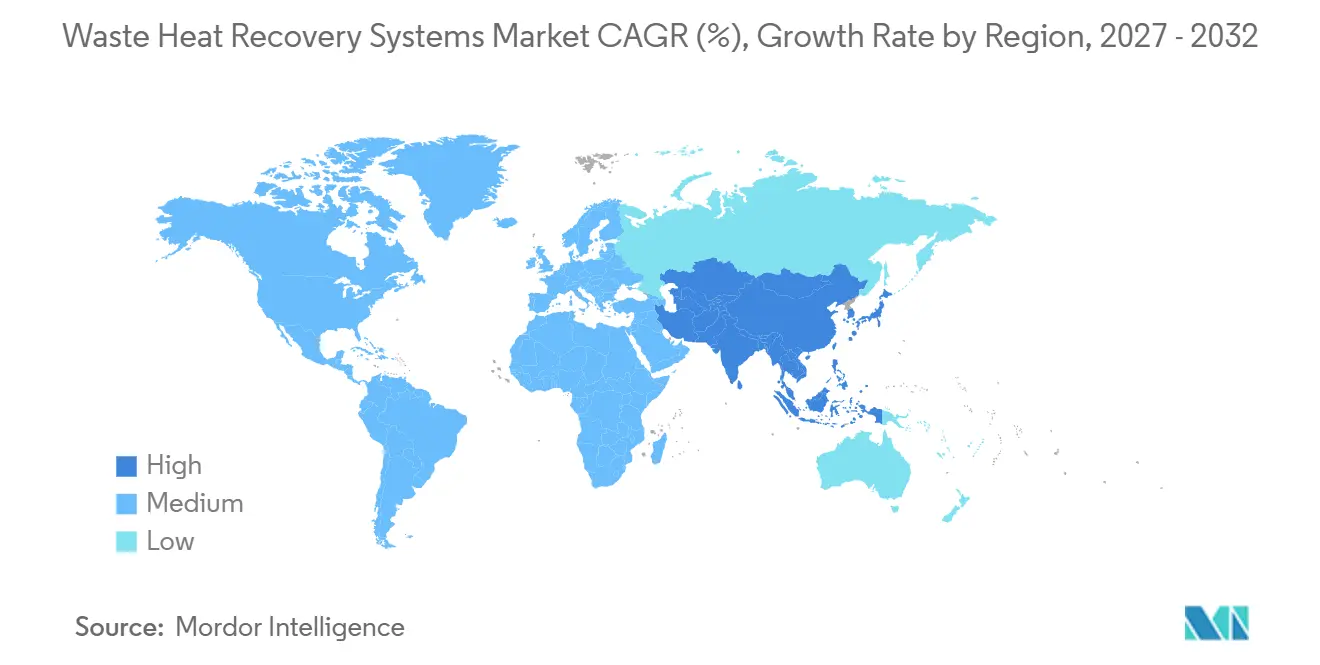
Asia-Pacific held 41.3% of the global waste heat recovery systems market share in 2026 and is forecast to grow at an 8.9% CAGR through 2032. The region combines industrial expansion with stronger energy-efficiency expectations in China and India. Large operating sites can often identify several recovery opportunities across kilns, furnaces, boilers, process cooling, and gas-handling equipment. This creates a varied project base in which technology selection depends on the temperature, cleanliness, timing, and intended use of each heat stream. Suppliers must therefore combine standard equipment with engineering that fits the process conditions at each site. China’s dual-carbon pathway targets peak emissions before 2030 and carbon neutrality by 2060. India’s Perform, Achieve and Trade scheme gives energy-intensity reductions an economic value through tradable certificates. These policy settings support recovery investment in heavy industrial facilities. The global waste heat recovery systems market has a large potential base in the region because cement, steel, chemicals, and refining capacity are extensive.
Europe is the second-largest regional market and has a mature district heating base that can receive recovered industrial heat. The region has high regulatory density, and the Emissions Trading System adds a cost to carbon emissions from energy-intensive operations. The IF26 Heat Auction has a EUR 1 billion budget, and its 80°C eligibility threshold can support projects across chemicals, pulp and paper, and food processing. Alfa Laval was selected by Saipem in September 2026 to supply heat-transfer technology for Stockholm Exergi’s BECCS facility, which is designed to capture and permanently store up to 800,000 tonnes of carbon dioxide annually when it begins operations in 2028. This project shows how heat recovery equipment can be used in broader carbon-management infrastructure. It also illustrates the role of heat-transfer equipment where carbon capture processes need reliable thermal integration with an industrial or energy facility. Such projects can create a different set of requirements from conventional efficiency upgrades, including integration with specialized capture equipment.
North America held the third-largest regional share in 2026. Investment Tax Credits for Waste Energy Recovery Property can reduce the effective cost of qualifying equipment at compressor stations, refineries, and data centers. The support is particularly relevant for projects that generate electricity because the value proposition can combine avoided power purchases with available tax incentives. The pipeline and midstream sector also has heat sources that are often steady and located close to existing electrical connections. These features can simplify the operating case for heat-to-power projects when compared with sites where heat output has no clear customer. Turboden commissioned a 19 MW waste-heat-to-power ORC plant at Strathcona Resources’ Orion SAGD facility in Alberta in October 2025. The unit recovers low-grade heat from produced steam and non-condensable gas and was expected to offset up to 80% of the facility’s grid electricity use. South America and the Middle East and Africa are earlier in their adoption cycle, where financing and local heat offtake can constrain implementation. The global waste heat recovery systems market can develop in these regions when industrial operators have access to predictable financing, dependable service support, and a clear use for recovered energy. Projects are more difficult where facilities are distant from district heating networks or where electricity export arrangements are uncertain. These conditions make local infrastructure and project preparation as important as the selection of the recovery equipment itself. Brazil, Chile, Saudi Arabia, the UAE, Morocco, and South Africa have industrial operations that can support future projects when these constraints are addressed.
Competitive Landscape
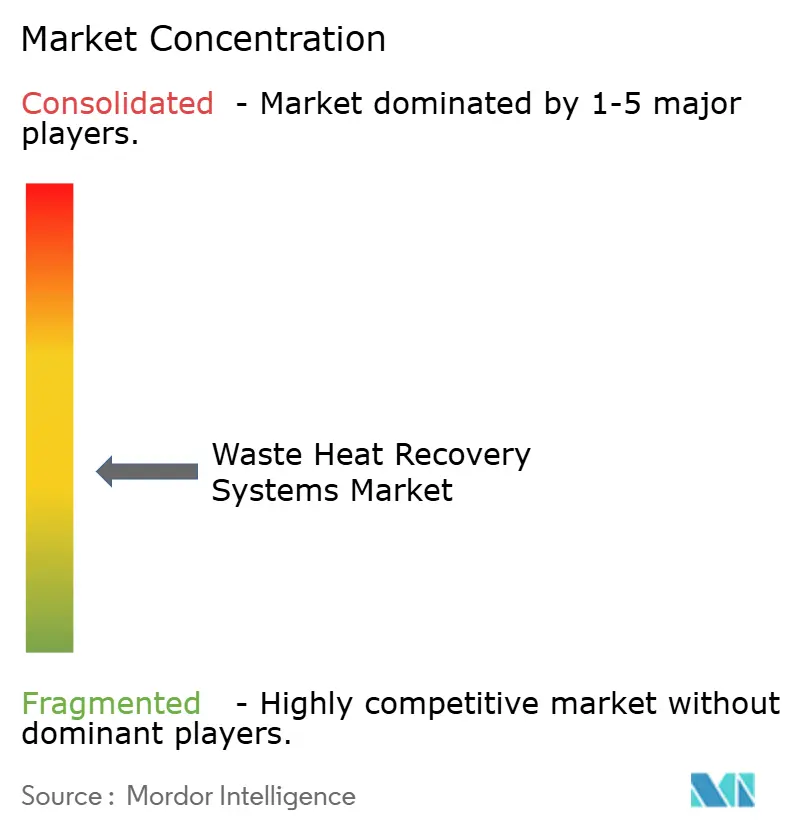
The global waste heat recovery systems market is moderately consolidated. It includes companies that supply complete thermal systems, firms focused on a specific recovery technology, and engineering groups that integrate equipment into a larger project. Their competitive positions differ by application because the requirements for a refinery, a cement plant, a gas compressor station, and a vessel are not the same. Large companies compete in heat recovery steam generators, heat exchangers, and complex projects that require engineering, procurement, and construction capability. GE Vernova, Siemens Energy, and Mitsubishi Heavy Industries, through Turboden, have broad technical portfolios and global service networks. Their strengths include turbine and boiler technology, thermal-performance guarantees, and experience with difficult operating conditions. These capabilities matter in cement, steel, and refinery projects where reliability can be more important than the initial equipment price. GE Vernova received an order from Enea Group in November 2025 for 2 9HA.01 gas turbine combined-cycle blocks at the Kozienice Power Station in Poland, each including a 3-pressure-level heat recovery steam generator.
Specialist suppliers compete in applications that require dedicated engineering or lower-temperature conversion technology. Turboden is expanding its power-recovery portfolio in gas compressor stations through the Tallgrass projects in Ohio and Indiana. Climeon has supplied HeatPower 300 systems for low-temperature applications and reported a first delivery to Jiangsu New Yangzi Shipbuilding in China in 2026. Alfa Laval is advancing its plate heat exchanger portfolio through the TS45, which targets high-capacity and high-pressure duties. These moves show that suppliers are focusing on both established industrial systems and specialized operating conditions.
Competition depends on the ability to adapt equipment to specific heat streams and plant constraints. Buyers evaluate whether a supplier can understand the full operating context, including temperature changes, gas composition, available space, maintenance access, and the timing of planned shutdowns. A supplier with proven equipment can still face a difficult sale if it cannot offer a design that fits the site’s process and installation plan. This favors companies that can provide engineering support from early feasibility work through commissioning and later service. Material performance is important where gases contain dust or corrosive components. Field service and maintenance coverage also affect customer selection because systems must operate over long periods. Digital monitoring is becoming part of the service offer, including Turboden’s Turboanalytics platform for predictive maintenance and anomaly detection. The global waste heat recovery systems market, therefore, includes both equipment competition and competition around long-term performance assurance. Customers can value a supplier that helps maintain output, identify abnormalities early, and coordinate service around plant operations. This service element is important because lost recovery output can increase fuel purchases and undermine the financial case that justified the installation. It also gives specialist suppliers a route to compete where their operating knowledge is stronger than their scale. Smaller companies can retain a role where a custom design, local support, or a specialized application has greater value than scale. The available information does not provide combined market shares for the leading companies, which is consistent with a market where no small group is shown to control most demand.
Waste Heat Recovery Systems Industry Leaders
-
Siemens Energy AG
-
GE Vernova Inc.
-
Mitsubishi Heavy Industries, Ltd.
-
Alfa Laval AB
-
ABB Ltd.
- *Disclaimer: Major Players sorted in no particular order
Waste Heat Recovery Systems Market Companies Covered in this Report
- Siemens Energy AG
- Mitsubishi Heavy Industries, Ltd. (MHI)
- GE Vernova Inc.
- ABB Ltd.
- Schneider Electric SE
- Bosch Industriekessel GmbH
- Ormat Technologies, Inc.
- Thermax Limited
- Alfa Laval AB
- Kelvion Holding GmbH
- Babcock & Wilcox Enterprises, Inc.
- Valmet Oyj
- Kawasaki Heavy Industries, Ltd.
- Sinoma Energy Conservation Ltd.
- FLSmidth & Co. A/S
- KHD Humboldt Wedag International AG
- John Wood Group PLC
- Climeon AB
- Turboden S.p.A.
- Exergy International Srl
Recent Industry Developments in Waste Heat Recovery Systems Market
- September 2026: Alfa Laval launched Hukka-5, a next-generation exhaust gas steam boiler for cruise vessels and passenger ferries, at SMM 2026 in Hamburg. The boiler's inverted downward natural circulation design enables waste heat recovery from exhaust gas with minimal equipment footprint; it is compatible with all marine fuels including methanol and hydrogen, supporting IMO decarbonisation compliance for vessel operators.
- May 2026: Alfa Laval launched the TS45 semi-welded plate heat exchanger, the largest in its semi-welded portfolio, for high-capacity, high-pressure heat transfer in energy transition and heavy industry applications. Available from Q2 2026, the TS45 is designed to compete directly with shell-and-tube incumbents in duties where compact footprint and high serviceability are valued.
- March 2026: Turboden America LLC, a Mitsubishi Heavy Industries Group subsidiary, announced selection by Tallgrass for 3 additional Waste-Heat-to-Power ORC plants at gas compressor stations in Ohio and Indiana, bringing the total portfolio to 4 installations and 46.1 MW of clean, water-free baseload power. The projects qualify for Investment Tax Credit incentives of up to 50% under the Inflation Reduction Act.
Global Waste Heat Recovery Systems Market Report Scope
Waste Heat Recovery Systems (WHRS) capture and reuse thermal energy generated as a byproduct of industrial processes or combustion systems that would otherwise be lost to the environment.
The global waste heat recovery systems market is segmented by technology, temperature band, application, end-use industry, and geography. By technology, the market is segmented into heat exchangers, waste heat boilers, organic rankine cycle (ORC), steam rankine cycle (SRC), kalina cycle, and others. By temperature band, the market is segmented into low temperature, below 200°C, medium temperature, 200°C to 650°C, and high temperature, above 650°C. By application, the market is segmented into steam generation, electricity generation, combined heat and power (CHP), preheating, and district heating. By end-user industry, the market is segmented into petroleum refining, chemicals & petrochemicals, cement, iron & steel, power generation, glass, pulp & paper, and others. The report also covers the market size and forecasts for the global waste heat recovery systems market across 26 countries in the key regions. For each segment, market sizing and forecasts are provided in terms of value (USD).
Segmentation Overview
| Heat Exchangers |
| Waste Heat Boilers |
| Organic Rankine Cycle (ORC) |
| Steam Rankine Cycle (SRC) |
| Kalina Cycle |
| Others |
| Low Temperature, Below 200 °C |
| Medium Temperature, 200 °C to 650 °C |
| High Temperature, Above 650 °C |
| Steam Generation |
| Electricity Generation |
| Combined Heat and Power (CHP) |
| Preheating |
| District Heating |
| Petroleum Refning |
| Chemicals & Petrochemicals |
| Cement |
| Iron & Steel |
| Power Generation |
| Glass |
| Pulp & Paper |
| Others |
| North America | United States |
| Canada | |
| Mexico | |
| Europe | Germany |
| France | |
| Italy | |
| Spain | |
| United Kingdom | |
| Poland | |
| Russia | |
| Rest of Europe | |
| Asia-Pacific | China |
| India | |
| Japan | |
| South Korea | |
| Australia | |
| Indonesia | |
| Vietnam | |
| Thailand | |
| Rest of Asia-Pacific | |
| South America | Brazil |
| Argentina | |
| Chile | |
| Rest of South America | |
| Middle East and Africa | Saudi Arabia |
| United Arab Emirates | |
| Egypt | |
| South Africa | |
| Morocco | |
| Rest of Middle East and Africa |
| By Technology | Heat Exchangers | |
| Waste Heat Boilers | ||
| Organic Rankine Cycle (ORC) | ||
| Steam Rankine Cycle (SRC) | ||
| Kalina Cycle | ||
| Others | ||
| By Temperature Band | Low Temperature, Below 200 °C | |
| Medium Temperature, 200 °C to 650 °C | ||
| High Temperature, Above 650 °C | ||
| By Application | Steam Generation | |
| Electricity Generation | ||
| Combined Heat and Power (CHP) | ||
| Preheating | ||
| District Heating | ||
| By End-Use Industry | Petroleum Refning | |
| Chemicals & Petrochemicals | ||
| Cement | ||
| Iron & Steel | ||
| Power Generation | ||
| Glass | ||
| Pulp & Paper | ||
| Others | ||
| By Geography | North America | United States |
| Canada | ||
| Mexico | ||
| Europe | Germany | |
| France | ||
| Italy | ||
| Spain | ||
| United Kingdom | ||
| Poland | ||
| Russia | ||
| Rest of Europe | ||
| Asia-Pacific | China | |
| India | ||
| Japan | ||
| South Korea | ||
| Australia | ||
| Indonesia | ||
| Vietnam | ||
| Thailand | ||
| Rest of Asia-Pacific | ||
| South America | Brazil | |
| Argentina | ||
| Chile | ||
| Rest of South America | ||
| Middle East and Africa | Saudi Arabia | |
| United Arab Emirates | ||
| Egypt | ||
| South Africa | ||
| Morocco | ||
| Rest of Middle East and Africa | ||
Key Questions Answered in the Report
What is the projected growth rate for waste heat recovery systems?
The Waste Heat Recovery Systems Market size is expected to grow from USD 95.01 billion in 2026 to USD 102.16 billion in 2027 and is forecast to reach USD 146.88 billion by 2032 at 7.53% CAGR over 2027-2032.
Which technology has the largest installed revenue base?
Heat exchangers held 35.3% share in 2026 because they serve a broad range of temperatures and industrial processes.
Which technology is forecast to expand fastest?
Organic Rankine Cycle systems are forecast to grow at an 8.3% CAGR through 2032, supported by lower-temperature power recovery applications.
Why do refineries use waste heat recovery equipment?
Refining held 21.4% share in 2026 and is forecast to grow at an 8.5% CAGR because refineries have continuous heat streams across several operating units.
Which region is growing fastest for waste heat recovery systems?
Asia-Pacific held 41.3% share in 2026 and is forecast to grow at an 8.9% CAGR through 2032.
How can data centers reuse excess heat?
Data centers can connect heat pumps and liquid cooling systems to district heating networks, as planned in Helsinki for more than 500,000 MWh of annual recovered heat.