
Warehouse Real Estate Market Size and Share
Market Overview
| Study Period | 2021 - 2032 |
|---|---|
| Market Size (2027) | USD 296.63 Billion |
| Market Size (2032) | USD 393.23 Billion |
| Growth Rate (2027 - 2032) | 5.80 % |
| Fastest Growing Market | North America |
| Largest Market | Middle East and Africa |
| Market Concentration | Medium |
Major Players *Disclaimer: Major Players sorted in no particular order Image © Mordor Intelligence. Reuse requires attribution under CC BY 4.0. | |
Warehouse Real Estate Market Analysis by Mordor Intelligence
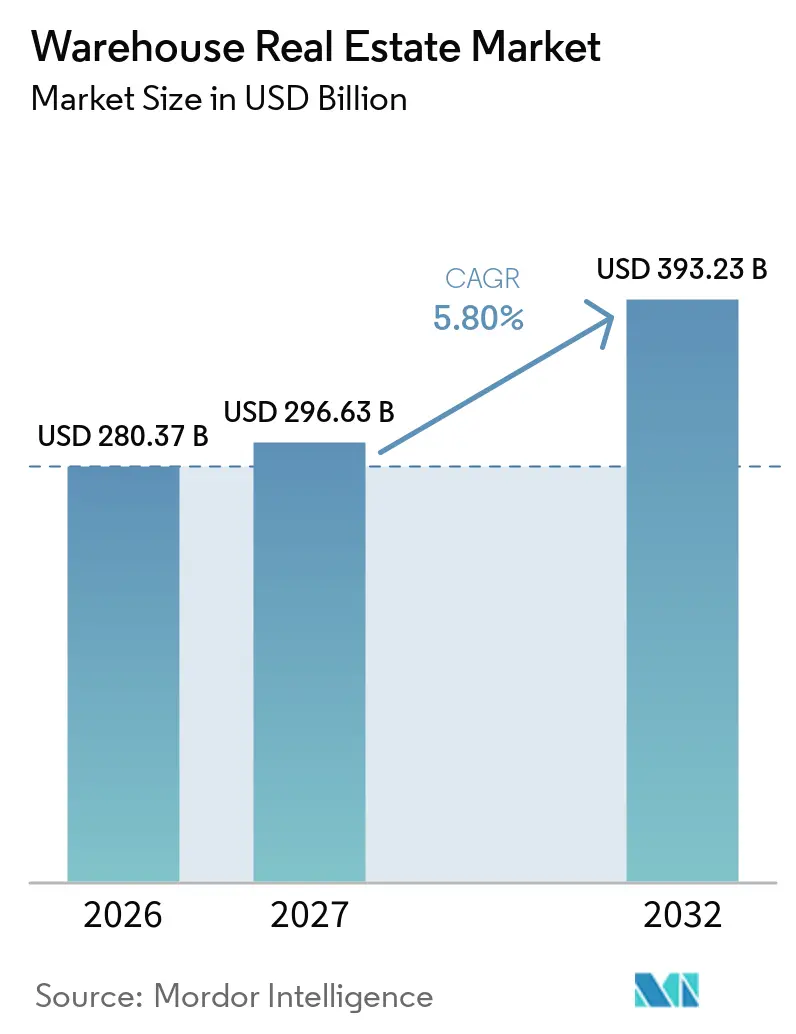
The Warehouse Real Estate Market size is projected to be USD 280.37 billion in 2026, USD 296.63 billion in 2027, and reach USD 393.23 billion by 2032, growing at a CAGR of 5.80% from 2027 to 2032.
The pipeline for modern logistics space is tightening because 2026 new-build deliveries are expected to be more than 70% below the pandemic-era peak, which narrows the supply of modern facilities. Demand is also less dependent on trade volumes than it may appear, since proximity to population centers drives 75% of U.S. logistics demand. Automation, cold-chain requirements, and access to power are changing which assets tenants consider usable. This creates opportunity for owners with sites that can support high power loads, modern building specifications, and locations close to consumers. At the same time, higher financing costs, localized vacancy, and grid constraints remain material limits on new development.
Key Report Takeaways
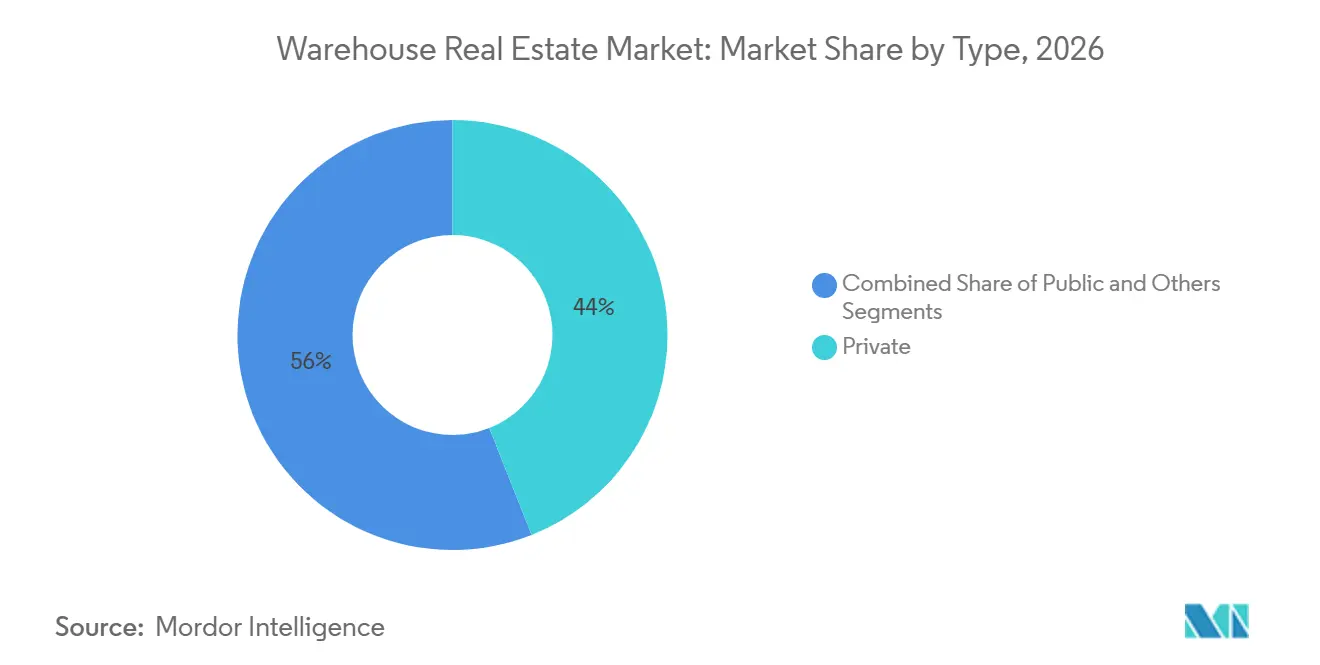
- By type, private warehouses held 44.00% of the warehouse real estate market share in 2026, while the Others segment is forecast to expand at a 6.80% CAGR through 2032.
- By temperature control, general warehouses accounted for 68.00% of the warehouse real estate market size in 2026, while refrigerated warehouses are forecast to expand at a 6.20% CAGR through 2032.
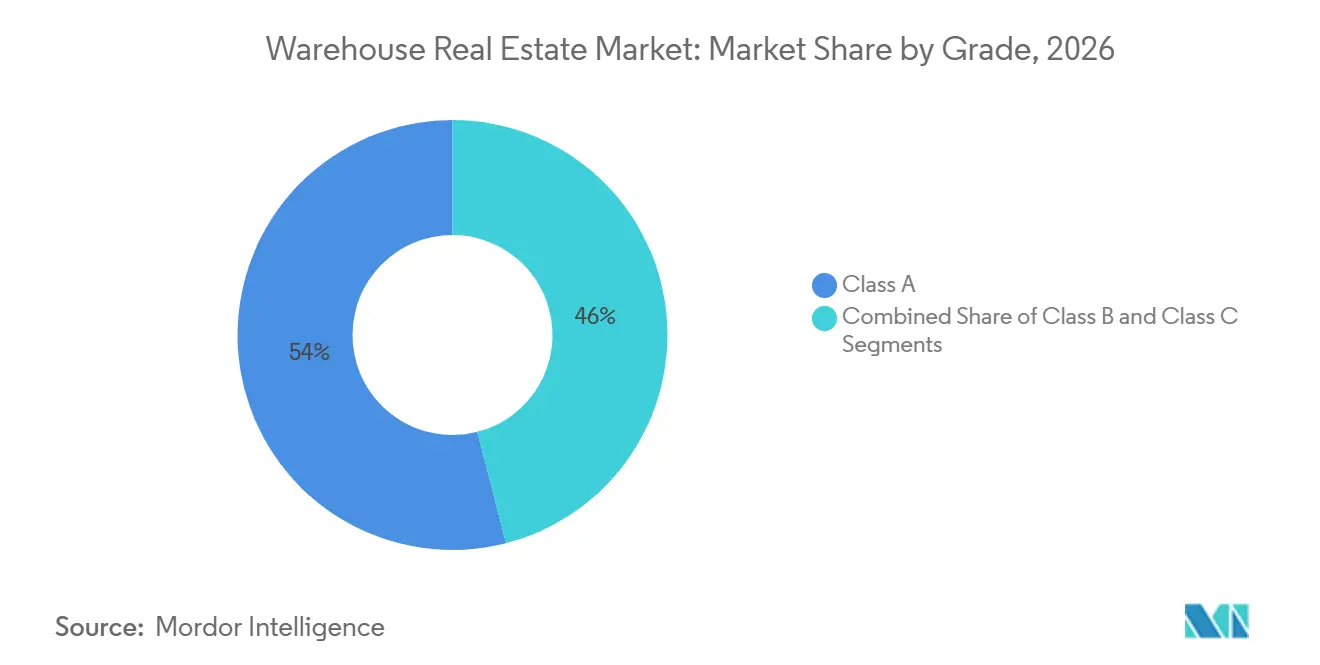
- By grade, Class A assets held 54.00% of the warehouse real estate market share in 2026 and are forecast to expand at a 7.80% CAGR through 2032.
- By warehouse size, large-scale warehouses accounted for 41.00% of the warehouse real estate market size in 2026, while small-scale warehouses are forecast to expand at an 8.20% CAGR through 2032.
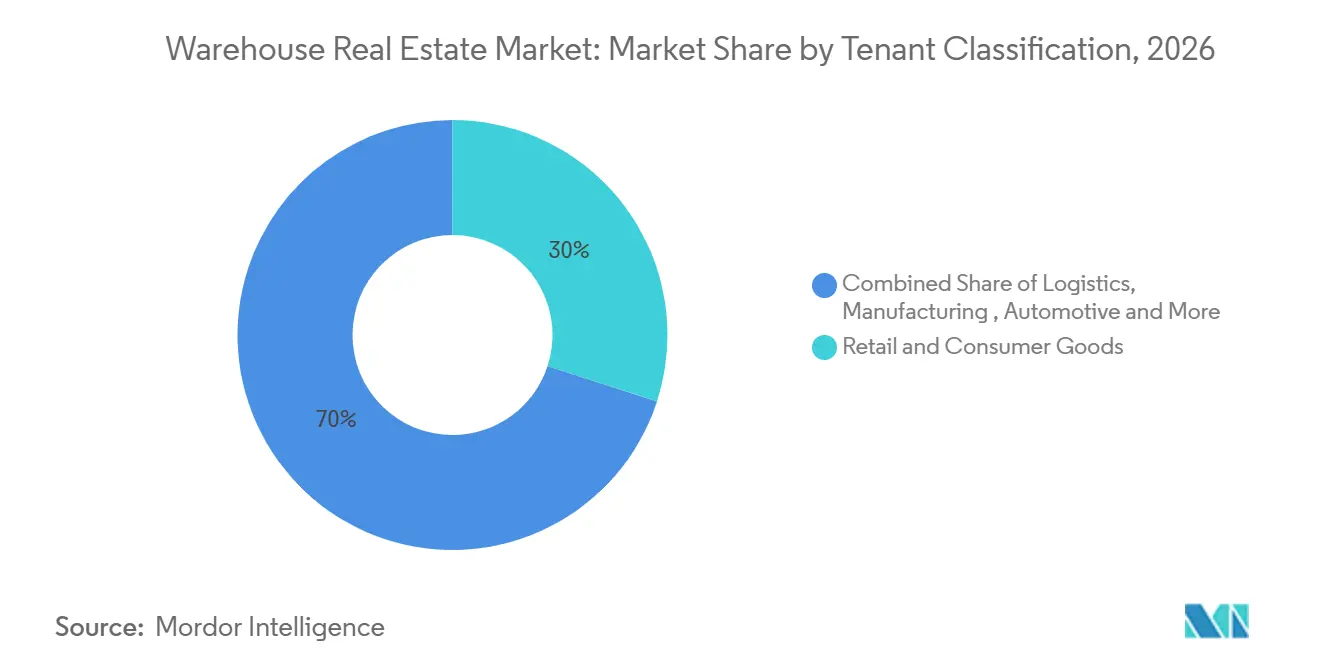
- By tenant classification, retail and consumer goods held a 30.00% share in 2026, while pharmaceuticals and healthcare are forecast to expand at a 7.60% CAGR through 2032.
- By geography, North America held a 46.00% share in 2026, while the Middle East and Africa are forecast to expand at a 7.90% CAGR through 2032.
Note: Market numbers in this report are based on Mordor Intelligence's proprietary estimation framework, which combines nine months of actuals with Q4 projections for base year 2026.
Market Trends and Insights
Drivers Impact Analysis of Warehouse Real Estate Market*
| Drivers | (~) % Impact on CAGR Forecast | Geographic Relevance | Impact Timeline |
|---|---|---|---|
| E-Commerce, Omnichannel Retail, and Inventory Decentralization | +2.5% | Global, led by North America, Asia-Pacific, and Europe | Short term (≤ 2 years) |
| Supply-Chain Regionalization, Nearshoring, and Reshoring | +1.8% | North America, Central and Eastern Europe, and India | Medium term (2-4 years) |
| Tenant Flight to Quality and High-Specification Space | +1.2% | Global, concentrated in North America and Europe | Medium term (2-4 years) |
| Cold-Chain, Pharmaceutical, and Food Logistics Expansion | +0.9% | North America, Europe, and the Middle East | Medium term (2-4 years) |
| Urban Land Scarcity and Last-Mile Delivery Requirements | +0.8% | Dense metropolitan areas globally, Asia-Pacific, and European gateway cities | Long term (≥ 4 years) |
| Data Center, Semiconductor, and Advanced Manufacturing Supply Chains | +0.5% | North America, India, and South Korea | Long term (≥ 4 years) |
| Source: Mordor Intelligence | |||
E-Commerce, Omnichannel Retail, and Inventory Decentralization
E-commerce remains a major source of leasing demand in the Warehouse real estate market because delivery expectations require inventory to be held closer to consumers. Online sales penetration is expected to reach 19.7% in 2026, while e-commerce companies are projected to account for nearly 25% of global new leasing that year[1]. Retailers have reduced occupied United States storefront space by 2.4% from the pre-pandemic period while expanding logistics footprints by 12%, which points to a lasting redistribution of space rather than a short-term response[2]. Facilities close to population centers are becoming more important because they can reduce delivery time and support higher order frequency. JD.com’s Joybuy marketplace launch in the United Kingdom, France, and Germany illustrates the push for next-day delivery capacity across European logistics corridors. The planned removal of the EUR 150 de minimis customs threshold in March 2028 is expected to encourage inventory positioning near Rotterdam, Antwerp-Bruges, and Hamburg before the rule takes effect.
Supply-Chain Regionalization, Nearshoring, and Reshoring
Supply-chain regionalization is broadening warehouse requirements beyond traditional import distribution. Manufacturers are building regional inventory buffers and creating logistics demand around semiconductor, electric vehicle, and clean-energy production sites, which brings suppliers, production sites, and warehouse space closer together[3]. Manufacturing represented 20% of new industrial leasing in the United States Southeast and Central regions in 2026, compared with 13% before the pandemic. The Warehouse real estate market is benefiting from shorter supply routes and production shifts toward Mexico, where the Monterrey and Nuevo León corridor links industrial activity with United States demand. Advanced manufacturing requires storage, inbound parts handling, and outbound distribution near production facilities, so its effect reaches beyond the factory itself. Labor shortages in positions that cannot be automated may spread leasing absorption across several years rather than concentrate it in a single cycle. This makes demand more gradual but can also make it more durable across regional logistics markets.
Tenant Flight to Quality and High-Specification Space
Tenant demand is moving toward facilities with stronger technical specifications because footprint alone no longer determines operating performance. Average United States lease sizes declined from 200,000 square feet to 160,000 square feet in 2025, as occupiers favored efficient and automation-compatible properties. Facilities built after 2010 with clear heights above 33 feet, stronger floor systems, and integrated tracking infrastructure can support more efficient operations. Construction of United States buildings larger than 750,000 square feet fell 85% from the pandemic peak, which is reducing the availability of large automation-ready space in key locations. The Warehouse real estate market is also seeing more tenant attention to Building Research Establishment Environmental Assessment Methodology, or BREEAM, and Leadership in Energy and Environmental Design, or LEED, standards. SEGRO identifies artificial intelligence, automation, and robotics as factors reshaping requirements for industrial properties, which adds value to facilities that can adapt to changing operating models.
Cold-Chain, Pharmaceutical, and Food Logistics Expansion
Cold-chain requirements are raising demand for specialized warehouse space in the Warehouse real estate market. DHL Group converted its Florstadt campus near Frankfurt into a 100,000 square meter European pharmaceutical hub in May 2025, with storage capacity down to minus 70 degrees Celsius. The project forms part of DHL Group’s USD 2.2 billion commitment through 2030 for health logistics, and it shows the scale of space and equipment required for regulated pharmaceutical handling. Movianto expanded cold-storage capacity in Germany and at its Aalst site in Belgium for 2026 operations. Good Distribution Practice and current Good Manufacturing Practice requirements create barriers for facilities handling medicines, which can limit competition from conventional warehouses. DP World announced a USD 53 million temperature-controlled hub beside Antwerp Gateway in August 2026 for healthcare, pharmaceutical, and perishable cargo.
Restraints Impact Analysis of Warehouse Real Estate Market*
| Restraints | (~) % Impact on CAGR Forecast | Geographic Relevance | Impact Timeline |
|---|---|---|---|
| Higher Interest Rates and Cost of Capital | -0.9% | Global, most acute in North America and Europe | Medium term (2-4 years) |
| Oversupply and Vacancy in Selected Secondary Markets | -0.7% | United States Sunbelt, Central and Eastern Europe, and selected Asia-Pacific metropolitan areas | Short term (≤ 2 years) |
| Limited Land, Power, and Transport Infrastructure | -0.5% | Dense metropolitan areas, European cities, and Asia-Pacific corridors | Long term (≥ 4 years) |
| Planning, Zoning, and Community Approval Delays | -0.4% | United States West Coast, Europe, and Indian urban centers | Long term (≥ 4 years) |
| Source: Mordor Intelligence | |||
Higher Interest Rates and Cost of Capital
Higher financing costs have reduced speculative development and reset property valuations in the Warehouse real estate market. Policy rates had fallen 175 basis points from their recent peak by 2026, while industrial capitalization rates remained above 2022 lows. United States construction starts in 2025 were 25% below the 2017 to 2019 average, and replacement-cost rents were 20% above Class A market rents. This gap discourages speculative construction in many locations because projected income may not justify higher financing and building costs. Higher debt service and tariffs on steel and aluminum can further increase the cost of delivering new Grade A facilities. The constraint is strongest outside supply-constrained gateway markets where rents do not fully support higher development costs.
Oversupply and Vacancy in Selected Secondary Markets
Vacancy pressure is concentrated in selected secondary locations rather than spread evenly across the sector. United States industrial vacancy reached 7.1% in the second quarter of 2025, with Austin at 18.20%, Phoenix at 13.3%, and Miami at 11.7%. The sharp variation between cities shows that local delivery pipelines and site quality continue to shape leasing conditions. Small-bay facilities in the United States South and Midwest retained vacancy below 4% and recorded 50% leasing growth. At the same time, Tokyo’s inner logistics areas saw vacancy decline as outer areas remained under pressure. Construction starts reached their slowest pace since the first quarter of 2015 in the second quarter of 2025. Lower starts may allow demand to absorb the remaining overhang in major consumption corridors by 2027.
*Our forecasts treat driver/restraint impacts as directional, not additive. The impact forecasts reflect baseline growth, mix effects, and variable interactions.
Warehouse Real Estate Market Segment Analysis
By Type:
Private Warehouses Lead While Specialized Assets ExpandPrivate warehouses held 44.00% of the warehouse real estate market share in 2026, reflecting the preference for dedicated facilities among retailers, manufacturers, and third-party logistics providers. These operators can configure proprietary automation and data systems when they control the full building. Dedicated space also helps tenants organize workflows around a single inventory model and service standard. Public warehouses remain useful for businesses entering new locations, handling seasonal volumes, or outsourcing noncore distribution. Shared facilities are particularly relevant in Asia-Pacific and the Middle East and Africa, where occupiers may expand gradually. This creates continued demand for both dedicated and multi-client formats.
The Others segment, which includes bonded warehouses, cross-docking terminals, and flex-industrial assets, is forecast to grow at a 6.80% CAGR through 2032. The planned European customs change supports interest in facilities that can process bulk inventory near Antwerp, Rotterdam, and Hamburg. Bonded storage can become more relevant as import flows are consolidated before they move to final markets. Cross-docking terminals also help retailers reduce handling time in regional distribution networks. Clarion Partners’ North 15 Logistics Center in North Las Vegas combines a private facility with AutoStore robotics and reduced delivery windows from 5 to 7 days to 2 to 3 days. Such projects show why operators value specialized layouts when delivery speed is a competitive requirement.

By Temperature Control:
General Warehouses Remain the Core Format as Refrigerated Capacity GrowsGeneral warehouses accounted for 68.00% of the warehouse real estate market size in 2026 because most retail, e-commerce, and manufacturing inventory does not need controlled temperatures. Ambient facilities provide the core storage capacity for consumer goods, industrial inputs, and standard distribution operations. Their broad customer base supports their large share of total warehouse demand. General warehouses also serve a wide mix of tenants in both mature and developing logistics locations. This breadth makes the segment less dependent on any one end-use sector. It remains the essential format for large regional distribution networks.
Refrigerated warehouses are forecast to grow at a 6.20% CAGR through 2032 as pharmaceutical, food, and specialty chemical supply chains require reliable temperature control. These facilities may handle products ranging from biologics requiring minus 70 degrees Celsius to controlled-ambient nutraceutical products. Insulated panels, redundant refrigeration equipment, and backup power create higher construction and operating requirements than standard warehouses. DHL’s Florstadt project demonstrates the scale of investment entering pharmaceutical logistics. DP World announced a USD 53 million temperature-controlled hub beside its Antwerp Gateway terminal for pharmaceutical and perishable cargo. Good Distribution Practice and current Good Manufacturing Practice compliance make certified capacity harder to replace with conventional space.
By Grade:
Class A Assets Lead in Share and GrowthClass A assets held 54.00% of the warehouse real estate market share in 2026 and are expected to expand at a 7.80% CAGR through 2032. This position reflects tenants moving from older Class B and Class C buildings into modern facilities. Power capacity, clear height above 33 feet, and robotics-compatible floors have become major location criteria. Fully automated facilities can use 3 to 5 times the power of conventional 2024 buildings. Assets with these features can better support automation and high-throughput operations. The combination of share and growth reinforces Class A’s role in new leasing decisions.
Class B properties face a wider gap with newer facilities as tenants compare retrofit costs with the benefits of modern space. Smaller average lease requirements can favor compact Class A units over larger, less efficient layouts. Some Class C buildings may be repurposed or demolished, although sites with useful power access or locations may still be retained for light manufacturing. In Europe, premium occupiers increasingly seek strong environmental specifications as part of lease commitments. XPO’s planned build-to-suit warehouse at Prologis DIRFT III included Building Research Establishment Environmental Assessment Methodology Outstanding and Energy Performance Certificate A+ targets. This trend places further pressure on owners of older stock to fund upgrades or accept a more limited tenant base.
By Warehouse Size:
Large-Scale Facilities Lead While Small Nodes Grow FasterLarge-scale warehouses above 250,000 sq ft accounted for 41.00% of the warehouse real estate market size in 2026. E-commerce operators, grocery retailers, and third-party logistics providers use these sites to serve national or multi-region networks. Their scale supports consolidated inventory, automation investment, and high-volume distribution. These facilities remain central to regional supply chains and broad consumer delivery networks. They also serve manufacturing and food-service operators that require large handling capacity. Their leading share shows the continued importance of major distribution centers.
Small-scale warehouses below 50,000 sq ft are forecast to grow at an 8.20% CAGR through 2032, the highest rate among size categories. Same-day and next-day delivery requires inventory within 30 minutes of end consumers, which supports micro-warehouses and infill sites. Land scarcity makes this format more valuable in dense metropolitan areas. Medium-scale warehouses remain relevant for regional distributors, manufacturers, and food-service businesses. Their role is strengthened in areas where reshoring creates demand near new factories.
By Tenant Classification:
Retail Leads While Healthcare Expands FasterRetail and consumer goods tenants held 30.00% of the warehouse real estate market share in 2026, making them the largest occupier group. Their networks are shifting from centralized distribution toward regional hubs and smaller delivery nodes. Same-day delivery, click-and-collect, and direct-to-consumer services require inventory to be located closer to customers. These needs support a mix of major distribution centers and urban facilities. Retailers also need flexible capacity during seasonal peaks and new product launches. The segment therefore remains a core source of leasing demand across regions.
Pharmaceuticals and healthcare are forecast to grow at a 7.60% CAGR through 2032, supported by cold-chain investment, compliance needs, and wider biopharmaceutical production. DHL’s health logistics program and Movianto’s capacity additions show how operators are expanding pharmaceutical infrastructure. Manufacturing tenants are also increasing their presence in U.S. Central and Southeast markets as semiconductor and electric vehicle production draws suppliers into nearby logistics parks. Food and beverage occupiers are important users of refrigerated capacity as online grocery and prepared-food distribution expand. Logistics providers continue to grow their leased footprints as businesses use external partners to manage flexible fulfillment capacity. Defense and public-sector users add specialized demand in several European locations as governments expand logistics infrastructure.
Geography Analysis
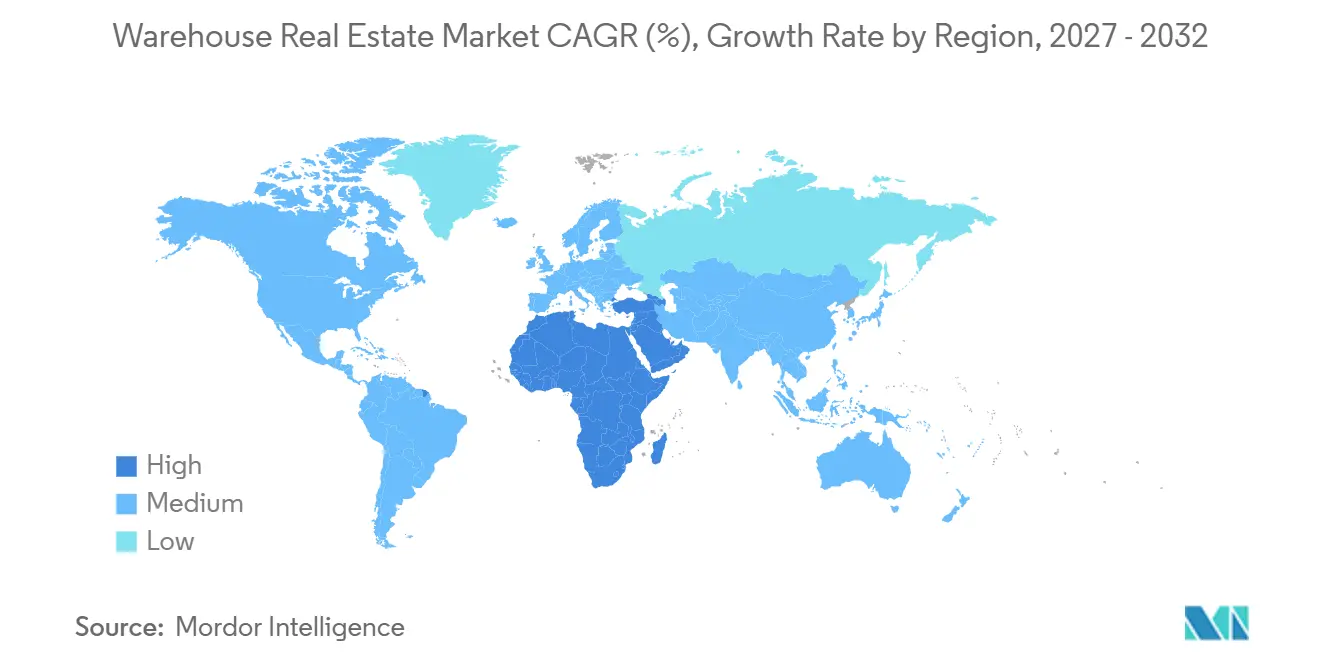
North America held 46.00% of the warehouse real estate market share in 2026, supported by a mature real estate investment trust structure and deep institutional capital. U.S. warehouse utilization reached 84% to 85% through the third quarter of 2025, close to the 85.5% level associated with expansionary leasing. This supports demand in gateway areas such as the Inland Empire and Northern New Jersey. Canada faces pressure from cross-border trade exposure, while Mexico benefits from manufacturing-linked demand in the Monterrey and Nuevo León corridor. New state proposals to limit logistics development near residential areas may further reduce available land in constrained U.S. gateway locations.
Europe remains a large institutional logistics area, with investment activity supported by supply constraints in key markets. The warehouse real estate market has benefited from demand in London, the Randstad, Lyon, Germany, France, and Poland. Europe’s vacancy was 6.1% in the second quarter of 2025, but well-located last-mile facilities continued to support rent growth. Asia-Pacific has a varied demand profile, with India’s online retail rate of 9.4% in 2025 below South Korea’s 27.7% and Taiwan’s 30.00%. Tokyo’s inner areas showed a stronger preference for well-located logistics facilities, while Brisbane faces tight industrial land availability.
The Middle East and Africa is forecast to grow at a 7.90% CAGR through 2032, the fastest regional rate in the warehouse real estate market. Saudi Arabia added more than 1.3 million sq m of warehouse space in the first half of 2025, but Riyadh occupancy reached 98%, showing the continuing shortage of high-quality stock. Blackstone and Lunate established the Gulf Logistics Infrastructure Development Enterprise platform, which targets USD 5 billion of Grade A logistics assets across the Gulf Cooperation Council. Brazil recorded 11.5% logistics rent growth in 2025 and 8.5% warehouse vacancy in the third quarter of 2025, while Mercado Libre continued to expand distribution capacity. South America offers targeted warehouse real estate market opportunities, although Argentina and Chile continue to face macroeconomic conditions that limit institutional activity. Sub-Saharan Africa is earlier in its institutional development, with Kenya approving its first dedicated industrial real estate investment trust in 2025.
Competitive Landscape
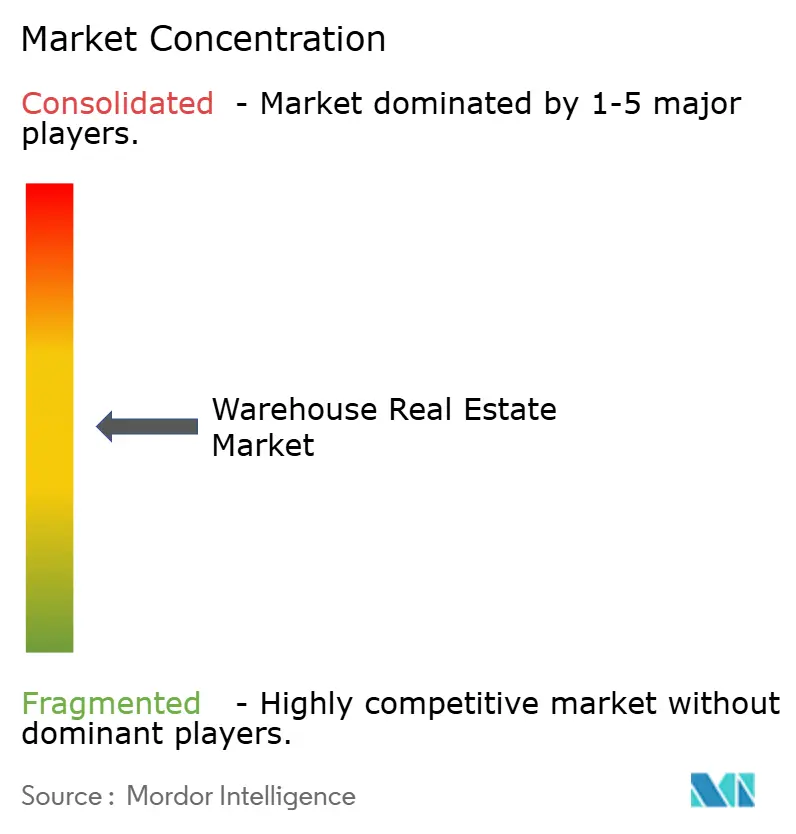
The Warehouse real estate market is moderately consolidated among large global logistics real estate investment trusts and private equity platforms. At the same time, national developers, family-owned parks, and opportunistic investors keep the wider field fragmented. Prologis operated around 1.3 billion square feet across 20 countries at the end of the third quarter of 2025. Blackstone describes itself as the largest private owner of logistics assets globally, with more than 1.2 billion square feet. The largest owners focus on gateway locations where limited land, power capacity, and development approvals constrain new supply.
Prologis announced a recommended acquisition of SEGRO in August 2026 for USD 18.8 billion. If completed, the transaction is expected to increase Prologis’ European operating portfolio by 47% to 368 million square feet and its European land bank by 126%, with a combined 13 million square foot development pipeline. It would extend Prologis’ presence in a region where supply constraints support demand for modern space. Blackstone and Lunate’s GLIDE platform shows that platform formation is also extending into the Gulf Cooperation Council. Norges Bank Investment Management acquired a 45% interest in a 48-building United States logistics portfolio in January 2025, while Goodman retained a 55% interest and remained asset manager.
White-space opportunities remain in Gulf Cooperation Council and Indian markets where institutional Grade A supply is limited. Urban last-mile formats also offer potential where high land prices and zoning constraints restrict new supply. Power-ready buildings that can support logistics and data-center uses create another competitive area, and Prologis, Goodman Group, and ESR Group are pursuing dual-use platforms on industrial land. ESR secured approval for a five-building, 24-hour warehouse complex with multi-level capability at its Huntingwood logistics estate in Sydney. Movianto’s TAPA-certified expansion in Aalst used full fencing, video surveillance, and access controls for pharmaceutical logistics.
Warehouse Real Estate Industry Leaders
-
Prologis, Inc.
-
Goodman Group
-
GLP Pte. Ltd.
-
Blackstone Real Estate
-
ESR Group Limited
- *Disclaimer: Major Players sorted in no particular order
Warehouse Real Estate Market Companies Covered in this Report
- Prologis, Inc.
- Goodman Group
- GLP Pte. Ltd.
- Blackstone Real Estate
- ESR Group Limited
- SEGRO plc
- Mapletree Investments Pte Ltd
- Panattoni Development Company, Inc.
- CapitaLand Investment Limited
- Brookfield Properties
- Frasers Property Limited
- P3 Logistic Parks
- CBRE Group, Inc.
- Cushman & Wakefield plc
- Colliers International Group Inc.
- Hines
- Macquarie Group Limited
- AEW Capital Management, L.P.
- First Industrial Realty Trust, Inc.
- STAG Industrial, Inc.
- EastGroup Properties, Inc.
- Rexford Industrial Realty, Inc.
- Link Logistics Real Estate
- Americold Realty Trust, Inc.
Recent Industry Developments in Warehouse Real Estate Market
- August 2026: Prologis announced a recommended acquisition of SEGRO plc, valued at USD 18.8 billion, to be effected through a scheme of arrangement. The combination is expected to expand Prologis' European operating portfolio by 47% to 368 million square feet, increase its European land bank by 126%, and create a combined development pipeline of 13 million square feet, with completion anticipated in H1 2027, subject to regulatory approvals.
- August 2026: DP World, in partnership with Montea and Maatschappij Linkerscheldeoever, announced a USD 53 million initial investment to develop a temperature-controlled logistics hub on an 83,000 square meter site adjacent to DP World’s Antwerp Gateway terminal. The facility is designed primarily for pharmaceutical and perishable cargo and is planned for completion in the second quarter of 2028.
- May 2026: EQT Real Estate agreed to acquire a 70% interest in a portfolio of 12 Americold cold-storage facilities totaling 124 million cubic feet of storage for USD 1.1 billion. Americold retained a 30% equity interest and continues as day-to-day manager.
Global Warehouse Real Estate Market Report Scope
Segmentation Overview
| Public |
| Private |
| Others |
| General Warehouse |
| Refrigerated Warehouse |
| Class A |
| Class B |
| Class C |
| Small-Scale Warehouses (Under 50,000 sq ft) |
| Medium-Scale Warehouses (50,000-250,000 sq ft) |
| Large-Scale Warehouses (Above 250,000 sq ft) |
| Manufacturing |
| Retail and Consumer Goods |
| Food and Beverage |
| Pharmaceuticals and Healthcare |
| Logistics |
| Other End Users |
| North America | United States |
| Canada | |
| Mexico | |
| Europe | Germany |
| United Kingdom | |
| France | |
| Italy | |
| Spain | |
| Rest of Europe | |
| Asia-Pacific | China |
| India | |
| Japan | |
| South Korea | |
| Australia | |
| Rest of Asia-Pacific | |
| South America | Brazil |
| Argentina | |
| Chile | |
| Rest of South America | |
| Middle East & Africa | United Arab Emirates |
| Saudi Arabia | |
| South Africa | |
| Nigeria | |
| Rest of Middle East & Africa |
| By Type | Public | |
| Private | ||
| Others | ||
| By Temperature Control | General Warehouse | |
| Refrigerated Warehouse | ||
| By Grade | Class A | |
| Class B | ||
| Class C | ||
| By Warehouse Size | Small-Scale Warehouses (Under 50,000 sq ft) | |
| Medium-Scale Warehouses (50,000-250,000 sq ft) | ||
| Large-Scale Warehouses (Above 250,000 sq ft) | ||
| By Tenant Classification | Manufacturing | |
| Retail and Consumer Goods | ||
| Food and Beverage | ||
| Pharmaceuticals and Healthcare | ||
| Logistics | ||
| Other End Users | ||
| By Region | North America | United States |
| Canada | ||
| Mexico | ||
| Europe | Germany | |
| United Kingdom | ||
| France | ||
| Italy | ||
| Spain | ||
| Rest of Europe | ||
| Asia-Pacific | China | |
| India | ||
| Japan | ||
| South Korea | ||
| Australia | ||
| Rest of Asia-Pacific | ||
| South America | Brazil | |
| Argentina | ||
| Chile | ||
| Rest of South America | ||
| Middle East & Africa | United Arab Emirates | |
| Saudi Arabia | ||
| South Africa | ||
| Nigeria | ||
| Rest of Middle East & Africa | ||
Key Questions Answered in the Report
What is the projected value of warehouse real estate by 2032?
The warehouse real estate market is projected to reach USD 393.23 billion by 2032, expanding at a 5.80% CAGR from 2027.
Which warehouse format holds the largest share?
Private warehouses lead the warehouse real estate market by type with a 44.00% share in 2026.
Which segment is expected to grow the fastest?
Small-scale warehouses in the warehouse real estate market are forecast to grow at an 8.20% CAGR through 2032.
Why are Class A facilities gaining demand?
Warehouse real estate market tenants need modern buildings with adequate power, clear height, and automation-ready specifications.
Which region leads global demand?
North America is the largest regional segment in the warehouse real estate market, with a 46.00% share in 2026.
What is driving demand for refrigerated facilities?
In the warehouse real estate market, pharmaceutical compliance, food distribution, and cold-chain expansion are supporting a 6.20% forecast CAGR through 2032.