
Warehouse Racking Market Size and Share
Market Overview
| Study Period | 2022 - 2032 |
|---|---|
| Market Size (2027) | USD 10.76 Billion |
| Market Size (2032) | USD 14.02 Billion |
| Growth Rate (2027 - 2032) | 5.43 % |
| Fastest Growing Market | Asia-Pacific |
| Largest Market | North America |
| Market Concentration | Medium |
Major Players *Disclaimer: Major Players sorted in no particular order Image © Mordor Intelligence. Reuse requires attribution under CC BY 4.0. | |
Warehouse Racking Market Analysis by Mordor Intelligence
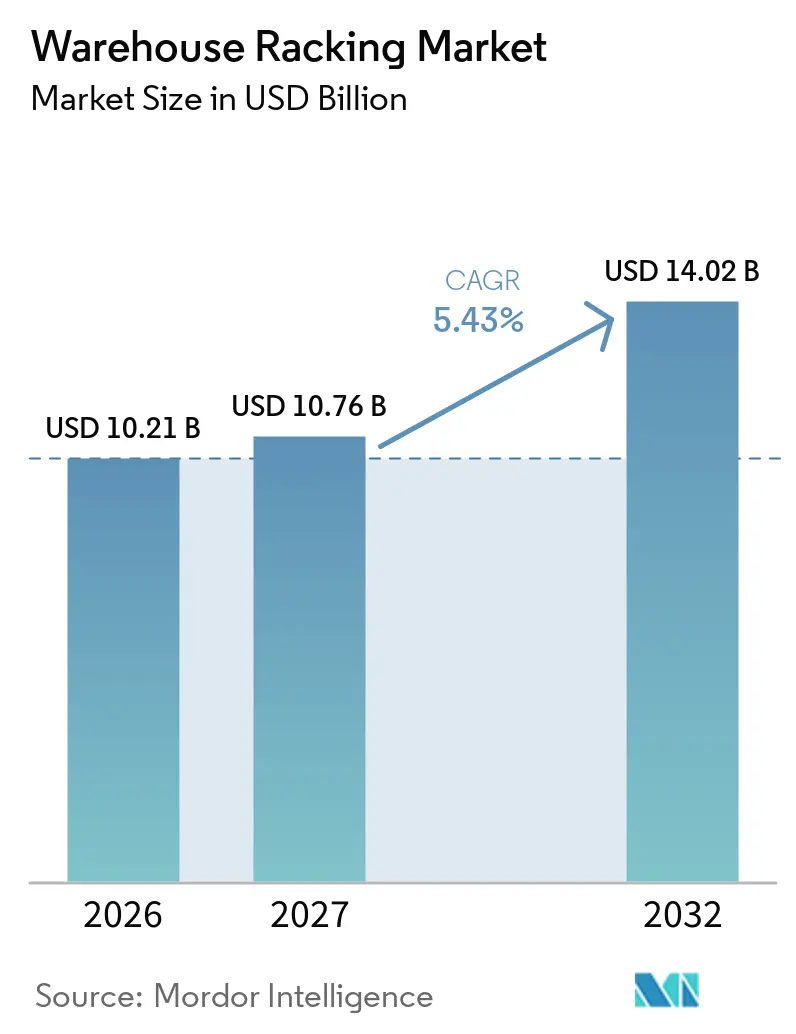
The warehouse racking market size was valued at USD 10.21 billion in 2026 and is estimated to grow from USD 10.76 billion in 2027 to USD 14.02 billion by 2032, at a CAGR of 5.43% during the forecast period (2027-2032). E-commerce fulfillment networks, pharmaceutical cold storage, and warehouse modernization in South and Southeast Asia are driving demand for storage systems capable of handling faster inventory movement. The warehouse racking market is moving toward systems that integrate with automated fulfillment equipment, making engineering capability increasingly important in supplier selection. Steel costs and the capital required for automation can delay individual projects, although they do not reduce the need for additional storage capacity. Suppliers that combine flexible layouts with a practical path toward automation can address demand from both new facilities and established distribution centers. These conditions are keeping the warehouse racking market focused on adaptable, high-density, and automation-ready designs.
Key Report Takeaways
- By racking type, Adjustable Pallet Racking held 45.13% of the warehouse racking market share in 2026 and is projected to grow at a 6.13% CAGR through 2032.
- By vertical, Retail and E-commerce held 35.78% of the warehouse racking market share in 2026, while Pharmaceutical and Healthcare are forecast to grow at a 7.05% CAGR through 2032.
- By system, Static Racking Systems held 52.61% of warehouse racking market share in 2026, while Automated Racking Systems are forecast to grow at a 6.74% CAGR through 2032.
- By geography, North America held 36.26% of the warehouse racking market share in 2026, while Asia-Pacific is forecast to grow at a 6.52% CAGR through 2032.
Note: Market numbers in this report are based on Mordor Intelligence's proprietary estimation framework, which combines nine months of actuals with Q4 projections for base year 2026.
Global Warehouse Racking Market Trends and Insights
Drivers Impact Analysis*
| Drivers | (~) % Impact on CAGR Forecast | Geographic Relevance | Impact Timeline |
|---|---|---|---|
| E-commerce Fulfillment Expansion | +1.5% | Global, concentrated in North America, Western Europe, and Asia-Pacific (APAC) core | Short term (≤ 2 years) |
| Warehouse Automation and Automated Storage and Retrieval Systems (AS/RS) Integration | +1.2% | North America, Germany, Japan, and South Korea | Medium term (2-4 years) |
| Vertical Space Optimization and Industrial Real Estate Costs | +0.8% | Coastal North America, Northern Europe, Singapore, and Greater Tokyo | Medium term (2-4 years) |
| Cold-Chain and Pharmaceutical Storage Expansion | +0.9% | Global, with early intensity in North America, Germany, Belgium, and India | Short term (≤ 2 years) |
| Modular and Reconfigurable Warehouse Layouts | +0.6% | North America and Europe, with spillover to the APAC core | Long term (≥ 4 years) |
| Source: Mordor Intelligence | |||
E-commerce Fulfillment Expansion
E-commerce growth is increasing demand for racking across a wider set of regional fulfillment nodes. The effect extends beyond additional floor space, as facilities also require layouts that support mixed inventories and rapid replenishment. Maersk opened a USD 100 million, 617,000-square-foot fulfillment hub in Hopedale, Massachusetts, in July 2026, with the capacity to process up to 330,000 units per day at peak demand[1]. These projects favor adjustable configurations over static storage because assortments and order patterns can change quickly. The warehouse racking market benefits when operators choose systems that support current manual processes and can accommodate future automation upgrades. The same need is evident in large omnichannel facilities, where storage equipment must support higher throughput without limiting future layout changes.
Warehouse Automation and AS/RS Integration
Automation is changing racking from a basic fabricated component into a precisely specified part of the warehouse system. Automated storage and retrieval systems require consistent dimensions, load distribution, and structural performance because cranes, shuttles, conveyors, and software operate around the rack structure. Swisslog installed six Vectura pallet stacker cranes at Lebkuchen-Schmidt's distribution center in Nuremberg in June 2026, together with an AutoStore system containing 17,000 bins. Such installations make automation experience and engineering credentials more important in competitive bids. The warehouse racking market is therefore placing greater value on suppliers that can deliver compatible structures and coordinate with broader material-handling systems. Requirements under the Rack Manufacturers Institute (RMI) and European standards further increase the importance of technical qualification for automation-led projects.
Cold-Chain and Pharmaceutical Storage Expansion
Pharmaceutical supply chains require dense, temperature-controlled storage that meets strict operating conditions. These projects favor suppliers that can provide corrosion protection, suitable steel grades, and layouts compatible with traceability and temperature-management systems. Movianto opened a 30,000-square-meter pharmaceutical cold-storage facility in Wiesloch, Germany, in September 2026, with 10,000 pallet positions at 2°C to 8°C and 2,400 positions at -20°C to -26°C. The facility also includes planned ultra-low-temperature capacity, reinforcing the need for specialized storage infrastructure. This demand supports a more protected position for certified racking suppliers, as conventional ambient-grade systems may not meet the required conditions. Pharmaceutical investment is consequently supporting the warehouse racking market in locations with established life sciences production and distribution networks.
Vertical Space Optimization and Industrial Real Estate Costs
High land and building costs are leading warehouse operators to use more vertical space. High-bay systems can increase storage capacity within an existing footprint and reduce the need to secure additional floor area. Mitsui O.S.K. Lines is co-investing in OMEGA 1 in Singapore, a five-story automated logistics facility totaling 71,000 square meters, with a 40-meter-high built-in automated storage and retrieval system (AS/RS) accessible from all floors. The project is scheduled for completion in 2028 at an estimated cost of SGD 260 million, equivalent to USD 195 million at the stated 2026 rate. The warehouse racking market is benefiting from this approach because high-bay facilities require rack structures designed to work with cranes and other automated equipment. Dense urban logistics markets in North America, Europe, Singapore, and Japan are likely to remain important locations for these systems.
Restraints Impact Analysis*
| Restraints | (~) % Impact on CAGR Forecast | Geographic Relevance | Impact Timeline |
|---|---|---|---|
| High Upfront Cost and Financing Constraints | -1.1% | Global, with the highest intensity in South America, MEA, and emerging APAC markets | Medium term (2-4 years) |
| Steel Price and Engineered-Project Cost Volatility | -0.9% | Global, most acute in North America and import-dependent manufacturing markets | Short term (≤ 2 years) |
| Retrofit Complexity in Existing Buildings | -0.6% | Europe, Japan, and established North American urban corridors | Long term (≥ 4 years) |
| Source: Mordor Intelligence | |||
High Upfront Cost and Financing Constraints
Full warehouse automation requires substantial initial investment in structural racking, handling equipment, software, installation, and facility preparation. This can be difficult for mid-sized third-party logistics providers and regional manufacturers that cannot commit capital to a complete automated system. As a result, many operators prefer staged projects that introduce part of the storage or automation system first. This approach preserves investment flexibility but can reduce the immediate density and throughput gains that support the original business case. Borrowing costs, which remain higher than those seen in 2020 and 2021, continue to lengthen approval cycles in North America and Europe. The warehouse racking market can still serve these customers through modular systems, although orders may be smaller and project decisions may take longer.
Steel Price and Engineered-Project Cost Volatility
Steel is the primary material used in warehouse racking, so price changes affect project budgets and supplier margins. US hot-rolled coil prices rose 22.0% from December 2025 to August 2026, while Section 232 tariffs created a higher cost floor for many steel imports from June 2025[2]. A project priced before a material cost increase may require new bids or delayed procurement. Buyers may defer a project even when the underlying need for capacity persists. Suppliers with stable procurement arrangements can reduce some uncertainty for their customers and may improve their position in tenders. Cost volatility, therefore, affects the timing of orders more directly than the long-term demand for racking systems.
*Our forecasts treat driver/restraint impacts as directional, not additive. The impact forecasts reflect baseline growth, mix effects, and variable interactions.
Segment Analysis
By Racking Type: Adjustable Pallet Racking Leads on Scale and Growth
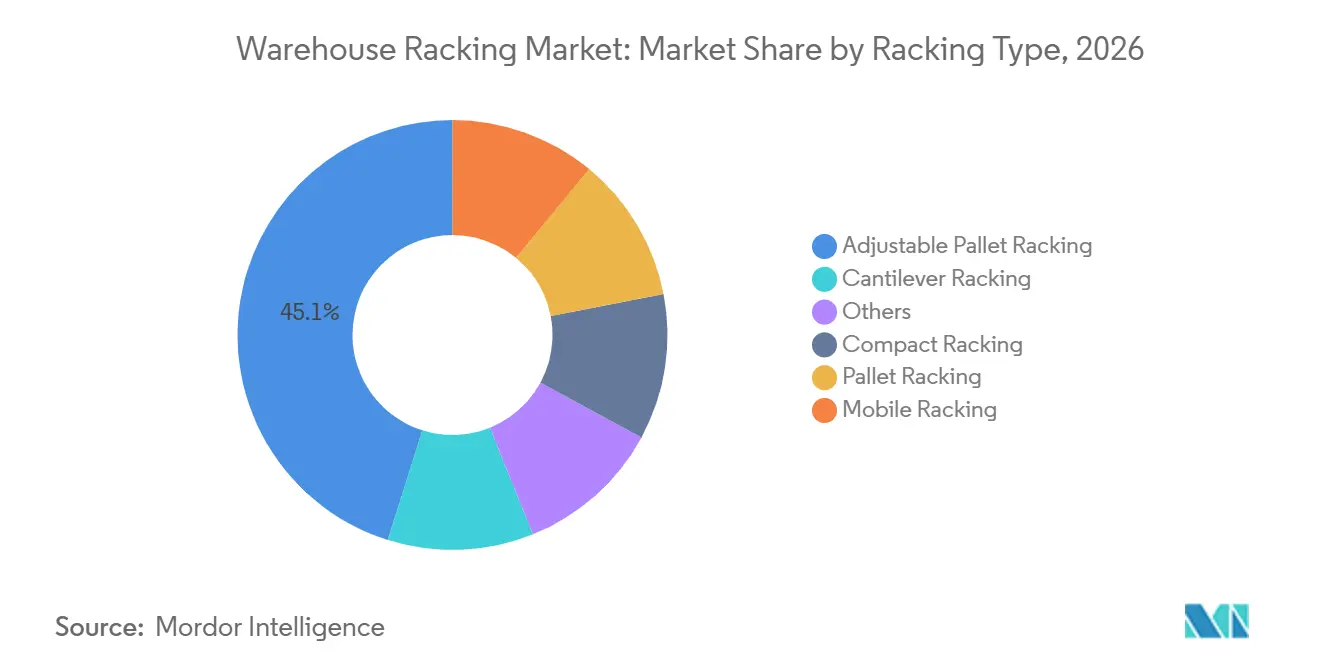
Adjustable Pallet Racking held 45.13% of the warehouse racking market share in 2026 and is projected to grow at a 6.13% CAGR through 2032. It is both the largest racking type and the fastest-growing category in the segmentation. Its position reflects the need for layouts that can be revised when product mixes, pallet dimensions, and fulfillment methods change. Retailers and e-commerce operators can use adjustable bays to accommodate varied inventory without replacing the entire rack structure. The format can also serve as a practical starting point for later integration with shuttles or autonomous mobile robots. This flexibility makes it suitable for facilities that want to control initial spending while retaining an upgrade path.
Compact Racking is relevant in cold-chain and fast-moving consumer goods facilities where storage density is a central requirement. Conventional Pallet Racking remains widely used in manufacturing and general merchandise because it is compatible with standard forklift operations and has a lower initial cost. Mobile Racking can reduce fixed aisle space and is particularly useful where refrigerated cubic space is expensive to operate. Cantilever Racking remains important for building materials, lumber, pipes, and other products that do not fit palletized storage. Mecalux introduced modular high-density storage racks for e-commerce fulfillment centers in 2025, reflecting the ongoing shift toward systems that combine density with adaptability. The warehouse racking market will continue to use multiple racking types because cargo forms, inventory velocities, and operating temperatures vary widely across end users.

By Vertical: Pharmaceutical Growth Complements Retail and E-commerce Scale
Retail and E-commerce held 35.78% of the warehouse racking market share in 2026, while Pharmaceutical and Healthcare are expected to expand at a 7.05% CAGR through 2032. Retail and e-commerce remain the largest vertical because fulfillment centers require storage for broad product ranges and frequent order processing. This vertical is investing in both new distribution centers and upgrades to older sites serving omnichannel networks. The pharmaceutical and healthcare segments are growing faster because biologics, biosimilars, and temperature-sensitive medical products require specialized storage. Procurement decisions in these segments are shaped by Good Distribution Practice requirements and operating conditions, rather than by purchase price alone. This creates demand for suppliers capable of documenting structural and temperature-related performance.
Vetter Pharma announced an investment of more than EUR 150 million (USD 165 million) to expand its Ravensburg warehouse. The project adds 16,000 pallet spaces, bringing the company's cool-storage pallet capacity to 68,000. Manufacturing remains a steady source of demand for buffer storage and finished-goods handling across the automotive, electronics, and industrial goods sectors. Food and Beverages require racking that can operate in humidity-controlled and cold environments, creating some overlap with pharmaceutical specifications. Other applications include data center support, warehousing, agricultural storage, and retail backroom storage. Across these verticals, the warehouse racking market must balance commodity storage requirements with increasingly specialized applications.
By System: Static Systems Lead, While Automated Systems Accelerate
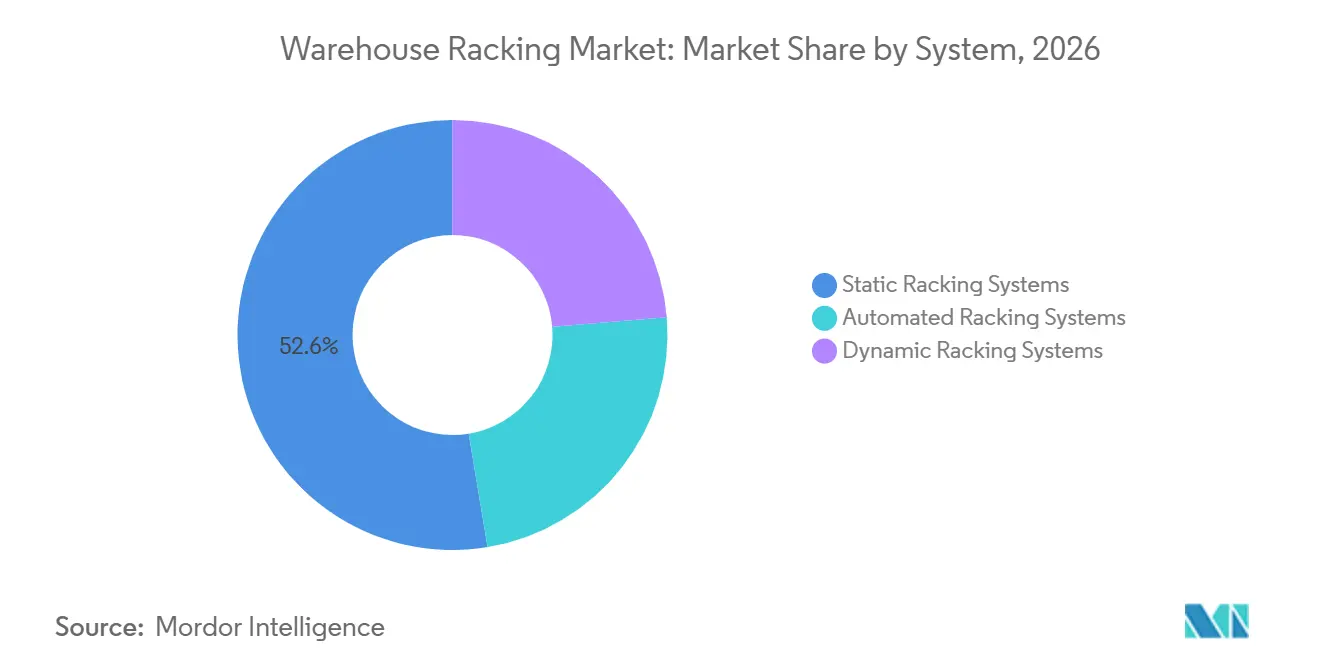
Static Racking Systems held 52.61% of the warehouse racking market share in 2026, while Automated Racking Systems are forecast to grow at a 6.74% CAGR through 2032. Static systems remain the largest category because the installed base has a long service life, commonly 15 to 25 years. Existing racks do not need to be replaced quickly, even as new facilities adopt more automation. This difference between the large installed base and new investment activity explains why static systems retain the leading share. Newer projects are increasingly designed around automated movement, storage density, and labor management. The warehouse racking market size for Automated Racking Systems is supported by projects that combine structural engineering with equipment and software.
Kardex is implementing an automated logistics center for Haberkorn that includes a 5,388-pallet high-bay warehouse and an AutoStore system with up to 178,800 bins. This illustrates the scale at which structural storage and warehouse automation are being combined. Dynamic Racking Systems support first-in, first-out handling via gravity or mechanical conveyors and are relevant to food, beverages, and pharmaceuticals. These applications may require reliable expiration-date sequencing, making storage flow a compliance issue as well as an operational preference. Rack Manufacturers Institute (RMI) standards in North America and EN 15620 in Europe set the technical requirements for automation-integrated systems. The result is a broader gap between suppliers that can engineer complete automated installations and those focused on standard racks.
Geography Analysis
North America accounted for 36.26% of the warehouse racking market share in 2026, supported by established logistics networks and continued investment by retailers, third-party logistics providers, and pharmaceutical operators. The United States has a dense fulfillment network that is being upgraded through high-bay, automated, and cold-chain projects. Langham Logistics opened a 320,000-square-foot pharmaceutical cold-chain facility in Plainfield, Indiana, with more than 46,000 pallet positions. These facilities require racking that performs in low-temperature environments and meets strict handling conditions. Canada contributes through the expansion of third-party logistics, while Mexico is attracting warehouse demand from nearshoring in the automotive, electronics, and consumer goods sectors. North America's established project base provides opportunities for integrators and regional manufacturers across both replacement and new-build work.
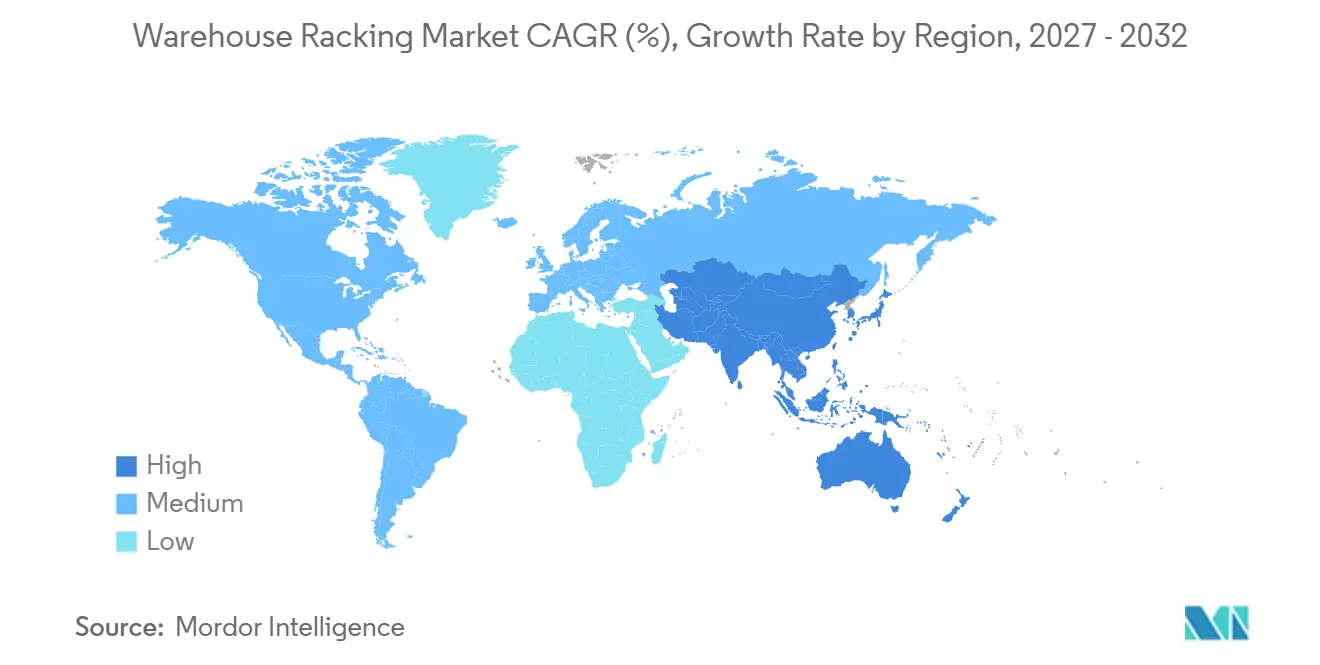
Asia-Pacific is projected to grow at a CAGR of 6.52% through 2032, the fastest rate among all geographic segments. India, ASEAN markets, China, and Japan are modernizing logistics capacity to serve e-commerce, food retail, manufacturing, and healthcare distribution. Gonvarri Material Handling and RINAC India established Constructor RINAC Pvt. Ltd. in August 2024 to supply pallet racking and automated storage solutions for India's e-commerce, food, pharmaceutical, and manufacturing sectors. This partnership demonstrates how global suppliers are using local operations to address regional requirements and shorter delivery expectations. Japan is also attracting capital for logistics facilities in Greater Tokyo, Greater Osaka, and Nagoya, where high-density storage is a priority. The warehouse racking market size in Asia-Pacific will depend on how quickly these markets convert expanding logistics demand into modern, automated warehouse capacity.
Europe has a large but fragmented installed base and faces a more complex retrofit environment in older urban facilities. EN 15620 requirements and Good Distribution Practice (GDP) standards raise the technical threshold for racking used in pharmaceutical, food, and cold-chain applications. Maersk opened a 72,000-square-meter logistics center in Herleshausen, Germany, in September 2024, featuring 12-meter-high racks across more than 62,000 square meters of storage. Italy, the UK, France, Germany, and the Nordic countries remain key markets for selective modernization. South America, the Middle East, and Africa represent earlier-stage demand, but e-commerce growth, agri-logistics, and large new distribution parks are supporting project activity. Kardex is scheduled to bring South Africa's first AutoStore system at Goldwagen's Centurion Distribution Center online in the fourth quarter of 2024.
Competitive Landscape
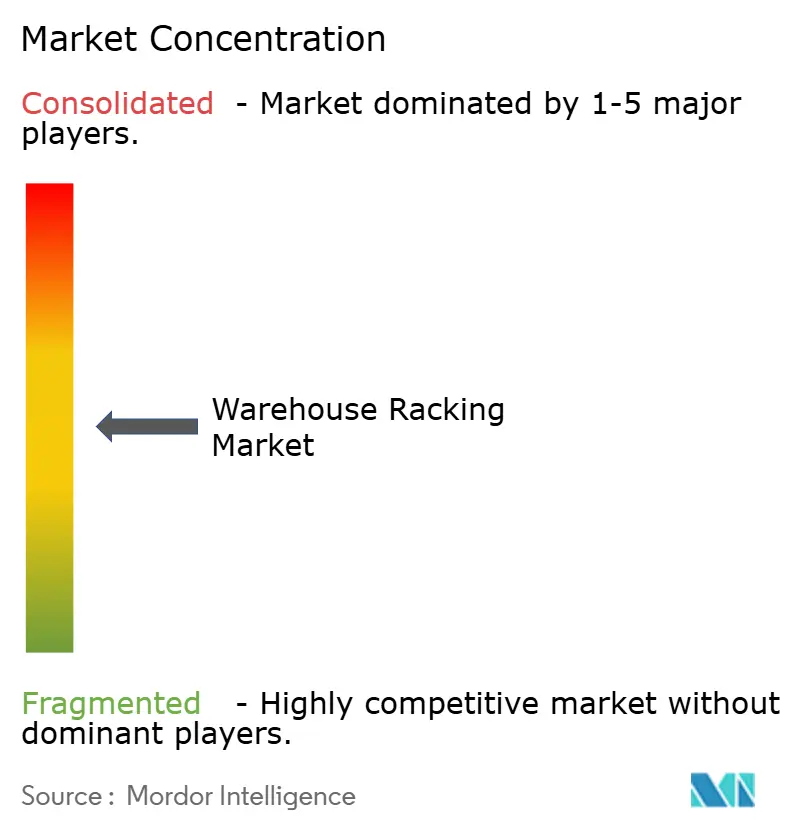
The warehouse racking market is moderately fragmented, with integrated global suppliers competing against regional specialists and automation-focused vendors. Mecalux, SSI SCHAEFER, Kardex, Jungheinrich, and KION Group compete on projects requiring structural racking, automated handling equipment, controls, and software. Their advantage lies in managing integrated projects through a single engineering and delivery structure. Jungheinrich expects 2026 revenue of EUR 5.2 billion to EUR 5.8 billion (USD 5.7 billion to USD 6.4 billion), illustrating the scale at which large intralogistics providers operate. In large tenders, the ability to coordinate storage, automation, and software is becoming as important as rack price, shifting the competitive landscape toward suppliers with stronger project-execution capabilities.
A significant opportunity remains in mid-sized facilities with 5,000 to 15,000 pallet positions. These operators often require density improvements and partial automation but may not be ready for a full Automated Storage and Retrieval System (AS/RS) installation. Modular high-bay systems and pallet shuttles can offer these facilities a staged path to automation. SSI SCHAEFER's project at Liebherr's Tupelo, Mississippi, facility combines a 39,700-pallet high-bay warehouse, more than 450 SSI Flexi Shuttles, and conventional pallet and cantilever racking. This project demonstrates how tier-1 suppliers are combining multiple storage formats to address different product and workflow requirements. Such bundled projects make it more difficult for single-product suppliers to compete for large integrated contracts.
Gonvarri Material Handling acquired a majority stake in Spanish engineering firms AEI and TGR in July 2026, expanding its design, fabrication, and installation capabilities. This type of acquisition can help suppliers protect margins on standard racking projects by increasing control over the delivery process. Regional firms, including Ridg-U-Rak, Steel King, and NEDCON, remain competitive in domestic tenders where manufacturing proximity, lead times, and responsive project management are prioritized over full automation integration. Their position is strongest where standard selective racks remain the primary requirement. The competitive structure, therefore, includes large integrators for complex projects and regional specialists for cost-sensitive or time-sensitive installations. The warehouse racking market accommodates both groups, as customer needs range from standard storage systems to highly automated distribution facilities.
Warehouse Racking Industry Leaders
-
Daifuku Co., Ltd.
-
SSI SCHAEFER Group
-
Mecalux, S.A.
-
KION GROUP AG
-
Jungheinrich AG
- *Disclaimer: Major Players sorted in no particular order
Recent Industry Developments
- September 2026: Maersk is scheduled to launch operations at its 72,000-square-meter logistics center in Herleshausen, Germany, featuring 12-meter-high racks across over 62,000 square meters of storage space, serving a major online retailer. The facility adds high-bay warehouse racking capacity to Maersk's European contract logistics network and is expected to employ up to 1,000 staff at peak.
- August 2026: Gonvarri Material Handling and RINAC India established Constructor RINAC Pvt. Ltd., a joint venture to deliver pallet racking and automated storage solutions across e-commerce, food, pharmaceutical, and manufacturing verticals in India. The venture targets India's intralogistics market, where rising land costs are driving demand for high-density warehouse racking solutions.
Global Warehouse Racking Market Report Scope
Warehouse racking is an engineered metal framework of vertical upright frames and horizontal load beams designed to store goods on multiple levels above the ground. It converts vertical air space into high-density storage for raw materials, parts, or finished inventory.
The warehouse racking market is segmented by racking type, vertical, system, and geography. By racking type, the market is segmented into adjustable pallet racking, compact racking, pallet racking, mobile racking, cantilever racking, and others. By vertical, the market is segmented into retail and e-commerce, manufacturing, food and beverages, pharmaceutical and healthcare, and others. By system, the market is segmented into static racking systems, dynamic racking systems, and automated racking systems. The report also covers the market size and forecasts for warehouse racking in 15 countries across major regions. The market sizes and forecasts are provided in terms of value (USD).
| Adjustable Pallet Racking |
| Compact Racking |
| Pallet Racking |
| Mobile Racking |
| Cantilever Racking |
| Others |
| Retail and E-commerce |
| Manufacturing |
| Food and Beverages |
| Pharmaceutical and Healthcare |
| Others |
| Static Racking Systems |
| Dynamic Racking Systems |
| Automated Racking Systems |
| Asia-Pacific | China |
| India | |
| Japan | |
| South Korea | |
| ASEAN Countries | |
| Rest of Asia-Pacific | |
| North America | United States |
| Canada | |
| Mexico | |
| Europe | Germany |
| United Kingdom | |
| France | |
| Italy | |
| NORDIC Countries | |
| Rest of Europe | |
| South America | Brazil |
| Argentina | |
| Rest of South America | |
| Middle East and Africa | Saudi Arabia |
| South Africa | |
| Rest of Middle East and Africa |
| By Racking Type | Adjustable Pallet Racking | |
| Compact Racking | ||
| Pallet Racking | ||
| Mobile Racking | ||
| Cantilever Racking | ||
| Others | ||
| By Vertical | Retail and E-commerce | |
| Manufacturing | ||
| Food and Beverages | ||
| Pharmaceutical and Healthcare | ||
| Others | ||
| By System | Static Racking Systems | |
| Dynamic Racking Systems | ||
| Automated Racking Systems | ||
| By Geography | Asia-Pacific | China |
| India | ||
| Japan | ||
| South Korea | ||
| ASEAN Countries | ||
| Rest of Asia-Pacific | ||
| North America | United States | |
| Canada | ||
| Mexico | ||
| Europe | Germany | |
| United Kingdom | ||
| France | ||
| Italy | ||
| NORDIC Countries | ||
| Rest of Europe | ||
| South America | Brazil | |
| Argentina | ||
| Rest of South America | ||
| Middle East and Africa | Saudi Arabia | |
| South Africa | ||
| Rest of Middle East and Africa | ||
Key Questions Answered in the Report
What is current market size of Warehouse Racking Market?
The warehouse racking market size was valued at USD 10.21 billion in 2026 and is estimated to grow from USD 10.76 billion in 2027 to USD 14.02 billion by 2032, at a CAGR of 5.43% during the forecast period (2027-2032).
Which racking type is expected to grow the fastest?
Adjustable Pallet Racking is the leading racking type and is forecast to expand at a 6.13% CAGR through 2032.
Which end-use vertical has the fastest growth outlook?
The Pharmaceutical and Healthcare sector is forecast to record a 7.05% CAGR through 2032, supported by specialized cold-chain and regulated storage requirements.
Which region is expanding fastest for warehouse storage systems?
Asia-Pacific is forecast to grow at a 6.52% CAGR through 2032, supported by logistics modernization in India, ASEAN markets, China, and Japan.