
Virtual Classroom Market Size and Share
Market Overview
| Study Period | 2022 - 2032 |
|---|---|
| Market Size (2027) | USD 31.94 Billion |
| Market Size (2032) | USD 58.96 Billion |
| Growth Rate (2027 - 2032) | 13.04 % |
| Fastest Growing Market | Asia-Pacific |
| Largest Market | North America |
| Market Concentration | Low |
Major Players *Disclaimer: Major Players sorted in no particular order Image © Mordor Intelligence. Reuse requires attribution under CC BY 4.0. | |
Virtual Classroom Market Analysis by Mordor Intelligence
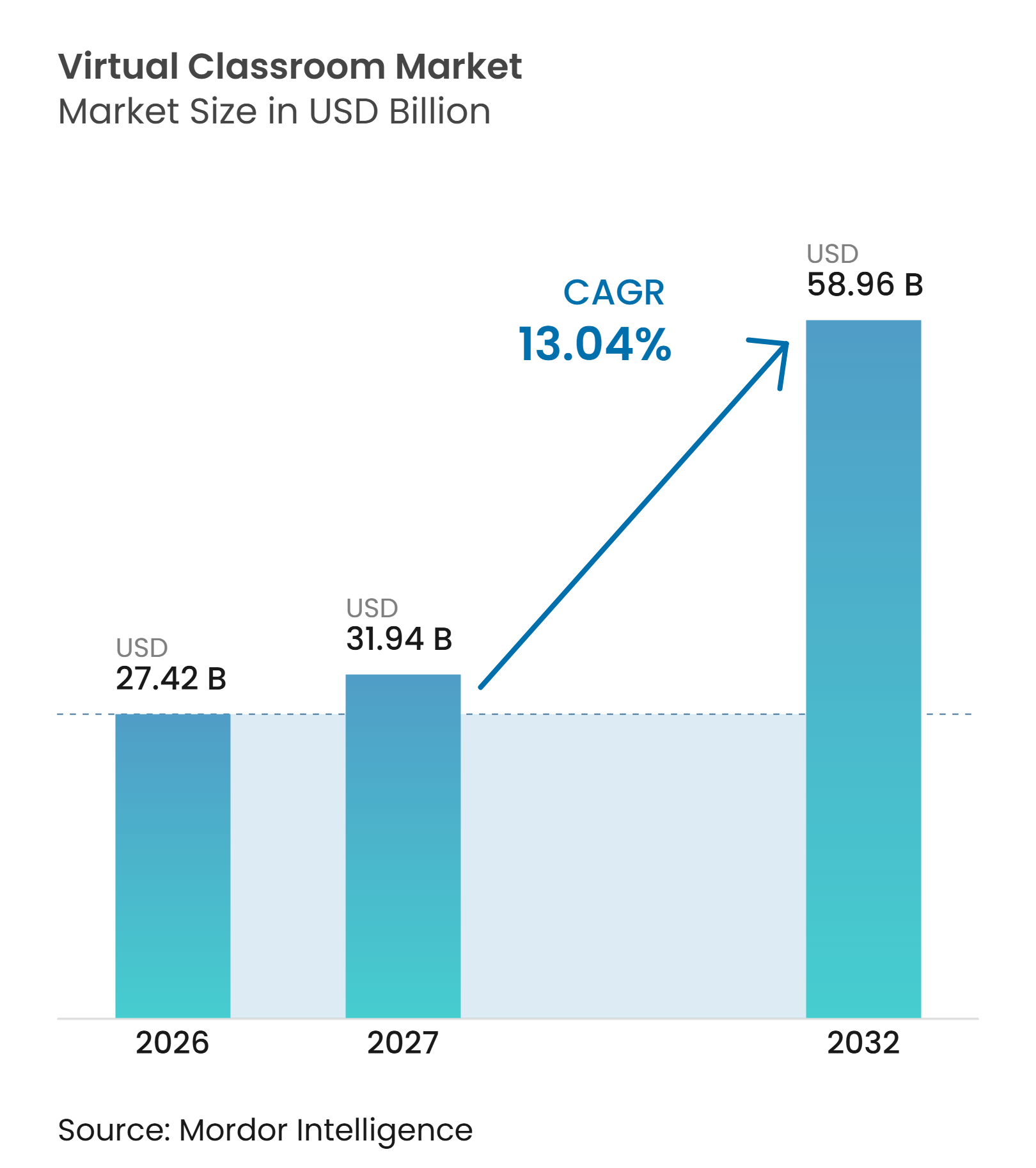
The virtual classroom market size was valued at USD 27.42 billion in 2026 and is estimated to grow from USD 31.94 billion in 2027 to reach USD 58.96 billion by 2032, at a CAGR of 13.04% during the forecast period 2027-2032. The continued use of hybrid teaching models, employer-led skills programs, and wider smartphone access in emerging economies supports the market. Artificial intelligence features are moving from optional tools to core procurement requirements because institutions want personalized learning, automated assessment, and stronger instructor support. Competition is widening across collaboration software providers, learning management system vendors, open-source platforms, and specialist providers, which gives buyers more options but also raises integration requirements. The virtual classroom market also depends on delivery models that work across institutional and corporate settings. Unequal access to broadband and devices, along with privacy and security obligations, continue to limit adoption in lower-income and highly regulated settings[1].
Key Report Takeaways
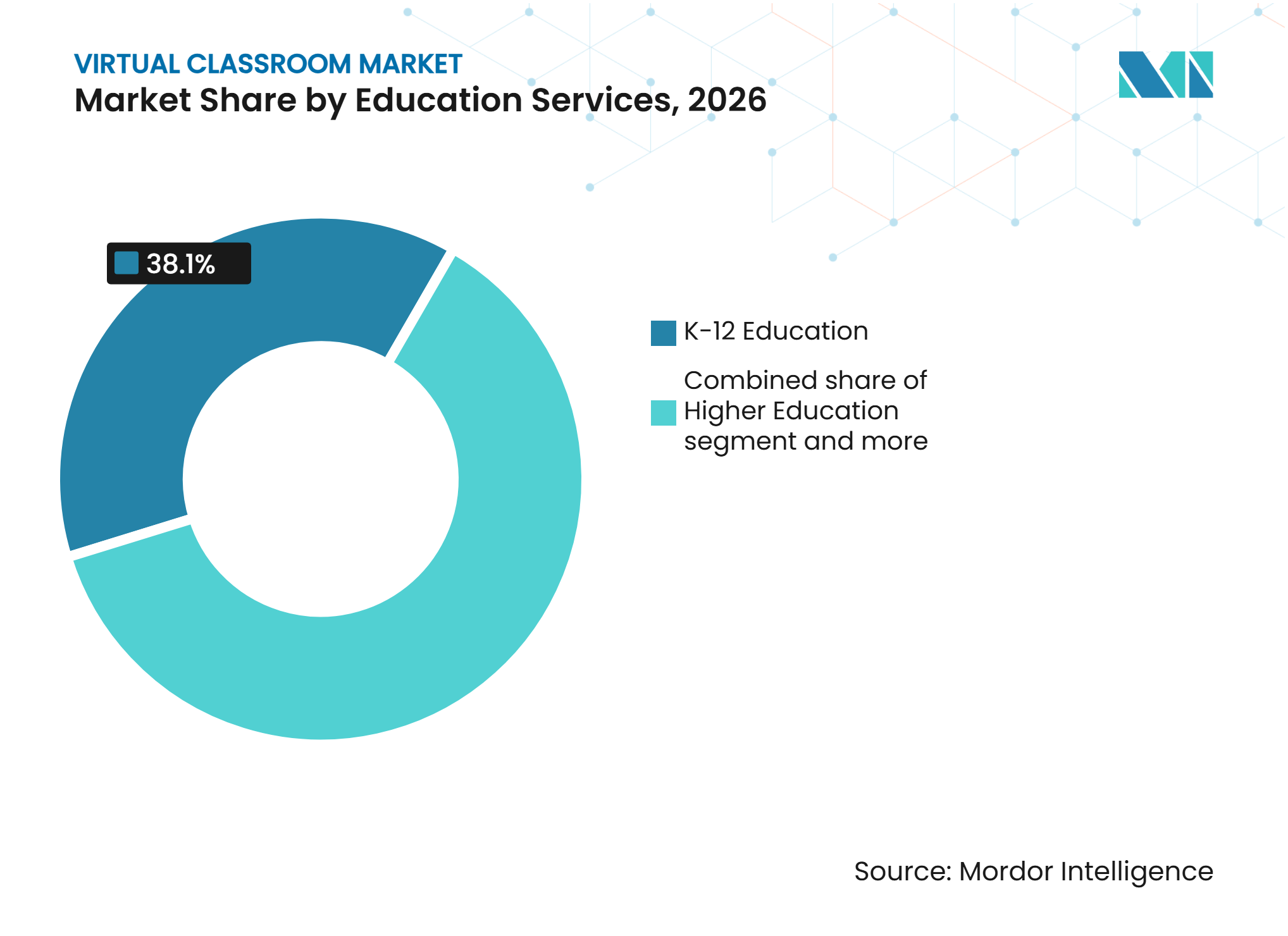
- By education services, K–12 Education held 38.1% of the virtual classroom market share in 2026, while Higher Education is forecast to grow at a 14.94% CAGR through 2032.
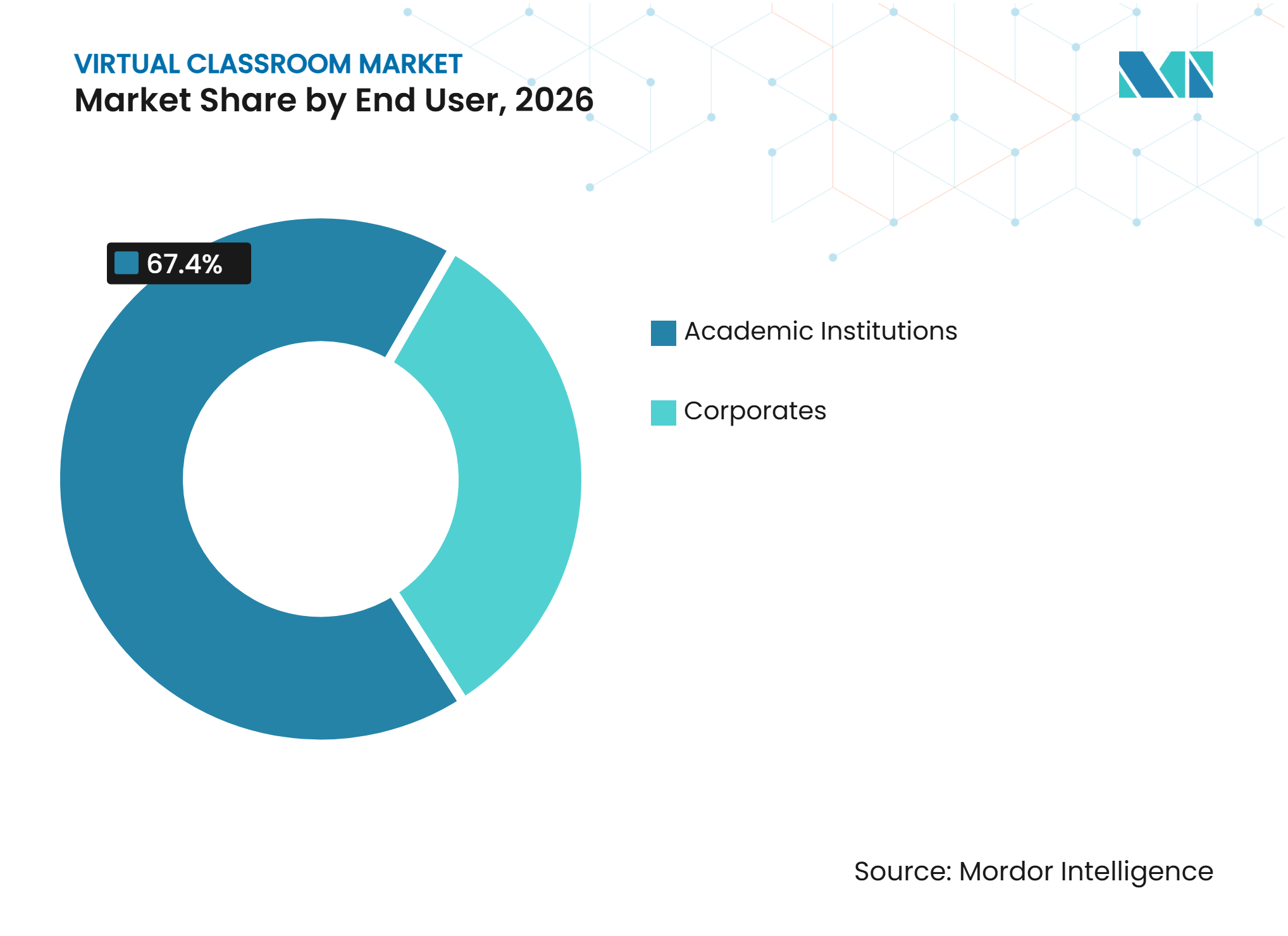
- By end user, Academic Institutions accounted for 67.4% of the virtual classroom market share in 2026, while Corporates recorded the highest projected CAGR at 14.53% through 2032.
- By delivery mode, Live Instructor-Led delivery accounted for 55.4% of the virtual classroom market size in 2026, while Self-Paced delivery is projected to expand at a 14.25% CAGR through 2032.
- By geography, North America holds 34.2% of the virtual classroom market in 2026, while Asia-Pacific is forecast to expand at a 15.21% CAGR through 2032.
Note: Market numbers in this report are based on Mordor Intelligence's proprietary estimation framework, which combines nine months of actuals with Q4 projections for base year 2026.
Market Trends and Insights
Drivers Impact Analysis of Virtual Classroom Market*
| Driver | (~) % Impact on CAGR Forecast | Geographic Relevance | Impact Timeline |
|---|---|---|---|
| Expansion of Hybrid and Remote Learning | +1.8% | Global, strongest in North America, Europe, and Oceania | Short term (≤ 2 years) |
| Growth of Online Higher-Education Enrollment | +2.1% | Asia-Pacific, with spillover to the Middle East and Africa and South America | Medium term (2-4 years) |
| Enterprise Upskilling and Virtual Instructor-Led Training | +1.9% | North America, Europe, and high-income Asia-Pacific | Medium term (2-4 years) |
| Government-Funded Digital Education Programs | +1.4% | India, Southeast Asia, Africa, and the Middle East | Medium term (2-4 years) |
| AI-Enabled Personalization and Automated Assessment | +2.1% | Global | Long term (≥ 4 years) |
| Smartphone-First Access in Emerging Education Markets | +1.5% | India, Sub-Saharan Africa, South Asia and Southeast Asia | Long term (≥ 4 years) |
| Source: Mordor Intelligence | |||
Expansion of Hybrid and Remote Learning
Hybrid instruction has become a planned delivery model for many institutions rather than a temporary response to disruption. Bellwether Education Partners reported that 20% of K–12 students in the United States received some virtual instruction during the 2023-24 school year, compared with 10% before the pandemic. This pattern supports longer contract cycles because schools include virtual learning tools in regular planning and budget processes. Canada also reported 6.8% of its 5.7 million K–12 students in distance or online learning during 2024-25, with consistent annual growth of 0.5%. The virtual classroom market benefits when institutions treat digital delivery as baseline infrastructure instead of an emergency purchase. This shift also lowers adoption barriers for providers that can integrate with existing school systems[2].
Growth of Online Higher-Education Enrollment
UNESCO reported that global higher-education enrollment reached 264 million students in 2025, up by 25 million from 2020. The global gross enrollment ratio was 43%, while Sub-Saharan Africa remained at 9%, showing that access gaps continue to be substantial. International mobility also remained important, with 6.9 million students studying outside their home country in 2025. Universities can use online degrees, hybrid courses, and short credentials to serve these learners without expanding campus space at the same rate. The virtual classroom market is therefore gaining demand from higher-education institutions that need greater teaching capacity and more flexible access.
Enterprise Upskilling and Virtual Instructor-Led Training
Enterprise training has become a strategic workforce priority as employers adapt to artificial intelligence and changing skill needs. The World Economic Forum found that 85% of employers plan to upskill their workforces between 2025 and 2030, and 77% plan to reskill staff for work alongside AI. The Association for Talent Development reported that nearly 60% of organizations used live instructor-led virtual classrooms in 2024. Usage rose to 77% among organizations with 2,500 or more employees, showing that large employers are active buyers of this format. Blended learning platforms can reduce training time by 33% and reduce per-learner costs by up to 19% compared with traditional instructor-led formats. These operating benefits are expanding the virtual classroom market among employers that need scalable and auditable learning delivery[3].
Government-Funded Digital Education Programs
Government investment is moving digital education from small pilots toward longer-term implementation programs. India allocated 14.32 billion to education in the Union Budget 2025-26, including USD 8.74 billion for school education. PM eVIDYA’s DIKSHA 2.0 platform reaches 250 million school children across 35 languages, creating a broad public digital learning foundation. The OECD reported that almost all of the 37 surveyed jurisdictions made major investments in digital education infrastructure during the previous 5 years. UNESCO estimated that connected schools and tailored digital learning in low- and lower-middle-income countries would require USD 183 billion in capital expenditure and USD 112 billion in recurring operating costs. These programs make India and other emerging economies more important for providers that can meet public procurement, language, and low-bandwidth requirements[4].
Restraints Impact Analysis of Virtual Classroom Market*
| Restraint | (~) % Impact on CAGR Forecast | Geographic Relevance | Impact Timeline |
|---|---|---|---|
| Unequal Broadband and Device Access | -1.1% | Africa, South Asia, Southeast Asia, rural North America, and South America | Long term (≥ 4 years) |
| Cybersecurity, Privacy, and Child-Safety Compliance Costs | -0.8% | North America, Europe, and Australia | Medium term (2-4 years) |
| Learner Engagement and Virtual Fatigue | -0.9% | Global | Short term (≤ 2 years) |
| Fragmented Platforms and Legacy-System Integration | -0.7% | North America and Europe, particularly higher education and large enterprises | Medium term (2-4 years) |
| Source: Mordor Intelligence | |||
Unequal Broadband and Device Access
Unequal internet and device access remains a structural restraint on the virtual classroom market. The ITU reported that 23% of people in low-income countries used the internet in 2025, compared with 94% in high-income countries. Internet use across Africa stood at 36%, which limits the reach of live and bandwidth-intensive learning formats. UNESCO estimated that 1.3 billion school-age children, or two-thirds of the global total, lacked internet access at home. These conditions make low-bandwidth, asynchronous, offline, and SMS-supported products important for India, Africa, and other emerging markets. The virtual classroom market can reach more learners when providers design for limited connectivity, while providers that depend on uninterrupted broadband face a narrower addressable base.
Cybersecurity, Privacy, and Child-Safety Compliance Costs
Privacy and child-safety obligations raise the cost and complexity of operating virtual learning platforms. Providers serving K–12 users may need to meet the Children's Online Privacy Protection Act, the Family Educational Rights and Privacy Act, and the General Data Protection Regulation. Compliance work extends beyond policies because platforms need secure data architecture, audit records, access controls, and incident response processes. Smaller vendors can find these requirements difficult to sustain without larger security teams and established controls. Institutions also use certifications such as SOC 2 Type II and ISO/IEC 27001:2022 as screening criteria before they evaluate commercial proposals. These requirements can support consolidation because larger providers may have stronger compliance capacity and more resources to maintain it.
*Our forecasts treat driver/restraint impacts as directional, not additive. The impact forecasts reflect baseline growth, mix effects, and variable interactions.
Student & Learner Behavior Analysis
Smartphone-first learning is a central access pattern in many high-growth education markets. Coursera reported that 45% of learners in Asia-Pacific accessed its courses through mobile devices, while 52% of its users in India used smartphones. Vietnam recorded 417% year-over-year growth in GenAI course enrollments, and Indonesia recorded 237% growth. The ITU reported that mobile broadband covered more than 95% of Asia-Pacific's population, although device quality, affordability, and digital literacy still differ widely. These conditions mean that a single desktop-led experience will not meet the needs of every learner population. Lightweight mobile applications, offline caching, and multilingual support are therefore important product capabilities in emerging markets.
Learners and employers are balancing the flexibility of self-paced learning with the engagement offered by instructor-led formats. The Association for Talent Development reported that 54% of organizations used hybrid learning in 2024, combining traditional and virtual facilitation. The same source reported a median class size of 25 learners for hybrid learning. Platforms that help instructors identify disengagement and respond early can improve the learning experience. Blended formats can therefore appeal to institutions that need both flexible access and structured engagement.
Education Performance Intelligence
Global higher-education enrollment reached 264 million students in 2025, increasing by 25 million since 2020. UNESCO reported a global gross enrollment ratio of 43%, but the rate in Sub-Saharan Africa was 9%. This difference shows the scale of unmet demand in regions where online and hybrid delivery can extend access. UNESCO expanded its Higher Education Policy Observatory in June 2025 to cover nearly 150 countries and 17 statistical indicators. The resource allows policymakers to assess enrollment, graduation, funding, and student mobility patterns. The OECD reported average government spending of USD 12,438 per student in educational institutions, which supports the cost case for scalable digital delivery where it is appropriately implemented.
Tuition pressures and constrained public budgets are making institutions assess the full cost of virtual learning more closely. UNESCO noted that sustainable digital transformation requires a balance between capital spending on devices and connectivity and recurring spending on software licenses, teacher training, and technical support. This balance is difficult for systems that have not yet secured predictable funding for recurring operating costs. The Association for Talent Development reported average direct learning expenditure of USD 1,254 per employee in 2024. Small organizations spent USD 1,965 per employee, which illustrates the heavier training burden for organizations with less scale. These conditions support interest in subscription-based and blended learning models that can make costs more predictable.
Virtual Classroom Market Segment Analysis
By Education Services:
Higher Education Accelerates While K–12 Anchors ScaleK–12 education held 38.1% of the virtual classroom market size in 2026, supported by broad adoption across public and private schools. The segment has a large daily instructional base, which makes digital teaching capacity a recurring infrastructure requirement. Hybrid-readiness programs have helped shift procurement from discretionary spending to planned budget items. School systems also need tools that work across different grades, subjects, languages, and learner abilities. This scale gives established platforms a strong role in K–12 purchasing decisions.
Higher education is forecast to grow at a 14.94% CAGR from 2027 to 2032. UNESCO's 2025 count of 264 million higher-education students shows the scale of demand institutions need to serve. Universities are using virtual teaching to enroll additional domestic and international learners without expanding physical campuses at the same rate. Academic supplementary tutoring is gaining attention in Southeast Asia and the Middle East as AI-supported tutoring becomes more available. The Others category, which includes skill development and test preparation, also benefits from employer interest in short, outcome-based credentials. The World Economic Forum reported that 14% of employers consider online certificates in hiring decisions, which supports this use case.



By End User:
Academic Institutions Dominate, Corporates Outpace on GrowthAcademic institutions accounted for 67.4% of the total in 2026. Longstanding use of learning management systems in schools and universities has created established workflows and meaningful switching costs. Institutions also need centralized records, accessibility functions, faculty tools, and integration with student administration systems. These requirements support demand for platforms that can operate across entire campuses or school networks. Public digital education programs add relevance to this user group because national-scale platforms are increasing institutional familiarity with online delivery.
Corporates are forecast to record the highest end-user CAGR at 14.53% from 2027 to 2032. Nearly 60% of organizations used live instructor-led virtual classrooms in 2024, and the rate reached 77% among large organizations. Employers are using virtual delivery for technical skills, onboarding, compliance, and AI-related reskilling. Regulated sectors such as financial services, healthcare, and manufacturing also need auditable training records. These needs position enterprise virtual learning systems as compliance and workforce tools rather than only content delivery products. The demand supports a broader role for the virtual classroom market in employer learning programs.

By Delivery Mode:
Live Instruction Holds Ground as Self-Paced Catches UpLive instructor-led delivery commanded 55.4% of the virtual classroom market size in 2026. Synchronous teaching remains familiar to academic institutions and employers because it preserves direct instructor interaction and scheduled learning time. The Association for Talent Development identified live virtual classrooms as the most common delivery method across both small and large organizations. It also reported a median class size of 20 learners per session for this format. Live delivery remains useful when organizations need discussion, practice, feedback, and clear attendance records.
Self-paced delivery is forecast to grow at a 14.25% CAGR from 2027 to 2032. Learners value scheduling flexibility, while employers can reduce the cost and effort of organizing cohorts. QA's Blended Learning Experience combines self-paced content and live instructor-led sessions in one workflow. This reflects a move toward blended delivery rather than a simple choice between asynchronous and synchronous models. AI-based content adaptation can make self-paced experiences more responsive to learner performance. As these functions improve, self-paced products can narrow the engagement gap while retaining their flexibility advantage.
Geography Analysis
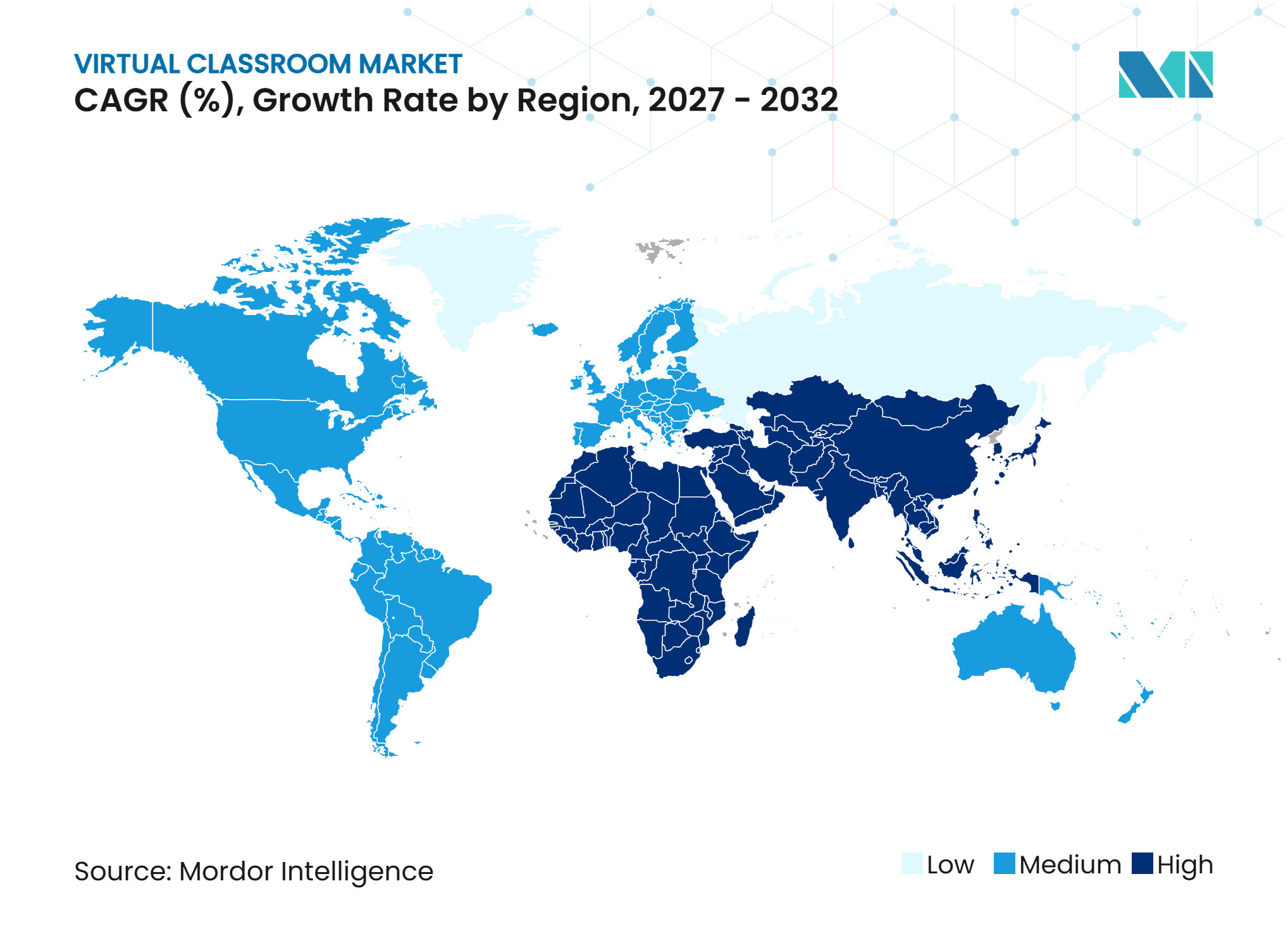
North America held a 34.20% share in 2026. The virtual classroom market in the region benefits from high learning management system penetration and established enterprise training practices. The Association for Talent Development found that 77% of large organizations used live instructor-led virtual classrooms in 2024. The United States Executive Order on AI education also signals greater public attention to AI-enabled instructional resources. North America is forecast to grow at a 12.8% CAGR from 2027 to 2032, which reflects its larger installed base and higher existing penetration. Canada recorded 6.8% of its 5.7 million K–12 students in distance or online learning during 2024-25, showing continued institutional use of the format.
Asia-Pacific is forecast to expand at a 15.21% CAGR from 2027 to 2032, with the highest regional rate. India, Vietnam, Indonesia, and the Philippines have learner populations that are increasingly comfortable with smartphone-based education. Coursera reported more than 56 million registered learners in Asia-Pacific, with 45% using mobile devices for learning. India recorded 3.6 million GenAI course enrollments, which supports the case for demand tied to workforce skills and career advancement. The Indian government's education allocation and DIKSHA 2.0 provide a national digital foundation that providers can use alongside institutional partnerships. ASEAN's Future of Education framework also supports regional digital transformation, which can create opportunities for multi-country learning programs.
Europe is forecast to grow at a 12.6% CAGR from 2027 to 2032, supported by demand for platforms that meet GDPR data governance requirements. QA's 2025 launch in the United Kingdom reflects continued interest in blended formats that combine self-paced and live training. South America is also expected to grow significantly, with public education digitization in Brazil and higher-education expansion in Chile and Peru supporting adoption.
Education Infrastructure & Development Intelligence
Public investment in digital education infrastructure is moving from short pilots toward multi-year implementation programs. India allocated 14.32 billion to education in the Union Budget 2025-26, including USD 8.74 billion for school education. This funding supports AI-enabled learning tools and broadband upgrades that can strengthen the operating environment for digital instruction. Brazil's Paraná state invested USD 42 million in education technology in 2025, including 15,000 Chromebooks, 25,000 tablets, and fiber connectivity for 85% of state schools at 100 Mbps. The OECD found that almost all of the 37 jurisdictions it surveyed had made major public investments in digital education infrastructure during the previous 5 years.
Institutional capacity is increasingly important because digital learning tools require teachers, administrators, and support teams that can use them effectively. The AUDA-NEPAD African EdTech 2030 Vision, launched in 2025, set out a continental roadmap for smartphone-first and locally relevant digital learning. The roadmap noted that smartphone ownership among teachers in South Africa already exceeded 90%. Such programs can strengthen the ability of institutions to deliver and support digital instruction at scale. They can also improve the case for platforms that offer local language support, mobile access, and practical training for educators.
Competitive Landscape
Market Concentration
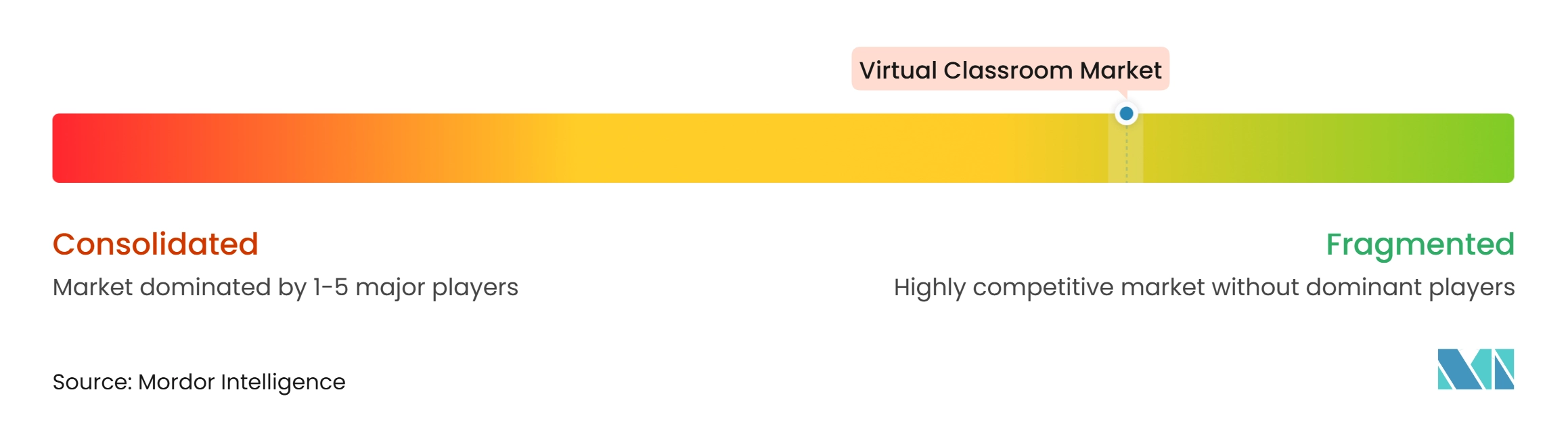
The virtual classroom market is moderately fragmented. Competition includes collaboration-suite providers such as Zoom Video Communications, Microsoft, and Alphabet, learning management system providers such as Instructure and D2L, open-source platforms such as Moodle and BigBlueButton, and specialists such as Class Technologies and LearnCube. Larger providers are using broad software suites and deep learning management system integrations to increase customer retention. Microsoft made Microsoft 365 LTI generally available in September 2025 to connect multiple learning management systems through one interface. Cisco introduced agentic AI functions and RoomOS 26 at WebexOne 2025, which strengthened its AI-focused collaboration offering. These moves show that established enterprise technology providers are expanding their role in virtual learning delivery.
A key competitive opportunity remains in low-connectivity settings where large global providers have limited offline and low-bandwidth reach. India, South Asia, Southeast Asia, and African markets require products that can operate across varied devices, data plans, languages, and network conditions. Vendors that combine asynchronous learning, offline caching, mobile design, and local content are better aligned with these needs. Compliance is also becoming a commercial differentiator because institutions need evidence of data protection and security controls. Providers unable to meet privacy and child-safety expectations can be excluded before commercial evaluation begins. This environment favors companies that can combine usability for learners with reliable integrations and compliance capacity.
Virtual Classroom Industry Leaders
-
Zoom Communications, Inc.
-
Microsoft Corporation
-
Alphabet Inc.
-
Cisco Systems, Inc.
-
Instructure Holdings, Inc.
- *Disclaimer: Major Players sorted in no particular order
Virtual Classroom Market Companies Covered in this Report
- Zoom Communications, Inc.
- Microsoft Corporation
- Alphabet Inc.
- Cisco Systems, Inc.
- Instructure Holdings, Inc.
- Anthology Inc.
- D2L Corporation
- Moodle Pty Ltd
- Adobe Inc.
- Oracle Corporation
- Kaltura, Inc.
- Class Technologies Inc.
- Blackboard Inc.
- Coursera, Inc.
- Udemy, Inc.
- Pearson plc
- Skillsoft Corporation
- Docebo Inc.
- BigBlueButton
- LearnCube
Recent Industry Developments in Virtual Classroom Market
- December 2025: Coursera and Udemy announced a definitive all-stock merger agreement at an implied equity value of USD 2.5 billion. The combined company would retain the Coursera name and have pro forma annual revenue above USD 1.5 billion. It was expected to realize USD 115 million in annual run-rate cost synergies within 24 months of closing. The transaction was expected to close in the second half of 2026 and serve 191 million registered learners.
- November 2025: LearnUpon acquired Courseau, an AI-assisted course-authoring platform. The acquisition was intended to accelerate content creation and delivery for enterprise customers. It added AI-supported authoring capability to LearnUpon's learning platform. The transaction reflects demand for faster content production in corporate learning programs.
- October 2025: Learning Pool acquired WorkRamp, a learning management system provider serving small and medium-sized businesses and extended-enterprise users. The acquisition broadened Learning Pool's ability to address different customer sizes. It also combined enterprise capabilities with WorkRamp's learning management platform. The move added further consolidation to the corporate learning software landscape.
- September 2025: Cisco launched new collaboration capabilities at WebexOne 2025. These included agentic AI in Cisco AI Assistant, RoomOS 26 for Cisco Devices, and integrations across the Webex Suite. The launch extended Cisco's AI-first collaboration position into virtual learning infrastructure. It also increased the range of tools available for enterprise-based virtual instruction.
- September 2025: QA launched its Blended Learning Experience platform. The platform combines self-paced digital content with live virtual instructor-led training in a unified format. QA reported a 33% reduction in training time and cost reductions of up to 19% compared with traditional instructor-led formats. The launch illustrates growing interest in integrated delivery models.
Key Questions Answered in the Report
What is the projected value of the virtual classroom sector by 2032?
The virtual classroom market is projected to reach USD 58.96 billion by 2032, growing at a 13.04% CAGR from 2027.
Which education service is growing fastest in virtual classrooms?
Higher education is forecast to grow at a 14.94% CAGR through 2032, supported by growing enrollment and cross-border learning demand.
Which delivery mode has the largest share in virtual classes?
Live instructor-led delivery held 55.4% in 2026 because institutions and employers continue to value scheduled instructor interaction.
What limits adoption of online classroom platforms?
Limited broadband and device access, data protection requirements, virtual fatigue, and difficult legacy-system integration can slow adoption.
Which companies are consolidating in this space?
Coursera and Udemy announced a merger, while Learning Pool acquired WorkRamp and Gainsight acquired Skilljar during 2025.