
Vietnam Residential Construction Market Size and Share
Market Overview
| Study Period | 2021 - 2032 |
|---|---|
| Forecast Data Period | 2027 - 2032 |
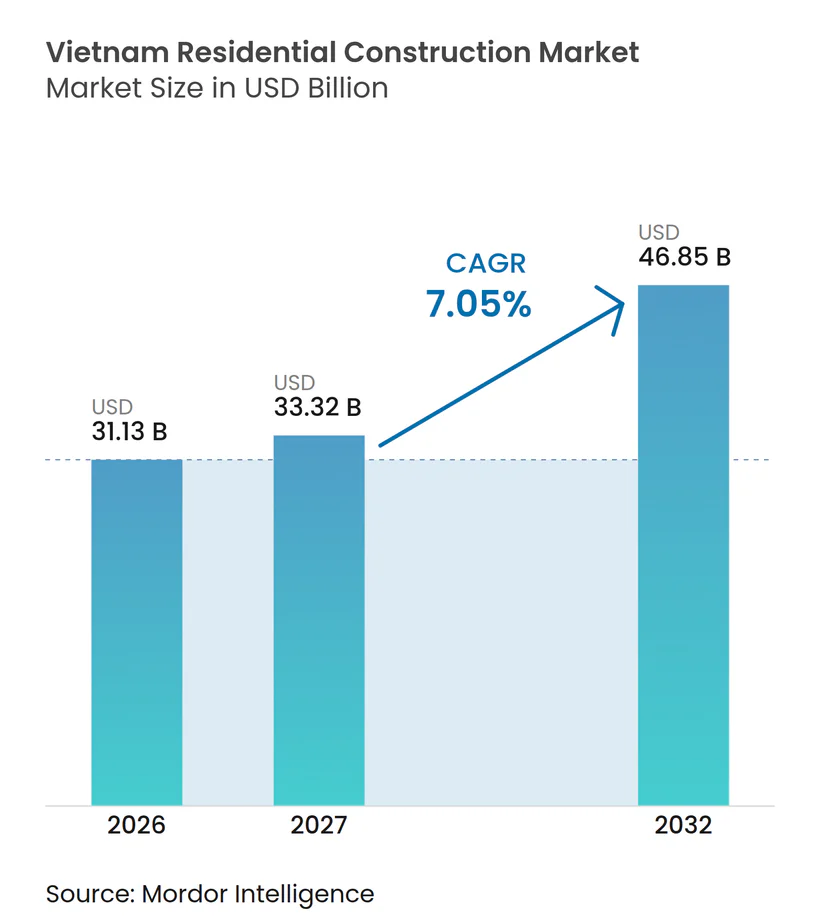
| Base Year Market Size (2026) | USD 31.13 Billion |
| Market Size (2027) | USD 33.32 Billion |
| Market Size (2032) | USD 46.85 Billion |
| Growth Rate (2027 - 2032) | 7.05 % |
| Market Concentration | Low |
Major Players *Disclaimer: Major Players sorted in no particular order Image © Mordor Intelligence. Reuse requires attribution under CC BY 4.0. | |
Vietnam Residential Construction Market Analysis by Mordor Intelligence
The Vietnam Residential Construction Market size was valued at USD 31.13 billion in 2026 and is estimated to grow from USD 33.32 billion in 2027 to reach USD 46.85 billion by 2032, at a CAGR of 7.05% during the forecast period (2027-2032).
A persistent urban housing shortfall, social housing targets, and new transport links support activity across major cities and secondary locations. Vietnam completed 102,630 social housing units in 2025, exceeding its national target of 100,275 units, while the government has assigned a further 995,445 units for delivery through 2030. Regulatory changes are gradually allowing delayed projects to advance, while metro and expressway investment is opening more suburban development sites. Higher borrowing costs, material price increases, and difficult land clearance still constrain delivery and place greater pressure on developer funding. The Vietnam residential construction market is becoming more geographically diverse as industrial provinces and transport-linked cities take a larger role in new housing supply.
Key Report Takeaways
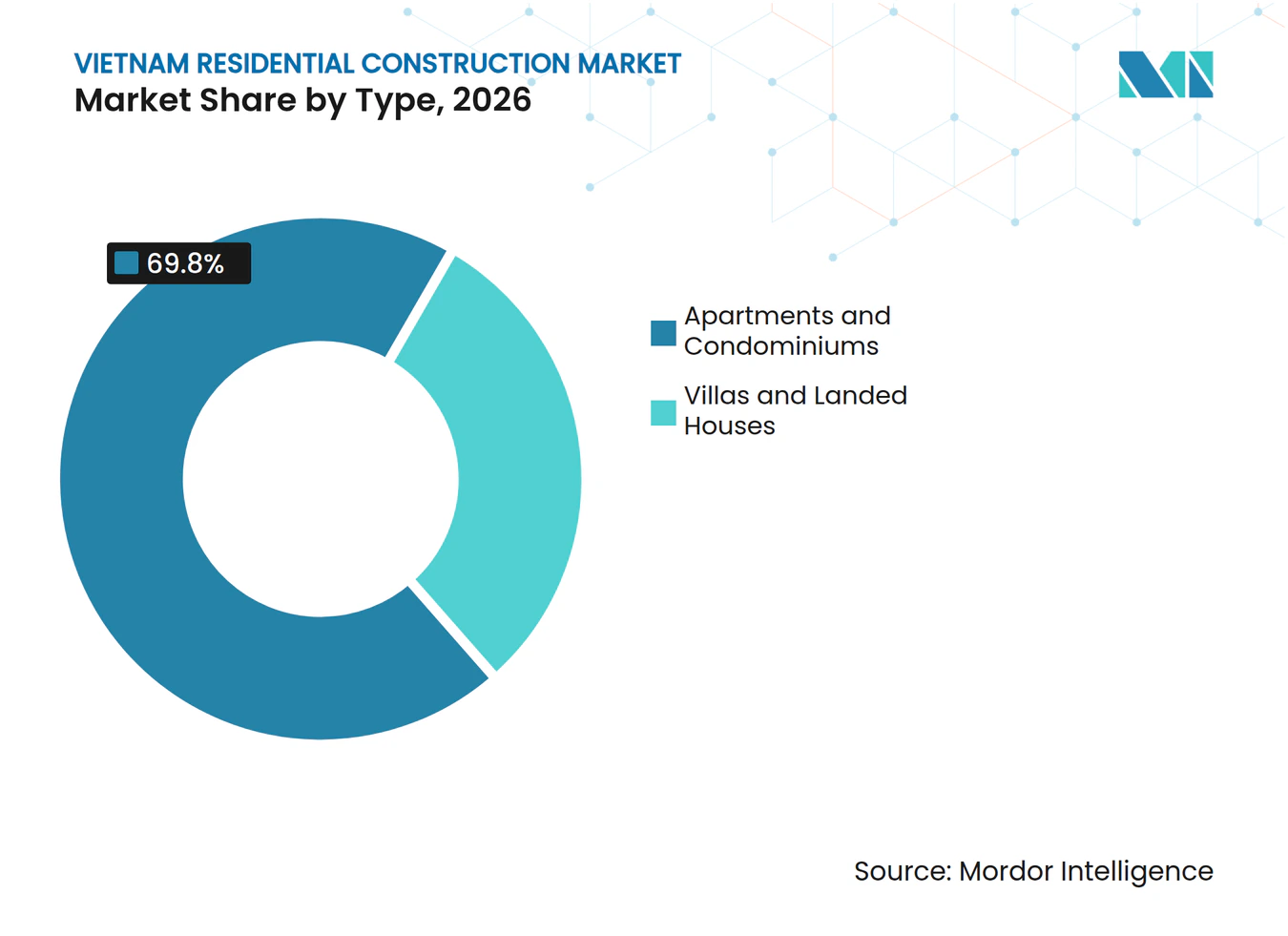
- By type, apartments and condominiums held 69.8% of the Vietnam residential construction market share in 2026, while villas and landed houses are forecast to expand at an 8.03% CAGR through 2032.
- By construction type, new construction accounted for 68.2% of the Vietnam residential construction market size in 2026, while renovation is forecast to grow at a 7.89% CAGR through 2032.
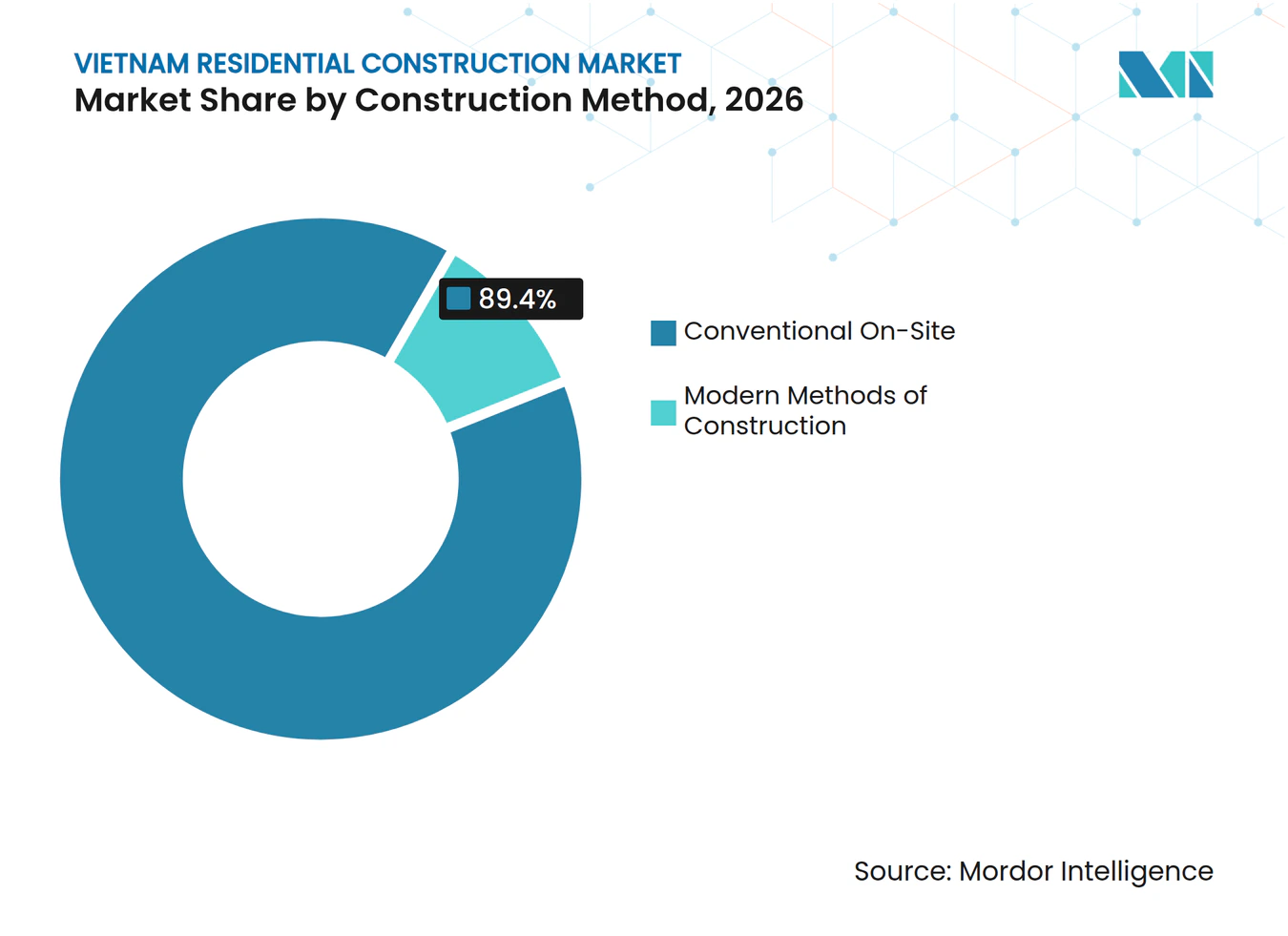
- By construction method, conventional on-site construction held 89.4% of the Vietnam residential construction market share in 2026, while modern methods of construction are forecast to grow at an 8.11% CAGR through 2032.
- By investment source, private investment accounted for 79.1% of the Vietnam residential construction market size in 2026, while public investment is forecast to grow at a 7.94% CAGR through 2032.
- By geography, Ho Chi Minh City held 37.3% of the Vietnam residential construction market size in 2026, while the rest of Vietnam segment is forecast to expand at an 8.31% CAGR through 2032.
Note: Market numbers in this report are based on Mordor Intelligence's proprietary estimation framework, which combines nine months of actuals with Q4 projections for base year 2026.
Market Trends and Insights
Drivers Impact Analysis of Vietnam Residential Construction Market*
| Drivers | (~) % Impact on CAGR Forecast | Geographic Relevance | Impact Timeline |
|---|---|---|---|
| Government-Backed Social Housing Targets | +1.8% | National, with early gains in Hanoi, Ho Chi Minh City, Dong Nai, Binh Duong, and Nghe An | Medium term (2-4 years) |
| Regulatory Reforms Unlocking Stalled Projects | +1.4% | National, with a pronounced effect in Ho Chi Minh City and Hanoi | Medium term (2-4 years) |
| Manufacturing Expansion and Workforce Migration | +1.2% | Binh Duong, Dong Nai, Bac Ninh, Nghe An, Hai Phong, and Tay Ninh | Long term (≥ 4 years) |
| Metro and Expressway Development | +1.0% | Ho Chi Minh City, Hanoi, Hai Phong, and Dong Nai | Medium term (2-4 years) |
| Demand for Modern High-Rise Apartments | +0.8% | Ho Chi Minh City, Hanoi, Da Nang, and Hai Phong | Short term (≤ 2 years) |
| Foreign Developer Partnerships and Joint Ventures | +0.7% | Ho Chi Minh City, Hanoi, Hung Yen, and Binh Duong | Short term (≤ 2 years) |
| Source: Mordor Intelligence | |||
Government-Backed Social Housing Targets Are Accelerating Affordable Residential Construction
Government housing targets provide a predictable base of work for the Vietnam residential construction market. Decision No. 444/QD-TTg assigned province-level quotas for 995,445 social housing units from 2025 to 2030, within a program ceiling of 1,062,200 units by 2030. The country completed 102,630 units in 2025, and 19 localities, including Hanoi, Ho Chi Minh City, and Dong Nai, met or exceeded their quotas[1]. Annual delivery requirements rise to 271,161 units by 2030, increasing demand for labor, materials, and contractor capacity. The State Bank of Vietnam set a 4.6% annual lending rate for eligible social housing borrowers in 2026, which improves access for qualified buyers. The program gives developers and contractors a more stable pipeline than private sales alone can provide.
Regulatory Reforms Are Unlocking Previously Stalled Housing Projects
Legal reforms are improving the conditions for new residential project launches. Resolution 171/2024/QH15 introduced a pilot mechanism that allows commercial housing projects to use eligible non-residential land parcels. Resolution 254/2025/QH15 later introduced a 75% transfer threshold, allowing authorities to address the remaining part of a site after voluntary agreements cover three-quarters of it. These changes are intended to reduce delays caused by fragmented land assembly and long negotiations. They can improve construction visibility for projects that have already secured approvals but could not move to site preparation. The Vietnam residential construction market can benefit as stronger legal clarity helps developers advance work on sites that have remained inactive.
Manufacturing Expansion and Workforce Migration Are Increasing Housing Demand Near Industrial Hubs
Industrial employment is expanding the Vietnam residential construction market outside the two largest cities. Vietnam has 430 industrial parks and 4.1 million workers, while 70-80% of workers rely on informal accommodation because supply near workplaces remains limited[2]. Dong Nai has 680,000 industrial park workers and a housing need for 450,000 people, but it had completed only 12,000 social housing units by August 2025[3]. Worker accommodation is therefore becoming a major requirement in industrial provinces. Employer-backed projects can supplement government programs and traditional developer activity. This demand is less dependent on discretionary home purchases because it is closely tied to labor retention and factory investment.
Metro and Expressway Development Is Opening New Suburban Residential Locations
Transport investment is changing the geography of the Vietnam residential construction market. The national plan targets 5,000 kilometers of expressways by 2030, compared with close to 1,000 kilometers in 2020. Ring Road 3 links Ho Chi Minh City, Dong Nai, and Tay Ninh, connecting areas with industrial employment and housing demand. The Ben Thanh-Suoi Tien metro began operation in late 2024 and has supported higher interest in its surrounding corridor. Improved access makes suburban projects more practical for households that work in central business areas. New roads and rail lines also increase the number of locations that developers can consider for apartment, landed, and worker housing projects.
Restraints Impact Analysis of Vietnam Residential Construction Market*
| Restraints | (~) % Impact on CAGR Forecast | Geographic Relevance | Impact Timeline |
|---|---|---|---|
| Elevated Mortgage Borrowing Costs | -1.5% | National, with the sharpest effect in Ho Chi Minh City and Hanoi | Short term (≤ 2 years) |
| Land Acquisition Disputes and Compensation Delays | -1.0% | National, concentrated in peri-urban corridors around Ho Chi Minh City, Hanoi, and expressway routes. | Medium term (2-4 years) |
| Rising Construction Material and Labor Costs | -0.9% | National, with the greatest effect on mid-market developers in higher-cost urban locations | Medium term (2-4 years) |
| Limited Affordable Urban Land | -0.7% | Ho Chi Minh City, Hanoi, Da Nang, and Can Tho | Long term (≥ 4 years) |
| Source: Mordor Intelligence | |||
Elevated Mortgage Borrowing Costs Are Constraining Homebuyer Affordability
Higher home-loan costs are limiting buyer affordability in the Vietnam residential construction market. Mortgage rates increased through 2026, while the end of promotional periods has raised repayment costs for many borrowers. Housing transactions fell 36% year over year in the first half of 2026, and the absorption rate for newly launched apartments fell to 73% in the second quarter of 2026 from 95% in 2025. Weaker absorption can delay cash receipts for developers and affect the timing of construction starts. The impact is strongest in higher-priced urban housing, where households rely more heavily on mortgages. Social housing lending support partly offsets the pressure for eligible buyers, but it does not remove the broader affordability challenge.
Land Acquisition Disputes and Compensation Delays Are Restricting Construction-Ready Sites
Land acquisition remains one of the main constraints on new housing delivery. The Land Law 2024 seeks to narrow the difference between official compensation and market values through market-referenced price lists. Implementation can still vary across locations, which creates uncertainty for developers and residents. Delayed handovers can postpone site preparation, contractor mobilization, and housing launches. The problem is particularly relevant in suburban areas where large developments depend on assembling many individual parcels. This risk tends to favor developers with established land banks, stronger funding, and experience working through complex approvals.
*Our forecasts treat driver/restraint impacts as directional, not additive. The impact forecasts reflect baseline growth, mix effects, and variable interactions.
Vietnam Residential Construction Market Segment Analysis
By Type:
Apartments and Condominiums Retain Scale While Villas and Landed Houses Expand in Suburban CorridorsApartments and condominiums held 69.8% of the market in 2026. High land costs in major cities continue to favor vertical development and large multi-unit schemes. In Hanoi, 78% of the new commercial apartment supply in 2026 was high-end or luxury housing priced above USD 3,100 per m², while lower-priced homes were scarce. The concentration of higher-priced supply reflects land costs, tighter approvals, and the need for developers to protect margins. Apartments remain the main delivery format for social housing, city-center projects, and foreign-backed condominium developments. Their large share keeps tower construction and related supply chains central to the Vietnam residential construction industry. It also places pressure on developers to align pricing and financing with local buyer incomes. Large apartment schemes will remain the primary source of formal housing units in Hanoi and Ho Chi Minh City.
Villas and landed houses are forecast to grow at an 8.03% CAGR through 2032. Better roads and rail access are making peripheral districts more attractive for households seeking larger homes. CapitaLand Development launched The Fullton in Hung Yen in May 2025 as a 25-hectare low-rise project with a gross development value of USD 800 million. The project shows how international developers are supporting more formal low-rise supply in suburban locations. Landed homes are gaining relevance where lower land costs make the product viable. The segment does not displace high-rise housing in city cores because density constraints remain strong. It broadens the Vietnam residential construction market by creating another route for household formation in connected satellite areas.



By Construction Type:
New Construction Leads While Renovation Builds a Larger RoleNew construction accounted for 68.2% of the market in 2026. Social housing commitments and previously delayed private schemes moving into the construction phase support this position. The government housing program gives developers a substantial source of new-build demand across cities and industrial provinces. Large urban developments also require new roads, utilities, and supporting amenities before home delivery can begin. New construction, therefore, remains the most important source of work for general contractors, material producers, and specialist trades. It is also most exposed to land approval timelines, financing conditions, and construction input costs. The Vietnam residential construction market depends on a steady flow of new launches to reduce the formal housing deficit. Stronger regulatory implementation can improve the pace of this delivery.
Renovation is forecast to grow at a 7.89% CAGR through 2032. Older apartment buildings and housing completed in earlier development cycles are creating a broader refurbishment base. Renovation demand includes interior upgrades, energy-related improvements, building-system replacements, and changes that improve thermal comfort. The Ministry of Construction published 2025 investment costs and construction price benchmarks in March 2026, which support more standardized project planning. This work can provide contractors with recurring activity when large greenfield projects face approval delays. It also supports smaller and mid-sized firms that operate outside major township projects. As urban homes age, renovation will provide a more durable source of residential construction demand.
By Construction Method:
Conventional On-Site Delivery Leads as Modern Methods of Construction Gain UseConventional on-site construction held 89.4% of the market in 2026. Traditional methods remain widely used because contractors have established site-labor networks and experience with local construction practices. They remain suitable for the broad range of residential buildings delivered across Vietnam. However, material costs and labor constraints are putting more pressure on conventional project schedules. The Ministry of Construction reported higher investment-cost benchmarks for 2025, with increases of 9-12% compared with 2024. Developers are responding by seeking closer control over procurement, site productivity, and construction waste. The Vietnam residential construction industry will continue to rely on conventional methods, but the delivery model is becoming more disciplined. Large contractors can use scale to manage these changes more effectively.
Modern methods of construction are forecast to grow at an 8.11% CAGR through 2032. This category includes modular prefabrication, prefabricated prefinished volumetric construction, and building information modeling integrated delivery. The National Housing Development Strategy promotes prefabrication for social housing, while the Building Information Modeling Application Handbook 2025 supports wider digital construction adoption. VNPrecast reported that its prefabricated system at the iD Junction township supported 15-20% faster delivery and 25-40% labor-cost savings. These benefits are especially relevant to repeatable social housing and larger residential projects. Off-site production can reduce exposure to labor shortages and weather-related site delays. Adoption will depend on project scale, financing, and the ability of contractors to integrate design and factory production.

By Investment Source:
Private Capital Leads While Public Programs ExpandPrivate investment accounted for 79.1% of the market in 2026. Private developers remain the main source of activity in commercial apartments, townships, villas, and mixed-use projects. Foreign-linked partnerships also bring funding, design expertise, and more formal project systems to selected developments. CapitaLand Development and Vinhomes entered a strategic partnership in May 2025 and launched The Fullton as part of their Vietnam expansion. Private capital can move quickly when land, approvals, and buyer demand are aligned. It is more sensitive to public delivery of mortgage rates and project cash flow. The Vietnam residential construction market therefore benefits when public and private programs progress at the same time. This balance supports a wider range of locations and buyer groups.
Public investment is forecast to grow at a 7.94% CAGR through 2032. The social housing allocation schedule rises from 100,275 units in 2025 to 271,161 units by 2030. Public programs provide a counterweight when private projects slow because of weaker affordability or funding pressure. The Vietnam General Confederation of Labour is also developing worker rental housing in locations such as Dong Thap, Bac Ninh, and Tay Ninh. This channel serves industrial workers whose housing needs are not fully met by commercial supply. Public allocations can help move construction activity into secondary cities where land is more available. Their success will depend on local implementation, access to finance, and contractor capacity.
Geography Analysis
Ho Chi Minh City held 37.3% of the market in 2026. The city remains the largest center for apartment values, foreign developer activity, and large urban projects. Ring Road 3, the Ben Thanh-Suoi Tien metro, and the Long Thanh airport connection are directing interest toward eastern and southeastern corridors. These connections support new project locations outside established central districts. Higher mortgage costs and land clearance issues continue to limit the speed of private residential launches. Still, the city’s scale, employment base, and infrastructure program keep it at the center of the Vietnam residential construction market.
Hanoi has a broad construction pipeline across social housing, commercial apartments, and higher-end developments. High-end and luxury homes represent a large share of the current supply, which can limit sales absorption among end-users. The city also has significant development potential along ring roads, bridges, and outer districts. Maison Privée, a 490-unit luxury condominium in Ciputra Township, was introduced in May 2026 by CapitaLand Development, Mitsubishi Estate, and Nomura Real Estate Development. Such projects show continued confidence in Hanoi’s premium segment. The city’s future growth will depend on making new locations accessible and matching supply to household purchasing capacity.
The rest of Vietnam is forecast to grow at an 8.31% CAGR through 2032, the fastest rate among the geographic segments. Dong Nai, Binh Duong, Bac Ninh, and Nghe An have large industrial workforces and major unmet demand for worker accommodation. Provincial growth is supported by lower land costs and the availability of larger sites than those in Hanoi and Ho Chi Minh City. Secondary cities connected by expressways can attract apartments, worker housing, and landed developments. Public housing programs and employer-backed accommodation can reduce dependence on individual mortgage borrowing. This broader geographic base makes the Vietnam residential construction market less dependent on the two main metro areas.
Competitive Landscape
Market Concentration
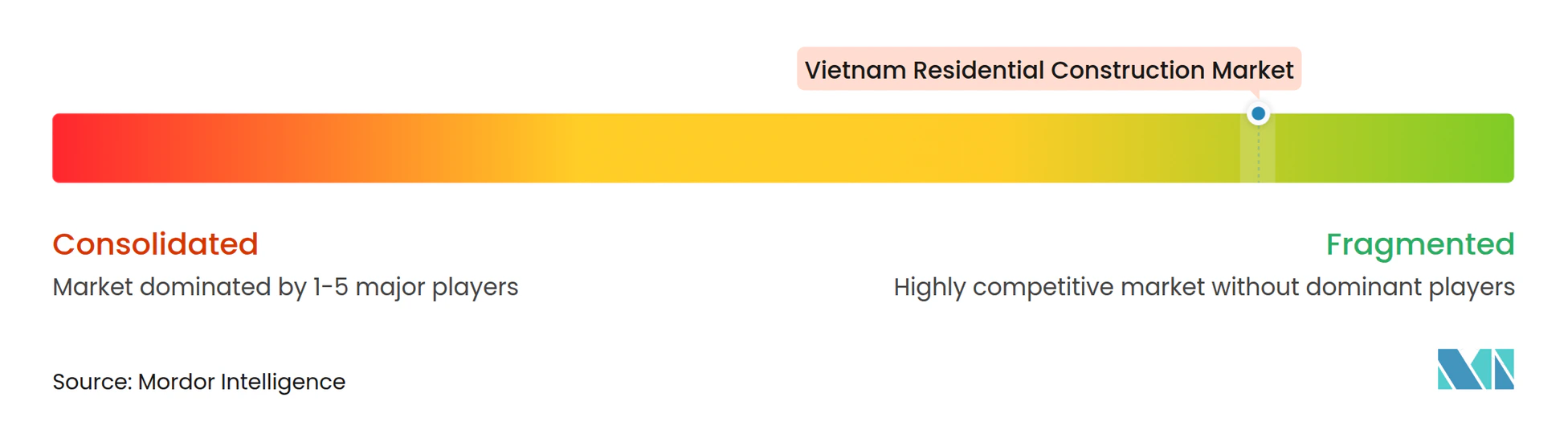
The Vietnam residential construction market is fragmented in nature. Larger developers have advantages in land access, funding, and the ability to coordinate complex projects. They can also spread design, procurement, marketing, and compliance costs across several sites, which is important when individual approvals are delayed. International partnerships are becoming an important way to combine local land access with overseas capital and product expertise. CapitaLand Development, Mitsubishi Estate, and Nomura Real Estate Development introduced Maison Privée in Hanoi in May 2026, adding a major foreign-backed project to the premium pipeline. Competition is therefore shaped by project execution, access to approvals, and credibility with buyers and financing partners. It is also affected by the ability to balance high-quality specifications with homes that remain within reach of local households. Developers that can offer suitable pricing and manage delivery risk are better positioned in a more cautious buyer environment.
Joint ventures continue to shape competitive strategies. CapitaLand Development and Vinhomes used their 2025 partnership to launch The Fullton in Hung Yen. This type of agreement allows international firms to enter priority locations without independently building every local capability. It also gives domestic developers access to partners with established design, capital, and marketing resources. Joint ventures can distribute the financing and construction risk of high-value projects over a wider group of participants. The approach is relevant in the Vietnam residential construction market because site assembly and approvals remain complex. Foreign-backed participants are likely to keep favoring partnerships where local execution experience reduces development risk.
Coteccons, Hoa Binh Construction Group, Ricons, and Newtecons are among the contractors competing for large residential and mixed-use work. Coteccons reported a record backlog of USD 2.4 billion and a 94% repeat-sales ratio in its first quarter of fiscal year 2026. The company also participated in the Gia Binh International Airport project, showing how leading contractors are broadening activity beyond residential projects. Larger contractors can protect their position through integrated planning, procurement discipline, and technology-led project management. Their wider project portfolios can also reduce reliance on the timing of new home sales. Smaller firms remain important within subcontracting networks but face greater exposure to labor and input-cost volatility.
Vietnam Residential Construction Industry Leaders
-
Vinhomes
-
Novaland Group
-
Dat Xanh Group
-
Sun Group
-
Hung Thinh Corporation
- *Disclaimer: Major Players sorted in no particular order
Vietnam Residential Construction Market Companies Covered in this Report
- Vinhomes
- Novaland Group
- Dat Xanh Group
- Sun Group
- Hung Thinh Corporation
- Coteccons Construction JSC
- Hoa Binh Construction Group JSC
- Vinaconex JSC
- Central Construction JSC
- Ricons Construction Investment Group JSC
- Unicons Investment Construction Co., Ltd.
- Newtecons JSC
- Ecoba Vietnam JSC
- Fecon Corp JSC
- Delta Construction Group
- Nam Long Investment Corporation
- Khang Dien House Trading and Investment
- CapitaLand Development (Vietnam)
- Gamuda Land Vietnam
- Phu My Hung Development
Recent Industry Developments in Vietnam Residential Construction Market
- October 2026: Gamuda Land Vietnam and Khai Minh Land formalized a comprehensive cooperation agreement for the Norton Park project, extending Gamuda Land's partnership-led strategy beyond its legacy HCMC and Hanoi townships to new geographic markets and local developer relationships.
- September 2026: A consortium led by Sao Mai, a wholly-owned subsidiary of Vinhomes, was approved as investor for the Van Giang–Hoan Long mixed-use urban area in Hung Yen Province following an international open tender, with total investment of approximately USD 863 million, extending Vinhomes' northern land bank adjacent to Ocean Park 2 and Dream City developments.
- August 2026: Vinhomes broke ground on a nearly VND 111.14 trillion (USD 4.26 billion) urban development spanning more than 600 hectares in southern Hanoi. The project is designed to accommodate over 105,000 residents and combine resettlement, affordable, and commercial housing, with completion expected by 2030.
Vietnam Residential Construction Market Report Scope
Segmentation Overview
| Apartments and Condominiums |
| Villas and Landed Houses |
| New Construction |
| Renovation |
| Conventional On-Site |
| Modern Methods of Construction |
| Public |
| Private |
| Ho Chi Minh City |
| Hanoi |
| Rest of Vietnam |
| By Type | Apartments and Condominiums |
| Villas and Landed Houses | |
| By Construction Type | New Construction |
| Renovation | |
| By Construction Method | Conventional On-Site |
| Modern Methods of Construction | |
| By Investment Source | Public |
| Private | |
| By Region | Ho Chi Minh City |
| Hanoi | |
| Rest of Vietnam |
Key Questions Answered in the Report
What is the projected growth rate for Vietnam residential construction through 2032?
The Vietnam residential construction market is forecast to grow at a 7.05% CAGR from 2027 to 2032 and reach USD 46.85 billion.
Which housing format has the largest share in Vietnam?
Apartments and condominiums lead with a 69.8% share in 2026 because high land costs and urban density favor high-rise projects.
Which residential format is forecast to grow the fastest?
Villas and landed houses are forecast to expand at an 8.03% CAGR through 2032 as suburban locations gain better transport links.
What supports social housing construction in Vietnam?
The government assigned 995,445 social housing units for delivery from 2025 to 2030, following 102,630 completed units in 2025.
Why are Modern Methods of Construction gaining use in Vietnam?
Modern methods of construction are forecast to grow at an 8.11% CAGR because they can shorten delivery time and reduce labor requirements on repeatable projects.
Which locations offer the strongest residential development potential?
Ho Chi Minh City leads by share, while industrial provinces and other areas in the rest of Vietnam are forecast to expand the fastest at an 8.31% CAGR.