
Vietnam Refrigerated Trucking Market Size and Share
Market Overview
| Study Period | 2021 - 2032 |
|---|---|
| Forecast Data Period | 2027 - 2032 |
| Base Year Market Size (2026) | USD 1.52 Billion |
| Market Size (2027) | USD 1.63 Billion |
| Market Size (2032) | USD 2.28 Billion |
| Growth Rate (2027 - 2032) | 6.97 % |
| Market Concentration | Medium |
Major Players *Disclaimer: Major Players sorted in no particular order Image © Mordor Intelligence. Reuse requires attribution under CC BY 4.0. | |
Vietnam Refrigerated Trucking Market Analysis by Mordor Intelligence
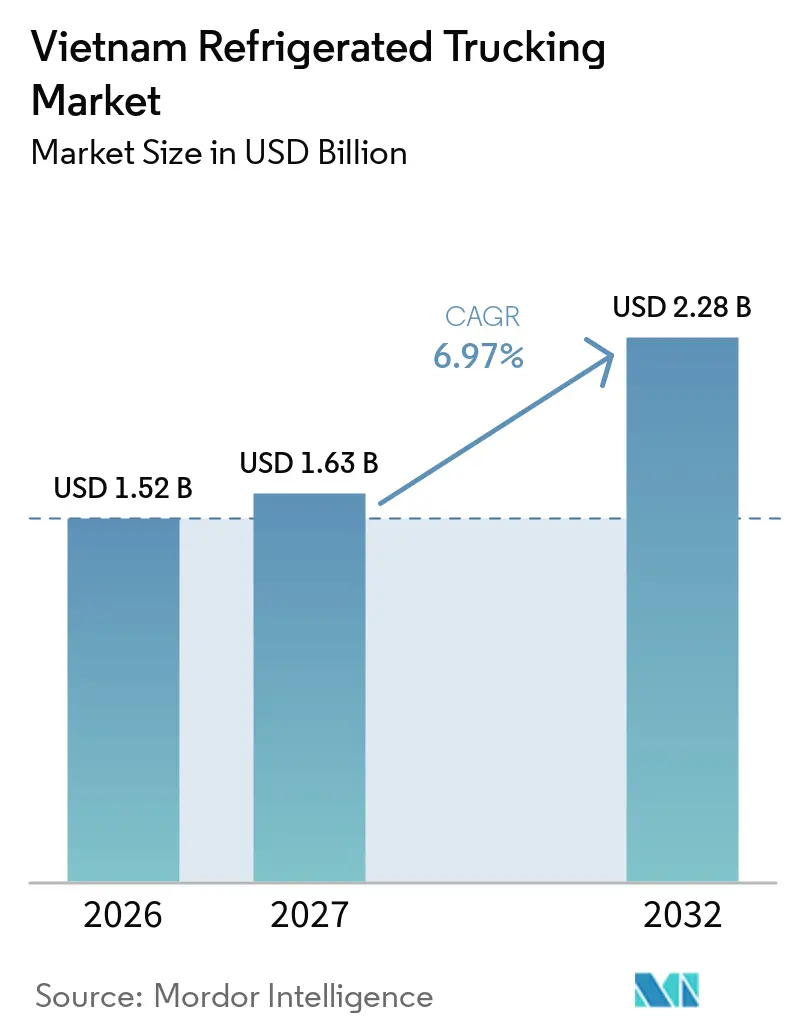
The Vietnam refrigerated trucking market size is valued at USD 1.52 billion in 2026 and is estimated to grow from USD 1.63 billion in 2027 to reach USD 2.28 billion by 2032, at a CAGR of 6.97% during the forecast period 2027 to 2032.
Seafood and agri-food exports support recurring refrigerated freight between producing regions, processing sites, ports, and domestic distribution hubs. Modern retailers are extending chilled distribution beyond established cities, which makes scheduled, traceable delivery capacity more important. Pharmaceutical demand raises the value of validated temperature controls and documented handling processes. Cost pressure and uneven infrastructure remain material constraints for fleet operators. The Vietnam refrigerated trucking market, therefore, favors carriers that can combine reliable equipment, route density, and compliance records.
Key Report Takeaways
- By application, meats, poultry, fish, and seafood account for 37.86% of the Vietnam refrigerated trucking market share in 2026, while healthcare and pharmaceuticals are forecast to register a CAGR of 10.64% through 2032.
- By truckload specification, full-truckload accounts for 65.78% of the Vietnam refrigerated trucking market size in 2026, while less-than-truckload is forecast to register a CAGR of 11.26% through 2032.
- By containerization, containerized freight accounts for 58.39% of the Vietnam refrigerated trucking market share in 2026 and is forecast to register a CAGR of 10.37% through 2032.
- By distance, long-haul freight accounts for 63.48% of the Vietnam refrigerated trucking market size in 2026, while short-haul freight is forecast to register a CAGR of 11.98% through 2032.
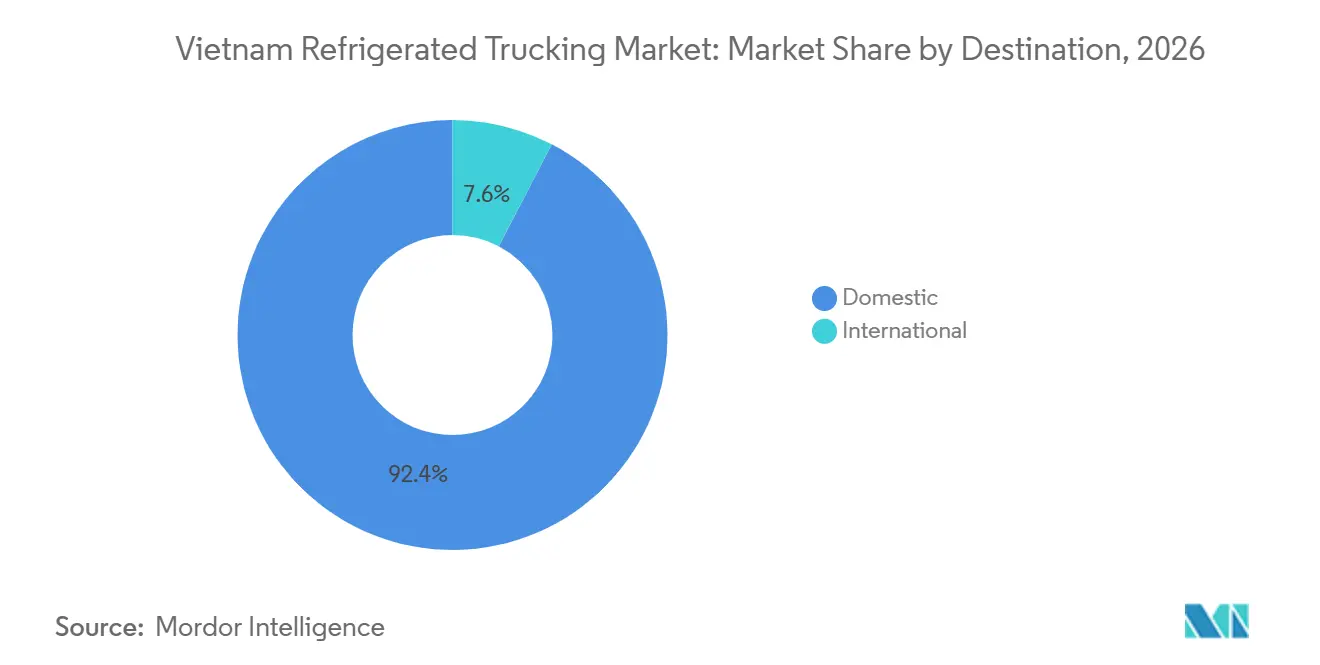
- By destination, domestic freight accounts for 92.37% of the Vietnam refrigerated trucking market share in 2026, while cross-border freight is forecast to register a CAGR of 10.59% through 2032.
- By temperature type, chilled freight accounts for 50.38% of the Vietnam refrigerated trucking market size in 2026, while the deep-frozen and ultra-low segment is forecast to register a CAGR of 9.46% through 2032.
- By geography, Southern Vietnam accounts for 48.37% of the Vietnam refrigerated trucking market share in 2026, while Northern Vietnam is forecast to register a CAGR of 8.58% through 2032.
Note: Market numbers in this report are based on Mordor Intelligence's proprietary estimation framework, which combines nine months of actuals with Q4 projections for base year 2026.
Vietnam Refrigerated Trucking Market Trends and Insights
Drivers Impact Analysis*
| Driver | (~) % Impact on CAGR Forecast | Geographic Relevance | Impact Timeline |
|---|---|---|---|
| Seafood export growth is increasing temperature-controlled transport demand | +2.0% | Southern Vietnam (Mekong Delta, Can Tho, HCMC export hubs); spill-over to Central Vietnam ports | Short term (≤ 2 years) |
| Agricultural exports are expanding perishable cold-chain freight volumes | +1.3% | National, with early gains in the Mekong Delta and the Central Highlands agri-corridors | Medium term (2-4 years) |
| Modern retail expansion is increasing chilled distribution requirements | +1.1% | National; concentrated in the HCMC-Binh Duong-Dong Nai triangle and the Hanoi metro | Medium term (2-4 years) |
| Online grocery growth is accelerating temperature-controlled delivery demand | +0.7% | HCMC and Hanoi urban cores; spill-over to tier-2 cities | Medium term (2-4 years) |
| Pharmaceutical demand is strengthening compliance with cold-chain logistics requirements | +0.6% | National, with early gains in HCMC, Hanoi, and Da Nang, the pharmaceutical distribution hubs | Long term (≥ 4 years) |
| Traceability regulations are increasing temperature-monitoring technology adoption | +0.4% | National exporters facing EU, US, and China market requirements | Short to medium term |
| Source: Mordor Intelligence | |||
Seafood Export Growth Drives Reefer Transport Volumes
Vietnam's seafood export turnover reached approximately USD 11.3 billion in 2025, increasing by more than 12% compared with 2024, which supports regular refrigerated loads from aquaculture areas to processing plants, port cold stores, and export terminals. During January–September 2025, shrimp exports exceeded USD 3.38 billion, while tra fish revenue exceeded USD 1.6 billion. These flows make seafood the main volume base for the Vietnam refrigerated trucking market. Higher-value shrimp, lobster, and bivalve shipments require more consistent temperature handling than commodity frozen fish. That requirement supports investment in multi-zone vehicles and data-loggers rather than basic single-compartment equipment. Export documentation and temperature records also become more important where buyers require reliable chain-of-custody information.
Agricultural Exports Expand Perishable Freight Volumes
Vietnam's fruit and vegetable exports reached USD 7.09 billion in the first 10 months of 2025, up 15.1% year-over-year[1]. Durian, dragon fruit, mango, and bananas need fast movement after harvest to preserve quality. This makes pre-cooled trucks useful on routes from the Mekong Delta and Central Highlands. China-bound shipments require traceable transport arrangements under product-specific registration and labeling rules. The Vietnam refrigerated trucking market gains from this shift because transport is increasingly part of export readiness. Carriers with documented temperature handling can serve exporters that need a more dependable service than informal transport provides.
Modern Retail Expansion Creates Structured Chilled Distribution Demand
Organized stores require planned deliveries for chilled, frozen, dairy, deli, and ready-to-eat goods. WinCommerce recorded revenue of VND 38,979 billion (USD 1.56 billion) in 2025, up 18.3% year on year, and stated that nearly 75% of new store openings were in rural areas[2]. Rural expansion creates new delivery routes where cold-chain coverage is less developed. Online grocery orders also increase the need for smaller, more frequent drops in the largest urban areas. These changes move the Vietnam refrigerated trucking market toward route planning, multi-stop scheduling, and dependable proof of delivery.
Pharmaceutical Cold-Chain Demand Drives Compliance-Focused Fleet Investment
Biologics, vaccines, and specialty medicines require reliable temperature control across the distribution chain. Good Distribution Practice and Good Storage Practice requirements make documented procedures and continuous records important for qualified operators. LOTTE Global Logistics began construction of a USD 34 million cold-chain center in Dong Nai in March 2025 to support food and pharmaceutical demand. Igarashi Reizo also began construction of a cold and dry warehouse complex in Tay Ninh Province during 2025. These investments indicate that qualified transport is becoming a more defined part of healthcare distribution. The Vietnam refrigerated trucking market benefits where carriers can provide validated temperature profiles and timely exception reporting.
Restraints Impact Analysis*
| Restraint | (~) % Impact on CAGR Forecast | Geographic Relevance | Impact Timeline |
|---|---|---|---|
| High energy costs are pressuring temperature-controlled operating margins | -1.0% | National; most acute for operators serving rural corridors with elevated fuel and grid-electricity exposure | Short to medium term |
| Infrastructure gaps are limiting reliable cold-chain network coverage | -1.1% | Mekong Delta, Central Vietnam; rural areas across all regions | Medium term (2-4 years) |
| Refrigeration equipment costs are increasing, resulting in fleet investment requirements | -0.9% | National, disproportionately impacting SME carriers and new market entrants. | Long term (≥ 4 years) |
| Urban restrictions and empty backhauls are reducing operational efficiency | -0.7% | HCMC and Hanoi inner-city districts; long-haul north-south routes with asymmetric cargo density | Short to medium term |
| Source: Mordor Intelligence | |||
High Energy and Equipment Costs Constrain Fleet Investment
Refrigerated fleets use diesel for traction and power for refrigeration during loading, unloading, and parking. Vietnam raised its average retail electricity tariff to VND 2,204 (USD 0.08) per kWh in May 2025, a 4.8% increase[3]. Tropical operating conditions add to refrigeration energy demand on many routes. Imported refrigeration units also raise the capital needed to renew older vehicles. Smaller domestic carriers may therefore delay fleet upgrades or rely on less efficient equipment. The Vietnam refrigerated trucking market can become more uneven when well-capitalized providers renew equipment faster than independent operators.
Infrastructure Gaps and Route Inefficiencies Limit Coverage
Cold storage and cross-docking capacity remain concentrated around Ho Chi Minh City, Binh Duong, and Dong Nai. The Mekong Delta produces large seafood and agricultural volumes, yet many rural routes have limited organized temperature-controlled facilities. Long north-south routes also face weak return cargo density. This creates empty-backhaul costs and reduces refrigerated truck utilization. Hanoi daytime restrictions for trucks of 2 tons or more require operators to use smaller vehicles or revise hub-and-spoke delivery schedules. The Vietnam refrigerated trucking market needs more regional cross-docking capacity and better load matching to reduce these operational constraints.
*Our forecasts treat driver/restraint impacts as directional, not additive. The impact forecasts reflect baseline growth, mix effects, and variable interactions.
Segment Analysis
By Application: Seafood Provides the Largest Volume Base
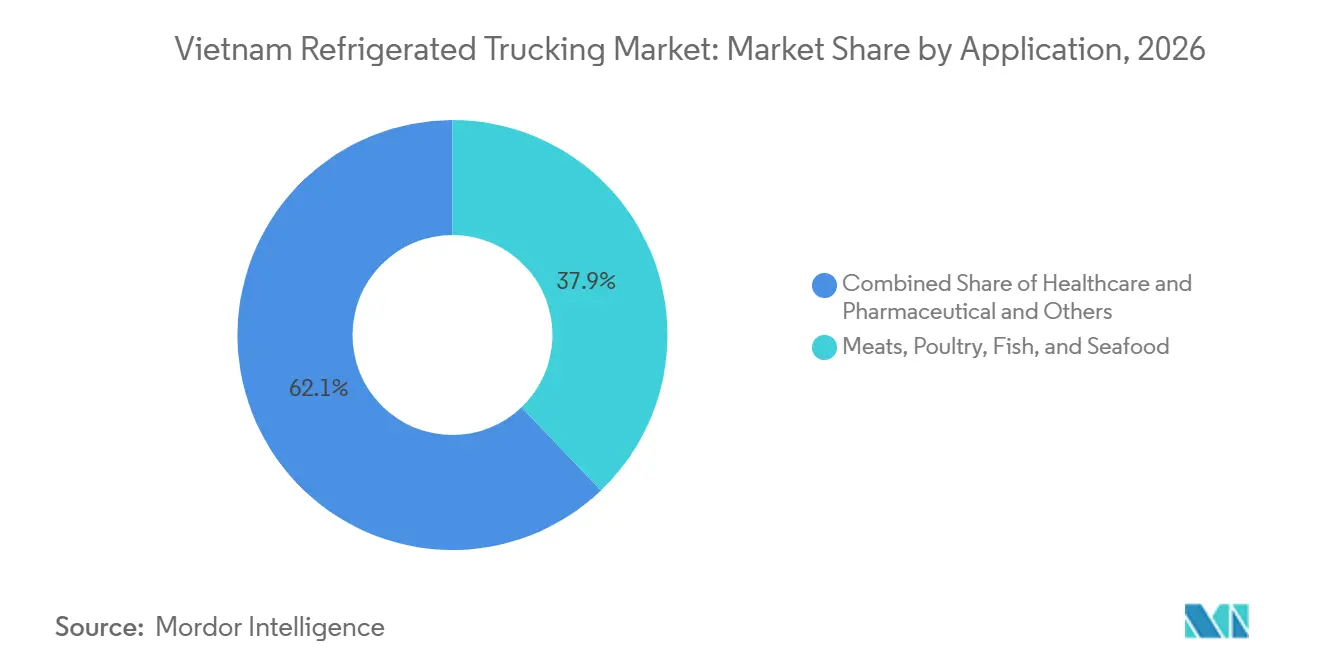
Meats, poultry, fish, and seafood account for 37.86% of the Vietnam refrigerated trucking market size in 2026. Seafood processing links farms, processors, cold stores, ports, and distributors across the Mekong Delta and coastal provinces[4]. Vietnam's USD 11.3 billion seafood export result in 2025 shows the scale of the freight base behind this segment. Producers need temperature stability during collection, blast-freezing transfers, and final transport to export terminals. Fresh and live products need tighter handling than standard frozen consignments. This keeps vehicle availability important during harvest and export peaks.
Healthcare and pharmaceuticals are forecast to register at a 10.64% CAGR through 2032. Biologics, vaccines, and specialty drugs make reliability, validated handling, and data records central to service selection. Processed foods, dairy, and frozen desserts benefit from broader organized retail distribution. Horticultural freight remains sensitive to cold-room availability near farm areas. Other applications include chemicals and industrial goods with defined temperature requirements. The Vietnam refrigerated trucking industry serves different temperature profiles, but seafood and healthcare create the clearest demand for specialized operating standards.

By Truckload Specification: FTL Leads While LTL Gains Relevance
Full-truckload accounts for 65.78% of the Vietnam refrigerated trucking market share in 2026. Large exporters, food manufacturers, and FMCG distributors commonly move dedicated loads between factories, cold stores, ports, and regional distribution centers. This model fits high-volume, repeatable routes. It also suits frozen seafood flows that move in predictable shipment sizes. Dedicated loads can simplify temperature accountability because a single shipper controls the vehicle load. Full-Truckload remains important for core long-distance freight.
Less-than-truckload is forecast to register at an 11.26% CAGR through 2032. Retailers, online grocery platforms, clinics, and pharmacies need smaller shipments delivered more often. Multi-stop transport can raise revenue per kilogram, but it requires route design and reliable temperature records at every delivery point. ABA Cooltrans reported that its route optimization work increased delivery density from 20 to 50 delivery points per day in 2026. The Vietnam refrigerated trucking market will reward carriers that can manage multi-temperature loads without losing delivery reliability. Providers that remain focused only on full loads may face more price-sensitive contracts.
By Containerization: Containerized Transport Aligns With Export Needs
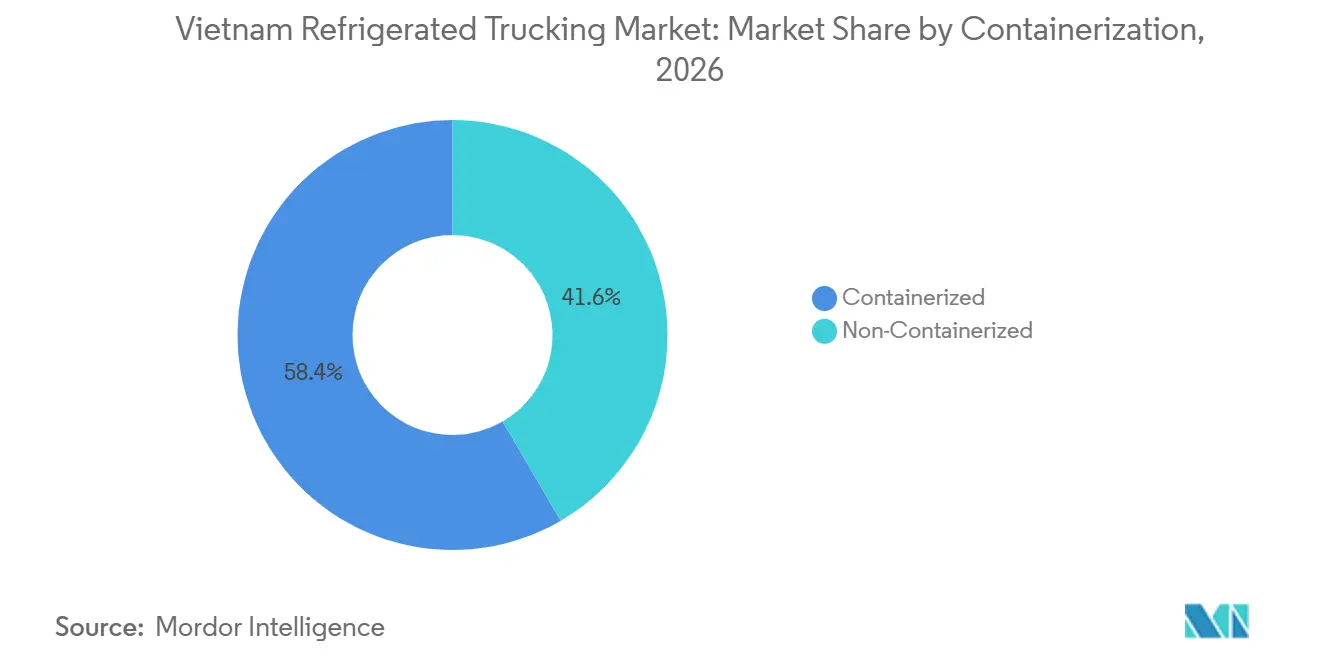
Containerized transport accounts for 58.39% of the Vietnam refrigerated trucking market size in 2026. Export-oriented food shipments often use sealed units that align with international shipping procedures. These units support temperature monitoring and stronger handling documentation. They are also suited to transfers between cold storage, ports, and inland logistics facilities. Modern retailers use trackable units where product integrity and delivery accountability are important. This supports containerized freight across established distribution corridors.
Containerized transport is forecast to register a 10.37% CAGR through 2032. Pharmaceutical and higher-value food exporters increasingly require real-time temperature and location records. Non-containerized vehicles remain relevant in domestic fresh produce routes and traditional trade channels. The national NDATrace pilot began in January 2026 and supports digital traceability for agricultural, forestry, and fishery products. Better documentation can favor enclosed and monitored equipment on export routes. The Vietnam refrigerated trucking market, therefore, has a clear reason to invest in container-level visibility.
By Distance: Long Haul Holds the Core Freight Base
Long haul accounts for 63.48% of the Vietnam refrigerated trucking market share in 2026. Vietnam's north-south geography links southern production areas with northern demand centers and connects northern industry with national distribution networks. Seafood, processed foods, and FMCG goods often move across extended corridors. Long-haul trips also connect regional cold facilities with ports and major urban markets. These routes require dependable fleet availability and planned refueling or parking arrangements. They remain a central part of the Vietnam refrigerated trucking market.
Short haul is forecast to register an 11.98% CAGR through 2032. Chilled consumption in large cities increases demand for store replenishment and pharmaceutical delivery. Short routes support frequent deliveries to supermarkets, convenience stores, food-service outlets, and clinics. They also require operators to work within urban truck restrictions. Smaller vehicles and local hubs can help carriers manage delivery windows in Hanoi and Ho Chi Minh City. The Vietnam refrigerated trucking industry will need more urban route capacity as retail networks become denser.
By Destination: Domestic Freight Remains the Main Revenue Pool
Domestic trucking accounts for 92.37% of the Vietnam refrigerated trucking market size in 2026. In-country food distribution, retail replenishment, and healthcare delivery represent the largest body of demand. Domestic trips connect food production with urban consumption centers. They also support movement between cold stores, processors, and export consolidation points. Retail expansion is widening the number of locations that need regular chilled deliveries. This keeps domestic distribution at the center of carrier network design.
Cross-Border freight is forecast to register at a 10.59% CAGR through 2032. China, Laos, and Cambodia offer nearby destinations for time-sensitive products. Border crossings introduce inspection procedures, phytosanitary requirements, and limited reefer parking capacity. These issues can create temperature risks and delay high-value cargo. Lao Cai and Lang Son are important gateways for fresh products bound for China. The Vietnam refrigerated trucking market needs strong documentation and contingency planning for carriers serving these routes.
By Temperature Type: Chilled Transport Has the Broadest Use Base
Chilled transport at 0 °C to 5 °C accounts for 50.38% of the Vietnam refrigerated trucking market share in 2026. Fresh seafood, dairy, produce, and many pharmaceutical goods operate within this range. This broad product base supports regular local and intercity demand. It also calls for dependable equipment calibration and monitoring. Chilled vehicles are used across both domestic distribution and export preparation. The Vietnam refrigerated trucking market relies on this band for a wide mix of high-turnover goods.
Deep-frozen and ultra-low transport is forecast to register at a 9.46% CAGR through 2032. Certain vaccines, biologics, premium frozen seafood, and processed exports require lower temperature ranges. Frozen transport from minus 20 °C to 0 °C remains the standard workhorse for blast-frozen seafood and processed foods. Ambient vehicles support certain packaged goods that need controlled conditions without active refrigeration. Pharmaceutical standards require validated equipment and continuous data logging for relevant products. These requirements make temperature capability an important basis for carrier differentiation.
Geography Analysis
Southern Vietnam accounts for 48.37% of revenue share in 2026. The region combines aquaculture, food processing, consumer distribution, and deep-sea port access. Ho Chi Minh City, Binh Duong, and Dong Nai form the primary refrigerated freight hub. The corridor links Mekong Delta production with Cai Mep and Thi Vai terminals. Can Tho, Ho Chi Minh City, Ca Mau, Khanh Hoa, and Dong Thap each exceeded USD 1 billion in seafood exports during 2025. Gemadept's 50,000-pallet cold-storage system, including its Mekong Logistics facility in Can Tho, supports freight flows between producers and port facilities. Food safety certification requirements also make temperature traceability important for exporters.
Northern Vietnam is forecast to register an 8.58% CAGR through 2032. Hanoi, Hung Yen, Bac Ninh, and Bac Giang are active corridors for manufacturing, distribution, and export logistics. These areas connect temperature-sensitive goods to Hai Phong port and Noi Bai Airport. DHL Supply Chain broke ground on a EUR 63 million logistics campus in Hung Yen in July 2026. NX Vietnam opened Dinh Vu Logistics Center Phase II in May 2025 and expanded its network with the Quang Minh Logistics Center in April 2026. Hanoi truck restrictions make urban delivery planning more complex. Operators must use smaller vehicles or adjust delivery schedules to meet daytime restrictions.
Central Vietnam remains an emerging corridor with limited multi-client cold storage and cross-docking capacity. Da Nang and Khanh Hoa connect north-south flows and support seafood export activity. Scarce return freight can raise empty-backhaul costs on these routes. ITL operates cold storage within its 35,000 m² network across Ho Chi Minh City and Da Nang. Transimex also operates a cold warehouse in Da Nang's Hoa Cam Industrial Zone. Fruit and vegetable export growth creates demand for pre-cooling and refrigerated transport from Central Highlands farms to coastal facilities. More regional facilities would improve utilization and help the Vietnam refrigerated trucking market cover this corridor more consistently.
Competitive Landscape
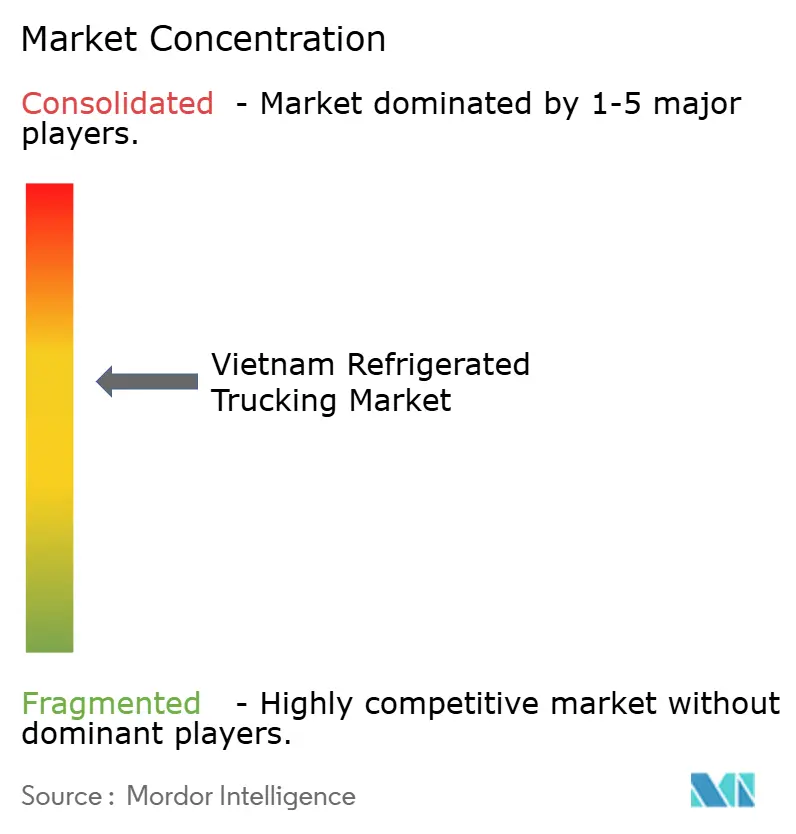
The Vietnam refrigerated trucking market is consolidated, with competition concentrated among established integrated logistics providers and specialized cold chain operators. Key domestic participants include ABA Cooltrans, Transimex, ITL Corporation, and Viet ColdChain, while Gemadept and APECTRANS participate through broader logistics networks. International companies such as DHL Group, NX Group, CJ Logistics, Konoike Vinatrans Logistics, Linfox, and Lineage extend competition across temperature-controlled transportation, warehousing, and supply chain services. These established operators compete for food, pharmaceutical, FMCG, and export cargo, with service differentiation centered on network coverage, refrigerated fleet capabilities, temperature monitoring, and reliability. Opportunities remain in underserved areas of the Mekong Delta and Central Vietnam, where operators can strengthen connections between production centers, processing facilities, and distribution hubs.
Technology and integrated service capabilities support the position of established operators. NX Group introduced NX-VISTA in August 2026 to improve visibility across orders, shipments, and inventory. In March 2026, Gemadept and CJ Logistics announced plans to optimize their strategic partnership, including logistics and shipping operations. DHL offers temperature-controlled logistics solutions with monitoring capabilities for pharmaceutical and perishable shipments. These initiatives reflect the importance of digital visibility, operational coordination, and specialized handling in serving customers with complex supply chain requirements.
Established integrated providers compete alongside independent trucking companies and subcontractors that contribute additional capacity to the market. Larger operators can differentiate their services by combining refrigerated transportation with cold storage, shipment tracking, and standardized handling procedures. Transimex, for example, operates cold storage facilities and provides logistics services for temperature-sensitive cargo, including seafood. As competition centers on service consistency and end-to-end cold chain capabilities, established providers can strengthen their positions through network integration, technology adoption, and targeted capacity expansion. Further consolidation opportunities may arise as customers increasingly require reliable refrigerated transport supported by documented temperature control and traceability.
Vietnam Refrigerated Trucking Industry Leaders
-
ABA Cooltrans
-
Konoike Vinatrans Logistics
-
Transimex Corporation
-
ITL Corporation
-
Nichirei TBA Logistics Vietnam
- *Disclaimer: Major Players sorted in no particular order
Recent Industry Developments
- April 2026: CJ CheilJedang signed an MOU with Bach Hoa Xanh to jointly develop processed food products, invest in refrigerated and frozen distribution infrastructure, and expand the Bibigo brand's cold-chain presence across Vietnam's grocery network.
- March 2026: Gemadept Corporation and CJ Logistics completed a strategic restructuring. CJ Logistics acquired full ownership of CJ Gemadept Logistics Holding's logistics division. At the same time, Gemadept separately contracted to acquire a 49% stake in Mekong Logistics JSC, operator of a 50,000-pallet cold storage system in the Mekong Delta.
- March 2026: Gemadept and CJ Logistics signed a Strategic Cooperation Agreement covering joint development of cold supply-chain services in the Mekong Delta and Vietnam.
- September 2025: Toan Phat Logistics, Kawanishi Warehouse, and MOL Logistics signed a strategic alliance to create the Mekong Logistics Hub, an integrated cold-chain system in Tay Ninh.
Vietnam Refrigerated Trucking Market Report Scope
| Horticultural Products |
| Dairy and Frozen Dessert Products |
| Meats, Poultry, Fish, and Seafood |
| Processed Food Products |
| Healthcare and Pharmaceutical |
| Other Applications |
| Full-Truckload (FTL) |
| Less-than-Truckload (LTL) |
| Containerized |
| Non-Containerized |
| Long Haul |
| Short Haul |
| Domestic |
| Cross-border |
| Chilled (0–5 °C) |
| Frozen (-20–0 °C) |
| Ambient |
| Deep-Frozen / Ultra-Low (Less than -20 °C) |
| Northern Vietnam |
| Central Vietnam |
| Southern Vietnam |
| By Application | Horticultural Products |
| Dairy and Frozen Dessert Products | |
| Meats, Poultry, Fish, and Seafood | |
| Processed Food Products | |
| Healthcare and Pharmaceutical | |
| Other Applications | |
| By Truckload Specification | Full-Truckload (FTL) |
| Less-than-Truckload (LTL) | |
| By Containerization | Containerized |
| Non-Containerized | |
| By Distance | Long Haul |
| Short Haul | |
| By Destination | Domestic |
| Cross-border | |
| By Temperature Type | Chilled (0–5 °C) |
| Frozen (-20–0 °C) | |
| Ambient | |
| Deep-Frozen / Ultra-Low (Less than -20 °C) | |
| By Region | Northern Vietnam |
| Central Vietnam | |
| Southern Vietnam |
Key Questions Answered in the Report
What is the forecast growth rate for refrigerated trucking in Vietnam?
The Vietnam refrigerated trucking market is forecast to register at a 6.97% CAGR from 2027 to 2032, reaching USD 2.28 billion by 2032.
Which application has the largest refrigerated trucking demand in Vietnam?
Meats, poultry, fish, and seafood lead the application mix with 37.86% share in 2026, supported by seafood processing and export freight.
What is driving demand for smaller refrigerated deliveries?
Retail expansion, online grocery activity, and pharmaceutical distribution support LTL growth at an 11.26% CAGR through 2032.
Which Vietnamese region leads refrigerated trucking activity?
Southern Vietnam leads with 48.37% share in 2026 because it combines food processing, cold storage, consumer distribution, and port access.
What are the main operational challenges for refrigerated carriers?
Energy and equipment costs, limited regional infrastructure, empty backhauls, and urban truck restrictions constrain fleet efficiency.
How are logistics companies improving cold-chain services in Vietnam?
Companies are investing in cold facilities, supply-chain visibility platforms, route optimization, and digital traceability records.