
Vietnam Office Real Estate Market Size and Share
Market Overview
| Study Period | 2021 - 2032 |
|---|---|
| Forecast Data Period | 2027 - 2032 |
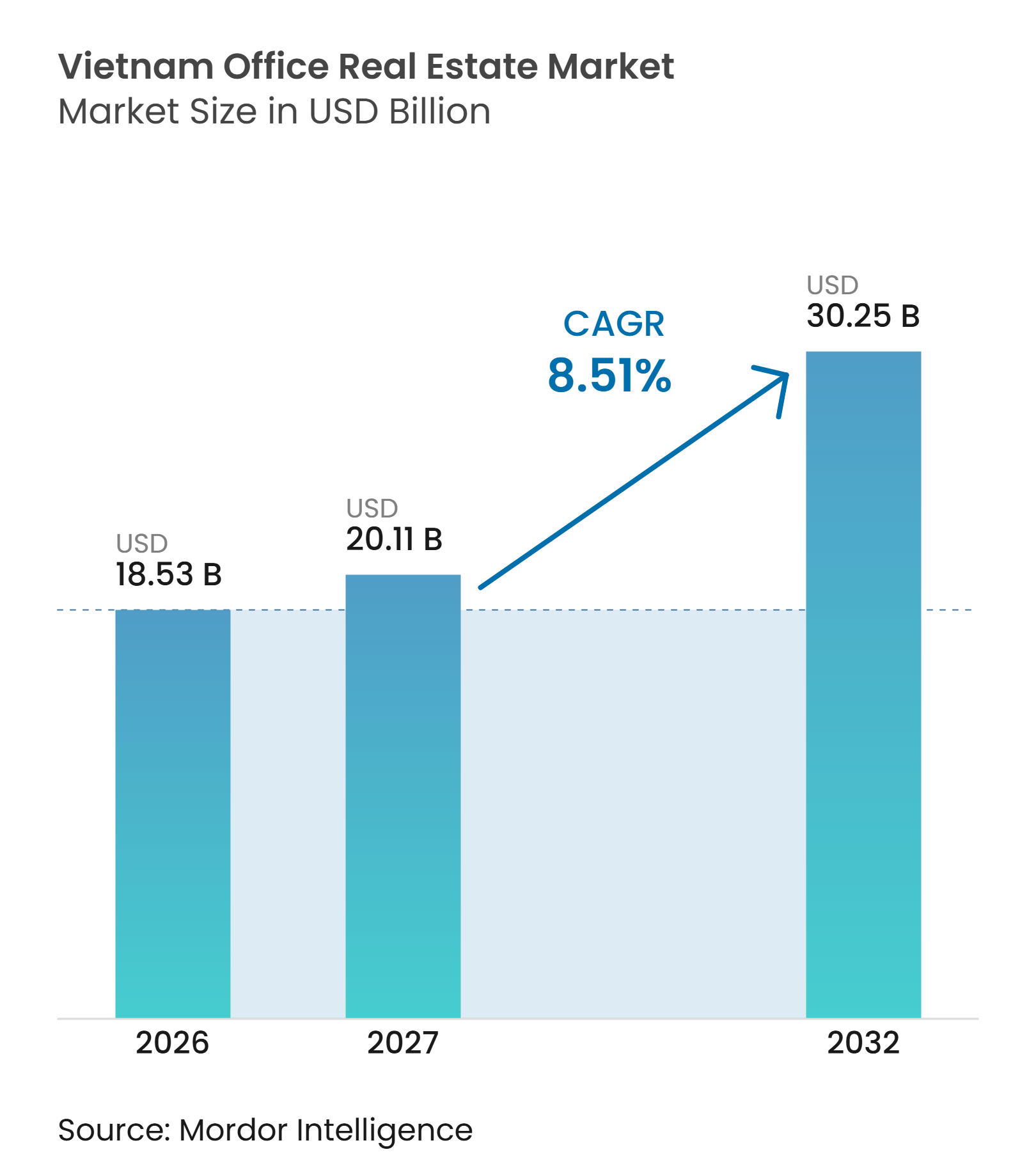
| Base Year Market Size (2026) | USD 18.53 Billion |
| Market Size (2027) | USD 20.11 Billion |
| Market Size (2032) | USD 30.25 Billion |
| Growth Rate (2027 - 2032) | 8.51 % |
| Market Concentration | Medium |
Major Players *Disclaimer: Major Players sorted in no particular order Image © Mordor Intelligence. Reuse requires attribution under CC BY 4.0. | |
Vietnam Office Real Estate Market Analysis by Mordor Intelligence
The Vietnam Office Real Estate Market size was valued at USD 18.53 billion in 2026 and is projected to grow from USD 20.11 billion in 2027 to USD 30.25 billion by 2032, registering a CAGR of 8.51% during the 2027–2032 forecast period.
Foreign direct investment and the expansion of domestic technology and financial services companies continue to support demand for modern workspace in Ho Chi Minh City and Hanoi. The Vietnam office real estate market is moving toward more selective demand, as occupiers favor efficient floor plates, reliable transport access, and buildings with recognized environmental credentials. This preference supports premium assets but also keeps Grade B offices relevant for tenants that need quality space at lower entry costs. Flexible workspace operators are widening their footprint in major cities, which gives companies more options to combine conventional leases with adaptable space. New Grade A supply has created short-term vacancy pressure in selected submarkets, although leasing absorption is expected to improve as the new buildings mature. This balance between new supply and tenant demand makes leasing quality, building standards, and submarket access central to the outlook for owners, investors, and occupiers.
Key Report Takeaways
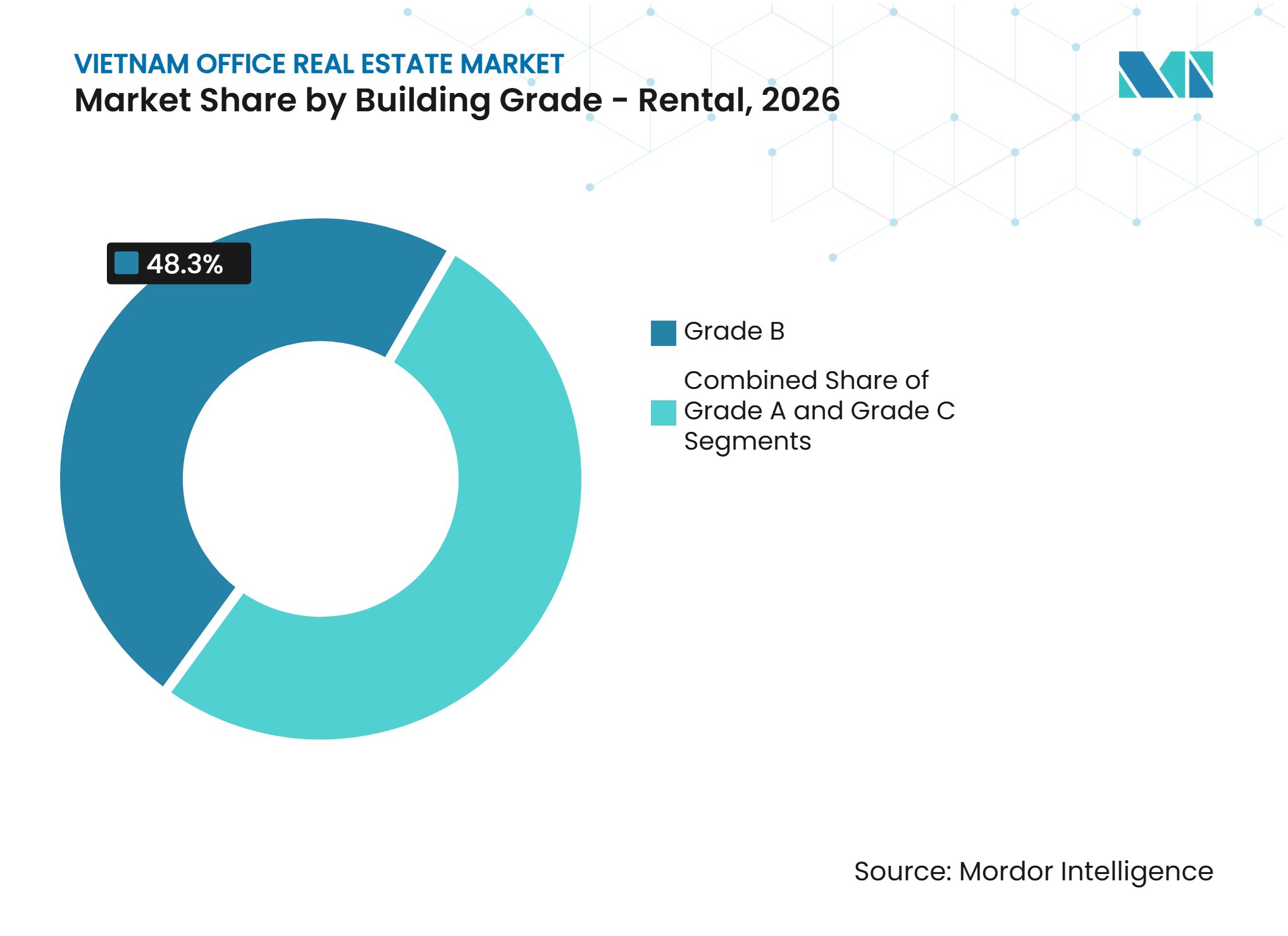
- By building grade in rentals, Grade B held 48.3% of the Vietnam office real estate market share in 2026, while Grade A is forecast to grow at a 9.15% CAGR through 2032.
- By end use in rental, information technology (IT and ITES) accounted for 31.2% of the Vietnam office real estate market share in 2026 and is projected to expand at a 9.2% CAGR through 2032.
- By geography in rental, Ho Chi Minh City held 48.7% of the Vietnam office real estate market in 2026, while the rest of Vietnam is forecast to grow at a 9.55% CAGR through 2032.
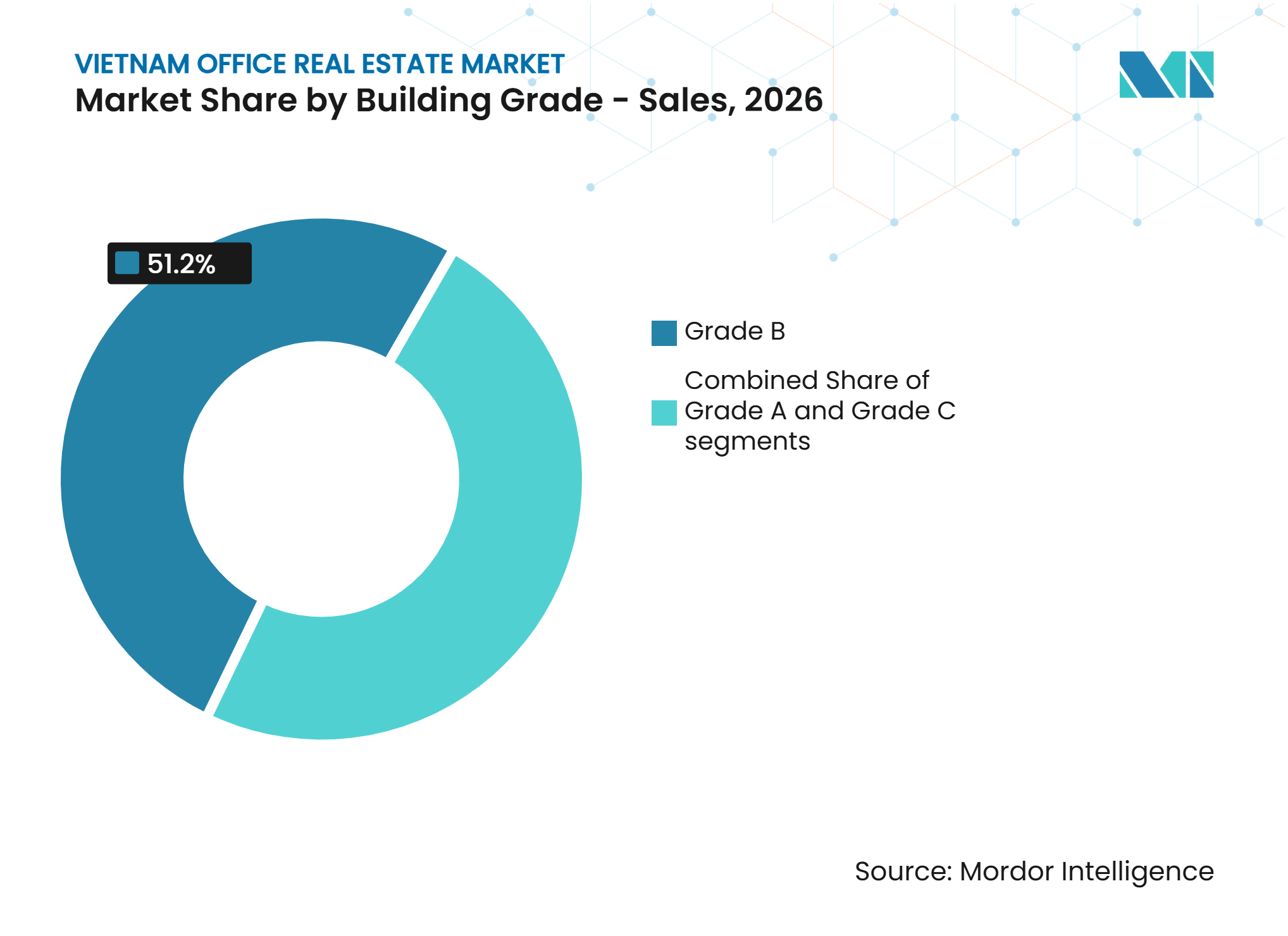
- By building grade in sales, Grade B accounted for 51.2% of the Vietnam office real estate market size in 2026, while Grade A sales are projected to grow at a 9.04% CAGR through 2032.
Note: Market numbers in this report are based on Mordor Intelligence's proprietary estimation framework, which combines nine months of actuals with Q4 projections for base year 2026.
Market Trends and Insights
Drivers Impact Analysis of Vietnam Office Real Estate Market*
| Drivers | (~) % Impact on CAGR Forecast | Geographic Relevance | Impact Timeline |
|---|---|---|---|
| FDI and Multinational Corporate Expansion | +2.1% | Ho Chi Minh City and Hanoi, with Da Nang emerging | Short term (≤ 2 years) |
| Domestic Technology and Financial Services Expansion | +1.9% | Ho Chi Minh City and Hanoi | Medium term (2-4 years) |
| Corporate Flight to Quality | +1.5% | Ho Chi Minh City, with growing relevance in Hanoi | Short term (≤ 2 years) |
| Flexible and Serviced Office Expansion | +1.2% | Ho Chi Minh City, Hanoi, and Da Nang | Medium term (2-4 years) |
| Metro Network Expansion | +0.8% | Ho Chi Minh City and Hanoi corridor areas | Medium term (2-4 years) |
| Corporate Sustainability Requirements | +0.7% | National, concentrated in Ho Chi Minh City Grade A assets | Long term (≥ 4 years) |
| Source: Mordor Intelligence | |||
FDI and Multinational Corporate Expansion Anchor Premium Office Demand
Foreign direct investment remains a major source of leasing demand in the Vietnam office real estate market. International occupiers are particularly relevant to the health of premium buildings in Ho Chi Minh City and Hanoi. Their requirements often include large floor plates, professional building management, and locations that support access to clients and staff. This makes investment policy and corporate expansion plans important to leasing conditions. Ho Chi Minh City’s enlarged administrative footprint may broaden the locations considered by corporate occupiers. Buildings that support regional teams, larger occupancies, and formal sustainability reporting requirements are better placed to compete for this demand.
Domestic Technology and Financial Services Companies Deepen Office Footprints
Domestic technology businesses add a separate source of demand that is not wholly dependent on foreign investment cycles. Technology companies often need continuous floor plates and building systems that support staff-intensive operations. The Vietnam office real estate market benefits when these firms expand engineering, product, operations, and service teams. Financial services companies also contribute through local bank expansion, insurance administration, and regional back-office activity. These occupiers can support newer buildings outside the traditional central business district when those locations provide more space and better cost value. Their presence also makes demand more diverse across established and emerging office corridors.
Corporate Flight to Quality Turns Relocation Into a Workplace Upgrade
Relocation decisions increasingly depend on building quality rather than rental costs alone. Companies use modern workplaces to attract and retain employees, particularly in skilled technology and professional services roles. Grade A assets with green certifications and efficient operating systems are better positioned to meet these requirements. Consequently, competition in the Vietnam office real estate market is intensifying around workplace quality, building performance, and tenant experience. This shift places pressure on older buildings that cannot enhance their energy performance, layouts, or tenant amenities. It also encourages landlords to invest in upgrades that improve the long-term relevance of existing assets.
Flexible and Serviced Office Operators Support Adaptable Demand
Flexible space has become an increasingly established component of occupier planning in the Vietnam office real estate market. JustCo entered Vietnam in December 2025 with its first center at Riverfront Financial Centre in Ho Chi Minh City, expanding its network into a new Southeast Asian market[1]. The flexible workspace model offers private offices, hot desks, and meeting rooms, catering to teams with fluctuating headcounts. Flexible workspace operators can also provide conventional tenants with short-term capacity without requiring them to expand their permanent leased area. This model supports a hybrid workplace strategy, in which companies maintain a core office while using flexible locations for project teams or distributed staff. As a result, occupiers have greater flexibility and choice, although flexible space may reduce the conventional office space requirements of some companies.
Restraints Impact Analysis of Vietnam Office Real Estate Market*
| Restraints | (~) % Impact on CAGR Forecast | Geographic Relevance | Impact Timeline |
|---|---|---|---|
| New Grade A Supply and Vacancy Pressure | -1.8% | Ho Chi Minh City central business district and inner districts, and West Hanoi | Short term (≤ 2 years) |
| Fit-Out and Relocation Costs | -1.2% | Ho Chi Minh City and Hanoi | Medium term (2-4 years) |
| Complex Land-Use Regulations and Approvals | -1.0% | National, particularly Tier 2 and Tier 3 cities | Long term (≥ 4 years) |
| Hybrid Work and Space Optimization | -0.8% | Ho Chi Minh City and Hanoi occupier base | Medium term (2-4 years) |
| Source: Mordor Intelligence | |||
Grade A Supply Wave Creates Transient Vacancy Pressure
New supply can increase vacancy rates before buildings reach stabilized occupancy levels. Marina Central Tower added 69,400 square meters of office space in the second quarter of 2025, increasing the Grade A vacancy rate in Ho Chi Minh City to 22.8%. Excluding newly completed buildings, the vacancy rate stood at 14.8%, indicating that fresh supply largely drove the increase. This distinction is important for owners, as lease-up periods can delay rental stabilization even when underlying demand remains healthy. New towers may require time to build their tenant base, particularly when multiple high-quality assets enter the market simultaneously. Consequently, the Vietnam office real estate market may record weaker short-term headline occupancy rates without indicating a fundamental decline in occupier demand.
Fit-Out Costs Widen the Affordability Gap for Mid-Tier Tenants
Fit-out and relocation costs can limit smaller occupiers’ ability to move into premium buildings. According to the draft’s cited design-and-build benchmarks, modern fit-outs in Ho Chi Minh City’s central business district require investment of USD 600-1,200 per square meter. Small and medium-sized enterprises often find it difficult to absorb the costs of raised floors, data cabling, air-conditioning distribution, and interior works over short lease terms. In contrast, large multinational tenants can distribute these costs over longer lease commitments and may receive landlord support. As a result, Grade B and Grade C assets remain important for tenants seeking lower upfront commitments. These costs also slow occupiers’ transition from older space to the highest-grade buildings.
*Our forecasts treat driver/restraint impacts as directional, not additive. The impact forecasts reflect baseline growth, mix effects, and variable interactions.
Vietnam Office Real Estate Market Segment Analysis
By Building Grade - Rental:
Grade B Accounts for the Largest Share, While Grade A Gains MomentumGrade B is projected to account for 48.3% of the Vietnam office real estate market, by rental value, in 2026, while Grade A is forecast to expand at a CAGR of 9.15% through 2032. Grade B office stock is ideal for domestic technology companies, banks, and multinational divisions that want modern specifications while managing occupancy costs. These buildings are available across established central business districts and decentralized corridors, providing tenants with a wider range of location options. The segment also benefits from its balance of quality, pricing, and practical building standards. Consequently, the Vietnam office real estate industry continues to rely on Grade B offices to serve the broadest tenant base. Grade A is expected to grow faster, supported by tenant relocations to newer and greener premises.
Grade A buildings increasingly compete based on recognized building performance, in addition to location and design. Vietnam’s QCVN 09:2017/BXD energy-efficiency code establishes a compliance baseline for new nonresidential buildings[2]. Green credentials are becoming increasingly important as tenants require building data and verified performance metrics for environmental reporting. Older Grade C properties face greater challenges, as some cannot meet the layout, efficiency, or workplace standards offered by newer assets. Where office repositioning is not viable, owners may consider alternative uses, including serviced apartments, co-living spaces, or creative studios. This widening quality gap strengthens the role of premium assets while maintaining demand for cost-conscious Grade B office space.



By End Use - Rental:
Information Technology (IT and ITES) Commands the Largest Share and Sustains Strong GrowthInformation Technology (IT and ITES) accounted for 31.2% of rental value in 2026 and is forecast to record a 9.2% CAGR through 2032. This makes the segment both the largest and the fastest-growing end-use category in the Vietnam office real estate market. Technology occupiers commonly need larger floor plates than consulting and financial-services tenants. Their space requirements support campus-style and open-plan buildings with reliable digital infrastructure. Demand is also moving beyond traditional downtown districts as technology businesses seek larger sites and access to wider talent pools. The sector’s requirements encourage development of office clusters that can combine space, amenities, and transport connections.
Ho Chi Minh City’s southern submarket reflects the growing attraction of decentralized locations for technology companies, multinational capability centers, and banks. Companies in these sectors often seek modern buildings with room to accommodate larger teams. This can favor locations outside the central business district where land and building formats allow more flexible layouts. Banking, financial services, and insurance remain the second-largest tenant group. Consulting and professional-services firms often favor central Grade A buildings because client access and address quality remain important to their business. Other services, including retail, life sciences, energy, and legal firms, provide a more diverse but less concentrated stream of demand.
By Building Grade - Sales:
Grade B Holds the Largest Market Share, While Grade A Strengthens Its PositionGrade B properties represented 51.2% of sales value in 2026, while Grade A sales are forecast to advance at a 9.04% CAGR through 2032. Grade B assets appeal to buyers because they often have established occupiers, shorter stabilization periods, and more predictable cash flow. Grade A assets are attracting interest when they provide verified energy performance, stronger tenant retention, and a recognizable quality position. The Vietnam office real estate industry is therefore seeing a clearer distinction between assets bought for immediate income and assets bought for premium long-term positioning. Buyers must still consider lease-up risk in recently completed buildings. This makes building quality, tenant mix, and location equally important to transaction decisions.
Daikin Air Tower in Ho Chi Minh City shows the direction of newer Grade A product. It received LEED Platinum v4, LOTUS Platinum, and WELL Platinum certification after its 2025 completion[3]. These certifications can support occupier reporting requirements and distinguish the asset in a competitive leasing environment. They also show that environmental performance, occupant health, and design standards can be addressed in a single office asset. For investors, this can improve the clarity of the asset’s positioning when assessing demand from international occupiers. For tenants, certification provides an external reference point when comparing operating standards across available buildings. Domestic institutional buyers are also becoming more active alongside Singapore-listed real estate investment trusts and private equity funds. This adds depth to the buyer base for stabilized commercial properties. Grade C office sales remain less liquid because transactions are often driven by conversion potential rather than long-term office investment.

Geography Analysis
Ho Chi Minh City
Ho Chi Minh City accounted for 48.7% of rental value in 2026. The city remains the main commercial center because it concentrates multinational headquarters, higher-grade stock, and the country’s largest consumer base. The Vietnam office real estate market is sensitive to investment and technology-sector decisions because those occupiers have a strong presence in the city. New commercial locations in Thu Thiem and South Saigon can offer quality buildings at lower rents than the central business district. Ministry of Construction standards and the QCVN 09:2017/BXD energy-efficiency code shape expectations for new buildings. Owners that can demonstrate efficient operations and credible green certification should be better positioned for corporate leasing mandates.
Rest of Vietnam
The rest of Vietnam is forecast to grow at a 9.55% rental CAGR between 2027 and 2032. Da Nang is adding technology, professional services, and flexible-workspace activity to its established tourism economy. Bac Ninh has office demand linked to engineering, procurement, and supply-chain roles that serve its manufacturing base. Hai Phong benefits from logistics and export-manufacturing activity associated with its deepwater port. These secondary markets can gain commercial depth as transport, industrial clusters, and services expand together. Their progress will depend on whether office supply reaches the right quality and scale for corporate tenants. Companies entering these locations can benefit from lower operating costs and closer access to production clusters. The pattern favors developments that support local business activity and corporate support functions related to industrial investment. It also makes practical building formats, reliable utilities, and access to transport as important as a central address. This growth is likely to remain uneven because each city has a different economic base, occupier profile, and level of available commercial stock.
Hanoi and Secondary Commercial Nodes
Hanoi’s office base is expanding beyond the traditional central business district as new developments move toward western corridors. Tenant preference for higher-quality premises supports a greater focus on modern specifications and green certification. Resolution No. 188/2025/QH15 supports faster urban railway development through transit-oriented development mechanisms. This framework may improve the appeal of office sites near planned stations as land allocation and higher-density development become more practical. The Vietnam office real estate market could therefore develop more distinct office clusters around transport corridors. Capital Place received dual LEED certifications in January 2025, showing how verified building performance is becoming part of prime-office positioning in Hanoi. This approach provides a clear reference point for other owners seeking to attract corporate tenants.
Competitive Landscape
Market Concentration
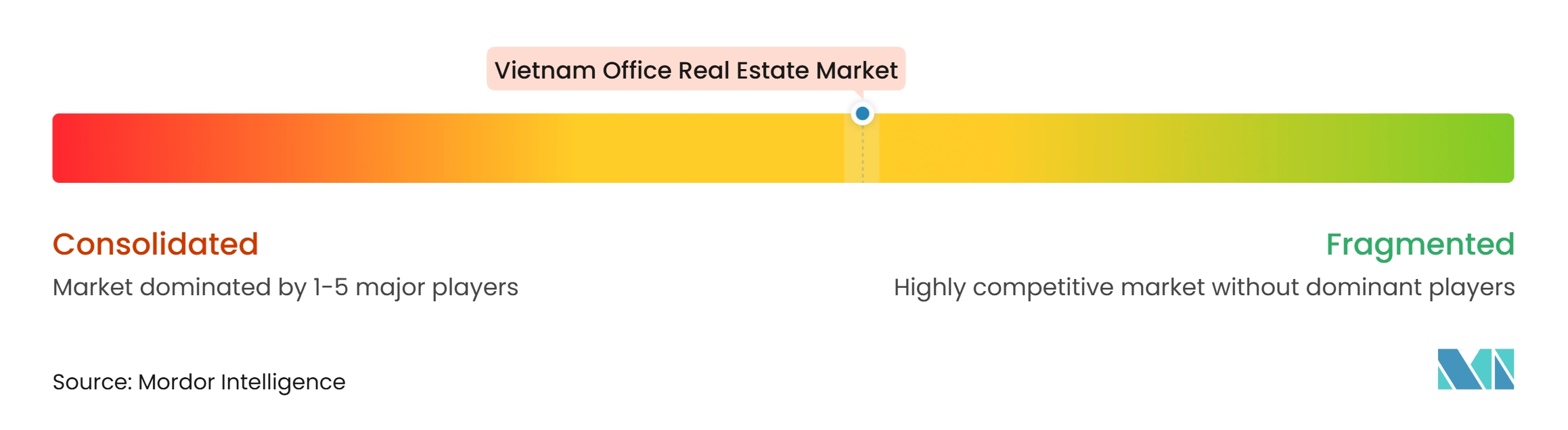
The Vietnam office real estate market is moderately fragmented among developers. CapitaLand Development, Mapletree Investments, Keppel Land, and Frasers Property have extensive experience in developing high-quality office properties in Vietnam. Domestic groups, including Vingroup, BRG Group, Trung Thuy Group, and Indochina Kajima, compete for major commercial opportunities in Ho Chi Minh City and Hanoi. Capital Place received LEED Platinum certification for operations and maintenance and LEED Gold certification for design and construction in January 2025. These credentials position sustainability and building operations as important competitive factors for attracting prime tenants. Competition also extends to flexible workspace formats, transit-oriented projects, and developments in secondary cities.
Companies are using partnerships, acquisitions, and new-site developments to strengthen their market positions. Keppel unlocked SGD 354 million (USD 270.4 million) through a strategic partnership for Saigon Sports City in August 2025, while retaining a 30% interest in the integrated township. This structure supports Keppel’s asset-light strategy while maintaining long-term exposure to the project’s development potential. UOA Group acquired a central business district site in Ho Chi Minh City for USD 68 million and committed USD 120 million to develop the sustainable Grade A Parc Tower. The project targets LEED Gold and WELL Silver certifications, with completion planned for 2028. These initiatives indicate that location, building performance, and capital discipline are closely connected in current development strategies.
Flexible workspace providers are also expanding occupier choices. JustCo opened its first Vietnam center at Riverfront Financial Centre in December 2025, offering private offices, hot desks, and meeting rooms. Its entry will add a regional operator to the growing flexible workspace supply in Ho Chi Minh City. Daibiru’s CornerStone Building in Hanoi achieved LEED Platinum certification for operations and maintenance in October 2025. Companies that combine low-carbon building operations with reliable tenant services can strengthen their appeal to larger corporate occupiers. This competitive environment favors owners that can translate building performance into clear value for tenants.
Vietnam Office Real Estate Industry Leaders
-
CapitaLand Development
-
Mapletree Investments
-
Keppel Land
-
Frasers Property
-
Vingroup
- *Disclaimer: Major Players sorted in no particular order
Vietnam Office Real Estate Market Companies Covered in this Report
- CapitaLand Development
- Mapletree Investments
- Keppel Land
- Frasers Property
- Vingroup
- An Khanh JVC
- Phu My Hung Development Corporation
- Tan Thuan Industrial Promotion Corporation (IPC)
- SonKim Land
- Sovico Group
- Novaland Group
- Gaw Capital Partners
- Trung Thuy Group
- BRG Group
- Geleximco Group
- Indochina Kajima
- JLL
- CBRE
- Savills
- Cushman & Wakefield
- Knight Frank
- Colliers
- NAI Vietnam
- Regus Group
- Toong
Recent Industry Developments in Vietnam Office Real Estate Market
- October 2026: Mapletree has appointed Cushman & Wakefield Vietnam as the lead leasing agent for Boulevard Tower, a 36-story Grade A office tower under development in Hanoi’s Starlake New Urban Area. The project will offer approximately 64,700 square meters of net lettable office area and target LEED Gold certification.
- July 2026: UOB Vietnam broke ground on UOB Plaza Ho Chi Minh City, becoming the first foreign bank to develop and own a purpose-built headquarters within the Vietnam International Financial Centre, Ho Chi Minh City (VIFC-HCMC). The 36-storey, 160-metre Grade A office tower at 2 Ton Duc Thang Street in the Ba Son area is designed by Gensler and is targeting BCA Green Mark certification, with an investment of approximately USD 450 million and completion planned for 2030.
- July 2026: Indochina Kajima and its partners held the topping-out ceremony for Parc Hanoi. The 23-storey Grade A office building in Starlake Tay Ho Tay, Hanoi, will provide 45,033 sq m of net leasable area, including 2,653 square meters of retail space. Constructed by Kajima Vietnam with support from Kajima Corporation, the project incorporates Japanese construction quality standards, has achieved LEED Gold and WELL Platinum certifications, and is scheduled to begin operations in Q1 2027.
Vietnam Office Real Estate Market Report Scope
Segmentation Overview
| Grade A |
| Grade B |
| Grade C |
| By Building Grade - Sales | Grade A |
| Grade B | |
| Grade C |
Key Questions Answered in the Report
What is the forecast growth rate for Vietnam office real estate through 2032?
The Vietnam office real estate market is projected to grow at an 8.51% CAGR from 2027 to 2032 and reach USD 30.25 billion by 2032.
Which office grade leads rental demand in Vietnam?
Grade B leads rental value with 48.3% in 2026, while Grade A is projected to grow faster at a 9.15% CAGR through 2032.
Why are green-certified office buildings gaining importance in Vietnam?
Corporate tenants increasingly seek verified energy performance and certifications that support sustainability reporting. Daikin Air Tower received LEED, LOTUS, and WELL Platinum certifications in 2025.
Which occupiers are driving office leasing in Vietnam?
Information Technology (IT and ITES) led rental value with 31.2% in 2026 and are also the fastest-growing end-use segment at a 9.2% CAGR through 2032.
Which geography is expected to grow fastest for office rentals?
The rest of Vietnam is forecast to grow at a 9.55% CAGR through 2032, supported by development in Da Nang, Bac Ninh, and Hai Phong.
How are metro projects likely to affect office location choices in Vietnam?
Transit-oriented development mechanisms under Resolution No. 188/2025/QH15 may improve the attractiveness of office locations near planned railway stations.