
Vietnam Less Than-Truckload (LTL) Market Size and Share
Market Overview
| Study Period | 2021 - 2032 |
|---|---|
| Forecast Data Period | 2027 - 2032 |
| Base Year Market Size (2026) | USD 5.14 Billion |
| Market Size (2027) | USD 5.54 Billion |
| Market Size (2032) | USD 7.90 Billion |
| Growth Rate (2027 - 2032) | 7.35 % |
| Market Concentration | Low |
Major Players *Disclaimer: Major Players sorted in no particular order Image © Mordor Intelligence. Reuse requires attribution under CC BY 4.0. | |
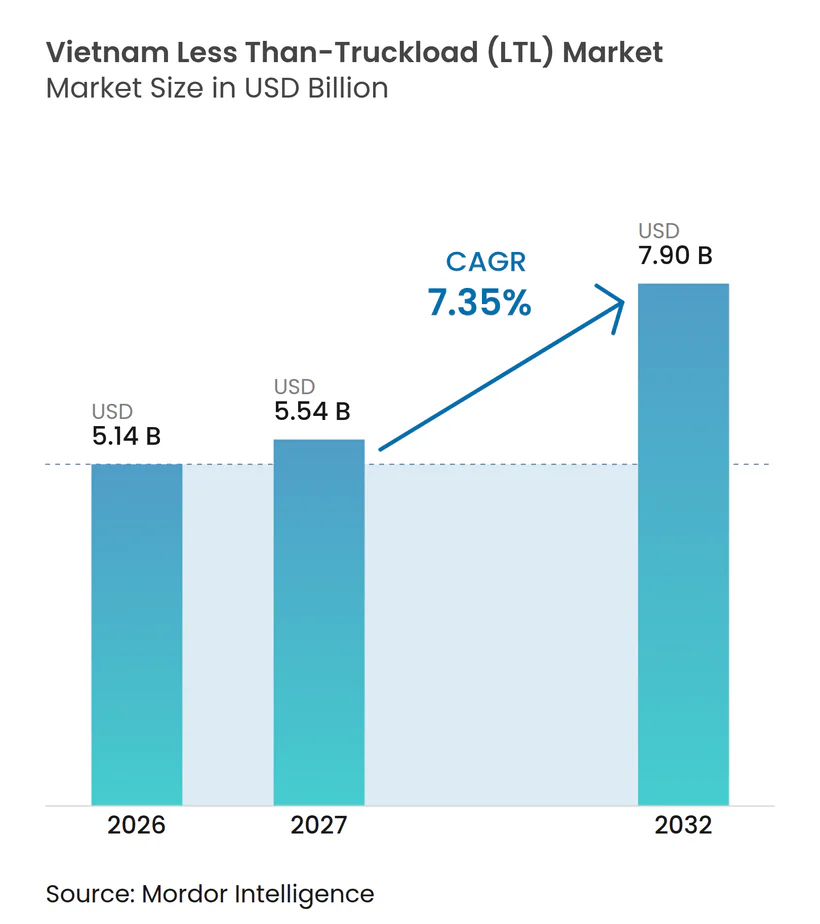
Vietnam Less Than-Truckload (LTL) Market Analysis by Mordor Intelligence
The Vietnam less-than truckload (LTL) market size is valued at USD 5.14 billion in 2026 and is estimated to grow from USD 5.54 billion in 2027 to reach USD 7.90 billion by 2032, at a CAGR of 7.35% during the forecast period (2027-2032).
Manufacturing sourcing, e-commerce order fragmentation, and modern retail expansion are increasing the need to consolidate smaller shipments across long domestic corridors. Vietnam’s import-export turnover exceeded USD 930 billion in 2025, which supported freight flows between factories, distribution centers, and ports. The Vietnam less-than truckload (LTL) market is also moving toward more formal service models as shippers require visibility, documented handling, and predictable delivery windows. Large operators are responding through hub investment, fleet additions, joint ventures, and warehouse capacity, while smaller carriers face higher compliance and operating requirements. The Vietnam less-than truckload (LTL) market, therefore, offers room for providers that can combine route density, cross-docking capability, and digital dispatch without relying on one-way truckloads.
Key Report Takeaways
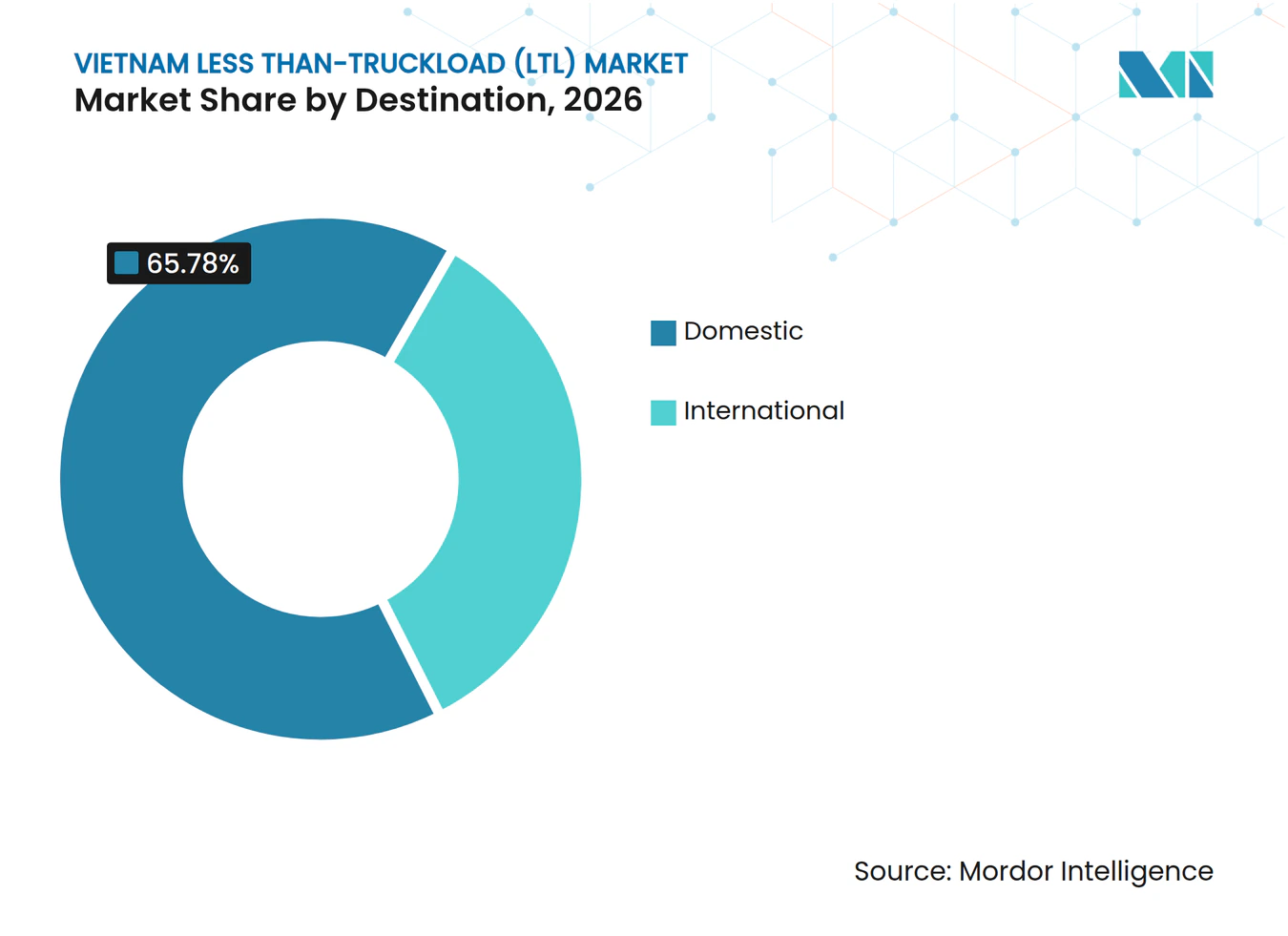
- By destination, domestic shipments account for 65.78% of Vietnam less-than truckload (LTL) market share in 2026, while international LTL is forecast to register a 9.39% CAGR through 2032.
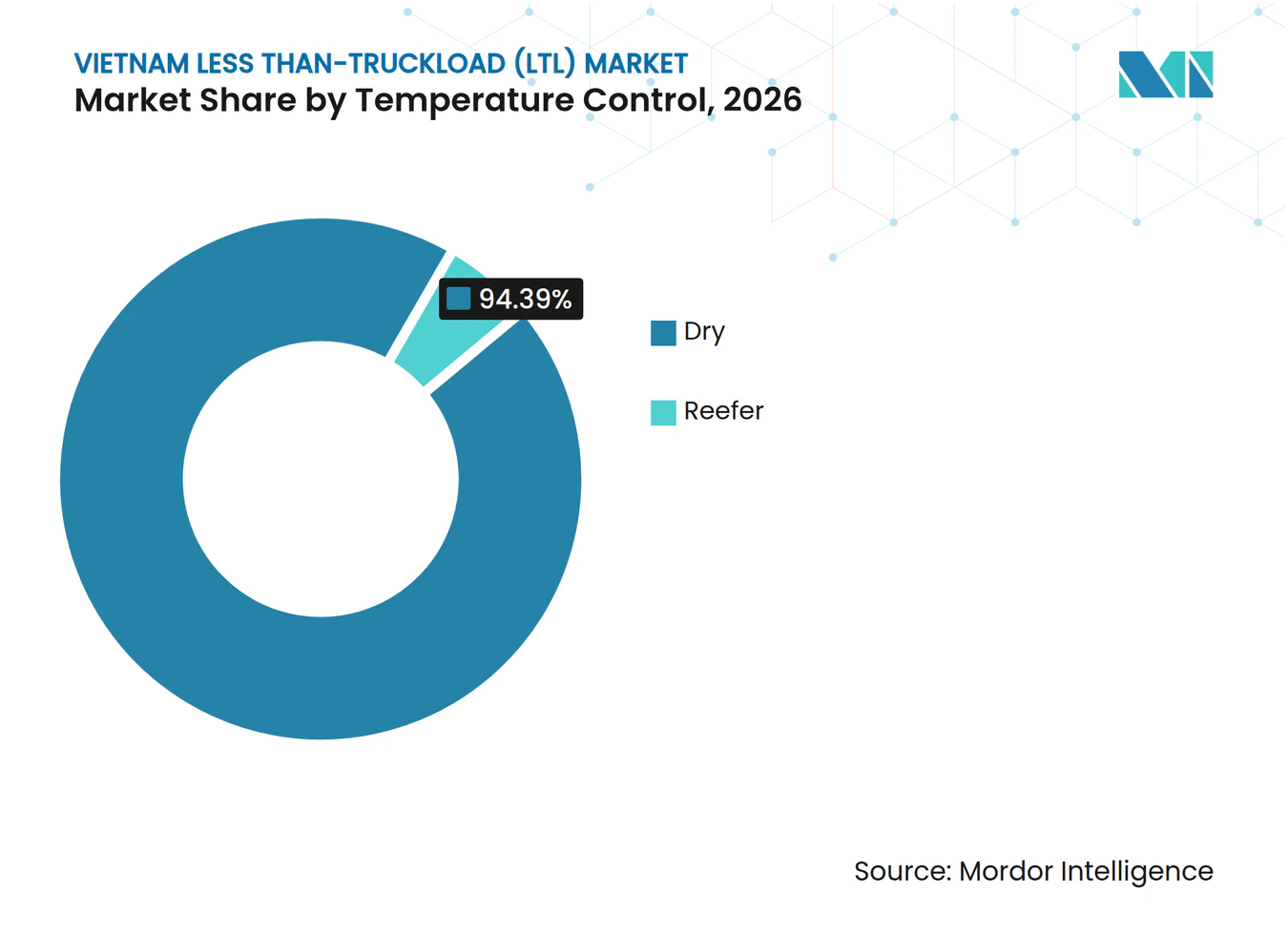
- By temperature control, dry freight accounts for 94.39% of the Vietnam less-than truckload (LTL) market size in 2026, while reefer is forecast to grow at a 10.56% CAGR through 2032.
- By end-user industry, manufacturing accounts for 35.83% of the Vietnam less-than truckload (LTL) market share in 2026, while wholesale and retail trade is forecast to register an 8.97% CAGR through 2032.
- By r, Southern Vietnam accounts for 43.62% of the Vietnam less-than truckload (LTL) market size in 2026, while Central Vietnam is forecast to register a 9.24% CAGR through 2032.
Note: Market numbers in this report are based on Mordor Intelligence's proprietary estimation framework, which combines nine months of actuals with Q4 projections for base year 2026.
Vietnam Less Than-Truckload (LTL) Market Trends and Insights
Drivers Impact Analysis*
| Driver | (~) % Impact on CAGR Forecast | Geographic Relevance | Impact Timeline |
|---|---|---|---|
| E-Commerce Growth and Shipment Consolidation | +1.8% | National, concentrated in Hanoi, Ho Chi Minh City, and Da Nang | Medium term (2-4 years) |
| Industrial Zone Expansion and Distribution Demand | +1.5% | Northern Vietnam and Southern Vietnam | Long term (≥ 4 years) |
| Modern Retail and Replenishment Demand | +1.2% | Southern and Northern Vietnam, extending into the Central and rural areas | Medium term (2-4 years) |
| Agricultural Export and Consolidated Freight Demand | +0.9% | Central and Southern Vietnam | Medium term (2-4 years) |
| Digital Freight Matching and Backhaul Utilization | +0.8% | National, led by the Ho Chi Minh City-Hanoi corridor | Short term (≤ 2 years) |
| Network Professionalization and Service Reliability | +0.6% | National | Long term (≥ 4 years) |
| Source: Mordor Intelligence | |||
E-Commerce Growth Increasing Fragmented Shipment Consolidation Demand
The Vietnam less-than truckload (LTL) market benefits as live commerce and online retail create small, frequent orders that need collection and consolidation from regional fulfillment locations. Smaller loads are less suited to dedicated truck routes because shipment timing and destination patterns vary across the day. Vietnam’s 2026 e-commerce rules are raising platform compliance and tax transparency requirements, which favor logistics providers able to meet documented service standards. Larger marketplaces can also set more consistent delivery requirements for their 3PL partners. This combination supports broader formalization of LTL services on e-commerce corridors.
Industrial Zone Expansion Strengthening Regional Distribution Demand
The Vietnam less-than truckload (LTL) market gains from the movement of components, packaging, finished goods, and maintenance supplies between factories and warehouses. The VSIP joint venture received approval for 5 industrial parks across Hai Phong, Nghe An, Hue, Ha Nam, and Ho Chi Minh City in 2026. Vietnam recorded USD 38.4 billion in registered FDI in 2025, with manufacturing receiving the largest share. These facilities create multi-directional freight flows that often do not justify full truckload capacity. Industrial clusters also create a clearer basis for terminal operators to build route density and scheduled collection services.
Modern Retail Expansion Increasing Frequent Replenishment Shipments
Vietnam’s retail and consumer-services revenue reached USD 269 billion in 2025, including USD 57 billion in modern trade. The Vietnam less-than truckload (LTL) market is supported when supermarkets, mini-marts, and convenience stores need frequent replenishment in smaller quantities. Masan planned to expand the WinMart and WiN network to 6,100 stores by the end of 2026, with 70% of additions aimed at rural and peri-urban locations. Central Retail committed USD 1.4 billion through 2027, while Aeon Vietnam committed USD 1.5 billion over 10 years for Vietnamese distribution networks. Store networks outside the largest cities often need 3-5 deliveries each week at sub-pallet volumes. These patterns favor planned, multi-stop services instead of dedicated full-truck deliveries.
Agricultural Export Growth Increasing Consolidated Freight Demand
Agriculture, forestry, and fisheries exports exceeded USD 70 billion for the first time in 2025, with the government setting a USD 100 billion target for 2030. The Vietnam less-than truckload (LTL) market is relevant to farm-gate collection, aggregation, and transport to processing facilities or ports. Producers in the Mekong Delta, Central Highlands, and coastal provinces commonly generate volumes below a single truckload. Logistics costs consumed 20-25% of agricultural product value, creating a strong incentive to improve consolidation. Decision No. 5223/QĐ-BNNMT calls for expanded cold-storage logistics centers in important production zones. This policy direction supports more temperature-controlled collection and distribution capacity[1].
Restraints Impact Analysis*
| Restraint | (~) % Impact on CAGR Forecast | Geographic Relevance | Impact Timeline |
|---|---|---|---|
| Fragmented Owner-Operators and Service Consistency | -1.0% | National, most acute on North-South long-haul routes | Medium term (2-4 years) |
| Empty Return Imbalances and Network Efficiency | -0.8% | National, most acute on the northbound Ho Chi Minh City-Hanoi routes | Long term (≥ 4 years) |
| Urban Congestion and Delivery Reliability | -0.6% | Ho Chi Minh City, Hanoi, and Da Nang | Short term (≤ 2 years) |
| Cold-Chain Compliance and Operating Costs | -0.5% | National, concentrated in agricultural export corridors and pharmaceutical hubs. | Medium term (2-4 years) |
| Source: Mordor Intelligence | |||
Fragmented Owner-Operators Limiting Capacity and Service Consistency
In 2025, 84% of Vietnamese trucks reportedly belonged to owner-operators operating fleets of fewer than 10 vehicles[2]. This structure limits the ability of the Vietnam less-than truckload (LTL) market to standardize fleet technology and dispatch practices at scale. Decree 168/2024/ND-CP increased compliance requirements under the 2025 Road Traffic Law. Smaller carriers can find it difficult to plan rest periods and meet delivery windows without formal dispatch systems. The gap creates an opening for fleet-sharing and hub-and-spoke structures that let small owners access shared capacity. It also increases the value of operators that can offer documented, predictable service to institutional shippers.
Empty Return Imbalances Reducing Long-Haul Network Efficiency
A significant share of northbound journeys on the Ho Chi Minh City–Hanoi route return empty, highlighting persistent backhaul imbalances. The imbalance lowers asset utilization and can pressure pricing on better-filled southbound legs. The Vietnam less-than truckload (LTL) market addresses part of this problem by combining smaller return shipments into a shared route. However, route consolidation needs sufficient terminal density and steady shipper participation. Digital spot matching alone may not create enough regular volume on lower-density northern routes. Seino-ITL Logistics and DHL Supply Chain have pursued hub capacity in Hung Yen, which could support more structured northbound consolidation.
*Our forecasts treat driver/restraint impacts as directional, not additive. The impact forecasts reflect baseline growth, mix effects, and variable interactions.
Segment Analysis
By Destination: Domestic Backbone Dominates While Cross-Border Flows Accelerate
Domestic shipments account for 65.78% of the Vietnam less-than truckload (LTL) market share in 2026. The domestic network serves North-Central-South manufacturing links and modern retail replenishment routes across the country. Vietnam’s administrative and production geography creates regular inter-provincial flows of components, consumer goods, and packaging. These cargo movements often remain below a dedicated truckload. The Vietnam LTL industry can improve truck use by combining compatible loads at regional hubs. Domestic route density also gives operators a foundation for fixed schedules, repeat collections, and delivery commitments. Greater route consistency can make smaller shipments more practical for factories and retailers.
International LTL is forecast to register at a 9.39% CAGR from 2027 to 2032. Cambodia, Laos, and southwestern China are the principal cross-border areas. The ASEAN Customs Transit System is progressively simplifying procedures across 6 ASEAN member states. Cross-border freight requires stronger customs, documentation, and service controls than domestic routes. Seino-ITL Logistics planned to develop inter-regional domestic services while using ITL’s nationwide footprint. This approach links domestic collection density with outward consolidation opportunities. International growth is therefore dependent on disciplined domestic hub operations as well as border connectivity.



By Temperature Control: Dry Freight Anchors the Market, While Reefer Attracts Investment
Dry freight accounts for 94.39% of the Vietnam less-than truckload (LTL) market size in 2026. Manufactured goods, garments, and electronics components make up much of this traffic and generally do not need temperature control in domestic transit. The scale of dry freight provides the core volume base for regular LTL collection and line-haul routes. It also gives operators broad opportunities to combine goods from several shippers. The Vietnam less-than truckload (LTL) market size for dry freight was supported by factory-to-port and inter-plant movements across key industrial areas. Service quality depends on reliable handling, load planning, and delivery documentation. Dry freight remains essential even as higher-value temperature-controlled traffic grows faster.
Reefer transport is forecast to register a 10.56% CAGR from 2027 to 2032. Agricultural export requirements and pharmaceutical handling needs are increasing the demand for monitored temperature-controlled lanes. Only 20-21% of Vietnamese agricultural products were stored under temperature-controlled conditions. That gap supports investment in shared cold-chain capacity. LOTTE Global Logistics started construction on a cold-chain facility in Dong Nai in early 2025, with an investment of USD 34 million. Multi-stop reefer loads require careful temperature monitoring and timing. Providers that maintain these controls can serve smaller shippers that do not need a dedicated refrigerated vehicle.

By End-User Industry: Manufacturing Anchors Demand While Modern Trade Drives Incremental Growth
Manufacturing accounts for 35.83% of the Vietnam less-than truckload (LTL) market share in 2026. The sector creates inbound flows of components and packaging and outbound movements of finished goods. Its factories often require repeat service between suppliers, assembly plants, warehouses, and ports. The Vietnam less-than truckload (LTL) market is closely tied to this production network because many loads fall below full-truck volume. Registered FDI reached USD 38.4 billion in 2025, and manufacturing received the largest share. This investment base sustains demand for recurring, scheduled freight services. It also raises the importance of shipment visibility and predictable receiving windows.
Wholesale and retail trade is forecast to register at a 8.97% CAGR from 2027 to 2032. Grocery chains and other modern formats need high-frequency deliveries to suburban and rural locations. The Vietnam LTL industry serves this need by combining sub-pallet orders across multiple outlets. Agriculture, fishing, and forestry add farm-to-aggregation freight that is usually too small for single-consignor truckloads. Construction, oil and gas, mining, and quarrying create more project-based flows to dispersed sites. The others category includes pharmaceutical distribution, electronics after-sales freight, and e-commerce returns. These use cases reinforce the role of consolidation in serving diverse shipment profiles.
Geography Analysis
Southern Vietnam accounts for 43.62% of the Vietnam less-than truckload (LTL) market share in 2026. Demand centers on the Ho Chi Minh City-Binh Duong-Dong Nai manufacturing triangle. The area combines dense retail activity, factory output, warehousing, and port access. This mix makes it the primary feeder area for export-bound freight. Gemadept is developing Gemalink Deep-sea Port Phase 2 at Cai Mep-Thi Vai with CMA CGM, an investment of USD 250 million that is expected to add 1.25 million TEU of annual capacity by the fourth quarter of 2027. Retail network expansion by Masan, Central Retail, and Aeon Vietnam also supports frequent replenishment loads. The Vietnam less-than truckload (LTL) market in the South must balance this density against congestion and delivery restrictions in Ho Chi Minh City.
Northern Vietnam is a major location for new logistics and industrial investment. Northern Vietnam is expected to add 5,050 hectares of industrial land and more than 1 million m² of ready-built factory space between 2026 and 2029. Electronics plants, bonded warehouses, and Lach Huyen port create recurring flows that suit consolidated transport. DHL Supply Chain broke ground on its EUR 63 million (USD 73.88 million) North Logistics Campus in Hung Yen in July 2026. The Vietnam less-than truckload (LTL) market gains from such facilities because they can act as predictable collection and distribution nodes. Seino-ITL’s Hung Yen Hub adds a purpose-built transshipment site with cross-docking and 24/7 heavy-truck access. Northern routes can also support cross-border road freight toward China when service documentation and customs coordination are in place.
Central Vietnam is forecast to record the fastest regional CAGR at 9.24% through 2032. Da Nang, Nghe An, Hue, and Ha Tinh are receiving industrial and logistics-related projects[3]. Proposed free-trade development in Da Nang includes a 276-hectare area supported by VSIP plans. Port upgrades at Cua Lo and Dong Hoi could provide alternative gateway options over time. The region remains less dense than Southern Vietnam, so operators need disciplined terminal placement and shipper commitments before expanding routes. The Vietnam less-than truckload (LTL) market has an opportunity to establish consolidation services before the region becomes more competitive. Freight growth in secondary centers can help improve the economics of regular collections and line-haul services.
Competitive Landscape
Market Concentration
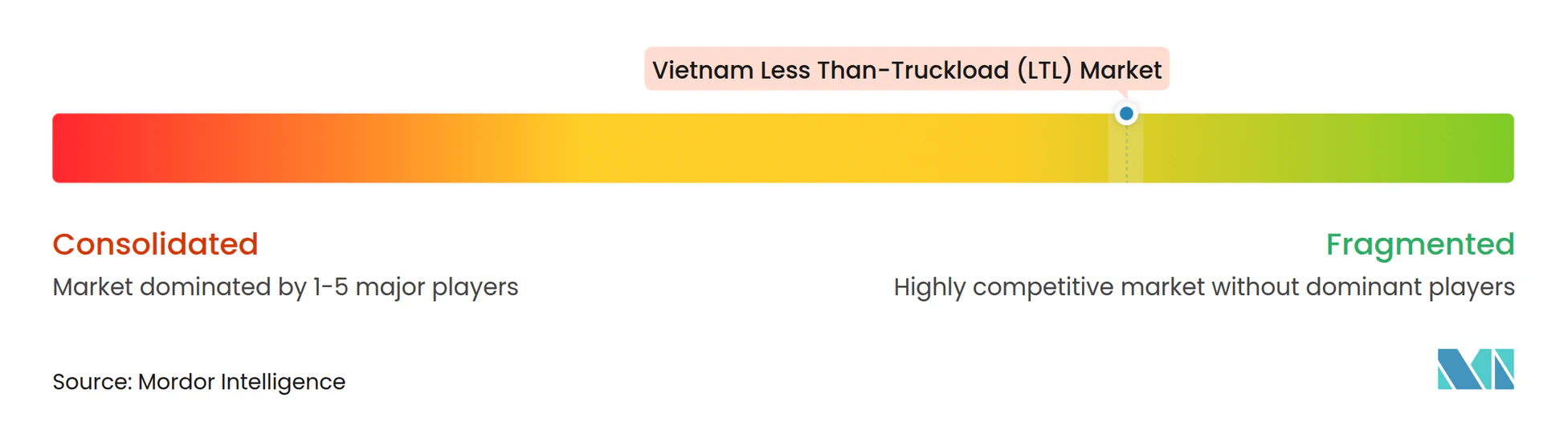
The Vietnam less-than truckload (LTL) market remains fragmented. This structure limits the concentration of carrier assets even as larger 3PLs formalize service standards. ITL Corporation and Transimex have national logistics networks, while Seino-ITL brings a more specific LTL operating model to Vietnam. ITL Corporation and Seino Holdings launched their joint venture in August 2025, combining a 40-branch domestic network with Seino’s 90 years of LTL experience. Seino-ITL opened its Hung Yen Hub in August 2026 to support cross-docking, industrial-zone access, and long-haul connections. The company also planned to expand long-haul truck capacity by more than 35%. These moves show how service standardization and terminal investment can create a stronger position in institutional freight.
Multinational providers are strengthening their Vietnamese physical networks. DHL Supply Chain is investing EUR 63 million (USD 73.88 million) in its Hung Yen campus, which will cover 82,500 m² across 4 Grade A building blocks[4]. Maersk opened its first bonded warehouse at Nam Dinh Vu Industrial Park. DSV completed its acquisition of DB Schenker on April 30, 2025, for EUR 14.3 billion (USD 16.77 billion), adding Schenker’s customer relationships and road logistics coverage to its platform. These asset commitments raise the competitive threshold for operators that rely only on informal capacity.
CJ Logistics acquired the remaining 49.1% stake in CJ Gemadept Logistics Holding in April 2026, taking full ownership of the Vietnamese 3PL joint venture. Gemadept and CJ Logistics then formalized a strategic cooperation agreement in March 2026, under which Gemadept focuses on ports and shipping while CJ Logistics manages 3PL activities. The Vietnam less-than truckload (LTL) market still has open space in Central Vietnam because no major provider has established a complete hub-and-spoke system there. Decision No. 2229/QĐ-TTg favors documented and technology-enabled logistics services at key hubs. Operators with tracking, reporting, fleet controls, and cross-docking capacity are positioned to compete for more formal freight contracts. The competitive structure remains dispersed at the carrier level despite rising investment by larger logistics groups.
Vietnam Less Than-Truckload (LTL) Industry Leaders
-
Indo Trans Logistics Corporation (ITL)
-
Linfox
-
Saigon Newport Corporation
-
DHL Group
-
Transimex Corporation
- *Disclaimer: Major Players sorted in no particular order
Recent Industry Developments
- August 2026: Seino-ITL Logistics opened the Hung Yen Hub in Dao Khe Village, Yen My Commune, Hung Yen Province, a purpose-built LTL transshipment facility with 24/7 heavy-truck access, cross-docking capability, and direct connectivity to National Highway 39A, serving Yen My and Pho Noi A industrial zones.
- July 2026: Vietnam Post Logistics and DSV Contract Logistics (Vietnam) signed a 3-year principal contract renewal, formalizing a continued B2B supply chain partnership. The agreement combines Vietnam Post Logistics' domestic distribution reach with DSV's global network spanning more than 90 countries to deliver integrated supply chain solutions for B2B customers.
- April 2026: CJ Logistics (South Korea) acquired the remaining 49.1% stake in CJ Gemadept Logistics Holding, achieving 100% ownership of its Vietnam 3PL joint venture previously co-owned with Gemadept Corporation. Simultaneously, Gemadept acquired CJ's 49% stake in the shipping joint venture, enabling each party to focus on its core business and accelerating CJ Logistics' investment in Vietnam logistics centers using TES Logistics Research Institute technology.
- March 2026: Gemadept Corporation and CJ Logistics formalized a new Strategic Cooperation Agreement, with Gemadept concentrating on port operations and shipping while CJ Logistics manages all 3PL logistics activities.
Vietnam Less Than-Truckload (LTL) Market Report Scope
| Domestic |
| International |
| Dry |
| Reefer |
| Agriculture, Fishing, and Forestry |
| Construction |
| Manufacturing |
| Oil and Gas, Mining and Quarrying |
| Wholesale and Retail Trade |
| Others |
| Northern Vietnam |
| Central Vietnam |
| Southern Vietnam |
| By Destination | Domestic |
| International | |
| By Temperature Control | Dry |
| Reefer | |
| By End-User Industry | Agriculture, Fishing, and Forestry |
| Construction | |
| Manufacturing | |
| Oil and Gas, Mining and Quarrying | |
| Wholesale and Retail Trade | |
| Others | |
| By Region | Northern Vietnam |
| Central Vietnam | |
| Southern Vietnam |
Key Questions Answered in the Report
What is the projected value of Vietnam’s LTL sector by 2032?
Vietnam’s LTL sector is forecast to reach USD 7.90 billion by 2032, growing at a 7.35% CAGR.
Which shipment destination leads demand in Vietnam?
Domestic shipments led demand with a 65.78% share in 2026, supported by manufacturing corridors and retail replenishment.
Which temperature-controlled service is growing the fastest?
Reefer services are forecast to register at a 10.56% CAGR through 2032 as agricultural and pharmaceutical handling requirements increase.
What end-user group creates the most LTL demand in Vietnam?
Manufacturing account for 35.83% of demand in 2026 because factories require recurring component and finished-goods movements.
Which Vietnamese region has the fastest expected LTL growth?
Central Vietnam is forecast to register at a 9.24% CAGR through 2032 as industrial and logistics investment expands.
How fragmented are Vietnamese trucking providers?
In 2025, 84% of Vietnamese trucks were owned by operators with fewer than 10 vehicles, which limited network standardization.