
Vietnam Less-than-Container Load (LCL) Market Size and Share
Market Overview
| Study Period | 2021 - 2032 |
|---|---|
| Forecast Data Period | 2027 - 2032 |
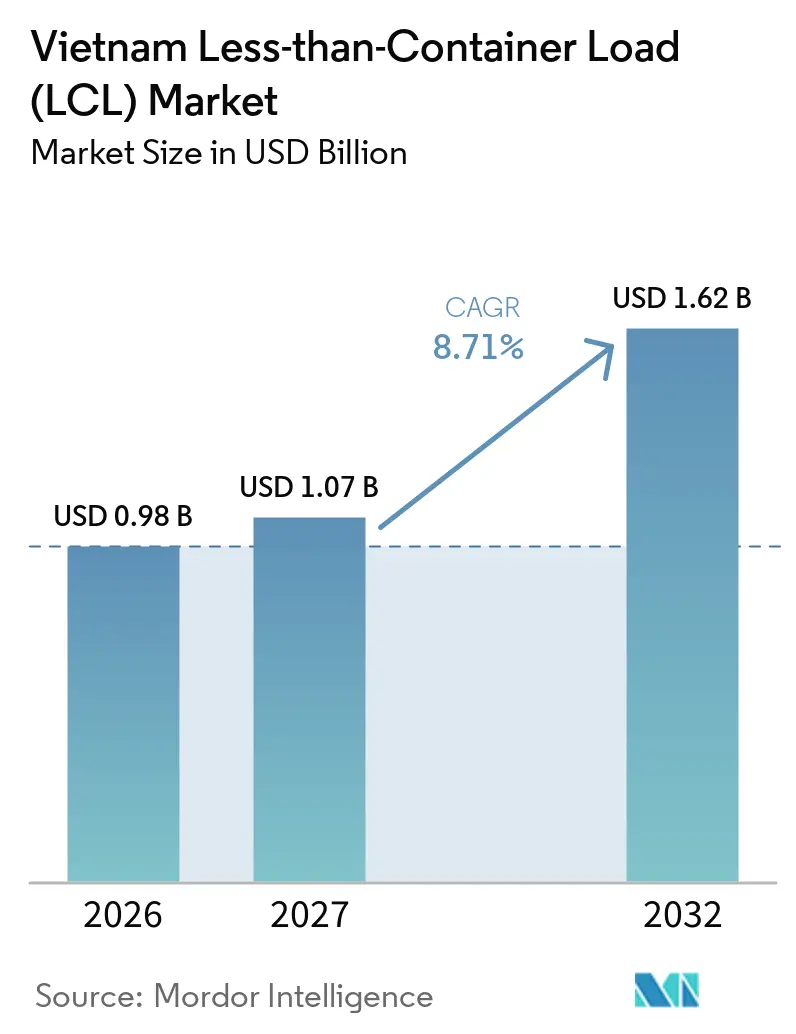
| Base Year Market Size (2026) | USD 0.98 Billion |
| Market Size (2027) | USD 1.07 Billion |
| Market Size (2032) | USD 1.62 Billion |
| Growth Rate (2027 - 2032) | 8.71 % |
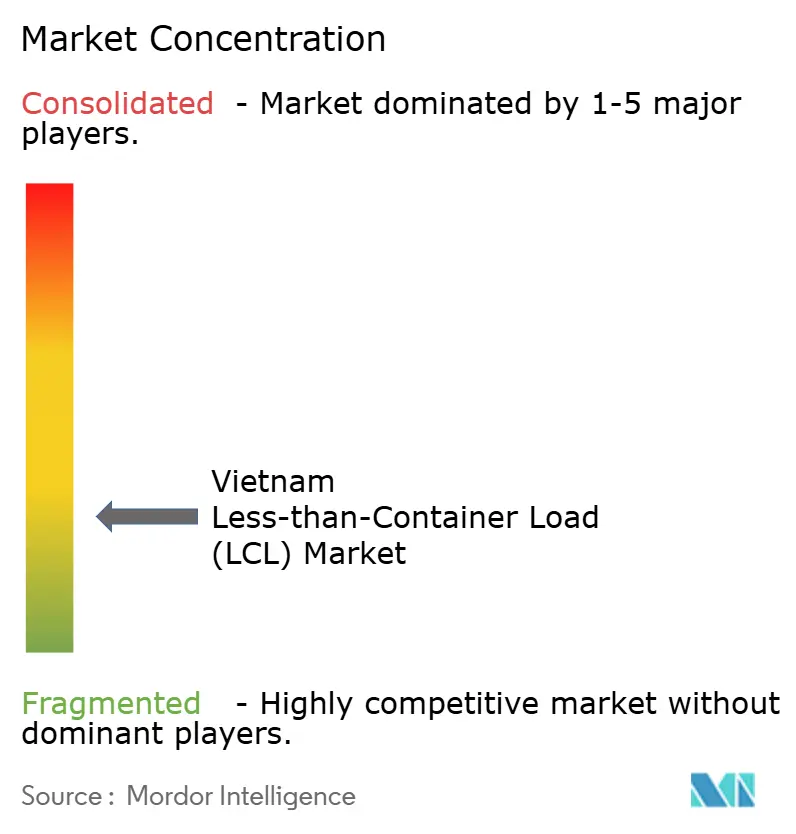
| Market Concentration | Low |
Major Players *Disclaimer: Major Players sorted in no particular order Image © Mordor Intelligence. Reuse requires attribution under CC BY 4.0. | |
Vietnam Less-than-Container Load (LCL) Market Analysis by Mordor Intelligence
The Vietnam less-than-container load (LCL) market size is valued at USD 0.98 billion in 2026 and is estimated to grow from USD 1.07 billion in 2027 to reach USD 1.62 billion by 2032, at a CAGR of 8.71% during the forecast period (2027-2032).
Vietnam's export-oriented manufacturing sector supports demand for shared-container shipping, particularly among suppliers whose consignments do not justify full-container bookings. Electronics, footwear, apparel, furniture, and consumer goods generate demand for cargo collection, consolidation, customs documentation, and destination distribution. Regional trade agreements and established Asian shipping connections also support cross-border movements of smaller cargo lots. Investment in port infrastructure and container freight stations is expanding handling capacity, while equipment availability, port congestion, and inland transport constraints continue to affect service reliability. Competition increasingly depends on carrier access, consolidation networks, customs expertise, specialized cargo handling, and shipment visibility.
Key Report Takeaways
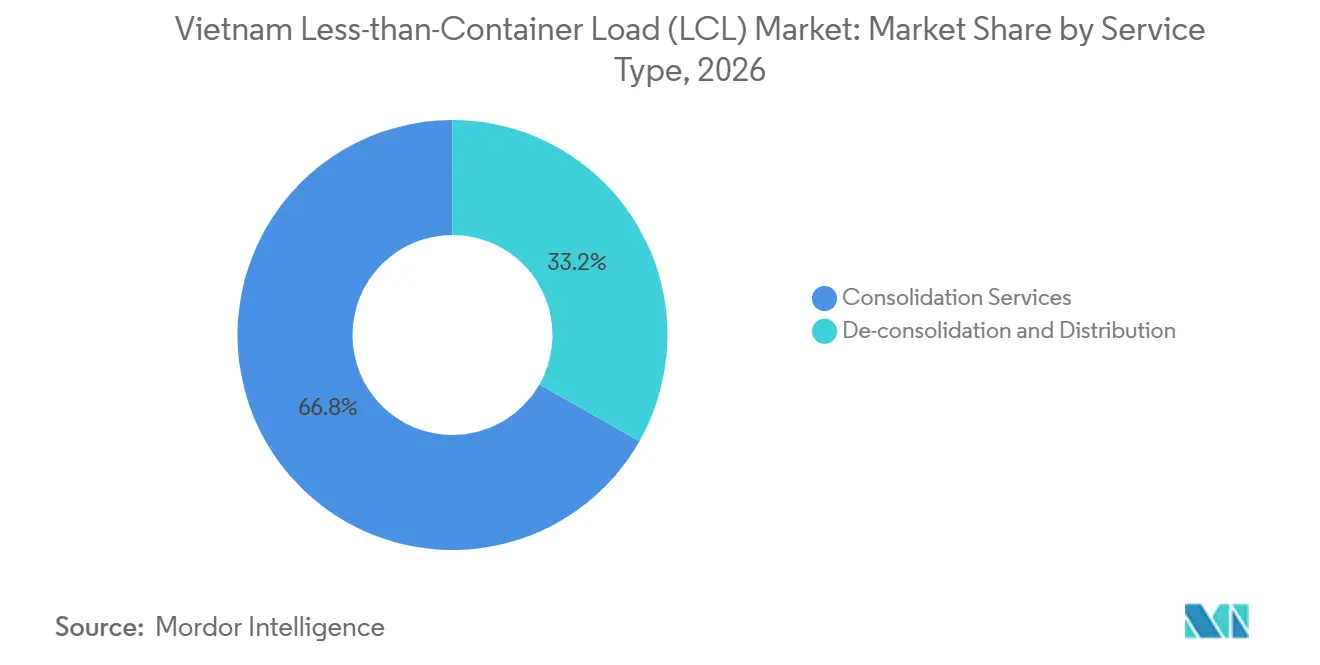
- By service type, consolidation services account for 66.78% of the Vietnam less-than-container load (LCL) market size in 2026, while de-consolidation and distribution are projected to register a CAGR of 10.38% through 2032.
- By destination, international shipments account for 61.38% of the Vietnam less-than-container load (LCL) market share in 2026, while domestic LCL is projected to register a CAGR of 9.37% through 2032.
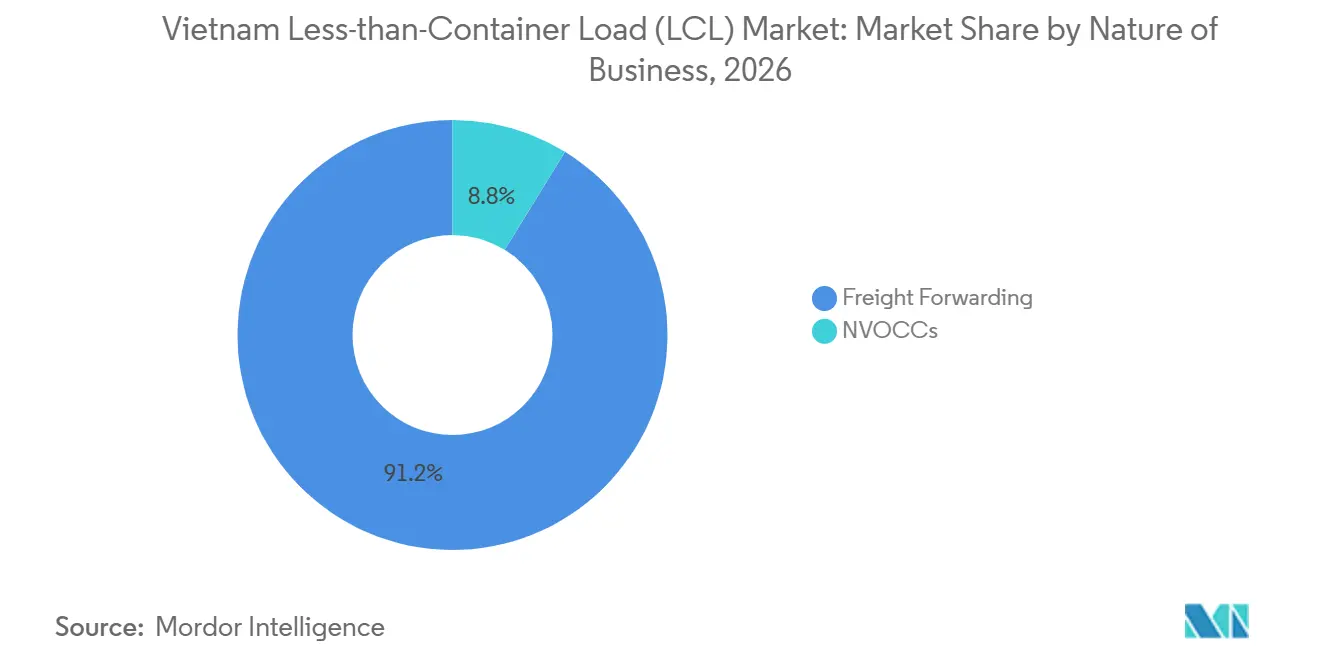
- By nature of business, freight forwarding accounts for 91.25% of the Vietnam less-than-container load (LCL) market size in 2026, while NVOCCs are projected to register a CAGR of 10.91% through 2032.
- By end user, the retail and e-commerce segment accounts for 36.13% of the Vietnam less-than-container load (LCL) market share in 2026, while healthcare and pharmaceuticals are projected to register a CAGR of 9.29% through 2032.
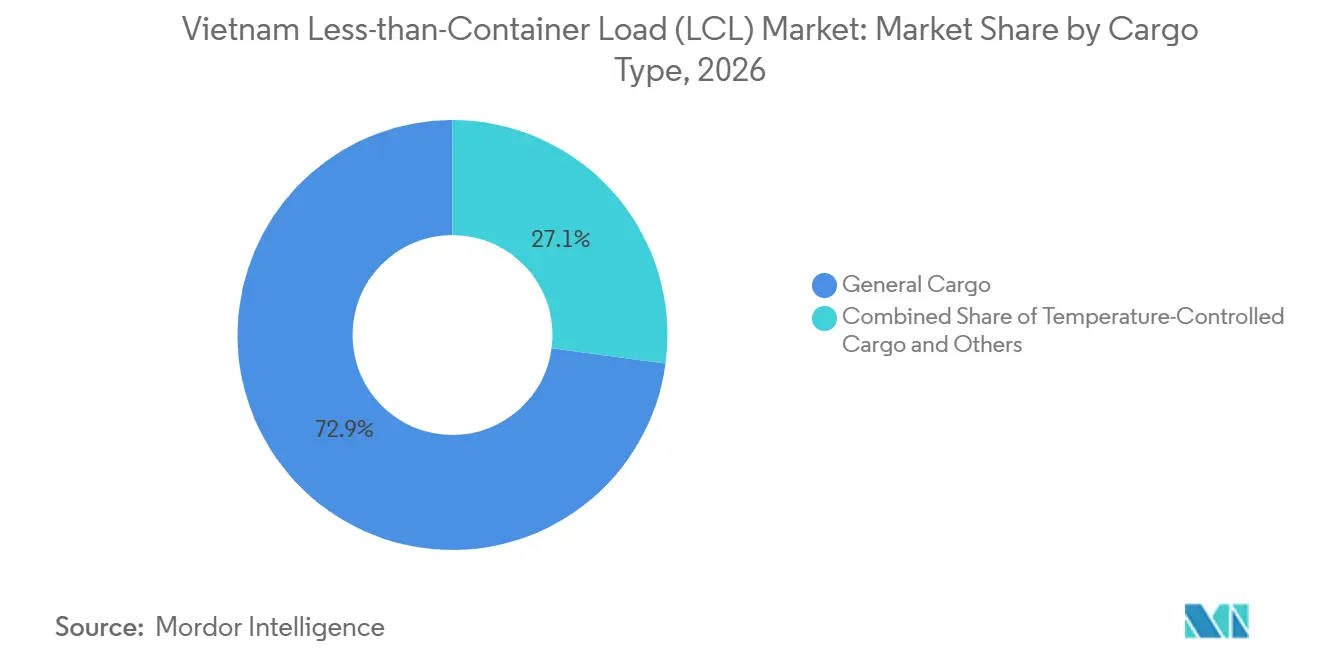
- By cargo type, general cargo accounts for 72.89% of the Vietnam less-than-container load (LCL) market size in 2026, while temperature-controlled cargo is projected to register a CAGR of 10.22% through 2032.
- By region, Southern Vietnam accounts for 52.89% of the Vietnam less-than-container load (LCL) market size in 2026, while Central Vietnam is projected to register a CAGR of 9.23% through 2032.
Note: Market numbers in this report are based on Mordor Intelligence's proprietary estimation framework, which combines nine months of actuals with Q4 projections for base year 2026.
Market Trends and Insights
Drivers Impact Analysis of Vietnam Less-than-Container Load (LCL) Market*
| Driver | (~) % Impact on CAGR Forecast | Geographic Relevance | Impact Timeline |
|---|---|---|---|
| Manufacturing Diversification Increasing Export-Oriented Consolidation Demand | +2.5% | Global, concentrated in Northern Vietnam (Bac Ninh, Hai Phong) and Southern Vietnam (Binh Duong, Dong Nai) | Medium term (2–4 years) |
| Cross-Border E-Commerce Expanding Small-Batch Shipment Volumes | +2.0% | Southern Vietnam core; spill-over to Northern Vietnam | Short term (≤ 2 years) |
| RCEP Integration Simplifying Regional Customs and Trade | +1.5% | ASEAN-wide, with early gains in Ho Chi Minh City, Hai Phong, and Da Nang | Medium term (2–4 years) |
| Deep-Sea Port Expansion Strengthening Consolidation Network Connectivity | +1.2% | Southern Vietnam (Cai Mep–Thi Vai); Northern Vietnam (Lach Huyen, Hai Phong) | Long term (≥ 4 years) |
| Factory Clustering Increasing Origin-Side Cargo Consolidation Demand | +1.0% | Binh Duong–Dong Nai–HCMC triangle; Bac Ninh–Bac Giang corridor | Medium term (2–4 years) |
| Apparel and Electronics Exports Supporting Frequent Shipments | +0.8% | Global, with origin concentrated in Northern Vietnam (electronics) and Southern Vietnam (apparel) | Short term (≤ 2 years) |
| Source: Mordor Intelligence | |||
Manufacturing Diversification Increasing Export-Oriented Consolidation Demand
Vietnam's manufacturing base supports demand for shared-container shipping as suppliers serve multiple buyers with differing order sizes and shipment schedules. Electronics, footwear, apparel, furniture, and consumer goods generate cargo volumes that may not fill a full container individually. LCL services allow these businesses to combine smaller consignments with compatible shipments, helping them access international markets without committing to full-container volumes. Consolidators can differentiate themselves through efficient cargo collection, documentation, warehouse handling, and reliable vessel bookings. The commercial opportunity is particularly relevant near industrial parks and export gateways in Northern and Southern Vietnam, where manufacturers and supporting suppliers generate recurring freight flows.
Cross-Border E-Commerce Expanding Small-Batch Shipment Volumes
Cross-border e-commerce supports demand for smaller, more frequent shipments that may be unsuitable for full-container bookings. Retailers and online sellers need coordinated collection, labeling, customs documentation, tracking, and destination delivery. LCL services can help combine consignments from multiple exporters and provide access to international routes without requiring each seller to book an entire container. Digital booking and shipment visibility can further improve the customer experience by making rates, schedules, and cargo status easier to manage. Providers that combine consolidation with customs support and destination distribution are better positioned to serve smaller merchants, although shipment economics depend on cargo density, handling charges, and delivery requirements.
RCEP Integration Supporting Regional Customs and Trade
The Regional Comprehensive Economic Partnership (RCEP) provides a common framework for regional trade and rules of origin among participating economies. For Vietnamese businesses, regional supply chains can involve sourcing components from one market, processing goods in Vietnam, and exporting finished products to another market. These movements can create demand for both inbound and outbound LCL services when individual suppliers or buyers do not require full containers. The Ministry of Industry and Trade has highlighted the agreement's relevance to regional trade and opportunities for small and medium-sized enterprises. Forwarders with experience in regional documentation, customs procedures, consolidation, and destination-agent coordination can support these supply chains. The scale of the benefit depends on actual trade flows, applicable origin rules, and individual shipment volumes.
Deep-Sea Port Expansion Strengthening Consolidation Network Connectivity
Port investment can expand routing options and support the development of consolidation services when reliable inland transport and warehouse connections accompany new capacity. In April 2026, Gemadept and CMA CGM held the groundbreaking ceremony for Phase 2 of Gemalink Deep-sea Port at Cai Mep-Thi Vai[1]. The expansion is planned to raise the port's capacity to more than 3 million TEUs annually after completion. The benefits for LCL providers will depend on vessel services, container freight station capacity, inland collection networks, and the ability to coordinate cargo from multiple shippers.
Restraints Impact Analysis of Vietnam Less-than-Container Load (LCL) Market*
| Restraint | (~) % Impact on CAGR Forecast | Geographic Relevance | Impact Timeline |
|---|---|---|---|
| Equipment Imbalances Increasing Container Repositioning and Costs | -0.8% | National, with acute impact at Cat Lai and Cai Mep (Southern Vietnam) | Short term (≤ 2 years) |
| Port Congestion Disrupting Schedule Reliability During Peaks | -0.7% | Southern Vietnam (Cat Lai, Cai Mep); spillover to Hai Phong during peak periods | Short term (≤ 2 years) |
| Fragmented Pickup Networks Reducing End-to-End Service Efficiency | -0.5% | National, with greater severity in Central Vietnam and secondary industrial zones | Medium term (2–4 years) |
| Inland Connectivity Gaps Increasing Origin-Destination Handling Complexity | -0.4% | Central Vietnam and upstream provinces far from licensed CFS facilities | Long term (≥ 4 years) |
| Source: Mordor Intelligence | |||
Equipment Imbalances Increasing Container Repositioning Costs
Equipment imbalances can increase costs and create scheduling uncertainty when consolidators cannot secure suitable container space at the required time. Smaller exporters often have less negotiating power than large shippers when equipment is scarce or carrier allocations are constrained. A missed sailing can delay several consignments within the same shared container and generate additional handling, storage, or rebooking requirements. These risks are particularly relevant around major export gateways, where cargo demand can be concentrated within particular shipping windows. LCL operators can reduce exposure through carrier diversification, accurate booking forecasts, flexible routing, and coordination between cargo-receiving facilities and vessel schedules. However, their ability to maintain service reliability remains influenced by carrier capacity and wider trade conditions.
Port Congestion Disrupting Schedule Reliability During Peak Periods
Port congestion can delay cargo acceptance, container loading, vessel departures, and customs coordination. LCL shipments are particularly sensitive to missed cut-off times because consolidators must coordinate multiple consignments and consignee requirements within the same container. Delays can lead to rebooking, additional storage, amended documentation, and missed delivery commitments. Congestion risks are relevant to Vietnam's main export gateways, where manufacturing cargo and international shipping services are concentrated. Additional port capacity can help over time, but it does not automatically resolve bottlenecks in road access, customs processing, container handling, or warehouse operations. Providers with reliable schedule information, alternative sailing options, and effective customer communication can manage these disruptions more effectively.
*Our forecasts treat driver/restraint impacts as directional, not additive. The impact forecasts reflect baseline growth, mix effects, and variable interactions.
Vietnam Less-than-Container Load (LCL) Market Segment Analysis
By Service Type:
Consolidation Services Anchor the Market While Distribution ExpandsConsolidation services account for 66.78% of the Vietnam less-than-container load (LCL) market size in 2026. These services combine cargo from multiple shippers into shared containers, allowing exporters with smaller consignments to access international shipping routes. Vietnam's manufacturing base generates demand from apparel, electronics, furniture, footwear, and consumer goods suppliers whose order volumes vary by customer and destination. Effective consolidation requires coordinated cargo collection, receiving, documentation, loading, and vessel booking. Container freight stations near industrial areas can support these activities by providing facilities for cargo inspection, staging, and container preparation. Operators with established carrier relationships and efficient warehouse processes can improve shipment reliability and container utilization.
CAGR for de-consolidation and distribution is projected at 10.38% from 2027 to 2032. This service category supports the separation of consolidated cargo after arrival and its distribution to individual importers or delivery locations. Growth opportunities arise when importers, retailers, and manufacturers require smaller consignments to be sorted and delivered across multiple destinations. Providers need suitable warehouse capacity, accurate cargo identification, customs coordination, and domestic transport arrangements. Forwarders that integrate these functions can reduce handoffs and improve shipment visibility. Growth will depend on import activity, the development of distribution networks, and the availability of facilities capable of handling different cargo categories.

By Destination:
International Flows Dominate While Domestic LCL Gains GroundInternational shipments account for 61.38% of the Vietnam less-than-container load (LCL) market share in 2026. The segment benefits from Vietnam's manufacturing exports and its participation in regional and global supply chains. Exporters can use shared-container services when order volumes do not justify a full container, while importers can consolidate smaller quantities of components, machinery, packaging, and finished goods. Service performance depends on carrier access, destination-agent coverage, customs documentation, and predictable transshipment arrangements. Providers with international networks can coordinate shipments across multiple countries and offer consistent service standards. International LCL therefore remains closely linked to the country's trade flows and manufacturing activity.
CAGR for domestic LCL is projected at 9.37% from 2027 to 2032. Domestic consolidation supports the movement of smaller shipments between manufacturing centres, warehouses, and distribution markets in Northern, Central, and Southern Vietnam. In February 2025, NX Vietnam announced a consolidation service using the North-South Railway between Hanoi and Ho Chi Minh City[2]. Rail can provide an alternative to road transport for suitable cargo, particularly when shipments can be grouped into regular movements. The commercial benefits depend on terminal access, handling requirements, transit schedules, and the coordination of first- and last-mile delivery. Providers that combine rail, road, and warehouse operations can offer shippers additional routing choices.
By Nature of Business:
Freight Forwarders Dominate While NVOCCs ExpandFreight forwarding accounts for 91.25% of the Vietnam less-than-container load (LCL) market size in 2026. Freight forwarders arrange carrier bookings, cargo collection, consolidation, documentation, customs coordination, and communication between shippers and destination agents. Their role is particularly important for small exporters and importers that lack the scale or internal resources to manage international freight independently. The market includes providers with different levels of international coverage, infrastructure access, and service specialization. Forwarders can strengthen their competitive position through reliable carrier relationships, transparent quotations, shipment tracking, and consistent cargo handling. Their performance also depends on how efficiently they coordinate multiple consignments within a shared container.
CAGR for Non-Vessel-Operating Common Carriers (NVOCCs) is projected at 10.91% from 2027 to 2032. NVOCCs purchase container capacity and resell shipping services under their own arrangements, allowing them to develop consolidation products and manage commercial relationships with shippers. As cargo volumes increase on particular trade lanes, established consolidators may gain greater negotiating leverage with shipping lines. This can support more control over pricing, capacity planning, and sailing options. However, NVOCC growth depends on access to carrier capacity, sufficient cargo density, and the ability to manage operational risks. Smaller forwarders can remain competitive through niche trade lanes, local collection services, and specialized customer support.
By End User:
Retail and E-Commerce Lead While Healthcare Requires Specialized HandlingRetail and e-commerce account for 36.13% of the Vietnam less-than-container load (LCL) market share in 2026. Retailers and online sellers often ship orders in quantities, creating demand for consolidated transportation and destination distribution. The segment includes consumer products, apparel, electronics, and other goods shipped through international sourcing and sales networks. Service requirements can include labeling, cargo sorting, customs documentation, shipment tracking, and coordination with distribution partners. Forwarders that combine consolidation with reliable visibility and delivery coordination can serve merchants that need frequent shipments and predictable replenishment. Price competitiveness remains important, but delays and poor shipment information can also affect customer satisfaction.
CAGR for healthcare and pharmaceuticals is projected at 9.29% from 2027 to 2032. Pharmaceutical products, medical equipment, and sensitive healthcare shipments may require controlled temperatures, humidity management, secure handling, and documented storage conditions. In June 2025, NX Group announced the opening of Phase II of the Dinh Vu Logistics Center in Hai Phong. The facility includes bonded warehousing, a container freight station, and temperature- and humidity-controlled storage. This infrastructure supports specialized logistics services, including LCL shipments that require pharmaceutical compliance. Providers can maintain cargo integrity through appropriate processes, trained personnel, and compatible transport and destination facilities.
By Cargo Type:
General Cargo Dominates While Temperature-Controlled Cargo ExpandsGeneral cargo accounts for 72.89% of the Vietnam less-than-container load (LCL) market size in 2026. This category includes many manufactured products that can be transported through standard container freight station operations, including garments, furniture, consumer goods, and selected electronics. These shipments provide a broad base of cargo for consolidators to combine by destination and shipping schedule. Service performance depends on efficient receiving, cargo identification, packaging, documentation, and container loading. General cargo is likely to remain important because it spans a wide range of manufacturing and retail activity. Its large base also means that container utilization and competitive freight pricing remain important commercial considerations.
CAGR for temperature-controlled cargo is projected at 10.22% from 2027 to 2032. This category includes shipments that require temperature management during storage or transportation, subject to the product's specific handling requirements. In September 2025, ITL Freight Management received its first TF 820V 2S Cool Van, equipped with GPS-connected sensors for real-time temperature monitoring and alerts. This investment demonstrates a development in specialized transport capability. Consolidators seeking this cargo must ensure that receiving facilities, storage, container arrangements, and delivery partners can maintain the required conditions. These requirements can raise operating complexity and make service capability more important than price alone.
Geography Analysis
Southern Vietnam accounts for 52.89% of the Vietnam less-than-container load (LCL) market size in 2026. The region benefits from the manufacturing clusters around Ho Chi Minh City, Dong Nai, and Binh Duong, as well as access to the Cat Lai and Cai Mep-Thi Vai port systems. These industrial and maritime connections support regular cargo collection, export consolidation, and international distribution. In April 2026, Gemadept and CMA CGM held the groundbreaking ceremony for Phase 2 of Gemalink Deep-sea Port at Cai Mep-Thi Vai[3]. The expansion is planned to raise annual capacity to more than 3 million TEUs after completion. The additional capacity could expand routing options for LCL providers, although actual benefits will depend on commissioning, carrier services, and supporting inland infrastructure.
Northern Vietnam is an important LCL region because of its electronics, machinery, apparel, and component manufacturing base. Hai Phong provides maritime access for industrial zones, while facilities near Hanoi and other manufacturing centres support cargo collection and consolidation. In November 2025, DHL Global Forwarding announced that its Ho Chi Minh City Container Freight Station had expanded to 6,800 m² and its Hai Phong facility had reached 4,000 m². In May 2025, NX Vietnam also brought Phase II of its Dinh Vu Logistics Center into operation in Hai Phong, adding 8,550 m² of warehouse space and controlled-temperature and low-humidity storage. These investments support cargo handling and storage, although the facilities differ in their ownership, services, and suitability for particular shipment types.
CAGR for Central Vietnam is projected at 9.23% from 2027 to 2032, making it the fastest-growing region in the segmentation. The region's potential is linked to manufacturing development, port connectivity, and the expansion of local cargo aggregation and distribution facilities. In March 2025, Bee Logistics held the opening ceremony for its Bee Distribution Center at Danang High-Tech Park. The facility strengthens the region's logistics infrastructure and can support cargo handling for businesses operating in and around Danang. Central Vietnam could become more attractive for LCL services as exporters gain access to local collection, consolidation, and distribution capacity. The pace of growth will depend on cargo volumes, shipping connections, warehouse development, and the efficiency of road links to ports and industrial zones.
Competitive Landscape
The Vietnam LCL market remains fragmented and includes international freight forwarders, domestic logistics providers, NVOCCs, port-linked logistics companies, and specialist warehouse operators. Global providers such as DHL Global Forwarding, Maersk, DSV, Kuehne+Nagel, and CEVA Logistics compete through international networks, carrier relationships, customs capabilities, and destination-agent coverage. Domestic companies, including Gemadept, ITL, Transimex, and Bee Logistics, compete through local collection networks, regional expertise, and access to Vietnamese logistics infrastructure.
Infrastructure investment is an important differentiator because LCL services require suitable facilities for receiving, sorting, consolidating, and distributing shipments. In November 2025, DHL Global Forwarding announced expanded Container Freight Station capacity in Ho Chi Minh City and Hai Phong[4]. In May 2025, NX Vietnam brought Phase II of its Dinh Vu Logistics Center into operation, adding bonded warehousing, a container freight station, and controlled storage. Gemadept's April 2026 groundbreaking for Gemalink Phase 2 further demonstrates investment in maritime capacity that may support future freight flows.
Technology and specialized handling create additional opportunities for differentiation. In September 2025, ITL Freight Management received a GPS-connected Cool Van equipped with real-time temperature monitoring and alerts. This capability supports temperature-controlled transportation, although end-to-end LCL services also require compatible storage and handling arrangements. Bee Logistics' Danang distribution centre strengthens its physical presence in Central Vietnam, while NX Vietnam's rail consolidation service offers an alternative to road transport for suitable domestic cargo. Smaller providers can compete through specialized cargo, focused trade lanes, and responsive local service. Providers that combine operational reliability with transparent pricing and shipment visibility are better placed to retain customers as service expectations rise.
Vietnam Less-than-Container Load (LCL) Industry Leaders
-
Indo Trans Logistics Corporation (ITL)
-
Transimex Corporation
-
Kuehne+Nagel
-
DSV
-
A.P. Moller - Maersk
- *Disclaimer: Major Players sorted in no particular order
Vietnam Less-than-Container Load (LCL) Market Companies Covered in this Report
- A.P. Moller - Maersk
- DHL Global Forwarding
- DSV
- Kuehne+Nagel
- CEVA Logistics
- Expeditors International
- Nippon Express
- Rhenus Logistics
- Sinotrans
- SEKO Logistics
- Yusen Logistics
- CJ Logistics
- Indo Trans Logistics Corporation (ITL)
- Bee Logistics Corporation
- Transimex Corporation
- Gemadept Corporation
- U&I Logistics Corporation
- VINATRANS
- Dolphin Sea Air Services Corporation
- ASL Logistics
- Vinafreight
- Vietfracht
Recent Industry Developments in Vietnam Less-than-Container Load (LCL) Market
- April 2026: Gemadept and CMA CGM held the groundbreaking ceremony for Phase 2 of Gemalink Deep-sea Port at Cai Mep-Thi Vai. The project is planned to increase annual port capacity to more than 3 million TEUs after completion.
- March 2026: Gemadept and CJ Logistics announced a strategic optimization of their logistics and shipping operations. The announcement focused on leveraging each company's operational strengths.
- November 2025: DHL Global Forwarding announced an expansion of its Vietnamese Container Freight Station network. Its Ho Chi Minh City facility increased from 4,600 m² to 6,800 m², while its Hai Phong facility reached 4,000 m².
- October 2025: Gemadept announced that Phase 3 of Nam Dinh Vu Port had officially entered operation following the first vessel's arrival on September 30, 2025. The expansion added approximately 650,000 TEUs of annual capacity, bringing the port cluster's total capacity to more than 2 million TEUs.
Vietnam Less-than-Container Load (LCL) Market Report Scope
Segmentation Overview
| Consolidation Services |
| De-consolidation and Distribution |
| Domestic |
| International |
| Freight Forwarding |
| NVOCCs |
| Manufacturing and Automotive |
| Retail and E-commerce |
| Healthcare and Pharmaceuticals |
| Agriculture and Forestry |
| Other End Users |
| General Cargo |
| Temperature-Controlled Cargo |
| Hazardous Cargo |
| High-Value and Sensitive Cargo |
| Other End Users |
| Northern Vietnam |
| Central Vietnam |
| Southern Vietnam |
| By Service Type | Consolidation Services |
| De-consolidation and Distribution | |
| By Destination | Domestic |
| International | |
| By Nature of Business | Freight Forwarding |
| NVOCCs | |
| By End User | Manufacturing and Automotive |
| Retail and E-commerce | |
| Healthcare and Pharmaceuticals | |
| Agriculture and Forestry | |
| Other End Users | |
| By Cargo Type | General Cargo |
| Temperature-Controlled Cargo | |
| Hazardous Cargo | |
| High-Value and Sensitive Cargo | |
| Other End Users | |
| By Region | Northern Vietnam |
| Central Vietnam | |
| Southern Vietnam |
Key Questions Answered in the Report
What is the size of Vietnam's LCL market?
The market is valued at USD 0.98 billion in 2026 and is estimated to reach USD 1.62 billion by 2032. The forecast model reports an 8.71% CAGR for 2027–2032, subject to reconciliation of rounded market values.
Which service category has the largest share of LCL activity in Vietnam?
Consolidation services account for 66.78% of the market in 2026, supported by demand from exporters whose consignments do not fill a full container.
Why is Domestic LCL freight growing in Vietnam?
Domestic LCL is projected to register a 9.37% CAGR through 2032 as businesses seek flexible shipment options between manufacturing centres and distribution markets.
Which end-user category is growing fastest?
Healthcare and pharmaceuticals is projected to register a 9.29% CAGR through 2032, supported by demand for specialized handling and controlled storage.
Which region leads Vietnam's LCL market?
Southern Vietnam account for 52.89% of the market in 2026, supported by its manufacturing clusters and access to major maritime gateways.
What competitive capabilities matter most in Vietnam's LCL services?
Carrier access, consolidation facilities, customs documentation, shipment visibility, reliable schedules, and specialized cargo handling are important competitive capabilities.