
Vietnam Last Mile Delivery Market Size and Share
Market Overview
| Study Period | 2021 - 2032 |
|---|---|
| Forecast Data Period | 2027 - 2032 |
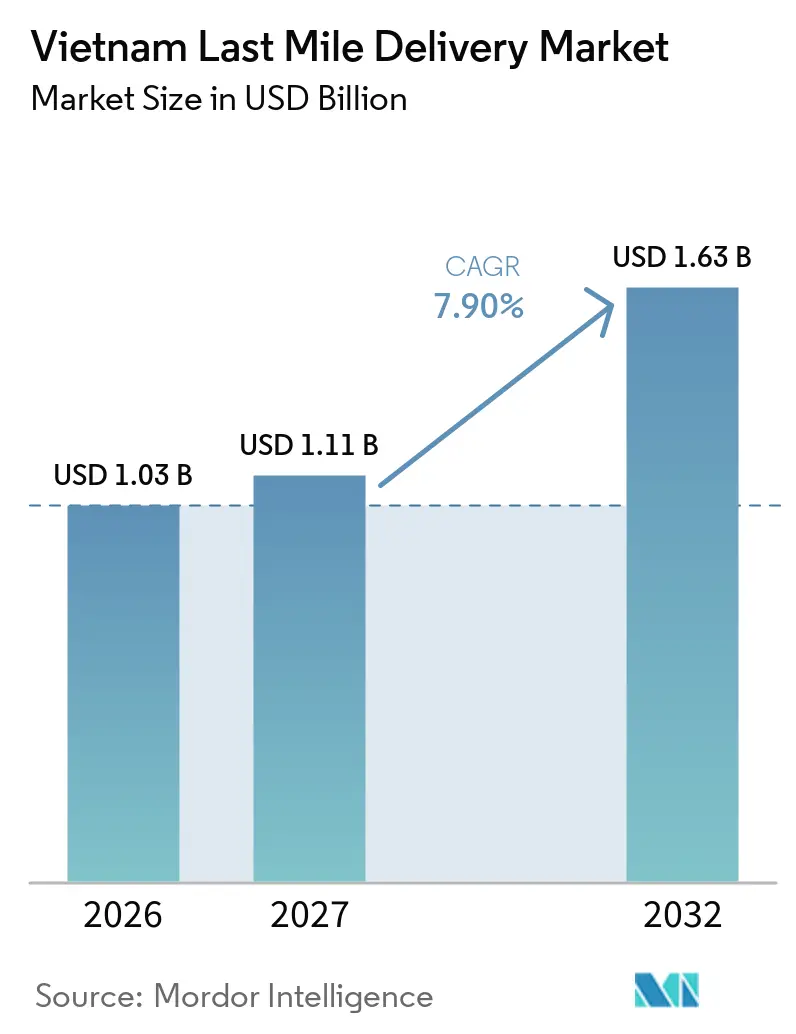
| Base Year Market Size (2026) | USD 1.03 Billion |
| Market Size (2027) | USD 1.11 Billion |
| Market Size (2032) | USD 1.63 Billion |
| Growth Rate (2027 - 2032) | 7.90 % |
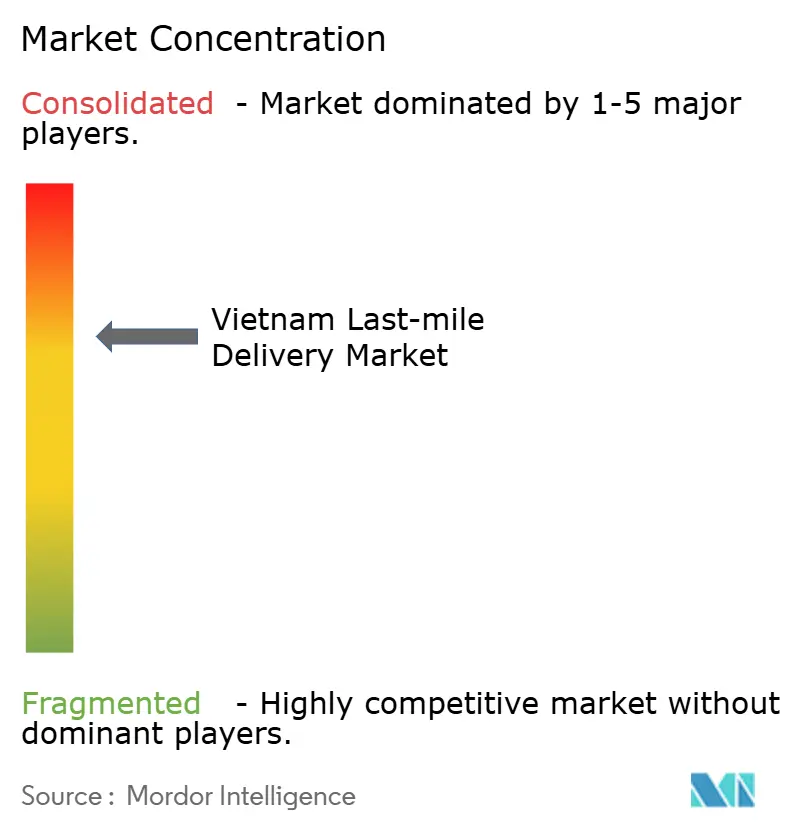
| Market Concentration | Medium |
Major Players *Disclaimer: Major Players sorted in no particular order Image © Mordor Intelligence. Reuse requires attribution under CC BY 4.0. | |
Vietnam Last Mile Delivery Market Analysis by Mordor Intelligence
The Vietnam last mile delivery market was valued at USD 1.03 billion in 2026 and is estimated to reach USD 1.11 billion in 2027 and USD 1.63 billion by 2032, registering a CAGR of 7.90% during 2027–2032.
Demand is supported by the continued shift of retail transactions to online channels, which sustains parcel volumes even as delivery pricing remains competitive. Delivery networks are adapting to smaller and more frequent orders, particularly as social commerce and marketplace promotions encourage shorter purchase cycles. Faster delivery options are becoming more important to merchants in large cities, increasing the need for dense local networks and efficient last mile capacity. Digital payments can reduce the operational risks associated with cash collection, particularly for operators that integrate payment confirmation with delivery workflows. The market also faces pressure from lower average delivery fees, road congestion, workforce turnover, and investment requirements for electric fleets and parcel lockers.
Key Report Takeaways
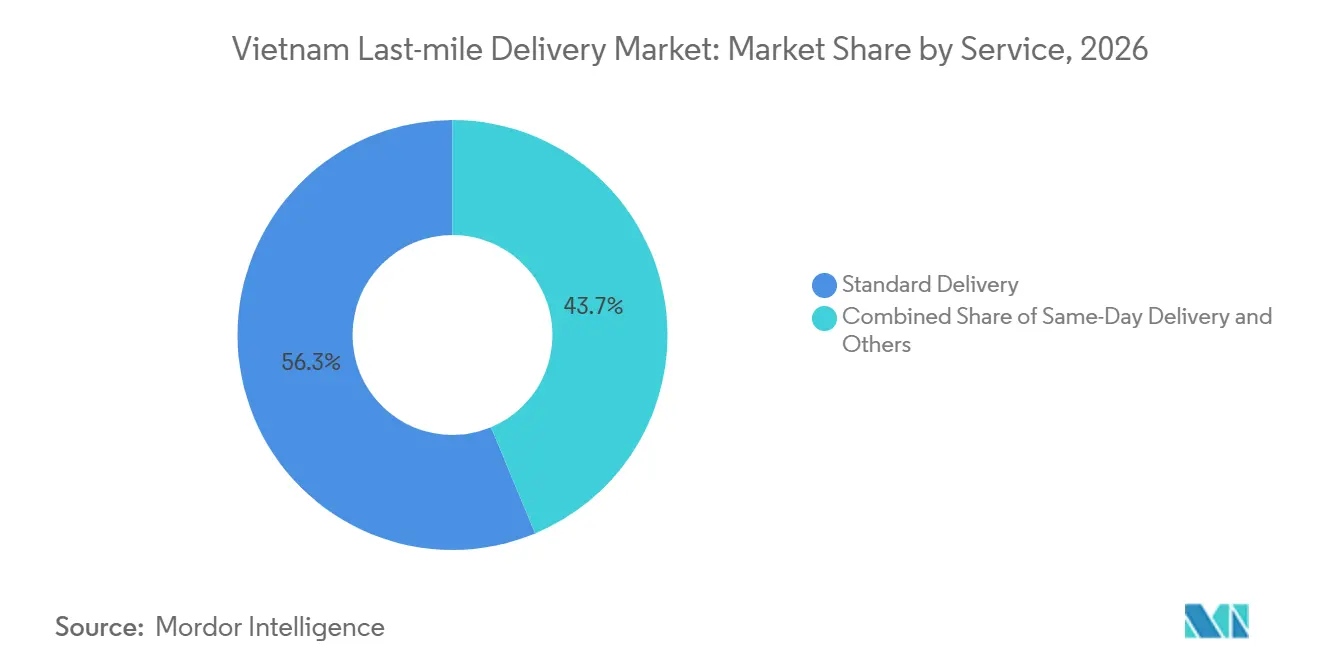
- By service, standard delivery accounted for 56.28% of the Vietnam last mile delivery market share in 2026, while same day delivery is forecast to register a CAGR of 9.46% during 2026–2031.
- By business, B2C accounted for 61.47% of the Vietnam last mile delivery market size in 2026, while C2C is forecast to register a CAGR of 8.68% during 2026–2031.
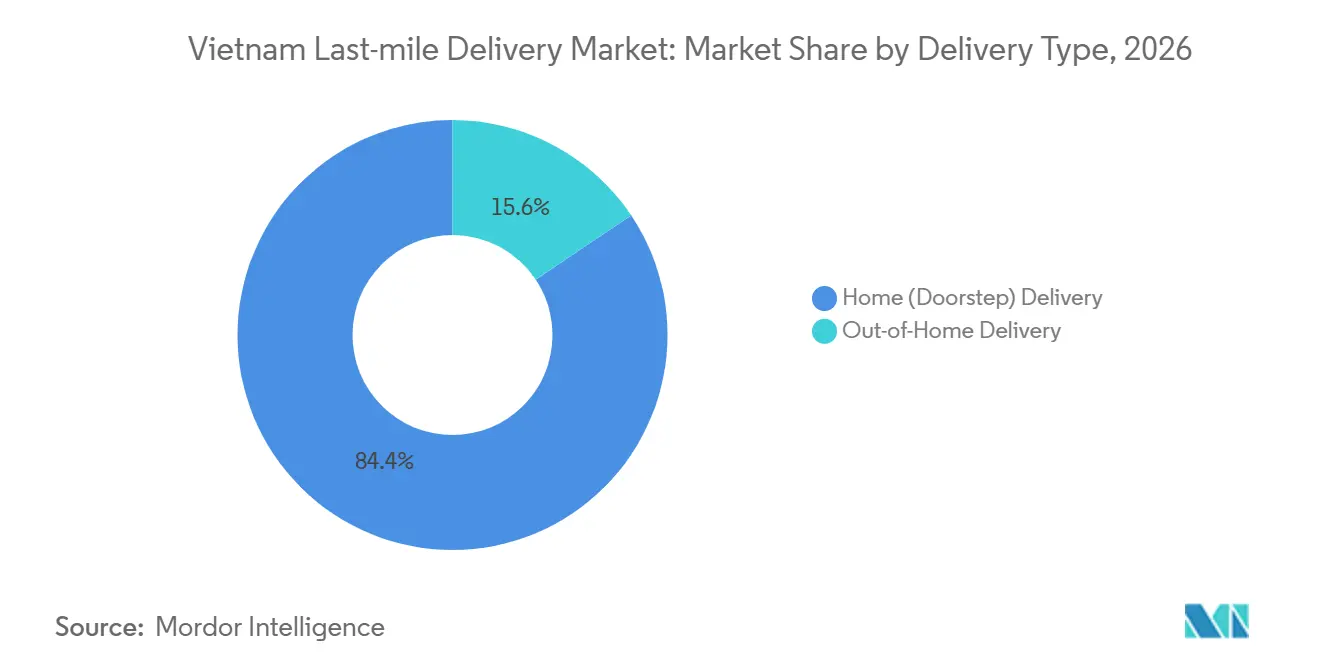
- By delivery type, home or doorstep delivery accounted for 84.37% of the Vietnam last mile delivery market share in 2026, while out-of-home delivery is forecast to register at a CAGR of 9.89% during 2026–2031.
- By end-user industry, e-commerce and retail accounted for 40.36% of the Vietnam last mile delivery market size in 2026, while healthcare and medical supplies are forecast to register at a CAGR of 10.46% during 2026–2031.
- By geography, Southern Vietnam accounted for 45.28% of the Vietnam last mile delivery market share in 2026, while Central Vietnam is forecast to register a CAGR of 8.83% during 2026–2031.
Note: Market numbers in this report are based on Mordor Intelligence's proprietary estimation framework, which combines nine months of actuals with Q4 projections for base year 2026.
Vietnam Last Mile Delivery Market Trends and Insights
Drivers Impact Analysis*
| Driver | (~) % Impact on CAGR Forecast | Geographic Relevance | Impact Timeline |
|---|---|---|---|
| E-Commerce and Social-Commerce Parcel Growth | +2.5% | National, concentrated in Ho Chi Minh City and Hanoi | Short term (≤ 2 years) |
| Rising Consumer Demand for Faster Deliveries | +1.5% | Urban centers, Ho Chi Minh City, Hanoi, and Da Nang | Short term (≤ 2 years) |
| Growing Use of Two-Wheelers for Urban Deliveries | +1.2% | Major urban corridors, Ho Chi Minh City, and Hanoi core zones | Medium term (2–4 years) |
| Expansion of Platform-Integrated Logistics and Digital Payments | +1.0% | National, strongest in Tier 1 and Tier 2 cities | Medium term (2–4 years) |
| Increasing Provincial Fulfillment and Cross-Border Order Volumes | +0.8% | Emerging provinces, the Mekong Delta, and the North Central Coast | Long term (≥ 4 years) |
| Fleet Electrification Supporting Lower Delivery Operating Costs | +0.6% | Ho Chi Minh City, Hanoi, and provincial hubs | Medium term (2–4 years) |
| Source: Mordor Intelligence | |||
E-Commerce and Social-Commerce Parcel Growth
Online retail activity provides a substantial source of parcel demand for Vietnam's last mile delivery market. Marketplace transactions generate frequent small-parcel shipments, increasing delivery-stop requirements even when the value of each shipment is relatively low. Social-commerce transactions also increase the importance of timely parcel handoffs, reliable tracking, and proof of delivery. These requirements favor operators with dense delivery networks, efficient dispatch systems, and integrated merchant tools. Vietnam's National E-Commerce Development Master Plan for 2026–2030 provides a broader policy context for e-commerce development and logistics digitalization. Carriers that connect online platforms with scalable delivery networks are better positioned to serve merchants across major cities and provincial markets.
Rising Consumer Demand for Faster Deliveries
Shopee introduced its Hoa Toc Uu Tien, or Priority Express, tier in early 2026 following the rollout of four-hour and same-day delivery options in 2025. The development highlights the increasing importance of delivery speed in urban e-commerce. Faster fulfillment influences merchant selection and customer experience, particularly for orders placed through online marketplaces. Carriers without nearby fulfillment capacity, real-time dispatch systems, or sufficient rider availability may struggle to meet shorter delivery windows. Operators are therefore encouraged to improve local inventory positioning, rider allocation, and peak-period capacity planning. These requirements favor providers with sufficient order density and operational scale to maintain service reliability across busy urban delivery zones.
Growing Use of Two-Wheelers for Urban Deliveries
Motorcycles remain central to parcel delivery in Vietnam because they can navigate narrow streets and dense residential areas that are difficult for larger vehicles to serve efficiently. The country's established motorcycle-based transport system supports frequent stops and flexible routing across urban neighborhoods. Restrictions on gasoline-powered motorcycles in central Hanoi are also increasing the need for delivery operators to evaluate electric alternatives. In June 2025, Ahamove partnered with Selex Motors to deploy 1,000 Selex Camel electric motorbikes, with the initial rollout supporting the adoption of electric vehicles in delivery operations[1]. Battery-swapping systems can reduce charging downtime and help vehicles return to service more quickly. The commercial benefits of electric two-wheelers will depend on battery availability, maintenance arrangements, operating range, and rider adoption.
Expansion of Platform-Integrated Logistics and Digital Payments
Platform-integrated logistics connects marketplace orders, payment information, shipment tracking, and delivery confirmation within a coordinated operating system. In FY 2025, J&T Express reported Southeast Asian parcel volume of 7.66 billion, an increase of 67.8% year over year, highlighting the scale of regional parcel activity[2]. Separately, Vietnam's expanding use of cashless payments creates opportunities to reduce cash-handling requirements and improve reconciliation between merchants and delivery operators. Digital payment confirmation can help reduce collection-related errors and provide better visibility into shipment status. Integration between merchant platforms and carrier systems can also support route planning, exception management, and delivery notifications. These capabilities are increasingly relevant as e-commerce operators seek to improve service reliability and manage cost per parcel.
Restraints Impact Analysis*
| Restraint | (~) % Impact on CAGR Forecast | Geographic Relevance | Impact Timeline |
|---|---|---|---|
| Intense Price Competition and Margin Pressure | -1.8% | National, most acute in Ho Chi Minh City and Hanoi | Short term (≤ 2 years) |
| Urban Congestion and Delivery-Time Uncertainty | -1.0% | Ho Chi Minh City, Hanoi, Da Nang, and Hai Phong | Medium term (2–4 years) |
| High Rider Turnover and Workforce Retention Challenges | -0.9% | National, most acute in Southern Vietnam | Medium term (2–4 years) |
| Limited Charging Infrastructure and Electric-Fleet Readiness | -0.7% | Provincial corridors and Tier 2 cities | Long term (≥ 4 years) |
| Source: Mordor Intelligence | |||
Intense Price Competition and Margin Pressure
The Vietnam last mile delivery market faces pricing pressure as carriers compete for marketplace orders and merchant contracts. Platform-affiliated operators can use promotional delivery rates and integrated services to attract parcel volumes, making it difficult for smaller independent providers to recover technology, sorting, rider, and onboarding costs. In September 2025, Ninja Van ceased its B2B and B2C express delivery operations in Vietnam, citing restructuring and competitive pressures[3]. The exit illustrates the challenges that can arise when an operator cannot sustain its position in a price-sensitive market. Providers need to improve route density, processing efficiency, and service differentiation to protect margins. Investment in sorting systems and delivery-point networks can help reduce unit costs, although these initiatives require capital.
High Rider Turnover and Workforce Retention Challenges
Workforce turnover can disrupt delivery consistency and increase the cost of training and daily operations. New riders require time to learn delivery routes, merchant procedures, building access requirements, and customer preferences. Frequent staff replacement can therefore increase delivery times, failed handoffs, and operating costs. Vietnam's logistics sector also faces broader challenges in developing a workforce with specialized logistics skills. Better route allocation, clear performance incentives, and more predictable working arrangements can help operators retain experienced riders. Workforce management remains important because delivery reliability and customer satisfaction depend heavily on rider availability and execution at the final delivery point.
*Our forecasts treat driver/restraint impacts as directional, not additive. The impact forecasts reflect baseline growth, mix effects, and variable interactions.
Segment Analysis
By Service: Standard Delivery Anchors Volume as Same-Day Reshapes Carrier Economics
Standard delivery accounted for 56.28% of the Vietnam last mile delivery market share in 2026, reflecting the importance of price-sensitive marketplace orders and non-urgent consumer shipments. Standard delivery provides carriers with recurring parcel volumes and supports broader geographic coverage. However, competitive pricing limits the ability to absorb inefficient routes, failed delivery attempts, and low parcel density. Operators need disciplined sorting, accurate address information, and effective rider scheduling to protect unit economics. Standard delivery is likely to remain important for merchants seeking affordable shipping and a wide customer reach.
Same day delivery is forecast to record a CAGR of 9.46% during 2026–2031. Demand is supported by platform service tiers, urban fulfillment requirements, and customer expectations for faster receipt of purchases. Same day operations require short order cut-off times, nearby inventory, and sufficient rider availability around demand clusters. Express delivery also serves related requirements, including urgent replenishment, business shipments, and time-sensitive goods. The commercial viability of faster delivery depends on whether carriers can meet tighter service windows without allowing costs per parcel to rise disproportionately.

By Business: B2C Commands the Market as C2C Expands
B2C accounted for 61.47% of the Vietnam last mile delivery market size in 2026, supported by parcel flows from organized merchants and online marketplaces to individual consumers. The segment benefits from recurring order volumes and broad seller participation, although promotions and free shipping offers can intensify price competition. Carriers must meet merchant service requirements while managing failed deliveries, returns, and cash collection, where applicable. Platform integration can improve order processing by connecting shipment labels, tracking, payment status, and delivery confirmation. Network density and reliable fulfillment remain important factors in maintaining service quality.
C2C is forecast to register a CAGR of 8.68% during 2026–2031. Individual sellers using social commerce, livestreaming, and online resale channels can generate frequent small-parcel shipments. These transactions create opportunities for carriers that provide accessible booking, transparent pricing, and convenient pickup services. However, small shipment volumes per seller can make route consolidation and cost control more challenging. Dynamic batching, accurate dispatch, and flexible pickup arrangements can help carriers serve this segment efficiently. B2B delivery differs because it generally involves business consignments, planned delivery schedules, and more structured invoicing arrangements.
By Delivery Type: Doorstep Delivery Leads as Out-of-Home Options Expand
Home or doorstep delivery accounted for 84.37% of the Vietnam last mile delivery market share in 2026. The segment benefits from established motorcycle delivery practices and consumers' familiarity with receiving parcels directly at their homes or workplaces. Doorstep delivery remains useful for orders requiring direct handover and for transactions involving cash on delivery. However, unsuccessful delivery attempts, waiting time, access restrictions, and congestion can raise operating costs. Clear delivery notifications, improved route sequencing, and flexible handover arrangements can help operators improve first-attempt delivery performance.
Out-of-home delivery is forecast to register at a CAGR of 9.89% during 2026–2031. Parcel lockers and collection points can allow carriers to consolidate multiple shipments at a single location and reduce the need for repeated delivery attempts. These models are particularly relevant to apartment complexes, office districts, campuses, and other locations with concentrated parcel demand. Their effectiveness depends on convenient placement, customer adoption, collection hours, and reliable parcel management. Doorstep delivery will continue to serve a substantial share of shipments, while pickup points and lockers can improve network efficiency in dense urban areas.
By End-User Industry: E-Commerce Leads as Healthcare Delivery Expands
E-commerce and retail accounted for 40.36% of the Vietnam last mile delivery market share in 2026. Online marketplaces and retail websites generate recurring parcel flows and periodic demand peaks during promotional campaigns. Carriers serving these merchants need flexible sorting capacity, dependable tracking, and responsive customer communication. Returns management is also important for categories such as fashion, beauty, personal care, and consumer electronics. Integration with merchant systems and a dense delivery network can help operators manage high volumes while maintaining service quality.
Healthcare and medical supplies are forecast to register at a CAGR of 10.46% during 2026–2031, the fastest rate among the end-user segments. Demand is supported by the need to distribute medicines, medical supplies, and other healthcare products reliably across retail and institutional channels. These shipments can require traceability, secure handling, defined delivery windows, and temperature controls for sensitive products. Carriers with suitable operating procedures and cold-chain capabilities may be better positioned to serve specialized healthcare requirements. Growth will depend on healthcare distribution needs, regulatory compliance, and the ability of logistics providers to maintain reliable service across urban and provincial locations.
Geography Analysis
Southern Vietnam accounted for 45.28% of the Vietnam last mile delivery market in 2026. Ho Chi Minh City provides a dense consumer base and a major concentration of online retail activity. Nearby provinces, including Binh Duong and Dong Nai, contribute to industrial activity and business-to-business shipment demand. In October 2025, SPX Express and Frasers Property Vietnam broke ground on a 170,000 m² automated sorting center in Hung Yen Province, a development relevant to the northern network rather than Southern Vietnam[4]. Southern operators nevertheless continue to face congestion and high delivery density, making local sorting facilities, pickup points, and efficient route planning important to service performance.
Northern Vietnam is another major delivery hub, centered on Hanoi and supported by logistics investment in Hung Yen Province. On January 14, 2026, GHN inaugurated its Hung Yen Transit Center, which was reported to cover 85,500 m² and process up to 165,000 orders per hour. The project represented an investment of VND 1,000 billion (USD 40 million). SPX Express also broke ground on a 170,000 m² automated sorting center in Hung Yen in October 2025, with commissioning planned for 2027. These investments are intended to expand parcel-processing capacity and strengthen connections between Hanoi and surrounding markets. Congestion in Hanoi remains an operational challenge, increasing the importance of coordinated dispatch, local delivery capacity, and flexible routing.
Central Vietnam is forecast to register at a CAGR of 8.83% during 2026–2031. Da Nang and other urban centers provide a base for regional distribution, while smaller cities and provincial markets offer opportunities to extend delivery coverage. Compared with the country's largest metropolitan areas, lower parcel density in some locations can increase the cost of serving dispersed customers. Carriers can address this challenge through regional sorting capacity, coordinated line-haul services, local delivery partners, and collection points. Cross-border e-commerce and improved trade connectivity can also create opportunities for regional sellers to access wider markets. The pace of growth will depend on order volumes, infrastructure investment, and the ability of operators to expand coverage without significantly increasing the cost per delivery.
Competitive Landscape
The Vietnam last mile delivery market is consolidated, including domestic operators, platform-affiliated carriers, and international logistics providers. Viettel Post, GHN, GHTK, and SPX Express are among the key participants in domestic parcel delivery, while J&T Express benefits from a broader Southeast Asian network. Competition is particularly strong in standard parcel delivery, where pricing, network coverage, and service reliability influence merchant selection. Operators are seeking to strengthen their positions through automated sorting, digital shipment management, wider service-point coverage, and more efficient delivery operations. The market's competitive structure continues to favor providers that can combine scale with cost control and reliable service execution.
Infrastructure investment is an important competitive tool because automated sorting and well-positioned delivery facilities can improve parcel throughput and reduce handling costs. GHN's Hung Yen Transit Center, inaugurated in January 2026, adds processing capacity to its northern network. SPX Express and Frasers Property Vietnam began developing a large automated sorting center in Hung Yen in October 2025, with commissioning planned for 2027. SPX has also reported investment in its service-point network and delivery partnerships. These initiatives reflect the importance of combining large processing hubs with convenient local collection and delivery options. However, capital expenditure and utilization risk remain important considerations for operators expanding ahead of demand.
International logistics providers and integrated networks are focusing on cross-border delivery, specialized services, and operational improvements. On April 26, 2026, Viettel Post became FedEx's National Network Provider in Vietnam under a strategic partnership intended to strengthen cross-border logistics. GEODIS also announced the deployment of electric VinFast EC Van vehicles for urban B2B and B2C delivery in Ho Chi Minh City during 2026. Such developments highlight opportunities in cross-border fulfillment and lower-emission urban delivery. Healthcare distribution and other specialized services may also provide differentiation where reliability and handling requirements matter more than the lowest delivery price. Competitive performance will depend on network integration, customer service, delivery density, and the ability to maintain sustainable unit economics.
Vietnam Last Mile Delivery Industry Leaders
-
Viettel Post Joint Stock Corporation
-
Giao Hang Nhanh (GHN)
-
J&T Express Vietnam
-
SPX Express
-
DHL Express Vietnam
- *Disclaimer: Major Players sorted in no particular order
Recent Industry Developments
- March 2026: Post Corporation and DHL Express renewed their joint venture agreement in March, 2026, to deepen cooperation in international express delivery and the VNQuick Post service.
- January 2026: GHN inaugurated its 85,500 m² Hung Yen Transit Center on January 14, 2026, with a reported processing capacity of 165,000 orders per hour and an investment of VND 1,000 billion (USD 40 million).
- October 2025: SPX Express and Frasers Property Vietnam broke ground on a 170,000 m² automated sorting center in Hung Yen Province, with commissioning planned for 2027 and a reported design capacity of 7 million parcels per day.
- September 2025: Ninja Van ceased B2B and B2C express delivery operations in Vietnam on September 30, 2025, amid restructuring and competitive pressures.
Vietnam Last Mile Delivery Market Report Scope
| Same-Day Delivery |
| Express Delivery |
| Standard Delivery |
| B2B (Business-to-Business) |
| B2C (Business-to-Consumer) |
| C2C (Customer-to-Customer) |
| Home (Doorstep) Delivery |
| Out-of-Home (OOH) Delivery |
| Fashion and Lifestyle |
| Beauty, Wellness, and Personal Care |
| Electronics and Electrical Equipment |
| Food, Grocery, and Beverages |
| Healthcare and Pharmaceuticals |
| Banking and Financial Services |
| Furniture, Home, and Office Products |
| Industrial Goods |
| Other End-User Industries |
| Northern Vietnam |
| Central Vietnam |
| Southern Vietnam |
| By Service | Same-Day Delivery |
| Express Delivery | |
| Standard Delivery | |
| By Business | B2B (Business-to-Business) |
| B2C (Business-to-Consumer) | |
| C2C (Customer-to-Customer) | |
| By Delivery Type | Home (Doorstep) Delivery |
| Out-of-Home (OOH) Delivery | |
| By End-User Industry | Fashion and Lifestyle |
| Beauty, Wellness, and Personal Care | |
| Electronics and Electrical Equipment | |
| Food, Grocery, and Beverages | |
| Healthcare and Pharmaceuticals | |
| Banking and Financial Services | |
| Furniture, Home, and Office Products | |
| Industrial Goods | |
| Other End-User Industries | |
| By Region | Northern Vietnam |
| Central Vietnam | |
| Southern Vietnam |
Key Questions Answered in the Report
What is the forecast growth rate for Vietnam's last mile delivery market?
The market is forecast to register at a CAGR of 7.90% from 2027 to 2032, reaching USD 1.63 billion by 2032.
Which service segment is growing fastest?
Same-day delivery is forecast to register at a CAGR of 9.46% during 2026–2031.
Why is out-of-home delivery gaining traction?
Out-of-home delivery is forecast to register at a CAGR of 9.89% during 2026–2031 as parcel lockers and pickup points provide alternatives to individual doorstep handoffs.
Which end-user segment has the strongest forecast growth?
Healthcare and medical supplies are forecast to register at a CAGR of 10.46% during 2026–2031.
Which region is the largest delivery market in Vietnam?
Southern Vietnam accounted for 45.28% of the market in 2026, supported by demand from Ho Chi Minh City and neighboring industrial provinces.
How are delivery companies responding to pricing pressure?
Operators are investing in automated sorting, digital delivery management, expanded service-point networks, and specialized services to improve operational efficiency and differentiate their offerings.