
Vietnam Full Container Load (FCL) Market Size and Share
Market Overview
| Study Period | 2021 - 2032 |
|---|---|
| Forecast Data Period | 2027 - 2032 |
| Base Year Market Size (2026) | USD 2.02 Billion |
| Market Size (2027) | USD 2.16 Billion |
| Market Size (2032) | USD 3 Billion |
| Growth Rate (2027 - 2032) | 6.78 % |
| Market Concentration | Low |
Major Players *Disclaimer: Major Players sorted in no particular order Image © Mordor Intelligence. Reuse requires attribution under CC BY 4.0. | |
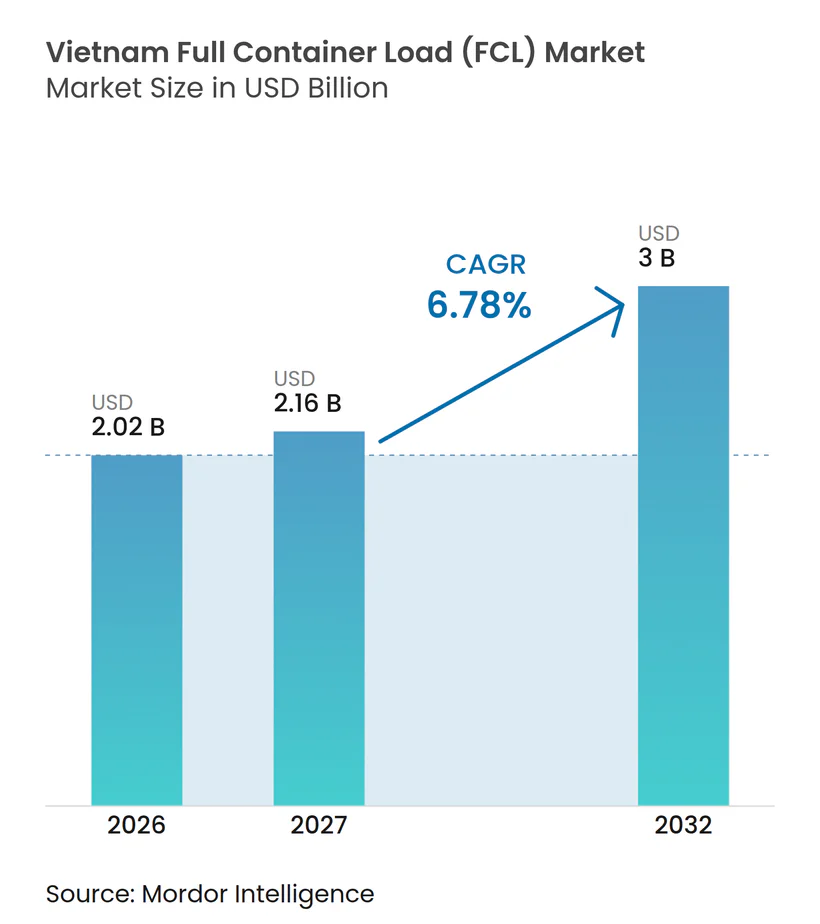
Vietnam Full Container Load (FCL) Market Analysis by Mordor Intelligence
The Vietnam full container load (FCL) market size is valued at USD 2.02 billion in 2026 and is estimated to grow from USD 2.16 billion in 2027 to reach USD 3 billion by 2032, at a CAGR of 6.78% during the forecast period (2027-2032).
Vietnam's role in electronics, footwear, apparel, and other manufacturing supply chains supports demand for dedicated container capacity on international routes. In fiscal 2026, factories in Vietnam manufactured approximately 52% of Nike Brand footwear, making Vietnam the company's largest footwear production location. This manufacturing base supports recurring movements of production inputs and finished goods. Port investment and inland transport services are also changing the operating environment for container shipping. New and planned terminal capacity in Hai Phong and Cai Mep–Thi Vai is intended to accommodate rising cargo volumes. At the same time, services such as Mekong Express connect the Mekong Delta with the Cai Mep gateway. These developments can broaden shippers' routing options, although their benefits depend on project completion, reliable schedules, equipment availability, and coordination between inland and ocean transport.
Key Report Takeaways
- By trade flow, international FCL accounts for 78.34% of the Vietnam full container load (FCL) market size in 2026, while domestic/inter-island FCL is projected to register a CAGR of 7.24% during 2027–2032.
- By container type, dry containers account for 74.19% of the Vietnam full container load (FCL) market share in 2026, while refrigerated containers are projected to register a CAGR of 7.38%.
- By container size, 40-foot containers account for 63.24% of the Vietnam full container load (FCL) market size in 2026 and are projected to register a CAGR of 8.12%.
- By end-user industry, the manufacturing and industrial segment accounts for 35.91% of the Vietnam full container load (FCL) market share in 2026, while healthcare and pharmaceuticals are projected to register a CAGR of 8.36%.
- By region, Southern Vietnam accounts for 55.47% of the Vietnam full container load (FCL) market in 2026, while Central Vietnam is projected to register a CAGR of 8.62%.
Note: Market numbers in this report are based on Mordor Intelligence's proprietary estimation framework, which combines nine months of actuals with Q4 projections for base year 2026.
Market Trends and Insights
Drivers Impact Analysis of Vietnam Full Container Load (FCL) Market*
| Driver | (~) % Impact on CAGR | Geographic relevance | Impact timeline |
|---|---|---|---|
| Manufacturing Growth Raising Export Container Demand | +2.0% | Global, concentrated in Northern and Southern Vietnam | Medium term (2–4 years) |
| Deep-Water Port Expansion Raising FCL Capacity | +1.5% | Northern, Southern, and Central Vietnam | Short term (≤ 2 years) |
| Trade Agreements Strengthening Container Connectivity | +1.0% | Global, particularly ASEAN, EU, and Trans-Pacific lanes | Long term (≥ 4 years) |
| Cold-Chain Demand Raising Reefer Shipping Needs | +0.7% | Southern Vietnam, with growing relevance in Northern Vietnam | Medium term (2–4 years) |
| Repositioning Platforms Improving Empty-Container Use | +0.4% | Southern and Northern Vietnam | Short term (≤ 2 years) |
| Mekong Barge Shift Supporting Inland Connectivity | +0.3% | Mekong Delta and Southern Vietnam | Short term (≤ 2 years) |
| Source: Mordor Intelligence | |||
Manufacturing Growth Increases Export Container Demand
Vietnam's manufacturing base supports recurring containerized shipments of electronics, footwear, apparel, furniture, and industrial products. These production chains also require imports of components, machinery, and other inputs, generating cargo in both directions. Nike's fiscal 2026 annual report states that Vietnam produced approximately 52% of its global footwear volume, illustrating the country's role in export-oriented manufacturing[1]. Manufacturers with predictable order volumes can use full containers to move cargo with fewer consolidation steps and more direct control over loading and delivery schedules. The relative appeal of FCL depends on shipment volume, cargo characteristics, equipment availability, and the cost of alternative services. Brokers, forwarders, carriers, and inland transport providers that coordinate factory pickup with vessel cutoffs can help reduce avoidable delays across the export process.
Deep-Water Port Expansion Increases FCL Handling Capacity
The expansion of deep-water terminals can increase the capacity available to shipping lines and exporters. In May 2025, Hai Phong Port inaugurated Lach Huyen Terminals 3 and 4, taking the port company's annual throughput capacity to approximately 3.5 million TEUs. The terminals were designed to accommodate fully loaded vessels of up to 100,000 DWT and larger vessels at reduced loading. Further expansion is planned at both ends of the country. In 2025, CMA CGM and Saigon Newport announced a USD 600 million partnership to develop Lach Huyen Terminals 7 and 8, with a planned capacity of 1.9 million TEUs and a target opening in 2028. In April 2026, Gemadept and CMA CGM held the groundbreaking ceremony for Gemalink Phase 2 at Cai Mep–Thi Vai. The project is expected to raise the terminal's capacity to more than 3 million TEUs per year after completion.
Trade Agreements Strengthen Cross-Border Container Connectivity
Vietnam's trade agreements, including the EU-Vietnam Free Trade Agreement and regional agreements, provide a framework for cross-border trade. The EVFTA supports trade between Vietnam and the European Union by progressively removing tariffs on qualifying goods, subject to the agreement's schedules and rules of origin. For container operators, trade agreements can support more diverse destination markets and sourcing patterns. Demand also depends on export competitiveness, product mix, shipping rates, and the reliability of available services. Shippers that source components from several countries may require both inbound and outbound container capacity, while carriers can adjust services in response to changes in trade flows and cargo demand.
Cold-Chain Demand Increases Reefer Shipping Requirements
Temperature-sensitive cargo creates demand for refrigerated containers and services that maintain the required conditions during transit. Seafood, processed food, and pharmaceutical products can require equipment with temperature control, monitoring, and procedures suited to the cargo. The Mekong Express service launched by DP World and VIMC Lines in May 2025 was designed to carry both dry and refrigerated containers between Can Tho and Cai Mep, connecting production areas with an international gateway. Reefer demand depends on the type of cargo, destination requirements, temperature range, monitoring needs, and availability of suitable equipment. Specialized handling can make reliable service and equipment condition more important than headline freight rates alone. Carriers and logistics providers that can coordinate inland movement with reefer availability and port connections may be better placed to serve exporters of temperature-sensitive products.
Restraints Impact Analysis of Vietnam Full Container Load (FCL) Market*
| Restraint | (~) % Impact on CAGR | Geographic relevance | Impact timeline |
|---|---|---|---|
| Port Congestion Raising Transit and Handling Delays | -1.2% | Southern and Northern Vietnam, with effects from regional transshipment hubs | Short term (≤ 2 years) |
| Freight-Rate Volatility Raising Cost Uncertainty | -0.8% | Global, particularly Trans-Pacific, Asia-Europe, and Asia-Middle East lanes | Medium term (2–4 years) |
| Data Fragmentation Disrupting Multimodal Coordination | -0.5% | National, particularly Central Vietnam and the Mekong Delta | Medium term (2–4 years) |
| River-Draft Disruptions Affecting Mekong Reliability | -0.3% | Mekong Delta and Southern Vietnam | Short term (≤ 2 years) |
| Source: Mordor Intelligence | |||
Port Congestion Increases Transit and Handling Delays
Congestion can disrupt vessel schedules, container availability, terminal handling, and the timing of factory deliveries. Delays at regional transshipment hubs can also affect onward connections for Vietnam-origin cargo. When a shipment misses a cutoff or connection, exporters may need to reschedule cargo, hold inventory, or seek alternative routing, adding uncertainty to transport planning. Additional port capacity may relieve some constraints over time, but announced projects do not provide immediate capacity until they become operational. The Can Gio International Transshipment Port project reached an important milestone in April 2026, when Ho Chi Minh City approved its investors[2]. It remains a development project rather than an operating terminal. In the meantime, exporters and carriers need to coordinate booking windows, gate-in times, equipment allocation, and inland transport to reduce the impact of congestion.
Freight-Rate Volatility Increases Shipping Cost Uncertainty
Container freight rates vary by route, direction, season, available vessel capacity, equipment supply, and the balance between demand and capacity. Exporters serving several destination markets may face different rate conditions at the same time, making it difficult to set reliable shipping budgets or commit to fixed delivered prices. Shippers with smaller volumes may have less negotiating leverage or fewer options for securing contract capacity. Rate uncertainty can also affect the choice between FCL and other shipping options for smaller consignments. Carriers with diversified networks and contracted cargo may be better able to manage changes in lane conditions, but no operating model removes exposure to market-wide freight-rate changes. Exporters can reduce some of this uncertainty through earlier planning, route diversification, and suitable freight contracts.
*Our forecasts treat driver/restraint impacts as directional, not additive. The impact forecasts reflect baseline growth, mix effects, and variable interactions.
Vietnam Full Container Load (FCL) Market Segment Analysis
By Trade Flow:
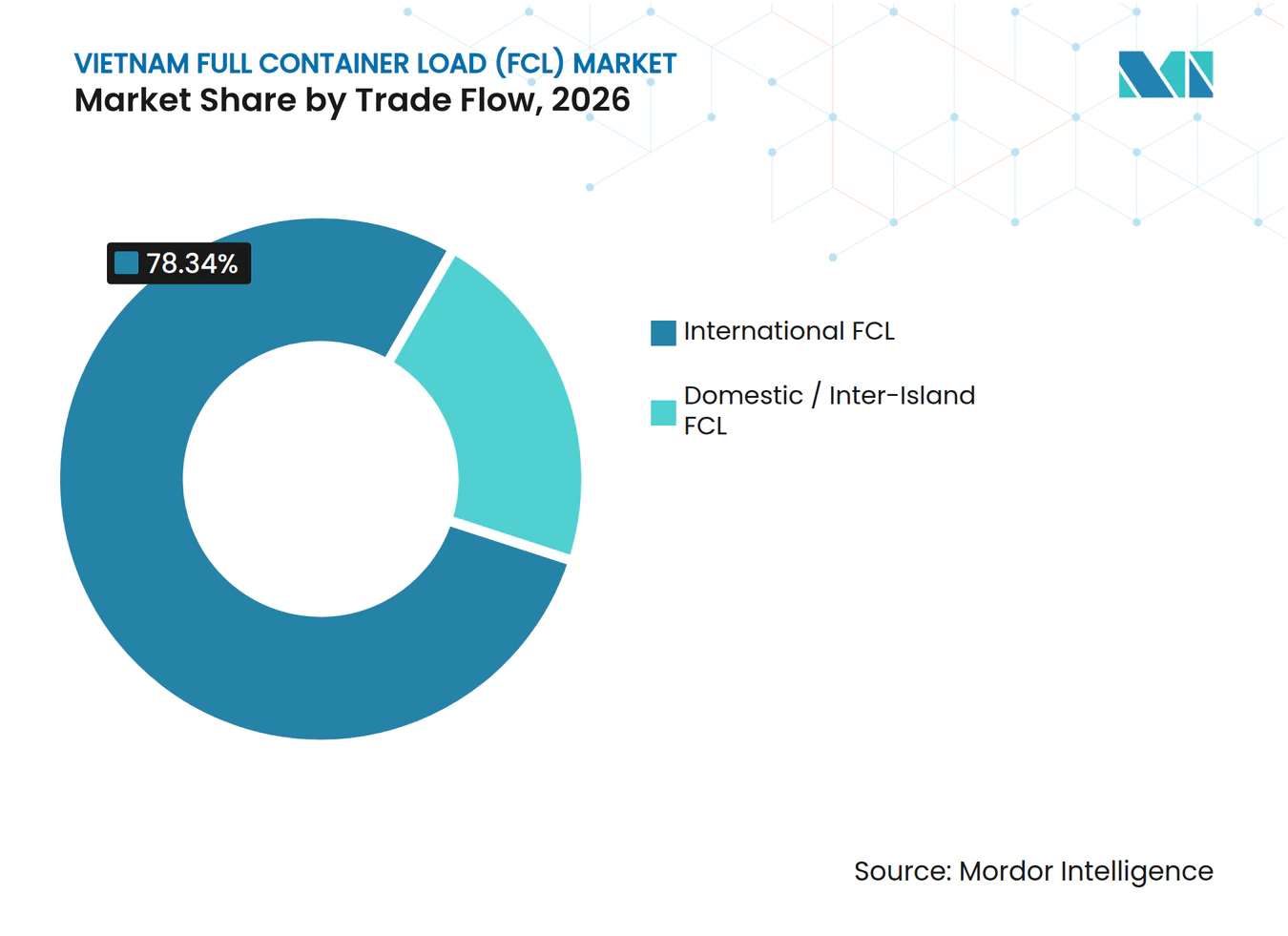
International FCL Leads While Domestic Services GrowInternational FCL accounts for 78.34% of the Vietnam full container load market share in 2026. Export-oriented manufacturing and imports of production inputs, machinery, and components support the segment. Electronics, footwear, apparel, furniture, and industrial goods generate recurring container movements between Vietnamese factories and international markets. International FCL also supports inbound cargo from Asian manufacturing and supplier locations. Its established carrier networks and access to major seaports underpin its leading position.
Domestic / inter-island FCL is projected to register at a 7.24% CAGR during 2027–2032. Coastal and inland waterway services connect production areas with major export gateways, including Cai Mep. Mekong Express, launched in May 2025, links Can Tho and Cai Mep and supports both dry and refrigerated cargo. These services complement international ocean routes by feeding containers into gateway ports and expanding access for shippers located away from the main terminals.



By Container Type:
Dry Containers Lead While Reefer Demand ExpandsDry containers account for 74.19% of the Vietnam full container load market size in 2026. They serve a broad range of cargo, including electronics, textiles, footwear, furniture, machinery, and other manufactured products. Their versatility and established depot and terminal infrastructure support their use across inbound and outbound shipments. Hoa Phat's delivery of 1,000 20-foot dry containers to CMA CGM in August 2025 also demonstrates the development of domestic container manufacturing capacity.
Refrigerated containers are projected to register a 7.38% CAGR during 2027–2032. Demand is linked to temperature-sensitive food, seafood, and pharmaceutical cargo that requires controlled conditions during transport. The Mekong Express service provides capacity for refrigerated containers alongside dry equipment. Tank Containers and specialized equipment also serve chemical, petrochemical, and oversized cargo, although demand depends on specific commodity requirements and suitable handling arrangements. Dry containers are expected to remain the largest equipment category given their broad range of applications.
By Container Size:
40-Foot Containers Lead and Grow Faster40-foot containers account for 63.24% of the Vietnam full container load market share in 2026 and are projected to register an 8.12% CAGR during 2027–2032. Their capacity suits higher-volume factory shipments and can reduce the number of containers required for eligible consignments. Manufacturing clusters with regular export orders can plan equipment around production schedules, provided that cargo weight, dimensions, and handling requirements allow the use of larger containers.
20-foot containers remain important for dense cargo, smaller shipments, and consignments whose weight or handling requirements make a larger unit less suitable. Container choice also depends on the cargo's volume, weight, route, and availability of equipment. The projected growth of 40-foot units reflects the market's demand for efficient handling of larger consignments.
By End-User Industry:
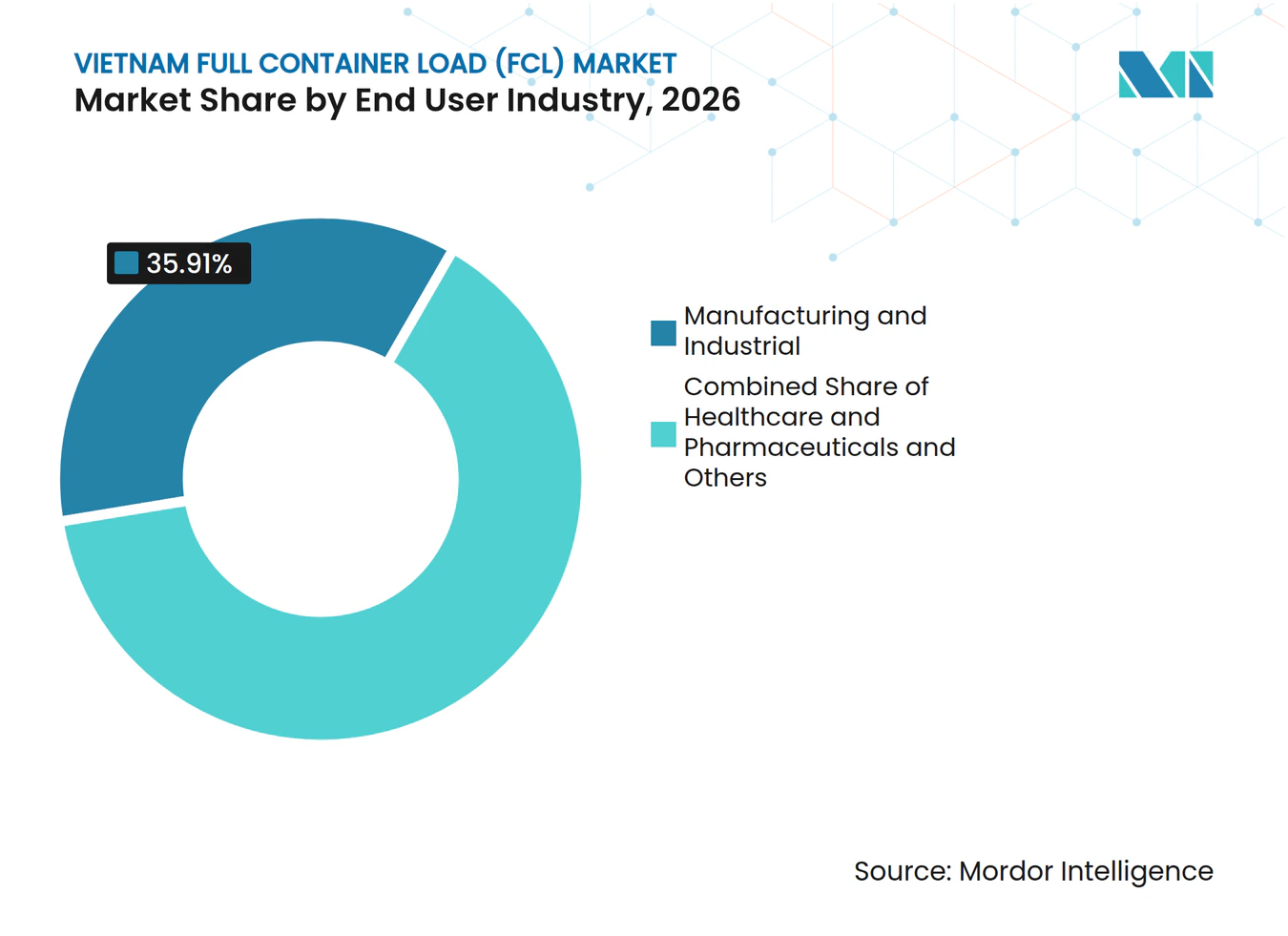
Manufacturing Leads While Healthcare ExpandsManufacturing and industrial account for 35.91% of the Vietnam full container load market share in 2026. The segment includes electronics, footwear, apparel, furniture, machinery, and other industrial products moving through international supply chains. Manufacturers need reliable container availability and coordination between factory dispatch, terminal gate-in, and vessel departure. Imports of components and machinery also contribute to the segment's demand, linking inbound cargo with outbound production.
Healthcare and pharmaceuticals are projected to register an 8.36% CAGR during 2027–2032. Pharmaceutical and healthcare shipments may require temperature monitoring, suitable equipment, and documentation tailored to the cargo. Retail and consumer goods, food and beverage, agriculture and forestry, automotive, chemicals, and electronics also contribute to container demand. Providers that offer suitable equipment, shipment visibility, and cargo-specific handling can serve customers with requirements beyond standard dry-container transport.

Geography Analysis
Southern Vietnam accounts for 55.47% of the market in 2026. Cai Mep–Thi Vai supports deep-water shipping, while industrial areas and inland transport connections feed cargo into the port network. In April 2026, Gemadept and CMA CGM held the groundbreaking ceremony for Gemalink Phase 2, which is expected to increase the terminal's capacity to more than 3 million TEUs per year after completion[3]. Mekong Express also strengthens links between Can Tho and Cai Mep, supporting dry and refrigerated cargo from the Mekong Delta.
The Hai Phong port cluster and nearby manufacturing areas support Northern Vietnam. In May 2025, Hai Phong Port inaugurated Lach Huyen Terminals 3 and 4, increasing the port company's annual throughput capacity to approximately 3.5 million TEUs. CMA CGM and Saigon Newport have also announced the planned development of Lach Huyen Terminals 7 and 8, with a target opening in 2028.
Central Vietnam is projected to register an 8.62% CAGR during 2027–2032. The region's growth opportunity is linked to industrial activity, port access, and better connections between inland production areas and shipping gateways. Central Vietnam's own market growth will depend on local cargo demand, the development of port and inland connections, and the ability of shipping providers to offer reliable services from the region.
Competitive Landscape
Market Concentration
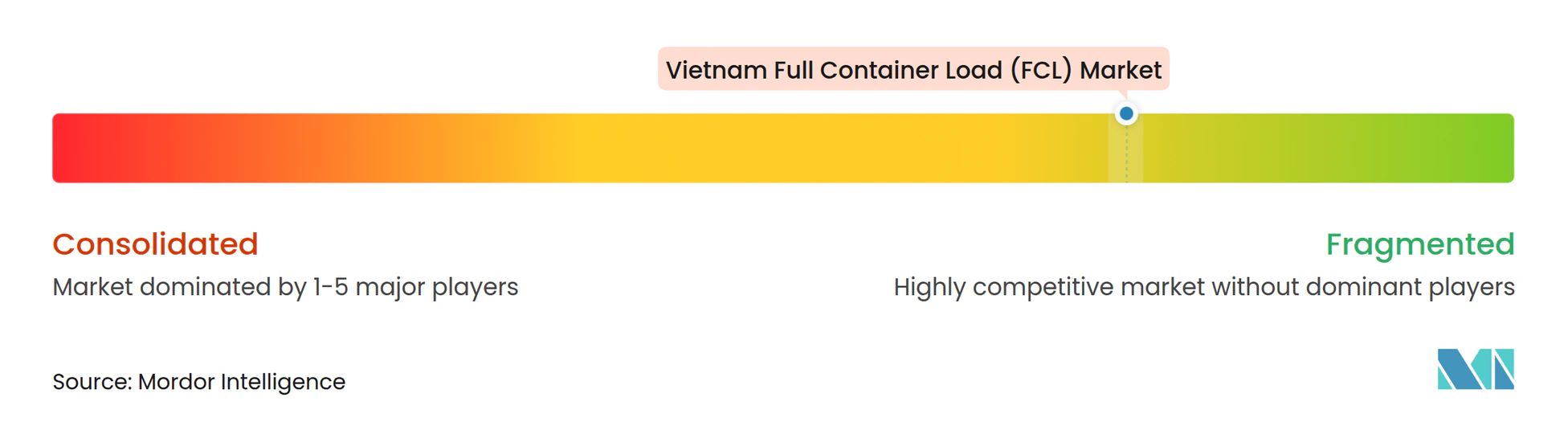
The Vietnam full container load market is fragmented and includes international shipping lines, domestic shipping and port operators, and logistics providers. Global carriers such as CMA CGM, MSC, and A.P. Moller–Maersk compete through vessel capacity, route networks, equipment access, and service coverage. Vietnamese operators such as Gemadept, Saigon Newport, Hai An, Viconship, and VIMC have local port, shipping, or inland transport capabilities. Freight forwarders also compete by coordinating container bookings, inland movement, and shipment visibility.
Terminal investment is an important competitive lever. CMA CGM and Saigon Newport announced a USD 600 million partnership for the planned Lach Huyen Terminals 7 and 8 project in Hai Phong in 2025. Gemadept and CMA CGM held the groundbreaking ceremony for Gemalink Phase 2 in April 2026. Both developments are intended to increase capacity and strengthen access to key trade gateways. Such projects can support long-term service capacity, although their commercial effects depend on completion, cargo demand, and the availability of connecting transport infrastructure.
Domestic services and equipment supply provide further areas of competition. DP World and VIMC Lines launched Mekong Express in May 2025, linking Can Tho and Cai Mep by a scheduled sea-river service[4]. In August 2025, Hoa Phat delivered 1,000 20-foot dry containers to CMA CGM, adding a domestic equipment supply relationship. Providers that combine dependable equipment availability, terminal access, inland links, and suitable reefer services can differentiate themselves from competitors that rely primarily on vessel capacity or price.
Vietnam Full Container Load (FCL) Industry Leaders
-
Gemadept Corporation
-
Hai An Transport and Stevedoring JSC
-
CMA CGM Group
-
Mediterranean Shipping Company (MSC)
-
A.P. Moller - Maersk
- *Disclaimer: Major Players sorted in no particular order
Vietnam Full Container Load (FCL) Market Companies Covered in this Report
- CMA CGM Group
- Mediterranean Shipping Company (MSC)
- A.P. Moller - Maersk
- Ocean Network Express (ONE)
- Evergreen Marine Corporation
- Saigon Newport Corporation
- Gemadept Corporation
- Vietnam Maritime Corporation (VIMC)
- Hai An Transport and Stevedoring JSC
- Vietnam Container Shipping JSC (VICONSHIP)
- COSCO SHIPPING Lines Co. Ltd
- Transimex Corporation
- Indo Trans Logistics Corporation (ITL)
- Bee Logistics Corporation
- DHL Global Forwarding
- Kuehne+Nagel
- DSV
- Hapag-Lloyd AG
- Nippon Express Vietnam
- Yusen Logistics Vietnam
- KLN Logistics Group
- Expeditors International
Recent Industry Developments in Vietnam Full Container Load (FCL) Market
- April 2026: Gemadept and CMA CGM held the groundbreaking ceremony for Gemalink Phase 2 at Cai Mep–Thi Vai. Upon completion, the project is expected to increase the terminal's capacity to more than 3 million TEUs per year.
- February 2026: A.P. Moller–Maersk described its cross-border barging solution for Vietnam–Cambodia supply chains, highlighting scheduled transport and support for cargo movement along the Mekong corridor.
- November 2025: DHL Global Forwarding expanded its Vietnam CFS network. Ho Chi Minh City CFS increased to 6,800 m², while its Hai Phong CFS reached 4,000 m².
- May 2025: CMA CGM and Saigon Newport announced a USD 600 million partnership to develop Lach Huyen Terminals 7 and 8, with planned annual capacity of 1.9 million TEUs and a target opening in 2028.
Vietnam Full Container Load (FCL) Market Report Scope
Segmentation Overview
| Domestic / Inter-Island FCL | |
| International FCL | Import Flow |
| Export Flow |
| Dry Containers |
| Refrigerated Containers |
| Tank Containers |
| Special Equipment Containers |
| 20-Foot Containers |
| 40-Foot Containers |
| Manufacturing and Industrial |
| Retail and Consumer Goods |
| Food and Beverage |
| Automotive and Components |
| Chemicals and Petrochemicals |
| Electronics and Electrical |
| Agriculture and Forestry |
| Healthcare and Pharmaceuticals |
| Other End Users |
| Northern Vietnam |
| Central Vietnam |
| Southern Vietnam |
| By Trade Flow | Domestic / Inter-Island FCL | |
| International FCL | Import Flow | |
| Export Flow | ||
| By Container Type | Dry Containers | |
| Refrigerated Containers | ||
| Tank Containers | ||
| Special Equipment Containers | ||
| By Container Size | 20-Foot Containers | |
| 40-Foot Containers | ||
| By End-User Industry | Manufacturing and Industrial | |
| Retail and Consumer Goods | ||
| Food and Beverage | ||
| Automotive and Components | ||
| Chemicals and Petrochemicals | ||
| Electronics and Electrical | ||
| Agriculture and Forestry | ||
| Healthcare and Pharmaceuticals | ||
| Other End Users | ||
| By Region | Northern Vietnam | |
| Central Vietnam | ||
| Southern Vietnam | ||
Key Questions Answered in the Report
What is the forecast value of Vietnam's FCL market by 2032?
The market is projected to reach USD 3.00 billion by 2032, rising from USD 2.16 billion in 2027 at a CAGR of 6.78%.
Which trade flow leads Vietnam's FCL market?
International FCL leads with a 78.34% share in 2026, reflecting the importance of international manufacturing and trade flows.
Why are 40-foot containers widely used in Vietnam?
40-foot containers held 63.24% of the market in 2026 and are projected to register an 8.12% CAGR through 2032. They can suit larger factory shipments when cargo dimensions and weight allow.
Which end-user segment is projected to grow fastest?
Healthcare and pharmaceuticals is projected to register an 8.36% CAGR during 2027–2032, supported by the need for specialized transport and handling of temperature-sensitive cargo.
Which region is projected to grow fastest?
Central Vietnam is projected to register an 8.62% CAGR during 2027–2032, although its smaller starting base should be considered when interpreting the growth rate.
What are the main constraints facing Vietnam's FCL market?
Port congestion, freight-rate volatility, fragmented multimodal data, and river-draft disruptions can affect costs, equipment availability, and shipment reliability.