
Market Overview
| Study Period | 2020 - 2031 |
|---|---|
| Forecast Data Period | 2026 - 2031 |
| Historical Data Period | 2020 - 2024 |
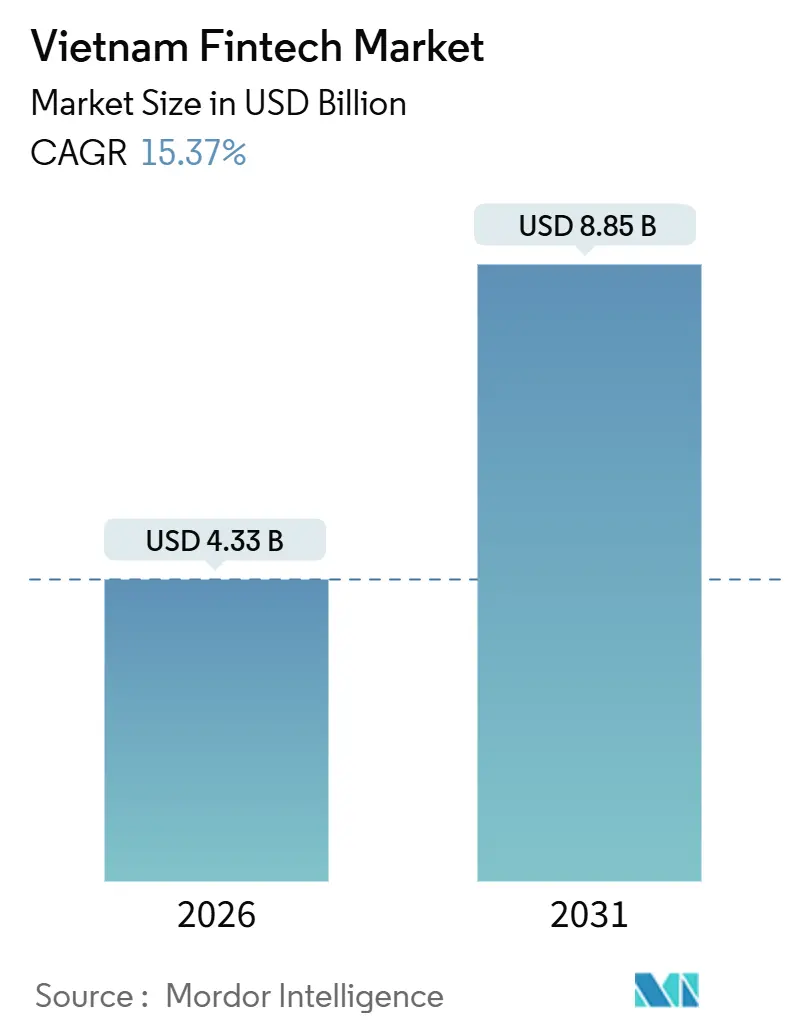
| Market Size (2026) | USD 4.33 Billion |
| Market Size (2031) | USD 8.85 Billion |
| Growth Rate (2026 - 2031) | 15.37% CAGR |
| Market Concentration | Medium |
Major Players *Disclaimer: Major Players sorted in no particular order Image © Mordor Intelligence. Reuse requires attribution under CC BY 4.0. | |
Vietnam Fintech Market Analysis by Mordor Intelligence
The Vietnam fintech market size is USD 4.33 billion in 2026 and is projected to reach USD 8.85 billion by 2031 at a 15.37% CAGR. This growth is fueled by a robust domestic digital payment ecosystem, which saw significant year-on-year expansion. Vietnam introduced a fintech sandbox, allowing innovative financial products to scale in a controlled environment. The shift toward cashless payments is evident, with 5.5 billion cashless transactions recorded in Q1 2025, facilitated by NAPAS 247's real-time QR infrastructure that lowers merchant acceptance costs and expands digital use cases. [1]International Monetary Fund, “The Impact of Central Bank Digital Currency on Payments Competition,” elibrary.imf.org. Expanding financial inclusion has also contributed to market growth, as more individuals gain access to bank accounts. Digital platforms and banks have further accelerated adoption by providing accessible and user-friendly fintech solutions. The market is strengthened by growing consumer trust in digital payments, supported by secure and well-regulated systems. Overall, Vietnam’s fintech landscape is poised for sustained growth, driven by technology adoption, regulatory support, and a broadening financial infrastructure.
Key Report Takeaways
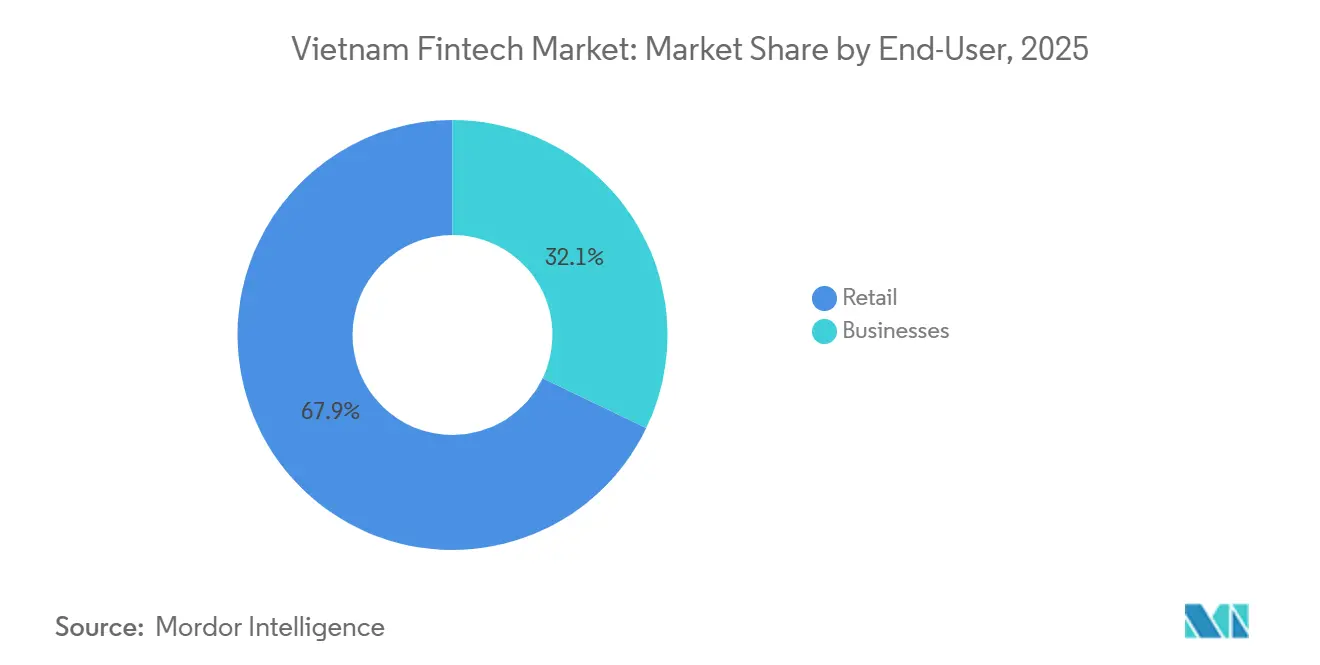
- By service proposition, digital payments held 71.73% of the Vietnam fintech market share in 2025, while insurtech is forecasted to expand at a 31.28% CAGR through 2031.
- By end-user, retail accounted for 67.88% of the Vietnam fintech market share in 2025, and business users are projected to record a 24.38% CAGR through 2031.
- By user interface, mobile applications captured 79.28% of the Vietnam fintech market share in 2025, while POS and IoT devices are set to grow at a 28.35% CAGR through 2031.
- By geography, Southern Vietnam accounted for 47.75% of the Vietnam fintech market share in 2025, while Central Vietnam is projected to grow at an 18.87% CAGR through 2031.
Note: Market size and forecast figures in this report are generated using Mordor Intelligence’s proprietary estimation framework, updated with the latest available data and insights as of January 2026.
Vietnam Fintech Market Trends and Insights
Drivers Impact Analysis*
| Driver | (~) % Impact on CAGR Forecast | Geographic Relevance | Impact Timeline |
|---|---|---|---|
| High smartphone and internet penetration, enabling mass mobile-first fintech adoption | +2.8% | Global, particularly urban centres in Northern and Southern Vietnam | Short term (≤ 2 years) |
| The government's cashless roadmap and the National Digital Transformation Program are accelerating the digital payment infrastructure | +3.5% | National, with accelerated implementation in Ho Chi Minh City and Hanoi | Medium term (2-4 years) |
| Rising middle-class demand for convenient, low-cost financial services | +2.1% | National, concentrated in urban areas across all three regions | Long term (≥ 4 years) |
| Expansion of NAPAS 247 real-time QR rail, reducing merchant acceptance costs | +2.3% | National | Short term (≤ 2 years) |
| Regulatory sandbox for P2P lending and open banking, enabling innovation pilots | +1.6% | National, with sandbox zones in Ho Chi Minh City and Da Nang | Medium term (2-4 years) |
| Cross-border e-commerce remittance inflows are driving multi-currency wallet demand | +1.4% | Southern Vietnam hub, expanding to Northern provinces | Medium term (2-4 years) |
| Source: Mordor Intelligence | |||
High Smartphone & Internet Penetration
Smartphone and internet penetration are a structural advantage for the Vietnam fintech market, with widespread connectivity enabling mobile-first service delivery across payments, lending, investments, and insurance. The Ministry of Information and Communications has driven household fiber and 4G coverage to high levels, which has reduced access friction for real-time transactions and account onboarding. National planning targets 5G availability at scale by 2030, which supports the next wave of low-latency fintech use cases like instant credit decisioning and dynamic QR payments. Platform growth shows the effect of this base, as leading wallets and bank apps scaled rapidly on the back of digital infrastructure and user readiness. As participation widens, hybrid models that blend digital channels with local agent support continue to expand reach in areas where digital literacy is still maturing, keeping the Vietnam fintech market inclusive while sustaining growth.
Government Cashless Roadmap & National Digital Transformation Program
The cashless roadmap and the National Digital Transformation Program have accelerated the Vietnam fintech market by pushing digital payments into the mainstream of commerce and public services. Fiscal and administrative measures, including requirements that link deductions and benefits to non-cash evidence, have created persistent incentives for businesses to digitize payment flows and record-keeping. National database integration prioritized by the government is improving the quality of identity, tax, and credit data that underpin digital onboarding, underwriting, and fraud control. Banks have reinforced these gains by rolling out biometric ID-based authentication at scale, which has improved security outcomes and reduced fraud exposure alongside compliance with new verification rules. As payroll, pensions, and subsidy distribution migrate to digital channels through local pilots, consumer switching costs rise, and platform lock-in strengthens, supporting durable adoption across the Vietnam fintech market.
Rising Middle-Class Demand for Convenient Financial Services
An expanding middle class is creating sustained demand for simple, convenient, and affordable financial services that are accessible on mobile devices across savings, credit, payments, and protection. Digital investment platforms that offer fractional investing and automated advisory features have grown their user bases by addressing entry barriers, including minimum balances and onboarding friction. Insurers and distributors are responding by embedding micro-insurance and on-the-go protection within everyday applications, which better fits customer preferences for convenience and transparency. Banks and wallets are also adopting personalization through AI-driven prompts and rewards that nudge users toward responsible credit and savings behavior, reinforcing engagement at low incremental cost. Together, these shifts strengthen retail-led monetization for the Vietnam fintech market, while opening new cross-sell opportunities as incomes rise and customer needs diversify.
Expansion of NAPAS 247 Real-Time QR Rail
The expansion of NAPAS 247 has been pivotal for the Vietnam fintech market, since interoperable QR and instant transfers reduce acceptance costs and increase merchant coverage across formal and informal retail. Rail interoperability allows any participating bank app or wallet to scan standardized codes, which removes silos in acceptance and supports broader use cases like delivery, on-demand transport, and utilities. Leading acquirers have gained share by coupling dynamic QR capabilities with merchant services, enhancing collections and reconciliation for e-commerce and logistics partners at scale. Faster and cheaper payments diminish the incremental benefits a retail CBDC might offer in the near term, since a public fast payment system is already delivering high-speed clearing and settlement nationwide. Network resilience remains a focus in more remote provinces, where connectivity limitations can slow confirmations, reinforcing the need for telco-fintech collaboration on service continuity for the Vietnam fintech market.
Restraints Impact Analysis*
| Restraint | (~) % Impact on CAGR Forecast | Geographic Relevance | Impact Timeline |
|---|---|---|---|
| Low financial literacy and trust gaps outside Tier-1 cities are limiting product adoption | -1.9% | Rural areas nationwide, particularly the Northern highlands and the Mekong Delta | Long term (≥ 4 years) |
| Fragmented multi-agency KYC rules are increasing onboarding friction and compliance costs | -1.4% | National | Medium term (2-4 years) |
| Unsustainably high customer acquisition cost from cashback wars eroding unit economics | -1.2% | Urban centres in Southern and Northern Vietnam | Short term (≤ 2 years) |
| Limited cloud availability zones and latency issues are constraining real-time fraud detection | -0.9% | National, with an acute impact in Central and rural provinces | Medium term (2-4 years) |
| Source: Mordor Intelligence | |||
Low Financial Literacy & Trust in Rural Areas
Over 70% of the population lives outside the largest cities, which means the Vietnam fintech market depends on outreach models that address gaps in confidence, awareness, and product understanding. [2]International Finance Corporation, “Digital Finance to Drive Viet Nam’s Economic Growth,” ifc.org. Government programs focused on financial inclusion and digital transformation continue to push acceptance infrastructure and e-services deeper into rural districts. Payment providers, banks, and agents are testing hybrid delivery that combines mobile onboarding with local assistance to bridge literacy constraints and build trust. Greater coverage of identity services, including chip-based IDs and biometric verification, is also reducing fraud risk and improving confidence in digital channels. A sustained focus on education, grievance redressal, and agent quality is likely to determine how quickly advanced products like investments and insurance scale beyond major urban corridors in the Vietnam fintech market.
Fragmented KYC Rules Across Ministries
KYC and data protection regulations are spread across multiple statutes and agencies, which complicates digital user onboarding and increases compliance costs for non-bank fintechs. Recent requirements for biometric verification of corporate representatives have prompted banks to implement both in-app and in-branch biometric options. Fintechs without banking licenses must rely on partnerships with licensed institutions to access credit data and identity services, creating third-party dependencies and potential revenue-sharing challenges. New frameworks in emerging financial centers are introducing sandbox pathways that could simplify rules for pilot participants, but this may result in inconsistent onboarding experiences across different regions until national standards are harmonized. Addressing this regulatory fragmentation is expected to shorten time-to-market for new products, reduce user drop-off during onboarding, and directly improve unit economics in the Vietnam fintech sector. [3]VietnamPlus, “Banks Accelerate Digitalisation, Non-cash Payments,” vietnamplus.vn.
*Our forecasts treat driver/restraint impacts as directional, not additive. The impact forecasts reflect baseline growth, mix effects, and variable interactions.
Segment Analysis
By Service Proposition: Payments Lead, Insurtech Accelerates
Digital payments held a commanding 71.73% share in 2025, while insurtech is forecast to be the fastest-growing service line at a 31.28% CAGR through 2031, underscoring the depth and breadth of the Vietnam fintech market. In parallel, the regulatory sandbox enables controlled pilots in P2P lending, credit scoring, and open APIs, which will support lending and data-led models as they transition from proof of concept to scaled deployment. Neobanking is advancing through bank-backed digital brands and partnerships with technology players that shorten the path from customer acquisition to product activation. Digital investments are expanding through fractional equity and automated saving tools, as platforms adapt to rising retail wealth and the need for low-barrier entry. Insurtech’s growth is leveraging embedded distribution and digital channels, which aligns with the policy environment that has supported greater foreign investment into the sector and modernization of distribution.
From a growth-composition perspective, the Vietnam fintech market is set to evolve as payments mature and other verticals accelerate from a smaller base. Digital payments are likely to sustain mid-teen rates as account ownership nears saturation, while new use cases in merchant acquiring and B2B payments keep activity healthy. Insurtech’s acceleration reflects a catch-up dynamic, as carriers pivot toward embedded models and consumer-grade digital experiences. Lending and financing are positioned to benefit from open-banking integration, improved credit data, and better verification, which together reduce default risk and increase addressable demand. These dynamics indicate a broader shift from a payments-led to a multi-product Vietnam fintech industry, which is likely to broaden revenue pools and diversify monetization.



By End-User: Retail Dominates, Business Surges
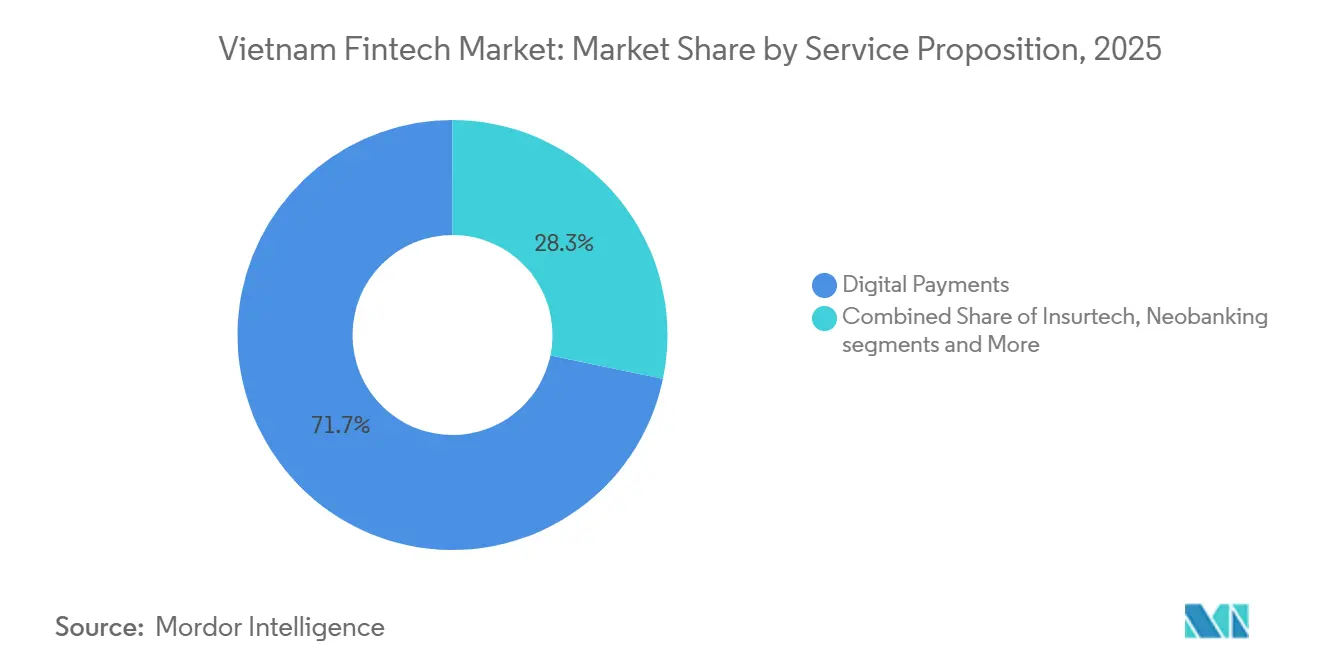
Retail accounted for 67.88% of value in 2025, reflecting the breadth of wallet usage, QR acceptance, and investment adoption among mass and mass-affluent consumers in the Vietnam fintech market. Business users are projected to expand at a 24.38% CAGR, as SMEs integrate embedded finance, supplier payments, collections, and working-capital solutions that improve cash conversion and reduce friction. Given that SMEs constitute the overwhelming majority of registered enterprises, the digitization of invoicing and merchant finance materially expands the serviceable opportunity. As APIs proliferate and enterprise systems connect with bank platforms, switching costs rise, and early movers consolidate share through account lock-in and workflow depth. Bank-fintech models that couple merchant services with short-term credit are gaining traction, underscoring the rising importance of B2B flows in the Vietnam fintech market.
Across the cycle, retail growth has been consumption-led, while business growth correlates with investment cycles and public-spending execution. Open banking standards are creating a cleaner environment for treasury connectivity, reconciliation, and embedded lending, which strengthens the business case for digitization. As more SMEs adopt ERP, e-commerce, and FinOps tools, data exhaust improves underwriting, which reduces collateral reliance and expands B2B credit access. These trends reinforce a gradual rebalancing from retail-only growth toward a more even split between consumer and enterprise flows in the Vietnam fintech market. The result is a broader and more resilient revenue base that is less sensitive to short-term changes in consumer spend.
By User Interface: Mobile Reigns, POS/IoT Devices Surge
Mobile applications captured 79.28% in 2025, reflecting a mobile-first adoption curve built on high smartphone use and low-friction onboarding among leading players in the Vietnam fintech market. POS and IoT devices show the highest growth at 28.35% CAGR, as soft POS has turned smartphones into contactless acceptance terminals for small merchants and service providers. Web and browser interfaces remain relevant for corporate banking, treasury dashboards, and higher-consideration advisory flows, where larger screens and controls are preferred. Platform integrations with transport and delivery services have pulled digital payments into daily mobility and food use cases across new provinces, broadening coverage outside metro cores. With mobile usage near saturation, further gains in the Vietnam fintech market are likely to come from deeper merchant acquiring in tier-2 and tier-3 cities through low-cost POS and IoT deployments.
Adoption patterns suggest mobile will continue to lead daily transacting, while POS and IoT fill acceptance gaps in long-tail retail and services. As banks and processors deploy tap-to-phone and QR solutions with unified reporting, the merchant value proposition strengthens through lower hardware costs and faster settlement. Enhanced API connectivity across channels and devices keeps user experiences consistent, which supports loyalty and higher frequency. This multi-interface progression helps the Vietnam fintech market move beyond core bill-pay and P2P into richer acquiring and B2B flows. Over time, cross-channel analytics and AI will add personalization that tightens engagement without raising variable cost.
Geography Analysis
Southern Vietnam accounted for 47.75% of activity in 2025, anchored by Ho Chi Minh City’s financial and commercial base and the emergence of its International Financial Centre framework. The region benefits from a dense ecosystem of banks, wallets, and merchant partners that continue to expand acceptance and embedded finance into retail and services. Ho Chi Minh City is targeting a USD 120 billion economy in 2025, with logistics and trade infrastructure that support payments and lending volume across supply chains. The concentration of financial services and technology talent has also enabled faster product testing and partnerships that feed the Vietnam fintech market. As digital-payments penetration increases, growth shifts from new-to-digital use cases to deeper monetization across merchant services and credit.
Northern Vietnam is an administrative and innovation center that aims to lift the digital economy’s contribution with policy support and ecosystem initiatives involving universities and research hubs. The region’s growth in manufacturing and services continues to draw investment, which sustains payment flows for payroll, procurement, and trade. Leading banks headquartered in Hanoi have deepened digital offerings but continue to operate hybrid models that combine branch strength with upgraded mobile and web platforms. Mobility platforms are expanding northward and bringing payments to new provinces, which extends acquiring and consumer finance to more districts. These shifts balance the Vietnam fintech market by adding regional diversity to growth drivers.
Central Vietnam is the fastest-growing region with an 18.87% projected CAGR, as Da Nang advances sandbox activity linked to green finance, blockchain, and cross-border flows under the International Financial Centre framework. The city is collaborating with international partners to build expertise and run controlled pilots, which support trade finance and tourism-related payments aligned with its logistics position. As infrastructure and regulatory pilots converge, Central Vietnam can attract new capital and specialized talent, while reinforcing nationwide initiatives on data and interoperability. Over the forecast horizon, the Vietnam fintech market should see a more balanced geographic contribution to growth as Central projects scale and Northern adoption deepens. This balancing makes the overall opportunity less dependent on one metropolitan region and more resilient to localized shocks.
Regulatory Landscape
Vietnam’s fintech oversight is increasingly built around controlled experimentation and system-wide risk controls led by the State Bank of Vietnam (SBV). Decree No. 94/2025/ND-CP, effective July 1, 2025, introduced a banking-sector regulatory sandbox for credit scoring, Open API, and P2P lending models, with testing limited to Vietnam and capped in duration. Alongside this, the SBV has deployed the System for Supporting, Monitoring, and Preventing Fraud Risks in Payment Operations (SIMO); as of June 1, 2026, the system had issued suspected-fraud alerts to 4.5 million customers, pointing to an emphasis on operational resilience as digital payments expand.
In 2026, the SBV also moved to operationalize sandbox administration closer to local markets. Circular No. 19/2026/TT-NHNN, issued May 19, 2026 and effective June 30, 2026, decentralized implementation of administrative procedures for the banking regulatory sandbox to SBV regional branches, which is intended to reduce processing friction for applicants outside Hanoi. The SBV’s 2026-2030 digital transformation planning, including the Digital Transformation Plan defined under SBV Decision No. 1344/QD-NHNN dated June 23, 2026, reinforces the push toward more data-driven supervision, with parallel workstreams such as the SBV’s draft circular on safety and risk management for AI applications in banking.
Value Chain Analysis
Vietnam’s fintech value chain begins with regulated account and identity rails (banks and licensed payment intermediaries) and runs through switching and clearing infrastructure, interoperability layers, application-layer wallets and bank apps, and merchant acceptance (QR, softPOS/POS, and e-commerce gateways). NAPAS is a key backbone for domestic instant payments and QR interoperability, with its 2026 plan focused on system security and expansion of VIETQRGlobal acceptance, while also serving as a technical gateway for cross-border QR linkages with markets such as Thailand, Laos, Cambodia, and China. SBV requirements and national digital identity initiatives increasingly shape compliance and onboarding inputs, which affects how fintechs design KYC, fraud monitoring, and underwriting.
On distribution and monetization, the chain is moving deeper into embedded B2B workflows, particularly around supply-chain finance and invoicing-connected payments. In 2026, BIDV expanded an integrated digital financial ecosystem with FPT IS, including the TradeFlat platform and BIDV SCF, to connect supply chain participants, and Nam A Bank launched a Supply Chain Finance technical assistance project with IFC, highlighting tighter collaboration between banks, tech integrators, and development institutions. In parallel, TASConnect’s alliance with M-invoice Vietnam shows how invoicing and ERP-adjacent platforms help embed working capital and payment capabilities into enterprise processes. SBV Circular No. 19/2026/TT-NHNN also feeds into the value chain by lowering administrative friction for sandbox pilots, supporting faster iteration among infrastructure providers, banks, and fintech product teams.
Competitive Landscape
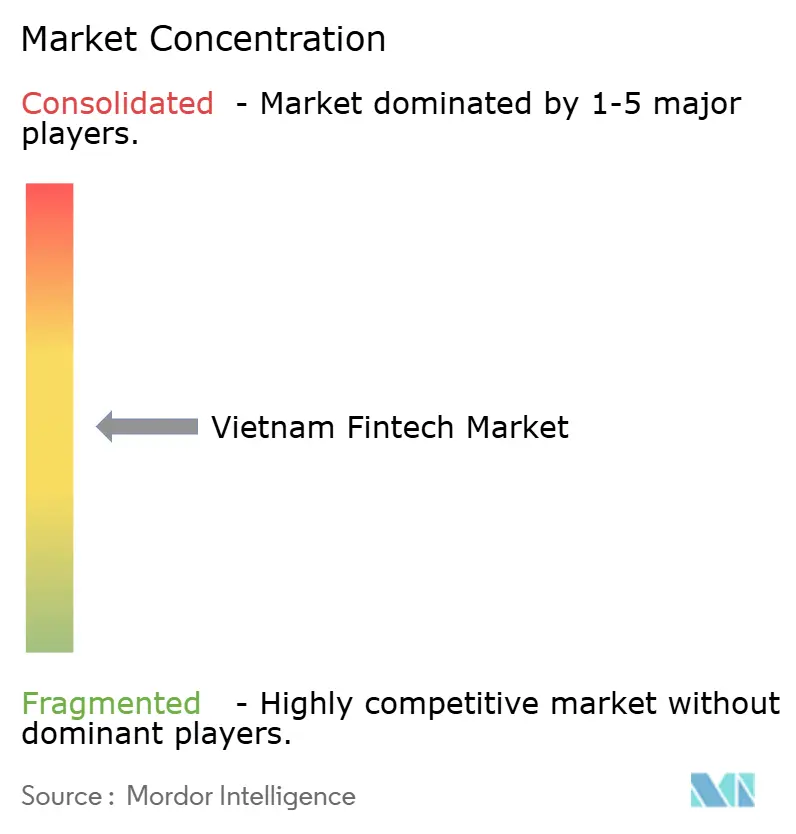
The Vietnam fintech market exhibits a moderately concentrated structure, with major players holding strong positions while competition remains active through bank-led digital brands and new foreign-backed entrants. Some digital wallets have achieved profitability by balancing scale, merchant reach, and disciplined spending, showing that network effects can offset acquisition costs as products mature. Other wallets leverage extensive social networks to enhance QR payment adoption, engagement, and user retention. Super-app ecosystems are integrating payments with commerce and mobility, increasing transaction frequency and creating opportunities for lending and insurance. Bank-backed neobanks are intensifying competition by combining deposit services with seamless digital experiences, reducing friction, and enabling cross-selling. Overall, the market demonstrates a dynamic balance between established leaders and innovative challengers, shaping the adoption of digital financial services.
Incumbent banks are investing heavily in data platforms, analytics, and cloud infrastructure to improve personalization, fraud detection, and operational efficiency. Generative AI is being deployed in customer service and lead allocation to accelerate response times and improve conversion, while biometric requirements enhance baseline security across the system. Partnerships between wallets and banks are expanding product offerings within super-apps, strengthening embedded finance through shared data and risk. New entrants are focusing on AI-driven credit solutions that shorten approval times and serve underbanked customers with limited or no credit history. The competitive emphasis is shifting toward quality underwriting, cross-sell potential, and operational efficiency rather than purely acquisition-driven strategies. In 2024, ZaloPay reinforced its position as a leading payment platform by expanding payment options, merchant networks, and QR solutions that support cross-platform and international use, while also adding financial services like savings, loans, and installment plans to deepen engagement. [4]VNG Corporation, “ZaloPay 2024: Hành Trình Mới và Mở,” vng.com.vn.
The International Financial Centre frameworks in Ho Chi Minh City and Da Nang are attracting global institutions with clear pilot mechanisms and incentives, increasing competitive intensity. Banks are extending their ecosystems into insurance and wealth management, creating additional cross-sell opportunities and strengthening customer relationships. Cross-border payment providers are partnering with domestic banks to localize operations, improving speed and reducing costs. As authentication and data standards converge, open-banking use cases are expected to expand, fostering collaboration between fintechs and banks. The emerging market playbook emphasizes regulatory alignment, technology leverage, and ecosystem partnerships as the primary sources of competitive advantage.
Vietnam Fintech Industry Leaders
M_Service (MoMo)
VNPay
ZaloPay (VNG)
ShopeePay
Grab Financial Group VN
- *Disclaimer: Major Players sorted in no particular order

Market Opportunities and Future Outlook
Open API, credit-scoring, and P2P lending pilots under Decree No. 94/2025/ND-CP create room for regulated data-sharing and alternative underwriting products that connect banks, fintechs, and merchant ecosystems beyond basic wallet payments. This direction aligns with broader inclusion and digitized distribution policy, including Decision No. 928/QD-TTg (signed May 2026) approving the 2026-2030 national financial inclusion strategy with emphasis on digital channels and cashless payments. Outside tier-1 cities, practical gaps remain in onboarding and risk controls, where fragmented KYC requirements and fraud concerns raise demand for regtech, identity orchestration, and monitoring tools that fit SBV’s fraud-prevention agenda, including SIMO-driven customer alerts.
Opportunity areas are also tightening around payment infrastructure competition and cross-border acceptance, particularly in interoperability, merchant services, and regional travel or e-commerce use cases. In March 2026, the licensing and launch of MobiFone Digital Payment as a switching and clearing operator (in addition to NAPAS) creates procurement and integration opportunities for wallets, banks, and merchants looking for redundancy and route optimization across operators. NAPAS’ cross-border QR initiatives, including the Vietnam-Singapore QR service launched in July 2026 via RoamQR, support expansion for multi-currency wallets, cross-border merchant acquiring, and fee-based acceptance services tied to tourism and SMEs trading with ASEAN partners. Separately, the International Financial Centre framework formalized by the National Assembly in September 2025 for Ho Chi Minh City and Da Nang provides an additional structured channel for pilots and partnerships in fintech and adjacent areas such as digital assets and green finance.
Recent Industry Developments
- July 2026: NAPAS launched a Vietnam-Singapore cross-border QR payment service via the RoamQR platform, expanding real-world ASEAN interoperability for QR acceptance. The move strengthens multi-market merchant acceptance and wallet use cases tied to travel and cross-border commerce, while adding momentum to Vietnam’s broader VIETQRGlobal and bilateral QR connectivity agenda.
- May 2026: Kredivo Group acquired a 99.99% stake in Timo Digital Bank, accelerating a foreign-backed entry into Vietnam’s digital banking ecosystem through an established platform. The transaction underscores rising strategic value in regulated customer acquisition, deposit-linked products, and embedded credit distribution through digital channels.
- September 2025: Vietnam’s National Assembly formalized the International Financial Centre framework in Ho Chi Minh City and Da Nang, including sandbox mechanisms spanning fintech, digital assets, and green finance. This created an additional, named institutional pathway for pilot programs and international participation beyond the SBV’s banking-sector sandbox, supporting more structured experimentation across multiple fintech verticals.


Research Methodology Framework and Report Scope
Market Definition and Coverage
For this study, the Vietnam fintech market is defined as revenue generated from technology-enabled financial services delivered through software and digital channels to retail users and businesses within Vietnam.
Scope exclusions: We exclude pure IT outsourcing, core banking software sold as a standalone IT project, and general e-commerce sales that do not represent a financial service.
Segmentation Overview
- By Service Proposition
- Digital Payments
- Digital Lending & Financing
- Digital Investments
- Insurtech
- Neobanking
- By End-User
- Retail
- Businesses
- By User Interface
- Mobile Applications
- Web / Browser
- POS / IoT Devices
- By Geography
- Northern Vietnam
- Central Vietnam
- Southern Vietnam
Data Sources, Market Sizing, and Validation
Desk Research
Desk work starts by building a clear view of Vietnam's digital finance environment, and we anchor it to official time series that can be checked year after year. Public sources such as the State Bank of Vietnam releases, the General Statistics Office, the Ministry of Information and Communications updates, and World Bank Global Findex help us understand account ownership, digital access, and the direction of payment adoption.
To make the market model practical, we also review materials that outline market rules and operating conditions, such as government decisions on cashless payments and regulatory sandbox discussions, followed by association sites and reputable press. Company annual reports, investor presentations, and product disclosures are used to cross-check service scope and monetization routes, and a paid subscription for company financials and news is used selectively where public reporting is thin. The examples above are illustrative only, and we also referenced many other public and secondary sources for data collection, validation, and research clarification.
Primary Interviews and Surveys
Primary work was used to confirm what is actually monetized in Vietnam fintech and how pricing moves over time, especially when public disclosures mix transaction volumes with revenue. We spoke with a spread of industry participants and informed observers across payments, lending, investments, insurance-focused fintech, and neobanking, and inputs were balanced across Vietnam's main economic regions to pressure-test assumptions and close data gaps.
Distribution of primary research fieldwork respondents
| Company type | Respondent position |
|---|---|
| Top tier: 36% | CXOs: 22% |
| Mid tier: 42% | Functional/Unit leaders: 36% |
| Smaller Players: 22% | Managers: 42% |
Market-Sizing & Forecasting
We size the market mainly using a top-down approach where Vietnam's digital finance demand pool is reconstructed from adoption signals and activity indicators, and then translated into service revenues by applying realistic monetization rates. We corroborate this with selective bottom-up approximations, such as sampled provider revenue run rates, channel checks, and simple volume times average take rate math, which helps adjust totals when one input looks overstated.
Inputs used in the model are practical and market-linked, including cashless payment growth trends, smartphone and internet penetration, the number of active digital finance users, mix shifts between mobile app and web usage, and product-level take rate ranges observed in interviews. When a segment has limited public clarity, we handle the gap conservatively by using proxy ratios from comparable services in Vietnam and validating them with primary feedback before adding them into the final roll up.
For forecasting, we use scenario analysis because policy pace, trust in digital services, and credit availability can change adoption and revenue paths quickly. Growth drivers and constraints are translated into year-by-year assumptions, and the final outlook is aligned to what primary respondents consider achievable under base case conditions.
Data Validation & Update Cycle
Outputs are checked through triangulation across independent signals, and we look for inconsistencies between revenue-sized results and what activity metrics suggest for Vietnam. When a variance shows up, we revisit assumptions, question outliers, and reconnect with selected respondents to confirm whether the change is real or a reporting artifact.
Before sign off, the model and narrative go through multi-step analyst reviews so definitions, math, and logic stay consistent across years and sub markets. Reports are refreshed annually, and interim updates are made when there is a material regulatory change, a major pricing shift, or a step change in adoption, followed by a final pre-delivery review so clients receive the latest view.
Mordor Intelligence's Vietnam Fintech Market Size Versus Other Published Estimates
Published market sizes for Vietnam fintech often differ because authors use different boundaries for what counts as fintech, and they also mix revenue with transaction value in some cases. Timing choices matter as well, since exchange rates, inflation, and policy-led adoption swings can move the headline number even when user activity stays stable.
The biggest gap drivers usually come from whether digital payment transaction value is treated as market size, whether adjacent IT and e-commerce activity is folded in, and whether lending is counted as loan book value or fee-based revenue. Another frequent driver is forecasting posture, where aggressive adoption curves are used without being cross-checked against cashless payment usage, active user levels, and realistic take rates for Vietnam.
Benchmark comparison
| Source | Market Size | Gaps in Research Methodology |
|---|---|---|
| Mordor Intelligence | USD 4.33 B (2026) | |
| Trade Journal A | USD 15.67 B (2024) | This figure is commonly built from a broader fintech definition and may reflect transaction value or activity-led totals rather than provider revenues, which can inflate the market size when compared on a revenue basis. |
| Regional Consultancy B | USD 3.89 B (2025) | This estimate appears to use a tighter service set and may apply more conservative monetization assumptions across lending and payments, which can lower the total when compared to a multi-service roll up. |
The table shows a wide spread mainly because some sources lean on payment value and broad adjacent scope, while others stay closer to monetized service revenue. Under Mordor Intelligence's scope, the count is limited to fintech service revenues across key propositions (including payments, lending and financing, investments, insurtech, and neobanking) and then checked against adoption and activity signals so the total stays traceable to practical variables.


Key Questions Answered in the Report
What is the size and growth outlook for the Vietnam fintech market through 2031?
The Vietnam fintech market size is USD 4.33 billion in 2026 and is projected to reach USD 8.85 billion by 2031 at a 15.37% CAGR, reflecting robust adoption and supportive policy.
Which segments lead and which are growing fastest in Vietnam’s fintech?
Digital payments led with 71.73% share in 2025, while insurtech is the fastest-growing at a 31.28% CAGR through 2031 on embedded distribution and policy support.
How are regulations shaping competition and innovation in Vietnam fintech?
The SBV sandbox under Decree 94 supports pilots for P2P lending, credit scoring, and open APIs, while biometric KYC and data rules standardize security and data flows.
Which regions are most important for Vietnam’s fintech providers?
Southern Vietnam holds 47.75% of activity, Northern Vietnam is a policy and innovation hub, and Central Vietnam is the fastest-growing region with sandbox momentum.
What are the main restraints facing fintech providers in Vietnam today?
Key constraints include fragmented KYC rules, rural financial literacy gaps, cashback-driven acquisition costs, and limited cloud availability zones that raise latency.
Page last updated on:




