
Vietnam Commercial Construction Market Size and Share
Market Overview
| Study Period | 2021 - 2032 |
|---|---|
| Forecast Data Period | 2027 - 2032 |
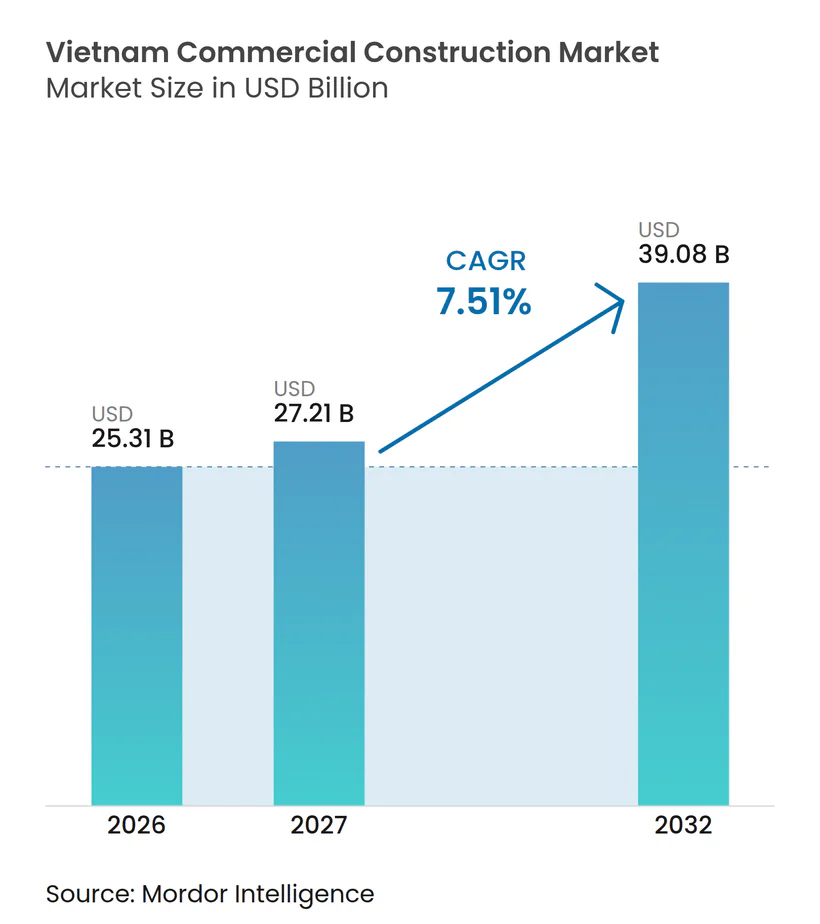
| Base Year Market Size (2026) | USD 25.31 Billion |
| Market Size (2027) | USD 27.21 Billion |
| Market Size (2032) | USD 39.08 Billion |
| Growth Rate (2027 - 2032) | 7.51 % |
| Market Concentration | Low |
Major Players *Disclaimer: Major Players sorted in no particular order Image © Mordor Intelligence. Reuse requires attribution under CC BY 4.0. | |
Vietnam Commercial Construction Market Analysis by Mordor Intelligence
The Vietnam Commercial Construction Market size is expected to grow from USD 25.31 billion in 2026 to USD 27.21 billion in 2027 and is forecast to reach USD 39.08 billion by 2032 at 7.51% CAGR over 2027-2032.
Industrial investment, e-commerce logistics, office requirements from multinational firms, and retail expansion support the Vietnam commercial construction market. Private capital supplies much of the funding, while public infrastructure spending opens new development corridors. Cost inflation, land clearance delays, financing limits, and weak demand for older offices and retail stock remain material constraints. Developers are responding by concentrating on automation-ready logistics assets, Grade A offices, mixed-use projects, and upgrades that meet tenant sustainability requirements. This leaves opportunities in provincial industrial centers, tourism locations, and redevelopment projects, while execution capacity remains important. Contractors that can coordinate specialized systems, manage complex sites, and maintain delivery schedules are better placed to participate in these opportunities. The mix of new development and refurbishment also gives owners options to respond to shifting tenant expectations without relying on a single building type.
Key Report Takeaways
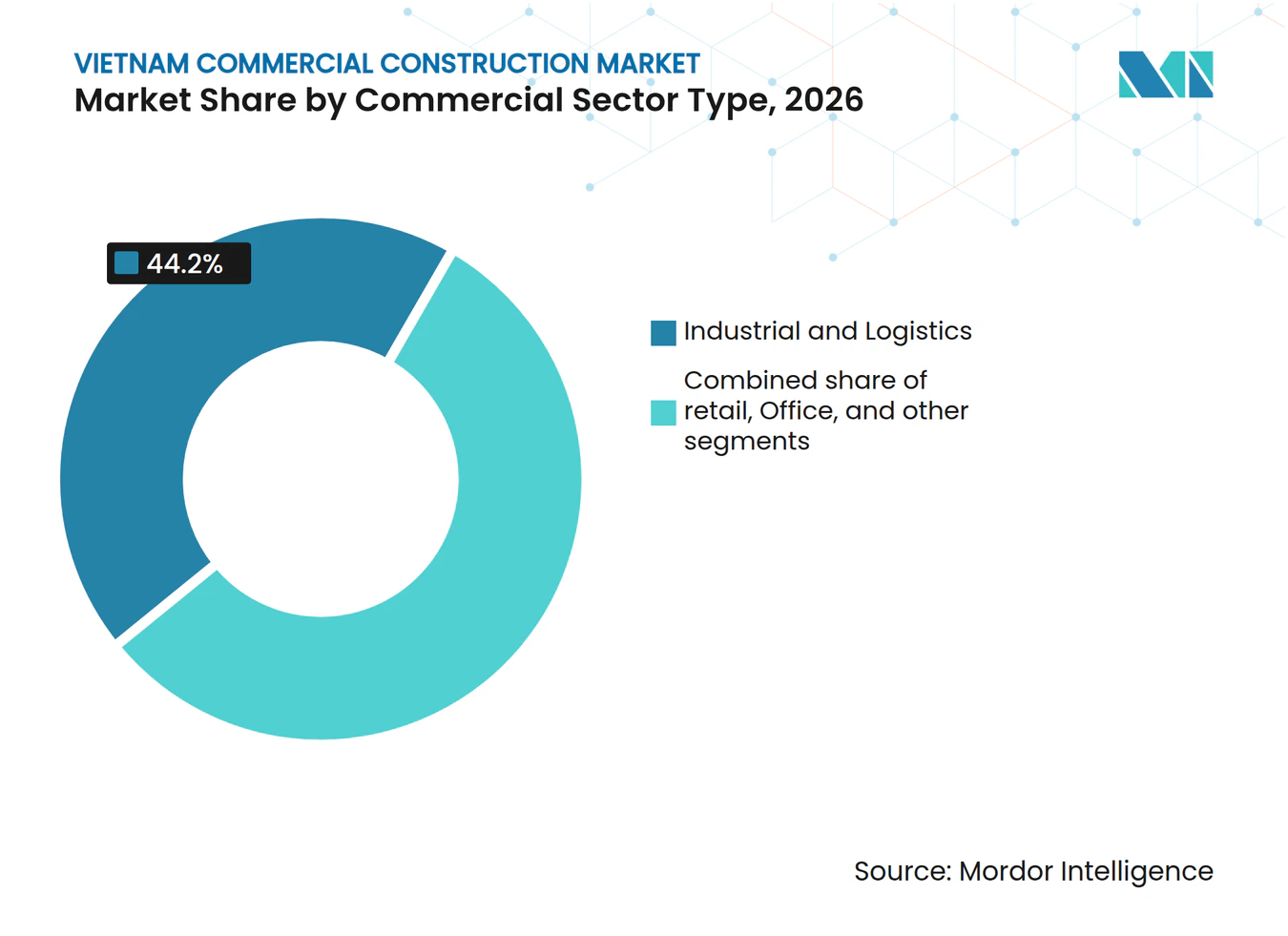
- By commercial sector type, industrial and logistics held 44.2% of the Vietnam commercial construction market share in 2026, while the same segment is forecast to grow at an 8.34% CAGR through 2032.
- By construction type, new construction accounted for 74.5% of the Vietnam commercial construction market size in 2026, while renovation is projected to grow at an 8.02% CAGR through 2032.
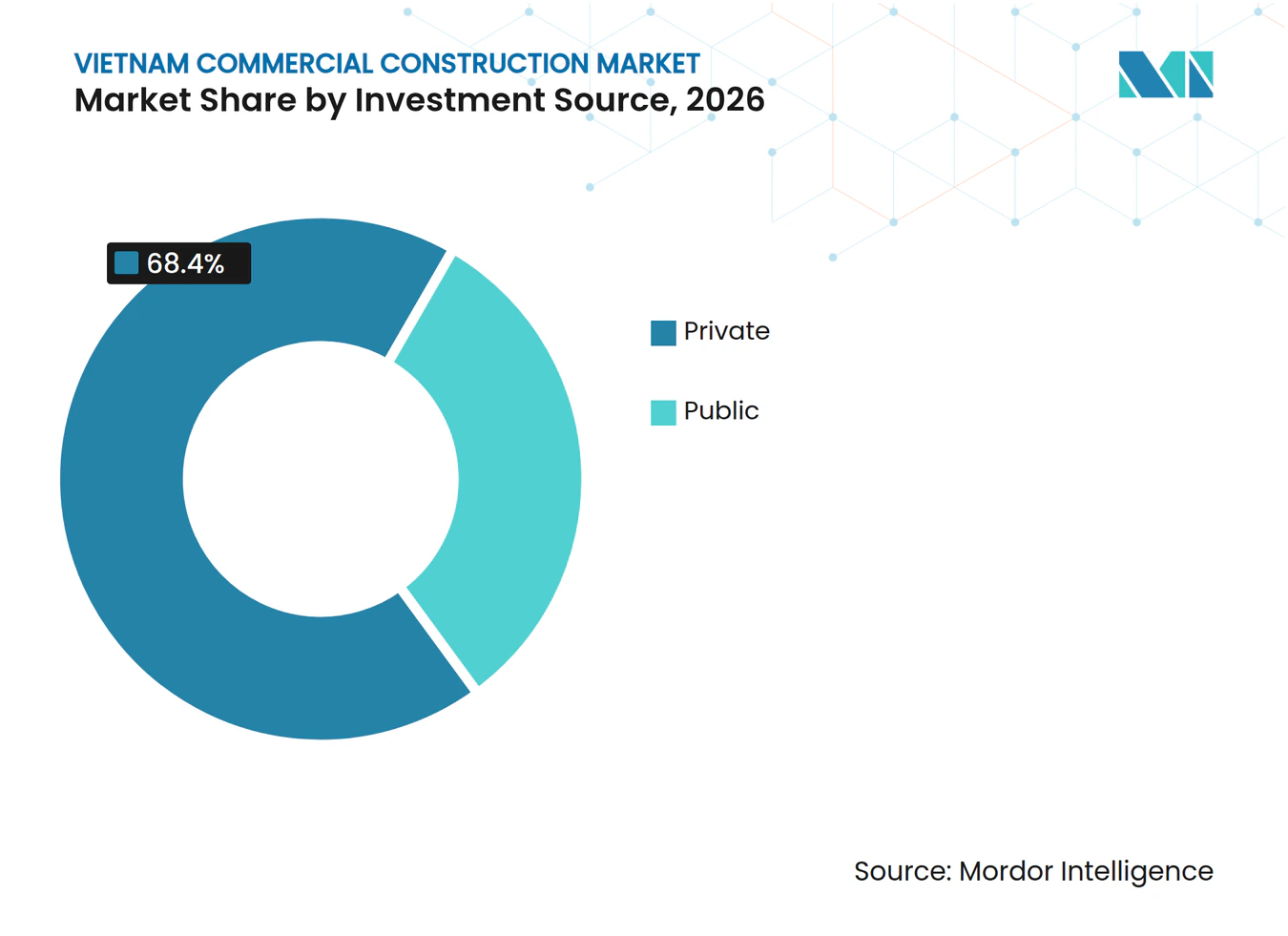
- By investment source, private investment held 68.4% of the Vietnam commercial construction market share in 2026 and is expected to grow at an 8.11% CAGR through 2032.
- By region, Ho Chi Minh City held 39.8% of the Vietnam commercial construction market in 2026, while the rest of Vietnam is forecast to grow at an 8.55% CAGR through 2032.
Note: Market numbers in this report are based on Mordor Intelligence's proprietary estimation framework, which combines nine months of actuals with Q4 projections for base year 2026.
Market Trends and Insights
Drivers Impact Analysis of Vietnam Commercial Construction Market*
| Drivers | (~) % Impact on CAGR Forecast | Geographic Relevance | Impact Timeline |
|---|---|---|---|
| E-commerce growth supporting fulfillment and warehouse construction | +1.5% | Ho Chi Minh City, Hanoi, Hung Yen, Binh Duong, Da Nang, and the Mekong Delta | Short term (≤ 2 years) |
| Multinational expansion supporting Grade A office demand | +1.2% | Ho Chi Minh City central business district and decentralized zones, Hanoi Starlake and Tay Ho Tay | Medium term (2-4 years) |
| Tourism and hotel investment supporting hospitality construction | +0.9% | Da Nang, Phu Quoc, Nha Trang, Ba Ria-Vung Tau, Ha Long, and Hue | Medium term (2-4 years) |
| Organized retail expansion supporting commercial centers | +0.8% | Ho Chi Minh City, Hanoi, Hai Duong, Quang Ninh, Can Tho, and provincial cities | Short term (≤ 2 years) |
| Urban regeneration supporting mixed-use redevelopment | +0.7% | Ho Chi Minh City, Hanoi, and Da Nang | Long term (≥ 4 years) |
| Private healthcare and education investment supporting institutional buildings | +0.6% | Ho Chi Minh City, Hanoi, provincial capitals, and the Mekong Delta | Long term (≥ 4 years) |
| Source: Mordor Intelligence | |||
E-commerce Expansion Transforms Logistics Construction Standards
E-commerce is increasing warehouse demand while changing how logistics assets are designed and located. The sector supports facilities with automation, cold-chain capacity, high floor loading, and fast access to consumers. Ready-built factory and ready-built warehouse occupancy exceeded 90% in the Southern Key Economic Region in the first quarter of 2026. High occupancy gives developers stronger support for additional supply in established industrial corridors. It also moves projects toward larger, automation-ready, sustainability-certified buildings that can serve e-commerce and pharmaceutical tenants. The Vietnam commercial construction market can benefit from this shift because higher building specifications increase the scope of construction work. Developers must also coordinate power, internal circulation, fire protection, loading areas, and digital systems before facilities become operational. This favors projects with clear specifications and experienced delivery teams.
Multinational Corporate Expansion Underpins Demand for Premium Office Space
Foreign-invested enterprises accounted for 82% of leased office space in Ho Chi Minh City in the first quarter of 2025, supporting demand for new Grade A properties[1]. Grade A asking rents reached USD 46.5 per sqm per month, rising 1.1% year over year. Hanoi had 1.74 million sqm of office supply in 2025 after substantial growth over the prior decade, but its Grade A stock remained limited in absolute terms. This supply gap directs development toward Starlake and Tay Ho Tay, where new office projects can meet the requirements of international occupiers. UOA Group committed USD 120 million to Parc Tower, a 20,000 sqm office project in Ho Chi Minh City's central business district, with construction beginning in the fourth quarter of 2025. The Vietnam commercial construction market therefore benefits when occupiers favor high-quality offices over older stock.
Tourism and Hotel Investment Drive Hospitality Construction at Scale
Tourism-related investment supports demand for hotels, resorts, convention space, and connected retail facilities in major destinations. Vietnam received 15.4 million international arrivals in the first 9 months of 2025, placing the country on course toward its 25 million full-year target[2]. Da Nang and Nha Trang resorts recorded occupancy above 70%, while Phu Quoc showed year-over-year occupancy growth. Hotel developers need purpose-built assets when international operators require consistent facilities and operating standards. This favors new construction in coastal destinations rather than limited upgrades to older buildings. The Vietnam commercial construction market also gains from the related demand for retail, transport-linked services, and mixed-use developments around tourism assets.
Organized Retail Expansion Accelerates Commercial Center Development
Organized retail chains are expanding beyond major cities and supporting new shopping centers in provincial markets. AEON opened 4 locations in 2025, its highest annual count, while Lotte Shopping planned additional malls. New supply in Hanoi and Ho Chi Minh City continues to favor projects that combine shopping, leisure, and food services. Retailers need modern layouts, parking, and logistics capacity that older high-street space may not provide. This creates demand for new malls in growing cities and for upgrades to existing commercial properties. The Vietnam commercial construction market also receives support where retail projects are integrated with housing, offices, hotels, or transport connections.
Restraints Impact Analysis of Vietnam Commercial Construction Market*
| Restraints | (~) % Impact on CAGR Forecast | Geographic Relevance | Impact Timeline |
|---|---|---|---|
| Land clearance and compensation complexity | -1.5% | National, particularly Ho Chi Minh City, Bac Kan, Dak Lak, and coastal provinces | Short term (≤ 2 years) |
| Construction material and skilled labor cost inflation | -1.2% | National, with pressure in Ho Chi Minh City and Hanoi | Short term (≤ 2 years) |
| Restricted long-term development financing | -0.8% | National, particularly secondary-city domestic developers | Medium term (2-4 years) |
| Weak absorption of secondary-grade office and retail space | -0.6% | Hanoi, Ho Chi Minh City, and selected provincial markets | Medium term (2-4 years) |
| Source: Mordor Intelligence | |||
Land Clearance Complexity Suppresses Project Commencement Rates
Land clearance remains a persistent constraint on commercial project starts and site acquisition. As of mid-September 2025, 179 investment projects in a major province had land clearance difficulties[3]. New Land Law 2024 procedures delayed some compensation reviews at provincial and district levels. The Ho Chi Minh City to Moc Bai Expressway had no approved compensation plans for 2,193 affected households as of June 2025. Commercial projects can therefore face delays even after approvals are in place, raising carrying costs and reducing the ability of smaller developers to compete. The Vietnam commercial construction market remains exposed when land acquisition schedules do not align with financing and construction schedules.
Construction Cost Inflation Compresses Contractor Margins
Material and labor costs have put pressure on contractor profitability and project budgets. Natural sand prices increased by up to 58.4% year over year in selected regions, while concrete B25 rose 16.9% quarter over quarter in the fourth quarter of 2025. Labor costs rose 20% to 25% during 2025 as infrastructure and commercial projects competed for skilled workers. The minimum wage adjustment effective in January 2026 is expected to sustain pressure. Hoa Binh Construction Group's gross margin fell from 10.5% in 2017 to 6.2% in 2025, showing how revenue growth can fail to protect earnings. The Vietnam commercial construction market must therefore balance growing construction activity with disciplined pricing, procurement, and contract terms.
*Our forecasts treat driver/restraint impacts as directional, not additive. The impact forecasts reflect baseline growth, mix effects, and variable interactions.
Vietnam Commercial Construction Market Segment Analysis
By Commercial Sector Type:
Industrial and Logistics Leads, Premium Subsegments DiversifyIndustrial and logistics accounted for 44.2% of the Vietnam commercial construction market size in 2026 and are the leading commercial sector type. Industrial and logistics is also the fastest-growing commercial sector, with an 8.34% CAGR forecast through 2032. Supply-chain diversification, e-commerce activity, and foreign-invested manufacturing support this position. Foreign developers control more than 75% of warehouse space, which reinforces the role of international standards in asset design. Domestic developers are responding with automation-ready and sustainability-certified facilities. Such facilities require more specialized design, equipment coordination, and construction sequencing than basic storage buildings. They also help occupiers standardize operations across their regional networks. This strategy helps them compete for multinational tenants that require reliable specifications and operational quality. For developers, standardized designs can improve planning across several locations, while allowing building features to be adjusted for the needs of each tenant. The approach supports clearer coordination between owners, contractors, equipment providers, and operators throughout the construction process. It also raises the value of contractors able to deliver controlled temperatures, complex mechanical systems, and resilient utility connections.
Office construction remains important in Hanoi and Ho Chi Minh City, where multinational tenants favor Grade A space. Grade A offices represented 17% of Ho Chi Minh City's stock in the first quarter of 2025, limiting the available premium supply. Retail development is tied to organized chains expanding through provincial cities and to the shift toward experience-led malls. Hospitality, healthcare, and institutional projects broaden the construction pipeline beyond offices and warehouses. Decree 71/2025/ND-CP removed sector and investment-scale restrictions for private hospital development, widening the scope for private healthcare construction. The Vietnam commercial construction industry can therefore draw demand from several commercial building types, even as industrial and logistics remain the main source of growth.



By Construction Type:
New Construction Dominates While Renovation AcceleratesNew construction represented 74.5% of total value in 2026, supported by greenfield industrial parks, warehouses, hotels, and mixed-use projects. Its scale reflects the continuing expansion of transport and industrial corridors. Vietnam targets an expressway network exceeding 5,500 km by 2030, which supports logistics parks, retail, and hospitality near new connections. Airport-adjacent and transit-linked development adds to this demand. New projects remain especially relevant where developers are entering provincial locations with limited modern commercial stock. In these areas, a single industrial or transport investment can create demand for supporting warehouses, retail services, accommodation, and office space. Development timing depends on practical access to power, roads, and cleared land. The segment is therefore central to the Vietnam commercial construction market.
Renovation is forecast to be the fastest-growing construction type at an 8.02% CAGR through 2032. Older Grade B office and retail assets need upgrades to remain competitive with new premium supply. Sustainability certifications and tenant requirements are encouraging owners to improve building systems and space quality. Saigon Centre Phase 3 received its investment registration certificate in October 2025, demonstrating the potential for long-stalled sites to return to the development pipeline. Renovation can range from refurbishment to broader repositioning of mixed-use properties. Owners may revise floor layouts, building systems, energy performance, and common areas to retain tenants. This work becomes more relevant where new Grade A supply gives tenants greater choice. This widens the opportunity set for contractors that can work in operational urban locations. Renovation work also requires careful phasing, because owners may need to preserve tenant access and existing building operations during construction. This can make delivery capability as important as design scope.
By Investment Source:
Private Investment Dominates, Supported by Strong Demand for Commercial DevelopmentPrivate investment held 68.4% of the Vietnam commercial construction market size in 2026 and is forecast to expand at an 8.11% CAGR through 2032. This concentration reflects the role of domestic developers, foreign investors, and institutional capital in funding commercial assets. Registered foreign direct investment reached USD 38.4 billion in 2025, while the real estate sector received USD 3.7 billion in newly registered capital. Disbursed foreign direct investment reached USD 27.6 billion, a 5-year high. Private capital is particularly important for logistics facilities, Grade A offices, retail centers, hotels, and mixed-use developments. Capital providers can prioritize projects with multiple income streams, established locations, and clear tenant demand. This can favor larger projects that combine commercial uses rather than stand-alone buildings.
Private developers such as Vingroup and Hung Thinh Incons are expanding beyond residential projects into schemes that combine offices, retail, and hospitality. This approach can spread risk across uses while creating larger and more complex construction packages. Public investment remains smaller in direct commercial building activity, but it enables private construction through roads, airports, and other infrastructure. The wider access to private healthcare construction under Decree 71/2025/ND-CP also supports institutional projects. The Vietnam commercial construction industry is therefore shaped by private funding decisions and by the public infrastructure that makes locations viable. Financing conditions remain important because they affect the timing of commitments, particularly for smaller domestic developers. Delays in finance can defer construction awards even where long-term demand remains sound. Contractors and developers must therefore align funding with land, design, and approval milestones.

Geography Analysis
Ho Chi Minh City accounted for 39.8% of the total value in 2026 and remains the country's principal commercial construction center. Ready-built factory and ready-built warehouse occupancy in the Southern Key Economic Region each exceeded 90% in the first quarter of 2026. Tight industrial capacity supports further logistics development. Grade A office rents reached USD 55 per sqm per month in the central business district, while weaker Grade B stock encourages repositioning. The expansion of the city's administrative boundary with Binh Duong and Ba Ria-Vung Tau opens corridors for logistics and retail projects. These areas can accommodate larger sites than central districts and can connect industrial tenants with urban consumers. They may also support project formats that combine distribution, retail, and supporting services.
Hanoi has a strong office construction pipeline beyond Hoan Kiem, particularly in Starlake and Tay Ho Tay. More than 120,000 sqm of Grade A office space is expected annually over the next 3 to 5 years. Northern Key Economic Region occupancy reached 86% for ready-built factories and 82% for ready-built warehouses in the first quarter of 2026. Vinaconex began Capital One in Hoang Mai District in April 2025, with offices, retail, serviced apartments, and a 5-star hotel. The project illustrates demand moving into secondary nodes with large mixed-use sites. Such developments can bring office, hotel, retail, and residential functions together, helping developers spread demand across several occupier groups. Their construction requires coordinated delivery across different building uses and shared infrastructure.
Da Nang and the Rest of Vietnam offer the fastest expansion, with the latter projected to grow at an 8.55% CAGR through 2032. Da Nang's links with Quang Nam support mixed-use towers, premium hospitality, and office development. Frasers Property Vietnam began a 170,000 sqm automated sorting center for SPX Express in Hung Yen in October 2025, with completion targeted for the fourth quarter of 2026. Coastal locations such as Nha Trang, Phu Quoc, and Ba Ria-Vung Tau continue to support resort construction. These geographic patterns extend the Vietnam commercial construction market beyond its established southern and northern urban centers. They also create a more dispersed pipeline for contractors, suppliers, and specialist service providers. Site selection remains important because logistics access, tourism demand, and industrial activity differ widely between locations.
Competitive Landscape
Market Concentration
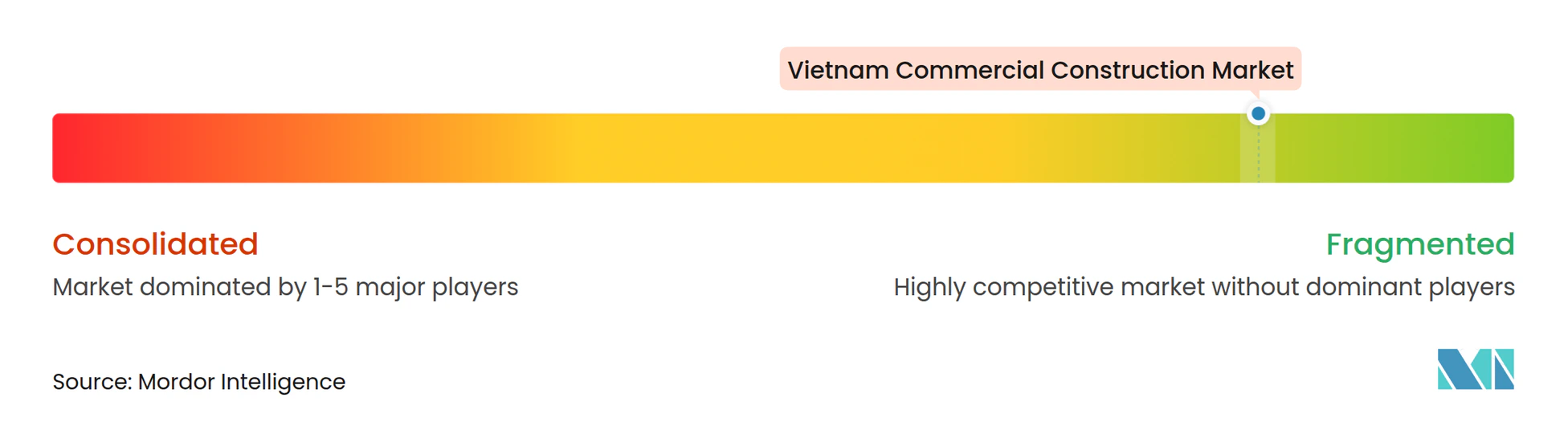
The Vietnam commercial construction market is fragmented, with large general contractors competing on backlog, execution records, and repeat relationships. Coteccons had a record backlog of VND 51,600 billion, equivalent to USD 2 billion, in the first quarter of fiscal year 2026. More than 70% of its contract wins came from repeat clients, including Gamuda Land, Masterise Homes, and Sun Group. In the first half of 2026, Coteccons generated VND 34,340 billion in revenue, up 38% year over year. Hoa Binh Construction Group also increased revenue but faced margin pressure, showing the importance of procurement discipline and contract selection.
Logistics developers compete through land banks, ready-built space, build-to-suit delivery, energy infrastructure, and sustainability features. BW Industrial holds more than 10 million sqm of industrial land across more than 60 projects in 9 provinces. In March 2026, BW Industrial signed memoranda of understanding with BV Power and VSSES for power infrastructure and a 30 MWp rooftop solar system. The move responds to the requirements of power-intensive and sustainability-focused tenants. Developers can differentiate through facilities that are built to suit tenant operations rather than through generic warehouse supply. This makes power availability and automation capability more important in industrial competition.
Competition is also extending into Central Vietnam and the Mekong Delta, where modern logistics capacity remains less developed than in core industrial clusters. Korean company Jeil Group is targeting cold-chain and sustainability-certified warehouses. Major developers are also linking commercial developments to retail, hospitality, offices, and healthcare to create broader project pipelines. Keppel's planned Saigon Centre Phase 3 and Frasers Property Vietnam's SPX Express facility are examples of this project-led approach. Competitive outcomes depend on the ability to secure sites, manage material costs, and deliver specialized projects on schedule. Contractors with reliable supplier relationships can better manage procurement pressure during periods of changing input costs. Developers with established tenant relationships can also reduce leasing risk before construction begins. Large backlogs can provide visibility, but they do not remove the risk from changing input prices or project delays. Repeat customers remain valuable because they can provide steadier order flow and lower bid uncertainty.
Vietnam Commercial Construction Industry Leaders
-
Coteccons Construction JSC
-
Vinaconex JSC
-
Hoa Binh Construction Group JSC
-
Central Construction JSC
-
Newtecons Investment Construction JSC
- *Disclaimer: Major Players sorted in no particular order
Vietnam Commercial Construction Market Companies Covered in this Report
- Coteccons Construction JSC
- Vinaconex JSC
- Hoa Binh Construction Group JSC
- Central Construction JSC
- Newtecons Investment Construction JSC
- Ricons Construction Investment JSC
- Delta Construction Group
- Fecon Corporation
- Ecoba Vietnam JSC
- Unicons Investment Construction Co. Ltd.
- An Phong Construction JSC
- Cofico
- Binh Duong Construction and Civil Engineering JSC
- CC1 Corporation
- Song Da Corporation
- Hung Thinh Incons JSC
- Viglacera Corporation
- Becamex IDC Corporation
- Hoa Phat Group JSC
- GS Engineering and Construction Corporation
- Hyundai Engineering and Construction Co. Ltd.
- Chiyoda Corporation
- CTCI Corporation
- Sumitomo Mitsui Construction Co. Ltd.
- Gamuda Land Vietnam
- CapitaLand (Vietnam) Holdings
- Frasers Property Vietnam
- BW Industrial Development JSC
- SLP Vietnam
- Mapletree Investments Vietnam
Recent Industry Developments in Vietnam Commercial Construction Market
- October 2026: Coteccons reported VND 34,340 billion (USD 1.37 billion) in net revenue for H1 2026, up 38% year on year, driven by large PPP-linked projects including Sun Group's Apec Phu Quoc and Masterise's Gia Binh Airport.
- March 2026: BW Industrial signed strategic memoranda of understanding with BV Power and VSSES to develop large-scale power infrastructure at BW Supply Chain City Industrial Park and deploy a 30 MWp rooftop solar system at BW Bau Bang Industrial Park, targeting hyperscale data center tenants.
- October 2025: Keppel receives Investment Registration Certificate for Saigon Centre Phase 3, a green mixed-use development integrating office, retail, and hospitality in HCMC's CBD; construction is expected to commence by the end of 2026, reviving a landmark project stalled for over three decades.
Vietnam Commercial Construction Market Report Scope
Segmentation Overview
| Office |
| Retail |
| Industrial and Logistics |
| Others |
| New Construction |
| Renovation |
| Public |
| Private |
| Ho Chi Minh City |
| Hanoi |
| Da Nang |
| Rest of Vietnam |
| By Commercial Sector Type | Office |
| Retail | |
| Industrial and Logistics | |
| Others | |
| By Construction Type | New Construction |
| Renovation | |
| By Investment Source | Public |
| Private | |
| By Region | Ho Chi Minh City |
| Hanoi | |
| Da Nang | |
| Rest of Vietnam |
Key Questions Answered in the Report
What is the projected value of Vietnam commercial construction by 2032?
The Vietnam commercial construction market is projected to reach USD 39.08 billion by 2032, growing at a 7.51% CAGR from 2027.
Which commercial sector is largest in Vietnam?
Industrial and logistics is the largest commercial sector type, holding 44.2% in 2026 and growing at an 8.34% CAGR through 2032.
Why is logistics construction expanding in Vietnam?
E-commerce, manufacturing investment, and high warehouse occupancy are increasing demand for automation-ready logistics facilities.
Is new construction or renovation growing faster in Vietnam?
New construction held 74.5% in 2026, while renovation is forecast to grow faster at an 8.02% CAGR through 2032.
Which location has the largest commercial construction base?
Ho Chi Minh City held 39.8% in 2026, supported by deep office, retail, hospitality, and logistics demand.
What are the main challenges for commercial development in Vietnam?
Land clearance delays, material and labor cost inflation, financing limits, and weak absorption of older office and retail stock constrain development.