
Vibration Damping Materials Market Size and Share
Market Overview
| Study Period | 2022 - 2032 |
|---|---|
| Market Size (2027) | USD 12.83 Billion |
| Market Size (2032) | USD 16.20 Billion |
| Growth Rate (2027 - 2032) | 4.78 % |
| Fastest Growing Market | Asia-Pacific |
| Largest Market | Asia-Pacific |
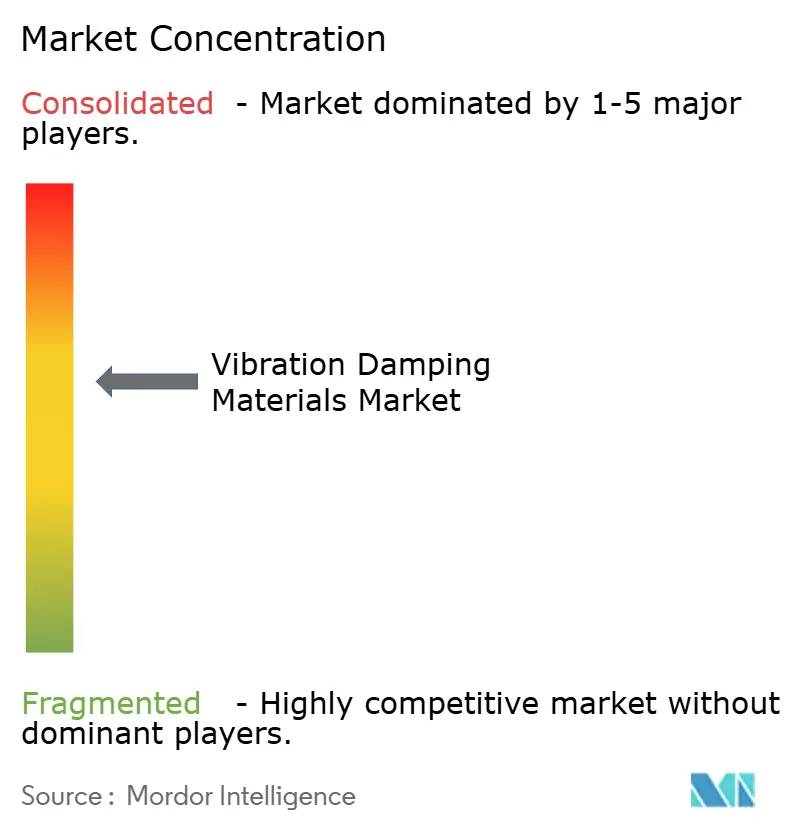
| Market Concentration | Medium |
Major Players *Disclaimer: Major Players sorted in no particular order Image © Mordor Intelligence. Reuse requires attribution under CC BY 4.0. | |
Vibration Damping Materials Market Analysis by Mordor Intelligence
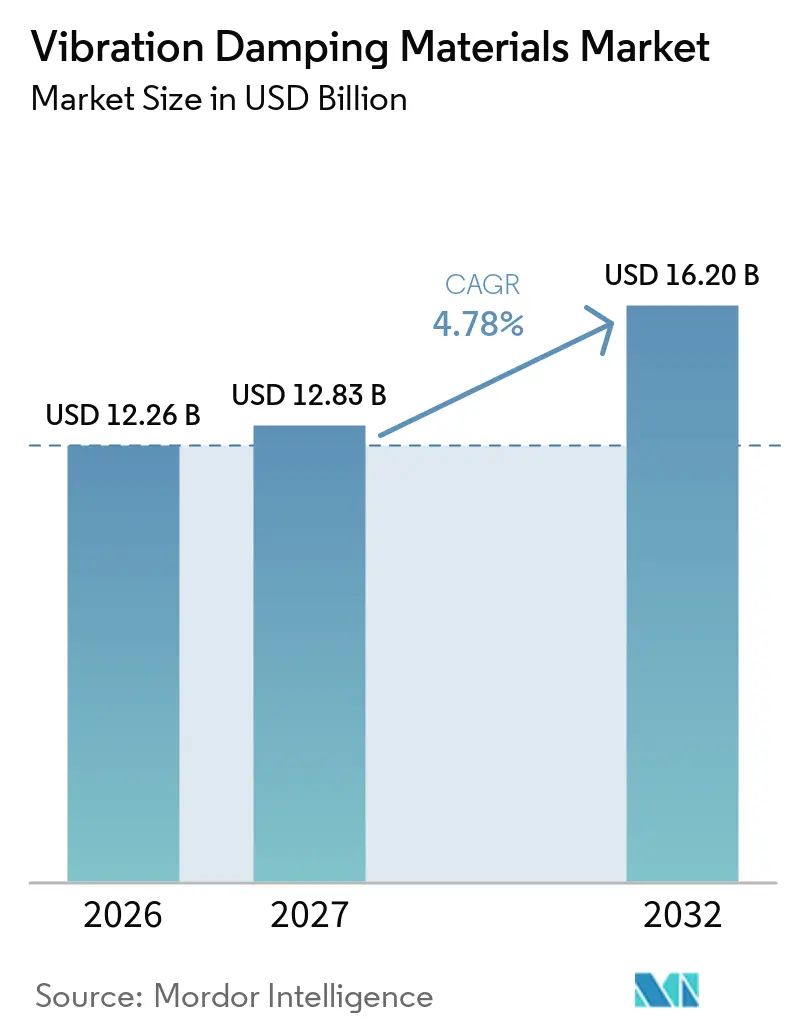
The vibration damping materials market size was valued at USD 12.26 billion in 2026 and is estimated to grow from USD 12.83 billion in 2027 to USD 16.20 billion by 2032, at a CAGR of 4.78% during the forecast period (2027-2032). The shift to electric powertrains is reshaping the vibration damping materials market. The absence of combustion and exhaust noise in electric vehicles exposes tonal vibrations from the motor, inverter, and road contact inside the cabin. As a result, manufacturers specify damping treatments for low-frequency structural resonances in floor panels, doors, wheel arches, powertrain mounts, motor housings, and power-electronics enclosures. Battery packs create additional demand, as their weight, vibration exposure, and thermal cycling can cause fatigue and sealing risks at the module and casing levels. The market also benefits from aerospace, electronics, and manufacturing activity in the Asia-Pacific region, where materials must meet more demanding requirements for performance, weight, and placement. Digital simulation and precision placement are transforming product development, enabling suppliers to integrate material sourcing with application engineering while reducing unnecessary material use.
Key Report Takeaways
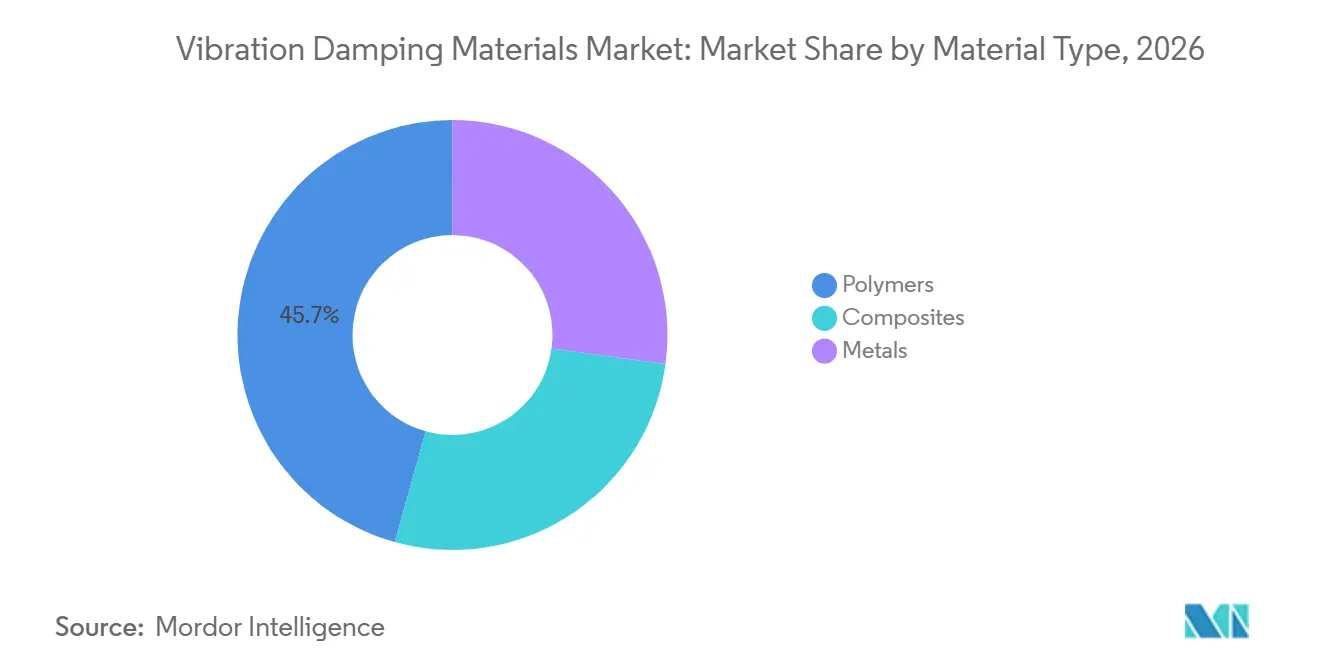
- By material type, polymers held 45.67% market share in 2026, while composites are forecast to expand at a 5.32% CAGR through 2032.
- By product form, films and sheets held 34.14% market share in 2026, while pads and tapes are forecast to expand at a 5.47% CAGR through 2032.
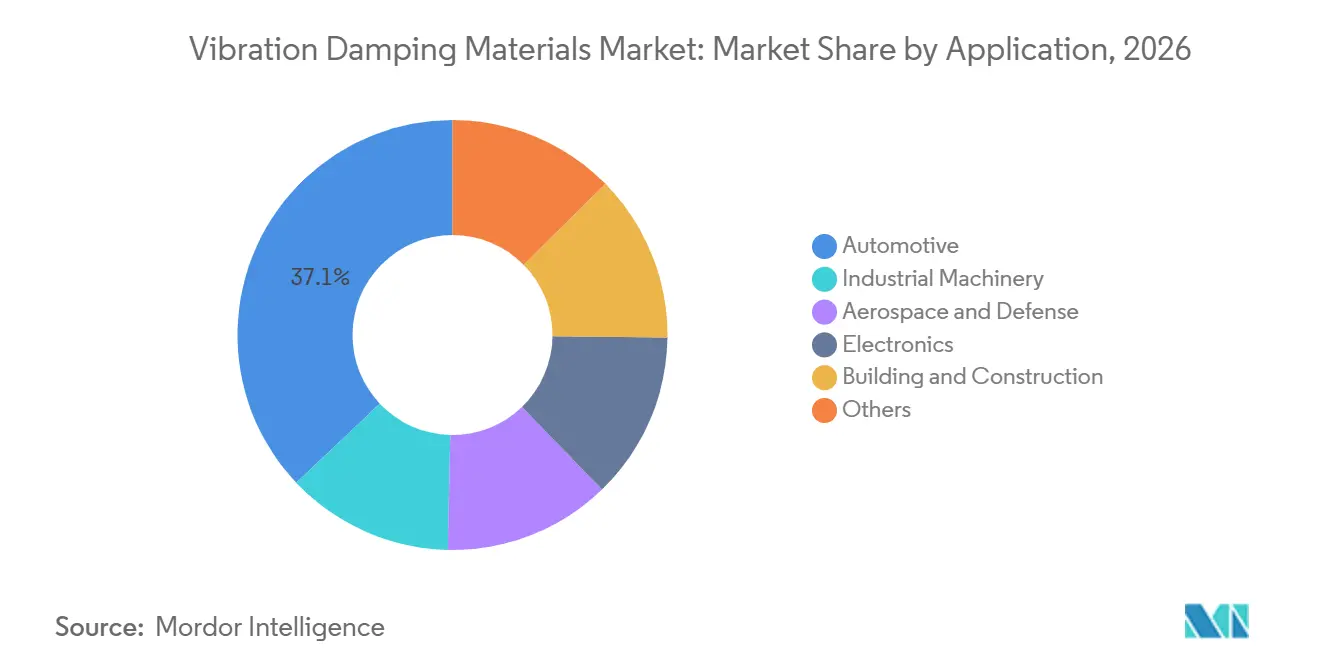
- By application, automotive held 37.05% market share in 2026, while aerospace and defense are forecast to expand at a 5.86% CAGR through 2032.
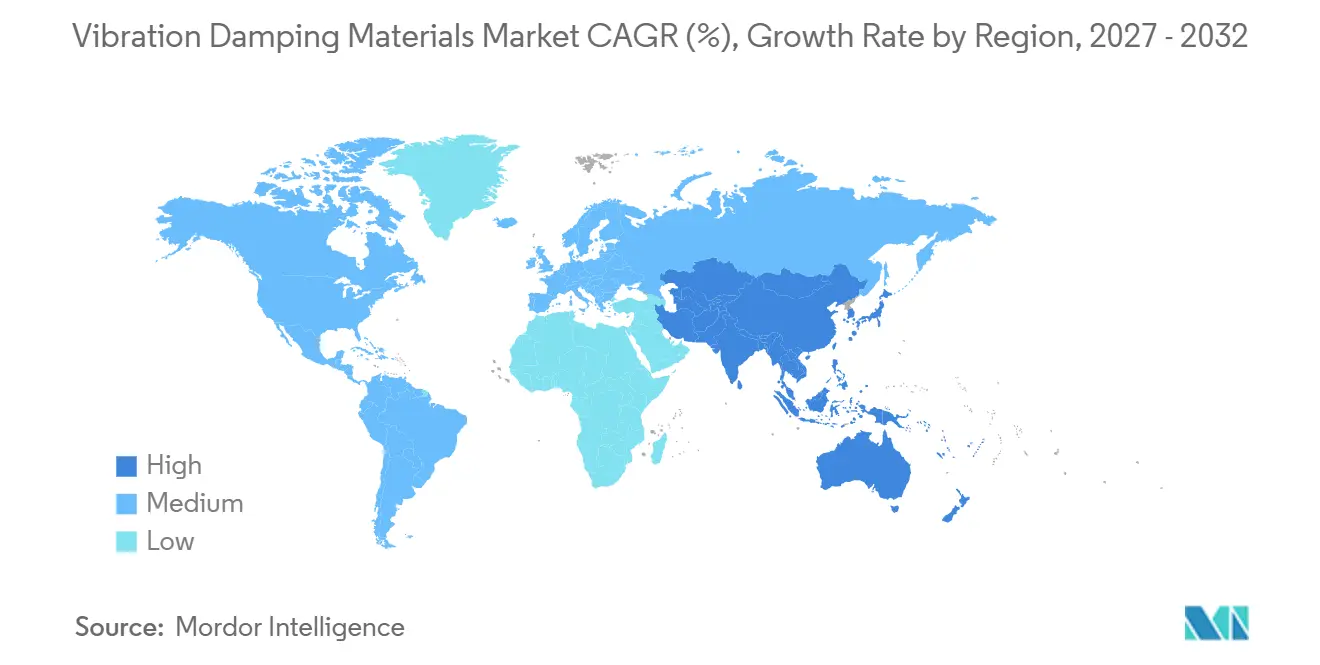
- By geography, Asia-Pacific held 48.11% market share in 2026 and is forecast to expand at a 5.73% CAGR through 2032.
Note: Market numbers in this report are based on Mordor Intelligence's proprietary estimation framework, which combines nine months of actuals with Q4 projections for base year 2026.
Market Trends and Insights
Drivers Impact Analysis of Vibration Damping Materials Market*
| Drivers | (~) % Impact on CAGR Forecast | Geographic Relevance | Impact Timeline |
|---|---|---|---|
| EV Powertrain Quietness and Low-Frequency Noise, Vibration, and Harshness (NVH) Control | +1.2% | Global, concentrated in China, Europe, and South Korea | Medium term (2-4 years) |
| Stricter Vehicle, Workplace, and Infrastructure Noise Standards | +0.8% | Global, with early policy implementation in the EU, China, and the US | Short term (≤ 2 years) |
| Asia-Pacific Manufacturing and Electronics Expansion | +1.0% | APAC core, spillover to MEA and South America | Long term (≥ 4 years) |
| Battery-Pack and Power-Electronics Isolation Requirements | +0.6% | Global, with leading adoption in China, Germany, and the US | Medium term (2-4 years) |
| Early-Stage Digital Noise, Vibration, and Harshness (NVH) Simulation and Predictive Maintenance Adoption | +0.2% | Global, advanced adoption in North America and EU | Long term (≥ 4 years) |
| Source: Mordor Intelligence | |||
EV Powertrain Quietness Increasing Low-Frequency Noise, Vibration, and Harshness (NVH) Control Requirements
Electric motors create tonal emissions between 500 and 4,000 Hz, while the absence of combustion and exhaust noise makes structural resonances more noticeable to vehicle occupants. These resonances can occur in floor panels, door liners, wheel-arch assemblies, powertrain mounts, motor housings, and power-electronics enclosures, making cabin refinement a more prominent design consideration for electric vehicle manufacturers. Research published in 2025 found that elastomeric engine mounts can stiffen by up to 5 times at frequencies above 200 Hz due to continuum resonances, limiting the applicability of validation factors developed for combustion drivetrains. The vibration damping materials market is responding through optimized mount geometries and materials designed for electric powertrain isolation, particularly for sub-200-Hz structural behavior that conventional bitumen patches do not address adequately. Polyurethane mounts are gaining attention because they are 30% lighter than natural rubber equivalents in comparable packaging sizes, enabling weight reduction without sacrificing isolation performance and making them relevant for compact electric-vehicle layouts. A 2025 Society of Automotive Engineers (SAE) review found that viscoelastic rubber layers on the outer surfaces of motors can reduce acoustic emissions by up to 9 dB, thereby supporting surface damping as an initial response before more complex active-control systems are adopted[1].
Battery-Pack and Power-Electronics Isolation Requirements
Battery packs are a major capital item in electric vehicles, and road vibration combined with internal thermal cycling can contribute to fatigue and seal failures. Packs weighing 500-800 kg on body-on-frame platforms require vibration control at both the module and casing levels, adding a layer of demand beyond legacy vehicle body-panel treatment. A 2025 study found that mechanical metamaterial-modified aluminum battery casings reduced vibration levels by 97-99% across 3 axes, pointing to opportunities in precision multi-material casing treatments. Another 2025 study showed that variable-density placement can reduce dominant frequency-specific resonances in battery casings without the mass burden of full-coverage treatments. Inverter housings and onboard charger enclosures also require films and gaskets that remain dimensionally stable at temperatures up to 150°C while limiting the transmission of high-frequency switching resonances. The vibration damping materials market benefits from demand for fluoropolymer and silicone-based specialty films, which command higher prices than general-purpose polymer sheets and complement targeted casing treatments.
Stricter Vehicle, Workplace, and Infrastructure Noise Standards
Noise regulations in aviation, automotive, and defense are increasingly making vibration control a necessary design consideration for original equipment manufacturers and defense contractors. These frameworks establish quantified noise limits that make damping investments less discretionary across civilian and defense transportation programs. China published GB/T 46098-2025 in August 2025, and the standard became effective in March 2026. It establishes performance requirements and test methods for automotive active noise cancellation systems, extending attention from passive damping to active acoustic management. The United States Department of Defense updated MIL-STD-1474 in March 2025 with revised acoustic noise limits for motor vehicles, construction equipment, and portable generator sets. The vibration damping materials market gains support as design teams specify passive materials that work alongside active systems earlier in civilian and defense transportation programs.
Asia-Pacific Manufacturing and Electronics Expansion
Asia-Pacific combines large automotive manufacturing capacity with expanding electronics and semiconductor activity, creating demand across both production and finished-product markets. India approved its Electronics Component Manufacturing Scheme in May 2025, and the program attracted 249 investment proposals valued at INR 1.15 trillion, signaling a broader increase in domestic component-production capacity. BASF announced in April 2025 that it would invest EUR 60 million in a second Cellasto NVH plant in Shanghai, targeting a 70% increase in capacity for China's electric vehicle supply chain, with production planned to begin in 2027. Manufacturing growth in Vietnam and South Korea also supports demand for isolation solutions in semiconductor fabrication, component assembly, and electronics equipment. The vibration damping materials market benefits where equipment manufacturers require consistent vibration management for precision production processes and where vehicle manufacturers need new materials for compact electric powertrain packages. The region's role in vehicle and electronics supply chains further raises demand for automotive materials with tighter packaging and acoustic requirements.
Restraints Impact Analysis of Vibration Damping Materials Market*
| Restraints | (~) % Impact on CAGR Forecast | Geographic Relevance | Impact Timeline |
|---|---|---|---|
| Performance Trade-Offs Between Damping, Weight, Durability, and Cost | -0.4% | Global | Medium term (2-4 years) |
| High Raw-Material Cost and Price Volatility | -0.5% | Global, most acute in North America and Europe | Short term (≤ 2 years) |
| Qualification and Validation Complexity for Advanced Damping Materials | -0.3% | Global, most restrictive in the EU and North America | Long term (≥ 4 years) |
| Source: Mordor Intelligence | |||
High Raw-Material Cost and Price Volatility
Petroleum-derived feedstocks account for a substantial share of polymer-based damping material input costs, leaving suppliers exposed to fluctuations in raw material, logistics, utility, and maintenance expenses. Kuraray raised prices for SEPTON, HYBRAR, and TU-Polymer elastomers by USD 0.33/kg across all regions in February 2025, citing cost increases that could no longer be offset by internal efficiency measures[2]. United States tariff actions have also increased pressure on manufacturers sourcing steel, aluminum, and polyurethane precursors across borders. A 25% duty on steel and aluminum under Section 232 and an additional 20% ad valorem tariff on polyurethane raw materials from China raised costs for some constrained-layer damping producers, while supplier diversification took time to implement. Suppliers with limited scale found it difficult to secure multiyear hedged supply arrangements, thereby compressing margins and limiting product development spending. As a result, the vibration damping materials market saw reduced capacity for product differentiation among mid-tier suppliers during periods of elevated input cost volatility.
Performance Trade-Offs Between Damping, Weight, Durability, and Cost
High loss factor, low mass, long service life, and cost efficiency remain competing objectives in material design. Variable-density topology optimization reduced the use of damping material by 31.2% while maintaining resonance attenuation in thin-walled structures, but precision placement requires investment in tooling, process control, and supplier qualification. Aerospace materials must retain specified loss-factor performance from -55°C to 125°C and withstand fatigue cycles over service lives measured in decades. Research on aeronautical prepreg composites with rubber interlayers reported loss-factor gains of 16-19 times over baseline laminates, while the apparent bending modulus declined by up to 11 times. This structural penalty limits use in primary load-bearing applications, even where damping performance is materially improved. The lengthy validation process for advanced damping materials further slows the rate at which the vibration damping materials market can adopt novel composite or nano-enhanced materials in certified aerospace programs.
*Our forecasts treat driver/restraint impacts as directional, not additive. The impact forecasts reflect baseline growth, mix effects, and variable interactions.
Vibration Damping Materials Market Segment Analysis
By Material Type:
Polymers Lead While Composites AcceleratePolymers accounted for 45.67% of the vibration damping materials market share in 2026, reflecting their broad use in constrained-layer sheets, viscoelastic foam pads, pressure-sensitive tapes, and extruded profiles. This material family serves the widest range of automotive, electronics, industrial machinery, and construction applications, giving it a stable role across high-output installations and specialized equipment. Polyurethane is gaining preference in electric vehicle programs because its viscoelastic response can be adjusted through density, crosslink density, and cell morphology to meet varying geometry and isolation requirements. This flexibility allows manufacturers to reformulate materials as platform geometries change, often without major tooling revisions or a shift away from established production methods. Thermoplastic elastomers are also being specified for compact motor mounts and housings because they can be insert-molded into complex shapes that thermoset rubber cannot achieve after curing.
Composites are projected to record the highest material-type CAGR at 5.32% through 2032. The vibration damping materials market size for composites is supported by aerospace and high-end automotive structures that require stiffness and damping performance without significant mass increases, particularly where conventional materials create a weight penalty. A 2025 study of carbon-fiber prepreg laminates with rubber interlayers showed a 16-19-fold improvement in loss factor over neat laminates in full-scale specimens, providing a performance basis for use in non-primary airframe structures. Metals retain a stable role in constrained-layer laminates and tuned mass dampers for industrial and infrastructure applications, where their density can help reduce low-frequency vibration in bridges and industrial buildings. The material mix, therefore, combines polymer scale with composite growth in applications where verified performance, weight management, and durability are prioritized over commodity pricing.

By Product Form:
Pads and Tapes Benefit from EV Packaging NeedsFilms and sheets accounted for 34.14% of revenue in 2026, supported by automotive body-panel and floor-pan applications where thin, large-area coverage is important. Their established use in vehicle body programs gives them a substantial installed base, particularly where broad coverage is needed to manage panel vibration over large surfaces. Waterborne, liquid-applied sound-damping technology is increasingly replacing bitumen sheets in body shops because spray application can reduce installation labor, eliminate off-cut waste, and integrate with automated coverage processes. This process shift can reduce material use per vehicle even as vehicle output rises, affecting how suppliers assess demand. Foams and gaskets also serve an important dual role in electric vehicle battery enclosures, providing thermal and acoustic insulation in compact spaces.
Pads and tapes are expected to grow at a 5.47% CAGR through 2032, making them the fastest-growing product form. Battery compression pads, conformal motor-housing tapes, and inverter sealing gaskets have become distinct procurement categories within electric vehicle programs, as these components must fit tight packaging envelopes while managing vibration, thermal movement, and sealing requirements. Covestro states that its Baysafe EA foam limits the mechanical loads transferred to battery cells to 60% compression during impact events, while also reducing vibration transfer between modules and casings. The vibration damping materials market is moving toward products with defined attenuation profiles rather than broad passive coverage alone, placing greater value on application-specific performance and repeatable placement. Injection-molded damping components, spray coatings, and structural foams continue to meet specialized needs in industrial equipment enclosures and precision electronics mounting.
By Application:
Automotive Output Supports Demand Alongside Aerospace Performance RequirementsAutomotive accounted for 37.05% of revenue in 2026, supported by global vehicle production and the broader adoption of dedicated materials in electric-vehicle bills of materials. Battery-pack isolators, e-axle mounts, and inverter-housing treatments use less material area than conventional floor-pan patches, but require higher-performing compounds that address new tonal and structural vibration sources. This shift can support higher average selling prices per kilogram even as conventional patch demand levels off and material placement becomes more precise. Electronics, industrial machinery, and building and construction account for the remaining demand for applications. Electronics activity is particularly strong in Asia-Pacific fabrication corridors, where wafer handling, 5G base-station isolation, and precision-instrument mounting require consistent vibration control.
Aerospace and defense is forecast to grow at a 5.86% CAGR through 2032, the fastest rate among application segments. Self-healing composite damping materials reviewed in 2025 combine microcrack-repair capacity with high specific damping performance for structures subjected to demanding temperature changes and fatigue cycling. Noise standards, VTOL procurement activity, and defense modernization support demand for material systems that can meet long service-life and performance requirements under stringent qualification conditions. Building and construction demand is linked to seismic-zone codes in earthquake-prone areas of the Asia-Pacific and South America, where structural dampers and elastomeric isolation pads are increasingly included in critical infrastructure specifications. The vibration damping materials market, therefore, serves high-output vehicle needs alongside lower-output applications with more stringent performance requirements and longer validation cycles.
Geography Analysis
APAC Vibration Damping Materials Market
Asia-Pacific held 48.11% of the vibration damping materials market share in 2026 and is projected to grow at a 5.73% CAGR through 2032. The region leads among major geographies in both market share and forecast growth, supported by its position in electric vehicles, electronics, and semiconductor production. China represents the largest concentrated demand pool, driven by electric vehicle manufacturing and a broad base of electronics production, which generates demand for both assembly equipment and finished products. Japan's supply chain has developed electric vehicle-focused Noise, Vibration, and Harshness (NVH) products, including Sumitomo Riko's foamed urethane e-axle covers and motor mounts, and NOK's High Damping Rubber line for electrified vehicles. India's component manufacturing program, along with activity in Vietnam and South Korea, supports a shift beyond assembly into component production, increasing the need for vibration control in precision manufacturing settings across the vibration damping materials market.
North America and Europe Vibration Damping Materials Market
North America holds the second-largest regional position, supported by automotive original equipment manufacturers, aerospace and defense procurement, and advanced air mobility activity. The vibration damping materials market in the region is tied to localized anti-vibration rubber production, vehicle programs, and demand for higher-value engineered materials that meet the requirements of automotive and aerospace customers. Europe is shaped by ongoing development of vehicle noise regulations and the European Union Aviation Safety Agency's 2025 proposed noise requirements for vertical takeoff and landing civil aircraft. Germany, France, and Nordic countries retain strong automotive engineering bases that are incorporating next-generation damping composites in electric vehicle refinement work, where precise material selection supports quieter vehicle operation.
MEA and South America Vibration Damping Materials Market
South America, the Middle East, and Africa represent smaller but growing parts of the vibration damping materials market. Brazil supports South American demand through automotive manufacturing, infrastructure development, acoustic compliance in public buildings, industrial machinery, and road and rail infrastructure programs. Sika expanded its Belo Horizonte site in June 2025 to include admixture production for Minas Gerais, Brazil's largest concrete-producing state, serving construction-related material demand. The Middle East and Africa benefit from Saudi construction programs, where seismic isolation and noise-control specifications are increasingly applied, and from South Africa's deep-level mining equipment sector. However, both regions remain net import markets through 2032 and are expected to grow more slowly than Asia-Pacific and North America.
Competitive Landscape
The vibration damping materials market is moderately consolidated, with large chemical groups and specialist elastomeric-system suppliers holding significant positions in constrained-layer, precision-mount, and composite damping applications. Regional polymer compounders and tape converter-distributors serve higher-quantity, cost-sensitive patch and tape applications, creating a split-pricing environment between engineered solutions and commodity products. The market rewards suppliers that demonstrate material performance, application engineering, and consistent quality in higher-value applications. The primary competitive approach is geographic localization aligned with original equipment manufacturer (OEM) procurement cycles. Capacity investments in China's electric vehicle corridors and near North American automotive operations are tied to established programs and contract requirements rather than speculative capacity building.
Suppliers are investing near China's electric vehicle supply corridors and North American automotive operations, where demand is linked to defined programs. BASF's planned Shanghai expansion illustrates this approach, with the company expecting its second Cellasto plant to increase local capacity by 70% when production starts in 2027. The market also presents opportunities in battery isolation at the cell-to-module interface, where no supplier has achieved dominant coverage of specifications across global OEM platforms. Aerospace composites for Vertical Take-Off and Landing (VTOL) and advanced air mobility structures represent another opportunity, as emerging certification frameworks may favor suppliers that can provide type-approved materials. Simulation-based application engineering can further help material suppliers differentiate themselves from commodity providers. These opportunities depend on suppliers combining measured material performance with local customer support, application testing, and reliable production capacity.
Digital tools are strengthening the role of technical service in the vibration damping materials market. Siemens introduced acoustic encapsulation modeling with poroelastic material effects in Simcenter 3D 2506, enabling multi-RPM Noise, Vibration, and Harshness (NVH) radiation prediction before prototype commitments. Topology-based placement can reduce material use without compromising attenuation, giving suppliers a practical way to improve performance per unit weight and reduce the need for blanket coverage. These capabilities favor companies that can translate material behavior into application-level designs. However, qualification requirements and input-cost volatility may limit the pace at which smaller suppliers scale advanced offerings. The market is, therefore, increasingly shaped by the quality of technical support offered alongside the material itself.
Vibration Damping Materials Industry Leaders
-
3M
-
Nitto Denko Corporation
-
Trelleborg AB
-
Henkel AG & Co. KGaA
-
Saint-Gobain
- *Disclaimer: Major Players sorted in no particular order
Vibration Damping Materials Market Companies Covered in this Report
- 3M
- Autoneum
- Avery Dennison Corporation
- BASF
- Dow
- Henkel AG & Co. KGaA
- Hutchinson
- LINTEC Corporation
- Nitto Denko Corporation
- PARKER HANNIFIN CORP
- Rogers Corporation
- Saint-Gobain
- Sika AG
- Sumitomo Riko Company Limited
- Trelleborg AB
Recent Industry Developments in Vibration Damping Materials Market
- August 2026: Sumitomo Riko invested USD 4.5 million to expand its anti-vibration rubber parts plant in Bluffton, Ohio, adding approximately 15% production capacity following an engine mount supply award for Ford F-series pickup trucks. The new manufacturing equipment enables mass production of hydraulic and conventional engine mounts, as well as chassis isolation products, reinforcing the company's North American supply position.
- July 2025: Parker Lord, part of Parker Hannifin's NVH division, signed a contract with Turkish Aerospace Industries (TAI) to design, manufacture, and support main and tail rotor dampers for the T625 Gokbey medium-weight helicopter, announced at the Paris Air Show. The engineered dampers reduce rotor-induced vibration, lowering maintenance costs and improving ride quality across search-and-rescue, utility, and VIP transport mission profiles.
Global Vibration Damping Materials Market Report Scope
Specialized substances that convert mechanical energy and motion into low-grade heat, reducing structural vibrations, resonance, and noise in machines, vehicles, and electronics. These materials are widely used across industries where vibration control and noise reduction are critical to performance and safety. They function by absorbing kinetic energy and dissipating it as heat, thereby minimizing the transmission of vibrations through mechanical structures.
The vibration damping materials market is segmented by material type, product form, application, and geography. By material type, the market is segmented into polymers, metals, and composites. By product form, the market is segmented into films and sheets, pads and tapes, foams and gaskets, and others. By application, the market is segmented into automotive, industrial machinery, aerospace and defense, electronics, building and construction, and others. The report also covers market sizes and forecasts for vibration damping materials across 15 countries in major regions. The market sizes and forecasts are provided in terms of value (USD).
Segmentation Overview
| Polymers |
| Metals |
| Composites |
| Films and Sheets |
| Pads and Tapes |
| Foams and Gaskets |
| Others |
| Automotive |
| Industrial Machinery |
| Aerospace and Defense |
| Electronics |
| Building and Construction |
| Others |
| Asia-Pacific | China |
| India | |
| Japan | |
| South Korea | |
| ASEAN Countries | |
| Rest of Asia-Pacific | |
| North America | United States |
| Canada | |
| Mexico | |
| Europe | Germany |
| United Kingdom | |
| France | |
| Italy | |
| NORDIC Countries | |
| Rest of Europe | |
| South America | Brazil |
| Argentina | |
| Rest of South America | |
| Middle East and Africa | Saudi Arabia |
| South Africa | |
| Rest of Middle East and Africa |
| By Material Type | Polymers | |
| Metals | ||
| Composites | ||
| By Product Form | Films and Sheets | |
| Pads and Tapes | ||
| Foams and Gaskets | ||
| Others | ||
| By Application | Automotive | |
| Industrial Machinery | ||
| Aerospace and Defense | ||
| Electronics | ||
| Building and Construction | ||
| Others | ||
| By Geography | Asia-Pacific | China |
| India | ||
| Japan | ||
| South Korea | ||
| ASEAN Countries | ||
| Rest of Asia-Pacific | ||
| North America | United States | |
| Canada | ||
| Mexico | ||
| Europe | Germany | |
| United Kingdom | ||
| France | ||
| Italy | ||
| NORDIC Countries | ||
| Rest of Europe | ||
| South America | Brazil | |
| Argentina | ||
| Rest of South America | ||
| Middle East and Africa | Saudi Arabia | |
| South Africa | ||
| Rest of Middle East and Africa | ||
Key Questions Answered in the Report
What is current market size of Vibration Damping Materials Market?
The vibration damping materials market size was valued at USD 12.26 billion in 2026 and is estimated to grow from USD 12.83 billion in 2027 to USD 16.20 billion by 2032, at a CAGR of 4.78% during the forecast period (2027-2032).
Why do electric vehicles need specialized damping materials?
Electric powertrains expose motor, inverter, and road-contact vibrations that combustion noise previously masked. The vibration damping materials market addresses these issues with targeted mounts, films, tapes, gaskets, and casing treatments that improve occupant comfort and component protection. These products also help manage battery fatigue and seal-related risks during demanding daily vehicle operation.
Which application is expected to expand most quickly?
Aerospace and Defense is forecast to record the fastest application growth at a 5.86% CAGR through 2032.
Which region leads demand and growth?
Asia-Pacific held a 48.11% revenue share in 2026 and is forecast to grow at a 5.73% CAGR through 2032.