
Vein-to-Vein Cell and Gene Therapy (CGT) Cryogenic Couriers Market Size and Share
Market Overview
| Study Period | 2021 - 2032 |
|---|---|
| Market Size (2027) | USD 0.94 Billion |
| Market Size (2032) | USD 1.48 Billion |
| Growth Rate (2027 - 2032) | 9.61 % |
| Fastest Growing Market | Asia-Pacific |
| Largest Market | North America |
| Market Concentration | Medium |
Major Players *Disclaimer: Major Players sorted in no particular order Image © Mordor Intelligence. Reuse requires attribution under CC BY 4.0. | |
Vein-to-Vein Cell and Gene Therapy (CGT) Cryogenic Couriers Market Analysis by Mordor Intelligence
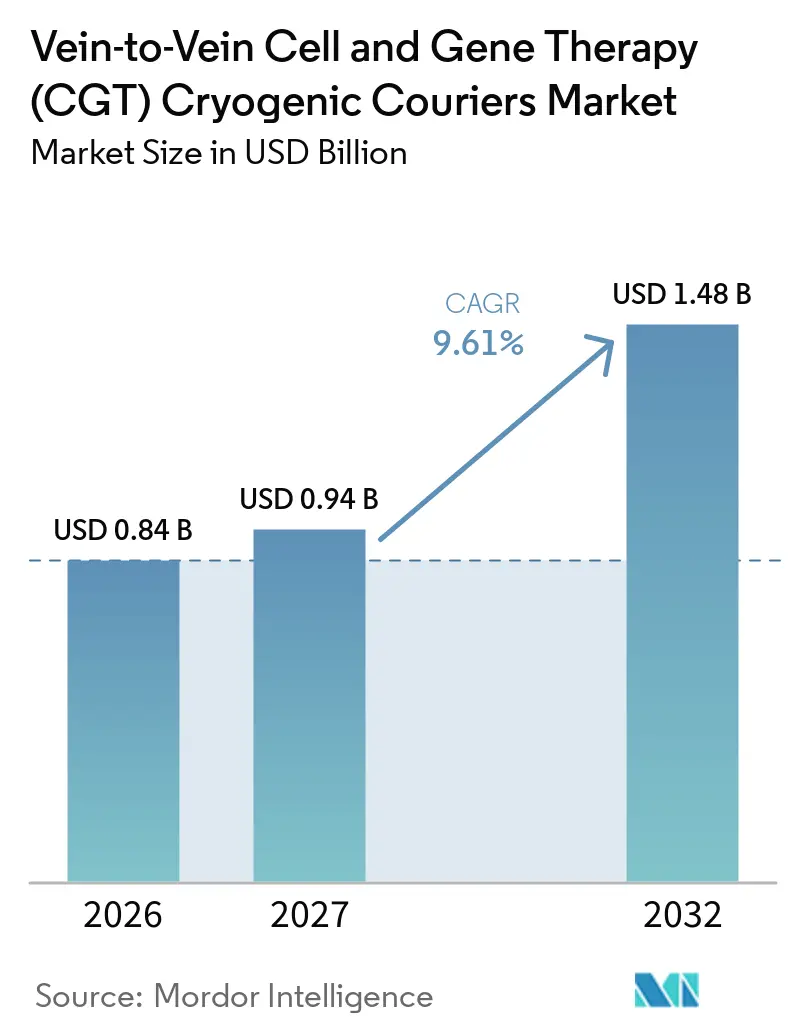
The vein-to-vein cell and gene therapy cryogenic couriers market size is valued at USD 0.84 billion in 2026 and is estimated to reach USD 0.94 billion in 2027 and USD 1.48 billion by 2032, registering a CAGR of 9.61% from 2027 to 2032.
The vein-to-vein cell and gene therapy cryogenic couriers market serves treatments that need storage and transport below -150 °C in liquid nitrogen vapor phase, a requirement that standard cold chains cannot reliably meet. The active development pipeline reached 4,487 gene, cell, and RNA therapies in Q2 2026, including 2,217 gene therapies that represented 49% of the pipeline.[1] This pipeline makes qualified transport capacity part of the process that determines how quickly patients can receive a therapy. The cell and gene therapy cryogenic couriers market also benefits as treatment moves from academic centers to community infusion sites, increasing the number of qualified delivery locations. Digital chain-of-identity records, temperature telemetry, and contingency planning are, therefore, becoming central features of courier selection.
Key Report Takeaways
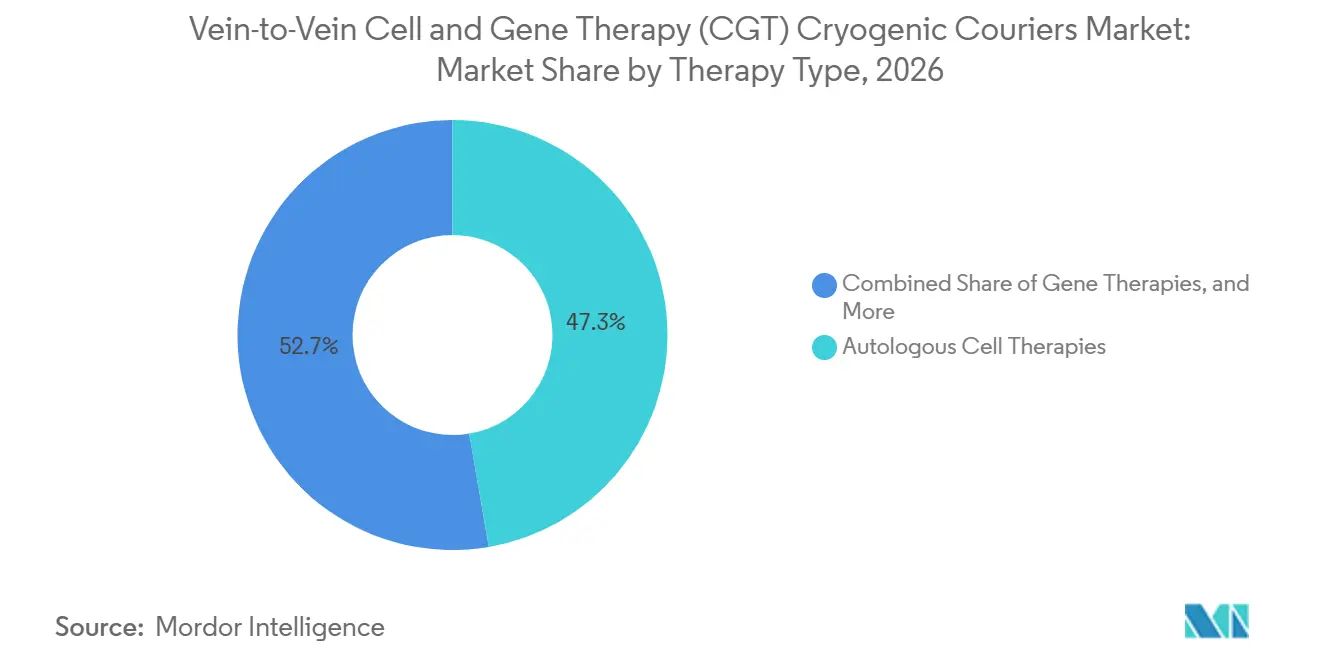
- By therapy type, autologous cell therapies held 47.31% of the vein-to-vein cell and gene therapy cryogenic couriers market size in 2026, while gene therapies recorded the highest projected CAGR at 13.27% through 2032.
- By shipment stage, finished therapeutic products held 45.65% of the vein-to-vein cell and gene therapy cryogenic couriers market size in 2026, while patient-derived and donor-derived starting materials recorded the highest projected CAGR at 11.83% through 2032.
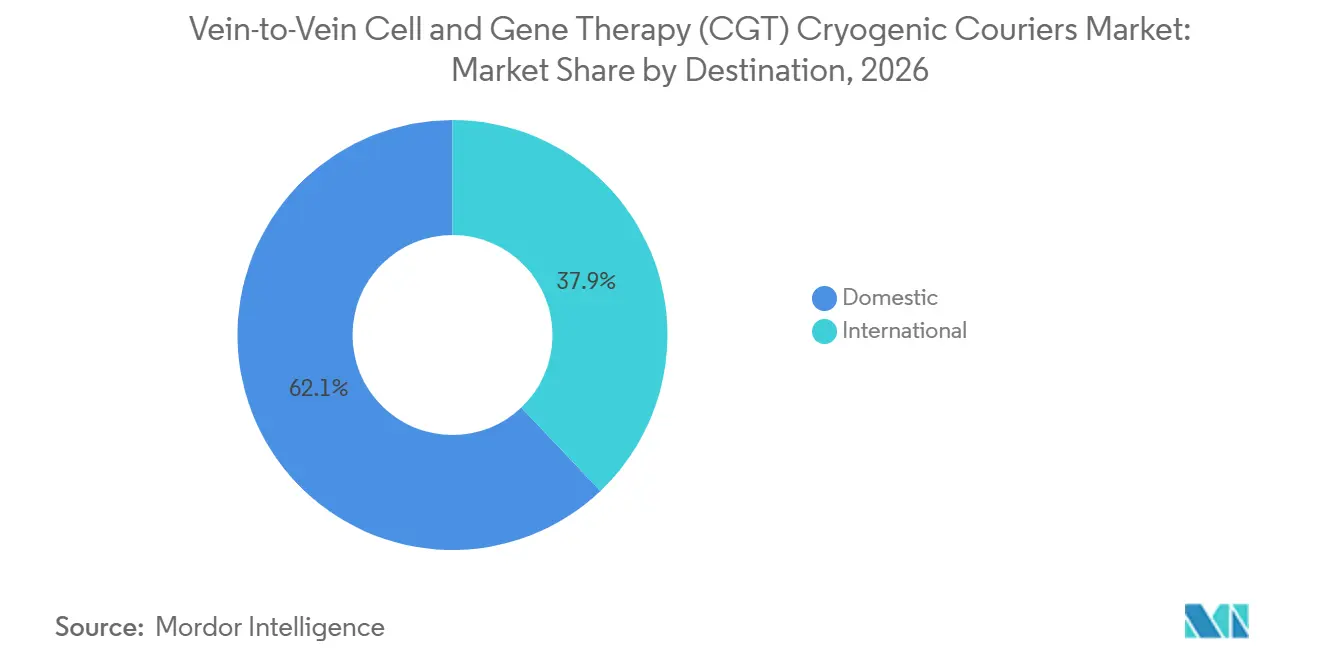
- By destination, domestic shipments held a 62.08% share of the vein-to-vein cell and gene therapy cryogenic couriers market size in 2026, while international destinations recorded the highest projected CAGR at 12.89% through 2032.
- By mode of transport, road transport held 57.69% of the vein-to-vein cell and gene therapy cryogenic couriers market share in 2026, while air transport recorded the highest projected CAGR at 11.40% through 2032.
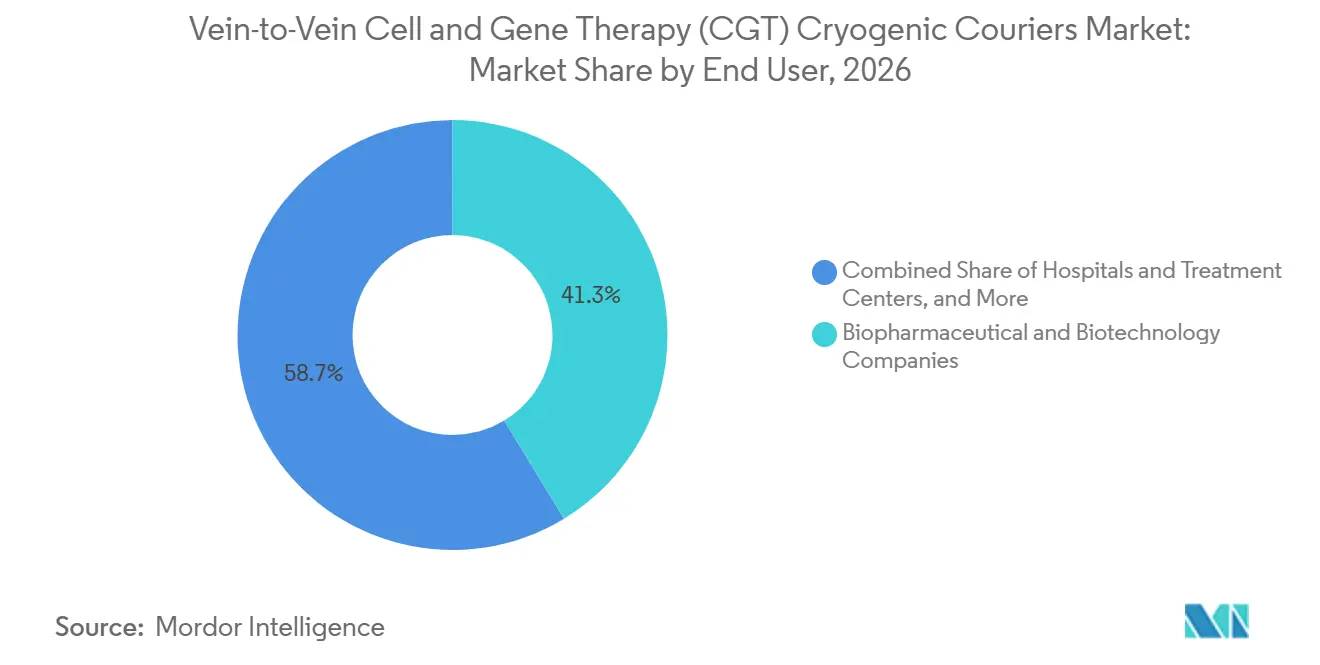
- By end user, biopharmaceutical and biotechnology companies held a 41.32% of the vein-to-vein cell and gene therapy cryogenic couriers market size in 2026, while CDMOs recorded the highest projected CAGR at 12.38% through 2032.
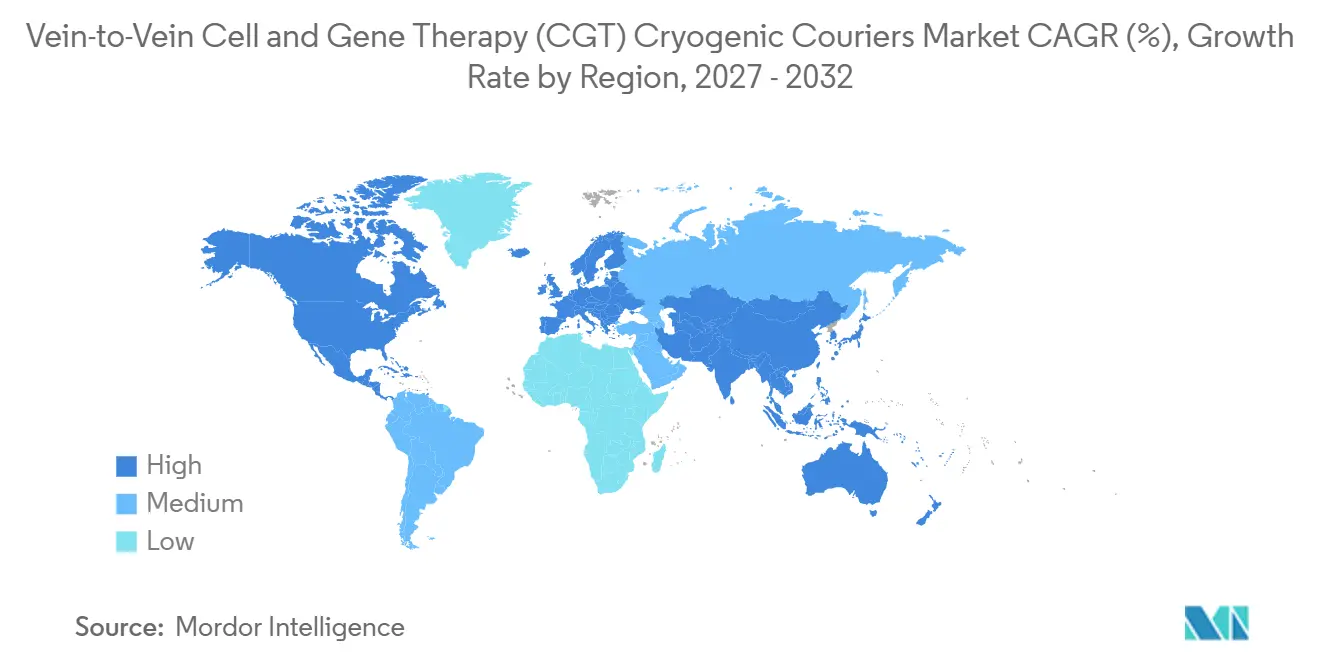
- By geography, North America held a 42.26% of the vein-to-vein cell and gene therapy cryogenic couriers market size in 2026, while Asia-Pacific recorded the highest projected CAGR at 12.95% through 2032.
Note: Market numbers in this report are based on Mordor Intelligence's proprietary estimation framework, which combines nine months of actuals with Q4 projections for base year 2026.
Market Trends and Insights
Drivers Impact Analysis of Vein-to-Vein Cell and Gene Therapy (CGT) Cryogenic Couriers Market*
| Driver | (~) % Impact on CAGR Forecast | Geographic Relevance | Impact Timeline |
|---|---|---|---|
| Approved and Late-Stage CGT Pipeline Expansion | +2.0% | Global | Long term (≥ 4 years) |
| Autologous and Allogeneic Treatment Volume Growth | +1.8% | North America and Europe, with growing APAC contribution | Medium term (2-4 years) |
| Patient-Specific Chain-of-Identity Assurance | +1.2% | Global | Medium term (2-4 years) |
| Global Clinical Trials and Cross-Border Therapy Distribution | +1.0% | Global | Short term (≤ 2 years) |
| Digital Control Towers and Real-Time Monitoring Adoption | +0.7% | North America and Europe | Short term (≤ 2 years) |
| Regional Cryogenic Hub Build-Out | +0.5% | APAC core, spillover to EMEA | Medium term (2-4 years) |
| Source: Mordor Intelligence | |||
Expansion of Approved and Late-Stage Cell and Gene Therapy Pipelines
The vein-to-vein cell and gene therapy cryogenic couriers market gains recurring demand when a therapy moves from development into commercial use. There were 59 gene therapy programs in Phase III globally in Q2 2026, compared with 45 in Q2 2025.[2] PhRMA documented 438 cell and gene therapies in active United States development in March 2026, and reported that China had surpassed the United States in global trial activity after its share of global trials grew by 15% since 2019. Each approval creates a continuing need to move patient material or released product under controlled conditions. FDA requirements for cellular and gene therapy products place strong importance on validated handling, temperature management, and documented custody. That framework favors providers with qualified cryogenic equipment and established compliance processes.
Growth of Autologous and Allogeneic Treatment Volumes
Treatment volumes are increasing as the approved roster of cellular and gene therapy products expands. The FDA list includes recent products such as AUCATZYL, TREGZI, OTARMENI, PAPZIMEOS, and ZEVASKYN. The Alliance for Regenerative Medicine identified a possible first CAR-T regulatory submission for Stiff Person Syndrome in the first half of 2026, extending the potential use of CAR-T therapies beyond oncology.[3] Each autologous treatment creates a collection shipment and a return shipment of the finished product. Allogeneic treatment uses donor material and supports production at a larger scale, but it needs reliable hub-and-spoke cryogenic networks. ICH identifies donor-to-recipient traceability as a key consideration for advanced therapy medicinal products. These treatment models require different operations, yet both expand the need for qualified custody and transport services.
Rising Need for Patient-Specific Chain-of-Identity Assurance
Chain-of-identity assurance connects the collected cellular material with the patient who will receive the therapy. This requirement has particular importance for autologous treatments, where a mislabeled or improperly transferred shipment can create a serious clinical risk. The vein-to-vein cell and gene therapy cryogenic couriers market relies on barcodes, RFID, electronic checkpoints, and real-time control towers to reduce gaps between collection, manufacture, and infusion. ICH states that traceability from donor procurement to patient administration is a central issue for advanced therapy guidance. Digital chain-of-identity and chain-of-custody records help sponsors identify a shipment location, document each handoff, and respond to an exception. The resulting service requirement gives experienced, digitally enabled couriers an advantage over providers using manual documentation.
Growth of Global Clinical Trials and Cross-Border Therapy Distribution
Clinical development is extending beyond established United States and European clusters, increasing the need for qualified international lanes. The Q2 2026 landscape included 427 gene therapy Phase I programs, continuing a quarterly increase since Q2 2025. International movements can involve multi-leg flights, controlled interim storage, dangerous goods paperwork, biological material permits, and customs clearance. The Precision Therapy Logistics Gateway completed an international test shipment between Belgium and Dallas in February 2025, showing the level of coordination needed before clinical corridors could operate routinely. Digital control towers can link carriers, clinical sites, and customs partners around a single shipment record. Regional hub investment also shortens transit time and can reduce the risk created by an extended handoff or delayed flight.
Restraints Impact Analysis of Vein-to-Vein Cell and Gene Therapy (CGT) Cryogenic Couriers Market*
| Restraint | (~) % Impact on CAGR Forecast | Geographic Relevance | Impact Timeline |
|---|---|---|---|
| Cost and Availability of Qualified Cryogenic Infrastructure | -1.6% | Global, most acute in APAC and MEA | Long term (≥ 4 years) |
| Air-Cargo, Dangerous-Goods, and Customs Restrictions | -1.2% | Global, most acute on cross-border and international routes | Medium term (2-4 years) |
| Liquid-Nitrogen Hold Time and Shipper-Handling Risk | -0.8% | Global | Short term (≤ 2 years) |
| Trained Personnel and Cross-Partner Procedure Scarcity | -0.6% | APAC core, spillover to MEA | Long term (≥ 4 years) |
| Source: Mordor Intelligence | |||
High Cost and Limited Availability of Qualified Cryogenic Infrastructure
Cryogenic depots, liquid nitrogen tanks, controlled-temperature rooms, dry vapor shippers, and airport staging facilities remain concentrated in a limited number of North American and European cities. Establishing a new depot requires capital, equipment qualification, and compliance with local rules before it can handle clinical or commercial materials. This can leave new therapy locations without suitable local capacity when launches proceed faster than infrastructure development. A May 2025 ISCT survey identified scaling cryopreservation as the most frequently cited operating hurdle among organizations supporting therapy commercialization.[4] The vein-to-vein cell and gene therapy cryogenic couriers market is, therefore, constrained by more than vehicle or flight availability. It also depends on qualified sites, trained operators, standardized procedures, and sufficient liquid nitrogen support near collection and treatment locations.
Air-Cargo, Dangerous-Goods, and Customs Restrictions
Liquid nitrogen vapor-phase shipments are subject to dangerous goods rules that affect packaging, airline acceptance, shipment documents, and customs treatment. A delayed inspection can use a significant part of a shipper's validated hold time and limit available contingency options. Countries may also apply different requirements for biohazard documentation, biological specimen permits, and related materials declarations. IATA dangerous goods requirements create an additional operational layer for air movements of cryogenic therapy materials. The vein-to-vein cell and gene therapy cryogenic couriers market also faces handling risks when equipment passes between airline, ground, customs, and local delivery teams. Limited skilled personnel and inconsistent cross-partner procedures can increase these risks, particularly in emerging corridors and locations without mature cryogenic infrastructure.
*Our forecasts treat driver/restraint impacts as directional, not additive. The impact forecasts reflect baseline growth, mix effects, and variable interactions.
Vein-to-Vein Cell and Gene Therapy (CGT) Cryogenic Couriers Market Segment Analysis
By Therapy Type:
Autologous Products Anchor Demand, Gene Therapies Drive GrowthAutologous cell therapies held 47.31% of the vein-to-vein cell and gene therapy cryogenic couriers market share in 2026, reflecting their leading role among commercialized patient-specific products. Their position is linked to a one-to-one relationship between a patient's collected cells and the dose returned for infusion. Each treatment cycle creates at least 2 cryogenic shipment events, covering upstream material collection and downstream return of the finished therapy. These movements need clear scheduling between collection centers, manufacturing sites, quality-release teams, and infusion locations. That operating design means a rise in autologous treatment volumes creates a corresponding need for qualified courier capacity. Three programs, avigbagene parvec, KITE-753, and TAEST-16001, entered Phase III in Q2 2026. Their progress illustrates how late-stage development can extend demand beyond the current base of commercial therapies. Gene therapy shipments also need validated temperature conditions, clear custody documentation, and reliable transfer between specialized facilities. Together, the two therapy types place different but sustained demands on the cell and gene therapy cryogenic couriers market.
Gene therapies registered a CAGR of 13.27% through 2032, the fastest rate among therapy-type segments. Allogeneic cell therapies use donor-derived starting material and follow a different logistics model from autologous products. Production can be undertaken at larger scale, with inventory held in qualified cryogenic depots before allocation to eligible patients. This shifts operational emphasis toward inventory control, lot-to-patient allocation, and dependable hub-and-spoke distribution. Couriers, therefore, need to support both individual identity continuity and disciplined control of larger cryogenic inventory pools. ISO 21973:2020 provides an international benchmark for the transportation of cells for therapeutic use. Cryoport reported ISO 21973:2020 certification in 2025, showing that recognized transport standards were becoming a relevant competitive requirement. Other cryogenically transported CGT products include exosome-based therapeutics and gene-modified tissue products. These early-stage modalities have requirements that are still being formalized across development, transport, and clinical use. Their progress may require providers to adapt qualification practices while retaining strict temperature and documentation controls. This variety of therapy models increases the need for flexible but standardized cryogenic operations.

By Shipment Stage:
Finished Products Lead Today, Starting Materials Accelerate FastestFinished therapeutic products accounted for 45.65% of the vein-to-vein cell and gene therapy cryogenic couriers market size in 2026. These shipments carry released CAR-T and gene therapy products from manufacturing sites to qualified infusion centers. The segment reflects the present weight of approved therapies that require recurring patient-level deliveries. Released products are high-value and often need detailed records for temperature, location, handoff, and delivery condition. Delivery timing also has to align with the receiving center's preparation for the patient. This faster rate reflects rising collection activity as clinical programs broaden and more treatments move toward commercialization. Starting-material movements depend on apheresis coordination, collection-site readiness, packaging, and timely manufacturing-site receipt. A weak handoff at this early stage can affect the entire treatment sequence. The faster expansion of upstream shipments creates a larger role for courier coordination before manufacturing begins.
Patient-derived and donor-derived starting materials registered a CAGR of 11.83% through 2032. In-process materials form a third shipment stage between testing organizations, manufacturing steps, and release sites. These transfers often occur within a distributed manufacturing network that includes specialist analytical, processing, and quality functions. Each movement has to preserve material identity and establish a documented connection between the sending and receiving sites. FDA and EMA expectations for biological products reinforce the use of validated processes for site-to-site handling. The cell and gene therapy cryogenic couriers market supports these links by maintaining qualified conditions across transfers that cannot be handled through conventional freight processes. The shift toward starting materials shows that logistics intensity is moving earlier in the therapy pathway. Collection networks will need closer coordination with manufacturing schedules as patient volume rises. CDMO outsourcing adds further transfers among facilities and makes standardized custody procedures more important. Finished products will retain their leading position in 2026, while upstream activity will place growing demands on qualified courier networks. This balance explains why stage-specific planning is central to vein-to-vein logistics.
By Destination:
Domestic Routes Dominate, International Share Grows SteadilyDomestic shipments held 62.08% of the vein-to-vein cell and gene therapy cryogenic couriers market share in 2026. The United States has a high concentration of approved therapy programs, manufacturing sites, and treatment centers, which supports this domestic position. Domestic movements can use direct road delivery between locations that are part of an established therapy network. This reduces handoffs and can improve control of custody, timing, and shipper condition. A driver-supervised route can also offer direct communication with the collection or infusion site. Their faster growth follows therapy approvals in Europe and Asia, broader cross-border clinical trials, and the geographic expansion of commercial treatment networks. International shipments need more planning because they often involve air transport, interim storage, customs processing, and final-mile delivery. Each additional handoff requires a clear record of identity, temperature, and responsibility. Domestic routes remain the larger part of the market in 2026, but international operations are becoming more significant.
International destinations registered a CAGR of 12.89% through 2032. DHL launched a Brussels-to-Cincinnati cold chain route in February 2026 and added 6 dedicated healthcare corridors connecting Europe and North America with Asian gateways in October 2026. Such lanes show how logistics providers are responding to the greater complexity of international CGT movements. Couriers need to coordinate carriers, customs brokers, clinical sites, and local delivery teams across each corridor. National rules can differ for biological specimens, dangerous goods, and import documentation. Providers that prepare clearance documents early and maintain local customs relationships can reduce avoidable delays. They also need real-time information and rerouting procedures when a flight disruption affects a time-sensitive shipment. The cell and gene therapy cryogenic couriers market depends on these capabilities because delays can threaten the available time within a validated shipping process. International expansion will gradually reduce the gap between domestic and international demand. It will not remove the value of domestic road networks, which remain important for direct, traceable delivery. The two destination types, therefore, require different network design, operating controls, and contingency arrangements.
By Mode of Transport:
Road Leads, Air Accelerates as Cross-Border Therapy Volumes RiseRoad transport represented 57.69% of the vein-to-vein cell and gene therapy cryogenic couriers market size in 2026. It supports direct domestic delivery from manufacturing facilities to collection centers and qualified infusion sites. Road movements can provide driver-supervised custody continuity and reduce the number of transfers between operators. This control is particularly relevant for autologous therapies, where each shipment has to remain connected to a specific patient. Direct routing can also give collection and treatment teams greater visibility into expected arrival timing. Growth follows international clinical trials, cross-border movement of starting materials and finished products, and broader access to approved therapies. Air routes connect markets that cannot be served through road networks within the required time window. They also give sponsors greater choice in locating clinical sites and manufacturing capacity. The increase in air movements makes qualified airport handling more important across the therapy supply chain.
Air transport registered a CAGR of 11.40% through 2032. Air freight involves handoffs among ground teams, airlines, customs authorities, storage facilities, and destination delivery providers. Each handoff can increase risk if the shipment record, shipper condition, or timing is not actively managed. UPS announced a USD 48 million investment in 27 IATA CEIV Pharma-certified cross-dock facilities in July 2026 to protect transfers near major airports. IATA CEIV Pharma certification is an important assurance mechanism for airport pharmaceutical handling. The cell and gene therapy cryogenic couriers market uses ocean and rail for only a small share of non-time-critical movements, such as reference material and clinical reserve inventories. Those modes do not suit most patient-specific treatments because they cannot meet their timing requirements. Road and air may remain the main transport modes for time-sensitive cryogenic therapy shipments. Road is central for controlled domestic delivery, while air supports global reach. The mix of modes will depend on route distance, patient timing, customs requirements, and the availability of qualified facilities.
By End User:
Biopharma Companies Lead, CDMOs Accelerate on Outsourcing MomentumBiopharmaceutical and biotechnology companies accounted for 41.32% of the vein-to-vein cell and gene therapy cryogenic couriers market size in 2026. They sponsor therapy programs and establish the logistics protocols that connect collection sites, manufacturing operations, and infusion centers. Their courier relationships can include appointment scheduling, starting-material collection, manufacturing-site coordination, and finished-product delivery. This gives therapy sponsors a direct role in the full vein-to-vein pathway. Sponsors also need oversight of the documentation that confirms product identity and transport conditions. Their growth reflects a broader use of outsourced manufacturing and integrated supply chain support across therapy programs. CDMOs can become central operating points in a distributed network of collection, testing, manufacturing, and release activities. This can create recurring cryogenic movement needs across the full manufacturing relationship. The segment's growth, therefore, raises the value of couriers that can work consistently with complex, multi-site programs.
CDMOs registered a CAGR of 12.38% through 2032. Manufacturing expansion can create associated demand for qualified cryogenic routes and operating procedures across collection, processing, testing, release, and treatment networks. Hospitals and treatment centers are also becoming more relevant as therapy access reaches community-based infusion settings. These locations need qualified last-mile delivery and careful coordination with their clinical schedules. Academic and research institutions continue to support clinical-stage demand, especially where starting material travels under GMP conditions. The vein-to-vein cell and gene therapy cryogenic couriers industry serves a broad group of users, but sponsors and CDMOs have the largest direct role in organizing the end-to-end pathway. Treatment centers influence the final delivery experience because they receive material close to patient administration. Research institutions contribute earlier-stage traffic that helps establish new operating lanes and procedures. The different end users, therefore, create demand across commercial, clinical, and development activities. Their requirements overlap around quality, traceability, timing, and communication.
Geography Analysis
North America accounted for 42.26% of the vein-to-vein cell and gene therapy cryogenic couriers market share in 2026. The region has the largest base of approved CGT products, substantial CDMO capacity, and established regulatory processes for these treatments. FDA expectations for shipping validation, cold-chain documentation, and temperature excursion reporting support demand for specialized providers. The Alliance for Regenerative Medicine recorded 6 new United States CGT drug approvals during 2025 and identified 10 or more possible regulatory submissions in 2026. Canada adds growth through active clinical sites and approved treatment centers.
Europe holds the second-largest regional position in 2026, supported by ATMP activity across Germany, the United Kingdom, France, and the Nordic countries. The EMA ATMP framework and GDP requirements place high qualification requirements on cryogenic depots and transport lanes. These requirements limit participation to providers that can document compliant handling. Cencora added NextPharma Logistics in December 2025, expanding its GDP-compliant presence across Germany, Austria, and Switzerland. Lonza expanded logistics capacity at its Porrino site in Spain in October 2025, reinforcing the connection between regional manufacturing investment and local courier demand. South America, the Middle East and Africa, and Russia represent smaller positions, while Brazil and the United Arab Emirates are emerging locations for clinical access and advanced therapy activity.
Asia-Pacific registered a CAGR of 12.95% through 2032, the fastest regional rate in the vein-to-vein cell and gene therapy cryogenic couriers market. China has increased its share of global CGT trials, while South Korea and Japan are progressing in domestic cell therapy commercialization. Qualified cryogenic depots remain scarce outside key gateway cities, which increases the value of targeted local investment. World Courier expanded its cryogenic depot network with new facilities in Beijing and Sao Paulo in 2025. Country-level import procedures, containment requirements, and local GDP standards can add cost and complexity to shipments within the region. These conditions create a need for providers with both regional infrastructure and strong local regulatory knowledge.
Competitive Landscape
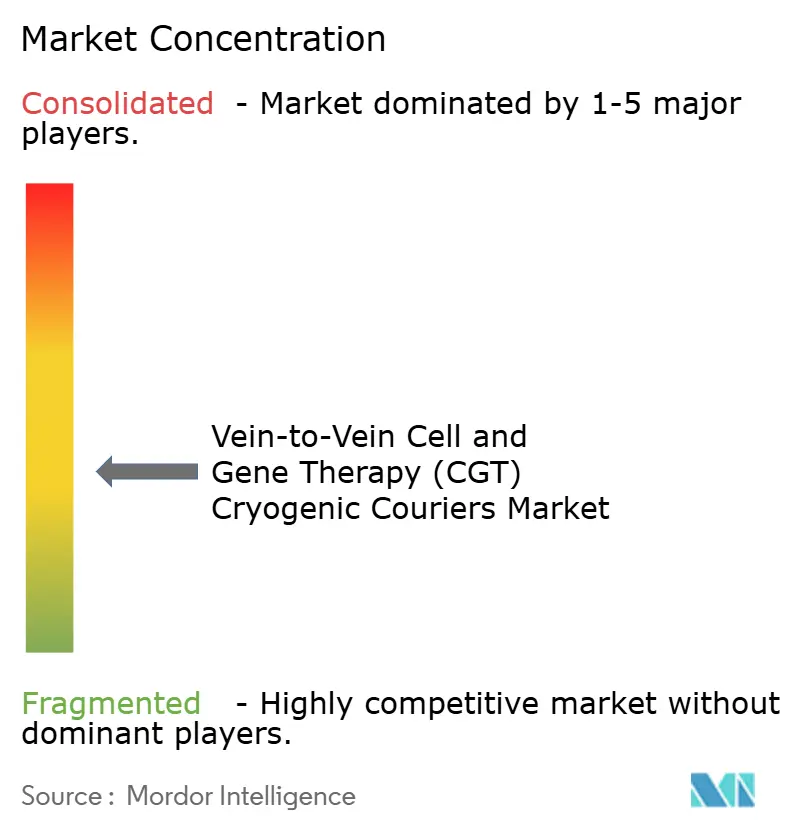
The vein-to-vein cell and gene therapy cryogenic couriers market has a tiered and moderately fragmented structure. DHL Group, UPS, BioCair, and Cencora bring broad logistics networks, while Cryoport Systems, TrakCel, SkyCell, Marken, and World Courier provide specialist capabilities. Large providers have focused on network capacity, qualified hubs, and healthcare-specific air routes in 2025 and 2026. DHL announced a EUR 2 billion (USD 2.35 billion) commitment to DHL Health Logistics through 2030 in April 2025. The program covers dedicated cryogenic infrastructure, GDP-certified healthcare hubs, and dedicated air corridors. UPS added airport cross-dock capacity that focuses on vulnerable transfers between air and ground operations.
Specialist providers compete through validated equipment, deep CGT operating knowledge, and tools that coordinate chain-of-identity and chain-of-custody events. Cryoport completed the divestiture of CRYOPDP to DHL in June 2025 for USD 200 million and established a strategic partnership. This transaction combined specialist courier expertise with a wider global network and highlighted a broader pattern of integration. Cryoport also opened a 55,000 ft² Global Supply Chain Center in Louvres, France, in October 2025. SkyCell expanded in South America with DHL Global Forwarding Brazil in April 2026 through a service center near Sao Paulo Guarulhos Airport. These actions show that network expansion can be achieved through partnerships as well as owned facilities.
Community infusion centers outside major academic hospitals offer a clear opportunity for qualified last-mile operations. APAC and Latin America also need more in-region depots that meet GDP and local requirements. Digital orchestration differentiates providers that can combine scheduling, telemetry, documentation, and delivery coordination in one system. The cell and gene therapy cryogenic couriers market may favor platforms that can manage those connected tasks without losing shipment-level accountability. Standards such as ISO 21973:2020 provide a common reference point for transport quality. Competition may remain active because broad-scale providers are investing in life sciences capacity while specialists retain expertise in patient-specific procedures, and because the cell and gene therapy cryogenic couriers market needs providers that can connect depot qualification, transport control, customs readiness, clinical-site coordination, and documented last-mile delivery within a single operating model. Along with that, they can provide facilities preserving the flexibility required by differing therapy types and destination-country rules, when international therapy corridors depend on coordination among several independent logistics, regulatory, customs, airline, and clinical participants across mature and emerging treatment corridors, and where shipment plans need to align with each therapy's handling protocol and each patient's treatment schedule.
Vein-to-Vein Cell and Gene Therapy (CGT) Cryogenic Couriers Industry Leaders
-
La Poste Group (Including BioCair)
-
DHL Group
-
United Parcel Service of America, Inc. (UPS)
-
Cencora
-
Cryoport Systems
- *Disclaimer: Major Players sorted in no particular order
Vein-to-Vein Cell and Gene Therapy (CGT) Cryogenic Couriers Market Companies Covered in this Report
- Cryoport, Inc.
- DHL Group
- La Poste Group (Including Biocair)
- Cencora, Inc.
- United Parcel Service of America, Inc. (UPS)
- FedEx
- AIT Worldwide Logistics
- Kuehne+Nagel
- BioLife Solutions, Inc.
- Thermo Fisher Scientific Inc.
- Lonza Group Ltd.
- TrakCel Limited
- Envirotainer AB
- Mercury
- World Distribution Services
- Aramex
- Expeditors International of Washington, Inc.
- A.P. Moller-Maersk
- Modality Solutions
- SkyCell
Recent Industry Developments in Vein-to-Vein Cell and Gene Therapy (CGT) Cryogenic Couriers Market
- October 2026: DHL Group launched 6 new dedicated Life Sciences and Healthcare airfreight cold chain corridors connecting European hubs (Liege, Brussels) and Cincinnati to Asian gateways including Shanghai, Singapore, Tokyo Narita, and Seoul Incheon. Building on the February 2026 Brussels-Cincinnati launch, these corridors would provide pharmaceutical customers with greater routing flexibility and temperature-controlled capacity for CGT and biologic shipments across key Asia-Pacific trade lanes.
- June 2026: United Parcel Service, Inc. (UPS) announced a USD 48 million investment in 27 new temperature-controlled cross-dock facilities located near major airports across the Americas, Europe, and Asia. All facilities carry IATA CEIV Pharma certification and are designed to protect cryogenic and refrigerated pharmaceutical shipments, including cell and gene therapy products, during air-to-ground and ground-to-ground mode transfers, the highest-risk handoff point in cold chain logistics.
- April 2026: SkyCell expanded into the South American pharmaceutical market in partnership with DHL Global Forwarding Brazil, establishing a service center located 5 kilometers from Sao Paulo's Guarulhos airport. The facility handles conditioning, cleaning, repair, and dispatch of temperature-controlled pharmaceutical containers, with an initial throughput target of 20 containers per day, planned to scale tenfold within a year.
- February 2026: DHL Group launched its dedicated Airfreight Cold Chain Network, introducing a dedicated Boeing 777 freighter in DHL Health Logistics livery operating between Brussels (BRUcargo) and Cincinnati (CVG). BRUcargo provides 45,000 m² of pharma-only zones to support the route, which is positioned as a temperature-controlled pathway for cell and gene therapies connecting the US Midwest with European life sciences ecosystems.
Global Vein-to-Vein Cell and Gene Therapy (CGT) Cryogenic Couriers Market Report Scope
Segmentation Overview
| Autologous Cell Therapies |
| Allogeneic Cell Therapies |
| Gene Therapies |
| Other Cryogenically Transported CGT Products |
| Patient-Derived / Donor-Derived Starting Materials |
| Intermediate / In-Process Materials |
| Finished Therapeutic Products |
| Domestic |
| International |
| Air |
| Road |
| Others |
| Biopharmaceutical and Biotechnology Companies |
| Contract Development and Manufacturing Organizations |
| Hospitals and Treatment Centers |
| Academic and Research Institutions |
| Other Healthcare and Life Sciences Organizations |
| North America | United States |
| Canada | |
| Mexico | |
| South America | Brazil |
| Argentina | |
| Peru | |
| Chile | |
| Rest of South America | |
| Europe | Germany |
| United Kingdom | |
| France | |
| Italy | |
| Spain | |
| Russia | |
| Nordics (Denmark, Finland, Iceland, Norway, and Sweden) | |
| Rest of Europe | |
| Asia-Pacific | China |
| India | |
| Japan | |
| South Korea | |
| Australia | |
| Southeast Asia (ASEAN) | |
| Rest of Asia-Pacific | |
| Middle East and Africa | Saudi Arabia |
| United Arab Emirates | |
| Qatar | |
| South Africa | |
| Nigeria | |
| Egypt | |
| Rest of Middle East and Africa |
| By Therapy Type | Autologous Cell Therapies | |
| Allogeneic Cell Therapies | ||
| Gene Therapies | ||
| Other Cryogenically Transported CGT Products | ||
| By Shipment Stage | Patient-Derived / Donor-Derived Starting Materials | |
| Intermediate / In-Process Materials | ||
| Finished Therapeutic Products | ||
| By Destination | Domestic | |
| International | ||
| By Mode of Transport | Air | |
| Road | ||
| Others | ||
| By End User | Biopharmaceutical and Biotechnology Companies | |
| Contract Development and Manufacturing Organizations | ||
| Hospitals and Treatment Centers | ||
| Academic and Research Institutions | ||
| Other Healthcare and Life Sciences Organizations | ||
| By Geography | North America | United States |
| Canada | ||
| Mexico | ||
| South America | Brazil | |
| Argentina | ||
| Peru | ||
| Chile | ||
| Rest of South America | ||
| Europe | Germany | |
| United Kingdom | ||
| France | ||
| Italy | ||
| Spain | ||
| Russia | ||
| Nordics (Denmark, Finland, Iceland, Norway, and Sweden) | ||
| Rest of Europe | ||
| Asia-Pacific | China | |
| India | ||
| Japan | ||
| South Korea | ||
| Australia | ||
| Southeast Asia (ASEAN) | ||
| Rest of Asia-Pacific | ||
| Middle East and Africa | Saudi Arabia | |
| United Arab Emirates | ||
| Qatar | ||
| South Africa | ||
| Nigeria | ||
| Egypt | ||
| Rest of Middle East and Africa | ||
Key Questions Answered in the Report
What is driving demand for vein-to-vein CGT cryogenic courier services?
Growth in approved and late-stage therapies, patient-specific treatment volumes, and stricter traceability needs are increasing demand for qualified cryogenic movement.
How large is the cell and gene therapy cryogenic couriers’ market in 2026?
The sector stands at USD 0.84 billion in 2026 and will reach USD 1.48 billion by 2032 at a 9.61% CAGR (2027-2032).
Which therapy type leads cryogenic courier demand?
Autologous cell therapies lead with 47.31% share in 2026 because each treatment involves patient-specific collection and finished-product movements.
Why are international CGT shipments growing faster than domestic shipments?
International destinations will grow at 12.89% CAGR through 2032 as therapy access, trials, and commercial networks expand across regions.
Which transport mode is growing fastest for CGT shipments?
Air transport will grow at 11.40% CAGR through 2032, supported by cross-border clinical trials and finished-therapy distribution.
Who are the main end users of cryogenic courier services?
Biopharmaceutical and biotechnology companies lead with 41.32% share in 2026, while CDMOs will grow fastest at 12.38% CAGR through 2032.