
Vehicle Conversion Market Size and Share
Market Overview
| Study Period | 2020 - 2032 |
|---|---|
| Market Size (2027) | USD 10.11 Billion |
| Market Size (2032) | USD 13.77 Billion |
| Growth Rate (2027 - 2032) | 6.37 % |
| Fastest Growing Market | Asia-Pacific |
| Largest Market | North America |
| Market Concentration | Low |
Major Players *Disclaimer: Major Players sorted in no particular order Image © Mordor Intelligence. Reuse requires attribution under CC BY 4.0. | |
Vehicle Conversion Market Analysis by Mordor Intelligence
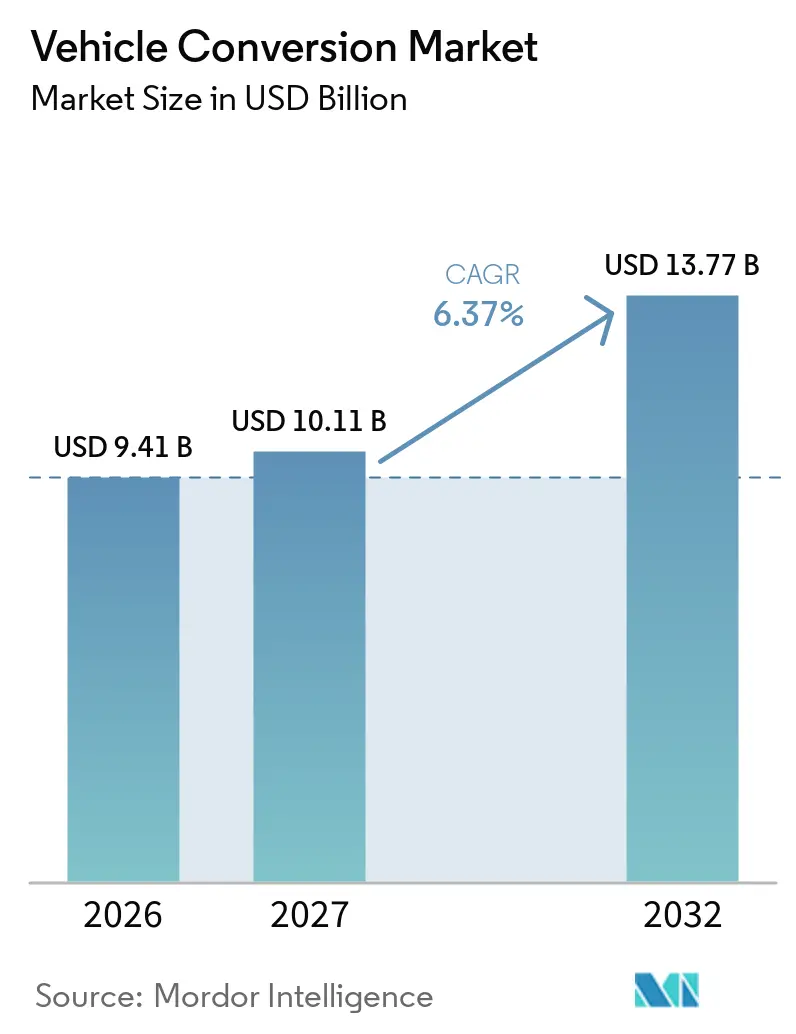
The vehicle conversion market size was valued at USD 9.41 billion in 2026 and is expected to increase from USD 10.11 billion in 2027 to reach USD 13.77 billion by 2032, growing at a CAGR of 6.37% over 2027-2032. The vehicle conversion market is supported by operators seeking to keep useful vehicles in service while adapting them to changing operating needs. Demand is moving beyond traditional fuel changes toward electric powertrain work, accessibility modifications, commercial upfits, and other specialized applications. Air-quality rules and fleet operating costs are increasing the value of solutions that extend vehicle life without requiring immediate replacement. Suppliers are responding with more standardized kits, trained installation networks, and conversion-ready vehicle platforms. The vehicle conversion market also remains local in practice because approvals, labor availability, vehicle specifications, and servicing arrangements differ widely across countries. This makes a locally supported installation network important for suppliers that want to move from a demonstration project to dependable customer delivery. It also explains why the same conversion concept can have different commercial value in different regions.
Key Report Takeaways
- By conversion type, CNG/LPG held 21.27% of revenue in 2026, while ICE-to-electric is forecast to expand at a 10.11% CAGR through 2032.
- By vehicle type, vans and LCVs held 34.18% of revenue in 2026, while buses are forecast to expand at a 7.03% CAGR through 2032.
- By component, conversion kits held 58.27% of revenue in 2026 and are forecast to expand at a 6.76% CAGR through 2032.
- By end user, fleet operators held 34.18% of revenue in 2026 and are forecast to expand at a 6.83% CAGR through 2032.
- By geography, North America held 34.27% of revenue in 2026, while Asia-Pacific is forecast to expand at a 7.64% CAGR through 2032.
Note: Market numbers in this report are based on Mordor Intelligence's proprietary estimation framework, which combines nine months of actuals with Q4 projections for base year 2026.
Global Vehicle Conversion Market Trends and Insights
Drivers Impact Analysis*
| Driver | (~) % Impact on CAGR Forecast | Geographic Relevance | Impact Timeline |
|---|---|---|---|
| Expansion of Low-Emission Zones and ZEV Retrofit Policies | +1.5% | Global; highest intensity in Europe and North America | Medium term (2–4 years) |
| Fleet Lifecycle Extension and Total-Cost-of-Ownership Optimization | +1.2% | Global | Short term (≤ 2 years) |
| E-Commerce and Specialized Commercial Fleet Growth | +1.0% | Global; concentrated in North America, Europe, and Asia-Pacific | Short term (≤ 2 years) |
| Availability of EV-Ready Upfit Platforms and Modular Conversion Architectures | +0.9% | Asia-Pacific and Europe, with spillover to North America | Medium term (2–4 years) |
| Rising Demand for Wheelchair-Accessible Mobility | +0.8% | North America and Europe | Long term (≥ 4 years) |
| Circular-Economy Value from Repurposing Existing Vehicles | +0.6% | Europe and North America | Long term (≥ 4 years) |
| Source: Mordor Intelligence | |||
Expansion of Low-Emission Zones and ZEV Retrofit Policies
Low-emission and zero-emission rules are creating a clearer reason for fleet owners to alter vehicles that still have useful operating life. The rules matter most in cities where commercial access depends on meeting emissions conditions. This is helping the vehicle conversion market by bringing forward decisions that might otherwise be deferred. CNG and LPG solutions can provide an interim option where they remain acceptable, while electric conversions address stricter rules. The Netherlands has introduced zero-emission zones with transition arrangements for eligible commercial vans, showing how policy can shape replacement and conversion timing[1]. The resulting need is not uniform, but it supports a pipeline of work across urban commercial fleets.
Fleet Lifecycle Extension and Total-Cost-of-Ownership Optimization
Fleet owners assess a conversion against continued operation, replacement, financing, and the costs of adapting a new vehicle for a specific task. This makes the decision more complex than a simple comparison between a converted vehicle and a new vehicle. The vehicle conversion market benefits when a well-maintained platform can be updated for an electric drivetrain, accessibility use, delivery work, or medical transport. Standardized fleet programs can also simplify procurement, installation scheduling, and warranty arrangements. Public fleet planning also shows that electrification decisions can consider continued use of existing assets rather than relying only on replacement. This gives conversion providers a reason to present their work as part of an operating plan instead of as a stand-alone technical modification. This approach keeps the focus on the vehicle’s full operating role rather than its original factory configuration, supporting decisions based on operational continuity, vehicle fitness, and day-to-day service needs.
E-Commerce and Specialized Commercial Fleet Growth
Commercial delivery activity is increasing the need for vehicles adapted to defined routes, packages, temperature requirements, and driver workflows. A base van often needs shelving, partitions, safety systems, connectivity equipment, or refrigeration before it can perform that role. This work creates a direct opening for upfitters even when the underlying vehicle is bought new. The vehicle conversion market therefore gains from specialization in equipment integration as well as from powertrain work. It also favors suppliers that can repeat a configuration across many vehicles with reliable service support. As fleet specifications become more consistent, component suppliers and installers can build longer relationships with customers instead of treating each job as a one-off project.
Availability of EV-Ready Upfit Platforms and Modular Conversion Architectures
Vehicle platforms designed to accept modifications can reduce engineering effort and make quality more repeatable. Modular kits also allow manufacturers to build common parts and control systems across several vehicle applications. Kia and BraunAbility presented an all-electric wheelchair-accessible taxi concept based on the PV5, a vehicle designed to support accessibility conversion work[2]. That example shows why collaboration between a vehicle manufacturer and a specialist converter can reduce practical barriers for customers. The vehicle conversion market is likely to benefit when vehicle interfaces, technical documentation, and installation processes are easier to manage. These changes can also make it easier for installers to maintain consistent outcomes across a larger fleet.
Restraints Impact Analysis*
| Restraint | (~) % Impact on CAGR Forecast | Geographic Relevance | Impact Timeline |
|---|---|---|---|
| Fragmented Conversion Approval and Homologation Requirements | -0.8% | Global; most acute in Europe (EU Reg. 2018/858) and Asia-Pacific | Medium term (2–4 years) |
| Shortage of Certified High-Voltage and Structural-Modification Technicians | -0.6% | North America and Europe | Long term (≥ 4 years) |
| Battery Mass, Axle-Load, Insurance, and Residual-Value Uncertainty | -0.5% | Global | Short term (≤ 2 years) |
| Restricted OEM Diagnostics, Software Access, and Cybersecurity Interfaces | -0.4% | Global | Medium term (2–4 years) |
| Source: Mordor Intelligence | |||
Fragmented Conversion Approval and Homologation Requirements
Approval requirements can prevent a conversion design from moving easily from one country to another. Technical rules, test procedures, insurer expectations, and certifier recognition can differ even when the vehicles are similar. This adds time and cost before a kit or completed vehicle can be offered at scale. The vehicle conversion market remains affected by these local requirements because conversion work changes safety-critical systems. A provider may need separate evidence for structural changes, electrical safety, and roadworthiness. The barrier favors companies that understand regional approval pathways and can incorporate compliance requirements early in product development.
Shortage of Certified High-Voltage and Structural-Modification Technicians
Electric conversions require careful work on high-voltage systems, vehicle structures, controls, and diagnostics. The skills needed may not be available in every workshop that can complete conventional mechanical or body modifications. This limits installation capacity and can affect lead times, labor costs, and quality assurance. The vehicle conversion market needs training that combines electrical competence with structural and vehicle-integration knowledge. Manufacturers and training providers are expanding the availability of high-voltage learning opportunities in response to the wider workforce need. A broader technician base would support more consistent conversion capacity, but this change takes time.
*Our forecasts treat driver/restraint impacts as directional, not additive. The impact forecasts reflect baseline growth, mix effects, and variable interactions.
Segment Analysis
By Conversion Type: CNG/LPG Leads While ICE-to-Electric Expands Fastest
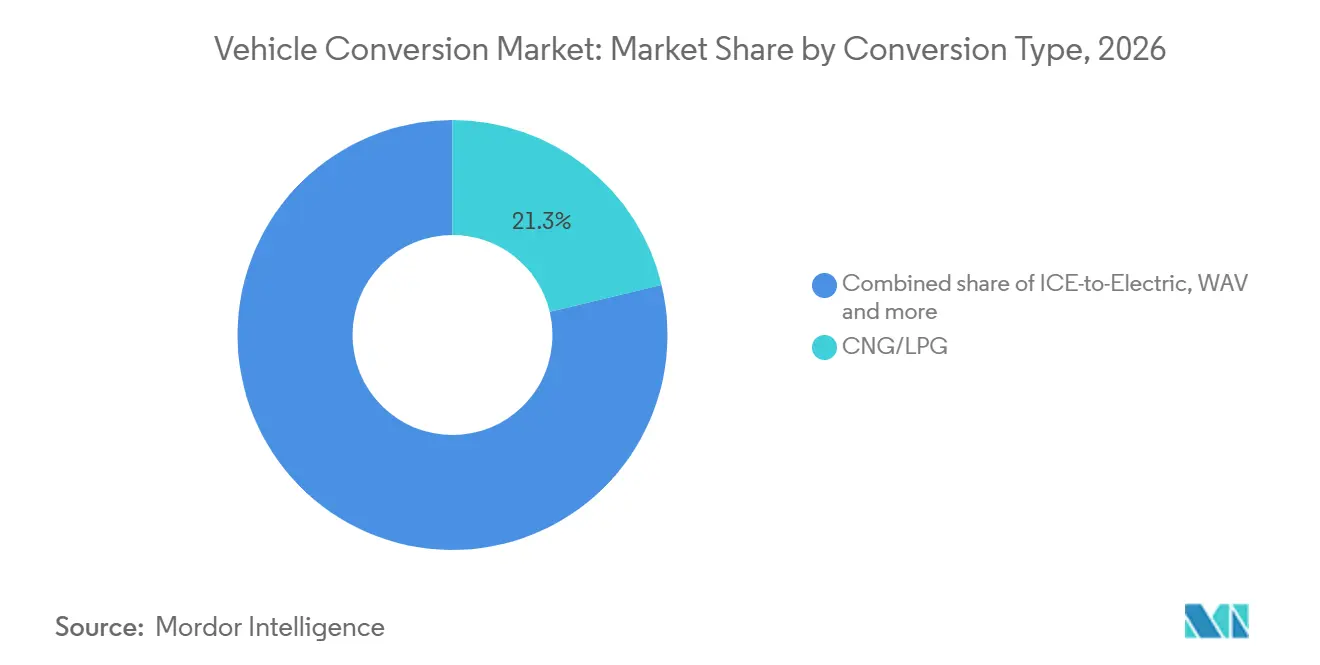
CNG/LPG captured 21.27% of the vehicle conversion market share in 2026, making it the largest conversion type. Its role reflects established demand for lower-cost fuel alternatives in markets with supportive fuel infrastructure and established conversion practices. These systems remain relevant where operators need practical changes to existing vehicles and where zero-emission rules have not yet become binding. They also provide familiar installation processes for workshops that have long experience with fuel-system modifications. The segment’s importance does not remove demand for other forms of conversion. Instead, it shows that fuel substitution still matters where fleet economics and local policy support it.
ICE-to-electric is projected to register a 10.11% CAGR in the vehicle conversion market size through 2032, the highest rate among conversion types. The segment is supported by fleet owners that need to retain a known vehicle platform while changing its operating emissions profile. Electric conversion can be relevant for commercial vans, specialty vehicles, and vehicles with expensive bodies or equipment that would be difficult to replace. It also creates demand for batteries, power electronics, control software, and safe installation capability. Accessibility, camper, armored, ambulance, and other special-purpose work continue to serve distinct customer needs. Their different use cases make the overall vehicle conversion market less dependent on a single technology pathway.

By Vehicle Type: Vans and LCVs Form the Largest Base While Buses Gain Momentum
Vans and LCVs held 34.18% of the vehicle conversion market share in 2026. These vehicles provide a practical base for delivery adaptations, mobility conversions, utility work, and other commercial uses. Their wide availability makes them familiar to installers, fleet managers, and aftermarket equipment suppliers. A single platform can also be adapted for several roles over its operating life. This versatility supports steady demand for upfitting and specialized modifications. It explains why vans and light commercial vehicles form the largest vehicle-type base in the vehicle conversion market.
Buses are forecast to grow at a 7.03% CAGR through 2032, making them the fastest-growing vehicle type. Municipal operators and other institutional customers often need vehicles that meet public-service, accessibility, and emissions requirements at the same time. Converting a bus can preserve a vehicle body and interior layout that are already suited to its route or passenger needs. The work requires thorough engineering and careful compliance, which supports specialist providers. Passenger cars, trucks, and two- and three-wheelers retain their own conversion opportunities. Their demand is shaped by local transport patterns, vehicle ownership, and the use case for each platform.
By Component: Conversion Kits Hold a Central Role in Repeatable Delivery
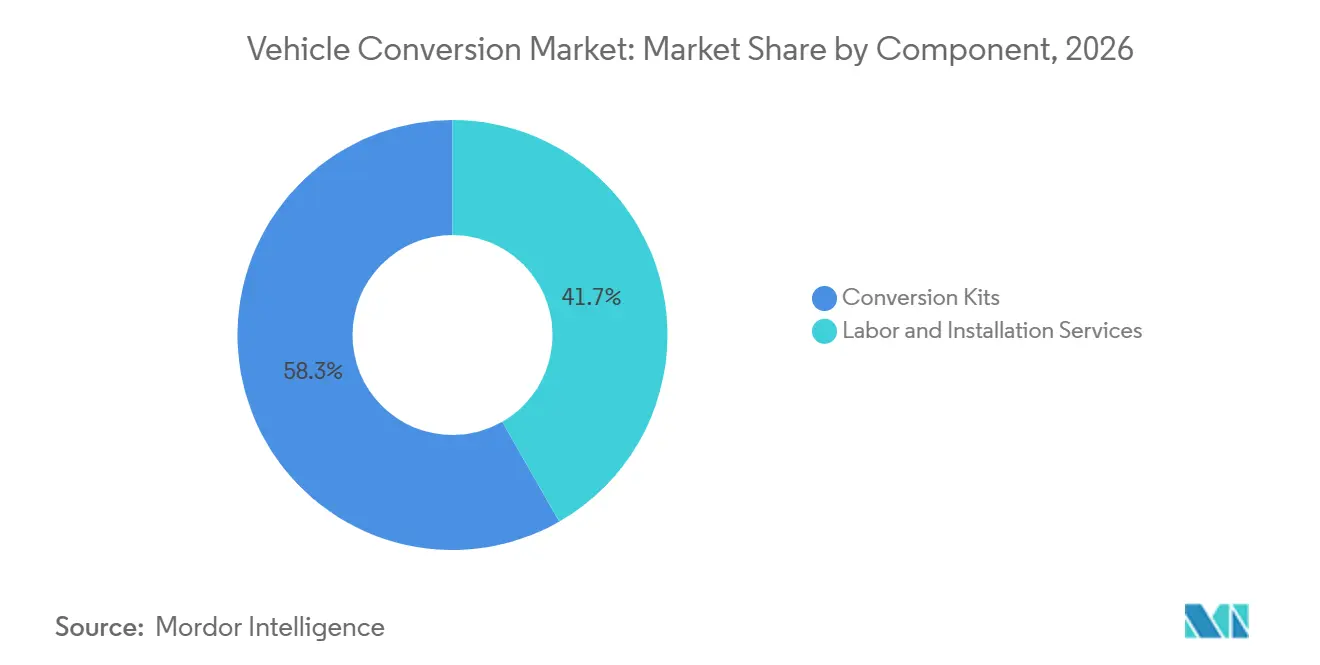
Conversion kits accounted for 58.27% of the vehicle conversion market share in 2026. A kit can bring together the core components needed to make a particular conversion repeatable across a defined vehicle family. This approach helps installers work from a validated package instead of sourcing each item separately. It can also improve the consistency of documentation, service procedures, and parts availability. Suppliers gain a stronger role when their kits become part of a customer’s standard fleet specification. These factors explain the leading position of conversion kits in the vehicle conversion market.
Conversion kits are forecast to expand at a 6.76% CAGR through 2032, the fastest component growth rate. Their position reflects the need to make complex work more predictable as fleet programs become larger. Kits can support common engineering, training, and maintenance practices across multiple installations. Labor and installation services remain essential because each vehicle still requires safe fitting, testing, and final quality checks. The relationship between components and installation is therefore complementary rather than competitive. Providers that combine a reliable kit with skilled installation support can offer a clearer path from design to in-service use.
By End User: Fleet Operators Lead Demand and Growth
Fleet operators held 34.18% of the vehicle conversion market share in 2026. Their scale can make it easier to standardize vehicle specifications, installation timing, and service arrangements. A fleet operator may seek a conversion when it wants to keep a vehicle body or route configuration that is already working well. This customer group also faces direct operating requirements involving access rules, utilization, and the equipment installed on each vehicle. Fleet programs can create recurring demand for kits, upfits, repairs, and technical support. That combination gives fleet operators a central role in the vehicle conversion market.
Fleet operators are expected to grow at a 6.83% CAGR through 2032, the highest rate among end users. Their demand is linked to delivery, municipal work, accessibility transportation, and other specialized operations. A well-defined fleet requirement allows a converter to apply similar designs and quality controls across several vehicles. Government users, healthcare providers, individuals, and other specialist buyers remain important because their needs often require custom engineering. Those applications can involve medical equipment, mobility devices, security features, or recreational layouts. The mix of customers helps preserve a role for both standardized and highly specialized providers.
Geography Analysis
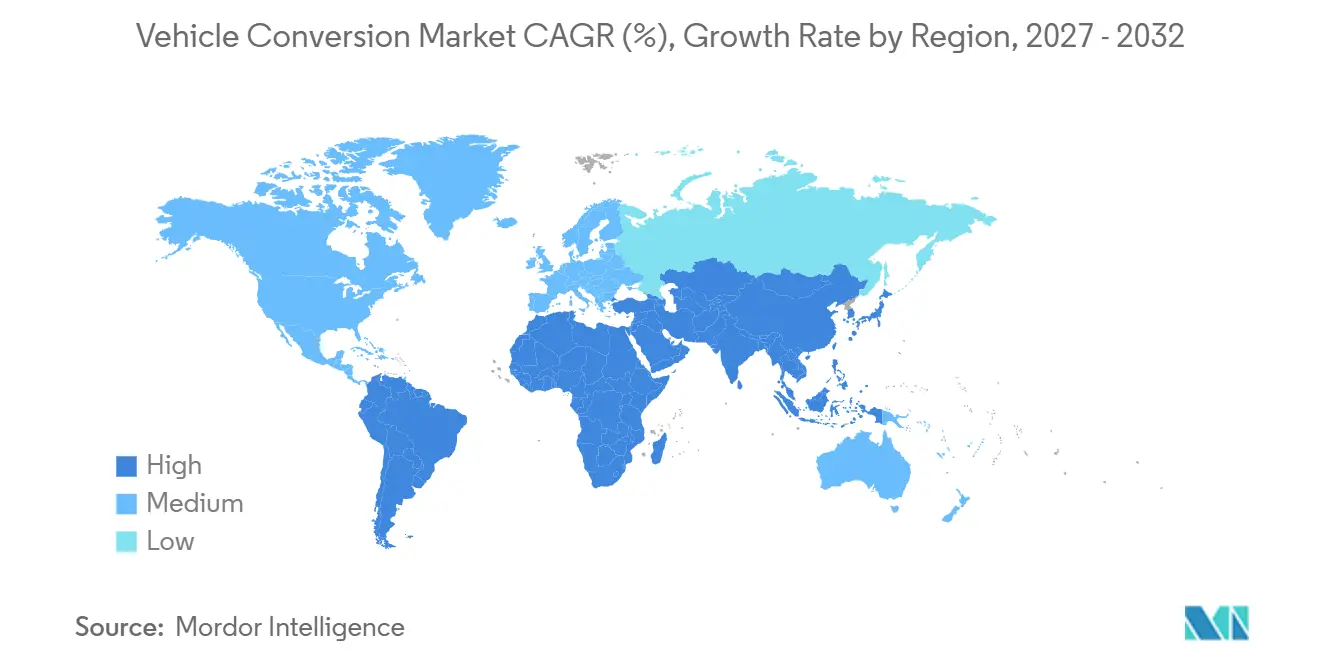
North America held 34.27% of the vehicle conversion market share in 2026, the largest regional position. The region has a developed base of commercial upfitters and accessible-vehicle specialists. Fleet owners also use modifications to equip vehicles for delivery, utility, medical, and public-service work. Accessibility demand continues to support dedicated vehicle adaptation across the region. General Motors and BraunAbility have introduced a next-generation wheelchair-accessible Chevrolet Traverse, showing continued manufacturer and converter collaboration. The vehicle conversion market in North America is therefore supported by both established upfit activity and newer electrification needs.
Europe has a mature conversion environment shaped by city access rules, fleet emissions targets, and established technical standards. Commercial vehicle operators face a practical need to adapt vehicles for urban operating conditions. Accessibility conversions and specialized commercial bodies also remain part of the regional base. Progress can be uneven because approval rules and technical requirements vary between countries. The vehicle conversion market therefore requires local knowledge even when a product concept is developed for several European markets. Suppliers that plan for compliance, service, and parts support can address this complexity more effectively.
Asia-Pacific is projected to grow at a 7.64% CAGR through 2032, the fastest geographic rate. The region includes varied demand for buses, commercial fleets, fuel conversions, and emerging electric conversion activity. Vehicle fleets are large and operating conditions vary greatly between countries and cities. This supports different solutions rather than a single regional product model. The vehicle conversion market can benefit from local technical partnerships and training systems that adapt platforms to domestic requirements. South America, the Middle East, and Africa also contribute demand through gas conversions, specialty work, and public or commercial fleet needs. Russia remains affected by conditions that limit the pace of vehicle and conversion activity.
Competitive Landscape
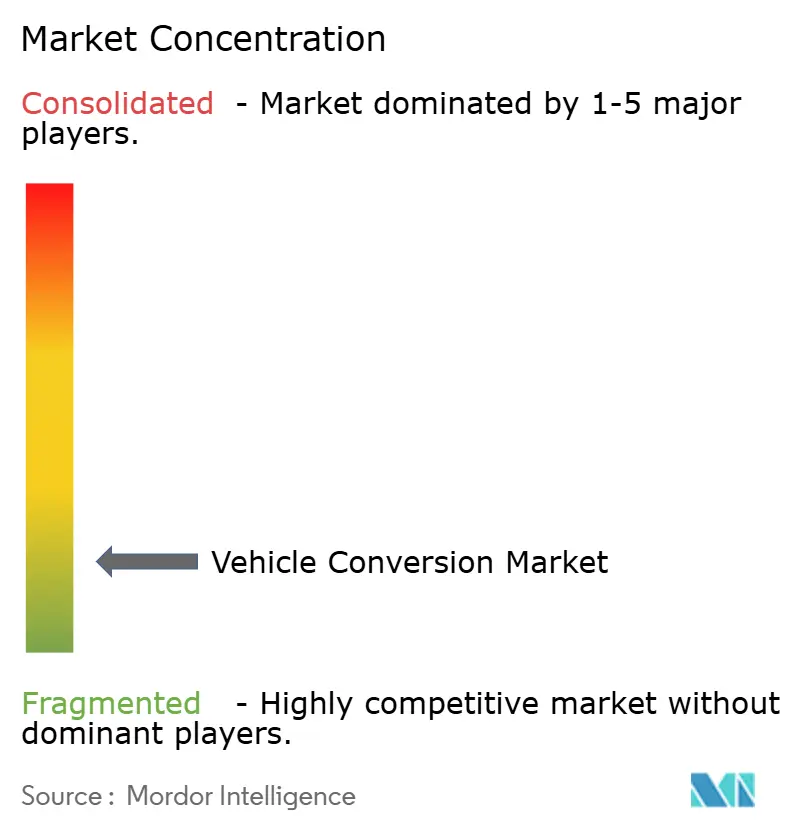
The vehicle conversion market has a fragmented supplier base because applications, certification requirements, and customer needs vary widely. Companies often build strength in a single area such as accessible mobility, commercial bodies, fuel systems, or electric powertrain integration. This specialization can be more valuable than broad product coverage when a conversion requires deep technical knowledge. The market does not have one standard vehicle or one standard installation process. Suppliers compete through engineering capability, local compliance knowledge, installation quality, and service support. This structure encourages focused partnerships between vehicle manufacturers, kit suppliers, and conversion specialists.
Companies are using product collaboration to make conversions easier to deliver and service. Kia and BraunAbility’s PV5 accessible taxi concept is an example of a vehicle manufacturer working with a specialist converter on an electric accessibility application. General Motors and BraunAbility have also advanced a wheelchair-accessible SUV offering for the North American market. These moves show that accessibility conversion remains a meaningful area for joint development. They also indicate that manufacturers can make conversion work more practical when platform design and specialist expertise are considered together. The vehicle conversion market rewards such cooperation when it improves safety, usability, and support for customers.
Alternative-fuel specialists are also pursuing combinations that widen their technology and geographic coverage. Landi Renzo and Westport Fuel Systems Italia signed an agreement concerning the integration of Green Transportation activities, with a focus on alternative-fuel systems. This type of move can strengthen access to fuel-system expertise, distribution, and customer relationships. Other competitors are likely to remain focused on defined vehicle types or local certification pathways. The vehicle conversion market is not likely to become uniform because buses, vans, accessible vehicles, and specialty applications need different engineering and customer support. Competitive advantage will continue to depend on credible installation capability and the ability to meet local approval requirements.
Vehicle Conversion Industry Leaders
-
BraunAbility
-
Vantage Mobility International, LLC
-
Terex Corporation
-
Westport Fuel Systems Italia S.r.l.
-
J.B. Poindexter & Co., Inc.
- *Disclaimer: Major Players sorted in no particular order
Recent Industry Developments
- October 2026: Wolong Electric and AEAUTO entered the mining truck diesel-to-electric conversion market, offering complete battery electric vehicle modification kits and charging systems for large mining equipment.
- September 2026: National Highways took delivery of four all-electric Hyundai IONIQ 9 vehicles, converted to full traffic officer specification by Richell Vehicle Conversions (RVC), for trial as traffic officer vehicles.
- July 2026: Janus Electric signed orders from four new California fleet operators for a combined 67 diesel-to-electric truck conversions, with first deliveries expected in the fourth quarter of 2026.
- April 2026: Hyundai Motor launched 'Hyundai Conversion+,' a commercial vehicle technical information platform providing technical support for vehicle bodybuilders and conversion partners across approximately 120 countries in 15 languages.
Global Vehicle Conversion Market Report Scope
The Vehicle Conversion Market is segmented by Conversion Type, Vehicle Type, Component, End User, and Geography. By Conversion Type, the market is segmented into ICE-to-Electric, CNG/LPG, Wheelchair-Accessible Vehicle (WAV), Camper/RV, Armored and Special-Purpose, Ambulance and Emergency, and Other Conversion Types, Including Hydrogen. By Vehicle Type, the market is segmented into Passenger Cars, Vans and LCVs, Buses, Trucks, and Two- and Three-Wheelers. By Component, the market is segmented into Conversion Kits and Labor and Installation Services. By End User, the market is segmented into Individuals, Fleet Operators, Government and Municipal, Healthcare and Emergency Services, and Other End Users. By Geography, the market is segmented into North America (United States, Canada, and Mexico), Europe (Germany, United Kingdom, France, Italy, Spain, Netherlands, Poland, Russia, and Rest of Europe), Asia-Pacific (China, India, Japan, South Korea, Australia, Indonesia, Thailand, and Rest of Asia-Pacific), South America (Brazil, Argentina, Colombia, Chile, and Rest of South America), and Middle East and Africa (Saudi Arabia, United Arab Emirates, Israel, Turkey, South Africa, Egypt, Nigeria, and Rest of Middle East and Africa). Market forecasts are provided in terms of Value (USD) and Volume (Units).
| ICE-to-Electric |
| CNG/LPG |
| Wheelchair-Accessible Vehicle (WAV) |
| Camper/RV |
| Armored and Special-Purpose |
| Ambulance and Emergency |
| Other Conversion Types, Including Hydrogen |
| Passenger Cars |
| Vans and LCVs |
| Buses |
| Trucks |
| Two- and Three-Wheelers |
| Conversion Kits |
| Labor and Installation Services |
| Individuals |
| Fleet Operators |
| Government and Municipal |
| Healthcare and Emergency Services |
| Other End Users |
| North America | United States |
| Canada | |
| Mexico | |
| Europe | Germany |
| United Kingdom | |
| France | |
| Italy | |
| Spain | |
| Netherlands | |
| Poland | |
| Russia | |
| Rest of Europe | |
| Asia-Pacific | China |
| India | |
| Japan | |
| South Korea | |
| Australia | |
| Indonesia | |
| Thailand | |
| Rest of Asia-Pacific | |
| South America | Brazil |
| Argentina | |
| Colombia | |
| Chile | |
| Rest of South America | |
| Middle East and Africa | Saudi Arabia |
| United Arab Emirates | |
| Israel | |
| Turkey | |
| South Africa | |
| Egypt | |
| Nigeria | |
| Rest of Middle East and Africa |
| By Conversion Type | ICE-to-Electric | |
| CNG/LPG | ||
| Wheelchair-Accessible Vehicle (WAV) | ||
| Camper/RV | ||
| Armored and Special-Purpose | ||
| Ambulance and Emergency | ||
| Other Conversion Types, Including Hydrogen | ||
| By Vehicle Type | Passenger Cars | |
| Vans and LCVs | ||
| Buses | ||
| Trucks | ||
| Two- and Three-Wheelers | ||
| By Component | Conversion Kits | |
| Labor and Installation Services | ||
| By End User | Individuals | |
| Fleet Operators | ||
| Government and Municipal | ||
| Healthcare and Emergency Services | ||
| Other End Users | ||
| By Geography | North America | United States |
| Canada | ||
| Mexico | ||
| Europe | Germany | |
| United Kingdom | ||
| France | ||
| Italy | ||
| Spain | ||
| Netherlands | ||
| Poland | ||
| Russia | ||
| Rest of Europe | ||
| Asia-Pacific | China | |
| India | ||
| Japan | ||
| South Korea | ||
| Australia | ||
| Indonesia | ||
| Thailand | ||
| Rest of Asia-Pacific | ||
| South America | Brazil | |
| Argentina | ||
| Colombia | ||
| Chile | ||
| Rest of South America | ||
| Middle East and Africa | Saudi Arabia | |
| United Arab Emirates | ||
| Israel | ||
| Turkey | ||
| South Africa | ||
| Egypt | ||
| Nigeria | ||
| Rest of Middle East and Africa | ||
Key Questions Answered in the Report
What is driving demand for vehicle conversion services?
Demand is supported by fleet life extension, urban emissions rules, accessibility needs, and specialized commercial vehicle use.
Which conversion type leads the vehicle conversion market?
CNG/LPG held the largest share in 2026, while ICE-to-Electric is forecast to be the fastest-growing conversion type through 2032.
Why are fleet operators important to vehicle converters?
Fleet operators lead both the end-user share and projected growth because standardized programs can support repeatable installations and service.
Which vehicle type has the greatest conversion opportunity?
Vans and LCVs lead the vehicle-type share because they can be adapted for delivery, mobility, utility, and other commercial roles.